ENS Governance Restructuring Approved: Foundation Formalized, Finally Able to Pursue .ens Top-Level Domain

marsbitXuất bản vào 2026-08-13Cập nhật gần nhất vào 2026-08-13

Tóm tắt

ENS token holders have approved the "Next Era of the ENS DAO" proposal, formally establishing the ENS Foundation as a legal entity. This enables the Foundation to represent ENS in institutional matters such as pursuing the .ens top-level domain with ICANN, engaging with standard-setting bodies like IETF and W3C, participating in regulatory discussions, defending trademarks, and hiring dedicated staff. The new structure clarifies roles: ENS Labs focuses on core protocol development (like ENSv2), the DAO retains control over protocol contracts and treasury (holding 54.6% of ENS tokens), and the Foundation handles off-chain, institutional representation. The five-member inaugural Foundation Board, appointed and overseen by token holders, includes an Executive Director and independent directors. This governance upgrade aims to strengthen ENS's role as credibly neutral, publicly governed internet infrastructure for the long term.

Author: ENS Foundation

Compiled by: Deep Tide TechFlow

Deep Tide Introduction: ENS token holders have approved a governance proposal, formally establishing the Foundation as a legal entity capable of representing ENS in regulatory matters, standards organizations, and top-level domain negotiations. This addresses a long-standing weakness of the DAO, which previously lacked the ability to handle institutional affairs, while preserving token holders' ultimate control over the protocol and the Foundation's personnel. For those focused on ENS's infrastructure status and governance boundaries, this is a crucial step.

ENS token holders have approved the "Next Era for the ENS DAO" proposal, and the relevant executable content has been completed on-chain. The ENS Foundation is now a fully operational organization with a full-time Executive Director, staff, and a five-member board of directors. This article explains the motivation behind this structure, what the Foundation can now do, and how it allows token holders to retain control over the protocol and the Foundation itself.

Why ENS Needs an Institution-Facing Foundation

Over the past decade, ENS has evolved into core infrastructure: hosting millions of domain names, integrated across wallets, applications, and L2s, with other systems relying on it for resolution. ENS has also engaged with policymakers and institutions like ICANN, which are responsible for coordinating the stable and secure operation of internet naming infrastructure. In 2021, the core team at ENS Labs launched the ENS DAO to safeguard the protocol. Specifically, the DAO placed the protocol's core contracts, pricing, and treasury under the control of token holders. These funds are used to finance public goods, service providers, and community projects within the ecosystem.

By itself, the DAO lacks the legal and operational capacity to act in many of the arenas this infrastructure now needs to represent. It cannot advocate for recognition and management rights of the .ens top-level domain at ICANN. It cannot sign agreements required to participate in standards work at IETF and W3C, cannot hire full-time employees, cannot enforce trademark rights against phishing campaigns impersonating ENS, cannot respond to legal proceedings, and cannot represent ENS in regulatory discussions concerning decentralized naming.

For years, some of this work went undone, while some informally fell to ENS Labs. ENS Labs is an engineering organization never authorized to act as the protocol's representative at the institutional level. Naming policies are being shaped within ICANN, standards bodies, and global regulatory discussions. Until now, ENS has lacked a formal entity to represent it in these settings.

The Foundation is that entity. Specifically, it can now:

  • Represent ENS where naming standards are made. The Foundation can actively participate in ICANN, IETF, W3C, and related forums; pursue recognition and management rights for the .ens top-level domain; and coordinate with the SEAL and DNS infrastructure communities.
  • Engage in policy work. As a legal entity, the Foundation can directly meet with regulators and legislators to discuss issues affecting ENS and decentralized naming.
  • Hold and defend the brand. ENS's trademarks, brand assets, and other intellectual property will be consolidated within the Foundation, enabling it to take action against scams and impersonation.
  • Hire people accountable to the mission. The Foundation can hire full-time staff to manage operations, grants, and endowment fund management, supervised by a board of directors appointed and removable by token holders.
  • Act as the protocol's institutional counterparty. Courts, registries, standards organizations, and other entities will have a clear entity to engage with on behalf of ENS.

This also clarifies the role of ENS Labs. Previously, Labs implicitly shouldered some institutional work while also focusing on core tasks like developing the protocol and applications and supporting the integration of ENS standards across the crypto ecosystem. With the Foundation operational, Labs can focus on product and engineering work, including ENSv2 and the infrastructure supporting the protocol.

Three Institutions, One Protocol

This vote creates a system where the different parts of ENS reinforce each other. ENS Labs, the ENS Foundation, and the broader community and token holders (including service providers and public goods beneficiaries) acting through the ENS DAO are all aligned around one thing: protecting and expanding the ENS protocol for decades to come.

To be clear, under the new proposal, the assets of the endowment fund, funded by .eth domain registration fee revenue, remain in place, and related transactions are now subject to a 9-day timelock, during which the ENS Security Council can cancel any transactions exceeding the Foundation's mandate. The Foundation will only spend according to a public, board-approved budget and will provide transparent reporting through annual audited financial statements and quarterly grant updates.

The ENS tokens held by the DAO (54.6% of the total ENS supply) remain untouched, continuing to be held by the DAO under the full control of token holders, with one approved exception: a one-time transfer of 1 million ENS tokens to the Foundation, exclusively for employee compensation under a public framework.

Furthermore, the ENS Foundation and ENS Labs are separate legal and operational entities, each with its own management and board. The Foundation does not own Labs. Labs has no governance rights over the Foundation, the endowment fund, the DAO-held ENS tokens, or the protocol. Its only presence in Foundation governance is the founder's seat among the five board seats, which will recuse itself from decisions involving funding support for ENS Labs.
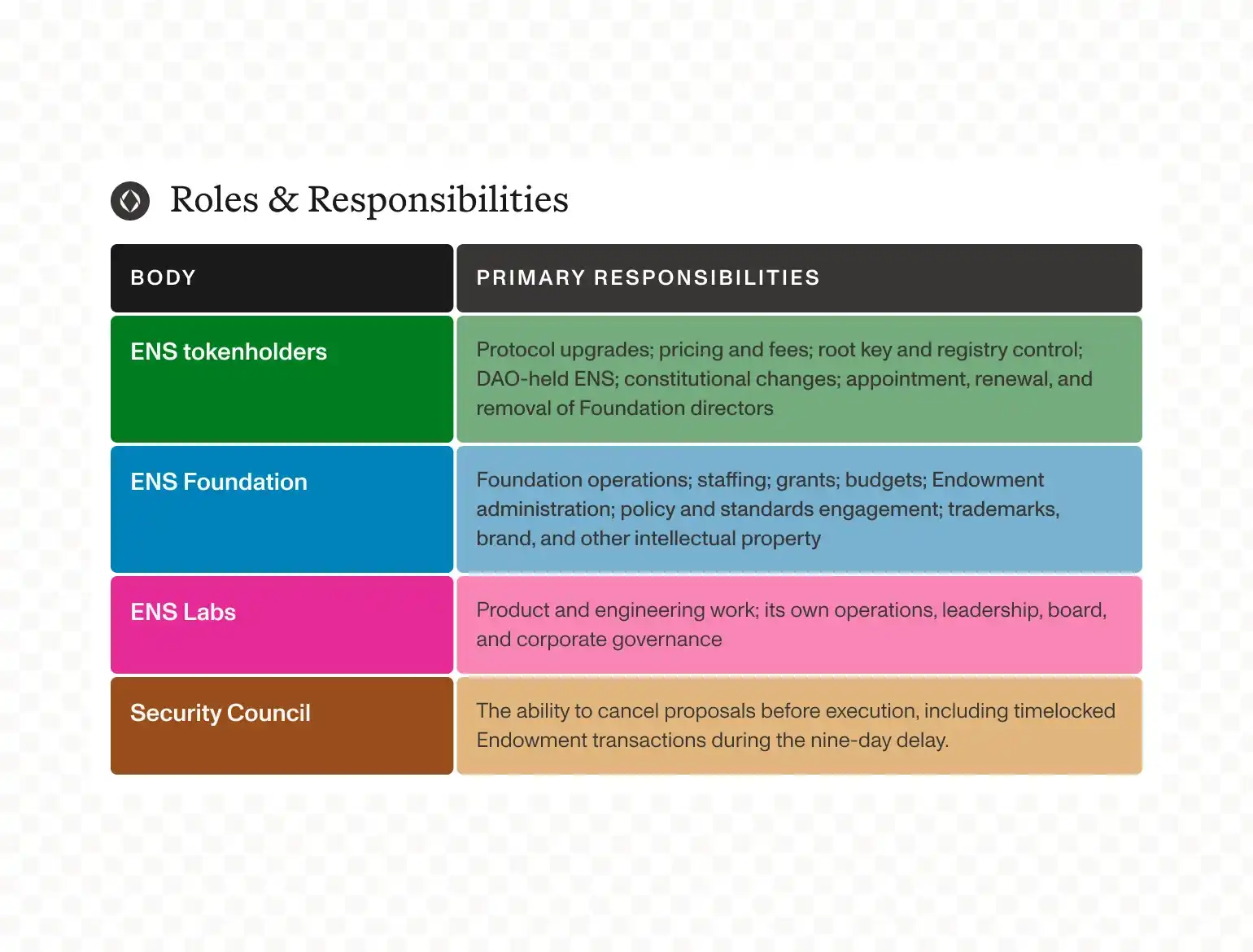
ENS Labs continues to lead core development of the ENS protocol, which is governed by token holders. Token holders also oversee the institutions representing them, including through the power to appoint or remove Foundation directors. The Foundation handles the off-chain work necessary to support the protocol, with its board responsible for overseeing operations and ensuring sustainable funding for ecosystem contributors, including ENS Labs. ENS Labs, the DAO, and the Foundation play different but complementary roles, aligned around the long-term stewardship of ENS. This symbiotic relationship makes ENS stronger while helping the on-chain protocol remain credibly neutral.

Foundation Board of Directors

The inaugural five-member board of the Foundation consists of:

  • Alexander Urbelis, Executive Director. Career spans cybersecurity law, DNS threat intelligence, and policy: former General Counsel & Chief Information Security Officer at ENS Labs, former Chief Information Security Officer at the NFL, former Chief Compliance Officer at Richemont.
  • Nick Johnson, Director. Founder of ENS, CEO of ENS Labs, previously at the Ethereum Foundation and Google.
  • Kartik Talwar, Independent Director. General Partner at A.Capital Ventures, Co-founder of ETHGlobal.
  • Brett Sun, Independent Director. Co-founder of Prelude, previously led technical work at Aragon, including early ENS integration AragonID.
  • Anthony Leutenegger, Independent Director. CEO of Aragon, a key ENS integrator, and also a delegate for Lido and Morpho.

Independent directors serve two-year terms, renewable by token holders. Each director brings distinct experience needed by ENS in this first term.

What Happens Next

Existing commitments will continue according to their agreed terms: stewards, active funding streams, grants, and current term commitments will persist. The Foundation will work with relevant parties to develop transition plans for grant programs, SPP3, and the current working group structure. Foundation positions will be publicly posted as staffing needs become clear.

With the proposal executed, the Foundation can begin fulfilling its approved operational, financial, policy, and institutional responsibilities. ENS Labs will continue to operate under its own management and governance, building ENSv2 and the products and infrastructure supporting the ENS protocol, while token holders retain control over protocol decisions and oversight of Foundation directors.

ENS aims to demonstrate that critical internet infrastructure can be credibly neutral, publicly governed, and outlast any single company. The complete governance record can be viewed in the executable proposal, on-chain votes, and execution transactions.


Tiền kỹ thuật số thịnh hành

Câu hỏi Liên quan

QWhat is the primary purpose of establishing the ENS Foundation as a legal entity?

ATo formally represent the ENS protocol in institutional settings, enabling it to engage in regulatory discussions, standard-setting organizations (like ICANN, IETF, W3C), and negotiate for the .ens top-level domain, which the DAO itself lacked the legal and operational capacity to do.

QHow does the new governance structure ensure that ENS token holders retain ultimate control over the protocol and the Foundation?

AToken holders control the core protocol contracts, treasury, and pricing via the DAO. They also have the power to appoint or remove the Foundation's Board of Directors. A 9-day timelock and the ENS Security Committee provide oversight for treasury transactions, and the Foundation must operate under a publicly approved budget with transparent financial reporting.

QWhat specific new capabilities does the ENS Foundation gain that the ENS DAO or ENS Labs could not previously perform?

AThe Foundation can now: 1) Actively participate in standard-setting bodies like ICANN to pursue the .ens TLD. 2) Engage directly with regulators and policymakers. 3) Hold and defend ENS trademarks and intellectual property against scams. 4) Hire full-time employees for operations and grant management. 5) Serve as a legal counterparty for courts, registries, and other institutions.

QWhat is the relationship between the ENS Foundation, ENS Labs, and the ENS DAO according to the new proposal?

AThey are three independent but complementary entities aligned around protecting and extending the ENS protocol. ENS Labs focuses on core protocol development (like ENSv2). The ENS DAO, governed by token holders, controls the protocol and treasury. The Foundation handles off-chain institutional representation and operations, overseen by a Board appointed by the DAO. The Foundation does not own or govern Labs.

QHow are the assets of the ENS DAO's endowment fund managed under the new structure, and what safeguards are in place?

AThe endowment fund, funded by .eth registration fees, remains under DAO control. Transactions now require a 9-day timelock, during which the ENS Security Committee can cancel any transaction deemed outside the Foundation's mandate. The Foundation spends only according to its publicly approved budget and undergoes annual audits and quarterly reporting.

Nội dung Liên quan

Bernstein Giải Mã Mức Tăng 177% Cổ Phiếu MRNA: Yếu Tố Cơ Bản Nào, Yếu Tố Cường Điệu Nào?

Ngày 19/8, kết quả thử nghiệm lâm sàng giai đoạn III INTerpath-001 của Moderna và Merck cho liệu pháp kháng nguyên mới cá nhân hóa (INT) kết hợp Keytruda trong điều trị ung thư hắc tố đã thành công, vượt qua các điểm cuối chính về thời gian sống không tái phát (RFS) và thời gian sống không di căn xa (DMFS). Tin tức này khiến cổ phiếu Moderna (MRNA) tăng khoảng 177%, định giá tăng thêm khoảng 450 tỷ USD. Phân tích của Bernstein chỉ ra rằng, mặc dù đột phá lâm sàng là có thật, nhưng khó có thể giải thích hoàn toàn mức tăng giá 177% chỉ bằng cơ bản. Đợt tăng này được thúc đẩy bởi ba yếu tố chồng chéo: 1) Giảm rủi ro cho dự án ung thư hắc tố; 2) Định giá lại tiềm năng nền tảng mRNA trong điều trị nhiều loại ung thư; 3) Việc mua lại vị thế bán khống (khoảng 14-15% cổ phiếu lưu hành) đã khuếch đại biên độ tăng. Tuy nhiên, Bernstein cảnh báo rằng thành công trong ung thư hắc tố - một bệnh có tính sinh miễn dịch cao - không đảm bảo sẽ được lặp lại ở các loại ung thư khác như phổi, thận hay bàng quang. INT là phương pháp điều trị cá nhân hóa cho bệnh nhân, không phải vaccine phòng ngừa, với quy mô bệnh nhân hạn chế và chi phí sản xuất riêng lẻ cao, có thể ảnh hưởng đến tỷ suất lợi nhuận. Hãng ước tính doanh thu chưa điều chỉnh rủi ro cho ung thư hắc tố và phổi giai đoạn đầu chỉ vào khoảng 2,4 tỷ USD. Do đó, Bernstein cho rằng thị trường đang định giá dựa trên kỳ vọng quá lạc quan về một nền tảng thành công trên nhiều loại ung thư và lợi nhuận dài hạn, trong khi điểm ngoặt về hiệu quả kinh doanh thực tế vẫn cần được xác nhận qua: 1) Dữ liệu lâm sàng đầy đủ; 2) Thành công trên các loại ung thư khác; và 3) Hiệu quả thương mại hóa. Bernstein duy trì xếp hạng "Thị trường" và mục tiêu giá 45 USD cho MRNA.

marsbit1 phút trước

Bernstein Giải Mã Mức Tăng 177% Cổ Phiếu MRNA: Yếu Tố Cơ Bản Nào, Yếu Tố Cường Điệu Nào?

marsbit1 phút trước

Con dấu của Haowei Huaxin bị hàng trăm người phá lấy đi, 'Sự răn đe hạt nhân' trong các cuộc chiến thương mại cao cấp lại phát huy uy lực

Ngày 19/8, công ty bán dẫn Hải Uy Hoa Tâm đăng thông báo cho biết vào ngày hôm trước, khoảng 100 người đã xông vào trụ sở, phá tủ sắt và lấy đi các con dấu quan trọng bao gồm dấu Đảng ủy, dấu công ty, dấu hợp đồng và chữ ký của pháp nhân. Công ty này có nền tảng quốc phòng và là doanh nghiệp sở hữu hỗn hợp. Mâu thuẫn bắt nguồn từ việc thay đổi cổ đông kiểm soát. Năm 2021, Tập đoàn Chính Oai thông qua công ty con Tài chính Chính Oai tăng vốn, trở thành cổ đông lớn nhất (34.01%), vượt qua cổ đông sáng lập Hải Đặc Cao Tân (33.79%). Thỏa thuận cân bằng quyền lực ban đầu nhanh chóng tan vỡ. Hai bên đã có hành động giành giấy phép và con dấu lẫn nhau. Năm 2023, một công ty quốc doanh tiếp quản phần vốn của Chính Oai và đổi tên thành Thanh Đảo Hải Nhạc Khống Cổ. Hải Đặc Cao Tân khởi kiện và thắng kiện vào các năm 2024-2026. Tòa án và Ủy ban Trọng tài đã phán quyết hủy bỏ các nghị quyết họp cổ đông/ hội đồng quản trị không hợp lệ của phía Hải Nhạc, và xác nhận quyền đề cử lãnh đạo của Hải Đặc Cao Tân. Tuy nhiên, phía Hải Nhạc được cho là không thi hành bản án, khiến Hải Đặc Cao Tân không thể tiếp quản quyền kiểm soát thực tế. Giá trị của Hải Uy Hoa Tâm được thị trường ước tính từ 12-16 tỷ NDT, trong khi Hải Đặc Cao Tân chỉ có vốn hóa khoảng 9 tỷ NDT. Khoản đầu tư vào Hải Uy Hoa Tâm trên sổ sách của Hải Đặc Cao Tân chỉ còn 832 triệu NDT. Việc mất quyền kiểm soát đồng nghĩa với tổn thất tài chính lớn. Ngày 20/8, Hải Đặc Cao Tân giải thích vụ "lấy dấu" là hành động tự bảo vệ quyền lợi của các cổ đông (5 bên, không bao gồm Hải Nhạc). Trong thương trường Trung Quốc, việc tranh giành con dấu không phải hiếm, từng xảy ra ở các công ty như Lôi Sĩ Chiếu Minh, Vi Hải, Đang Đang, Bitmain... Con dấu nắm giữ quyền vận hành hàng ngày, tạo ra một thế cân bằng mong manh kiểu "răn đe hạt nhân". Tuy nhiên, việc chiếm giữ con dấu không giải quyết được vấn đề sở hữu cuối cùng. Bên bị mất có thể báo cáo công an, tuyên bố con dấu mất hiệu lực hoặc làm lại con dấu mới. Giá trị thực tế của nó chủ yếu là trì hoãn thời gian. Vụ việc này một lần nữa cho thấy sự lố bịch và những rủi ro quản trị trong một số doanh nghiệp. Câu trả lời cho việc quản lý một công ty không nằm trong chiếc tủ sắt đựng con dấu.

marsbit1 phút trước

Con dấu của Haowei Huaxin bị hàng trăm người phá lấy đi, 'Sự răn đe hạt nhân' trong các cuộc chiến thương mại cao cấp lại phát huy uy lực

marsbit1 phút trước

Cardano Foundation Đệ Trình Bản Dự Thảo Nâng Cấp Dijkstra Cho Việc Thực Thi Hợp Đồng Thông Minh

Cardano Foundation đã công bố bản dự thảo Đề xuất Cải tiến Cardano (CIP) mang tên Dijkstra, với mục tiêu cải thiện đường dẫn thực thi hợp đồng thông minh và hiệu quả tính toán. Bản đề xuất hiện đang ở dạng dự thảo, chưa được triển khai trên mạng chính (mainnet) và chưa được xác nhận là một bản nâng cấp chính thức. Đề xuất Dijkstra có ý nghĩa quan trọng vì nó trực tiếp giải quyết vấn đề hiệu suất hợp đồng thông minh - một yếu tố then chốt để Cardano cạnh tranh với các hệ sinh thái khác như Ethereum, Solana hay Avalanche. Nếu thành công, nó có thể giúp các nhà phát triển xây dựng ứng dụng hiệu quả hơn, hỗ trợ các sản phẩm DeFi phức tạp và trải nghiệm người dùng tốt hơn. Quy trình CIP cho phép cộng đồng thảo luận và đánh giá thay đổi trước khi đưa vào hệ thống. Do đó, việc công bố bản dự thảo này đánh dấu sự khởi đầu của một cuộc thảo luận kỹ thuật, chứ không phải là một thay đổi ngay lập tức. Bước tiếp theo sẽ là quá trình xem xét của cộng đồng và các nhà phát triển để đánh giá mục tiêu, sự đánh đổi và vị trí của đề xuất trong lộ trình tổng thể.

bitcoinist34 phút trước

Cardano Foundation Đệ Trình Bản Dự Thảo Nâng Cấp Dijkstra Cho Việc Thực Thi Hợp Đồng Thông Minh

bitcoinist34 phút trước

Giao dịch

Giao ngay

Bài viết Nổi bật

Làm thế nào để Mua ENS

Chào mừng bạn đến với HTX.com! Chúng tôi đã làm cho mua Ethereum Name Service (ENS) trở nên đơn giản và thuận tiện. Làm theo hướng dẫn từng bước của chúng tôi để bắt đầu hành trình tiền kỹ thuật số của bạn.Bước 1: Tạo Tài khoản HTX của BạnSử dụng email hoặc số điện thoại của bạn để đăng ký tài khoản miễn phí trên HTX. Trải nghiệm hành trình đăng ký không rắc rối và mở khóa tất cả tính năng. Nhận Tài khoản của tôiBước 2: Truy cập Mua Crypto và Chọn Phương thức Thanh toán của BạnThẻ Tín dụng/Ghi nợ: Sử dụng Visa hoặc Mastercard của bạn để mua Ethereum Name Service (ENS) ngay lập tức.Số dư: Sử dụng tiền từ số dư tài khoản HTX của bạn để giao dịch liền mạch.Bên thứ ba: Chúng tôi đã thêm những phương thức thanh toán phổ biến như Google Pay và Apple Pay để nâng cao sự tiện lợi.P2P: Giao dịch trực tiếp với người dùng khác trên HTX.Thị trường mua bán phi tập trung (OTC): Chúng tôi cung cấp những dịch vụ được thiết kế riêng và tỷ giá hối đoái cạnh tranh cho nhà giao dịch.Bước 3: Lưu trữ Ethereum Name Service (ENS) của BạnSau khi mua Ethereum Name Service (ENS), lưu trữ trong tài khoản HTX của bạn. Ngoài ra, bạn có thể gửi đi nơi khác qua chuyển khoản blockchain hoặc sử dụng để giao dịch những tiền kỹ thuật số khác.Bước 4: Giao dịch Ethereum Name Service (ENS)Giao dịch Ethereum Name Service (ENS) dễ dàng trên thị trường giao ngay của HTX. Chỉ cần truy cập vào tài khoản của bạn, chọn cặp giao dịch, thực hiện giao dịch và theo dõi trong thời gian thực. Chúng tôi cung cấp trải nghiệm thân thiện với người dùng cho cả người mới bắt đầu và người giao dịch dày dạn kinh nghiệm.

Tổng lượt xem 372Xuất bản vào 2024.12.10Cập nhật vào 2026.06.02

Làm thế nào để Mua ENS

Thảo luận

Chào mừng đến với Cộng đồng HTX. Tại đây, bạn có thể được thông báo về những phát triển nền tảng mới nhất và có quyền truy cập vào thông tin chuyên sâu về thị trường. Ý kiến ​​của người dùng về giá của ENS (ENS) được trình bày dưới đây.

活动图片