Why Has NeoCloud Experienced the Largest Rally in This Round of U.S. Tech Stock Rebound?

marsbitXuất bản vào 2026-08-13Cập nhật gần nhất vào 2026-08-13

Tóm tắt

This round of tech stock rebound saw NeoCloud companies like CoreWeave and Nebius among the biggest gainers. The market is essentially pricing in highly leveraged AI infrastructure assets with locked-in, fast-deployable compute capacity. The key driver is a shift in AI bottlenecks from just GPUs to the entire ready-to-run capability—GPU clusters, power, data centers, networking—delivered within months. NeoCloud operators fit this gap perfectly. Their value lies in scarce, contractible assets: existing power capacity and data center space that can be locked in via long-term customer agreements. Recent earnings from CoreWeave and Nebius showcased a viable business model, shifting the narrative from "capital-intensive GPU lessors" to "order-backed AI infrastructure operators." Large backlogs and recurring revenue provide visibility, ease financing for expansion, and create a growth flywheel. The outperformance relative to storage or hyperscaler cloud stocks stems from greater leverage and exposure. NeoCloud's smaller revenue base offers higher earnings and valuation elasticity per new contract. Its leverage is threefold: operational (high fixed costs), financial (contracts enabling debt financing), and equity-based (amplified impact on equity value). Ultimately, the rally represents a re-rating of assets that combine GPU, power, and data center capacity into deliverable AI compute. Market focus is now on execution: converting massive backlogs into energized clusters, recogni...

In this round of the U.S. technology stock rebound, one of the strongest trends comes from NeoCloud: CoreWeave, Nebius, and some AI infrastructure companies possessing power and data center resources.

Logically, capital is pricing an AI infrastructure equity instrument with multiple layers of leverage: computing power capacity that is already contractually locked in and can be delivered rapidly.

If AI demand is revised upward, NeoCloud's revenue expectations, financing capabilities, and shareholder equity value may all shift upward simultaneously. This gives it strong upside elasticity during the tech stock rebound phase; the elasticity of power, data centers, financing, and valuation collectively constitutes this layer of leverage.

The bottleneck for AI is shifting. In the early stages, the most critical shortage was GPUs, followed by HBM and high-speed networking. Now, what customers truly lack is a complete set of deployable capabilities: acquiring GPUs, securing sufficient power, completing data center construction, network interconnection, and delivering clusters at scale within a few months.

NeoCloud is positioned precisely at this gap.

Capital is Buying "Already Powered Compute Factories"

NeoCloud's offerings typically include GPU clusters, networking, liquid cooling, data centers, power connectivity, and operational services. Customers are buying a block of large-scale compute capacity that can directly run AI training and inference workloads.

This point is crucial. GPUs can be procured, but power capacity, land, substations, data center permits, and network connectivity cannot be replicated in the short term. While large cloud providers have capital and customers, they are also constrained by construction cycles. Some AI companies seek greater flexibility and are reluctant to concentrate all their demand with a single hyperscaler.

Therefore, NeoCloud firms with readily available power and rapid deployment capabilities have become "accelerators" for AI infrastructure investment.

The market is willing to assign them higher valuations, primarily because such resources have two characteristics:

· Scarcity: Available power and deliverable data center capacity are limited.

· Contractable: Customers are willing to sign multi-year capacity contracts with minimum commitments.

When scarce resources can be locked in with long-term contracts, the market reinterprets them from ordinary IT service revenue into cash-flow assets with infrastructure-like characteristics.

Earnings Reports Changed the Market's View of the Business Model

Previously, the market's primary question for NeoCloud was direct: Buying GPUs and building data centers require massive Capex. Would these companies fall into a cycle of "continuous financing, continuous cash burn"?

Recent earnings reports have provided a more positive answer.

CoreWeave's Q2 revenue reached $2.575 billion, disclosing a backlog (contracted but not yet recognized expected revenue) of approximately $104 billion. Nebius's AI Cloud ARR (Annualized Recurring Revenue) reached $3 billion, disclosing multiple large, long-term contracts. The market focuses on quarterly revenue but pays even more attention to the complete commercial loop emerging from these numbers:

AI clients sign long-term capacity contracts
→ Some clients provide upfront payments or minimum payment commitments
→ Companies find it easier to obtain debt and equipment financing
→ New GPU, data center, and power capacity come online
→ Revenue and EBITDA (Earnings Before Interest, Taxes, Depreciation, and Amortization) grow
→ Financing capacity and expansion ability continue to increase

This shifts NeoCloud's narrative from "high-Capex GPU lessor" progressively towards "AI infrastructure operator supported by orders for expansion."

As long as orders, financing, and delivery can sustainably connect, growth exhibits a clear flywheel effect.

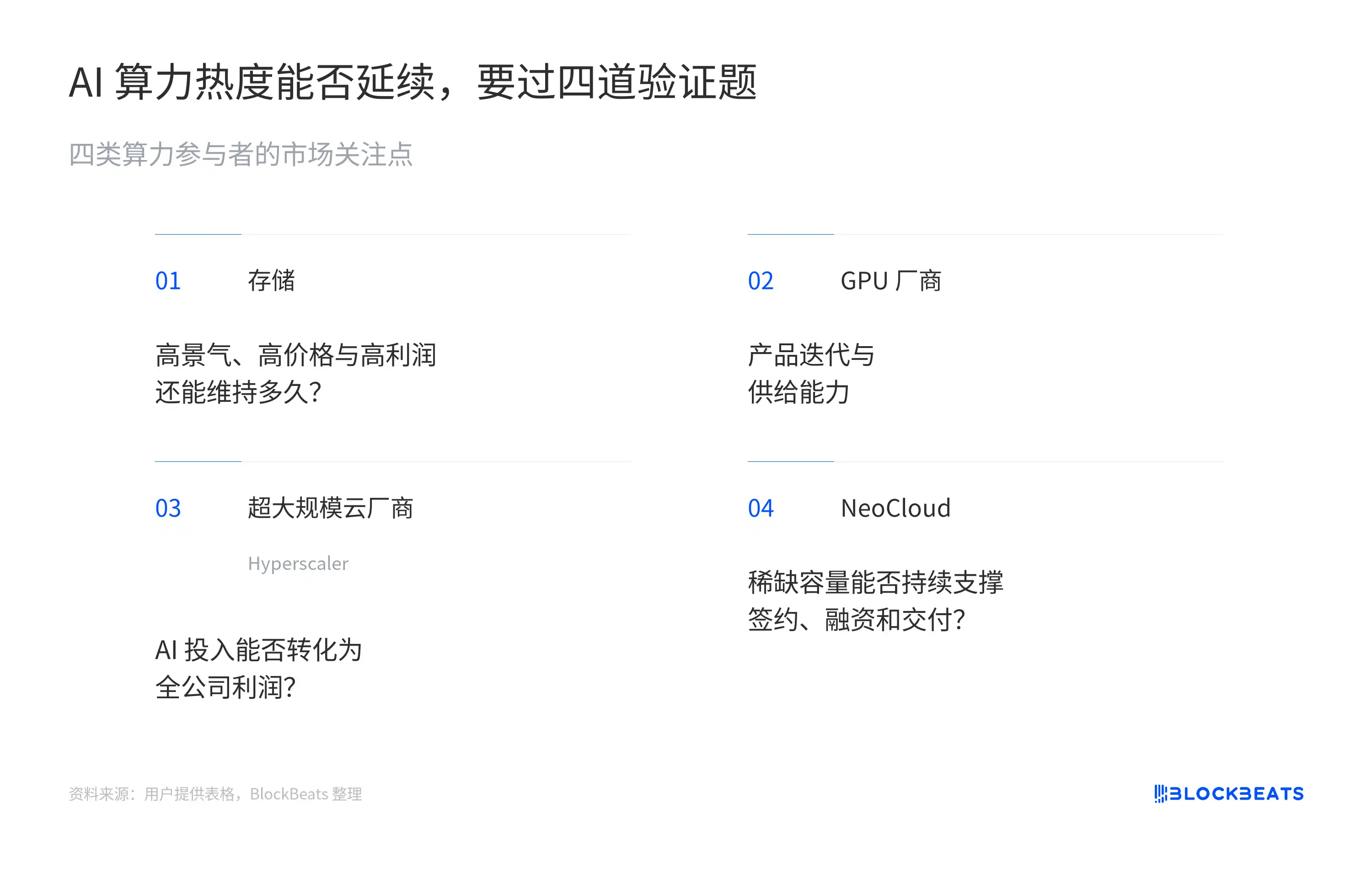
Why Didn't Capital Prioritize Memory and the Big Three Clouds?

Capital's choice reflects the variation in expectations across different segments.

Memory leaders benefit from AI demand, and the outlook for products like HBM and DRAM remains strong. However, the market has already begun to worry about supply ramp-ups, peak prices, margin ceilings, and whether earlier optimistic expectations are fully reflected in stock prices. Strong earnings reports, if not accompanied by upward revisions to future guidance, can easily pressure stock prices.

The challenge for memory companies lies in their cyclical nature. The market trades based on the future path of prices, shipment volumes, and gross margins over the next few quarters. When supply might catch up with demand and average selling prices may decline, strong current earnings find it hard to persistently drive valuation expansion. HBM/DRAM, NAND/SSD, and HDD also belong to different sub-cycles, so the performance of all memory company stocks cannot be attributed to the same single reason.

The Big Three Clouds—Microsoft Azure, Amazon AWS, and Google Cloud—have more robust cash flows, customers, and technical capabilities and are also core beneficiaries of AI investment. Their AI business is diluted by massive revenue bases from advertising, enterprise software, e-commerce, and consumer businesses; the impact of new AI capital expenditures also takes longer to manifest as margin improvements for the entire group. For capital seeking elasticity, a major NeoCloud contract's marginal impact on revenue and valuation is often greater than that of a similarly sized order on the overall valuation of the Big Three Clouds.

NeoCloud sits between these two: lower revenue base, pure AI exposure, fast order growth, and each new large long-term contract can directly support the next round of financing and expansion. Capital easily views it as a high-elasticity AI infrastructure play.

The logic currently traded by the market can be summarized as:
NeoCloud is Essentially a Form of AI Infrastructure Leverage

Understanding NeoCloud's leading gains lies in understanding its leverage effect. Buying shares in these companies is essentially holding an equity asset highly sensitive to AI compute demand, deliverable capacity pricing, and the financing environment. This leverage has three layers of meaning.

The first is operating leverage. Upfront investments in GPUs, data centers, power connectivity, networking, and operations are high, and many costs are relatively fixed once capacity is online. As utilization of active clusters rises and unit capacity pricing improves, incremental revenue can convert into profits relatively quickly, and marginal improvement in profit margins can be significant.

The second is financing leverage. Long-term contracts, non-recourse "take-or-pay" commitments, and customer prepayments enhance the project's attractiveness to lenders and equipment financiers. Companies can thus leverage equity capital to finance larger-scale investments in GPUs, facilities, and power; once new capacity begins billing, revenue can support the next construction cycle.

The third is equity leverage. NeoCloud companies typically have smaller revenue bases and market capitalizations than the Big Three Clouds but have a higher proportion of fixed assets and debt on their balance sheets. If a major contract simultaneously lifts revenue expectations, utilization, and financing accessibility, the market's reassessment of shareholder equity value can be very steep. The rapid post-earnings stock price appreciation often comes from a combination of upward revisions to profit expectations and valuation multiples.

These three layers of leverage create a positive feedback loop in the uptrend:

Larger long-term contracts
→ Easier access to financing and capacity expansion
→ Higher utilization and operating profits
→ Improved equity value and financing ability
→ Securing more contracts and the next expansion opportunity

The same mechanism also magnifies downside risks. If customers delay, utilization falls, GPU or power delivery lags, or debt costs rise, fixed costs and financing obligations can compress shareholder returns. Therefore, the high elasticity priced into NeoCloud by the market also reflects the high execution demands placed on it.

Order Visibility is the Core of This Re-rating

The most attractive aspect of NeoCloud is the visibility of its revenue.

If customers sign non-recourse take-or-pay contracts, even if actual usage fluctuates short-term, customers remain obligated to make certain minimum payments. For operators, this type of revenue is more predictable; for creditors, these contracts also improve the feasibility of asset-based financing.

Therefore, the market will continuously track several metrics:

· Duration, enforceability, and customer creditworthiness of signed contracts;

· Gap between activated MW (Megawatts) and committed MW;

· Revenue per MW and Capex per MW;

· Proportion and payment schedule of customer prepayments;

· Utilization rate, renewal rate, and customer concentration;

· Debt interest rates, debt maturity, and follow-on financing capacity.

Among these, "Activated Capacity" is particularly crucial. Committed MW represents demand; only MW that are powered, equipped, and begin billing enter revenue and cash flow.

This is Also a Re-rating of Power Assets

The most valuable insight from the community regarding NeoCloud shifts the focus from GPU counts to Power (power capacity).

GPU supply will expand with procurement by NVIDIA, AMD, and cloud providers; the formation of high-quality power capacity is slower. It involves the power grid, substations, land, permits, data center construction, and regional network conditions.

Whoever secures sufficient power earlier can convert GPUs into salable compute power sooner.

This is also why some companies transitioning from Bitcoin mining can enter this theme: they already possess some power resources, land, and infrastructure, needing only to shift assets from mining loads to AI loads. Of course, a resource base does not guarantee commercial success; it ultimately still depends on customer acquisition, financing, and delivery capabilities.

NeoCloud's leading gains in the tech stock rebound reflect a market reordering of the AI infrastructure value chain.

The asset currently most valued by capital is computing capacity that can combine GPUs, power, data centers, and long-term customer contracts and deliver rapidly. It captures AI capital expenditure while possessing more contractible characteristics than pure chips and components; it offers both high growth elasticity and a premium for infrastructure scarcity.

Going forward, whether NeoCloud can continue to outperform depends on a straightforward question: Can these massive orders be transformed on time into powered clusters, recognized revenue, and cash flow covering the cost of capital?

Tiền kỹ thuật số thịnh hành

Câu hỏi Liên quan

QWhat key factor contributed to NeoCloud leading the recent tech stock rebound?

ANeoCloud's significant gains are attributed to its role as a 'powered-up compute factory' that provides a complete, rapidly deployable AI infrastructure package—including GPU clusters, networking, cooling, data center space, power, and operations. This addresses the current critical bottleneck in AI: a lack of ready-to-use, large-scale compute capacity that can be delivered within months. The market is valuing the scarcity of such assets and the long-term, contractually locked-in revenue streams they generate.

QHow have recent financial reports changed the market's view of the NeoCloud business model?

ARecent financial reports from companies like CoreWeave and Nebius have shifted the market's perception from viewing NeoCloud as a high-Capex GPU renter to seeing it as an AI infrastructure operator with a sustainable 'flywheel' business loop. Key metrics like large backlogs, significant Annualized Recurring Revenue (ARR), and long-term customer contracts demonstrate a model where customer commitments lead to improved financing, which fuels capacity expansion and revenue growth, creating a self-reinforcing cycle.

QAccording to the article, why might investors favor NeoCloud over major cloud providers (like Azure, AWS, Google Cloud) during this rebound?

AInvestors seeking higher returns may favor NeoCloud over major cloud providers due to its greater financial and valuation elasticity. NeoCloud has a smaller revenue base and is a purer play on AI demand. A single large contract has a much more significant marginal impact on NeoCloud's revenue and valuation compared to a similar-sized order for a hyperscaler, whose AI business is diluted within their massive, diversified revenue streams.

QWhat are the three layers of leverage that explain NeoCloud's high stock price volatility, as described in the article?

AThe three layers of leverage are: 1) **Operating Leverage**: High fixed costs for infrastructure mean improved utilization and pricing lead to faster profit margin expansion. 2) **Financing Leverage**: Long-term contracts and customer prepayments enable the company to use equity to secure larger debt/equipment financing for further expansion. 3) **Equity Leverage**: A smaller market cap and high asset/debt base mean positive developments (like large contracts) can trigger steep re-ratings of shareholder equity value, combining earnings upgrades with multiple expansion.

QWhat underlying asset revaluation is central to the NeoCloud investment thesis, beyond just GPUs?

AThe investment thesis for NeoCloud involves a fundamental re-rating of **power (electricity) assets**. While GPU supply can increase, high-quality, permitted, and grid-connected power capacity is scarcer and takes longer to develop. The ability to secure and deliver power is now seen as the primary bottleneck for converting GPUs into sellable compute capacity, granting a significant premium to operators who control these resources.

Nội dung Liên quan

Grayscale: "Nếu các đề xuất được thông qua, giá của hai altcoin này có thể tăng"

Trưởng bộ phận nghiên cứu tại Grayscale, Zach Pandl, cho biết nếu các đề xuất thay đổi tokenomics trong cộng đồng Ethereum ($ETH) và Solana ($SOL) được thông qua, tốc độ tăng nguồn cung của cả hai tài sản crypto này có thể chậm lại đáng kể, từ đó tác động tích cực đến giá. Các thay đổi được đề cập nhằm giảm tỷ lệ lạm phát token hàng năm của $ETH và $SOL. Việc nguồn cung tăng chậm hơn có thể làm giảm lượng token mới lưu hành, làm tăng tính khan hiếm. Grayscale ước tính nếu được áp dụng, lạm phát nguồn cung hàng năm của Ethereum có thể giảm xuống khoảng 0.4% vào cuối năm 2031, gần với tốc độ tăng nguồn cung của Bitcoin. Dự kiến lạm phát nguồn cung hàng năm của Solana sẽ giảm xuống khoảng 1.1%. Tuy nhiên, việc giảm lạm phát token cũng có thể dẫn đến phần thưởng staking thấp hơn cho các nhà đầu tư, vì phần lớn thu nhập từ staking $ETH và $SOL đến từ việc phát hành token mới. Pandl lưu ý rằng việc tăng trưởng nguồn cung chậm lại có thể làm tăng tính khan hiếm, tạo áp lực tăng giá, đặc biệt có lợi cho những nhà đầu tư nắm giữ token mà không staking.

cryptonews.ru2 giờ trước

Grayscale: "Nếu các đề xuất được thông qua, giá của hai altcoin này có thể tăng"

cryptonews.ru2 giờ trước

Các chuyên gia chỉ ra nguyên nhân Bitcoin giảm sau khi lạm phát Mỹ hạ nhiệt

Các chuyên gia CryptoQuant cho rằng tin tốt về lạm phát Mỹ không thể hỗ trợ giá Bitcoin vì nhu cầu giao ngay yếu. Dữ liệu CPI và PPI tháng 7 của Mỹ đáp ứng hoặc vượt kỳ vọng, khiến lợi tức trái phiếu giảm và thị trường chứng khoán tăng, nhưng Bitcoin vẫn giao dịch quanh mức 63.000-64.000 USD. Nguyên nhân chính là dòng vốn đổ vào các ETF Bitcoin Mỹ vẫn thấp và chỉ số Coinbase Premium (phản ánh chênh lệch giá) âm từ tháng 5, cho thấy áp lực mua từ nhà đầu tư Mỹ hạn chế. Trong khi đó, vị thế trên thị trường tương lai vẫn cao, tạo ra sự mất cân bằng giữa nhu cầu giao ngay yếu, thanh khoản thấp và khối lượng vị thế ký quỹ lớn. Các chuyên gia cảnh báo trong điều kiện này, tin tích cực vĩ mô có thể không kích thích tăng giá. Nếu giá không phản ứng, các nhà giao dịch có thể đóng vị thế mua ký quỹ, gây thêm áp lực giảm. Mức kháng cự quan trọng là 68.700 USD - giá vốn trung bình của các nhà nắm giữ ngắn hạn. Theo CryptoQuant, để thị trường hồi phục mạnh mẽ cần: dòng tiền mạnh trở lại vào ETF Bitcoin Mỹ, chỉ số Coinbase Premium chuyển sang dương, khối lượng giao dịch giao ngay tăng và Bitcoin vượt vững chắc trên 68.700 USD.

cryptonews.ru2 giờ trước

Các chuyên gia chỉ ra nguyên nhân Bitcoin giảm sau khi lạm phát Mỹ hạ nhiệt

cryptonews.ru2 giờ trước

Giá Bitcoin giảm xuống 62.470 USD khi người bán thử thách lại ngưỡng hỗ trợ 63.000 USD

Giá Bitcoin giảm xuống 62.470 USD vào thứ Sáu, lần thứ hai liên tiếp phá vỡ ngưỡng 63.000 USD. Sau một thời gian củng cố quanh 63.400 USD, đợt bán tháo bắt đầu sau nửa đêm đã đẩy giá xuống đáy 62.470 USD trong phiên, trước khi phục hồi nhẹ lên trên 63.000 USD. Biến động mạnh dẫn đến việc thanh lý hàng loạt các vị thế mua ký quỹ, với tổng giá trị vị thế Bitcoin bị thanh lý trong 24h là 32 triệu USD. Áp lực bán càng gia tăng do dòng tiền ròng rút khỏi các Quỹ ETF Bitcoin, với mức rút hơn 131 triệu USD, đánh dấu ngày thứ hai liên tiếp có dòng tiền ra. Yếu tố khác gây lo ngại là đề xuất tiêu chí mới từ nhà cung cấp chỉ số MSCI, có thể dẫn đến việc loại các công ty nắm giữ tài sản kỹ thuật số như Bitcoin (ví dụ: MicroStrategy) ra khỏi các chỉ số chính. MicroStrategy đã phản đối mạnh mẽ đề xuất này, cho rằng các nhà cung cấp chỉ số không nên quyết định loại tài sản nào công ty được phép nắm giữ. Quyết định cuối cùng của MSCI dự kiến vào giữa tháng Mười, và nếu được thông qua, có thể kích hoạt đợt bán tháo từ các quỹ chỉ số từ tháng Mười một, gây thêm áp lực giảm cho thị trường Bitcoin.

cryptonews.ru2 giờ trước

Giá Bitcoin giảm xuống 62.470 USD khi người bán thử thách lại ngưỡng hỗ trợ 63.000 USD

cryptonews.ru2 giờ trước

Bí mật khai thác 1 BTC trên máy tính công ty: Nhân viên hãng tiền mã hóa đối mặt án tù

Christopher Renkin, 40 tuổi, từ bang Washington, đã nhận tội vì truy cập trái phép vào máy tính của một công ty khai thác bitcoin và đánh cắp tiền điện tử. Anh ta đã chuyển hướng khoảng 100 thiết bị sang nhóm khai thác (mining pool) riêng của mình và chiếm đoạt 1,0668 BTC. Theo công tố viên, Renkin bắt đầu làm việc tại công ty ở Niagara Falls, New York vào tháng 7/2021. Anh ta đã tự ý truy cập, khởi động lại máy tính công ty và chuyển chúng sang pool khai thác do mình tạo ra, sau đó chuyển bitcoin thu được vào ví tiền điện tử dưới sự kiểm soát của mình. Không chỉ vậy, Renkin còn chuyển máy tính sang chế độ "hiệu suất cao", gây thiệt hại cho phần cứng, làm giảm đáng kể tuổi thọ thiết bị và xâm phạm tính toàn vẹn, khả năng truy cập thông tin lưu trữ. Hành động này khiến công ty mất 1,06 BTC, trị giá 53.315 USD tại thời điểm phạm tội. Renkin bị kết tội truyền chương trình, thông tin, mã hoặc lệnh vào máy tính được bảo vệ và gây thiệt hại cho nó. Mức hình phạt tối đa có thể lên đến một năm tù và phạt 100.000 USD. Bản án dự kiến được tuyên vào ngày 17 tháng 11 năm 2026.

cryptonews.ru2 giờ trước

Bí mật khai thác 1 BTC trên máy tính công ty: Nhân viên hãng tiền mã hóa đối mặt án tù

cryptonews.ru2 giờ trước

Giao dịch

Giao ngay

Bài viết Nổi bật

Làm thế nào để Mua ONE

Chào mừng bạn đến với HTX.com! Chúng tôi đã làm cho mua Harmony (ONE) trở nên đơn giản và thuận tiện. Làm theo hướng dẫn từng bước của chúng tôi để bắt đầu hành trình tiền kỹ thuật số của bạn.Bước 1: Tạo Tài khoản HTX của BạnSử dụng email hoặc số điện thoại của bạn để đăng ký tài khoản miễn phí trên HTX. Trải nghiệm hành trình đăng ký không rắc rối và mở khóa tất cả tính năng. Nhận Tài khoản của tôiBước 2: Truy cập Mua Crypto và Chọn Phương thức Thanh toán của BạnThẻ Tín dụng/Ghi nợ: Sử dụng Visa hoặc Mastercard của bạn để mua Harmony (ONE) ngay lập tức.Số dư: Sử dụng tiền từ số dư tài khoản HTX của bạn để giao dịch liền mạch.Bên thứ ba: Chúng tôi đã thêm những phương thức thanh toán phổ biến như Google Pay và Apple Pay để nâng cao sự tiện lợi.P2P: Giao dịch trực tiếp với người dùng khác trên HTX.Thị trường mua bán phi tập trung (OTC): Chúng tôi cung cấp những dịch vụ được thiết kế riêng và tỷ giá hối đoái cạnh tranh cho nhà giao dịch.Bước 3: Lưu trữ Harmony (ONE) của BạnSau khi mua Harmony (ONE), lưu trữ trong tài khoản HTX của bạn. Ngoài ra, bạn có thể gửi đi nơi khác qua chuyển khoản blockchain hoặc sử dụng để giao dịch những tiền kỹ thuật số khác.Bước 4: Giao dịch Harmony (ONE)Giao dịch Harmony (ONE) dễ dàng trên thị trường giao ngay của HTX. Chỉ cần truy cập vào tài khoản của bạn, chọn cặp giao dịch, thực hiện giao dịch và theo dõi trong thời gian thực. Chúng tôi cung cấp trải nghiệm thân thiện với người dùng cho cả người mới bắt đầu và người giao dịch dày dạn kinh nghiệm.

Tổng lượt xem 835Xuất bản vào 2024.12.12Cập nhật vào 2026.06.02

Làm thế nào để Mua ONE

Thảo luận

Chào mừng đến với Cộng đồng HTX. Tại đây, bạn có thể được thông báo về những phát triển nền tảng mới nhất và có quyền truy cập vào thông tin chuyên sâu về thị trường. Ý kiến ​​của người dùng về giá của ONE (ONE) được trình bày dưới đây.

活动图片