Home Furnishing Listed Companies Are Trying to Turn Around with AI and Semiconductors

marsbitXuất bản vào 2026-08-06Cập nhật gần nhất vào 2026-08-06

Tóm tắt

Chinese home furnishing listed companies are increasingly turning to AI and semiconductor cross-border ventures to revive their fortunes amid declining core businesses. A prominent example is PVC flooring giant **Elegant Home Furnishing**, whose stock price skyrocketed with 10 consecutive trading limits after announcing a plan to acquire a majority stake in **Ou Kang Nuo**, a semiconductor storage testing equipment and services company. Despite Elegant Home's own financial struggles—including recent losses and tight cash flow—the acquisition, funded through asset sales and loans, has dramatically boosted its market value. The deal involves a cross-shareholding structure with Ou Kang Nuo's controlling shareholder. This trend is widespread. Over the past year, numerous home furnishing firms with stagnant main operations have seen their stock prices surge after announcing moves into hot sectors like AI, semiconductors, or computing power. Key cases include: * **Markor Home Furnishings** ("high-end home furnishing first share"), after years of heavy losses, acquired an AI server high-speed copper cable company and later introduced AI computing power investors. * **Zhenai Meijia** ("blanket king") became the first A-listed manufacturer controlled by an AI large model company following a takeover. * **Fasilon** (integrated ceiling) saw its stock soar after establishing an AI subsidiary. * **Jinlong Decoration** experienced multiple trading limits after being linked to "c...

Another home furnishing listed company's stock price has skyrocketed due to a cross-border venture into semiconductors.

On August 6, PVC flooring giant Elysium Home Furnishings resumed trading with another daily limit-up, marking its 10th consecutive daily limit-up. Wind data shows that from July 21 to August 6, the company's stock price has surged by 159.31% cumulatively.

This struggling flooring company achieved a turnaround solely through a cross-border capital operation.

On the evening of July 20, Elysium Home Furnishings announced that it had signed an "Equity Acquisition Intent Agreement" with shareholders Zhao Ming, Tong Shujuan, Anhui Mingde Zhonghe, and Anhui Zhonghe of OCONOR, intending to acquire no less than 77.08% of OCONOR's equity with cash and make it a controlling subsidiary.

OCONOR is mainly engaged in storage testing equipment and related testing services. Its product series include GA300, SW400, MS200, and ES100, covering test scenarios such as SSD modules, DDR modules, storage chips, and embedded memory. It boasts a complete solution centered on system-level testing (SLT) while also providing professional testing services.
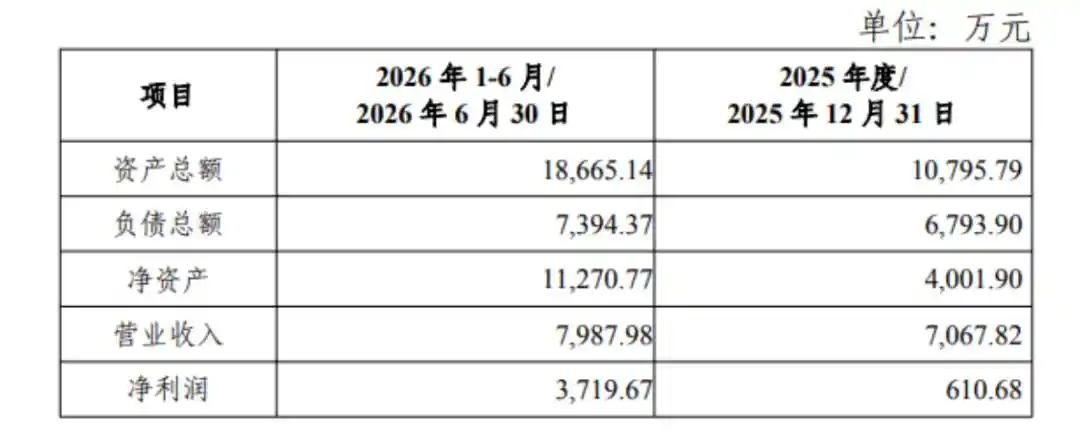
OCONOR Financial Data | Screenshot from the Announcement

This acquisition involves many clever transaction details: Elysium Home Furnishings acquires OCONOR, while OCONOR's actual controller Zhao Ming simultaneously acquires 20% of Elysium Home Furnishings' shares. You buy me, I buy you, a two-way binding. Additionally, OCONOR has made a performance commitment: cumulative non-GAAP net profit over four years shall be no less than 230 million yuan.

The key question is: where does Elysium Home Furnishings' acquisition funding come from?

The announcement shows that the acquisition funds will come from the company's own funds and self-raised funds through methods such as disposing of idle assets (valued at approximately 200 million to 300 million yuan), bank loans, and loans from major shareholders.

Currently, Elysium Home Furnishings does not have much cash on its books.

According to its Q1 2026 report, Elysium Home Furnishings had only 259 million yuan in cash and cash equivalents on its books, while short-term interest-bearing debt reached 277 million yuan. The acquisition requires 500 million yuan.

The reason for the limited cash on hand is that Elysium Home Furnishings' "flooring business" has long been in the red.

In 2025, the company's revenue and net profit attributable to shareholders both declined, with net profit attributable to shareholders plummeting 87.6% year-on-year to 17.17 million yuan. Entering 2026, losses continued to widen, with a loss of 14.82 million yuan in Q1 and a projected loss for the first half of the year increasing to 34.5 million to 40.5 million yuan.
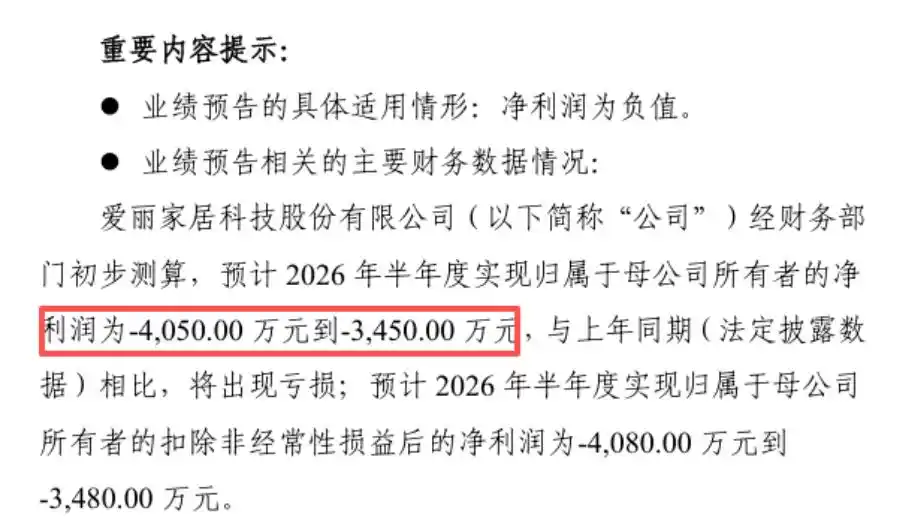
Image Source: Elysium Home Furnishings Announcement

However, Elysium Home Furnishings did not persist in returning to its core business. Instead, it set its sights on cross-border mergers and acquisitions, which have yielded positive effects so far—its stock price has soared, with nine consecutive daily limit-ups, and its market capitalization skyrocketed from 2.3 billion to 5.46 billion yuan. As of the close on August 6, its total market capitalization had increased to 6 billion yuan.

Elysium Home Furnishings is not an isolated case.

Over the past year or more, home furnishing listed companies have collectively staged a drama of "cross-border survival." The script is almost identical: sluggish growth in the core business leads to targeting AI, semiconductor, or computing power concepts. Once announced, stock prices soar.

Once the "first stock in high-end home furnishings," Markor Home Furnishings, accumulated losses exceeding 3.7 billion yuan over four years. At the end of 2025, the company announced the acquisition of 100% equity in AI server high-speed copper cable company Wandetai Optoelectronics. After resuming trading, its stock price surged continuously. Subsequently, it also introduced AI computing power industry investors to participate in its restructuring.

The Yiwu "Blanket King," Zhenai Meijia, saw AI unicorn Tanji Technology acquire 44.99% of its shares through "agreement transfer + tender offer" for approximately 1.8 billion yuan in Q4 2025, making it the first A-share manufacturing company controlled by an AI large model company. Its stock price immediately hit consecutive daily limit-ups.

Integrated ceiling giant Fasilon announced in September 2025 that it would invest 250 million yuan to establish an AI subsidiary, leading to eight consecutive daily gains and a rise of over 380% within a year. The company, with only 900 million yuan in assets, supported a market capitalization of nearly 9 billion yuan.

Home decoration leader Gold Mantis, after associating itself with "commercial aerospace" and "AI computing power," secured 11 daily limit-ups in 15 trading days, with a cumulative increase of 136.8%. However, the company clarified that the related business accounts for less than 1% of its total.

Preliminary statistics show that in 2025, over 20 A-share listed companies announced cross-border ventures into the semiconductor sector, with home furnishing and building materials companies accounting for the highest proportion. The downturn in the real estate industry, stagnation in core business growth, and continuous profit shrinkage have forced these companies to flock to popular sectors, attempting to turn around with trending concepts.

The ultimate outcome of countless cross-border speculation cases is consistent: the concept fades, the bubble bursts, and the stock price returns to fundamentals. For example, Gold Mantis' stock price quickly retreated after market sentiment cooled. As of the close on August 6, its stock price had been halved from its peak.

This is also the case with Elysium Home Furnishings this time. A letter of intent for acquisition that has not yet led to a formal agreement; the company has repeatedly issued announcements warning that "the formal agreement has not been signed and there is uncertainty." How can fundamentals showing a half-year loss exceeding 40 million yuan support a market capitalization of 6 billion yuan?

Home furnishing companies continue to cross borders and ride hype waves, more out of helpless survival tactics amid slowing core business.

The downturn in real estate, shrinking overseas demand, and tariff impacts have continuously lowered the ceiling for traditional home furnishing manufacturing. Rather than competing fiercely in a red ocean, it seems better to embrace a cutting-edge concept, let the stock price rise, and allow major shareholders to find more possibilities within it.

However, after the狂欢狂欢 (carnival), someone always has to be left behind.

Note: Article materials sourced from official reports and public information; views are for reference only. | Some images sourced from the internet; please inform for deletion if there is any infringement.

This article is from the WeChat public account "Yuan Mei Hui," author: Xie Chunsheng

Tiền kỹ thuật số thịnh hành

Câu hỏi Liên quan

QWhat caused Aili Home Furnishing's stock price to soar by nearly 160% in recent weeks?

AAili Home Furnishing's stock price skyrocketed due to its announcement of a cross-border acquisition plan to purchase a majority stake (over 77.08%) in Oukangnuo, a company specializing in semiconductor storage testing equipment and services.

QHow does the financial performance of Aili Home Furnishing's core business compare to its recent market valuation surge?

AThe core business (PVC flooring) of Aili Home Furnishing is performing poorly, with significant profit declines in 2025 and an expanding net loss forecast for the first half of 2026. This weak fundamental performance sharply contrasts with its soaring market valuation, which increased from 2.3 billion to 6 billion RMB following the acquisition news.

QWhat is a common strategy among home furnishing listed companies in China to revitalize their business and stock performance, as illustrated in the article?

AA common strategy is cross-border M&A or investment into hot technology sectors like AI, semiconductors, and computing power. When companies announce such moves, their stock prices often surge significantly, even if their core businesses are struggling.

QBeyond Aili Home Furnishing, name two other home furnishing companies mentioned that used cross-sector moves related to AI or tech to boost their market performance.

ATwo other examples are: 1) Markor Furnishings (美克家居), which acquired an AI server high-speed copper cable company and introduced AI computing power investors. 2) Faslong (法狮龙), which established an AI subsidiary, leading to a stock price increase of over 380% within a year.

QWhat does the article suggest is the primary driver behind this trend of home furnishing companies pursuing cross-border acquisitions in tech sectors?

AThe primary driver is the struggle and stagnation of their core home furnishing businesses, exacerbated by the downturn in the real estate sector, shrinking overseas demand, and tariff impacts. Facing a limited ceiling in their traditional industry, they turn to hot tech concepts as a means to seek survival and boost stock prices.

Nội dung Liên quan

Grayscale: "Nếu các đề xuất được thông qua, giá của hai altcoin này có thể tăng"

Trưởng bộ phận nghiên cứu tại Grayscale, Zach Pandl, cho biết nếu các đề xuất thay đổi tokenomics trong cộng đồng Ethereum ($ETH) và Solana ($SOL) được thông qua, tốc độ tăng nguồn cung của cả hai tài sản crypto này có thể chậm lại đáng kể, từ đó tác động tích cực đến giá. Các thay đổi được đề cập nhằm giảm tỷ lệ lạm phát token hàng năm của $ETH và $SOL. Việc nguồn cung tăng chậm hơn có thể làm giảm lượng token mới lưu hành, làm tăng tính khan hiếm. Grayscale ước tính nếu được áp dụng, lạm phát nguồn cung hàng năm của Ethereum có thể giảm xuống khoảng 0.4% vào cuối năm 2031, gần với tốc độ tăng nguồn cung của Bitcoin. Dự kiến lạm phát nguồn cung hàng năm của Solana sẽ giảm xuống khoảng 1.1%. Tuy nhiên, việc giảm lạm phát token cũng có thể dẫn đến phần thưởng staking thấp hơn cho các nhà đầu tư, vì phần lớn thu nhập từ staking $ETH và $SOL đến từ việc phát hành token mới. Pandl lưu ý rằng việc tăng trưởng nguồn cung chậm lại có thể làm tăng tính khan hiếm, tạo áp lực tăng giá, đặc biệt có lợi cho những nhà đầu tư nắm giữ token mà không staking.

cryptonews.ru3 giờ trước

Grayscale: "Nếu các đề xuất được thông qua, giá của hai altcoin này có thể tăng"

cryptonews.ru3 giờ trước

Các chuyên gia chỉ ra nguyên nhân Bitcoin giảm sau khi lạm phát Mỹ hạ nhiệt

Các chuyên gia CryptoQuant cho rằng tin tốt về lạm phát Mỹ không thể hỗ trợ giá Bitcoin vì nhu cầu giao ngay yếu. Dữ liệu CPI và PPI tháng 7 của Mỹ đáp ứng hoặc vượt kỳ vọng, khiến lợi tức trái phiếu giảm và thị trường chứng khoán tăng, nhưng Bitcoin vẫn giao dịch quanh mức 63.000-64.000 USD. Nguyên nhân chính là dòng vốn đổ vào các ETF Bitcoin Mỹ vẫn thấp và chỉ số Coinbase Premium (phản ánh chênh lệch giá) âm từ tháng 5, cho thấy áp lực mua từ nhà đầu tư Mỹ hạn chế. Trong khi đó, vị thế trên thị trường tương lai vẫn cao, tạo ra sự mất cân bằng giữa nhu cầu giao ngay yếu, thanh khoản thấp và khối lượng vị thế ký quỹ lớn. Các chuyên gia cảnh báo trong điều kiện này, tin tích cực vĩ mô có thể không kích thích tăng giá. Nếu giá không phản ứng, các nhà giao dịch có thể đóng vị thế mua ký quỹ, gây thêm áp lực giảm. Mức kháng cự quan trọng là 68.700 USD - giá vốn trung bình của các nhà nắm giữ ngắn hạn. Theo CryptoQuant, để thị trường hồi phục mạnh mẽ cần: dòng tiền mạnh trở lại vào ETF Bitcoin Mỹ, chỉ số Coinbase Premium chuyển sang dương, khối lượng giao dịch giao ngay tăng và Bitcoin vượt vững chắc trên 68.700 USD.

cryptonews.ru4 giờ trước

Các chuyên gia chỉ ra nguyên nhân Bitcoin giảm sau khi lạm phát Mỹ hạ nhiệt

cryptonews.ru4 giờ trước

Giá Bitcoin giảm xuống 62.470 USD khi người bán thử thách lại ngưỡng hỗ trợ 63.000 USD

Giá Bitcoin giảm xuống 62.470 USD vào thứ Sáu, lần thứ hai liên tiếp phá vỡ ngưỡng 63.000 USD. Sau một thời gian củng cố quanh 63.400 USD, đợt bán tháo bắt đầu sau nửa đêm đã đẩy giá xuống đáy 62.470 USD trong phiên, trước khi phục hồi nhẹ lên trên 63.000 USD. Biến động mạnh dẫn đến việc thanh lý hàng loạt các vị thế mua ký quỹ, với tổng giá trị vị thế Bitcoin bị thanh lý trong 24h là 32 triệu USD. Áp lực bán càng gia tăng do dòng tiền ròng rút khỏi các Quỹ ETF Bitcoin, với mức rút hơn 131 triệu USD, đánh dấu ngày thứ hai liên tiếp có dòng tiền ra. Yếu tố khác gây lo ngại là đề xuất tiêu chí mới từ nhà cung cấp chỉ số MSCI, có thể dẫn đến việc loại các công ty nắm giữ tài sản kỹ thuật số như Bitcoin (ví dụ: MicroStrategy) ra khỏi các chỉ số chính. MicroStrategy đã phản đối mạnh mẽ đề xuất này, cho rằng các nhà cung cấp chỉ số không nên quyết định loại tài sản nào công ty được phép nắm giữ. Quyết định cuối cùng của MSCI dự kiến vào giữa tháng Mười, và nếu được thông qua, có thể kích hoạt đợt bán tháo từ các quỹ chỉ số từ tháng Mười một, gây thêm áp lực giảm cho thị trường Bitcoin.

cryptonews.ru4 giờ trước

Giá Bitcoin giảm xuống 62.470 USD khi người bán thử thách lại ngưỡng hỗ trợ 63.000 USD

cryptonews.ru4 giờ trước

Bí mật khai thác 1 BTC trên máy tính công ty: Nhân viên hãng tiền mã hóa đối mặt án tù

Christopher Renkin, 40 tuổi, từ bang Washington, đã nhận tội vì truy cập trái phép vào máy tính của một công ty khai thác bitcoin và đánh cắp tiền điện tử. Anh ta đã chuyển hướng khoảng 100 thiết bị sang nhóm khai thác (mining pool) riêng của mình và chiếm đoạt 1,0668 BTC. Theo công tố viên, Renkin bắt đầu làm việc tại công ty ở Niagara Falls, New York vào tháng 7/2021. Anh ta đã tự ý truy cập, khởi động lại máy tính công ty và chuyển chúng sang pool khai thác do mình tạo ra, sau đó chuyển bitcoin thu được vào ví tiền điện tử dưới sự kiểm soát của mình. Không chỉ vậy, Renkin còn chuyển máy tính sang chế độ "hiệu suất cao", gây thiệt hại cho phần cứng, làm giảm đáng kể tuổi thọ thiết bị và xâm phạm tính toàn vẹn, khả năng truy cập thông tin lưu trữ. Hành động này khiến công ty mất 1,06 BTC, trị giá 53.315 USD tại thời điểm phạm tội. Renkin bị kết tội truyền chương trình, thông tin, mã hoặc lệnh vào máy tính được bảo vệ và gây thiệt hại cho nó. Mức hình phạt tối đa có thể lên đến một năm tù và phạt 100.000 USD. Bản án dự kiến được tuyên vào ngày 17 tháng 11 năm 2026.

cryptonews.ru4 giờ trước

Bí mật khai thác 1 BTC trên máy tính công ty: Nhân viên hãng tiền mã hóa đối mặt án tù

cryptonews.ru4 giờ trước

Giao dịch

Giao ngay

Bài viết Nổi bật

Làm thế nào để Mua HOME

Chào mừng bạn đến với HTX.com! Chúng tôi đã làm cho mua Defi.app (HOME) trở nên đơn giản và thuận tiện. Làm theo hướng dẫn từng bước của chúng tôi để bắt đầu hành trình tiền kỹ thuật số của bạn.Bước 1: Tạo Tài khoản HTX của BạnSử dụng email hoặc số điện thoại của bạn để đăng ký tài khoản miễn phí trên HTX. Trải nghiệm hành trình đăng ký không rắc rối và mở khóa tất cả tính năng. Nhận Tài khoản của tôiBước 2: Truy cập Mua Crypto và Chọn Phương thức Thanh toán của BạnThẻ Tín dụng/Ghi nợ: Sử dụng Visa hoặc Mastercard của bạn để mua Defi.app (HOME) ngay lập tức.Số dư: Sử dụng tiền từ số dư tài khoản HTX của bạn để giao dịch liền mạch.Bên thứ ba: Chúng tôi đã thêm những phương thức thanh toán phổ biến như Google Pay và Apple Pay để nâng cao sự tiện lợi.P2P: Giao dịch trực tiếp với người dùng khác trên HTX.Thị trường mua bán phi tập trung (OTC): Chúng tôi cung cấp những dịch vụ được thiết kế riêng và tỷ giá hối đoái cạnh tranh cho nhà giao dịch.Bước 3: Lưu trữ Defi.app (HOME) của BạnSau khi mua Defi.app (HOME), lưu trữ trong tài khoản HTX của bạn. Ngoài ra, bạn có thể gửi đi nơi khác qua chuyển khoản blockchain hoặc sử dụng để giao dịch những tiền kỹ thuật số khác.Bước 4: Giao dịch Defi.app (HOME)Giao dịch Defi.app (HOME) dễ dàng trên thị trường giao ngay của HTX. Chỉ cần truy cập vào tài khoản của bạn, chọn cặp giao dịch, thực hiện giao dịch và theo dõi trong thời gian thực. Chúng tôi cung cấp trải nghiệm thân thiện với người dùng cho cả người mới bắt đầu và người giao dịch dày dạn kinh nghiệm.

Tổng lượt xem 580Xuất bản vào 2025.06.10Cập nhật vào 2026.06.10

Làm thế nào để Mua HOME

Thảo luận

Chào mừng đến với Cộng đồng HTX. Tại đây, bạn có thể được thông báo về những phát triển nền tảng mới nhất và có quyền truy cập vào thông tin chuyên sâu về thị trường. Ý kiến ​​của người dùng về giá của HOME (HOME) được trình bày dưới đây.

活动图片