Ethereum Community in Uproar! Whose Cake is EIP-8363 Cutting Into?

marsbitXuất bản vào 2026-08-06Cập nhật gần nhất vào 2026-08-06

Tóm tắt

**Ethereum Community Debates Controversial Staking Proposal EIP-8363** A new Ethereum proposal, EIP-8363, dubbed "Tapered Issuance Burn," has ignited heated debate within the community. The core idea is to reduce and eventually eliminate new issuance rewards for validators as the total amount of staked ETH approaches 50% of the total supply (around 60.25 million ETH). The authors, including EthCC founder Jérôme de Tychey and Ethereum Foundation researcher Justin Drake, argue the current system perpetually incentivizes more staking, potentially leading to centralization as stake flows to large custodians and liquid staking tokens (LSTs). They also aim to reduce dilution pressure on non-staking ETH holders. Under the proposal, validator rewards from consensus-layer issuance would be partially burned based on a formula tied to the total staked amount. Net rewards would gradually approach zero as staking nears the 50% threshold. Notably, execution-layer rewards (tips, MEV) are unaffected. A proposed 18-month transition period would soften the initial impact. The community reaction has been predominantly critical. Key concerns include: * **Centralization Risk:** Critics like Obol's Oisín Kyne argue very low rewards could drive out solo stakers and smaller operators, leaving only large, cost-insensitive institutions, thus increasing validator centralization. * **Ecosystem Impact:** Aave's Stani Kulechov warns it could hurt ETH's predictable yield appeal for institutions and...

Author: KarenZ, Foresight News

Intuitively, the more ETH staked, the higher the economic cost to attack the network.

However, an expansion in staking scale does not necessarily bring a proportional increase in security gains; if the new staking primarily flows to a few large service providers, the validator ecosystem could become more centralized instead.

On August 4th, EthCC founder Jérôme de Tychey, Ethereum Foundation's Justin Drake, and four other researchers jointly submitted a "Tapered Issuance Burn" proposal, attempting to install a "profit downgrade path" for the ever-increasing staking rate. When the staked amount approaches 50% of the total ETH supply, the consensus layer issuance rewards obtained by validators will be entirely offset.

This proposal was initially released under the number EIP-8361, but was later changed to EIP-8363 after that number was reassigned to another proposal. Although it is still in an early draft stage, it has quickly become one of the most hotly debated topics within the Ethereum community.

What exactly is this proposal trying to do?

Currently, Ethereum consensus layer rewards decrease as the total staked amount increases, but even if all ETH were staked, there remains a theoretical lower bound of about 1.5% for the nominal consensus yield of a single validator.

The authors of EIP-8363 argue that this means the protocol always provides positive incentives for more staking, lacking a real "stop button," potentially driving ETH towards concentration among large custodians, exchanges, and staking derivatives.

Additionally, unstaked ETH is continuously diluted by new issuance. Liquid Staking Tokens (LSTs), because they inherently carry yield, can more easily replace native ETH as collateral and savings assets in DeFi. The proposal authors hope to reduce this dilution pressure, making native ETH a more competitive neutral asset again.

The solution given by the proposal is not to prohibit new validators from entering or to rigidly lock the staking rate at 50%, but to deduct and burn a portion of the validator rewards after their normal calculation. The burn ratio depends on the total network effective staked balance: calculated as "1.5 times the power of the ratio of the total network effective staked balance to 60.25 million ETH," capped at 100%, i.e.:
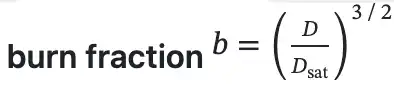
60.25 million ETH is approximately half of the current total ETH supply. As the staked amount approaches this value, the net consensus layer earnings for validators gradually approach zero; when reaching or exceeding this value, the consensus layer issuance rewards earned by normally, fully-functioning validators will be completely offset by the newly added burn deduction. It is worth adding that 60.25 million ETH is a fixed value proposed to be written into the protocol at the time of the hard fork.

There are two points easily misunderstood:

First, 50% is not a staking cap, nor is it a target staking rate. Validators can still continue to join; the proposal merely hopes the market will stop growing on its own before the yield is insufficient to cover liquidity, operational, slashing, and regulatory risks.

Second, so-called "zero earnings" refers only to the net consensus layer issuance reward. Execution layer income such as priority fees and MEV is unaffected by this proposal.
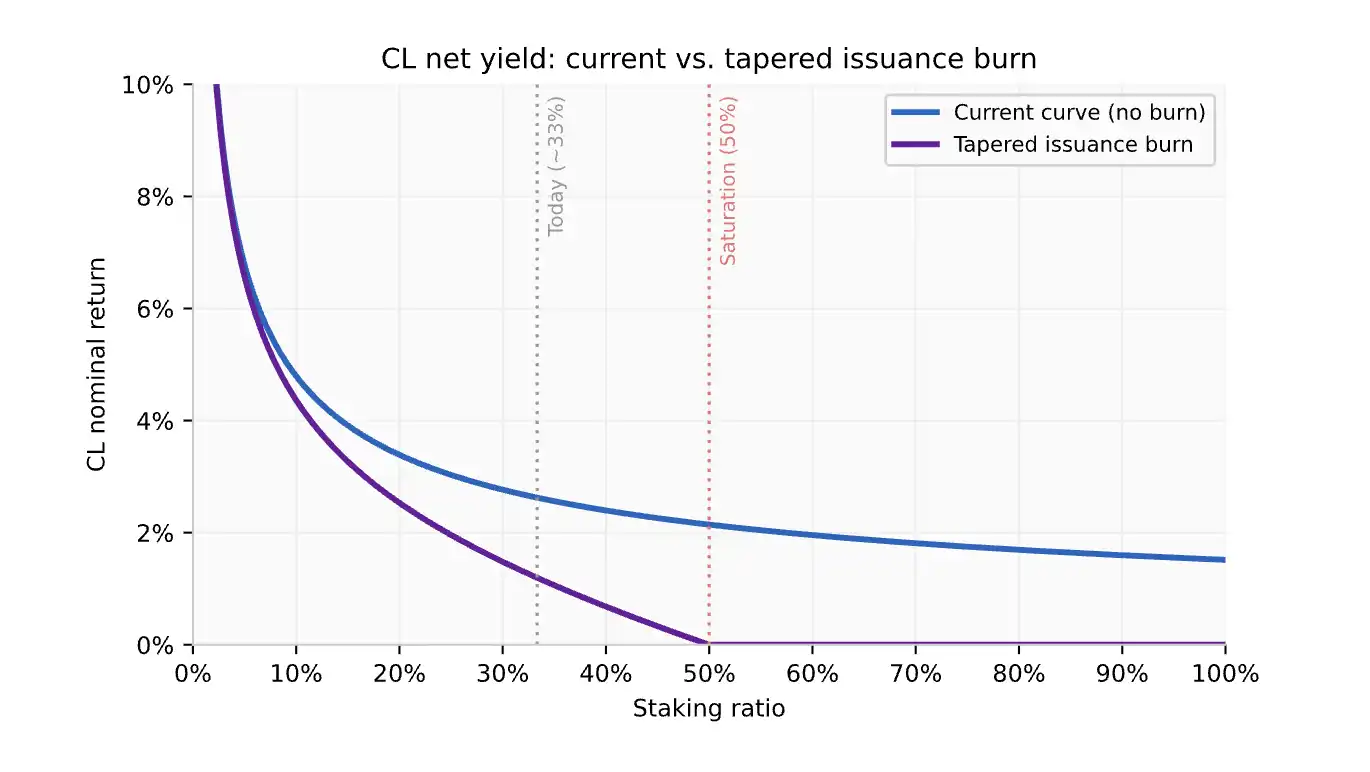
Net consensus layer earnings under the current issuance curve versus the EIP-8363 curve

According to the proposal's curve, the annual consensus layer issuance would peak near a staking rate of about 19.8%, then decline as the staking rate increases. Estimating with the current ~33% staking rate, if this curve were fully implemented at the time of a fork, the consensus layer yield would drop from about 2.6% to about 1.2%.
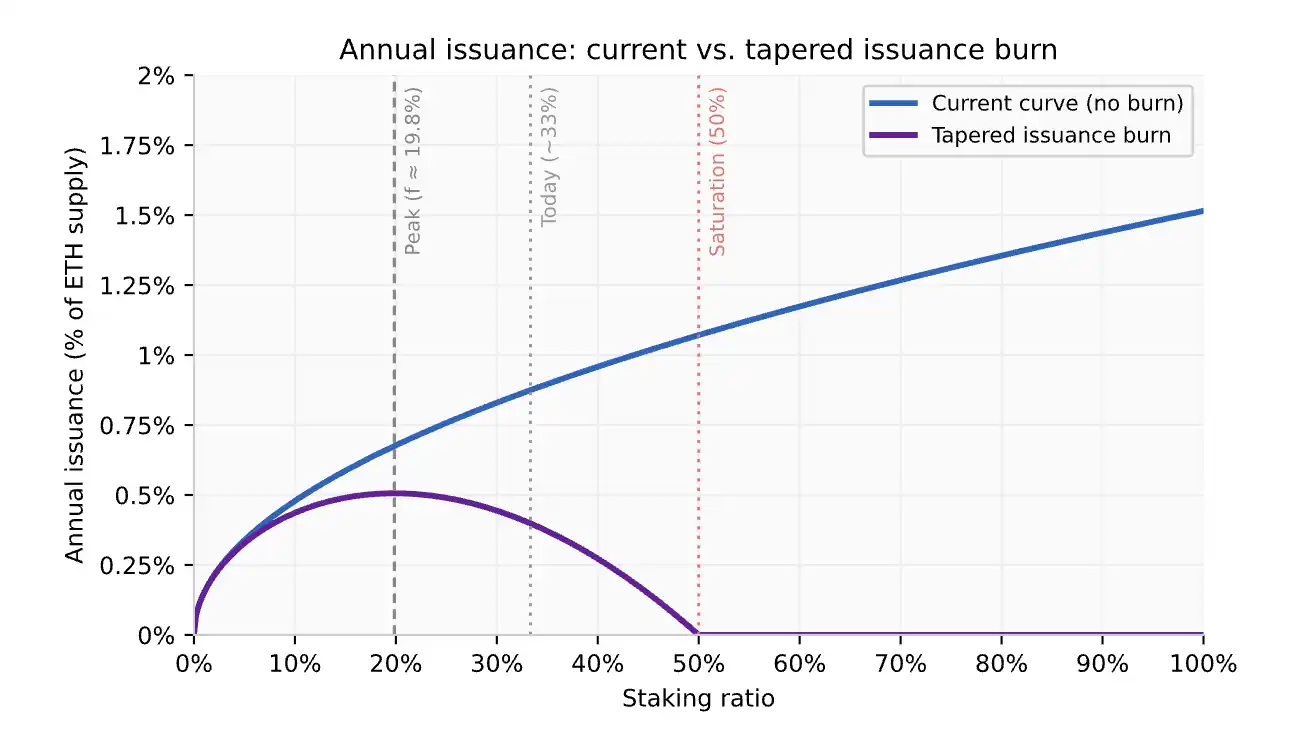
Annual issuance under the current issuance curve versus the EIP-8363 curve

To avoid a sudden halving of earnings, the proposal designs an 18-month transition period: upon activation, the base reward factor is temporarily increased from 64 to 128, then gradually reduced back to 64 over 65 steps, each lasting about 8.6 days. Therefore, net earnings near activation would be close to current levels, gradually declining afterward. However, the curve "providing no consensus layer issuance incentive after 50%" takes effect from the first day of activation and does not wait for 18 months.

Currently, this proposal remains an unmerged Core EIP draft, in the editing review and consensus evaluation stage. The authors have separately submitted PR #12087, hoping to list it as Proposed for Inclusion for the Hegotá upgrade, meaning "proposed for inclusion in discussion." This PR is also not yet merged; the current formal Hegotá Meta EIP does not include it.

Ethereum core developers plan to discuss the Hegotá proposal deadline items at the ACDC 184th meeting on August 6th. Even if it enters Proposed for Inclusion, it does not equal definite implementation; it would still need to go through subsequent steps like developer evaluation, client implementation, testing, and Scheduled for Inclusion.

Community reaction is clearly negative

One of the authors of EIP-8363, Jérôme de Tychey, believes this is a "minimalist, market-driven" change. He also stated in a forum response that the issuance debate started back in 2023, and this proposal merely opens a formal feedback window, not implying definite inclusion.

He also warned that if the validator entrance queue remains constantly full with few exits, by early 2028, the staked amount could exceed 70 million ETH, representing over 55% of the supply; reversing course then could involve larger exit volumes and market disruptions.

Supporters of reducing issuance mainly have three reasons:

  • Ethereum may be paying an excessively high cost for economic security that is already sufficiently ample;
  • Unstaked holders are continuously diluted, forced to choose between "accepting dilution" and "taking staking risks";
  • LSTs, ETFs, and custodial services continuously reduce staking friction, potentially allowing a few intermediaries to eventually control large amounts of ETH and validation rights simultaneously.

However, opposing voices are more concentrated in the public reactions so far.

Aave founder Stani Kulechov believes that consensus layer staking rewards fluctuating with the staking rate and eventually approaching zero would undermine the cash flow predictability valued by institutions when allocating ETH and compress positive interest rate strategies like ETH lending and LST restaking loops.

Obol co-founder Oisín Kyne pointed out that Ethereum's true security depends not only on how much ETH is staked but also on whether validation rights are sufficiently decentralized. If yields drop to extremely low levels, large institutions with low capital costs and insensitivity to yield might have the ability to stay in the game long-term and squeeze out high-cost independent operators.

ether.fi CEO Mike Silagadze criticized the proposal for being submitted just before the Hegotá deadline, leaving insufficient pre-discussion time for ecosystem developers; he worries that low yields would impact staking-related protocols and reduce institutional confidence in Ethereum's governance stability.

Ethereum community member Ryan Berckmans summarized that opponents at least include those worried about who would run validators at zero yield, those unwilling to reduce staking yields, those opposed to changing ETH monetary policy again, and those hoping to avoid controversy escalating and disrupting ecosystem growth. He personally supports moderately reducing issuance but opposes letting yields trend all the way to zero and also believes the current proposal is too divisive for the community.

A relatively neutral view comes from ARK Invest Director of Research Lorenzo Valente. He approached the debate from the perspective of ETH's asset positioning. If more emphasis is placed on ETH's "Internet bond" attribute, weakening staking yields would indeed harm the lending market and yield curve; if more emphasis is placed on ETH being neutral money and a store of value, then the base yield obtained from restaking primarily comes from protocol new issuance, at the cost of unstaked holders being diluted. Reducing issuance means decreasing this transfer of yield—borne by unstaked holders and flowing to stakers and their leverage strategies.

Who benefits, who bears pressure?

If this proposal passes, Solo Stakers would be the first affected.

The 18-month transition period can spread out the earnings decline but will not reduce fixed costs like hardware, electricity, and maintenance. The proposal maintains the current offline penalty intensity while lowering net earnings, meaning it would take longer for a single failure to be compensated by subsequent earnings. The proposal's own estimate suggests that at the current ~33% staking rate, the time needed to compensate for downtime losses could increase to about 3.8 times the current duration.

For large operators with backup power, remote disaster recovery, and 24/7 operations, such changes are relatively easier to absorb; for home validators, a few internet outages or equipment failures could significantly erode annual returns.

Tax treatment might also amplify this disparity. The EIP-8363 proposal notes that in some jurisdictions, it's not yet clear whether tax authorities would recognize income based on the pre-deduction reward. If the burn portion can only be recognized as a capital loss, the after-tax income of solo stakers could be lower than the apparent net yield.

The impact would further transmit to LSTs. The base yield of products like stETH and rETH comes from the underlying validators. When consensus layer issuance declines, the yield gap between LSTs and native ETH will also narrow. Whether users are still willing to bear smart contract, governance, custodial, and depeg risks for an extra one or two percentage points of yield will become a new pricing question.

Loop strategies relying on LST yields would feel the pressure earlier. A common practice is to borrow ETH, buy or mint LST, then use the LST as collateral to borrow more ETH. As staking yield gradually approaches the borrowing cost, the positive spread of such trades will gradually disappear, and leveraged positions might actively unwind. Protocols like Aave, Morpho, Pendle, and products built around LST yields might therefore face decreased ETH borrowing demand, capital utilization, and liquidity.

The impact would ultimately land on the entire DeFi interest rate system. Staking yield is a crucial base rate for the ETH-denominated market; LST lending, fixed income, yield splitting, and leverage loops all price around this benchmark.

Of course, LSTs wouldn't lose all utility because of this. What might truly change is LST's advantage relative to native ETH.

Looking further upstream, the staking income of ETFs, exchanges, custodians, and ETH treasury companies would also decline. For institutions relying on staking yield to improve asset returns, the predictability of ETH's cash flow would weaken, potentially affecting their willingness for new allocations. This is why Aave founder Stani Kulechov believes the proposal would increase the difficulty for institutions to evaluate ETH yields and weaken ETH's competitiveness relative to other yield-bearing assets.

The actual impact on institutions may not be uniform. When base yields fall, high-cost participants might exit first, while the largest institutions least dependent on staking yield might be more capable of staying. This is precisely the reason opponents worry about further validator centralization.

For ordinary ETH holders, the direction of impact is relatively clear. The issuance being burned doesn't go to a specific protocol or fund but benefits all ETH holders collectively by reducing dilution.

However, reduced issuance does not mean ETH will necessarily become deflationary, nor can one infer that the price will necessarily rise. The final supply change still depends on EIP-1559 fee burns, network usage, validator issuance, and market conditions. If lower yields simultaneously weaken institutional allocation, LST demand, and on-chain lending activity, demand-side changes could also offset some of the supply-side benefits.


Tiền kỹ thuật số thịnh hành

Câu hỏi Liên quan

QWhat is the main goal of the EIP-8363 (Tapered Issuance Burn) proposal?

AThe main goal of the EIP-8363 proposal is to install a 'declining yield path' for staking rewards as the total amount of staked ETH grows. It aims to reduce and eventually cancel out the consensus-layer issuance rewards for validators when the effective staked balance approaches 50% of the total ETH supply. This is intended to prevent excessive dilution for non-stakers, reduce the systemic incentive for further staking concentration in large custodians, and enhance the competitiveness of native ETH as a neutral asset.

QHow does EIP-8363 plan to achieve its goal of reducing staking rewards?

AEIP-8363 plans to achieve its goal by calculating a validator's standard issuance reward and then deducting and burning a portion of it. The proportion burned depends on the total network's effective staked balance relative to 60.25 million ETH (roughly half the supply). The burn ratio increases as the staked amount approaches this threshold, eventually reaching 100%, which would fully offset the consensus-layer issuance reward for a properly functioning validator, effectively bringing the net issuance reward to zero at or above the 50% staking level.

QWhat are some of the main criticisms or concerns raised by the community against the EIP-8363 proposal?

AThe main criticisms include: 1) It could undermine the predictability of cash flows, which is important for institutional investment in ETH. 2) It might lead to further centralization, as low yields could push out high-cost solo stakers while low-cost, yield-insensitive large institutions remain. 3) It was submitted very close to the Hegotá upgrade deadline, leaving insufficient time for community discussion. 4) It could negatively impact protocols and strategies built around staking rewards and LSTs (Liquid Staking Tokens). 5) It represents another contentious change to Ethereum's monetary policy, potentially causing community division.

QAccording to the article, who would be most negatively impacted if EIP-8363 is implemented?

ASolo stakers (individual validators) would be the first and most negatively impacted. Their fixed costs (hardware, electricity, maintenance) remain, but their net rewards decrease. The extended time needed to recoup losses from penalties would disproportionately affect them compared to large operators with better infrastructure. Additionally, Liquid Staking Token (LST) providers, DeFi protocols relying on staking yield (like Aave, Pendle), and leveraged staking strategies would also face pressure as the yield spread narrows or disappears.

QWhat is the '18-month transition period' mentioned in the proposal, and what is its purpose?

AThe 18-month transition period is a design feature in EIP-8363 to avoid a sudden, sharp drop in validator rewards upon activation. It temporarily increases the base reward factor from 64 to 128 at the start and then gradually reduces it back to 64 over 65 steps, each lasting about 8.6 days. This means the net reward at activation would be close to current levels and then slowly decline over the transition period. However, the core rule of 'zero net issuance reward at 50% staking' takes effect from day one.

Nội dung Liên quan

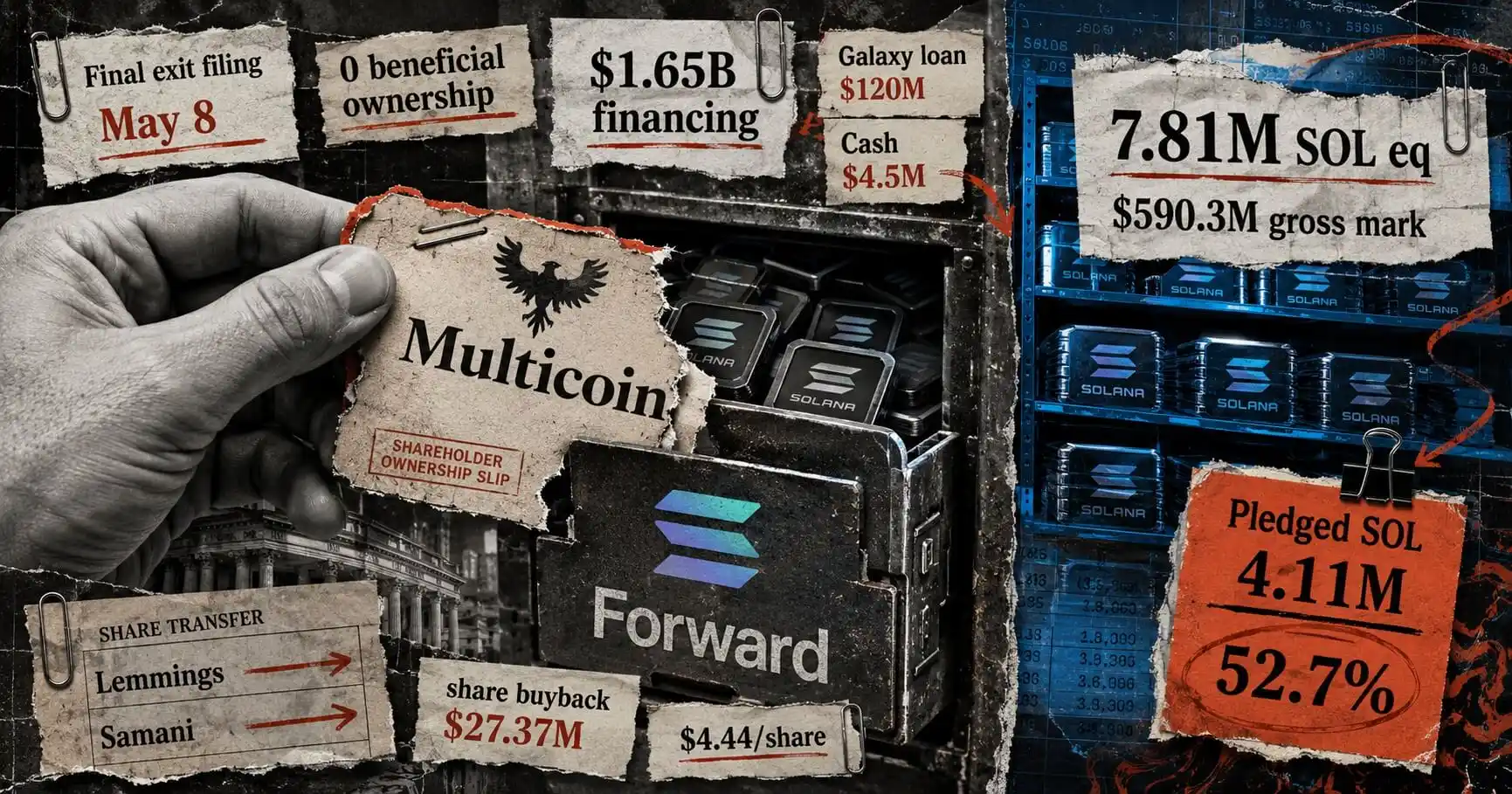
Cùng nhau thành lập chỉ sau 8 tháng, Multicoin rút khỏi công ty kho bạc Solana lớn nhất Forward

Theo tài liệu của SEC, Multicoin Capital đã thoái toàn bộ vốn đầu tư tại Forward Industries, công ty quỹ kho bạc Solana lớn nhất, chỉ 8 tháng sau khi cùng Galaxy Digital và Jump Crypto rót 16.5 tỷ USD. Việc Multicoin, nhà đầu tư sớm nổi tiếng của Solana, rút lui thu hút sự chú ý. Quá trình thoái vốn diễn ra qua nhiều giao dịch, phần lớn cổ phần được Forward mua lại hoặc chuyển cho Lemmings Holdings LLC do cựu Chủ tịch Kyle Samani kiểm soát. Điều này đi kèm với sự chia tay giữa Samani và Multicoin, thể hiện qua việc Samani từ chức tại Multicoin từ tháng 1 và sau đó chỉ trích công khai một sáng kiến do Multicoin ủng hộ. Dù Multicoin rời đi, Forward vẫn kiên định với chiến lược Solana. Báo cáo quý III/2026 cho thấy họ tiếp tục mua vào, nâng tổng nắm giữ lên khoảng 7.81 triệu SOL, bất chấp thua lỗ 69 triệu USD do giá SOL giảm. Công ty cũng đang đa dạng hóa danh mục, tìm kiếm các nguồn thu không phụ thuộc vào giá SOL, như đầu tư vào dự án OnRe, và xem xét các cơ hội mua lại trong bối cảnh thị trường suy giảm. Forward cũng được đưa vào chỉ số Russell 2000 & 3000, mở đường cho dòng vốn ETF.

marsbit54 phút trước

Cùng nhau thành lập chỉ sau 8 tháng, Multicoin rút khỏi công ty kho bạc Solana lớn nhất Forward

marsbit54 phút trước

Grayscale: "Nếu các đề xuất được thông qua, giá của hai altcoin này có thể tăng"

Trưởng bộ phận nghiên cứu tại Grayscale, Zach Pandl, cho biết nếu các đề xuất thay đổi tokenomics trong cộng đồng Ethereum ($ETH) và Solana ($SOL) được thông qua, tốc độ tăng nguồn cung của cả hai tài sản crypto này có thể chậm lại đáng kể, từ đó tác động tích cực đến giá. Các thay đổi được đề cập nhằm giảm tỷ lệ lạm phát token hàng năm của $ETH và $SOL. Việc nguồn cung tăng chậm hơn có thể làm giảm lượng token mới lưu hành, làm tăng tính khan hiếm. Grayscale ước tính nếu được áp dụng, lạm phát nguồn cung hàng năm của Ethereum có thể giảm xuống khoảng 0.4% vào cuối năm 2031, gần với tốc độ tăng nguồn cung của Bitcoin. Dự kiến lạm phát nguồn cung hàng năm của Solana sẽ giảm xuống khoảng 1.1%. Tuy nhiên, việc giảm lạm phát token cũng có thể dẫn đến phần thưởng staking thấp hơn cho các nhà đầu tư, vì phần lớn thu nhập từ staking $ETH và $SOL đến từ việc phát hành token mới. Pandl lưu ý rằng việc tăng trưởng nguồn cung chậm lại có thể làm tăng tính khan hiếm, tạo áp lực tăng giá, đặc biệt có lợi cho những nhà đầu tư nắm giữ token mà không staking.

cryptonews.ru4 giờ trước

Grayscale: "Nếu các đề xuất được thông qua, giá của hai altcoin này có thể tăng"

cryptonews.ru4 giờ trước

Các chuyên gia chỉ ra nguyên nhân Bitcoin giảm sau khi lạm phát Mỹ hạ nhiệt

Các chuyên gia CryptoQuant cho rằng tin tốt về lạm phát Mỹ không thể hỗ trợ giá Bitcoin vì nhu cầu giao ngay yếu. Dữ liệu CPI và PPI tháng 7 của Mỹ đáp ứng hoặc vượt kỳ vọng, khiến lợi tức trái phiếu giảm và thị trường chứng khoán tăng, nhưng Bitcoin vẫn giao dịch quanh mức 63.000-64.000 USD. Nguyên nhân chính là dòng vốn đổ vào các ETF Bitcoin Mỹ vẫn thấp và chỉ số Coinbase Premium (phản ánh chênh lệch giá) âm từ tháng 5, cho thấy áp lực mua từ nhà đầu tư Mỹ hạn chế. Trong khi đó, vị thế trên thị trường tương lai vẫn cao, tạo ra sự mất cân bằng giữa nhu cầu giao ngay yếu, thanh khoản thấp và khối lượng vị thế ký quỹ lớn. Các chuyên gia cảnh báo trong điều kiện này, tin tích cực vĩ mô có thể không kích thích tăng giá. Nếu giá không phản ứng, các nhà giao dịch có thể đóng vị thế mua ký quỹ, gây thêm áp lực giảm. Mức kháng cự quan trọng là 68.700 USD - giá vốn trung bình của các nhà nắm giữ ngắn hạn. Theo CryptoQuant, để thị trường hồi phục mạnh mẽ cần: dòng tiền mạnh trở lại vào ETF Bitcoin Mỹ, chỉ số Coinbase Premium chuyển sang dương, khối lượng giao dịch giao ngay tăng và Bitcoin vượt vững chắc trên 68.700 USD.

cryptonews.ru5 giờ trước

Các chuyên gia chỉ ra nguyên nhân Bitcoin giảm sau khi lạm phát Mỹ hạ nhiệt

cryptonews.ru5 giờ trước

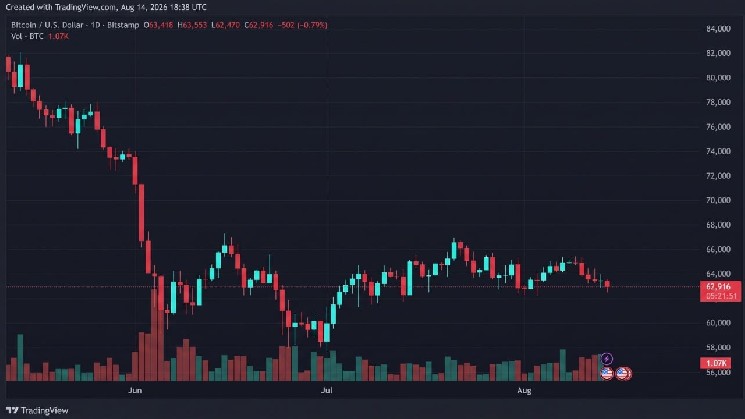
Giá Bitcoin giảm xuống 62.470 USD khi người bán thử thách lại ngưỡng hỗ trợ 63.000 USD

Giá Bitcoin giảm xuống 62.470 USD vào thứ Sáu, lần thứ hai liên tiếp phá vỡ ngưỡng 63.000 USD. Sau một thời gian củng cố quanh 63.400 USD, đợt bán tháo bắt đầu sau nửa đêm đã đẩy giá xuống đáy 62.470 USD trong phiên, trước khi phục hồi nhẹ lên trên 63.000 USD. Biến động mạnh dẫn đến việc thanh lý hàng loạt các vị thế mua ký quỹ, với tổng giá trị vị thế Bitcoin bị thanh lý trong 24h là 32 triệu USD. Áp lực bán càng gia tăng do dòng tiền ròng rút khỏi các Quỹ ETF Bitcoin, với mức rút hơn 131 triệu USD, đánh dấu ngày thứ hai liên tiếp có dòng tiền ra. Yếu tố khác gây lo ngại là đề xuất tiêu chí mới từ nhà cung cấp chỉ số MSCI, có thể dẫn đến việc loại các công ty nắm giữ tài sản kỹ thuật số như Bitcoin (ví dụ: MicroStrategy) ra khỏi các chỉ số chính. MicroStrategy đã phản đối mạnh mẽ đề xuất này, cho rằng các nhà cung cấp chỉ số không nên quyết định loại tài sản nào công ty được phép nắm giữ. Quyết định cuối cùng của MSCI dự kiến vào giữa tháng Mười, và nếu được thông qua, có thể kích hoạt đợt bán tháo từ các quỹ chỉ số từ tháng Mười một, gây thêm áp lực giảm cho thị trường Bitcoin.

cryptonews.ru5 giờ trước

Giá Bitcoin giảm xuống 62.470 USD khi người bán thử thách lại ngưỡng hỗ trợ 63.000 USD

cryptonews.ru5 giờ trước

Bí mật khai thác 1 BTC trên máy tính công ty: Nhân viên hãng tiền mã hóa đối mặt án tù

Christopher Renkin, 40 tuổi, từ bang Washington, đã nhận tội vì truy cập trái phép vào máy tính của một công ty khai thác bitcoin và đánh cắp tiền điện tử. Anh ta đã chuyển hướng khoảng 100 thiết bị sang nhóm khai thác (mining pool) riêng của mình và chiếm đoạt 1,0668 BTC. Theo công tố viên, Renkin bắt đầu làm việc tại công ty ở Niagara Falls, New York vào tháng 7/2021. Anh ta đã tự ý truy cập, khởi động lại máy tính công ty và chuyển chúng sang pool khai thác do mình tạo ra, sau đó chuyển bitcoin thu được vào ví tiền điện tử dưới sự kiểm soát của mình. Không chỉ vậy, Renkin còn chuyển máy tính sang chế độ "hiệu suất cao", gây thiệt hại cho phần cứng, làm giảm đáng kể tuổi thọ thiết bị và xâm phạm tính toàn vẹn, khả năng truy cập thông tin lưu trữ. Hành động này khiến công ty mất 1,06 BTC, trị giá 53.315 USD tại thời điểm phạm tội. Renkin bị kết tội truyền chương trình, thông tin, mã hoặc lệnh vào máy tính được bảo vệ và gây thiệt hại cho nó. Mức hình phạt tối đa có thể lên đến một năm tù và phạt 100.000 USD. Bản án dự kiến được tuyên vào ngày 17 tháng 11 năm 2026.

cryptonews.ru5 giờ trước

Bí mật khai thác 1 BTC trên máy tính công ty: Nhân viên hãng tiền mã hóa đối mặt án tù

cryptonews.ru5 giờ trước

Giao dịch

Giao ngay

Bài viết Nổi bật

Làm thế nào để Mua CAKE

Chào mừng bạn đến với HTX.com! Chúng tôi đã làm cho mua PancakeSwap (CAKE) trở nên đơn giản và thuận tiện. Làm theo hướng dẫn từng bước của chúng tôi để bắt đầu hành trình tiền kỹ thuật số của bạn.Bước 1: Tạo Tài khoản HTX của BạnSử dụng email hoặc số điện thoại của bạn để đăng ký tài khoản miễn phí trên HTX. Trải nghiệm hành trình đăng ký không rắc rối và mở khóa tất cả tính năng. Nhận Tài khoản của tôiBước 2: Truy cập Mua Crypto và Chọn Phương thức Thanh toán của BạnThẻ Tín dụng/Ghi nợ: Sử dụng Visa hoặc Mastercard của bạn để mua PancakeSwap (CAKE) ngay lập tức.Số dư: Sử dụng tiền từ số dư tài khoản HTX của bạn để giao dịch liền mạch.Bên thứ ba: Chúng tôi đã thêm những phương thức thanh toán phổ biến như Google Pay và Apple Pay để nâng cao sự tiện lợi.P2P: Giao dịch trực tiếp với người dùng khác trên HTX.Thị trường mua bán phi tập trung (OTC): Chúng tôi cung cấp những dịch vụ được thiết kế riêng và tỷ giá hối đoái cạnh tranh cho nhà giao dịch.Bước 3: Lưu trữ PancakeSwap (CAKE) của BạnSau khi mua PancakeSwap (CAKE), lưu trữ trong tài khoản HTX của bạn. Ngoài ra, bạn có thể gửi đi nơi khác qua chuyển khoản blockchain hoặc sử dụng để giao dịch những tiền kỹ thuật số khác.Bước 4: Giao dịch PancakeSwap (CAKE)Giao dịch PancakeSwap (CAKE) dễ dàng trên thị trường giao ngay của HTX. Chỉ cần truy cập vào tài khoản của bạn, chọn cặp giao dịch, thực hiện giao dịch và theo dõi trong thời gian thực. Chúng tôi cung cấp trải nghiệm thân thiện với người dùng cho cả người mới bắt đầu và người giao dịch dày dạn kinh nghiệm.

Tổng lượt xem 692Xuất bản vào 2024.12.11Cập nhật vào 2025.03.21

Làm thế nào để Mua CAKE

Thảo luận

Chào mừng đến với Cộng đồng HTX. Tại đây, bạn có thể được thông báo về những phát triển nền tảng mới nhất và có quyền truy cập vào thông tin chuyên sâu về thị trường. Ý kiến ​​của người dùng về giá của CAKE (CAKE) được trình bày dưới đây.

活动图片