Show me 'The Lord of the Rings', Karpathy Recommends New Benchmark for Large Model Evaluation

marsbitXuất bản vào 2026-08-03Cập nhật gần nhất vào 2026-08-03

Tóm tắt

In a new benchmark for evaluating large language models, Andrej Karpathy proposes replacing the once-popular "pelican riding a bicycle" SVG test with a more complex challenge: generating a 3D scene from the opening text of *The Lord of the Rings*. Using Anthropic's Opus 5 model and the Three.js library, the task consumed approximately 1 million tokens, 2 hours, and 5,500 lines of code to produce a rudimentary, low-polygon animation of the Shire. While the output is visually crude with notable glitches like floating characters, it demonstrates the model's ability to parse narrative text and translate it into a functional, programmatic 3D world with defined objects, cameras, lighting, and basic animation. This "Lord of the Rings benchmark" is argued to test a model's capacity for long-horizon project planning, spatial reasoning, and maintaining consistency across thousands of code lines—capabilities not fully captured by simpler single-output tests. The initiative has sparked community experimentation, with users generating other 3D worlds like a low-poly San Francisco, a data-driven New York City model, and even a virtual Kanye West concert. Karpathy suggests a future pipeline where code-generated scenes provide the structural "bones" for video-to-video models to enhance visual fidelity. While some debate the computational cost and specificity to Three.js, proponents see it as a test of a model's general ability to structure its understanding of the world into an executable ...

Without further ado, let's start the daily slump (doge)!

Just moments ago, the great Karpathy announced that "we" at Anthropic have started using a brand new way to push large models to their limits—

"The Lord of the Rings."
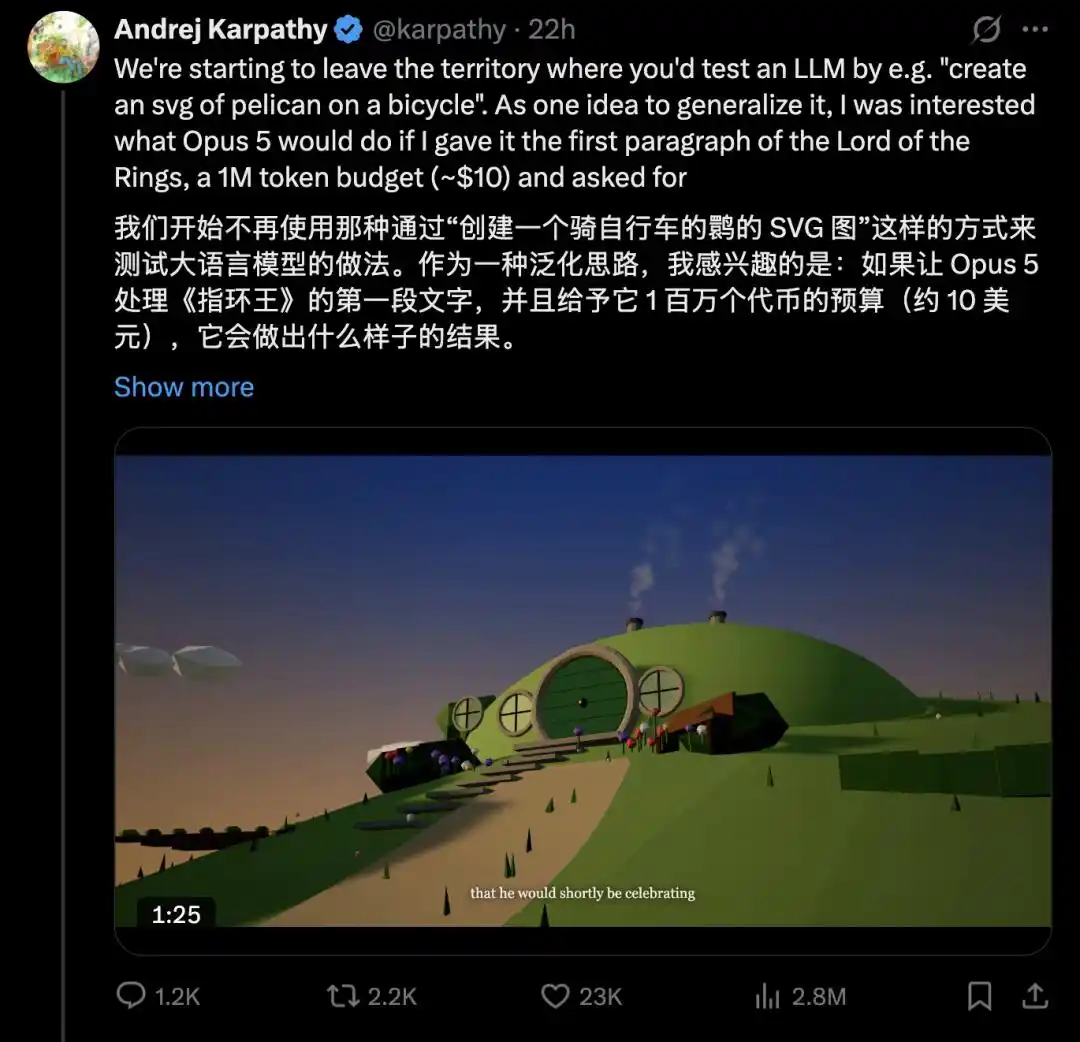
According to Karpathy, this "Lord of the Rings benchmark" is taking over from the once-popular "Pelican Riding a Bicycle" SVG test.
Specifically, Karpathy directly fed the beginning of "The Lord of the Rings" to Opus 5, instructing the model to use Three.js to craft an entire "Middle-earth" world on the spot.

As for the final effect... well, it somewhat resembles domestic 3D animations from the late 1990s and early 2000s: very rough and quite abstract.

But objectively speaking, if you look closely for a while and happen to be familiar with the "Lord of the Rings" filming location Hobbiton in New Zealand, you can indeed catch a hint of its flavor~

However, this seemingly unpolished creation genuinely cost Opus 5: 1 million tokens, 2 hours, and 5,500 lines of code.

Of course, it's not just the Claude model shining solo on this stage.

The most hilarious part is probably the new offering from netizens—a DeepSeek V4 Flash version.

It's a complete "Chinese people can fly" situation, with all characters floating in the air.

Faced with these currently obvious goofs, Karpathy was quite fair.

He pointed out that Opus 5 still cannot truly "enter" the world it generates; it can only continuously take screenshots at different time points and slowly check where things went wrong.

And this precisely exposes a significant shortcoming of current large models:

They can already write code, build scenes, and generate games, but they still cannot truly understand videos, nor can they actually play the games they create.

Two Hours, Crafting Middle-earth by Hand

Let's first look at how this "Lord of the Rings" test was conducted.

If taken literally from Karpathy's tweet, the main prompt input for Opus 5 should be the beginning of Chapter One, "A Long-expected Party," from "The Lord of the Rings" novel.

When Mr. Bilbo Baggins of Bag End announced that he would shortly be celebrating his eleventy-first birthday with a party of special magnificence, there was much talk and excitement in Hobbiton...

Interested folks can try it themselves.

In addition, Karpathy also specified Three.js in the prompt—a JavaScript library for building 3D scenes with code.

Thus, the task for Opus 5 was to first comprehend the text at the beginning of "The Lord of the Rings," and then translate it into a 3D world that could run in real-time in a browser.
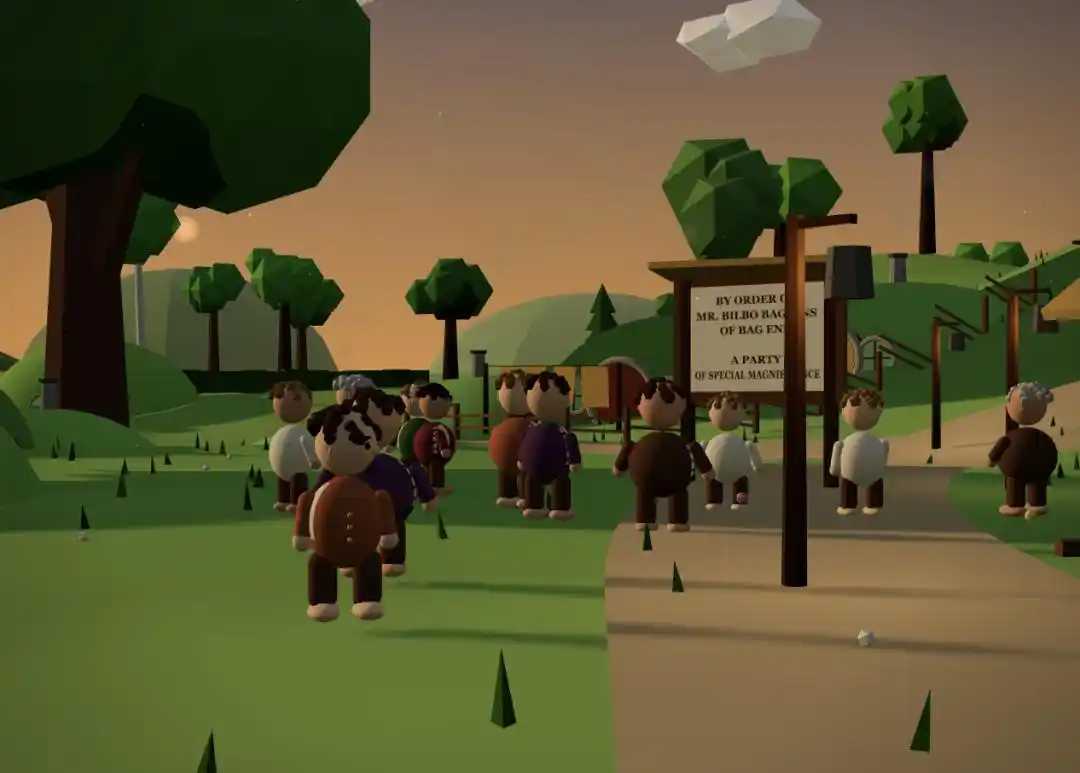
Throughout the process, Opus 5 needed to use polygons to piece together characters, buildings, and props, place them one by one into x, y, z coordinate systems, and then arrange cameras, lighting, and animations.

When characters should move, where the camera should turn, how lighting should change, and how objects in the scene should interact—all needed to be defined by the model using code.

Although the final visuals aren't exactly refined, and issues like clipping and floating frequently occur—for example, characters' bodies and heads separating... but at least the entire scene was genuinely built.

It's important to note that this is not the same as video models directly generating pixel frames.

Three.js first needs to build characters, objects, and scenes as 3D objects, then calculate their positions, angles, and motion states in real-time based on the code.

Therefore, the demo we see is not a regular AI-generated video, but a recording of a running 3D web scene.

However, Karpathy also mentioned in the comments that procedural 3D and video generation are not an either-or choice.

A netizen suggested that this rough Three.js recording could be fed to Sora as a reference video, letting the video model render it again with higher visual quality.
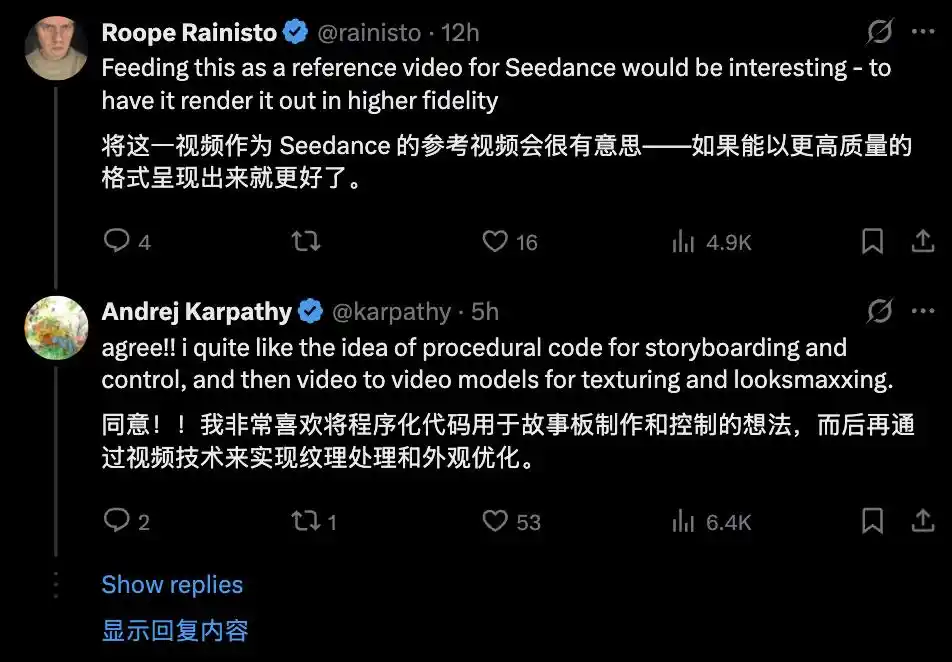
Karpathy quickly agreed.

According to his vision, procedural code could handle storyboarding and control, first finalizing the skeleton: where characters stand, how the camera moves, and how the plot progresses.

Then, the recording could be passed to a Video-to-Video model to add textures, lighting, shadows, and details, enhancing the overall "appeal" of the Middle-earth world.

As for audio, Opus 5 didn't handle it all this time.

Karpathy stated that, due to personal requirements for sound quality, he ultimately used ElevenLabs.
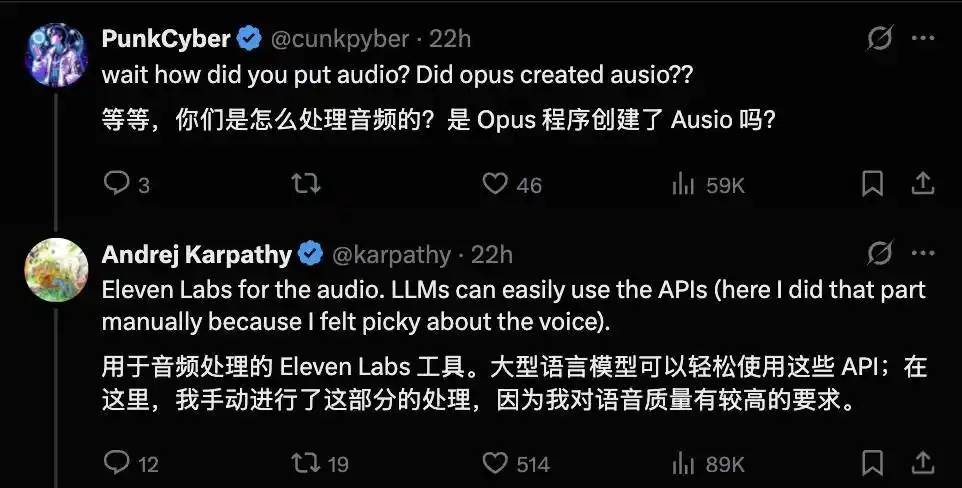
Thus, that "Lord of the Rings" demo with visuals, camera work, and narration at the beginning came into being.

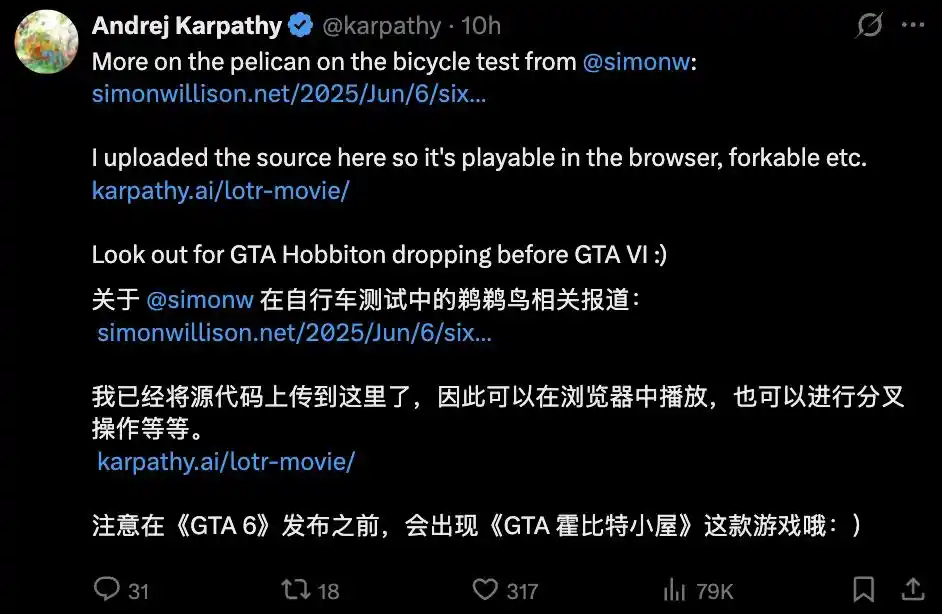
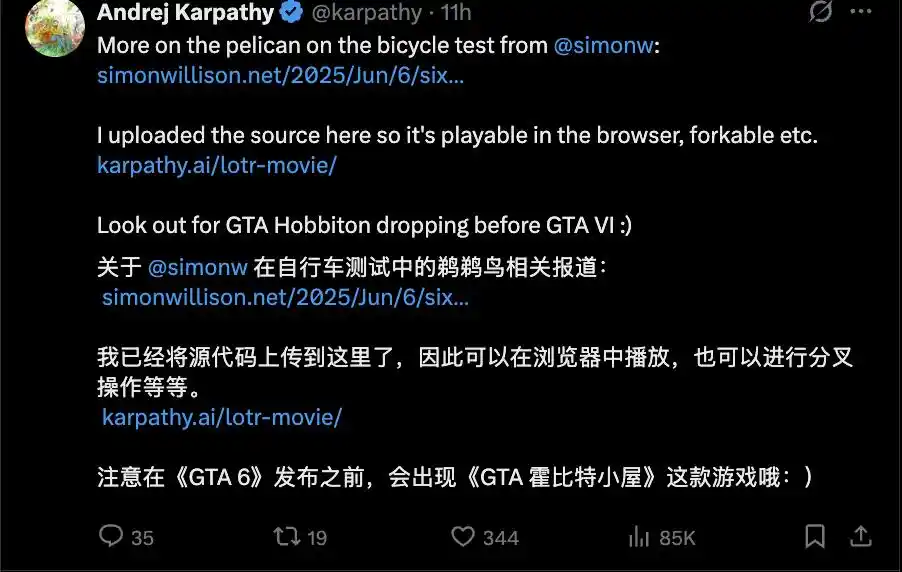
Karpathy has also open-sourced the entire project; the specific link can be found at the end.
Netizens Are More Interesting Than Karpathy

After Karpathy released the demo, many netizens also rushed to test it out.

Looking at the overall response, one can only say:

This bunch of netizens is more imaginative than Karpathy.

Someone used Claude to launch an 'Earth Online' project, aiming to build the entire Earth bit by bit with a group of AI Agents.

Currently, the Agents haven't finished the whole Earth, having only built a low-poly-style San Francisco waterfront area. But from the available visuals, the building proportions, character scales, and overall style remain quite consistent.

This effect is somewhat like those Lego-world animations. The art style isn't complex, but characters, scenes, and actions can operate stably within the same world.

Continuing in this direction, simple-styled animations and lightweight games are already showing a hint of AI-native potential.

Another netizen used Fable 5 and GPT-5.6 Sol to build a 3D digital model of New York City, incorporating real-time data into it.

The model not only had to position New York's streets and buildings correctly but also maintain spatial relationships between different areas. The author thus proposed that this task of generating virtual worlds could perhaps become a new benchmark for spatial reasoning.

Even more exaggerated examples followed.

One netizen couldn't get tickets to Kanye West's concert, so they simply used AI to host a private concert for themselves in the browser.

The entire project was still built with Three.js. It consisted of a single HTML file, without calling any pre-made 3D models; the stage, characters, and lighting were all generated by code.

The concert prepared 14 songs in total, each with independent lighting design and a dedicated set of spherical stage visuals.

Regular users could listen to clips; after connecting a Spotify Premium account, they could play full songs and the entire show.

Couldn't get tickets? Just generate a private show for yourself. Incredible!

And there's more!!!

Karpathy also envisioned in the original post that gameplay could be added to these 3D worlds later, allowing players to enter as observers, NPCs, or even story characters.

Before Karpathy could arrange a game version, netizens had already made one.
This project also used Opus 5 and Three.js. It could not only run and be interactive but also had audio added.

More 3D design cases kept appearing. From building proportions and spatial layouts to scene style, Opus 5 could already maintain relatively stable consistency across fairly large-scale projects.

There are many similar examples; we won't showcase them all here.

Objectively speaking, these works still have some distance from truly mature games.

Whether the dazzling array of gameplay is fun, if it runs stably over long periods, and if players would genuinely stay for 15 minutes—all these questions currently lack answers.

But the barrier to creating real-time 3D content and playable prototypes has indeed been significantly lowered.

Moreover, having a new way to test model capabilities that is also sufficiently fun and interesting—isn't that a beautiful thing?

The Pelican Has Ridden Far Enough

So, why suddenly ask large models to generate "The Lord of the Rings"?

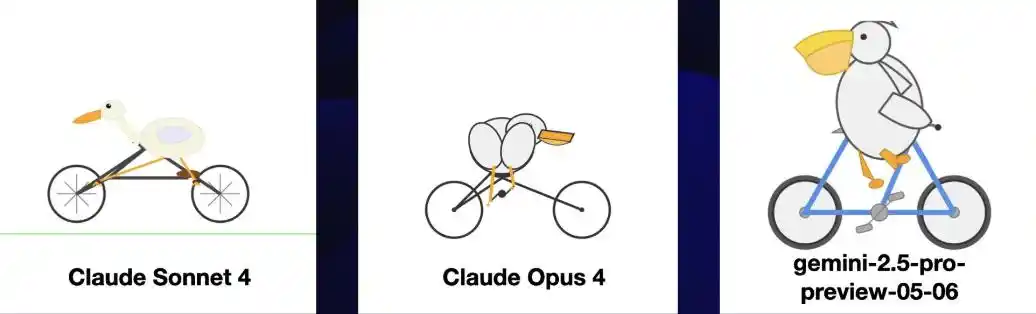
This goes back to the wildly popular "Pelican Riding a Bicycle" test from a few years ago.

This problem originated from developer Simon Willison, with only one sentence as the requirement:

Generate an SVG image of a pelican riding a bicycle.

Although this problem seems simple, it actually tests models quite significantly.

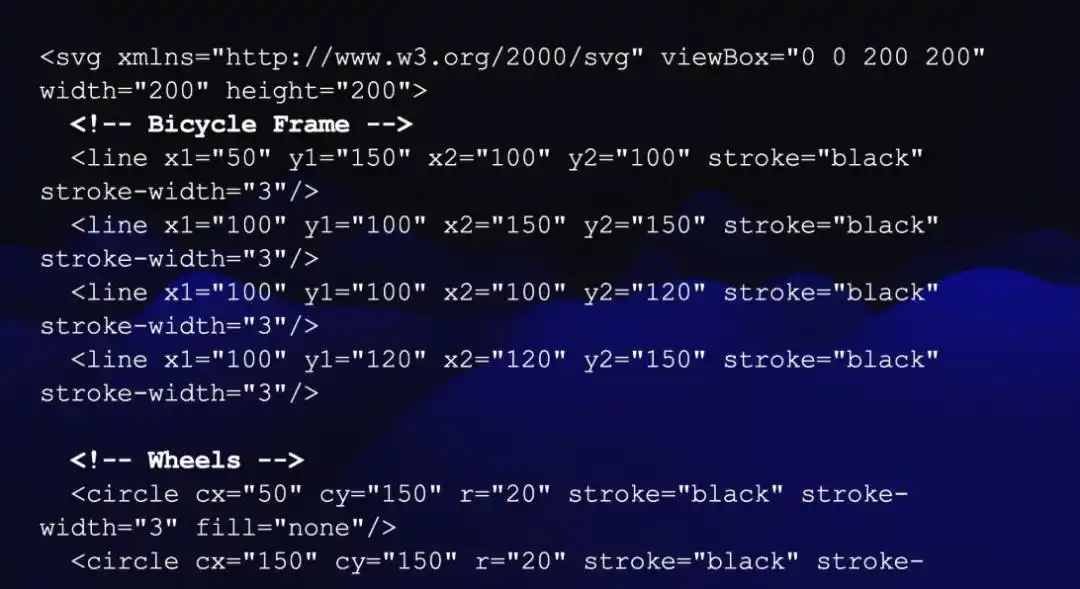
Because an SVG looks like an image, but its underlying structure is a string of code.

The model not only needs to know what a pelican and a bicycle look like separately but also must break them down into lines, circles, and polygons, then arrange the positional relationships of each component using coordinates.
More crucially, pelicans and bicycles themselves are not a natural fit.

The bicycle's frame, tires, and pedals must maintain correct geometric structures; the pelican has a large beak, short legs, and a physique that doesn't look at all suited for pedaling.
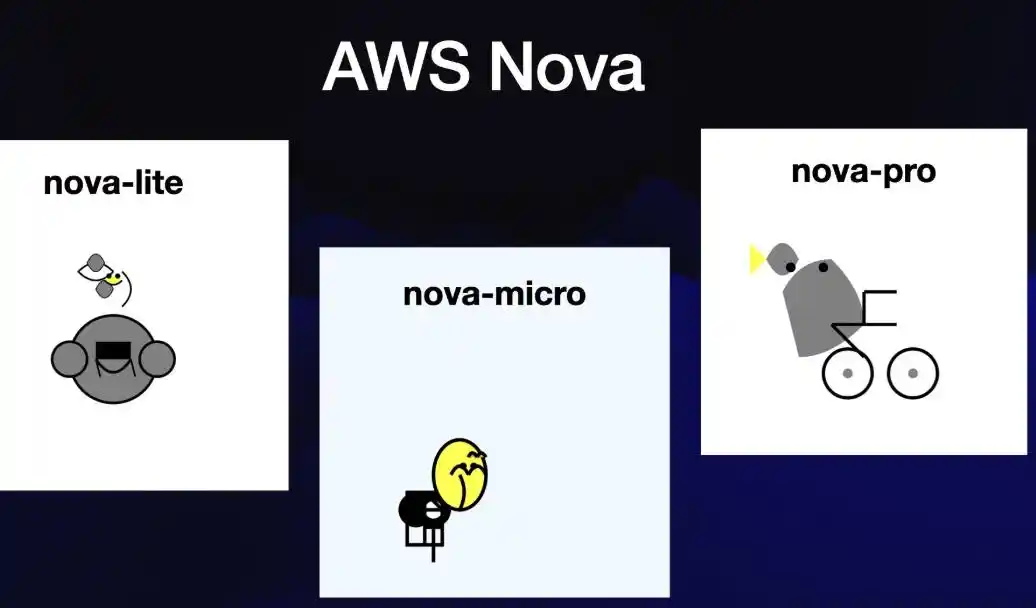
Combined, whether the model truly understands spatial relationships becomes almost immediately apparent:

Are the wheels crooked? Are the feet stepping on the pedals? Is the bird actually riding, or has it been dismembered by the bike frame?

Take a look at these demos from late 2024 above~

For this reason, "Pelican Riding a Bicycle" once became a classic folk test for observing large models' spatial understanding, object composition, and code generation abilities.
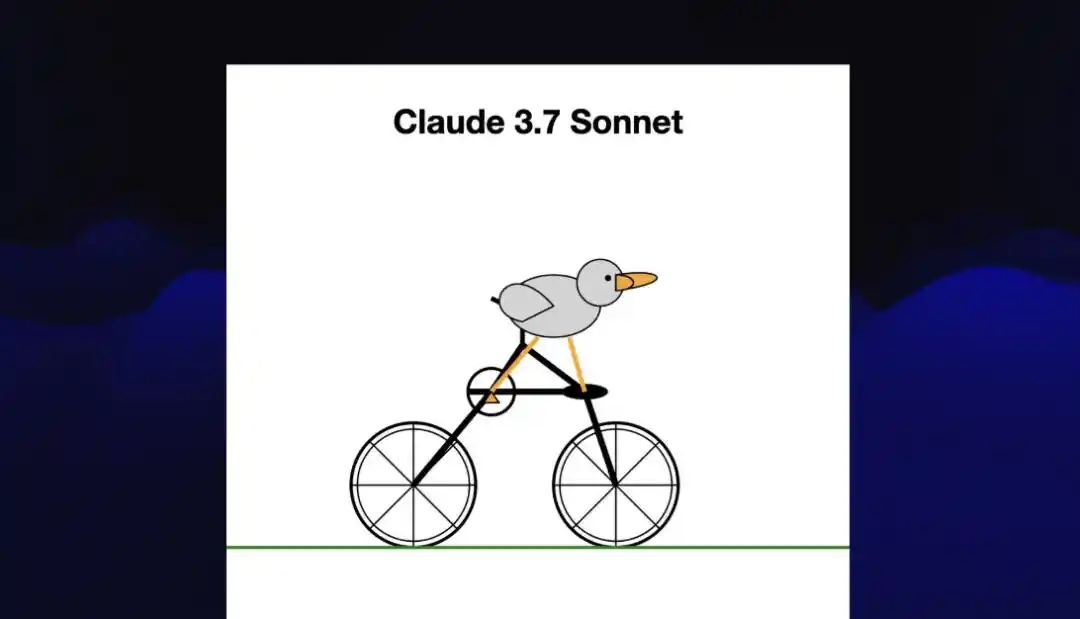
But as models grew stronger, this pelican's ride is nearing its end.

Just look at the performance of DeepSeek R1 and DeepSeek V4 below. Nowadays, models can handle this problem quite decently.
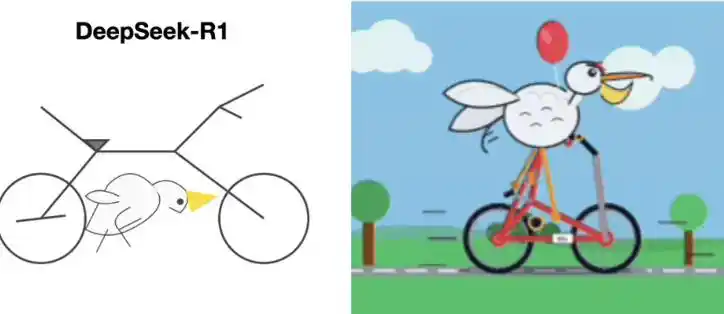
More importantly, a single SVG can only test a model's one-time output.

It cannot measure whether a model can plan a complex project, work continuously for hours, and repeatedly check and correct its own mistakes across thousands of lines of code.

Thus, Karpathy replaced a small "draw a picture" problem with a major "build a world" project—

The pelican can dismount now; Middle-earth officially takes over.
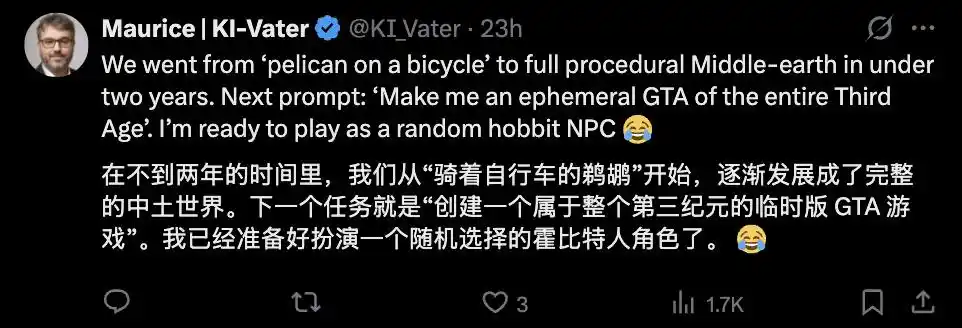
Karpathy's Pelican

Soon, news that Karpathy was preparing to change the "Pelican test" problem also spread to various communities.

High-rated comments on Hacker News argued that although the visual quality of these demos is generally low, this precisely indicates we need a new test more challenging than generating a single image.

The new benchmark shouldn't just see if the model can draw the picture correctly; it should also examine whether it can comprehend a world.
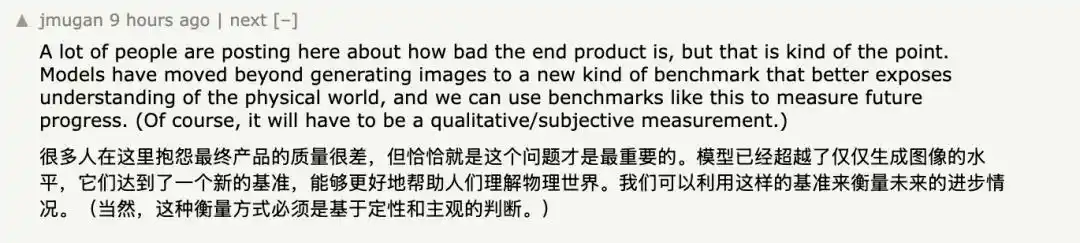
After all, "Pelican Riding a Bicycle" has been used for too long.

Models continuously optimize for this type of task on leaderboards, making the differences between them harder to discern.

In contrast, generating a complete 3D world requires the model to understand spatial relationships between characters and objects, handle camera, motion, and scene changes—not simply call a video generation model to spit out a sequence of frames.
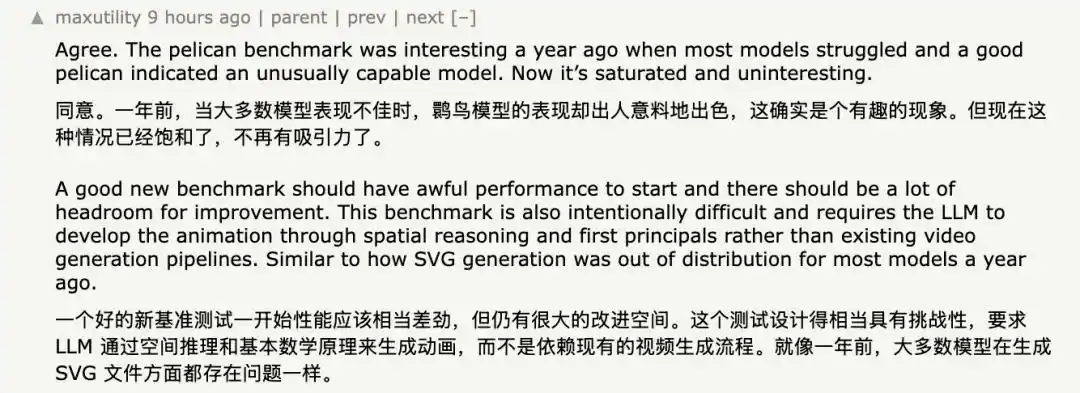
Of course, there were opposing opinions as well.

The Pelican test is sufficiently concise, low-cost, and its results are easy to compare.

Consuming so many Tokens to generate an entire 3D world just to test a model once seems a bit like setting off fireworks with computing power.
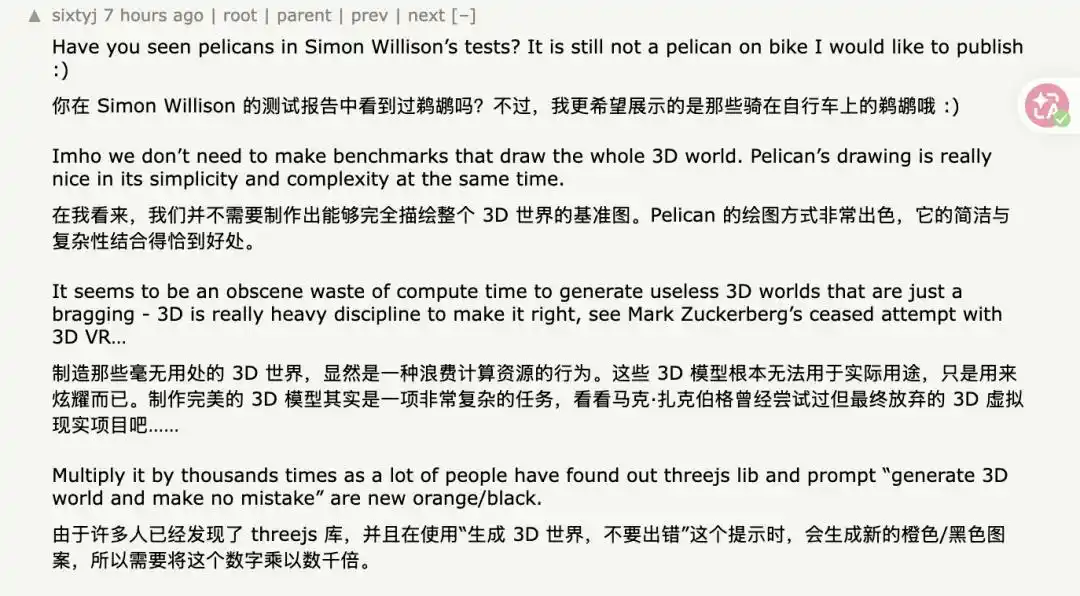
Simultaneously, whether Three.js itself can measure a large model's comprehensive abilities was also questioned.

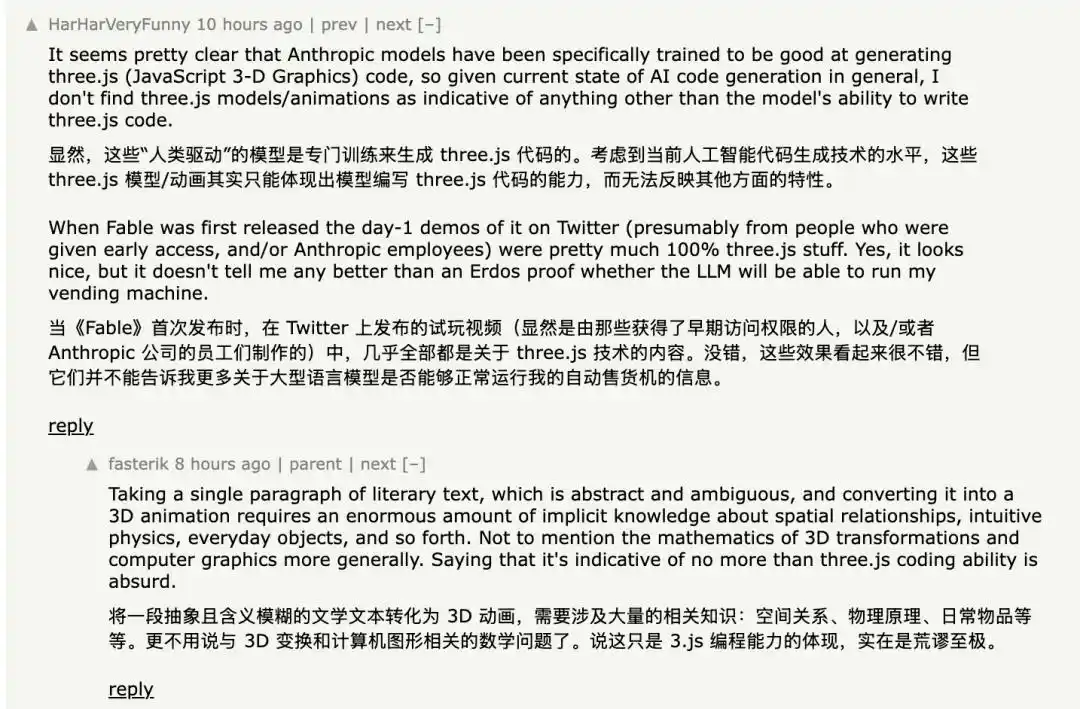
Some argued that such demos can at most prove that Anthropic has trained well on Three.js code, not that the model truly understands space and the physical world.

But soon, netizens rebutted:

Transforming an abstract, ambiguous literary text into a 3D animation requires the model to simultaneously handle spatial relationships, physical laws, everyday objects, as well as mathematical problems in 3D transformations and computer graphics.

If this is still considered merely "knowing how to write Three.js," that somewhat underestimates these 5,500 lines of code.
Another netizen raised an even more open question:

Is so-called "spatial reasoning" truly different from the reasoning large models typically perform when processing text and code?

One view holds that whether a scene holds up depends on whether the model understands spatial relationships like "front/back, inside/outside, near/far, occlusion," as well as the distance, angles, and relative sizes of objects from different viewpoints.
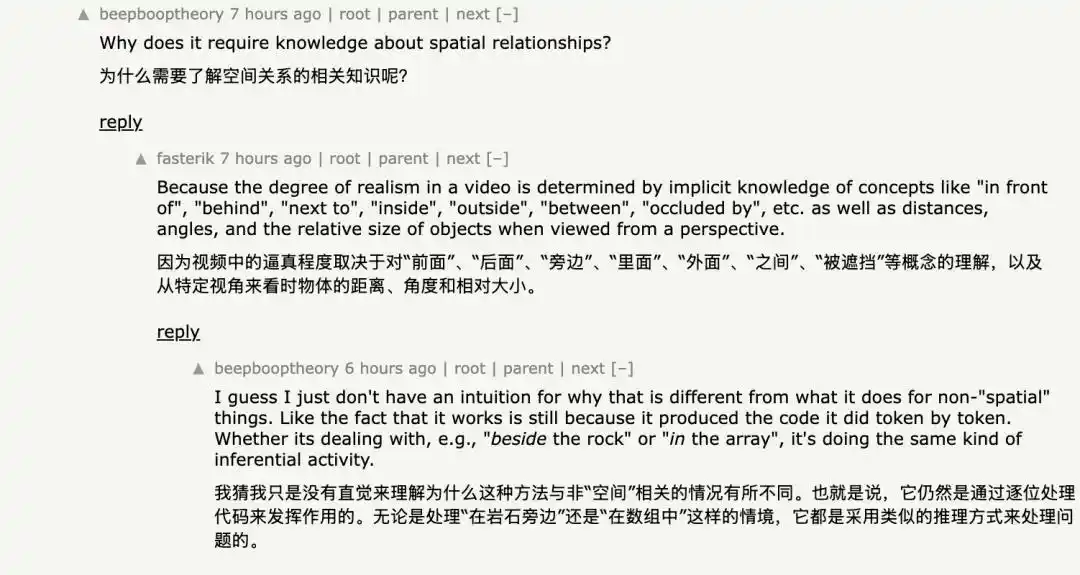
But another view argues that whether the model processes "beside a stone" or "inside an array," it might be doing the same thing: generating Tokens one by one based on context, completing reasoning in the process.

If so, then what Opus 5 demonstrates is not just a suddenly emerging "spatial ability."

A more likely scenario is that the general reasoning ability originally used by large language models to understand text and code has begun naturally extending into the three-dimensional world.

From drawing a pelican to building Middle-earth, the problem seems to have changed, but what's being tested behind the scenes might always be the same question:

Can the model transform its understanding of the world into a structure that can truly run.

And finally, perhaps there's an even more outrageous question—

If general large models can already write code to build 3D worlds themselves, then call APIs like Sora and ElevenLabs to complete visuals and audio, how much need is there left for users to personally open a specialized video generation product and input a Prompt?

Reference Links

[1]https://karpathy.ai/lotr-movie/

[2]https://simonwillison.net/2025/Jun/6/six-months-in-llms/

[3] https://x.com/wizardbrainz/status/2083012159341203708

[4]https://x.com/aniketjart/status/2083645765097033845

[5]https://x.com/davidfromkansas/status/2075691129899528254

[6]https://x.com/MindaugasLT/status/2083488027343470939

This article is from the WeChat public account "QbitAI," author: henry

Tiền kỹ thuật số thịnh hành

Câu hỏi Liên quan

QWhat is the 'Lord of the Rings benchmark' proposed by Karpathy, and what does it test?

AThe 'Lord of the Rings benchmark' is a new test proposed by Andrej Karpathy for evaluating large language models. It involves giving a model, like Anthropic's Opus 5, the opening text from 'The Lord of the Rings' and instructing it to generate an interactive 3D scene using Three.js code. This benchmark tests a model's ability to comprehend complex narratives, understand and reason about spatial relationships, plan and execute large-scale projects (generating thousands of lines of code over hours), and translate abstract textual descriptions into a functional, multi-element digital world.

QHow does the 'Lord of the Rings' benchmark differ from the previous 'Pelican Riding a Bicycle' SVG test?

AThe 'Pelican Riding a Bicycle' test required models to generate a single SVG image, testing basic spatial understanding and object composition in a simple, static output. The new 'Lord of the Rings' benchmark is significantly more complex. It replaces a simple image generation task with the creation of a dynamic, multi-scene 3D world. It assesses a model's capability for long-term planning, multi-step reasoning, maintaining consistency across a large codebase, and managing interactive elements like camera angles, lighting, and character animations over time.

QWhat were some limitations or humorous failures observed when other models attempted the new benchmark?

AWhen other models attempted the task, notable failures included the DeepSeek V4 Flash version generating a scene where all characters were floating in the air, humorously described as 'Chinese people can fly.' Other common issues across demos included characters' bodies detaching from their heads, objects clipping through each other ('穿模'), and generally rough, abstract 3D graphics reminiscent of early 2000s animations. These highlight current model shortcomings in precise spatial reasoning and physical consistency.

QAccording to the article, what major shortcoming of current large models does this benchmark expose?

AThe benchmark exposes that while current large models can write code, build scenes, and generate game prototypes, they lack the ability to truly 'understand' or interact with the worlds they create. Karpathy pointed out that Opus 5 cannot 'enter' its generated world to playtest it; it can only inspect it by taking screenshots at different points in time. This reveals a gap in capabilities: models can create interactive content but cannot perceive it visually (understand video) or agency-based understanding (play the game) to debug or refine the experience autonomously.

QWhat future applications or possibilities does the article suggest based on the success of these 3D world-generation demos?

AThe article suggests several future possibilities: 1) Lowering the barrier for creating real-time 3D content and playable prototypes, enabling more AI-native simple animations and lightweight games. 2) A hybrid workflow where procedural code (from the LLM) handles scene composition and camera control, and a video-to-video model enhances the visual fidelity. 3) The potential for users to rely on general-purpose LLMs that can orchestrate multiple specialized APIs (for 3D, video, audio) to create complex media, reducing the need to use separate, specialized tools for each task. 4) The concept of AI agents collaboratively building large-scale virtual worlds like an 'Earth Online.'

Nội dung Liên quan

Mã Chìm Của Claude Đã Bị Bẻ Khóa, Đạt 11k Sao, Nhưng Bị Từ Chối Cài Đặt

Việc Anthropic áp dụng hình mờ (watermark) ẩn lên toàn bộ văn bản do Claude tạo ra, kể cả khi người dùng chỉ sửa lỗi chính tả, đã gây tranh cãi. Hình mờ dựa trên kỹ thuật SynthID-Text của Google, cấy mẫu thống kê vào các lựa chọn từ ngữ để nhận diện nguồn gốc AI. Phản ứng lại, một dự án mã nguồn mở có tên watermarks-remover đã xuất hiện và thu hút 11k sao trên GitHub chỉ sau 5 ngày. Công cụ này hoạt động trên ba lớp: loại bỏ ký tự Unicode ẩn, viết lại văn bản để phá vỡ mẫu thống kê, và xóa siêu dữ liệu khỏi các file. Nó nhắm đến hình mờ từ Claude, Gemini và OpenAI. Điểm trớ trêu là khi được yêu cầu tự cài đặt skill xóa hình mờ này, Claude đã từ chối thẳng thừng dù người dùng viện dẫn lý do họ là khách hàng trả phí. Cuối cùng, mô hình GLM 5.2 đã thực hiện việc cài đặt. Sự việc làm nổi bật cuộc chạy đua không hồi kết giữa việc đánh dấu nội dung AI và nỗ lực xóa bỏ nó. Một bên cho rằng hình mờ là cần thiết để chống tin giả và truy xuất nguồn gốc, trong khi bên kia cho rằng nó tạo ra sự phân biệt đối xử và vi phạm quyền của người dùng trả phí. Cộng đồng mã nguồn mở tiếp tục phản ứng nhanh hơn các quy định.

marsbit1 giờ trước

Mã Chìm Của Claude Đã Bị Bẻ Khóa, Đạt 11k Sao, Nhưng Bị Từ Chối Cài Đặt

marsbit1 giờ trước

30 năm sau khi bị AI nghiền nát, con người lại yêu cờ vua một lần nữa

Ngày 11/5/1997, siêu máy tính Deep Blue của IBM đánh bại nhà vô địch cờ vua Garry Kasparov. Năm 2016, AlphaGo của Google tiếp tục đánh bại kỳ thủ cờ vây Lee Sedol, làm dấy lên câu hỏi về tương lai của các trò chơi trí tuệ truyền thống. Thế nhưng, gần 30 năm sau khi bị AI áp đảo, cờ vua không những không chết đi mà còn đạt đỉnh cao phổ biến chưa từng thấy. Chess.com hiện có 250 triệu người dùng đăng ký và hơn 10 triệu người hoạt động hàng ngày. Lý do nằm ở sự thay đổi động cơ của con người. Khi AI chấm dứt cuộc tranh luận "ai mạnh nhất", áp lực chiến thắng được gỡ bỏ, niềm vui thuần túy của việc chơi cờ được giải phóng. AI từ đối thủ đã trở thành công cụ hỗ trợ: một "huấn luyện viên trong túi" để phân tích nước đi, một công cụ chống gian lận, và thậm chí là nhân vật thu hút người chơi mới như Mittens Bot. Ngược lại, cờ vây tại Đông Á lại trải qua một "sự sụp đổ về ý nghĩa". Vốn được xem như một nghệ thuật và công cụ giáo dục danh giá, việc AI chứng minh nhiều định thức truyền thống là không tối ưu đã làm mất đi sự sáng tạo và câu chuyện xung quanh các ván đấu. Động cơ chủ yếu hướng đến kết quả và thành tích khiến nó dễ bị tổn thương khi AI lấy mất ý nghĩa của việc tranh giành ngôi vị cao nhất. Sự phát triển của cờ vua trong thời đại AI cho thấy: những hoạt động mà phần thưởng nằm ở chính quá trình trải nghiệm, như chơi nhạc, vẽ tranh hay nấu ăn, sẽ không biến mất chỉ vì máy móc làm tốt hơn. Chúng thậm chí có thể trở nên thuần khiết hơn. Yếu tố then chốt quyết định một việc có tồn tại hay không không phải là "ai làm tốt hơn", mà là "con người tận hưởng điều gì khi làm việc đó".

marsbit1 giờ trước

30 năm sau khi bị AI nghiền nát, con người lại yêu cờ vua một lần nữa

marsbit1 giờ trước

Rút khỏi top 10 cổ đông lớn Moutai Quý Châu, lộ tuyến điều chỉnh danh mục của 'vốn dài hạn', Quỹ Bảo hiểm Xã hội mới mua 12 mã cổ phiếu, tập trung vào công nghệ lõi Moore Thread

Các quỹ đầu tư dài hạn như Quỹ Bảo hiểm Xã hội (BHXH), tiền bảo hiểm đã bắt đầu lộ diện lộ trình điều chỉnh danh mục trong quý II thông qua báo cáo bán niên của các công ty niêm yết. Đáng chú ý, "đội quân quốc gia" bao gồm Công ty TNHH Quản lý tài sản Hội Kim Trung ương và Công ty Tài chính Chứng khoán Trung Quốc đã rút khỏi nhóm 10 cổ đông lớn nhất của Kweichow Moutai. Dữ liệu tính đến ngày 14/8 cho thấy Quỹ BHXH xuất hiện trong danh sách cổ đông lớn của 33 công ty A-share, với tổng giá trị danh mục hơn 11 tỷ nhân dân tệ, trong đó có 12 mã mới được mua vào quý II, thuộc các ngành hóa chất, thực phẩm-đồ uống, bán dẫn. Quỹ BHXH tiếp tục phong cách đầu tư ổn định, ưu tiên các mã có triển vọng lợi nhuận rõ ràng và định giá hợp lý. Một điểm sáng là quỹ này cũng đầu tư vào các công ty công nghệ chưa có lãi trên sàn STAR như Moore Threads, một công ty GPU nội địa Trung Quốc. Về phía tiền bảo hiểm, quý II chứng kiến 41 công ty được nắm giữ nặng với tổng giá trị trên 26 tỷ nhân dân tian. Các dòng tiền này có xu hướng tăng mạnh cổ phiếu chu kỳ như kim loại màu, hóa chất và nhóm cổ phiếu có cổ tức cao. Hikvision là mã được nắm giữ nhiều nhất về giá trị. Chuyên gia phân tích cho rằng, các quỹ dài hạn đóng vai trò vừa là "lá chắn" thị trường vừa là chỉ báo đầu tư, giúp định hướng thị trường tập trung vào giá trị cơ bản. Trong tương lai, họ sẽ tiếp tục chiến lược song song: giữ "đáy" là các tài sản có cổ tức cao để ổn định danh mục, đồng thời từng bước bố trí vào các lĩnh vực tăng trưởng như công nghệ chủ chốt, chế tạo cao cấp nhằm nắm bắt cơ hội từ nâng cấp công nghiệp và chủ động kiểm soát chuỗi cung ứng.

marsbit1 giờ trước

Rút khỏi top 10 cổ đông lớn Moutai Quý Châu, lộ tuyến điều chỉnh danh mục của 'vốn dài hạn', Quỹ Bảo hiểm Xã hội mới mua 12 mã cổ phiếu, tập trung vào công nghệ lõi Moore Thread

marsbit1 giờ trước

Dữ liệu của 54.000 người dùng ví bị rò rỉ, Tỷ lệ thông qua dự luật CLARITY chỉ còn 10%: Bản tin Hodler, 16 tháng 8

Galaxy Digital đã giảm ước tính khả năng thông qua Đạo luật CLARITY vào năm 2026 xuống chỉ còn 10%. Thời gian tại Thượng viện rất hạn chế. Nếu dự luật thất bại, SEC và CFTC dự kiến sẽ tự ban hành quy định cho thị trường tiền mã hóa. Các công ty tiền mã hóa như Trezor và SafePal báo cáo rò rỉ dữ liệu của tổng cộng khoảng 54.000 người dùng ví, làm dấy lên lo ngại về các cuộc tấn công lừa đảo. Đồng thời, họ kêu gọi các phòng lab AI cung cấp cho nhà phát triển quyền truy cập sớm vào các mô hình mạnh nhất để nâng cao bảo mật. CFTC đang tranh chấp với một số tiểu bang về quyền điều chỉnh các thị trường dự đoán như Kalshi, cho rằng luật phái sinh liên bang có quyền ưu tiên. Quỹ Ethereum thay đổi kế hoạch kiến trúc hậu lượng tử, chuyển từ hàm băm Poseidon sang các giải pháp như SHA hoặc BLAKE. Họ cũng đang xác định phạm vi cho bản nâng cấp Hegotá tiếp theo. Tether đã hoàn thành cuộc kiểm toán tài chính độc lập đầy đủ đầu tiên, nhận được ý kiến chấp thuận từ KPMG, cho thấy dự trữ vượt nợ phải trả 6,814 tỷ USD. Về thị trường, Bitcoin và các đồng tiền chính giảm nhẹ trong tuần. Giám đốc điều hành Swan Bitcoin dự đoán Bitcoin có thể chạm đáy vào tháng 10. Trong khi đó, một nhà nghiên cứu cho rằng dự báo Bitcoin đạt 1 triệu USD vào năm 2030 là "bất khả thi về mặt toán học". Glassnode báo cáo giai đoạn đầu hàng kéo dài nhất kể từ sau sự sụp đổ của FTX.

cointelegraph2 giờ trước

Dữ liệu của 54.000 người dùng ví bị rò rỉ, Tỷ lệ thông qua dự luật CLARITY chỉ còn 10%: Bản tin Hodler, 16 tháng 8

cointelegraph2 giờ trước

500 tỷ, cặp anh em Tứ Xuyên đổi đời

**Siêu Thuần Ứng Tài (Super Pure Applied Materials) – “Vua cổ phiếu mới” Tứ Xuyên với mức tăng 700% trong ngày đầu niêm yết** Công ty TNHH Vật liệu Ứng dụng Siêu Thuần Thành Đô (Siêu Thuần Ứng Tài) đã chính thức lên sàn ChiNext (Sàn Growth Enterprise Board) với mức tăng giá chóng mặt. Giá mở cửa là 450 nhân dân tệ/cổ phiếu, tăng mạnh so với giá phát hành 65,99 nhân dân tệ, đưa vốn hóa thị trường của công ty vượt 50 tỷ nhân dân tệ (khoảng 500 tỷ nhân dân tệ), trở thành công ty có giá cổ phiếu cao nhất trong khối A-share tại Tứ Xuyên. Đằng sau thành công này là câu chuyện khởi nghiệp hơn 20 năm của hai anh em Sài Kiệt (Chai Jie) và Sài Lâm (Chai Lin). Bắt đầu từ lĩnh vực gốm kỹ thuật và gia công chính xác vào năm 2005, công ty đã kiên trì tập trung vào mục tiêu cuối cùng: sản xuất linh kiện phủ lớp phủ đặc biệt cho thiết bị bán dẫn - một thị trường từng bị thống trị bởi các tập đoàn nước ngoài như KoMiCo (Hàn Quốc) và TOCALO (Nhật Bản). Với vai trò Chủ tịch kiêm Tổng giám đốc, Sài Kiệt phụ trách điều hành và mở rộng thị trường. Trong khi đó, anh trai Sài Lâm, với nền tảng kỹ thuật vững chắc, đảm nhận vai trò Tổng công trình sư, dẫn dắt toàn bộ hoạt động R&D. Bước ngoặt đến vào năm 2011 khi sản phẩm của Siêu Thuần Ứng Tài lần đầu tiên được đưa vào chuỗi cung ứng của AMEC (Trung Vi), mở ra cánh cửa thay thế hàng nội địa. Đến năm 2020, công ty đã đạt được bước tiến công nghệ quan trọng khi sản phẩm có thể ứng dụng cho thiết bị khắc etching tiến trình 5nm. IPO thành công không chỉ làm tăng tài sản của hai nhà sáng lập (sở hữu trực tiếp gần 47% cổ phần) mà còn mang lại lợi ích thiết thực cho đội ngũ nhân viên trung thành. Công ty đã thiết lập hai cơ chế khuyến khích, bao gồm các quỹ hợp danh hữu hạn cho nhân sự cốt cán và một kế hoạch quản lý tài sản đặc biệt dành cho hơn 200 nhân viên chủ chốt từ quản lý nhà máy đến kỹ sư R&D. Siêu Thuần Ứng Tài là một minh chứng cho làn sóng các "quý tộc công nghệ" mới nổi lên và bám rễ tại địa phương như Thành Đô, cùng với các tên tuổi như Tân Dịch Thịnh (New Easystone) trong lĩnh vực AI và quang học, hay Bách Lợi Thiên Hằng (Baili Tianheng) trong lĩnh vực dược phẩm sinh học. Họ cho thấy rằng với nguồn nhân tài và sự kiên nhẫn đầu tư cho công nghiệp, các thành phố nội địa hoàn toàn có thể ươm mầm những doanh nghiệp dẫn đầu ngách, góp phần thay thế hàng nhập khẩu.

marsbit3 giờ trước

500 tỷ, cặp anh em Tứ Xuyên đổi đời

marsbit3 giờ trước

Giao dịch

Giao ngay

Bài viết Nổi bật

HANMI là gì

Tài sản cơ sở của hợp đồng là Công ty TNHH Hanmi Semiconductor. Công ty TNHH Hanmi Semiconductor sản xuất và phát triển thiết bị bán dẫn.

Tổng lượt xem 71Xuất bản vào 2026.08.14Cập nhật vào 2026.08.14

HANMI là gì

NAVER là gì

Tài sản cơ sở của hợp đồng là NAVER Corp. NAVER Corp là một công ty internet có trụ sở tại Hàn Quốc cung cấp dịch vụ tìm kiếm, nội dung, thương mại và fintech.

Tổng lượt xem 91Xuất bản vào 2026.08.14Cập nhật vào 2026.08.14

NAVER là gì

KODEX200 là gì

Hợp đồng vĩnh viễn KODEX200USDT theo dõi giá của quỹ ETF Samsung KODEX 200. Nó theo dõi hiệu suất của Chỉ số KOSPI 200, cung cấp sự tiếp cận rộng rãi đến các công ty lớn hàng đầu của Hàn Quốc.

Tổng lượt xem 90Xuất bản vào 2026.08.14Cập nhật vào 2026.08.14

KODEX200 là gì

Thảo luận

Chào mừng đến với Cộng đồng HTX. Tại đây, bạn có thể được thông báo về những phát triển nền tảng mới nhất và có quyền truy cập vào thông tin chuyên sâu về thị trường. Ý kiến ​​của người dùng về giá của G (G) được trình bày dưới đây.

活动图片