When 8 Million ETH Start 'Moving': The Post-Pectra Era Ushers in a Structural Transformation for Staking?

marsbitXuất bản vào 2026-07-29Cập nhật gần nhất vào 2026-07-29

Tóm tắt

A major shift is underway in Ethereum staking, as Lido begins migrating over 8 million ETH (worth ~$16B) from traditional validators to a new architecture enabled by the Pectra upgrade. This migration involves consolidating over 265,000 legacy validators (using 0x01 withdrawal credentials) into a smaller number of higher-balance "0x02" validators, potentially reducing the total validator count on Ethereum by nearly a third. The core driver is EIP-7251 from the Pectra upgrade, which introduced "compounding validators." These allow a single validator's effective balance to grow up to 2048 ETH, with staking rewards automatically reinvested to compound earnings. This contrasts with the old model, where rewards exceeding 32 ETH were automatically sent to a withdrawal address, creating idle funds and operational complexity for reinvestment. While the direct APR boost from compounding is modest—estimated at a ~4.7% relative improvement for smaller validators—the structural benefits are significant. For large operators like Lido, the primary value is operational efficiency: managing fewer validators reduces node, key management, and network message overhead. For smaller individual stakers, the upgrade lowers the barrier to reinvestment by eliminating the need to manually accumulate 32 ETH for new validators. The migration signifies a deeper change in Ethereum's staking landscape. Competition is evolving beyond simple yield, focusing instead on capital efficiency, liquidity managem...

A recent major news event, largely overlooked by the market, is that Lido is 'moving' over 8 million ETH (approximately $16 billion USD).

Of course, this does not involve transferring funds from Lido to a new protocol. Instead, it is about migrating the hundreds of thousands of legacy validators underpinning stETH to the new validator architecture introduced after the Pectra upgrade.

According to Lido's plan, more than 265,000 validators using the old 0x01 withdrawal credential will gradually be consolidated into a smaller number of validators with higher balances using the 0x02 credential. After the migration is complete, the total number of validators on the Ethereum network is expected to drop from about 880,000 to approximately 628,000—a reduction of nearly one-third. The number of attestation messages needing to be propagated per epoch may also decrease by about 29%.

This will not directly lower the gas fees paid by ordinary users, nor will it suddenly speed up transaction confirmation times. In fact, to complete the migration, Lido estimates a temporary reward loss equivalent to roughly 0.28% of the protocol's annual staking rewards.

Given that the potential revenue increase is limited and the migration itself incurs costs, why is Lido still pushing forward with this 'move' on a scale of tens of billions of dollars?

The answer lies in a significant change brought by the Pectra upgrade in May 2025—the Compoundable Validator.
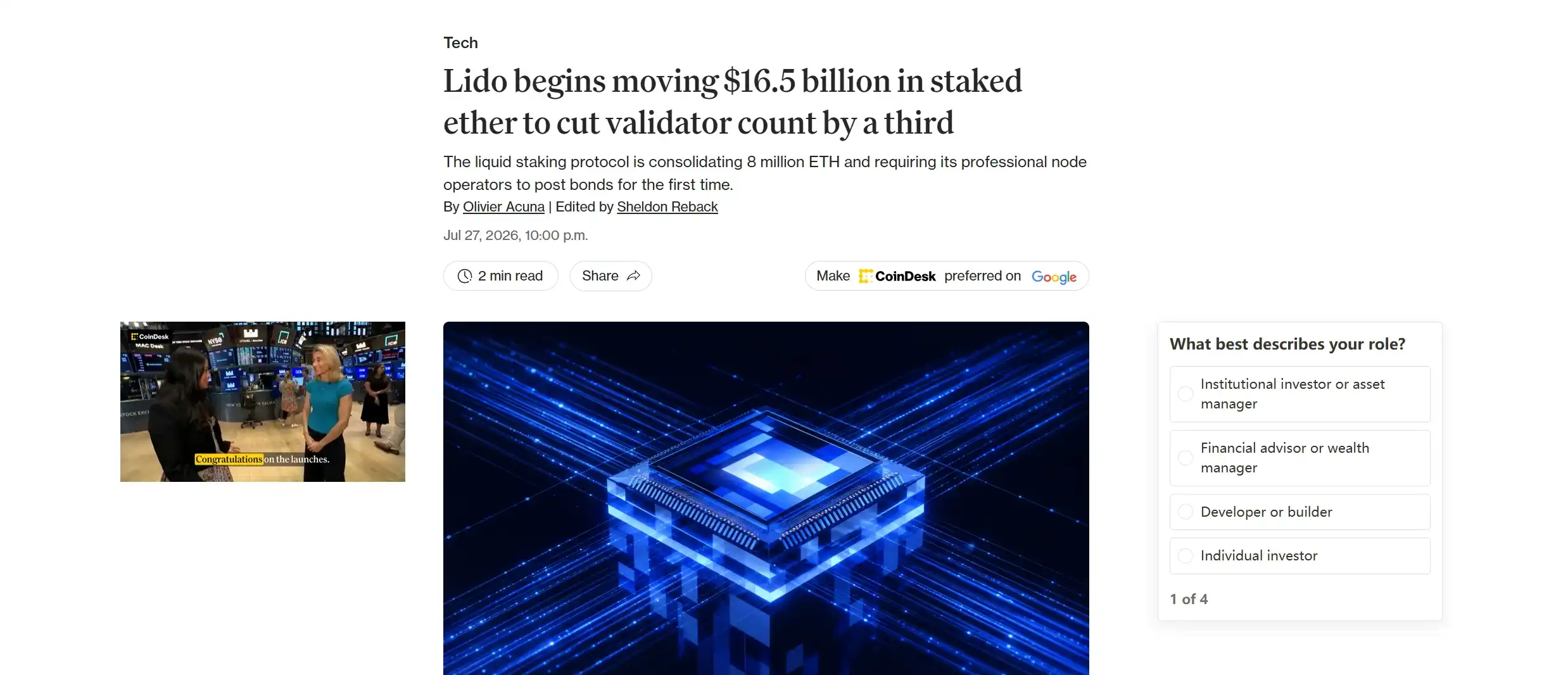
I. What Exactly Is Lido 'Moving' with 8 Million ETH?

The Pectra upgrade officially launched on the Ethereum mainnet on May 7, 2025.

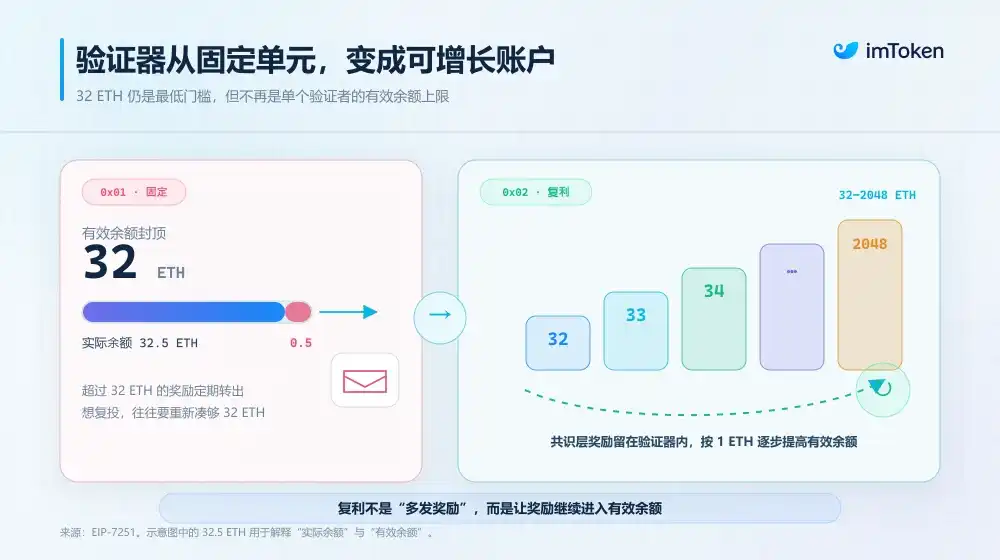
Among its changes, EIP-7251 increased the maximum effective balance for a single validator from 32 ETH to 2048 ETH and introduced withdrawal credentials starting with '0x02'. Validators using this new credential can retain their consensus layer rewards in the beacon chain balance, gradually increasing their effective balance and generating new rewards. Hence, they are called 'Compoundable Validators.'

On the surface, this simply hardcodes 'auto-compounding of rewards' into the protocol. However, the deeper change is that it breaks the long-standing fixed 32 ETH structure of Ethereum validators.

As is well known, the effective balance cap for an Ethereum validator has always been fixed at 32 ETH. Whether it grows to 33 ETH or higher subsequently, the effective balance that actually participates in consensus reward calculations remains capped at 32 ETH. Any amount exceeding this limit does not increase its validation weight but is periodically transferred to the execution layer withdrawal address.

For individual stakers running only one or a few validators, to have their rewards continue participating in native staking, they must gather dispersed rewards from different validators until they reach 32 ETH again, making the reinvestment threshold relatively high, and smaller amounts of ETH remain outside the staking system in withdrawal addresses.

Meanwhile, for entities like Lido, large exchanges, and professional staking service providers, while they can aggregate scattered rewards from numerous users more quickly to amass new 32 ETH increments, they face another cost—every additional 32 ETH typically requires creating and maintaining a new validator.

As Ethereum's staking scale continues to grow, the number of validators keeps expanding, along with the associated indexing, keys, signatures, and attestation messages, driving operational and maintenance costs ever higher.
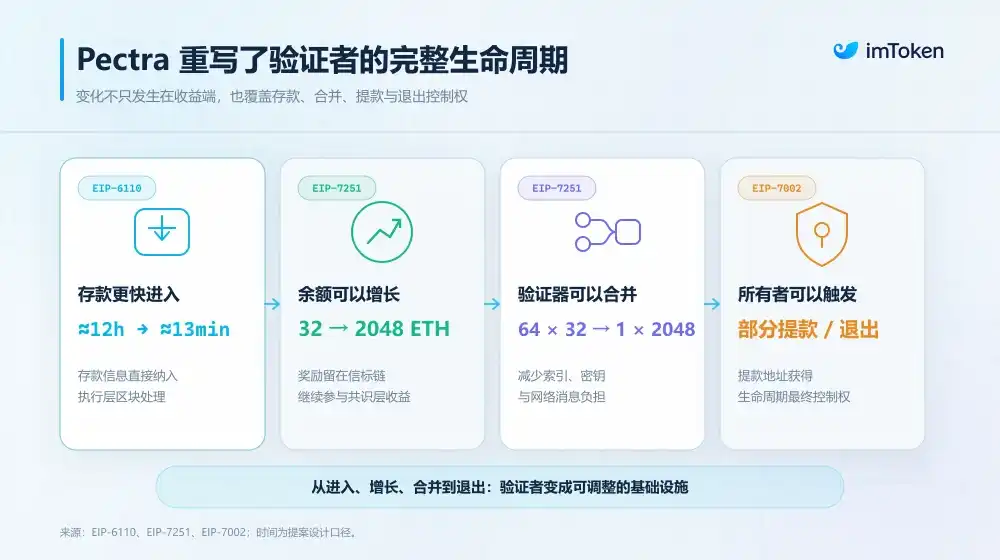
EIP-7251 introduced in the Pectra upgrade aims to change this structure.

Under the new 0x02 model, the minimum threshold to activate a validator remains 32 ETH, but the maximum effective balance for a single validator is increased to 2048 ETH. This means rewards no longer have to be automatically transferred out but can remain in the validator, continuing to increase its effective balance and generate new rewards.

At the same time, multiple existing validators can be merged. For example, 2048 ETH originally distributed across 64 validators can be consolidated into one high-balance validator. The total staking weight remains unchanged, but the number of validators, keys, and network messages that need to be maintained is significantly reduced (see extended reading: "After a Year, 'Lean Ethereum' Sets Out Again: What Answer Does Ethereum Want to Deliver?").

Ultimately, the funds do not leave Ethereum, and the economic security provided is not diminished, but the operational burden is substantially lowered.

What Lido is promoting is precisely this kind of consolidation.

So, strictly speaking, the 'compounding' aspect of the Compoundable Validator only explains half of its value. The other half lies in the fact that validators can finally be reconfigured from a large number of standardized 32 ETH units into more streamlined infrastructure better suited for large-scale operations.
II. What Kind of Revenue Improvement Can It Bring?

Interestingly, from a pure revenue perspective, the improvement brought by compounding is not uniformly distributed.

Theoretically, both individual stakers and large institutions can reduce idle balances through 0x02, allowing rewards to participate more directly in subsequent staking. However, because different participants originally had varying capabilities in fund management, the marginal benefit of the upgrade is not the same for everyone.

A paper published in June 2026, "When Staking Rewards Compound: Measuring the Impact of Ethereum's Pectra Upgrade," compared the performance of 0x01 and 0x02 validators.

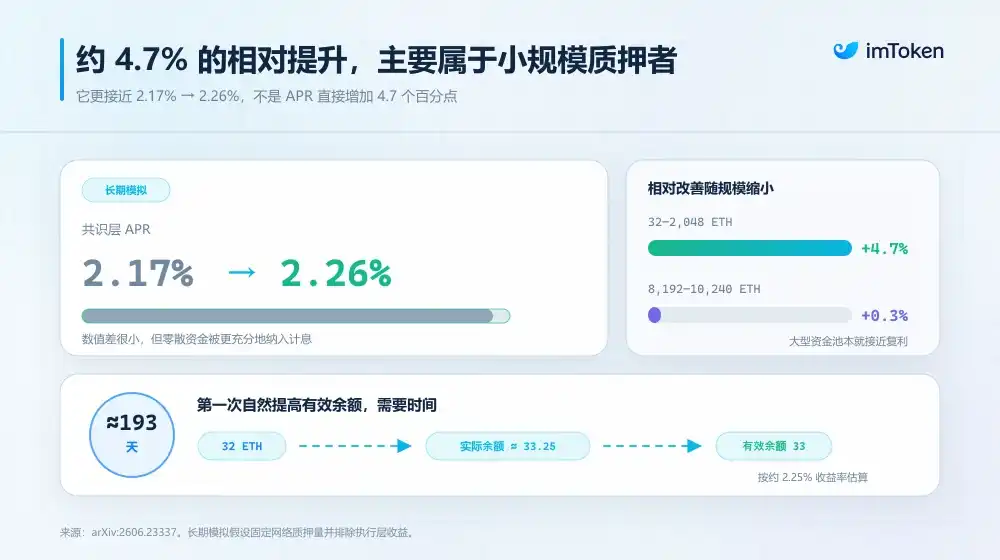
Simulation results showed that within the balance range of 32 ETH to 2048 ETH, the average consensus layer APR for 0x01 validators was about 2.17%, while for 0x02 validators it was about 2.26%. This represents a relative improvement of approximately 4.7% for the latter. However, when the staking scale reached between 8192 ETH and 10240 ETH, the relative gap between the two narrowed to about 0.3%.

It's crucial to note that the paper's mention of "about 4.7%" does not mean the APR directly increases by 4.7 percentage points. It refers to a relative improvement of roughly 4.7% on top of the original consensus layer APR of about 2% to 3%.

The reason smaller-scale stakers see more noticeable improvement is not because they have some exclusive yield, but because they previously faced greater difficulty in reinvesting.

For example, a user with only one 32 ETH validator would have their rewards automatically sent to a withdrawal address. They would then need to accumulate for a long time or combine with other funds to reach 32 ETH again and launch the next validator. Amounts less than 32 ETH would remain scattered across different addresses, naturally leading to lower aggregation willingness.

The 0x02 validator, however, allows these funds to continue increasing the effective balance within the same validator, thereby reducing idle funds formed by "amounts less than 32 ETH." Ultimately, what small-scale stakers lacked in the past wasn't just the willingness to reinvest, but also the ability to funnel scattered ETH back into native staking.

Large staking service providers can also benefit from native compounding, but they originally possessed stronger fund aggregation capabilities. They could quickly gather new 32 ETH increments to launch the next validator. From the perspective of the entire fund pool, they could achieve a fund allocation effect close to compounding.

Therefore, the larger the staking scale, the lower the proportion of scattered balances relative to total funds, and naturally, the smaller the marginal improvement brought by 0x02.
However, this does not mean 0x02 is unimportant for large institutions.

On the contrary, the core problem large institutions face is shifting from 'how to make rewards continue generating yield' to 'how to manage more ETH with fewer validators.'

For them, the value of 0x02 is more evident in two aspects: First, rewards can remain in the validator for compounding, reducing frequent aggregation, redeposit, and validator creation operations. Second, a large number of existing 32 ETH validators can be merged, significantly lowering the management costs associated with nodes, keys, and consensus layer messages.

Of course, this change also brings new trade-offs.

Traditional 0x01 validators automatically transfer rewards exceeding 32 ETH to withdrawal addresses, requiring no active on-chain operations. In contrast, 0x02 validators default to retaining rewards within the validator. If large service providers need to meet user redemptions or manage liquidity, they must actively initiate partial withdrawals and redesign their accounting, reward distribution, and capital buffer mechanisms.

Thus, for small-scale stakers, the most direct value of 0x02 is lowering the reinvestment threshold and reducing idle funds. For large institutions, while the yield improvement might be smaller, the benefits from validator consolidation and infrastructure efficiency gains are more significant.

Both benefit from the same mechanism, but the sources and priorities of their benefits differ.

III. The Changing and Unchanging Aspects of Ethereum's Staking Ecosystem

Therefore, if viewed solely from an APR perspective, Lido's migration doesn't seem like an exceptionally attractive deal.

After all, the yield improvement large service providers gain through compounding might be less than 1%, and there will be temporary reward losses during the migration. Existing accounting, withdrawal, and liquidity management systems also need to be adjusted accordingly.

Yet, Lido has decided to push forward with this largest core architecture upgrade since V2 in 2023. This is because when a protocol manages over 8 million ETH, the sheer number of validators itself becomes a cost.

Especially after the Pectra upgrade, a single 2048 ETH validator can carry the staking weight equivalent to 64 traditional validators, meaning it can manage more capital more efficiently with fewer validators.

In fact, Lido's upgrade involves more than just merging validators.

After migrating to Curated Module v2, its professional node operators are for the first time required to lock ETH as collateral. If operational outages, slashing, reward mismatches, or other attributable issues occur, this collateral can be used to cover losses.

In the past, Lido's curated node operators primarily relied on historical performance and reputation for trust. Now, reputation remains, but it is supplemented by a layer of real capital constraint. The existing 34 curated node operators are all expected to migrate to CMv2, with none opting out due to the collateral requirement.

This change might be more noteworthy than compounding itself, indicating that the competitive standards for Staking in the post-Pectra era are undergoing a structural transformation. Future differences among staking services may increasingly manifest in how to improve effective capital utilization, manage withdrawals and liquidity, allocate validator risk, and achieve balance between asset control, operational complexity, and yield.
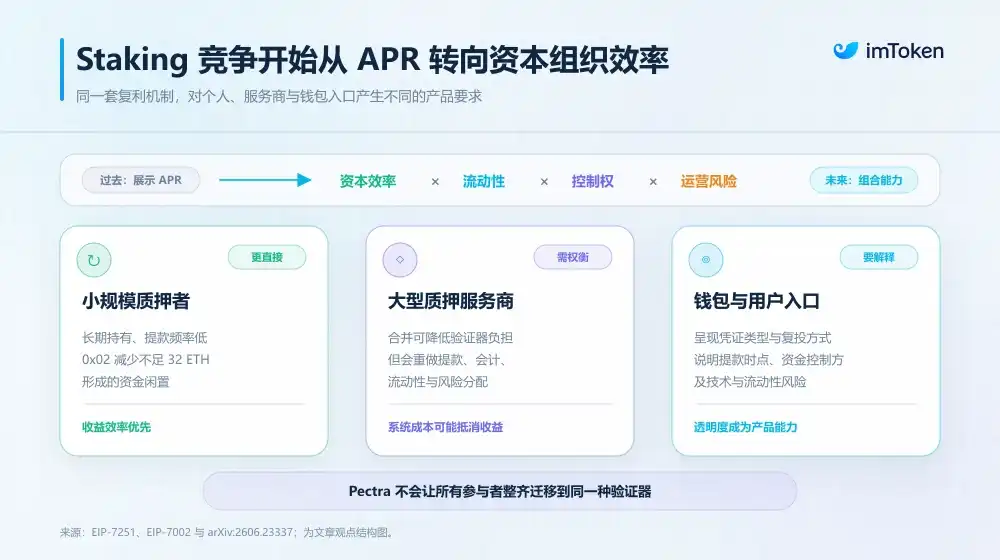
For user-facing gateways like wallets, their value will no longer be just about displaying a yield number to users. They will increasingly need to help users understand the fund flows and risk structures behind different staking methods. Taking imToken Stake as an example:

  • Currently, users can directly access the staking function from the ETH asset page and choose appropriate services based on their capital size and needs. For users wishing to participate with smaller amounts, they can complete the operation through integrated staking services within the wallet.
  • For users holding more than 32 ETH who wish to retain asset control, they can also opt for non-custodial validator solutions, participating in Ethereum's native Staking without maintaining their own nodes.

As compoundable validators become more widespread, the content such gateways need to present will also increase. For instance, whether rewards auto-compound, when rewards can be withdrawn, which withdrawal credential the validator uses, who controls the funds, and the technical and liquidity risks associated with different schemes.

This also means wallets are connecting not just to a Staking yield page, but to a set of increasingly differentiated validator services.

Conclusion

Overall, from The Merge to the Shanghai upgrade, and now to the Pectra upgrade, Ethereum is gradually completing the staking lifecycle.

The Merge made validators the core of network security. The Shanghai upgrade addressed how staked funds exit. The Pectra upgrade is now further optimizing how funds enter, accumulate, and are reorganized.

Of course, compoundable validators will not bring the same magnitude of yield improvement to all participants:

  • For small-scale stakers, it can reduce idle balances, allowing long-held ETH to participate more fully in consensus.
  • For large institutions, its more significant value may lie not in increasing APR, but in reducing validator counts and lowering operational burdens.

Therefore, the migration to 0x02 validators is destined to be gradual. Different participants will choose to retain their original validators or gradually shift to the compoundable model based on their capital scale, liquidity needs, and operational structure.

However, the way Ethereum organizes staking capital is undergoing a step-by-step structural transformation. Especially now that validators are no longer fixed at 32 ETH, the Staking ecosystem is also shifting from standardized yield products towards more segmented fund management and infrastructure competition.

This is the paradigm shift in Ethereum Staking worth tracking over the long term.

Tiền kỹ thuật số thịnh hành

Câu hỏi Liên quan

QWhat is the main change that the Pectra upgrade introduces for Ethereum validators, and why is Lido migrating its 8 million ETH to the new system?

AThe Pectra upgrade introduces EIP-7251, which raises the maximum effective balance of a single validator from 32 ETH to 2048 ETH and introduces a new '0x02' withdrawal credential. Validators using the 0x02 credential can retain their consensus layer rewards, allowing for compounding interest ('restaking') and enabling the merging of multiple smaller validators into fewer, larger ones. Lido is migrating its 8 million ETH (over 265,000 validators) to this new architecture primarily to reduce operational complexity and cost by consolidating a large number of validators, thereby decreasing the overhead associated with managing keys, signatures, and attestation messages, even though the direct APR improvement for a large operator like Lido is marginal.

QAccording to the cited research paper, how does the benefit of the new 0x02 'compounding' validators differ between small-scale and large-scale stakers?

AThe research paper 'When Staking Rewards Compound: Measuring the Impact of Ethereum's Pectra Upgrade' indicates that the relative benefit of 0x02 validators is more significant for smaller-scale stakers. For validators in the 32-2048 ETH range, the consensus layer APR for 0x02 validators is about 4.7% higher relative to 0x01 validators (e.g., ~2.26% vs ~2.17%). This is because small stakers previously struggled to efficiently reinvest rewards that were automatically sent to a withdrawal address, leaving funds idle. For large-scale stakers with 8192-10240 ETH, the relative APR gap shrinks to about 0.3%, as they already had strong capital aggregation capabilities to reinvest rewards quickly.

QBeyond potential APR improvements, what is a key operational benefit for large staking service providers like Lido in migrating to the new 0x02 validator structure?

AA key operational benefit for large providers is the ability to consolidate many 32 ETH validators into fewer high-balance validators (up to 2048 ETH each). This significantly reduces the number of validators, keys, and consensus-layer messages that need to be managed, lowering infrastructure and maintenance costs. For Lido, migrating 265,000+ validators is expected to reduce the total number of validators on the network from about 880,000 to approximately 628,000, a reduction of nearly one-third, which streamlines operations at scale.

QWhat is the new requirement for Lido's Curated Node Operators (CNOs) under the Curated Module v2, and what is its significance?

AUnder the new Curated Module v2 (CMv2), Lido's Curated Node Operators are required to lock up ETH as a security bond or guarantee. This bond can be used to cover losses in case of operational failures, slashing events, reward misallocations, or other attributable issues. This change adds a layer of real capital-at-risk on top of reputation-based trust, aligning operator incentives more closely with protocol security and user protection. It signifies a structural shift in staking service standards towards greater accountability.

QHow does the article describe the evolving role of wallet applications (like imToken) in the post-Pectra staking landscape?

AThe article states that wallet applications are evolving from simply displaying a staking APY to becoming gateways that help users navigate increasingly differentiated validator services. They need to clearly present not just the potential return, but also critical details such as: whether rewards are auto-compounded, when rewards can be withdrawn, what type of withdrawal credential is used (0x01 vs 0x02), who controls the funds (custodial vs non-custodial), and the associated technical and liquidity risks of different staking options. Essentially, they connect users to a complex ecosystem of staking services rather than just a simple yield page.

Nội dung Liên quan

Bitcoin đã chạm đáy, hay một 'cơn lốc' đang đến gần? Tình hình của XRP ra sao?

Nền tảng phân tích tiền mã hóa Santiment vừa chia sẻ những tín hiệu quan trọng về thị trường Bitcoin và altcoin. Phân tích cho thấy chỉ số MVRV (Market Value – Realized Value) 365 ngày của Bitcoin đã giảm xuống -26%, cho thấy các nhà đầu tư dài hạn đang chịu lỗ đáng kể. Mức MVRV âm sâu như vậy từng xuất hiện trong các đáy thị trường trước đây, báo hiệu khả năng tạo đáy và cơ hội mua vào dài hạn. Dữ liệu chuỗi khối cho thấy các "cá voi" (ví từ 10-10.000 BTC) đang tích lũy thêm khoảng 18.500 BTC trong 10 ngày qua. Trong khi đó, các nhà đầu tư nhỏ lẻ vẫn mua vào khi giá giảm, nhưng hành vi này đôi khi có thể dẫn đến rủi ro điều chỉnh hoặc "shaking" thị trường. Thị trường altcoin có diễn biến trái chiều. Ethereum có MVRV 365 ngày khoảng -33%, nhưng sự phục hồi gần đây kèm theo tâm lý quá lạc quan trên mạng xã hội có thể dẫn đến điều chỉnh ngắn hạn. XRP đang trong vùng quá bán với MVRV 30 ngày là -57,5% và MVRV 365 ngày là -45,5%, báo hiệu khả năng phục hồi mạnh trong trung và dài hạn. Solana được thảo luận tích cực, trong khi Cardano có tâm lý ổn định hơn. Triển vọng của Bitcoin và altcoin chịu ảnh hưởng bởi các yếu tố vĩ mô và pháp lý, như quyết định lãi suất của Cục Dự trữ Liên bang Mỹ (Fed) và quá trình thông qua Dự luật Rõ ràng tại Quốc hội Mỹ, có thể làm tăng biến động thị trường.

cryptonews.ru18 phút trước

Bitcoin đã chạm đáy, hay một 'cơn lốc' đang đến gần? Tình hình của XRP ra sao?

cryptonews.ru18 phút trước

Tin đồn lan truyền về altcoin: Cựu nhân viên lên tiếng về vấn đề này

Theo báo cáo từ Sandmark, nền tảng memecoin Pump.fun trên Solana đã bắt đầu sa thải nhân viên khoảng hai tháng trước thời điểm token $PUMP của họ được mở khóa. Ít nhất một cựu nhân viên bị tước quyền nhận token, với giá trị ước tính hơn 1 triệu USD theo thời giá hiện tại. Các tài liệu nội bộ cho thấy công ty chấm dứt hợp đồng với một số nhân viên vào đầu tháng 4, với lý do "phát triển quá nhanh". Nhân viên bị sa thải được đề nghị trợ cấp thôi việc, nhưng thiệt hại chính nằm ở việc mất quyền nhận token $PUMP theo thỏa thuận phân bổ ký năm 2025. Một nhân viên sa thải tháng 4 đã mất lượng token trị giá bảy con số. Một đợt sa thải thứ hai diễn ra vào giữa tháng 7, với cáo buộc rằng một số người bị sa thải chỉ một ngày trước khi token được mở khóa. Tổng số nhân viên bị sa thải trong hai tháng được cho là vượt quá 40 người. Các đồng sáng lập Pump.fun không đưa ra bình luận. Pump.fun, nền tảng tạo memecoin hàng đầu, đã tạo hơn 20,8 triệu token và có tổng doanh thu ước đạt 1,3 tỷ USD. Công ty dự kiến tăng quy mô nhân sự lên khoảng 100 người vào đầu năm 2026.

cryptonews.ru55 phút trước

Tin đồn lan truyền về altcoin: Cựu nhân viên lên tiếng về vấn đề này

cryptonews.ru55 phút trước

Trên Ethereum, hàng chờ stake đã hình thành với thời gian chờ 43 ngày: nhưng theo một chuyên gia, đây không phải là tín hiệu tăng giá thực sự

Số lượng người xác thực muốn đặt cọc token trong mạng Ethereum đã tăng mạnh, tạo ra hàng chờ kích hoạt khoảng 2,5 triệu ETH. Do tắc nghẽn hiện tại, người tham gia đặt cọc mới phải chờ khoảng 43 ngày. Tuy nhiên, Thomas Brunner từ Sygnum Bank cho rằng thời gian chờ dài này không phải là tín hiệu trực tiếp cho thấy xu hướng tăng giá mạnh. Ông giải thích rằng hàng chờ không chỉ phản ánh nhu cầu thể chế mà còn bị ảnh hưởng bởi các đặc điểm kỹ thuật của giao thức Ethereum, như giới hạn thông lượng hàng ngày sau bản cập nhật Dencun. Một phần lượng ETH trong hàng chờ là do phân bổ lại, bổ sung vào các trình xác thực hiện có và quá trình lãi kép. Brunner nêu bật rằng tín hiệu thị trường mạnh hơn là hàng chờ rút tiền gần như trống, cho thấy những người tham gia hiện tại đang tiếp tục giữ vị thế của họ. Ông nhấn mạnh sự tin tưởng thực sự này. Hiện có khoảng 41,2 triệu ETH được đặt cọc, tương đương 33,8% tổng nguồn cung lưu hành. Dù giá ETH giảm, các nhà đầu tư thể chế vẫn không từ bỏ việc đặt cọc, coi đó là đặc điểm cơ bản của Ethereum. Tuy nhiên, vấn đề riêng tư vẫn là rào cản chính vì các địa chỉ và giao dịch liên quan đến đặt cọc có thể bị theo dõi trên blockchain, khiến các thể chế thận trọng khi mở rộng hoạt động.

cryptonews.ru1 giờ trước

Trên Ethereum, hàng chờ stake đã hình thành với thời gian chờ 43 ngày: nhưng theo một chuyên gia, đây không phải là tín hiệu tăng giá thực sự

cryptonews.ru1 giờ trước

Ngân hàng Trung ương Hàn Quốc công bố kết quả thử nghiệm tiền gửi token hóa

Ngân hàng Trung ương Hàn Quốc (BOK) đã công bố kết quả thử nghiệm dự án tiền gửi được mã hóa (tokenized deposits) với sự tham gia của 28 ngân hàng trung ương và tổ chức tài chính quốc tế. Các ngân hàng Hàn Quốc tham gia gồm KB Kookmin Bank, NH NongHyup Bank, Shinhan Bank, Woori Bank và Hana Bank. Toàn bộ quy trình, từ lệnh thanh toán đến quyết toán cuối cùng, chỉ mất trung bình 1 phút 20 giây. Trong đợt thử nghiệm, 30 giao dịch đã được thực hiện theo 17 kịch bản khác nhau, bao gồm chuyển tiền doanh nghiệp và liên ngân hàng, với 6 loại tiền tệ như won Hàn Quốc, USD và euro. Tổng giá trị giao dịch đạt khoảng 995.000 USD. Nền tảng hoạt động ổn định, cho phép thanh toán nhanh chóng, minh bạch ngay cả trong môi trường kết nối một phần với cơ sở hạ tầng ngân hàng hiện có. BOK cũng đã thử nghiệm chuyển khoản nội bộ 20 triệu won (13.890 USD) giữa NH NongHyup Bank và Shinhan Bank thông qua nền tảng Project Agora, có kết nối thử với nền tảng CBDC của BOK. Ngoài ra, KB Kookmin Bank và MUFG Bank của Nhật Bản đã hoàn tất thử nghiệm thanh toán bằng token tiền gửi. Đây là các chứng chỉ số do ngân hàng phát hành trong dự án thí điểm, không phải do ngân hàng trung ương phát hành trực tiếp. BOK dự định tiếp tục thử nghiệm loại hình thanh toán này. Năm ngoái, chính quyền Hàn Quốc cam kết siết chặt quy định đối với stablecoin dựa trên won, yêu cầu phải có sự cho phép của BOK và Ủy ban Dịch vụ Tài chính (FSC).

cryptonews.ru2 giờ trước

Ngân hàng Trung ương Hàn Quốc công bố kết quả thử nghiệm tiền gửi token hóa

cryptonews.ru2 giờ trước

Lãnh đạo một thợ đào lớn đánh giá lợi nhuận từ AI cao gấp mười lần so với đào coin

Giám đốc công ty khai thác tiền điện tử HIVE Digital Technologies của Canada, Frank Holmes, tuyên bố về việc tăng tốc phát triển hướng điện toán cho trí tuệ nhân tạo (AI). HIVE là một trong những công ty khai thác lớn nhất, kiểm soát khoảng 2% hash rate toàn cầu của Bitcoin. Theo Holmes, tỷ trọng doanh thu từ AI của công ty dự kiến tăng từ khoảng 10% lên hơn 50% trong năm nay. Ông chỉ ra rằng hiện tại, các máy ASIC khai thác mang lại khoảng 0,12–0,14 USD mỗi giờ, trong khi một GPU Nvidia H100 có thể tạo ra gần 2 USD mỗi giờ. Ngay cả các GPU cũ hơn cũng tạo ra khoảng 1,4 USD mỗi giờ, cao gấp khoảng mười lần so với thiết bị khai thác. Nhiều công ty khai thác lớn như Riot Platforms, Cipher Digital, MARA và TeraWulf đang giảm thiểu thua lỗ bằng cách chuyển từ khai thác tiền điện tử sang hỗ trợ điện toán AI trong các trung tâm dữ liệu hoặc kết hợp cả hai hoạt động. Đầu tháng 7, công ty khai thác lớn nhất Hoa Kỳ, MARA Holdings, đã mua một địa điểm cho trung tâm dữ liệu AI và khai thác với giá 600 triệu USD. Từ tháng 11 năm ngoái, Giám đốc MARA Fred Thiel đã cảnh báo rằng nếu giá Bitcoin không tăng ít nhất 50% mỗi năm, mô hình khai thác hiện tại sẽ trở nên không có lãi. Mặc dù không thể tính toán chính xác chi phí sản xuất một Bitcoin, nhưng theo các mô hình ước tính khác nhau, vào mùa hè năm 2026, chi phí này vào khoảng 78.000 USD. Giá Bitcoin đã duy trì dưới mức này trong vài tháng, khiến một số công ty khai thác bắt đầu tắt thiết bị khi độ khó và chi phí tăng cao.

cryptonews.ru2 giờ trước

Lãnh đạo một thợ đào lớn đánh giá lợi nhuận từ AI cao gấp mười lần so với đào coin

cryptonews.ru2 giờ trước

Giao dịch

Giao ngay

Bài viết Nổi bật

Làm thế nào để Mua ERA

Chào mừng bạn đến với HTX.com! Chúng tôi đã làm cho mua Caldera (ERA) trở nên đơn giản và thuận tiện. Làm theo hướng dẫn từng bước của chúng tôi để bắt đầu hành trình tiền kỹ thuật số của bạn.Bước 1: Tạo Tài khoản HTX của BạnSử dụng email hoặc số điện thoại của bạn để đăng ký tài khoản miễn phí trên HTX. Trải nghiệm hành trình đăng ký không rắc rối và mở khóa tất cả tính năng. Nhận Tài khoản của tôiBước 2: Truy cập Mua Crypto và Chọn Phương thức Thanh toán của BạnThẻ Tín dụng/Ghi nợ: Sử dụng Visa hoặc Mastercard của bạn để mua Caldera (ERA) ngay lập tức.Số dư: Sử dụng tiền từ số dư tài khoản HTX của bạn để giao dịch liền mạch.Bên thứ ba: Chúng tôi đã thêm những phương thức thanh toán phổ biến như Google Pay và Apple Pay để nâng cao sự tiện lợi.P2P: Giao dịch trực tiếp với người dùng khác trên HTX.Thị trường mua bán phi tập trung (OTC): Chúng tôi cung cấp những dịch vụ được thiết kế riêng và tỷ giá hối đoái cạnh tranh cho nhà giao dịch.Bước 3: Lưu trữ Caldera (ERA) của BạnSau khi mua Caldera (ERA), lưu trữ trong tài khoản HTX của bạn. Ngoài ra, bạn có thể gửi đi nơi khác qua chuyển khoản blockchain hoặc sử dụng để giao dịch những tiền kỹ thuật số khác.Bước 4: Giao dịch Caldera (ERA)Giao dịch Caldera (ERA) dễ dàng trên thị trường giao ngay của HTX. Chỉ cần truy cập vào tài khoản của bạn, chọn cặp giao dịch, thực hiện giao dịch và theo dõi trong thời gian thực. Chúng tôi cung cấp trải nghiệm thân thiện với người dùng cho cả người mới bắt đầu và người giao dịch dày dạn kinh nghiệm.

Tổng lượt xem 953Xuất bản vào 2025.07.17Cập nhật vào 2026.06.02

Làm thế nào để Mua ERA

Thảo luận

Chào mừng đến với Cộng đồng HTX. Tại đây, bạn có thể được thông báo về những phát triển nền tảng mới nhất và có quyền truy cập vào thông tin chuyên sâu về thị trường. Ý kiến ​​của người dùng về giá của ERA (ERA) được trình bày dưới đây.

活动图片