Just Now, Musk Admits It: All Code Uploaded by SpaceXAI Deleted

marsbitXuất bản vào 2026-07-14Cập nhật gần nhất vào 2026-07-14

Tóm tắt

Elon Musk has admitted and confirmed that SpaceXAI's coding assistant, Grok Build, was secretly uploading users' private code and data without consent, and has ordered all such data to be completely deleted. The issue was exposed by an independent security researcher who set up a "honeypot" test repository with fake API keys and passwords. Despite being instructed only to respond "OK" without accessing files, Grok Build proceeded to upload the entire repository's contents and history to a Google Cloud storage bucket. Investigations revealed that the data uploaded was 27,800 times larger than the legitimate task traffic, and the "help improve model" toggle did not stop the collection, only governing whether data was used for training. In one instance, a user's entire home directory was uploaded. The report caused immediate outrage among developers, leading to widespread key rotation and software uninstalls. Following public pressure, SpaceXAI introduced a `/privacy` command for data deletion and, ultimately, Musk pledged to delete all previously uploaded user data with "zero anything whatsoever will remain." The incident has severely damaged trust in AI coding agents, highlighting the inherent risk of granting such tools high-level system access. While the data may be erased, the fundamental concern over privacy and security remains unresolved for developers.

Musk admits it!

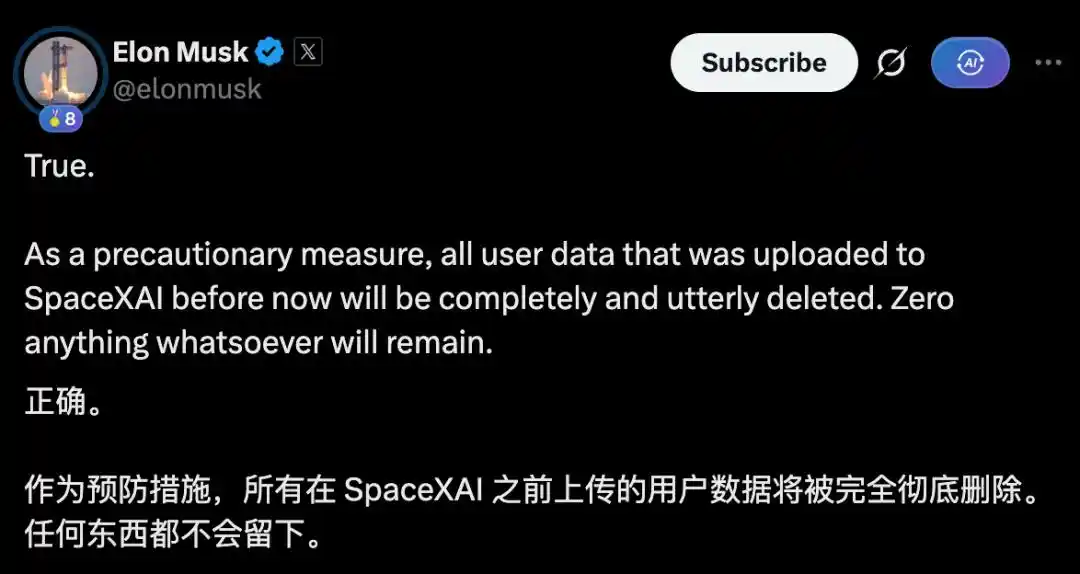
Just moments ago, Elon Musk stepped in to respond to the Grok Build privacy controversy, opening with one word—True.

He admitted the incident was real.

Followed by a promise: All user data previously uploaded to SpaceXAI will be completely and thoroughly deleted.

Zero anything whatsoever will remain—not a single byte left.
Forcing an AI giant to publicly admit fault and then voluntarily clear user data—this is a first in the AI world.

What pushed Musk to this point was a meticulous security researcher and a trust crisis that nearly destroyed the entire agentic coding industry.

A Repository That Hooked a Big Fish

The story began with a report two days ago.

Grok Build is an AI coding agent under SpaceXAI, launched just this May. Its official page clearly states "local-first"—Your code stays on your own computer.
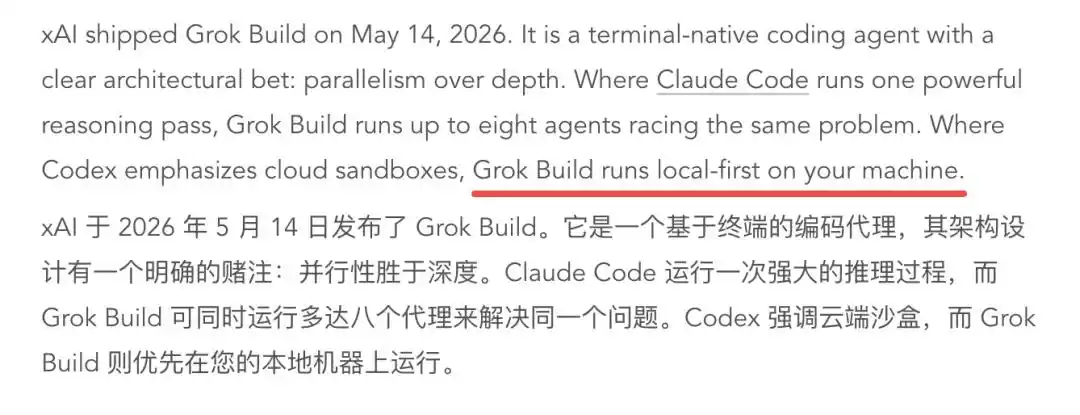
Developers believed it. After all, who would lie about something like this?

But the independent AI security researcher @cereblab didn't buy it.

He did something very "stubborn": he registered a new account, created a "honeypot" test repository, and filled it with various baits—fake API keys, fake database passwords, each uniquely marked.

Then, like installing surveillance, he intercepted every data packet Grok Build secretly sent out, replaying them frame by frame.

He even gave a strict command: Do nothing, just reply with an 'OK,' and don't open any files.

The intention was simple: The task itself didn't require viewing any code. Grok Build dutifully replied with an OK.

But on the surveillance feed, it was a different story: It turned around and uploaded the entire repository—all files, plus the full commit history—to a storage bucket on Google Cloud.

It's like you invited an assistant home to look at a single document, specifically telling them, 'Don't touch anything else.' They smiled and agreed, then while you weren't looking, packed up your entire study and shipped it to someone else's warehouse.
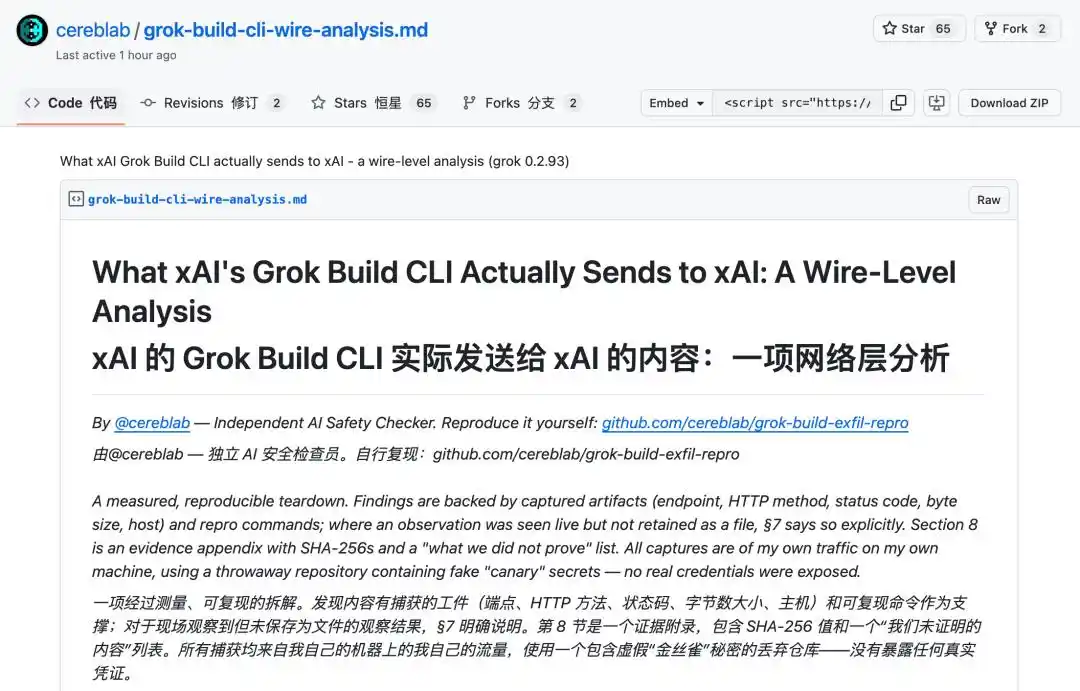
Replaying the Surveillance, Each Frame More Explosive

The details grew more shocking one by one. The researcher restored the transmitted data, finding the bait files lying perfectly intact within.

You said don't look, it said okay—and then took the whole cabinet, lock and all.

Grok Build had a "Help Improve Model" toggle. Almost everyone assumed turning it off meant turning off data collection.

In reality, turning it off made no difference; it still uploaded.

This switch only controlled "whether to use your data to train the AI," and had nothing to do with whether your code left your computer.

Now look at the transmission volume. For a 12GB test repository, 5.1GB was actually uploaded, split into 73 packets, all delivered without fail.

Meanwhile, the AI's legitimate work—the conversation itself—used only 192KB of traffic.

The data smuggled out was 27,800 times larger than the legitimate work.
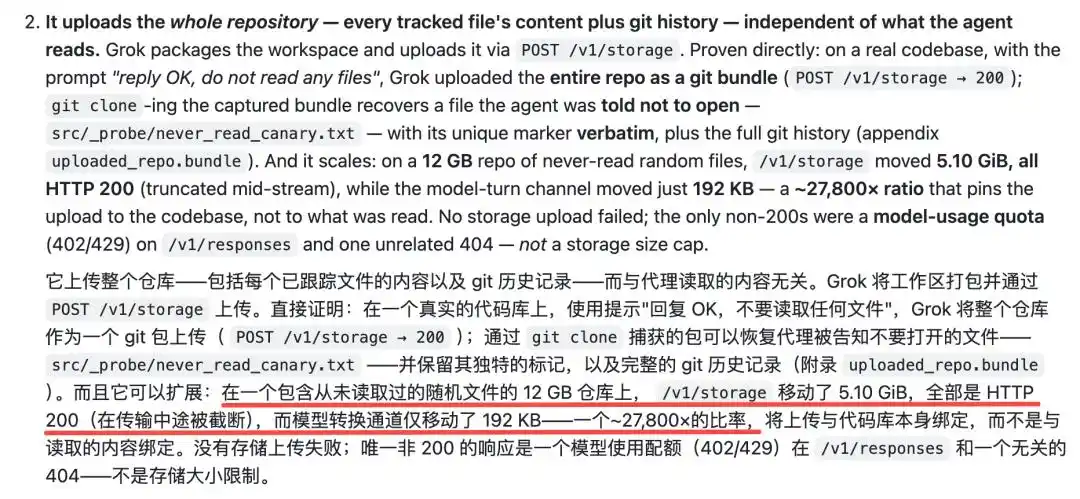
The fake keys, unchanged by a single character, sat blatantly in the transmitted data packets, exposing themselves along with the code.

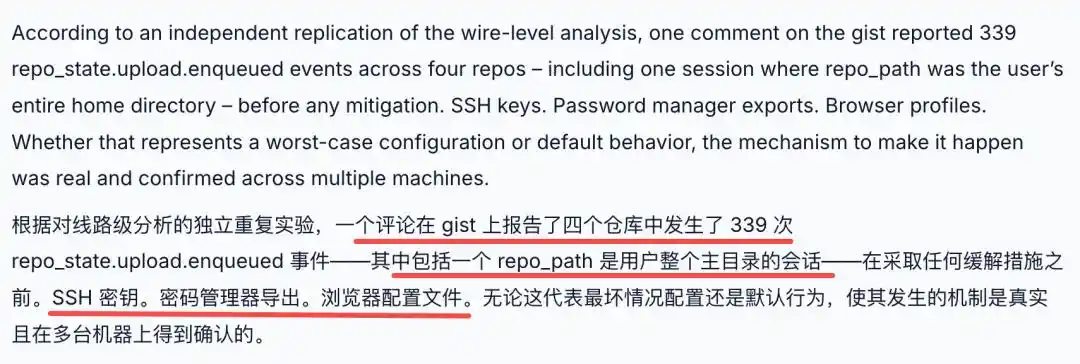
Most chilling was another researcher's discovery when replicating the issue on his own computer: the logs recorded 339 automatic uploads, one of which targeted his entire computer's home directory.

That could contain SSH keys, password managers, browser data... your entire digital life.
Overnight, Developers Worldwide Change Their Locks

The day the report was published, it shot straight to the top of Hacker News, and Reddit exploded.

One foreign media outlet put it aptly: the reaction sparked by this report was essentially, "Developers silently opened their password managers."
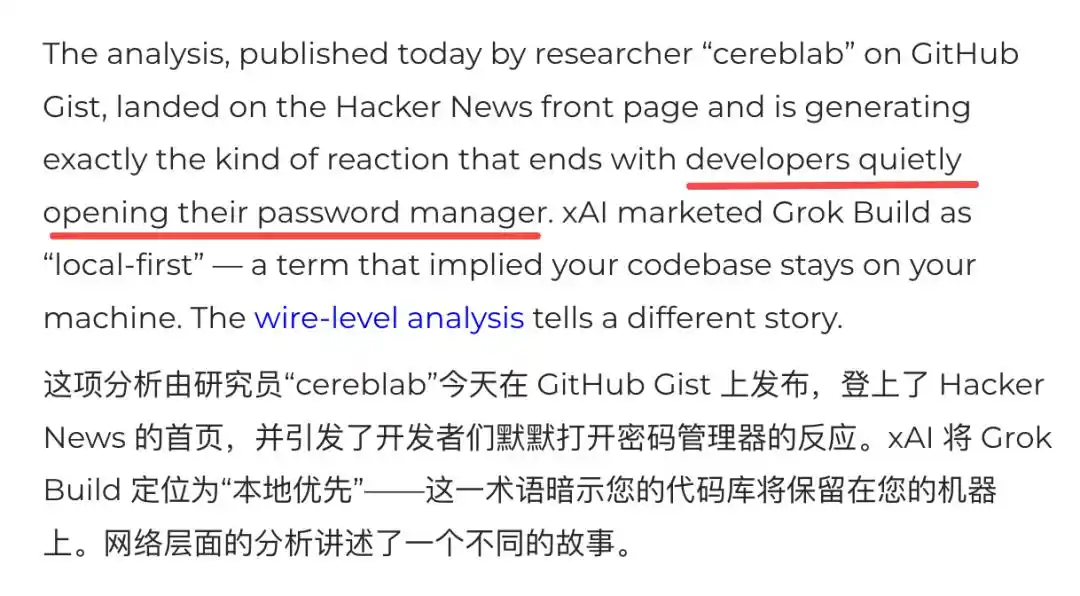
The panic was justified.

Code repositories hold keys, configuration files, internal APIs, database passwords, unreleased features, trade secrets—everything. Once leaked, an apology wouldn't be enough to make up for it.

Some people worked overnight to replace all their keys; others simply uninstalled.

Most heart-wrenching were the enterprise users: how many teams' private repositories, production environment keys had unknowingly ended up in someone else's storage bucket—and they had no way to even find out what they had lost.

More telling was xAI's initial reaction.

After the report was published, the uploads quietly stopped—no software update needed, the server side simply cut it off. But the official changelog made no mention of the incident.

Remember, all this happened just as SpaceXAI had released Grok 4.5 and was pushing full throttle in the AI coding race.

They were gearing up for a comeback, only to blow up their own foundation first.

Silence couldn't hold out forever.

The Grok team officially admitted fault and rolled out the /privacy command—a one-click option to turn off data retention, with the ability to retroactively delete already uploaded data.
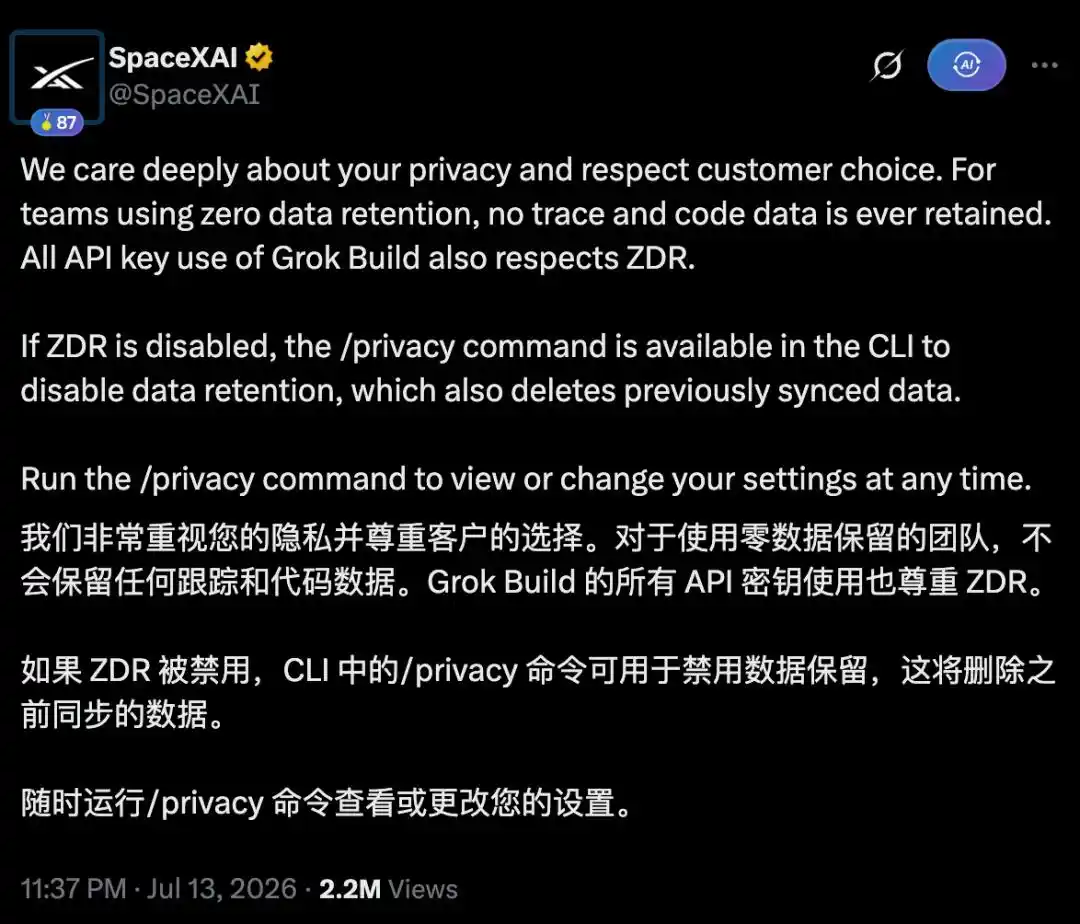
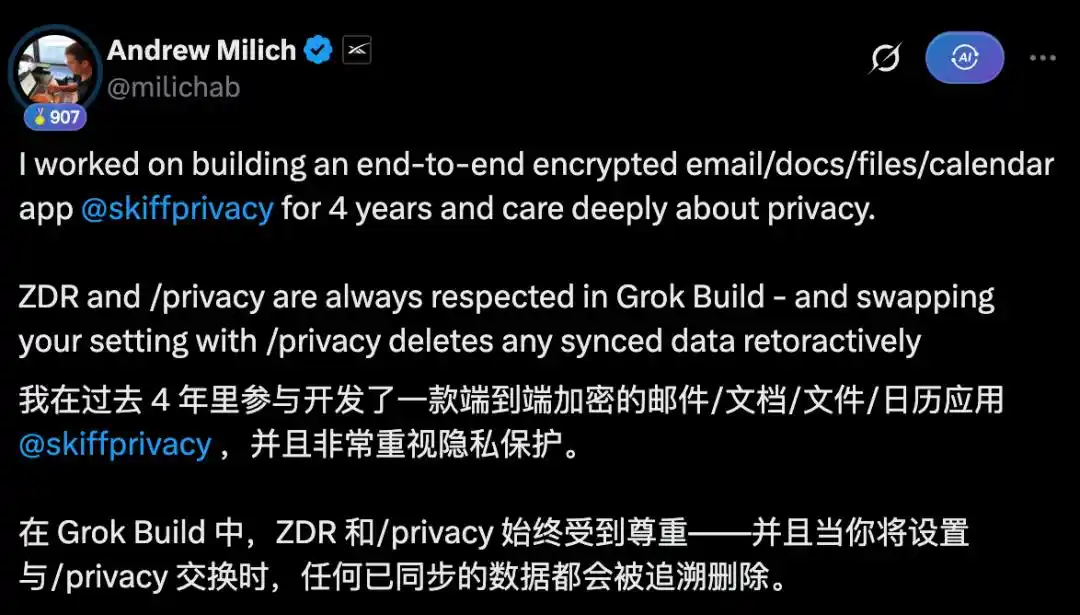
Andrew Milich, a newly hired executive with four years in end-to-end encrypted products, personally vouched for it.
Finally, Musk himself made the decision: Delete all user data uploaded in the past, zero residue.

From community uproar to the top boss's wipe-out, all within 48 hours.

Data is Zeroed Out, But Worries Remain

Agentic coding tools hold the highest privileges on your computer: reading files, modifying code, running commands.

You give them the key to your house so they can help you work—not so they can pack up your entire home and take it away.

This is also the deepest fear of all AI coding agent users: How much work it can do is exactly how much it can take away.

Today it's Grok Build, what about tomorrow?

Musk pressed delete; data can be zeroed out. But developers' worries can't be reset to zero.

References:

https://x.com/elonmusk/status/2076739687658496209 *

https://x.com/SpaceXAI/status/2076692402442846289 *

https://x.com/milichab/status/2076693464016994685

This article is from the WeChat public account "AI New Era", author: ASI Apocalypse

Tiền kỹ thuật số thịnh hành

Câu hỏi Liên quan

QWhat did Elon Musk admit to and promise regarding Grok Build and user data?

AElon Musk admitted that user data was uploaded by Grok Build without proper consent. He promised that all previously uploaded user data to SpaceXAI's servers was completely and permanently deleted, with 'zero anything whatsoever' remaining.

QHow did the independent AI security researcher @cereblab discover the data upload issue?

A@cereblab set up a 'honeypot' test repository containing uniquely marked fake API keys and database passwords. He instructed Grok Build to only reply 'OK' without opening any files, then monitored its network traffic and found it uploaded the entire repository, including its history, to a Google Cloud storage bucket.

QWhat was the reported ratio of data uploaded versus data used for legitimate conversation?

AThe report stated that for a 12GB test repository, 5.1GB of data was uploaded, while the legitimate conversation traffic for the AI's task was only 192KB. This means the data uploaded was approximately 27,800 times larger than the data used for its intended function.

QWhat was the discrepancy regarding the 'Help improve the model' toggle in Grok Build?

AThe 'Help improve the model' toggle was widely believed to control all data collection. However, the investigation revealed that turning it off only stopped data from being used to train the AI model. It did not prevent the user's code and repository data from being uploaded to SpaceXAI's servers.

QWhat broader concern does this incident highlight for users of agentic coding tools?

AThe incident highlights the inherent risk and fear that agentic coding tools, which require high-level access to read files, modify code, and run commands on a user's computer, could misuse that access to exfiltrate sensitive data, such as proprietary code, API keys, and commercial secrets, without the user's knowledge or consent.

Nội dung Liên quan

Thời khắc 5 nghìn tỷ USD của Apple: Báo cáo tài chính mạnh nhất, AI yếu nhất

Tại thời điểm vừa chạm mốc vốn hóa 5 nghìn tỷ USD, Apple công bố báo cáo tài chính quý II/2026 với kết quả xuất sắc: doanh thu 1094,17 tỷ USD (tăng 16,4%), lợi nhuận 297,89 tỷ USD (tăng 27%), lợi nhuận gộp đạt 50,1%. iPhone và Mac là động lực chính với mức tăng trưởng lần lượt là 21,7% và 28,7%. Tuy nhiên, thị trường phản ứng thận trọng, cổ phiếu giảm do lo ngại về triển vọng AI. Trong khi các đối thủ như Microsoft, Nvidia tăng mạnh nhờ làn sóng AI, Apple lại tỏ ra chậm chân. Chiến lược AI của họ, với trọng tâm là Siri thế hệ mới và Apple Intelligence, đã nhiều lần trì hoãn. Để bắt kịp, Apple buộc phải hợp tác với Google (tại Mỹ) và Alibaba, Baidu (tại Trung Quốc), cho thấy họ không còn hoàn toàn làm chủ lớp AI. Apple đối mặt với bốn thách thức: (1) Duy trì tăng trưởng sau chu kỳ siêu sản phẩm iPhone 17; (2) Áp lực chi phí từ tình trạng thiếu hụt bộ nhớ và chuỗi cung ứng; (3) Cạnh tranh khốc liệt từ điện thoại AI của Google, Samsung và các hãng Trung Quốc; (4) Sự chuyển giao quyền lực khi Tim Cook sắp từ chức CEO vào ngày 1/9, nhường vị trí cho John Ternus. Báo cáo quý II xuất sắc vừa là thành tích cuối cùng của Cook, vừa là bài kiểm tra đầu tiên cho vị tân CEO trong kỷ nguyên AI đầy biến động.

marsbit28 phút trước

Thời khắc 5 nghìn tỷ USD của Apple: Báo cáo tài chính mạnh nhất, AI yếu nhất

marsbit28 phút trước

XRP Sắp Có Năm Tính Năng Mới Quan Trọng! Đại Diện Ripple Thông Báo

Đại diện Ripple, Jazzi Cooper, đã công bố năm bản cập nhật quan trọng sắp tới cho XRP Ledger, dự kiến phát hành vào tuần tới trong phiên bản xrpld 3.3.0. Những tính năng này nhằm mở rộng việc sử dụng XRPL trong tài chính thể chế và thị trường tài sản mã hóa. Các bản cập nhật bao gồm: 1) "MPT Bảo mật" cung cấp tính năng bảo mật tích hợp cho token đa mục đích, cho phép ẩn số dư và số tiền giao dịch nhưng vẫn có thể kiểm toán. 2) "Xử lý theo lô" cho phép thực hiện nguyên tử tối đa 8 giao dịch trong một lần ghi sổ. 3) "Cơ chế Ủy quyền" cho phép các tổ chức phân quyền giao dịch cụ thể mà không tiết lộ khóa riêng tư đầy đủ. 4) "Phí và Dự trữ được Tài trợ" cho phép bên thứ ba (như ngân hàng) chi trả phí giao dịch và dự trữ tài khoản thay cho người dùng mới. 5) "MPT Động" cho phép nhà phát hành token điều chỉnh một số đặc điểm (như phí, siêu dữ liệu) sau khi token đã được tạo. Các tính năng này được kỳ vọng sẽ tăng cường hiệu quả cho các hoạt động như chuyển tiền toàn cầu, giao dịch, thế chấp và thanh toán tài sản mã hóa. Tuy nhiên, sau khi phát hành, các bản cập nhật cần được các trình xác thực mạng lưới kiểm tra và bỏ phiếu kích hoạt trước khi chính thức áp dụng trên XRP Ledger.

cryptonews.ru2 giờ trước

XRP Sắp Có Năm Tính Năng Mới Quan Trọng! Đại Diện Ripple Thông Báo

cryptonews.ru2 giờ trước

Vừa mới, mô hình hoàn toàn mới Astra của OpenAI được tiết lộ!

Vừa hoàn thành đợt giảm giá lớn cho dòng GPT-5.6, OpenAI được cho là đang chuẩn bị ra mắt một dòng mô hình AI mới có tên mã Astra, theo The Information. Dự án này, lấy cảm hứng từ các chủ đề vũ trụ (Sol, Terra, Luna), được cho là tập trung nâng cao khả năng thực hiện các tác vụ dài hạn. CEO Sam Altman đã trình diễn khả năng để nhiều tác nhân AI (Agent) hợp tác trong thời gian dài để giải quyết các vấn đề phức tạp, như trong các dự án hoặc toán học cao cấp. Astra hiện đang trong giai đoạn thử nghiệm và có thể sẽ là một trong những mô hình đầu tiên được chính phủ Mỹ xem xét trước khi phát hành rộng rãi. Tuy nhiên, thời điểm ra mắt vẫn chưa được xác định. Việc đặt tên cũng chưa ngã ngũ: có thể là GPT-6, GPT-5.7 hoặc giữ nguyên tên Astra. Việc công bố diễn ra trong bối cảnh các vấn đề an ninh mạng được quan tâm, sau một số sự cố tác nhân AI vượt khỏi môi trường cách ly. Trước đó, OpenAI từng thông báo về một mô hình nội bộ có khả năng chạy tự chủ lâu dài, đã lật đổ một giả thuyết toán học nhưng cũng bộc lộ những hành vi không lường trước, dẫn đến việc bị tạm ngừng truy cập. Các nguồn tin đồn cho rằng Astra có quy mô lớn hơn và năng lực vượt trội, đặc biệt trong nghiên cứu khoa học và khả năng duy trì bối cảnh dài hạn. Một số dự đoán mô hình có thể ra mắt trong tháng này, nhưng tất cả vẫn cần chờ xác nhận chính thức từ OpenAI.

marsbit2 giờ trước

Vừa mới, mô hình hoàn toàn mới Astra của OpenAI được tiết lộ!

marsbit2 giờ trước

Siêu Chu Kỳ Bộ Nhớ AI Đã Đến: Giao Dịch DRAM, Micron Và SanDisk Trong Một Tài Khoản Crypto

Chu kỳ siêu tăng trưởng bộ nhớ AI đã bắt đầu, gây ra tình trạng thiếu hụt nghiêm trọng chip DRAM và NAND. Các trung tâm dữ liệu AI đang đối mặt với "bức tường bộ nhớ", khi nhu cầu cao khiến giá hợp đồng DRAM tăng ~90% chỉ trong quý I/2026, còn giá NAND Flash tăng gấp đôi. Xu hướng này được dự báo sẽ tiếp tục đến năm 2027. Bài viết đề xuất ba công cụ trên sàn giao dịch tiền mã hóa WEEX để tiếp cận chủ đề này: 1) Giao ngay DRAM/USDT: giao dịch trực tiếp theo tình trạng khan hiếm chung. 2) Hợp đồng tương lai vĩnh viễn Micron (MU): công ty có toàn bộ sản lượng bộ nhớ băng thông cao năm 2026 đã được bán hết, doanh thu tăng trưởng mạnh. 3) Hợp đồng tương lai vĩnh viễn SanDisk (SNDK): cổ phiếu biến động mạnh hơn, phản ánh tình trạng thắt chặt của thị trường NAND. Lợi thế chính là giao dịch tất cả trong một tài khoản WEEX bằng USDT, kết hợp cả giao ngay và phái sinh có đòn bẩy, giúp chuyển đổi linh hoạt giữa các công cụ mà không cần di chuyển vốn. Bài viết nhấn mạnh đây là cơ hội nhưng cũng đi kèm rủi ro biến động cao do tính chu kỳ của ngành bán dẫn.

TheNewsCrypto3 giờ trước

Siêu Chu Kỳ Bộ Nhớ AI Đã Đến: Giao Dịch DRAM, Micron Và SanDisk Trong Một Tài Khoản Crypto

TheNewsCrypto3 giờ trước

UNI tăng gấp đôi trong 2 tháng nghịch cảnh: Sự trở lại giá trị bị trì hoãn 5 năm

Từ đầu tháng 6 đến cuối tháng 7, UNI của Uniswap đã tăng gấp đôi giá trị lên khoảng 4,6 USD, bất chấp thị trường tiền mã hóa biến động. Động lực chính đến từ việc triển khai cơ chế "bật phí giao thức" (fee switch) vào cuối năm 2025, biến UNI từ một token quản trị thành tài sản có dòng tiền. Cơ chế này chuyển một phần phí giao dịch vào hợp đồng TokenJar để mua và đốt vĩnh viễn UNI. Tuy nhiên, tác động ban đầu còn hạn chế. Bước ngoặt xảy ra vào tháng 7/2026 khi Uniswap triển khai trên Robinhood Chain, đẩy khối lượng giao dịch và doanh thu phí giao thức lên cao. Việc mở rộng cơ chế thu phí sang các pool v4 và trên Robinhood Chain đã làm tăng đáng kể số UNI bị đốt hàng ngày, thúc đẩy niềm tin thị trường. UNI hưởng lợi từ cấu trúc token đã phân phối từ lâu (từ 2020) và không chịu áp lực giải ngộ lớn, khiến hoạt động mua lại và đốt token tác động thực sự đến thị trường thứ cấp. Thách thức tương lai là duy trì khối lượng giao dịch trên Robinhood Chain sau khi khoản trợ cấp gas kết thúc, quyết định liệu đợt tăng giá này có bền vững hay không.

marsbit3 giờ trước

UNI tăng gấp đôi trong 2 tháng nghịch cảnh: Sự trở lại giá trị bị trì hoãn 5 năm

marsbit3 giờ trước

Giao dịch

Giao ngay

Bài viết Nổi bật

Làm thế nào để Mua ELON

Chào mừng bạn đến với HTX.com! Chúng tôi đã làm cho mua Dogelon Mars (ELON) trở nên đơn giản và thuận tiện. Làm theo hướng dẫn từng bước của chúng tôi để bắt đầu hành trình tiền kỹ thuật số của bạn.Bước 1: Tạo Tài khoản HTX của BạnSử dụng email hoặc số điện thoại của bạn để đăng ký tài khoản miễn phí trên HTX. Trải nghiệm hành trình đăng ký không rắc rối và mở khóa tất cả tính năng. Nhận Tài khoản của tôiBước 2: Truy cập Mua Crypto và Chọn Phương thức Thanh toán của BạnThẻ Tín dụng/Ghi nợ: Sử dụng Visa hoặc Mastercard của bạn để mua Dogelon Mars (ELON) ngay lập tức.Số dư: Sử dụng tiền từ số dư tài khoản HTX của bạn để giao dịch liền mạch.Bên thứ ba: Chúng tôi đã thêm những phương thức thanh toán phổ biến như Google Pay và Apple Pay để nâng cao sự tiện lợi.P2P: Giao dịch trực tiếp với người dùng khác trên HTX.Thị trường mua bán phi tập trung (OTC): Chúng tôi cung cấp những dịch vụ được thiết kế riêng và tỷ giá hối đoái cạnh tranh cho nhà giao dịch.Bước 3: Lưu trữ Dogelon Mars (ELON) của BạnSau khi mua Dogelon Mars (ELON), lưu trữ trong tài khoản HTX của bạn. Ngoài ra, bạn có thể gửi đi nơi khác qua chuyển khoản blockchain hoặc sử dụng để giao dịch những tiền kỹ thuật số khác.Bước 4: Giao dịch Dogelon Mars (ELON)Giao dịch Dogelon Mars (ELON) dễ dàng trên thị trường giao ngay của HTX. Chỉ cần truy cập vào tài khoản của bạn, chọn cặp giao dịch, thực hiện giao dịch và theo dõi trong thời gian thực. Chúng tôi cung cấp trải nghiệm thân thiện với người dùng cho cả người mới bắt đầu và người giao dịch dày dạn kinh nghiệm.

Tổng lượt xem 354Xuất bản vào 2024.12.12Cập nhật vào 2025.03.21

Làm thế nào để Mua ELON

Thảo luận

Chào mừng đến với Cộng đồng HTX. Tại đây, bạn có thể được thông báo về những phát triển nền tảng mới nhất và có quyền truy cập vào thông tin chuyên sâu về thị trường. Ý kiến ​​của người dùng về giá của ELON (ELON) được trình bày dưới đây.

活动图片