Don't Be Misled by the $1.25 Billion Cap: MicroStrategy's Three-Pronged Bitcoin Sale Pools Hide Massive Selling Pressure

Foresight NewsXuất bản vào 2026-07-08Cập nhật gần nhất vào 2026-07-08

Tóm tắt

Don't Be Misled by the $1.25B Cap: Strategy's Three-Tier Bitcoin Sales Plan Hides Massive Potential Selling Pressure Strategy recently sold 3,588 BTC (~$216M) to fund a dividend and replenish its dollar reserve, while claiming its $1.25B "reserve build" capacity remains fully available. This highlights a key nuance: the widely cited $1.25B limit applies only to sales for "Building" the reserve. Strategy's broader capital framework, however, allows Bitcoin sales for three primary purposes, each with different scales: 1. **Building the Reserve:** Selling BTC to raise up to $1.25B for the reserve. 2. **Covering Priority Share Expenses:** Selling BTC to pay dividends/interest or to replenish the reserve after such payments are made from it (no specified limit). 3. **Share Repurchase Funding:** Selling BTC to fund up to $1B each in convertible note and common stock repurchases (totaling $2B potential). Combined, just the capped "Build" and "Repurchase" channels could facilitate over $3B in Bitcoin sales, excluding the uncapped "Cover Expenses" channel. The accounting distinction between "Building" (adding cash before a payout) and "Replenishing" (adding cash after a payout) is operationally blurry but allows sales like the recent $216M transaction without touching the $1.25B "Build" quota. This gives Strategy significant flexibility. The move signifies a strategic shift: Strategy is transforming from a simple Bitcoin accumulator into an active capital manager, akin to a he...


Author: David Christopher

Compiler: Saoirse, Foresight News


Recently, MicroStrategy disclosed that between June 29 and July 5, the company sold 3,588 bitcoins for a total value of approximately $216 million. The proceeds from this sale were used to distribute STRC dividends and to replenish the U.S. dollar reserves that had been depleted by previous dividend payments. Even after completing this sale, MicroStrategy publicly stated that its $1.25 billion reserve construction capacity remains fully available.


In other words, this $216 million bitcoin sale, intended to replenish reserves, does not consume the $1.25 billion quota allocated for building reserves. Financially, there is a distinction between "replenishing reserves" and "building reserves." However, both operations essentially serve the same purpose: injecting funds into the same pool of dollar reserves, differing only in their accounting classification.


Put differently, this bitcoin monetization plan never locks the total potential bitcoin sale volume at $1.25 billion. That cap only limits one type of operation: raising new funds through bitcoin sales to build up the dollar reserve. Beyond that, the plan allows MicroStrategy to sell bitcoin for other purposes, with the recent sale being a prime example.


Three Major Funding Pools


On June 29, after several weeks of sustained pressure on MSTR and STRC stock prices, MicroStrategy launched a bitcoin monetization plan as part of its overall Digital Credit Capital framework. This plan permits the company to sell bitcoin for three core purposes:


  1. Build Reserve: Sell bitcoin to raise up to $1.25 billion to bolster the dollar reserve;
  2. Cover Preferred Stock-Related Expenses: Sell bitcoin to pay fixed dividends on preferred stock and debt interest; or, after using reserve funds to make payments, sell bitcoin to refill the reserve — a method management may choose when selling bitcoin is deemed more advantageous than issuing common stock;
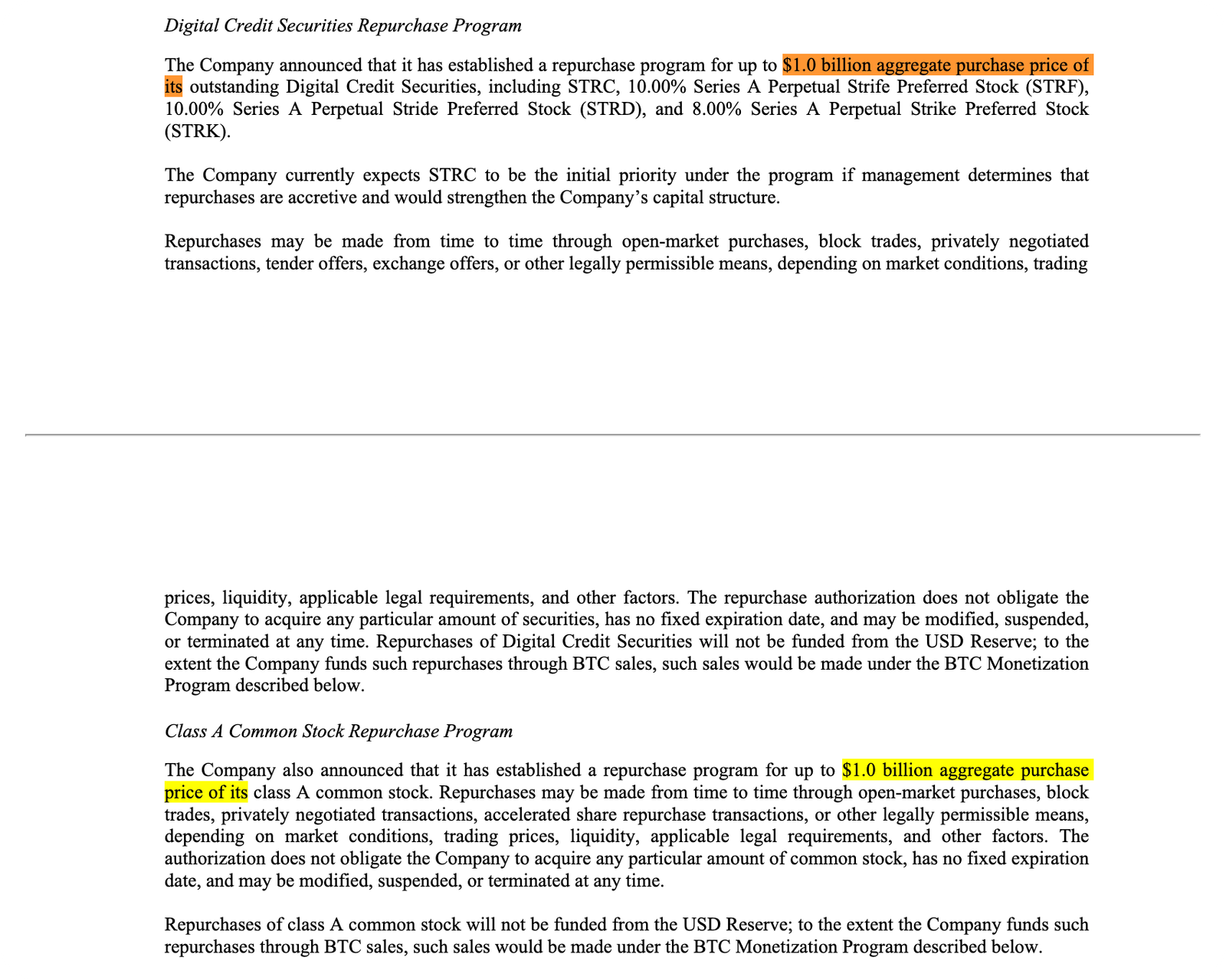
  3. Fund Share Repurchases: Sell bitcoin to repurchase preferred stock or MSTR common stock, with each repurchase channel capped at $1 billion, totaling $2 billion. Sale proceeds can also cover taxes, fees, and related expenses from the repurchases.


Only the first funding pool has the widely reported $1.25 billion limit; the third repurchase channel alone could monetize up to $2 billion worth of bitcoin. Just these two channels with explicit caps could lead to the sale of over $3 billion in bitcoin, not even counting the unlimited funding pool for dividend payments and reserve replenishment.


Distinguishing 'Building' from 'Replenishing': Blurry-Lined Accounting Operations


The sole purpose of the dollar reserve is to fund preferred stock dividends and debt interest payments. Under current rules, this money cannot be used for stock buybacks. As of June 28, the dollar reserve balance was $2.55 billion, sufficient to cover the company's annual $1.76 billion in mandatory payments for approximately 17 months. The board has set a floor: the reserve must cover at least 12 months of payments, unless the board approves a lower threshold.


This is why the distinction between "building reserve" and "replenishing reserve" deserves close scrutiny:


  • Selling bitcoin *before* a dividend payment and depositing the new cash into the reserve: defined as building reserve;
  • First using the reserve to pay a dividend, then later selling bitcoin to make up the shortfall: defined as replenishing reserve.


The plan categorizes them as two distinct operations, but their ultimate purpose is identical: selling bitcoin for cash to fund preferred stock dividends and interest payments. The relevant details were publicly disclosed, but this recent sale event vividly demonstrates how convenient this classification system is for the company. MicroStrategy sold $216 million worth of bitcoin, used the funds for dividends and to refill the reserve, yet publicly maintains that the $1.25 billion reserve-building quota remains untouched.


The market must now learn to read this "MicroStrategy-specific vernacular." "Building" and "replenishing" are merely nuanced accounting terms, yet they directly determine whether a bitcoin sale counts against the publicly stated cap.


From Simple Accumulation to Active Capital Management


In the June 29 announcement, Michael Saylor stated that this capital framework was designed to meet the company's needs for liquidity, standardized operations, and active capital management. CEO Phong Le was more direct: MicroStrategy is transitioning from a one-way street of issuing stock to buy bitcoin to a comprehensive, active capital operation.


As Matt Walsh and Jeff Dorman of Castle Island Ventures analyzed on a podcast last week, MicroStrategy has effectively become an actively managed hedge fund.


The market's narrative for MicroStrategy used to be simple: issue MSTR common stock, buy bitcoin, providing investors with leveraged bitcoin exposure. The new framework fundamentally alters this logic: the company will now actively buy and sell its own various capital instruments to balance the multiple pressures between common stock, preferred stock, dollar reserves, and bitcoin assets.


Walsh and Dorman pointed out that this operating model is internally contradictory: issuing common stock can secure preferred stock dividends but suppresses MSTR's valuation premium relative to its bitcoin holdings; selling bitcoin can extend the cash runway but fundamentally undermines the core "never sell" narrative; fully funding preferred dividends can stabilize market confidence but continuously depletes cash reserves; cutting preferred dividends preserves liquidity but could trigger a sharp drop in preferred stock prices.


The accounting loophole in the reserve quota is a microcosm of this strategic shift. Bitcoin is no longer the core asset held for the long term but a financial lever to adjust the balance sheet and maintain the functioning of the preferred stock payment system.


Conclusion


Investors must now anticipate the risks in Michael Saylor's capital management model: every action benefits one part of the capital structure while harming another.


This is also the key signal from the July 6 announcement: MicroStrategy is not short on room to sell bitcoin; its potential sale volume far exceeds the number the market superficially sees. The $1.25 billion figure only represents the company prioritizing the preservation of its bitcoin holdings if investors mistakenly believe it's the total sales cap; don't fall into this cognitive trap.


Today's MicroStrategy is a financial institution whose rules the market must parse word by word. Every professional term is critical: build, replenish, issue, repurchase, stabilize. Investors must dissect every term, like Fed watchers parsing policy statements, to gauge the potential scale of its future bitcoin sales.


This monetization plan gives MicroStrategy operational flexibility, but the underlying internal contradictions remain. It is no longer a simple, clear leveraged bitcoin investment vehicle; betting on this company is essentially a wager on its active capital management capabilities — betting it can continuously sell, refill, issue, repurchase, and stabilize its various capital tools without one link breaking and causing a systemic collapse.


Personally, I wouldn't take that bet.

Tiền kỹ thuật số thịnh hành

Câu hỏi Liên quan

QWhat are the three main purposes for which MicroStrategy can sell Bitcoin under its capital framework?

AThe three main purposes are: 1) To build a reserve, with an upper limit of $1.25 billion in funds raised; 2) To cover preferred share-related expenses, such as paying fixed dividends and debt interest; 3) To fund share repurchases, with a combined upper limit of $2 billion for repurchasing preferred shares and MSTR common stock.

QHow does MicroStrategy's recent sale of 3,588 bitcoins not deplete the widely reported $1.25 billion 'reserve building' limit?

AThe recent sale was categorized as 'reserve replenishment,' not 'reserve building.' According to MicroStrategy's accounting rules, only sales that add new cash to the reserve before dividends are paid count against the $1.25 billion 'building' limit. Sales that refill the reserve after it has been used for payouts are classified as 'replenishment' and do not count against that limit.

QWhat is the fundamental shift in MicroStrategy's corporate strategy as highlighted in the article?

AMicroStrategy has shifted from being a simple 'Bitcoin accumulator' that primarily issued shares to buy Bitcoin, to a company engaged in active capital management. It now strategically buys and sells various capital instruments (Bitcoin, preferred shares, common stock) to balance pressures across its balance sheet and maintain its payout systems.

QWhat is the 'intrinsic contradiction' within MicroStrategy's new operational model, according to the analysts cited?

AThe model is internally contradictory: issuing common stock ensures preferred share dividends but lowers MSTR's valuation premium over its Bitcoin holdings; selling Bitcoin extends cash runway but breaks the 'never sell' narrative; fully paying preferred dividends maintains market confidence but depletes cash reserves; cutting preferred dividends preserves liquidity but could cause the preferred stock price to crash.

QWhat key signal does the author suggest was released in MicroStrategy's July 6th announcement?

AThe announcement signaled that MicroStrategy has far more room to sell Bitcoin than the market's superficial focus on the $1.25 billion 'reserve building' limit suggests. The total potential selling capacity is much higher, and the $1.25 billion figure only represents a limit on one specific purpose, not the company's total Bitcoin sales capacity.

Nội dung Liên quan

Nga Tiến Hành Dự Luật Crypto Sau Khi Loại Bỏ Yêu Cầu Công Khai Địa Chỉ Ví

Ủy ban Thị trường Tài chính thuộc Duma Quốc gia Nga đã thông qua dự luật sửa đổi về quy định tiền mã hóa, chuẩn bị cho lần đọc thứ hai tại nghị viện. Theo thông báo của Chủ tịch Ủy ban Anatoly Aksakov, điểm gây tranh cãi về việc bắt buộc công khai địa chỉ ví đã được bãi bỏ. Thay vào đó, người dùng chỉ cần báo cáo số dư và khối lượng giao dịch. Dự luật sửa đổi mở rộng cơ hội đầu tư vào chứng khoán và tài sản tài chính số của Nga, nhưng vẫn duy trì giới hạn đầu tư hằng năm cho nhà đầu tư cá nhân phổ thông là 300.000 rúp thông qua một trung gian được phê duyệt. Luật cũng cho phép các công ty môi giới có giấy phép tiếp cận sàn giao dịch tiền mã hóa nước ngoài trong những điều kiện cụ thể. Bên cạnh đó, dự luật đưa ra các hạn chế đối với một số giao dịch chuyển tiền mã hóa ra nước ngoài, cho phép cơ quan chức năng tạm hoãn các giao dịch đủ điều kiện trong tối đa hai ngày. Tiền mã hóa sẽ được công nhận là tài sản trong các thủ tục phá sản và ly hôn, trong khi việc thanh toán bằng tiền mã hóa trong nước bị cấm, ngoại trừ giao dịch thương mại quốc tế.

TheNewsCrypto10 phút trước

Nga Tiến Hành Dự Luật Crypto Sau Khi Loại Bỏ Yêu Cầu Công Khai Địa Chỉ Ví

TheNewsCrypto10 phút trước

Odaily Biên tập viên trà thoại (8 tháng 7)

Đây là bản tóm tắt tiếng Việt của bài viết "Odaily编辑部茶话会 (8 tháng 7)": Đây là chia sẻ không chính thức từ biên tập viên Odaily về các quan sát và suy nghĩ đầu tư. **Wenser** chia sẻ: 1) Cổ phiếu bán dẫn Mỹ/Hàn điều chỉnh mạnh (~30%), nhưng tin rằng DRAM vẫn trong giai đoạn cung nhỏ hơn cầu. 2) Thị trường dự đoán World Cup: Không nên đặt cược mù quáng, yếu tố thương mại của FIFA rất quan trọng. Anh ấy dự đoán Pháp vô địch. 3) Vẫn có xu hướng bán khống các cổ phiếu liên quan đến tiền mã hóa như DAT, trong khi Circle và Coinbase là lựa chọn để bắt đáy. 4) Cổ phiếu phần mềm như Microsoft gần đây biểu hiện tốt, cần theo dõi thêm. **Bcxiongdi** chia sẻ: 1) Thị trường Meme trên SOL và BSC có nhiều cơ hội giao dịch nhỏ lẻ. 2) Thị trường dự đoán World Cup khó hơn cả giao dịch Meme, có thể cân nhắc đặt cược trong khi trận đấu đang diễn ra. **Azuma** chia sẻ: 1) Tiếp tục theo dõi đợt điều chỉnh mạnh của cổ phiếu bán dẫn, tin rằng nhu cầu vẫn ổn định và xem xét mua vào khi giá giảm (ưu tiên DRAM). 2) Một tín hiệu luân chuyển vốn: các quỹ phòng hộ đang tập trung mua lại cổ phiếu công nghệ. 3) Tiếp tục mua vào cổ phiếu RKLB sau khi cửa sổ bán cổ phiếu của người sáng lập đóng lại, vì cho rằng rủi ro giảm hạn chế trong khi tiềm năng tăng giá tốt. *Lưu ý: Nội dung này dựa trên trải nghiệm cá nhân, không phải lời khuyên đầu tư.*

Odaily星球日报19 phút trước

Odaily Biên tập viên trà thoại (8 tháng 7)

Odaily星球日报19 phút trước

Thiếu niên thiên tài của Huawei đặt nghi vấn về buổi phỏng vấn DeepSeek, bị mắc kẹt trong 'cuộc công kích' của nhà đầu tư Web3

Vào ngày 6/7, Lý Bác Kiệt, cựu "Thiên tài thiếu niên" của Huawei, đã thu hút sự chú ý khi công khai phàn nàn về trải nghiệm phỏng vấn tại DeepSeek. Tuy nhiên, cuộc tranh cãi lớn hơn lại nổ ra giữa anh và quỹ đầu tư cũ ABCDE Capital về dự án khởi nghiệp Metagent. Lý Bác Kiệt mô tả việc bị hoãn phỏng vấn gần nửa tháng và bị cáo buộc gian lận trong bài kiểm tra code, dẫn đến việc anh kết thúc buổi phỏng vấn. Tiếp theo đó, vào ngày 7/7, đồng sáng lập ABCDE Capital, Đỗ Quân, đã chỉ trích Lý Bác Kiệt là "người sáng lập thiếu tinh thần hợp đồng nhất". Tranh chấp xoay quanh dự án Metagent, một nền tảng no-code Web3+AI được đầu tư 150 triệu USD, trong đó 50 triệu USD đã được giải ngân. Đỗ Quân cáo buộc dự án tiến triển kém, không minh bạch tài chính và Lý Bác Kiệt bỏ đi. Lý Bác Kiệt phản bác rằng do số vốn còn lại không đến, anh phải giảm lương và gặp khó khăn khi tuyển dụng. Anh rời dự án vào tháng 10/2024 vì lý do gia đình và lo ngại rủi ro pháp lý. Các bên liên quan khác cũng bày tỏ quan ngại về tính chuyên nghiệp và tính minh bạch của Lý Bác Kiệt trong quá trình gọi vốn. Dự án Metagent sau đó ngừng hoạt động. Hiện tại, Lý Bác Kiệt tham gia với tư cách cố vấn và sau đó là Nhà khoa học trưởng tại Pine AI, một nền tảng trợ lý AI tự động cho người tiêu dùng, đã huy động được 25 triệu USD vòng Series A. Anh gần đây đã rời Pine AI do thay đổi hướng nghiên cứu sang mô hình cơ bản.

Foresight News49 phút trước

Thiếu niên thiên tài của Huawei đặt nghi vấn về buổi phỏng vấn DeepSeek, bị mắc kẹt trong 'cuộc công kích' của nhà đầu tư Web3

Foresight News49 phút trước

Giải mã chương trình quy định năm 2026 của SEC: Ý nghĩa đối với tiền mã hóa

Ủy ban Chứng khoán và Sàn giao dịch Hoa Kỳ (SEC) đã công bố lộ trình quy định cho năm 2026, đánh dấu sự chuyển hướng từ trọng tâm thực thi sang xây dựng khuôn khổ "safe harbor" để tạo ra các quy tắc minh bạch hơn cho tài sản kỹ thuật số, với mục tiêu bảo vệ nhà đầu tư. Những hướng dẫn rõ ràng hơn về lưu ký và giao dịch dự kiến sẽ củng cố niềm tin của các tổ chức, khuyến khích họ tăng cường phân bổ vào crypto thông qua các sản phẩm được quản lý như ETF. Tài sản trong các quỹ ETF crypto đã vượt 65 tỷ USD, phản ánh sự tham gia ngày càng tăng. Để đáp ứng dòng vốn tổ chức, các nền tảng Tài chính Phi tập trung (DeFi) đang phát triển các lớp tuân thủ như nhóm được cấp phép và hệ thống danh tính số, cho phép tham gia thị trường token hóa trong khi vẫn tuân theo quy định. Tuy nhiên, thách thức lớn vẫn là cân bằng giữa tuân thủ và các nguyên tắc mở cốt lõi của DeFi. Tóm lại, động thái của SEC hứa hẹn mang lại sự rõ ràng pháp lý, thúc đẩy sự tham gia của tổ chức, đồng thời buộc hệ sinh thái DeFi phải thích nghi để hòa nhập với môi trường quy định mới này.

ambcrypto55 phút trước

Giải mã chương trình quy định năm 2026 của SEC: Ý nghĩa đối với tiền mã hóa

ambcrypto55 phút trước

SemiAnalysis: Lợi nhuận Quý III của Anthropic sẽ vượt 10 tỷ USD

Phân tích của SemiAnalysis cho thấy Anthropic đang tái định hình thị trường AI thương mại với lợi nhuận và tốc độ tăng trưởng vượt trội. Dự báo công ty sẽ đạt lợi nhuận hoạt động (GAAP EBIT) 1 tỷ USD vào quý 3/2026, với tỷ suất lợi nhuận ~6%. Doanh thu định kỳ hàng năm (ARR) đã tăng vọt từ 9 tỷ USD cuối 2025 lên trên 600 tỷ USD hiện tại. Nếu duy trì tốc độ tăng ARR ròng (NNARR) ~150 tỷ USD/tháng, ARR cuối 2027 có thể chạm 3.000 tỷ USD, định giá doanh nghiệp lên tới 6.000 tỷ USD. Động lực chính đến từ sự phổ biến bùng nổ của Claude Code, hiện chiếm hơn 7% lượng commit code trên GitHub. Mô hình kinh doanh chủ yếu dựa trên API (75-85% ARR) mang lại lợi thế lớn: tỷ lệ giữ chân doanh thu ròng (NRR) lên tới 500% và biên lợi nhuận gộp trên 80%. Ngược lại, OpenAI vẫn phụ thuộc nhiều vào thuê bao người dùng cuối. Lợi nhuận cải thiện nhờ hiệu suất suy luận tăng, với ARR trên mỗi megawatt dự kiến đạt 60 triệu USD. Tuy nhiên, hạn chế chính là nguồn cung năng lực tính toán. Nhu cầu tổng hợp của Anthropic và OpenAI có thể vượt 100 GW vào 2030, trong khi nguồn cung hiện rất hạn chế. Đây là lý do then chốt cho đợt IPO sắp tới của Anthropic nhằm huy động vốn mua sắm năng lực tính toán. Các rủi ro tiềm ẩn bao gồm áp lực cạnh tranh về giá, sự cạnh tranh từ các mô hình lập trình của Google và Meta, quy định của chính phủ, và việc phụ thuộc ngày càng nhiều vào kênh phân phối "Token như một Dịch vụ" (TaaS) có thể làm loãng biên lợi nhuận tổng thể.

marsbit1 giờ trước

SemiAnalysis: Lợi nhuận Quý III của Anthropic sẽ vượt 10 tỷ USD

marsbit1 giờ trước

Giao dịch

Giao ngay

Bài viết Nổi bật

Làm thế nào để Mua CAP

Chào mừng bạn đến với HTX.com! Chúng tôi đã làm cho mua Cap (CAP) trở nên đơn giản và thuận tiện. Làm theo hướng dẫn từng bước của chúng tôi để bắt đầu hành trình tiền kỹ thuật số của bạn.Bước 1: Tạo Tài khoản HTX của BạnSử dụng email hoặc số điện thoại của bạn để đăng ký tài khoản miễn phí trên HTX. Trải nghiệm hành trình đăng ký không rắc rối và mở khóa tất cả tính năng. Nhận Tài khoản của tôiBước 2: Truy cập Mua Crypto và Chọn Phương thức Thanh toán của BạnThẻ Tín dụng/Ghi nợ: Sử dụng Visa hoặc Mastercard của bạn để mua Cap (CAP) ngay lập tức.Số dư: Sử dụng tiền từ số dư tài khoản HTX của bạn để giao dịch liền mạch.Bên thứ ba: Chúng tôi đã thêm những phương thức thanh toán phổ biến như Google Pay và Apple Pay để nâng cao sự tiện lợi.P2P: Giao dịch trực tiếp với người dùng khác trên HTX.Thị trường mua bán phi tập trung (OTC): Chúng tôi cung cấp những dịch vụ được thiết kế riêng và tỷ giá hối đoái cạnh tranh cho nhà giao dịch.Bước 3: Lưu trữ Cap (CAP) của BạnSau khi mua Cap (CAP), lưu trữ trong tài khoản HTX của bạn. Ngoài ra, bạn có thể gửi đi nơi khác qua chuyển khoản blockchain hoặc sử dụng để giao dịch những tiền kỹ thuật số khác.Bước 4: Giao dịch Cap (CAP)Giao dịch Cap (CAP) dễ dàng trên thị trường giao ngay của HTX. Chỉ cần truy cập vào tài khoản của bạn, chọn cặp giao dịch, thực hiện giao dịch và theo dõi trong thời gian thực. Chúng tôi cung cấp trải nghiệm thân thiện với người dùng cho cả người mới bắt đầu và người giao dịch dày dạn kinh nghiệm.

Tổng lượt xem 73Xuất bản vào 2026.06.26Cập nhật vào 2026.06.26

Làm thế nào để Mua CAP

Thảo luận

Chào mừng đến với Cộng đồng HTX. Tại đây, bạn có thể được thông báo về những phát triển nền tảng mới nhất và có quyền truy cập vào thông tin chuyên sâu về thị trường. Ý kiến ​​của người dùng về giá của CAP (CAP) được trình bày dưới đây.

活动图片