$8 Billion Valuation, 2x Growth in 8 Months! What Makes Crypto-Friendly Bank Erebor Bank So Special?

链捕手Xuất bản vào 2026-07-04Cập nhật gần nhất vào 2026-07-04

Tóm tắt

Erebor Bank, a crypto-friendly U.S. bank founded by Palmer Luckey, is reportedly in talks for a new funding round targeting a valuation of at least $8 billion, double its $4.35 billion valuation from December. Despite being operational for only a few months, its rapid growth—deposits surged from $1.1 billion in March to approximately $4.05 billion within a quarter, adding nearly 400 clients—has attracted investor interest. The bank aims to fill the void left by Silicon Valley Bank's collapse, targeting startups and businesses with non-traditional assets like defense contracts and digital tokens. Its strategy involves holding its own banking license to offer services like stablecoin deposits, payments, and 24/7 on-chain settlement. While digital assets are a core long-term focus, recent growth has been driven more by financing for U.S. manufacturing and defense sectors. Erebor's leadership combines Luckey's tech/defense background with a seasoned financial team. It received a national bank charter from the OCC in early 2026, benefiting from a favorable regulatory climate for digital assets. However, the bank faces significant risks, including reliance on a concentrated client base, exposure to crypto market volatility, potential regulatory shifts, and the unproven demand for its integrated banking model. Investors are betting on its future potential to monetize deposits through lending and crypto services, despite current losses typical for a new bank.

Author: Chloe, ChainCatcher

According to a Bloomberg report, digital bank Erebor, initiated by Anduril founder Palmer Luckey and backed by billionaire investor Peter Thiel, is in talks with investors for a new round of financing, targeting a valuation of at least $8 billion, roughly double its December 2025 round ($350 million raised, $4.35 billion valuation). The financing is still in early stages, with the valuation not yet finalized. An Erebor spokesperson declined to comment on the negotiations.

A bank that has only been operating for a few months, doubling its valuation, stands as one of the highest valuation increases among newly licensed U.S. banks in recent years. What likely makes investors willing to reprice it is the expansion speed revealed in its financial reports.

What Potential Do Investors See in the Financials?

According to sources familiar with the matter, Erebor's deposit base surged from $1.1 billion disclosed to regulators at the end of March to approximately $4.05 billion within three months, nearly quadrupling in a single quarter. It also added nearly 400 new clients, with the bank expecting to become profitable by the end of 2026.
This growth rate has also sparked external skepticism—whether Erebor's ties to Silicon Valley tech circles and government/defense circles are too close, raising suspicions of a "friends and family" game.

Luckey responded directly, emphasizing that none of the quarterly growth came from his own companies, and new clients independently chose Erebor. He added that a significant portion of the recent expansion focused on companies rebuilding U.S. manufacturing capacity, and the bank has correspondingly expanded equipment financing, venture debt, and credit businesses supporting industrial and defense enterprises.

Looking back at the Q1 financials, Erebor's total assets were $1.703 billion, deposits $1.098 billion, and bank equity $600.6 million. There were no loans, leases, or borrowings other than deposits (items like federal funds purchased, repurchase agreements, other borrowed money, subordinated debt were all zero). The asset structure was extremely liquid: approximately $1.411 billion in cash and due from banks, and about $275 million in available-for-sale debt and equity securities (of which bonds $116 million, equity securities $159 million).

Additionally, quarterly net interest income was only $3.36 million, non-interest expenses were $10.56 million, resulting in a net loss of $6.01 million. However, for a newly launched bank still amortizing technology, compliance, and operational costs, such losses are considered necessary expenditures.

In other words, investors are willing to pay an $8 billion valuation not for Erebor's current monetization potential, but for its growth speed—deposits surging from $1.1 billion to $4.05 billion—and the expectation that it will eventually lend out these deposits and develop stablecoin business.

Founder Unfamiliar with Wall Street, Yet Comes with Considerable Pedigree

To understand Erebor, one must first understand the recurring product-building pattern behind it.

Founder Palmer Luckey's trajectory spans Oculus VR and Anduril, consistently focusing on capital-intensive industries at the intersection of hardware, regulatory moats, and government-adjacent ecosystems. In 2012, he entered the not-yet-formed VR market, solving long-standing industry issues like latency and spatial tracking, selling Oculus to Facebook for $2 billion in 2014. His second venture, Anduril, applied the same playbook to the defense industry: using private venture capital to build defense systems first, then selling them to the government as "products" rather than through traditional "cost-plus" contracts, thereby building deep relationships with the Department of Defense and intelligence agencies. Luckey explicitly stated that Erebor would "work with the intelligence community from day one" to prevent fraud, adopting a proactive compliance posture.

However, Luckey himself is an outsider to banking. Erebor's brand partly relies on his and Thiel's reputations, but prestige ultimately cannot replace regulatory and operational track records. Once entering Wall Street, the bank will ultimately be judged by the standards of a regulated institution.

Therefore, the real operators are a team with deep financial backgrounds: President Michael Hagedorn from Wells Fargo's regional banking; CEO Owen Rapaport with crypto compliance experience through Aer Compliance; Chief Strategy Officer Jacob Hirshman, who worked on Circle's stablecoin business and practiced at Sullivan & Cromwell; Growth VP Noah Pompan with a background at MoonPay. The investor lineup includes Joe Lonsdale's 8VC, Thiel's Founders Fund, Lux Capital, and a fund associated with a16z.
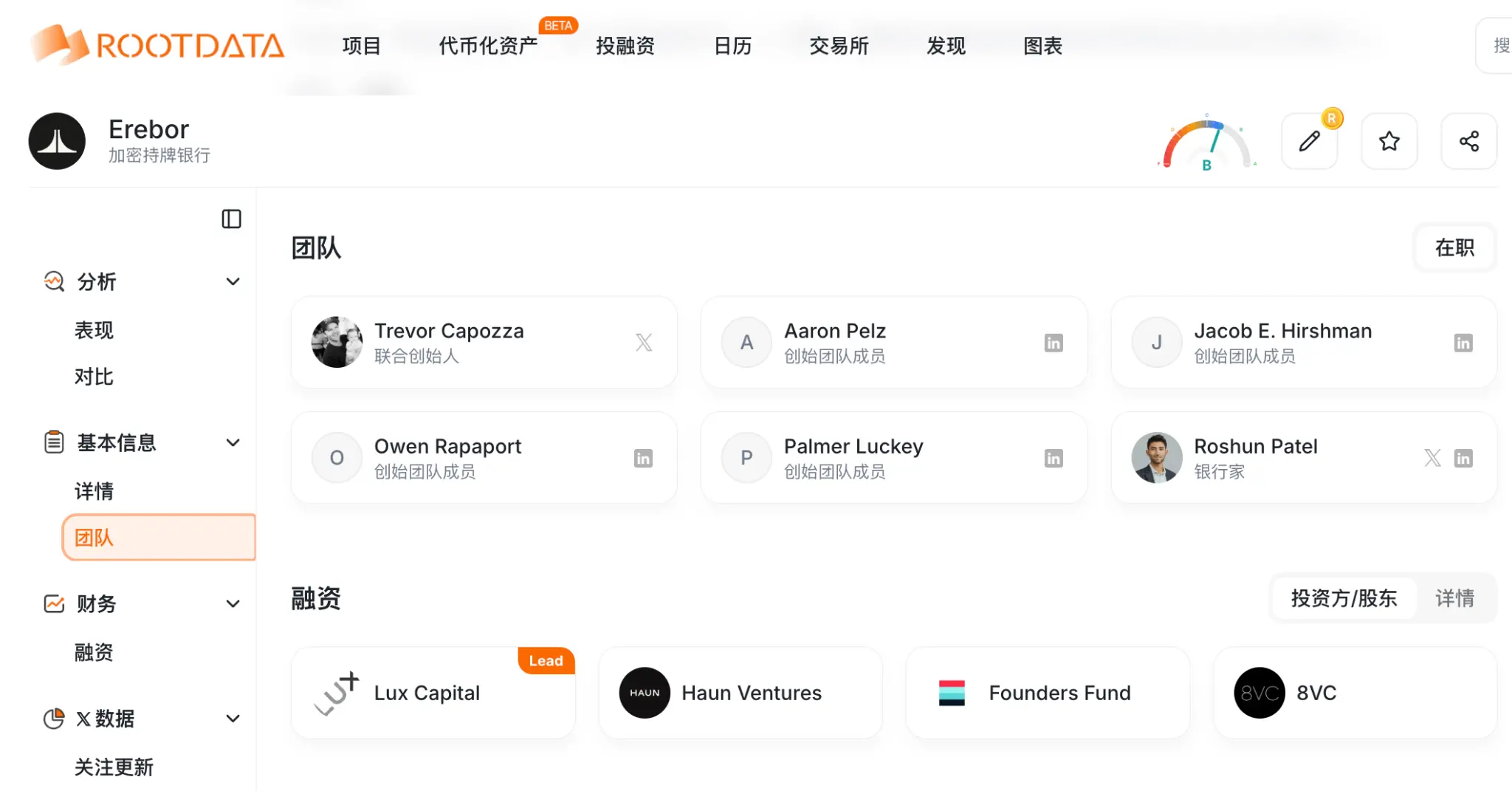
Image Source:RootData

Furthermore, a key strategic choice for Erebor is: insisting on obtaining its own license and being responsible for its financials, unlike Mercury or Brex which rely on partner banks. Luckey's argument is that relying on third-party infrastructure exposes one to risks of "de-platforming," policy pressure, and product limitations; only by holding the license and ledger can it fulfill promises of on-chain settlement, stablecoin minting, and redemption.

Looking back at Erebor's origin, it is almost entirely tied to the collapse of Silicon Valley Bank (SVB) in 2023. That failure left a large number of startups and venture capitalists suddenly without banking partners and deposit protection. Luckey and investors believed this left a "structural vacuum"—the disappearance of banks specializing in serving startups, while traditional banks were too conservative or slow for startups holding non-standard assets (defense contracts, AI hardware, digital tokens).

Erebor claims to address roughly four pain points: First, providing credit for physical assets—traditional banks are good at lending against real estate or receivables but not at valuing "GPUs" or "aerospace research." Second, bridging the on-chain/off-chain divide, bringing fiat banking and stablecoin settlement onto the same regulated balance sheet. Third, meeting 24/7 settlement needs, replacing SWIFT and ACH still operating on decades-old schedules. Fourth, providing USD access for high-growth international companies, combating the "de-banking" friction they often face.

Of course, how much of this operational potential is real versus marketing remains debatable. Venture-backed companies now have alternatives like non-bank lenders and DeFi lending, and some incumbent banks had already started targeting tech niches before SVB's collapse. Erebor's founders clearly believe existing institutions are insufficient, and the fact that it obtained a full banking license suggests regulators might also see some merit in this assessment?

Additionally, digital assets are core to Erebor's long-term strategy. It plans to handle deposits and payments for dollar stablecoins, provide instant fiat/stablecoin conversion, 24/7 settlement rails, and gradually support stablecoin minting and redemption within a regulated framework. Its OCC license even explicitly allows it to hold small amounts of crypto assets on its own books to pay for on-chain transaction fees, with supervisory letters defining such holdings as "incidental" to banking business—a noteworthy precedent in compliance.

On April 2nd, the Sui Foundation announced that Erebor now supports the Sui network, allowing clients to deposit and withdraw stablecoins. This is one of the first public pieces of evidence of it connecting regulated bank infrastructure to on-chain payments.

However, reality also presents gaps. Sources indicate demand for crypto-collateralized loans has been lower than the bank initially expected. This aligns with the earlier financials: the recent growth has actually been driven by companies rebuilding U.S. manufacturing capacity and their equipment financing and venture debt needs. In other words, Erebor currently resembles more of a "defense + advanced manufacturing + crypto" hybrid than a purely native crypto bank.

Perfect Timing—Even Its License Application Timing Was Fortuitous?

Breaking down the licensing: Erebor received preliminary conditional approval from the OCC on October 15, 2025, FDIC deposit insurance approval on December 16, final license in early February 2026, and officially launched on February 8 with approximately $625 million in initial capital (significantly increased from about $275 million during the preliminary approval phase). It is the first newly issued (de novo) national bank charter under the current U.S. administration.
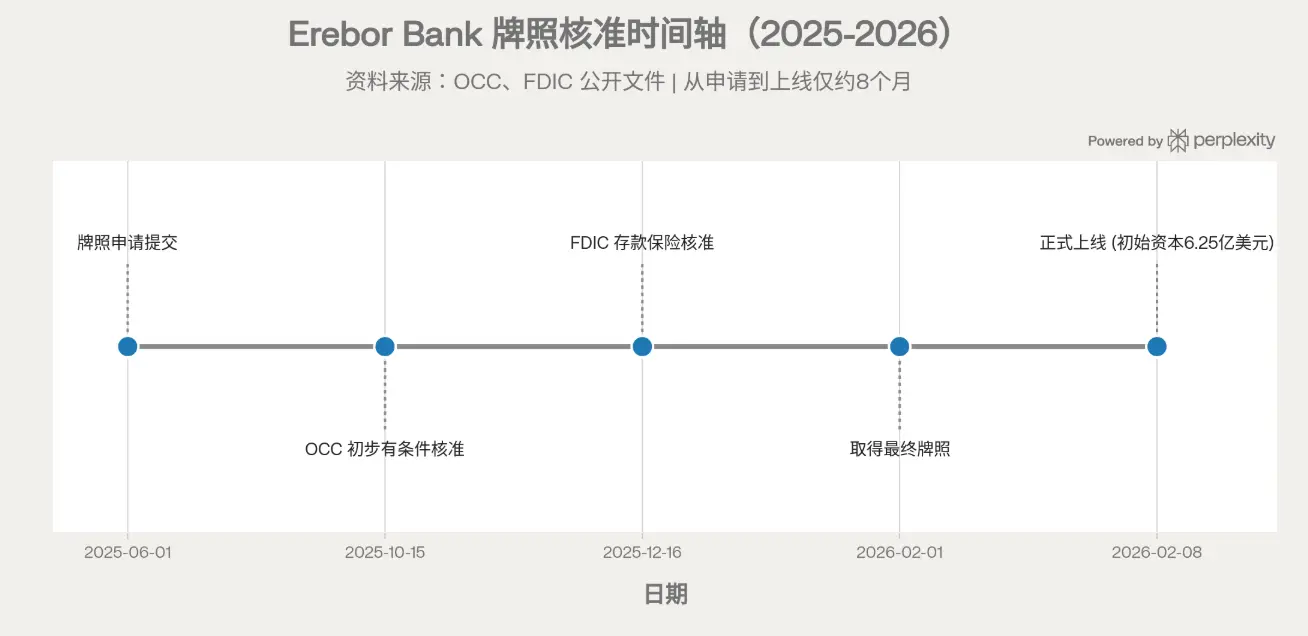
All this occurred against the backdrop of a clear shift in U.S. banking policy: Under the leadership of Acting Comptroller Jonathan Gould, the OCC has adopted an explicitly open regulatory stance toward digital asset banks, with Gould himself hailing this license as an example of a "dynamic and diverse financial system"; coupled with the advancement of federal-level stablecoin framework (GENIUS Act), once-fuzzy legal territories have been clarified considerably.

Notably, regulators did not grant approval without conditions. In exchange for approval, the OCC and FDIC imposed strict requirements: maintaining a Tier 1 leverage ratio of at least 12% for the first three years (roughly double the "well-capitalized" threshold) and a capital maintenance commitment. It could be said that Erebor's feasibility is partly tied to the current political cycle. If future regulatory stances shift, or stablecoin and anti-money laundering rules tighten, its entire narrative built on "token-friendly rules" could face headwinds.

Finally, synthesizing external media judgments, Erebor's model replicates almost every risk that contributed to SVB's downfall.

It serves early-stage, tech-heavy companies with non-traditional collateral. It caters to a small number of large accounts (startups, founders, investment funds) rather than thousands of retail customers; any single client's failure or withdrawal (crypto market volatility, venture capital pullback) could significantly impact liquidity. Regulators have long pointed out that SVB's "monoculture" client structure was a key driver of its run.

Crypto correlation makes the issue more tricky. If a supported stablecoin de-pegs or crypto prices crash, the deposit base and loan collateral could shrink simultaneously. Further down are policy reversal risks (its entire narrative bets on lenient token rules), execution risks of building core systems and on-chain settlement from scratch, and the unverified premise of "whether stablecoins will be widely adopted by clients." Finally, reputational and political risks—Luckey's highly controversial political affiliations plus the novelty of a "crypto bank" itself could amplify market confidence loss if the bank ever faces trouble.

It could be said Erebor is a high-profile experiment happening at the intersection of banking, crypto, and industrial policy.

The market need it advocates emerged from the financing gap left by SVB's collapse and friction in crypto payments. Now, regulators have given paper endorsement, the team combines tech prestige with Wall Street backgrounds. The execution of this new model, the continuity of regulatory stances, and the genuine market demand for its integrated services are precisely the points under rigorous market scrutiny.


Tiền kỹ thuật số thịnh hành

Câu hỏi Liên quan

QWhat are the key factors driving Erebor Bank's rapid valuation increase to $8 billion?

AThe rapid valuation increase to $8 billion is primarily driven by the bank's exceptional deposit growth, which surged from $1.1 billion to approximately $4.05 billion in a single quarter. Investors are betting on its future potential to deploy these deposits into profitable lending and stablecoin operations, its strategic positioning to fill the void left by Silicon Valley Bank's collapse, and its unique combination of founder reputation (Palmer Luckey, Peter Thiel) and a seasoned financial and crypto-compliance team.

QHow does Erebor Bank's business model differ from that of traditional banks and other fintech companies like Mercury?

AErebor Bank's business model differs from traditional banks by focusing on niche, capital-intensive clients like defense, advanced manufacturing, and crypto-native businesses, offering services like equipment financing for non-traditional assets (e.g., GPUs) and crypto integration. Unlike fintechs like Mercury or Brex that operate on third-party bank infrastructure, Erebor holds its own national bank charter, giving it direct control over its ledger, compliance, and the ability to offer regulated stablecoin minting/redemption and 24/7 on-chain settlement services.

QWhat are the main risks associated with Erebor Bank's strategy as outlined in the article?

AThe main risks include: 1) Concentrated client risk similar to SVB, relying on a small number of large depositors from volatile sectors (tech startups, crypto). 2) Execution risk in building core banking and on-chain settlement systems from scratch. 3) Regulatory and policy risk, as its model depends on a favorable crypto regulatory environment which could reverse. 4) Market adoption risk for its core crypto/stablecoin services, which currently have lower-than-expected demand. 5) Reputational and political risk tied to its founders' controversial profiles and the novel nature of a 'crypto bank'.

QWhat role does digital asset integration play in Erebor Bank's long-term strategy?

ADigital asset integration is central to Erebor's long-term strategy. It plans to offer deposit and payment services for US dollar stablecoins, provide instant fiat-to-stablecoin conversions, enable 24/7 settlement rails, and support the minting and redemption of stablecoins within a regulated framework. Its OCC charter even allows it to hold small amounts of crypto assets on its balance sheet for operational purposes. The bank has already taken steps like integrating with the Sui network for stablecoin transactions.

QWhy was the timing of Erebor Bank's regulatory approval considered favorable?

AThe timing was favorable due to a significant shift in U.S. banking policy under the current administration. The OCC, led by Acting Comptroller Jonathan Gould, adopted an explicitly open stance toward digital asset banks. This coincided with legislative progress on a federal stablecoin framework (the GENIUS Act), which helped clarify the legal landscape. Erebor's charter is the first *de novo* national bank charter issued under this administration, making it a beneficiary of this specific regulatory and political moment.

Nội dung Liên quan

Ethereum Chuẩn Bị Nhẹ Nhàng? Những Người Ủng Hộ Ethereum Nghĩ Gì Về Triển Vọng Sau Nâng Cấp Lean Ethereum

Tác giả: Biteye Ethereum (ETH) đang có dấu hiệu phục hồi sau đợt giảm giá vào tháng Sáu, một phần nhờ kỳ vọng giảm lãi suất. Trong bối cảnh này, Vitalik Buterin đã công bố lộ trình "Lean Ethereum", được mô tả là bản nâng cấp lớn thứ ba của mạng lưới, nhằm thiết kế lại các lớp đồng thuận, dữ liệu và thực thi để trở nên đơn giản hơn, an toàn hơn (chống lượng tử), dễ xác minh và có khả năng mở rộng cao hơn. Cùng lúc, việc Quỹ Ethereum cắt giảm 20% nhân sự và sự xuất hiện của các tổ chức mới như EthLabs cho thấy một sự tái cơ cấu hướng tới vận hành tinh gọn hơn. **Quan điểm lạc quan:** Các nhân vật có ảnh hưởng như Sassal (The Daily Gwei), Ryan Sean Adams (Bankless), BITWU, Lanhu và gigi nhìn nhận Lean Ethereum là một tín hiệu tích cực. Họ cho rằng điều này giúp Ethereum tập trung trở lại vào nền tảng giao thức, tăng cường tính phi tập trung (ví dụ: giảm yêu cầu phần cứng chạy node), bảo mật và khả năng tồn tại lâu dài. Đây được xem là sự chuyển mình từ "mở rộng câu chuyện" sang "củng cố giao thức", trả lời cho câu hỏi về giá trị cốt lõi của Ethereum trong thập kỷ tới. **Quan điểm thận trọng:** Mặt khác, các chuyên gia như Ignas (nhà nghiên cứu DeFi) và Dankrad Feist (cựu nghiên cứu viên Quỹ Ethereum) thừa nhận lộ trình tốt nhưng lo ngại về tiến độ thực hiện kéo dài 3-4 năm. Họ nhấn mạnh thị trường cần thấy kết quả cụ thể và khả năng nắm bắt giá trị nhanh chóng, đặc biệt khi các đối thủ cạnh tranh trong lĩnh vực RWA đang gia tăng. **Tóm lại:** Dù còn những ý kiến về tốc độ triển khai, Lean Ethereum được kỳ vọng sẽ định hình lại chủ đề chính cho Ethereum, mang lại cảm giác chủ động hiếm có về mặt định hướng phát triển. Thành công cuối cùng sẽ phụ thuộc vào khả năng thực thi và điều kiện thị trường chung.

marsbit27 phút trước

Ethereum Chuẩn Bị Nhẹ Nhàng? Những Người Ủng Hộ Ethereum Nghĩ Gì Về Triển Vọng Sau Nâng Cấp Lean Ethereum

marsbit27 phút trước

AI Gấp Lại, Fable 5 Và GPT-5.6, Đang Trở Thành Đặc Quyền Của Một Số Ít Người

Chúng ta đang sống trong một thế giới “AI phân tầng”. Một bên là thiểu số tinh hoa công nghệ được tiếp cận những mô hình AI đỉnh cao như Fable 5 hay GPT-5.6 sắp ra mắt, có khả năng như một kiến trúc sư hay kỹ sư cấp cao, thậm chí phát hiện công thức toán học mới. Trong khi đó, đa số công chúng chỉ trải nghiệm các mô hình miễn phí, thông thường từ 8B đến 30B tham số, tương đương ChatGPT bản miễn phí hay Copilot cơ bản - những sản phẩm bị xem là "đồ chơi" AI với khả năng hạn chế. Sự chênh lệch trải nghiệm này tạo ra một hố sâu ngăn cách nhận thức. Giới bình thường không hiểu AI có thể thay thế công việc thế nào, trong khi giới tinh hoa đang tận hưởng lợi thế cạnh tranh khổng lồ. Khoảng cách này càng được nới rộng bởi chi phí: có người tiết lộ đã chi 1000 USD/ngày cho các dự án suy luận trên Fable. Hơn nữa, người dùng cao cấp không dùng một mô hình đơn lẻ mà xây dựng một ma trận đa mô hình, nơi mỗi AI đảm nhận một vai trò chuyên biệt (như lập kế hoạch, kiến trúc, lập trình, rà soát) để đạt hiệu quả tối đa. Sự phân tầng này đặc biệt nghiêm trọng trong lĩnh vực sức khỏe, nơi AI miễn phí có tỷ lệ sai sót cao (được cho là trên 51%) khi trả lời câu hỏi y tế, trong khi phiên bản Pro chính xác và an toàn hơn nhiều. Tuy nhiên, cũng có ý kiến cho rằng với 90% công việc văn phòng thông thường, các mô hình như ChatGPT 5.4/5.5 là đủ dùng; vấn đề nằm ở việc tích hợp ngữ cảnh và dữ liệu phù hợp vào quy trình làm việc hơn là trí thông minh thuần túy của AI. Tóm lại, sự bất bình đẳng trong tiếp cận AI mạnh mẽ đang âm thầm định hình tương lai. Khi các gã khổng lồ công nghệ nói về việc AI định hình lại xã hội, đừng chê bai AI là "ngu ngốc" chỉ vì chatbot miễn phí tính toán sai. Trong thế giới bị "gấp khúc" này, AI không ngu đi, mà là những AI thực sự mạnh mẽ đang ngày càng trở nên xa tầm với của số đông.

marsbit1 giờ trước

AI Gấp Lại, Fable 5 Và GPT-5.6, Đang Trở Thành Đặc Quyền Của Một Số Ít Người

marsbit1 giờ trước

Ark Invest của bà Cathie Wood mua vào 77 triệu USD trong tháng 6, liệu cổ phiếu crypto có phải là ‘phiên bản thay thế’ an toàn hơn Bitcoin?

ARK Invest của Cathie Wood đã mua vào 77 triệu USD cổ phiếu công ty tiền mã hóa trong tháng 6, trong bối cảnh Bitcoin có tháng tồi tệ nhất 4 năm. Tuy nhiên, phân tích của CryptoSlate cho thấy các cổ phiếu này không hẳn là "thay thế an toàn" cho Bitcoin. Các công ty như Circle, MSTR và Bullish có mức biến động cao gấp đôi Bitcoin (68%–103.6% so với ~37.6%–37.8%). Hơn nữa, mối tương quan giá của chúng với Bitcoin chỉ ở mức trung bình (0.55–0.85), nghĩa là biến động giá chịu ảnh hưởng lớn từ các rủi ro riêng như báo cáo tài chính, cạnh tranh ngành và pha loãng vốn cổ đông. MSTR là cổ phiếu duy nhất theo sát Bitcoin với beta 1.59. Coinbase có mối tương quan khá mạnh (beta 1.26) nhưng vẫn biến động cao hơn. Trong khi đó, Circle hay Robinhood chịu ảnh hưởng nhiều bởi mô hình kinh doanh riêng (ví dụ: cạnh tranh stablecoin, đa dạng hóa dịch vụ môi giới). Các công ty khai thác như RIOT hay MARA thậm chí tăng giá mạnh nhờ chuyển hướng sang kinh doanh dịch vụ điện toán AI, tách biệt với xu hướng giá Bitcoin. Trường hợp của Strategy minh họa rủi ro bổ sung khi đầu tư cổ phiếu: cơ cấu vốn và nhu cầu thanh khoản có thể buộc công ty bán Bitcoin dự trữ, một rủiro mà người nắm giữ Bitcoin trực tiếp không gặp phải. Tóm lại, đầu tư vào cổ phiếu tiền mã hóa không đơn giản là một cách tiếp xúc gián tiếp với Bitcoin. Nó có thể khuếch đại biến động hoặc mang thêm rủi ro kinh doanh đặc thù. Những cổ phiếu hoạt động tốt nhất năm nay chủ yếu nhờ các động lực tăng trưởng độc lập như AI hay dịch vụ tài chính đa dạng.

marsbit1 giờ trước

Ark Invest của bà Cathie Wood mua vào 77 triệu USD trong tháng 6, liệu cổ phiếu crypto có phải là ‘phiên bản thay thế’ an toàn hơn Bitcoin?

marsbit1 giờ trước

Thị trường tiền mã hóa đón 'bước ngoặt tháng Bảy'? Tín hiệu đáy hàng loạt hiện rõ, nhưng cần vượt 70.000 USD để đảo chiều xu hướng

Tín hiệu tích cực xuất hiện trên thị trường tiền mã hóa vào tháng 7, với Bitcoin dẫn đầu đợt phục hồi vượt mức 63.000 USD. Tổng vốn hóa thị trường tăng lên 2,28 nghìn tỷ USD. Động lực đến từ kỳ vọng chính sách tiền tệ Mỹ ít nghiêm ngặt hơn, dòng tiền quay trở lại ETF Bitcoin và hiện tượng bán tháo trong thị trường phái sinh. Nhiều chỉ số on-chain báo hiệu đáy tiềm năng: chỉ số sợ hãi-tham lam ở mức thấp, tỷ lệ Sharpe âm sâu, tỷ lệ lãi/lỗ UTXO cho thấy dấu hiệu "đầu hàng", và chỉ số AHR999 tiệm cận vùng cực kỳ hiếm gặp trong lịch sử. Áp lực bán từ thợ đào cũng đạt mức cao. Tuy nhiên, bức tranh tổng thể chưa hoàn toàn lạc quan. Nhu cầu giao dịch spot còn yếu, dòng vốn thể chế vẫn thận trọng với mức chiết khấu kéo dài trên Coinbase, và thị trường altcoin tiếp tục chịu áp lực bán. Các nhà phân tích cho rằng đợt tăng giá hiện tại có tính chất phục hồi kỹ thuật nhiều hơn là đảo chiều xu hướng thực sự. Mức giá 70.000 USD - tương ứng với giá thực hiện của nhà đầu tư ngắn hạn (STH-RP) - được xem là ngưỡng then chốt cần chinh phục để xác nhận đảo chiều tăng trưởng. Nếu không có sự cải thiện mạnh mẽ về dòng tiền thể chế và thanh khoản spot, thị trường vẫn có thể dao động và thử thách các vùng đáy tiềm năng trong khoảng 37.000 - 60.000 USD trước khi bước vào chu kỳ tăng giá mới.

marsbit1 giờ trước

Thị trường tiền mã hóa đón 'bước ngoặt tháng Bảy'? Tín hiệu đáy hàng loạt hiện rõ, nhưng cần vượt 70.000 USD để đảo chiều xu hướng

marsbit1 giờ trước

Giao dịch

Giao ngay

Bài viết Nổi bật

$BANK là gì

Ngân Hàng AI: Một Bước Đột Phá Cách Mạng Trong Tương Lai Ngành Ngân Hàng Giới thiệu Trong một thời đại được đánh dấu bởi những tiến bộ nhanh chóng trong công nghệ, Ngân hàng AI đứng tại giao điểm của trí tuệ nhân tạo (AI) và dịch vụ ngân hàng. Dự án đổi mới này nhằm định hình lại cảnh quan tài chính, nâng cao hiệu quả hoạt động, các biện pháp an ninh và trải nghiệm của khách hàng thông qua sức mạnh của AI. Khi chúng ta bắt đầu cuộc khám phá về Ngân hàng AI, chúng ta sẽ tìm hiểu về nội dung của dự án, động lực hoạt động của nó, bối cảnh lịch sử và những cột mốc quan trọng. Ngân Hàng AI là gì? Về bản chất, Ngân hàng AI đại diện cho một sáng kiến biến đổi nhằm tích hợp trí tuệ nhân tạo vào các hoạt động ngân hàng khác nhau. Dự án này tận dụng khả năng của AI để tự động hóa quy trình, cải thiện các quy trình quản lý rủi ro và nâng cao tương tác với khách hàng thông qua các dịch vụ cá nhân hóa. Mục tiêu chính của Ngân hàng AI bao gồm: Tự động hóa các chức năng ngân hàng: Bằng cách tận dụng công nghệ AI, Ngân hàng AI nhằm tự động hóa các nhiệm vụ thường nhật, giảm gánh nặng cho nhân lực và nâng cao hiệu quả. Quản lý rủi ro nâng cao: Dự án sử dụng các thuật toán AI để dự đoán và xác định rủi ro, từ đó củng cố các biện pháp an ninh chống lại gian lận và các mối đe dọa khác. Cá nhân hóa dịch vụ ngân hàng: Ngân hàng AI tập trung vào việc cung cấp các sản phẩm và dịch vụ tài chính được điều chỉnh theo nhu cầu của từng khách hàng bằng cách phân tích dữ liệu và hành vi của họ. Cải thiện trải nghiệm khách hàng: Việc triển khai các giải pháp sử dụng AI như chatbot và trợ lý ảo nhằm cung cấp cho người dùng những tương tác giống như con người hơn, cách mạng hóa cách khách hàng tương tác với ngân hàng. Với những mục tiêu này, Ngân hàng AI định vị mình như một nhân tố quan trọng trong việc làm cho ngân hàng trở nên hiệu quả hơn, an toàn hơn và tập trung vào người dùng. Ai là người sáng tạo ra Ngân Hàng AI? Thông tin về người sáng tạo ra Ngân hàng AI vẫn chưa rõ ràng. Do đó, không có cá nhân hay tổ chức cụ thể nào được xác định trong thông tin hiện có. Sự ẩn danh xung quanh sự ra đời của dự án đặt ra nhiều câu hỏi nhưng không giảm bớt tầm nhìn và mục tiêu đầy tham vọng của nó. Ai là nhà đầu tư của Ngân Hàng AI? Tương tự như người sáng tạo của dự án, thông tin cụ thể về các nhà đầu tư hoặc các tổ chức hỗ trợ Ngân hàng AI chưa được công bố. Thiếu thông tin này, thật khó để nêu rõ sự hỗ trợ tài chính và hỗ trợ từ các tổ chức có thể thúc đẩy dự án tiến triển. Tuy nhiên, tầm quan trọng của việc có một nền tảng đầu tư vững chắc là rất quan trọng để duy trì sự phát triển trong một lĩnh vực đổi mới như vậy. Ngân Hàng AI hoạt động như thế nào? Ngân hàng AI hoạt động trên nhiều lĩnh vực đổi mới, tập trung vào những yếu tố độc đáo phân biệt nó với các khuôn khổ ngân hàng truyền thống. Dưới đây là các đặc điểm hoạt động chính: Tự động hóa: Bằng cách áp dụng các thuật toán học máy, Ngân hàng AI tự động hóa nhiều quy trình thủ công trong ngân hàng. Điều này dẫn đến việc giảm chi phí hoạt động và cho phép nhân viên chuyển hướng nỗ lực của họ vào các hoạt động chiến lược hơn. Quản lý rủi ro nâng cao: Việc tích hợp AI vào các thực hành quản lý rủi ro trang bị cho các ngân hàng các công cụ để dự đoán chính xác các mối đe dọa tiềm ẩn như gian lận, đảm bảo rằng thông tin và tài sản của khách hàng luôn được bảo vệ. Khuyến nghị tài chính được cá nhân hóa: Thông qua việc học liên tục từ các tương tác của khách hàng

Tổng lượt xem 151Xuất bản vào 2024.04.06Cập nhật vào 2024.12.03

$BANK là gì

Làm thế nào để Mua BANK

Chào mừng bạn đến với HTX.com! Chúng tôi đã làm cho mua Lorenzo Protocol (BANK) trở nên đơn giản và thuận tiện. Làm theo hướng dẫn từng bước của chúng tôi để bắt đầu hành trình tiền kỹ thuật số của bạn.Bước 1: Tạo Tài khoản HTX của BạnSử dụng email hoặc số điện thoại của bạn để đăng ký tài khoản miễn phí trên HTX. Trải nghiệm hành trình đăng ký không rắc rối và mở khóa tất cả tính năng. Nhận Tài khoản của tôiBước 2: Truy cập Mua Crypto và Chọn Phương thức Thanh toán của BạnThẻ Tín dụng/Ghi nợ: Sử dụng Visa hoặc Mastercard của bạn để mua Lorenzo Protocol (BANK) ngay lập tức.Số dư: Sử dụng tiền từ số dư tài khoản HTX của bạn để giao dịch liền mạch.Bên thứ ba: Chúng tôi đã thêm những phương thức thanh toán phổ biến như Google Pay và Apple Pay để nâng cao sự tiện lợi.P2P: Giao dịch trực tiếp với người dùng khác trên HTX.Thị trường mua bán phi tập trung (OTC): Chúng tôi cung cấp những dịch vụ được thiết kế riêng và tỷ giá hối đoái cạnh tranh cho nhà giao dịch.Bước 3: Lưu trữ Lorenzo Protocol (BANK) của BạnSau khi mua Lorenzo Protocol (BANK), lưu trữ trong tài khoản HTX của bạn. Ngoài ra, bạn có thể gửi đi nơi khác qua chuyển khoản blockchain hoặc sử dụng để giao dịch những tiền kỹ thuật số khác.Bước 4: Giao dịch Lorenzo Protocol (BANK)Giao dịch Lorenzo Protocol (BANK) dễ dàng trên thị trường giao ngay của HTX. Chỉ cần truy cập vào tài khoản của bạn, chọn cặp giao dịch, thực hiện giao dịch và theo dõi trong thời gian thực. Chúng tôi cung cấp trải nghiệm thân thiện với người dùng cho cả người mới bắt đầu và người giao dịch dày dạn kinh nghiệm.

Tổng lượt xem 901Xuất bản vào 2025.05.09Cập nhật vào 2026.06.02

Làm thế nào để Mua BANK

Thảo luận

Chào mừng đến với Cộng đồng HTX. Tại đây, bạn có thể được thông báo về những phát triển nền tảng mới nhất và có quyền truy cập vào thông tin chuyên sâu về thị trường. Ý kiến ​​của người dùng về giá của BANK (BANK) được trình bày dưới đây.

活动图片