Tiger Research: Crypto Payment Cards Handling $1.5B Monthly Volume Stuck in the 1990s

marsbitXuất bản vào 2026-07-02Cập nhật gần nhất vào 2026-07-02

Tóm tắt

Titled "Crypto Payment Cards at a $1.5 Billion Monthly Volume, Stuck in the 1990s," this article analyzes the crypto payment card industry, arguing its development stage is analogous to debit cards before they became core banking accounts. Despite rapid growth to ~$15B monthly volume, usage is concentrated in emerging markets (e.g., Bangladesh, India) where access to USD is limited, not in developed economies. The industry lacks integration into daily financial life—most cards rely on user-topped-up stablecoins, not payroll deposits or recurring payments, resulting in low circulation velocity compared to fiat. The piece outlines four main business models: 1) Issuing Infrastructure (highly concentrated, with players like Rain offering T+0 stablecoin settlement), 2) Exchange-Issued Cards (for user retention, not core revenue), 3) Decentralized Wallet/DeFi Cards (complex, high-Gas, limited to crypto-natives), and 4) Stablecoin Digital Banks (the largest segment by volume, focusing on account functions for emerging markets). The conclusion warns that pure payment functionality is unsustainable. For long-term viability, companies must control the funds flow, secure niche markets, and build indispensable user account relationships—similar to how traditional banks captured primary accounts. Without this, crypto cards risk remaining niche prepaid tools.

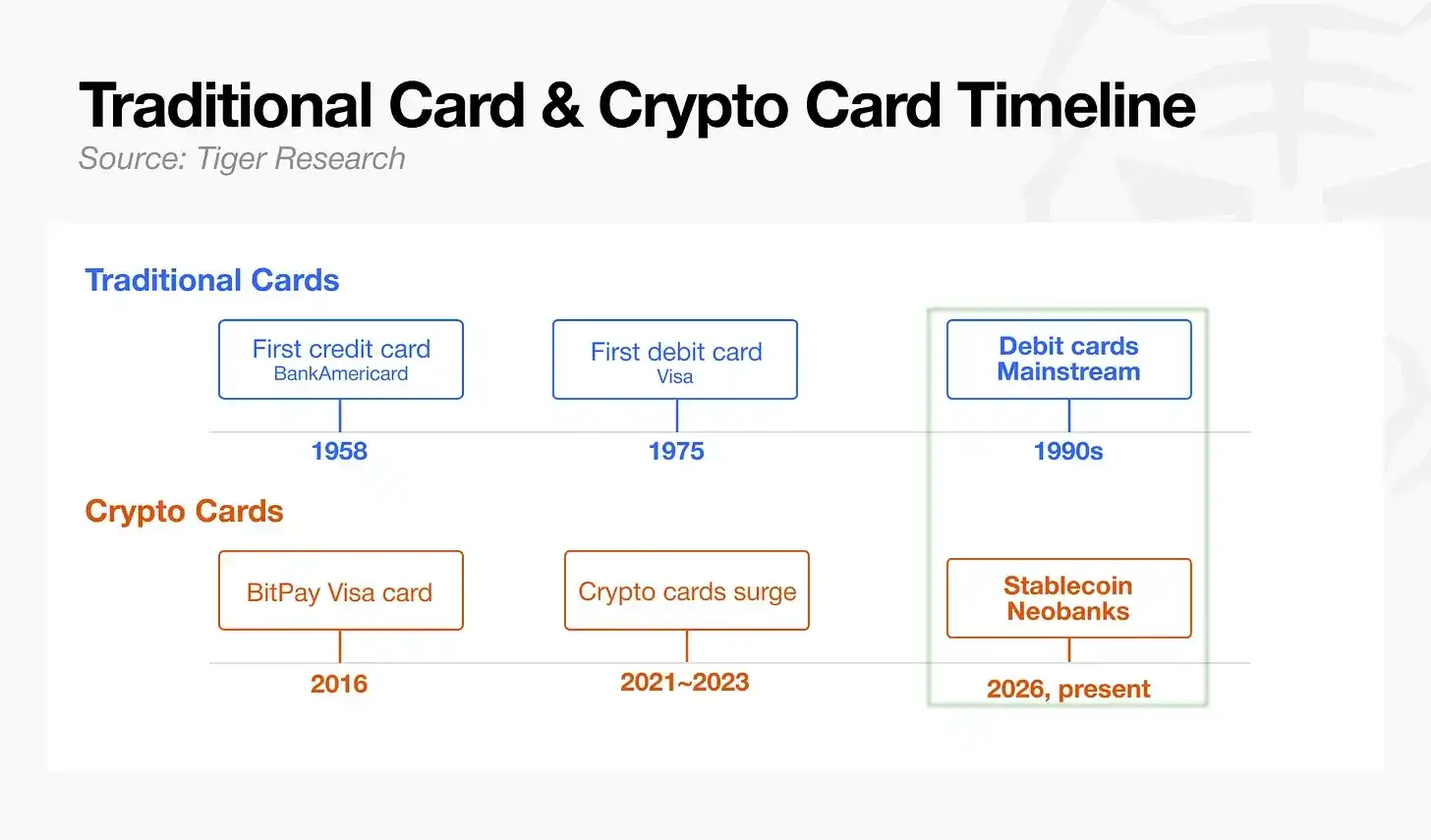
In September 1958, Bank of America bulk-mailed credit cards to 65,000 residents of Fresno, California. This was the first payment card launched without supporting underlying infrastructure. One year after launch, the business was dismal, with a delinquency rate of 22% and losses as high as $20 million. The industry spent 15 years building an electronic settlement system; debit cards took another 17 years to officially appear, and Visa spent a full 20 years establishing a globally accepted payment standard.
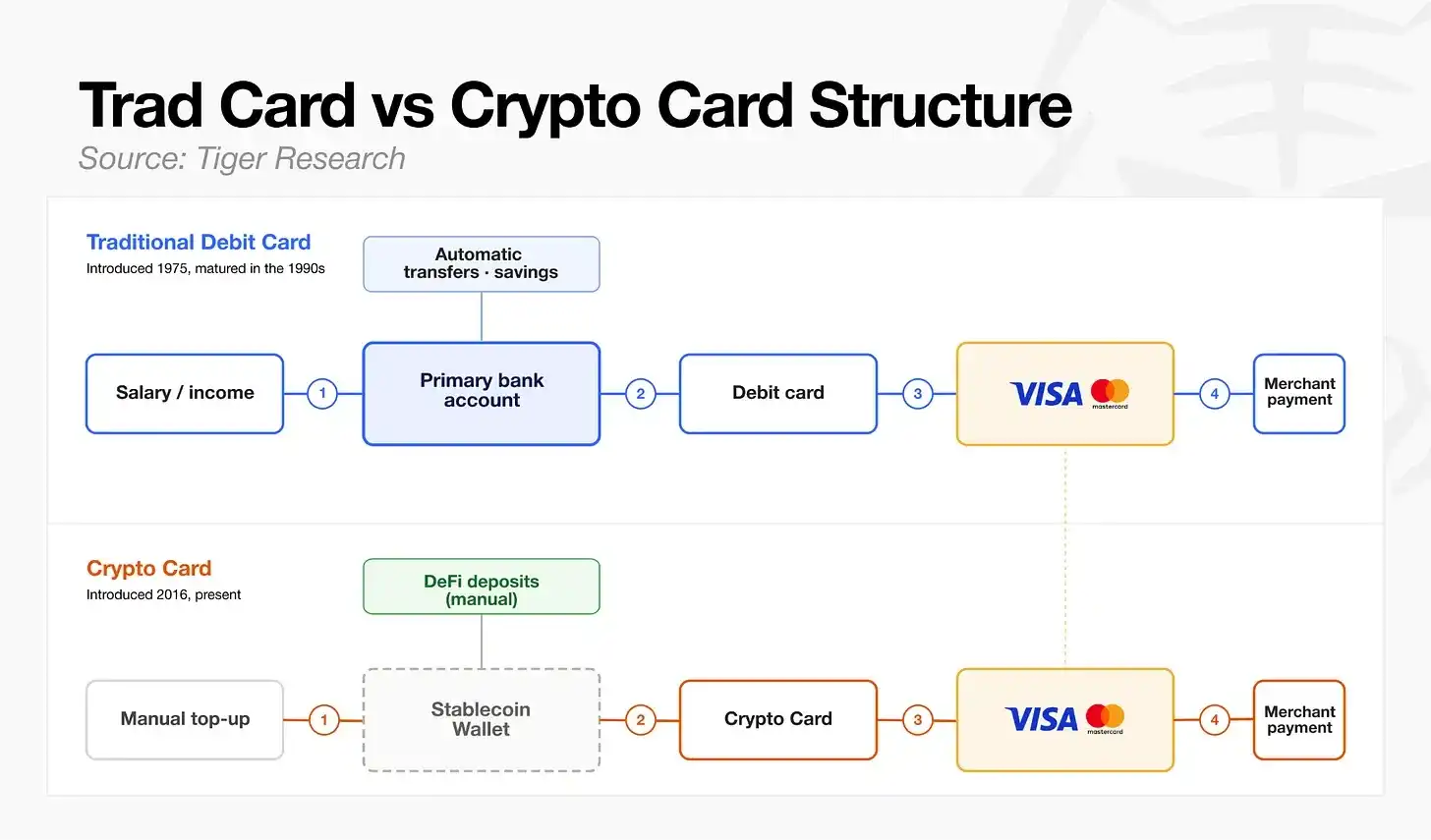
The biggest watershed between traditional payment and crypto payment lies in whether they foster users' routine financial account relationships. Debit cards were born in 1975, but only became a standard feature of individual core bank accounts after salary deposit services became widespread in the 1990s. In contrast, for today's crypto payment cards, the main funding source is basically users self-topping up stablecoins; the vast majority of crypto wallets cannot handle daily financial flows like salary deposits or scheduled bill payments. The industry's overall development stage is roughly equivalent to that of debit cards around the early 1990s.

The future leader in the crypto payment card race won't be determined by the number of cards issued, but by who first builds a core account that truly serves daily income and expenses, or finds a growth driver that fosters long-term user retention.

Monthly Transaction Volume of $1.5 Billion Does Not Equate to Industry Maturity

According to data from analytics firm Artemis, the monthly transaction volume of crypto payment cards grew from $100 million in early 2023 to $1.5 billion by the end of 2025, representing an annualized scale of approximately $18 billion. Affected by variations in on-chain data statistical methods, the actual annualized figure may fluctuate slightly, but the explosive growth in transaction volume is an indisputable fact.
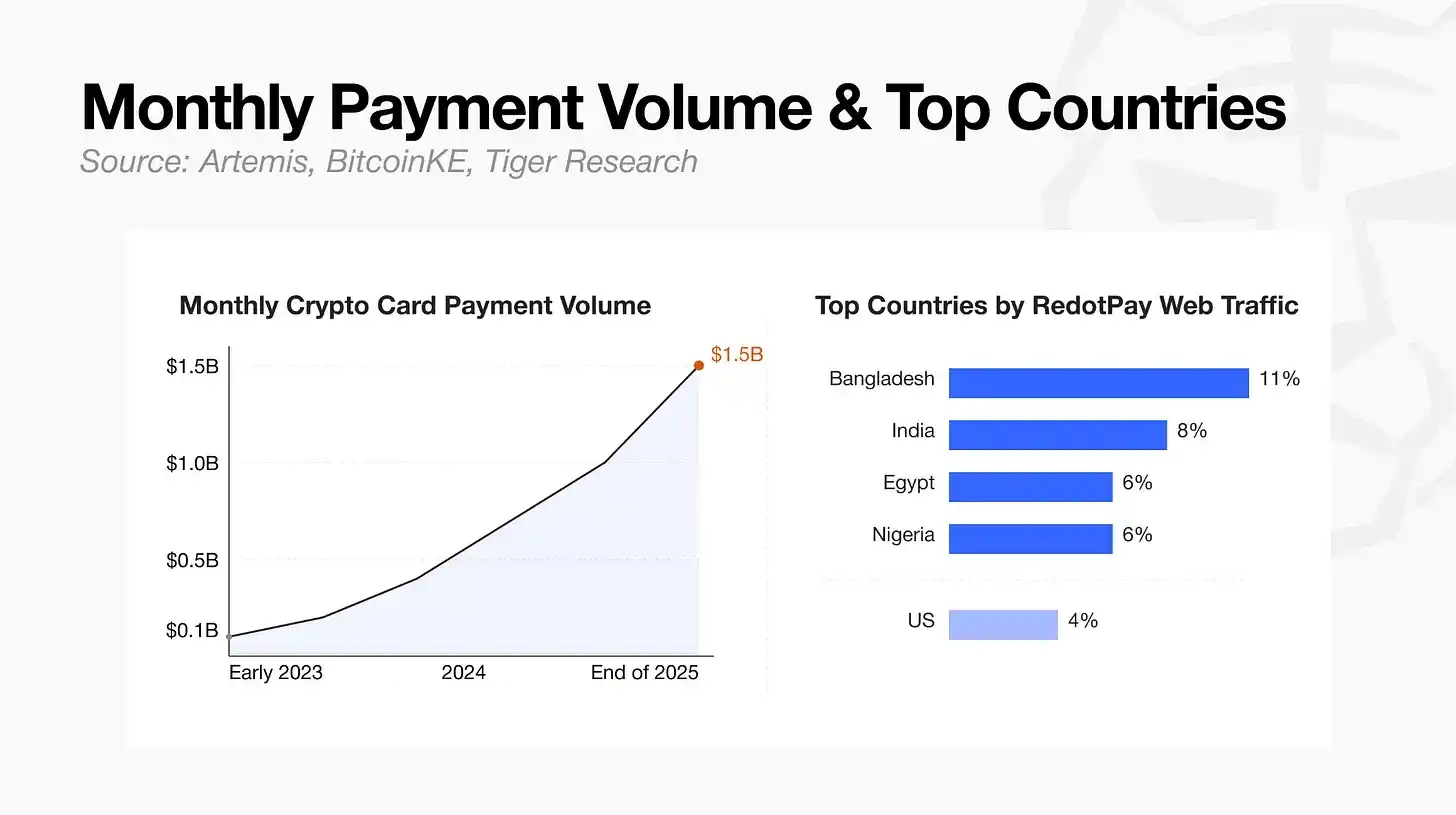
A closer analysis of these metrics reveals significant concentration among services and regions. Leading service provider RedotPay alone accounts for over half of the entire industry's transaction flow; platform users are highly concentrated in emerging markets: Bangladesh accounts for 11%, India 8%, Egypt 6%, Nigeria 6%, with the US representing only 4%.

This shows that the real demand for crypto payment cards does not come from developed mainstream markets, but from developing regions with insufficient financial services and restricted access to USD.
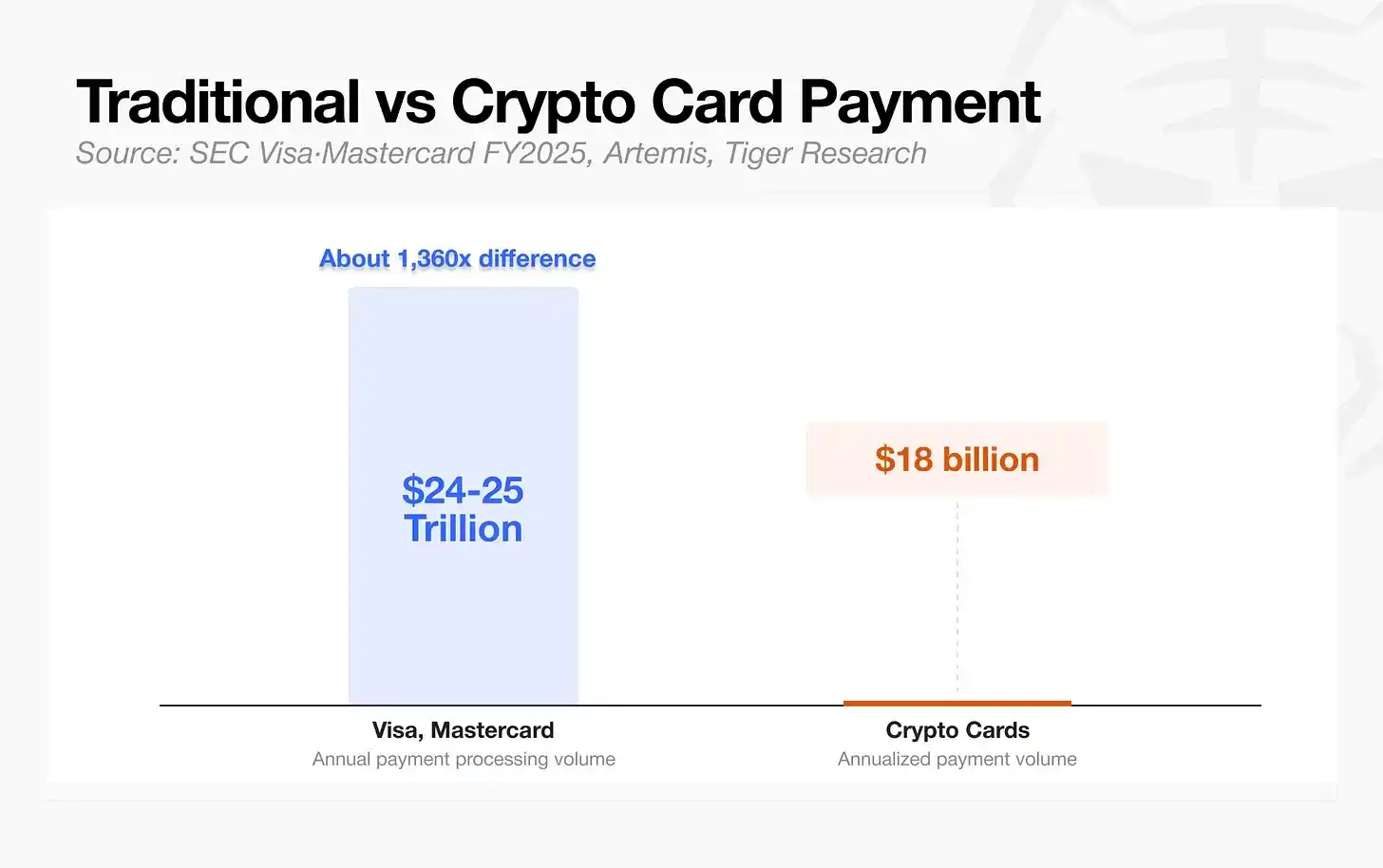
Compared to mature financial networks, the scale gap of cryptocurrency remains vast. Visa and Mastercard's annual total payment volume reaches $24-25 trillion, while crypto payment card annualized transactions are merely $18 billion. They are not on the same scale.
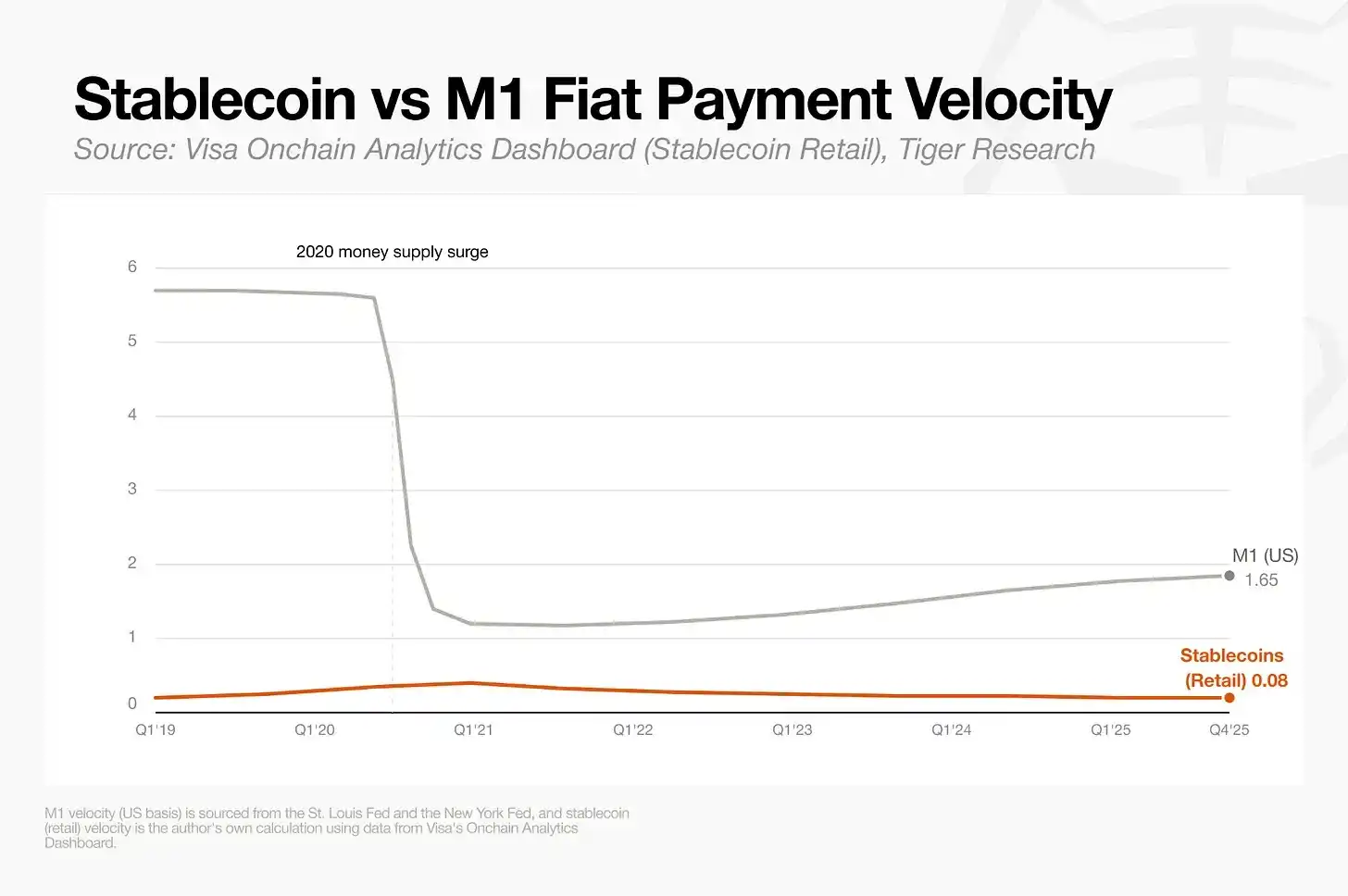
The velocity of circulation indicator, which measures the penetration of daily payments, is also relatively low. According to Visa statistics, the retail circulation velocity of on-chain stablecoins is only 0.08, merely one-twentieth of the velocity (1.65) of narrow fiat money M1. The pattern of stablecoin usage for most users is not the routine cycle of salary deposit, daily spending, and top-up recharge, but rather a one-time top-up followed by intermittent card spending.

Growth in transaction volume numbers does not equate to the market forming a mature, universally accepted clearing system. Currently, a large portion of crypto payment card transactions come from users in emerging markets who lack convenient access to USD-denominated bank accounts. For these users, crypto cards indeed possess practical financial value.

However, in developed markets, crypto payment cards have yet to find a stable product-market fit, nor have they established the deep account binding relationships brought about by features like salary deposits and automated bill payments.

Considering both funding channels and spending scenarios, current crypto payment cards are better suited for specific country-specific niche needs, acting as supplementary tools rather than universal financial infrastructure. Nonetheless, amidst the industry's rapid growth, leading players across four major business models are simultaneously refining various aspects of the industry chain.

Four Mainstream Business Models for Crypto Payment Cards
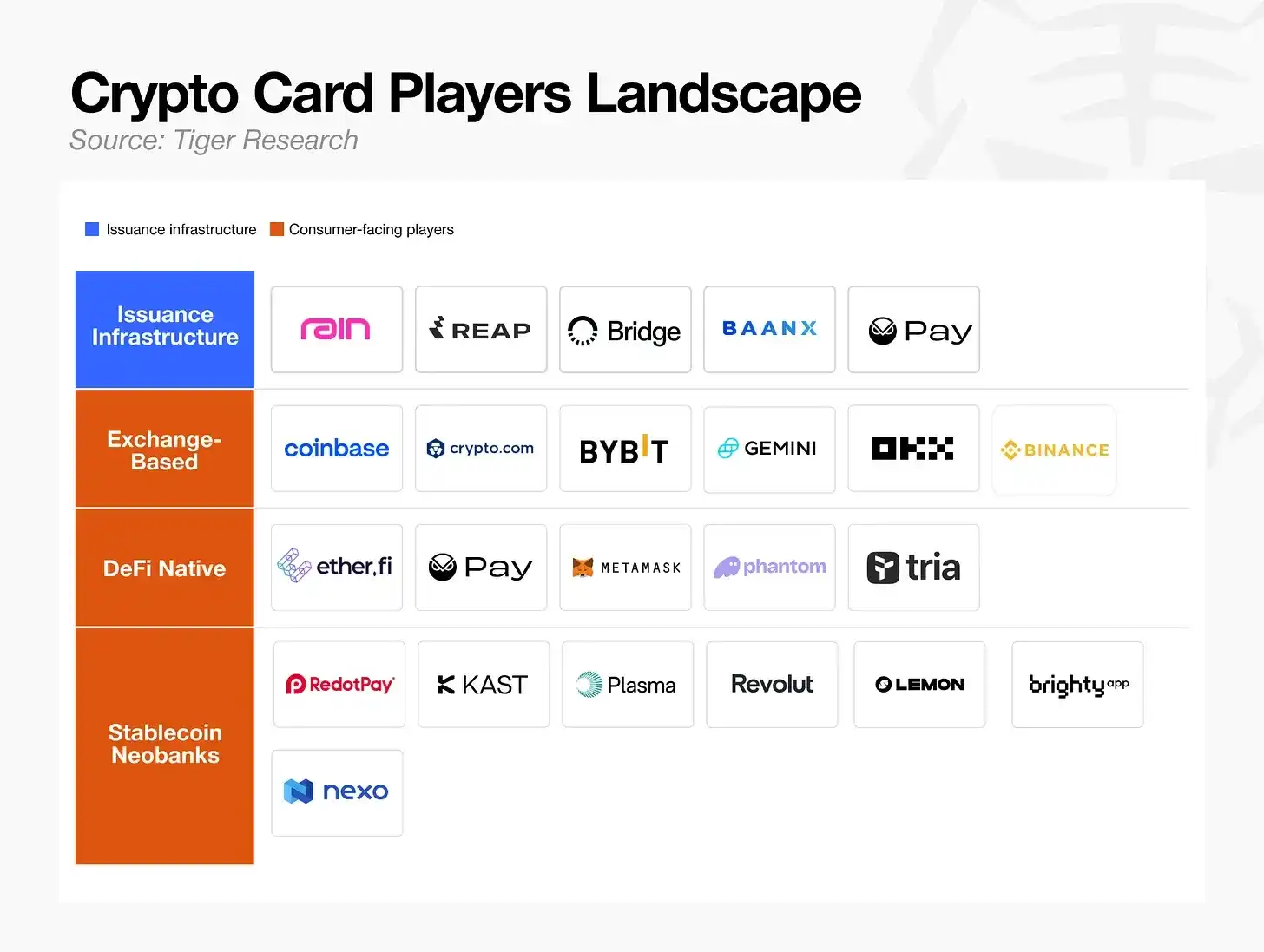
The crypto card industry can be broadly categorized into four business models, with various participants vying for first-mover advantage at different layers. These models vary widely, from companies focused on providing backend infrastructure to those merely adopting the card form factor but with entirely different underlying structures.

Card Issuing Infrastructure

The well-known payment networks Visa and Mastercard also apply to the crypto card ecosystem. Beneath them lies the card issuing infrastructure layer, which ultimately extends to the consumer card. As shown in the diagram above, there are two structures within the issuing infrastructure layer. The first is the traditional two-tier structure, where the program manager responsible for operations is separate from the issuing bank responsible for member management and settlement. The second is the full-stack issuer, such as Rain and Reap, which combines these two roles.
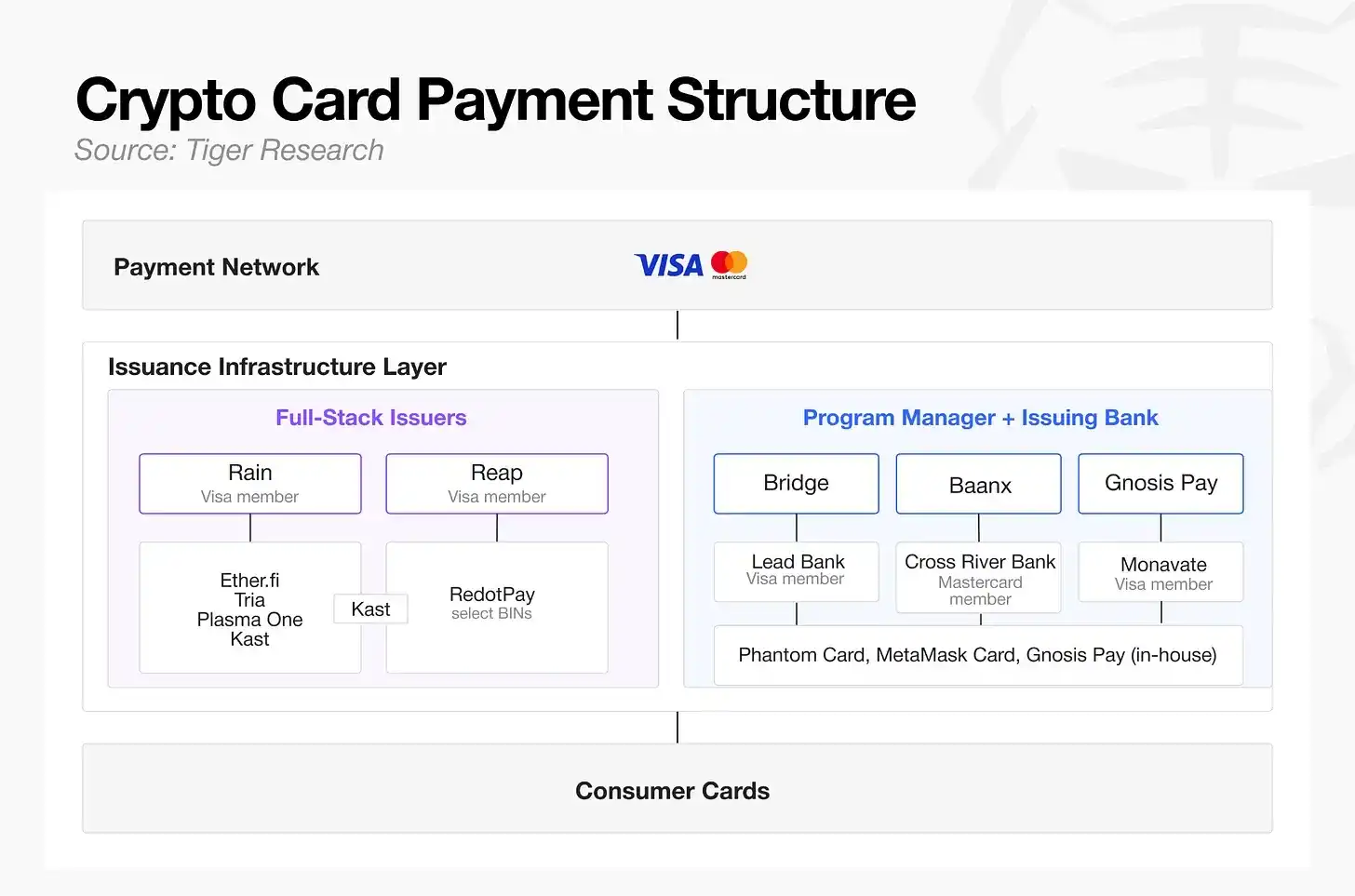
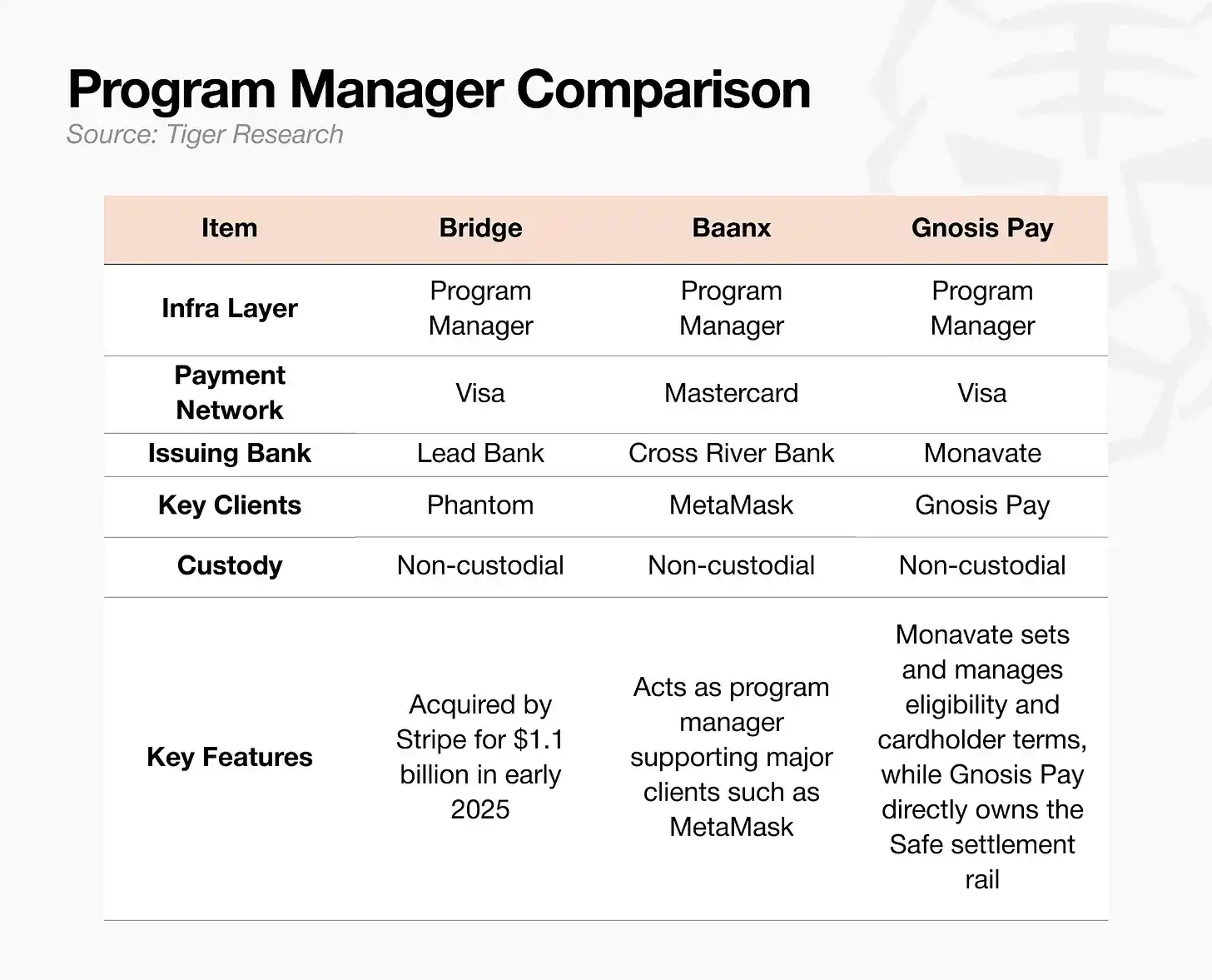
Multiple seemingly independent payment card brands actually reuse a handful of program service providers at their core. Phantom Card, MetaMask Card, and Gnosis Pay are typical examples.
Seemingly independent payment card products like Kast, Ether.fi, Tria, and Plasma One similarly share a small number of underlying infrastructure service providers, with Rain handling the majority of consumer-grade card business.

The high concentration of issuing infrastructure has also attracted established traditional digital banks to enter the fray. In March 2026, Nium launched a stablecoin card issuing platform, supporting both Visa and Mastercard networks. Other traditional financial infrastructure vendors include Bridge (acquired by Stripe for $1.1 billion in early 2025) and BVNK (acquired by Mastercard for up to $1.8 billion in March 2026).

Competition in the issuing sector is intensifying, with full-stack issuers, veteran program managers, and new fintech players competing on the same stage. Pure card issuing business alone can no longer build high barriers.

Rain has differentiated itself by leveraging daily stablecoin settlements. Traditional card settlement cycles take several days; Rain achieves T+0 settlement for stablecoins through Visa, significantly improving capital turnover efficiency for partner platforms like Ether.fi. Recently, the platform launched an AI Agent control layer, enabling programs to automatically generate disposable virtual cards, moving functionality beyond basic issuing infrastructure.

Issuing service providers seeking to break through cannot merely offer basic payment rails; they must also rapidly implement differentiated value-added features that traditional infrastructure cannot provide.

Exchange-Attached Payment Cards

For exchanges, payment cards are not a core revenue source; their primary role is to retain existing users. By overlaying card functionality onto the platform's existing user base, assets, and transaction data, they aim to prevent user churn. The platform's real profits come from trading fees, lending services, and asset custody, not from card spending itself.
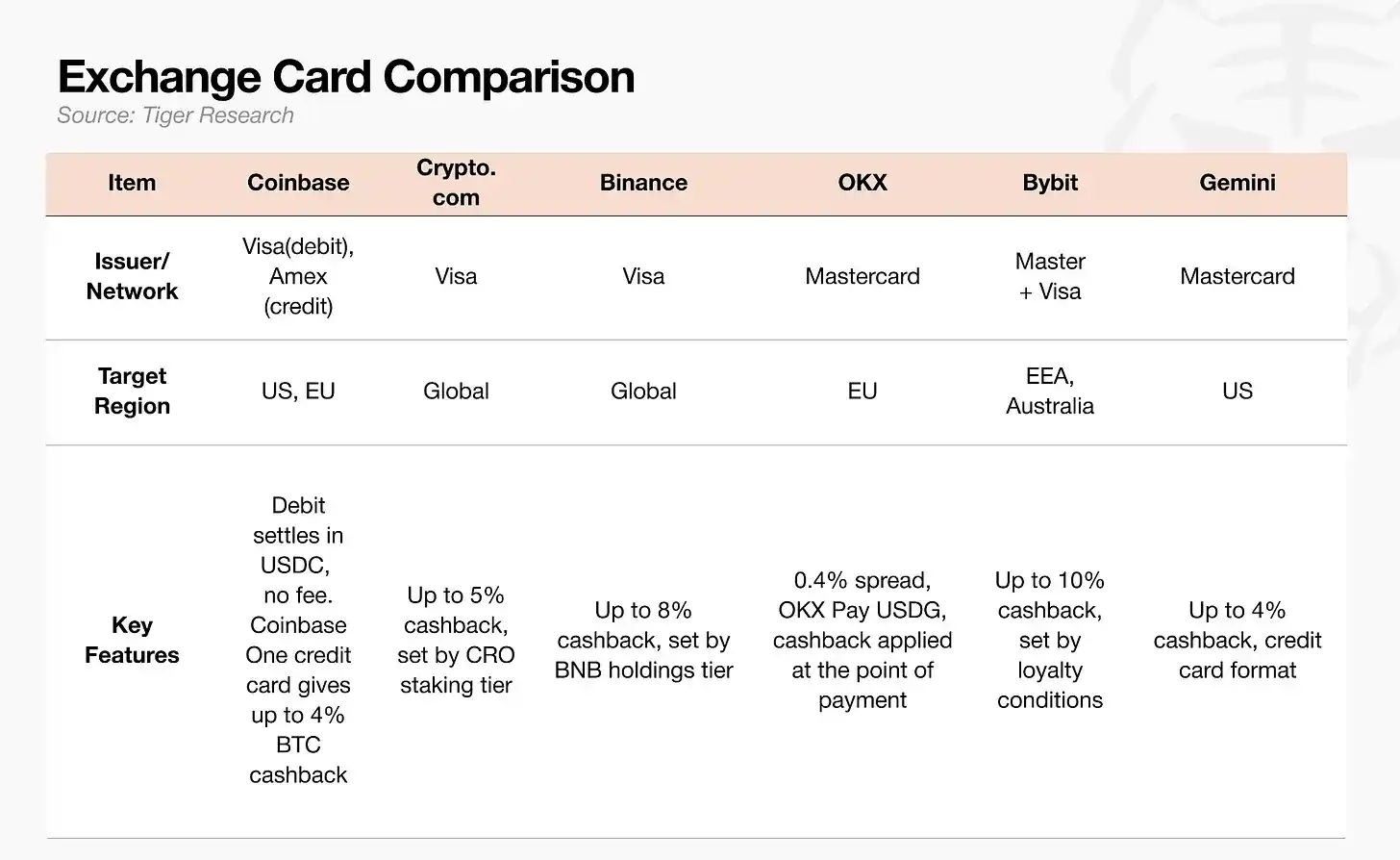
Exchanges view payment cards as a traffic entry point for building a financial super-app. However, the platform's native token cashback model carries risks: token price volatility directly leads to unstable actual cashback ratios.

Industry alternatives include stablecoin cashback and balance interest accrual, but the US "GENIUS Stablecoin Act" prohibits interest-bearing activities, creating a barrier to market expansion.

Decentralized Wallet DeFi Model

The core logic of this model is that the wallet itself is the user account, with assets self-custodied on-chain, eliminating the need to deposit them with a centralized exchange. Card spending is settled directly from on-chain assets. Simultaneously, it offers a line of credit, using the assets as collateral.

However, users need to set up vaults, manage collateral, and monitor liquidation risks themselves, resulting in high operational barriers. This consequently limits the scale of the user base for this model.
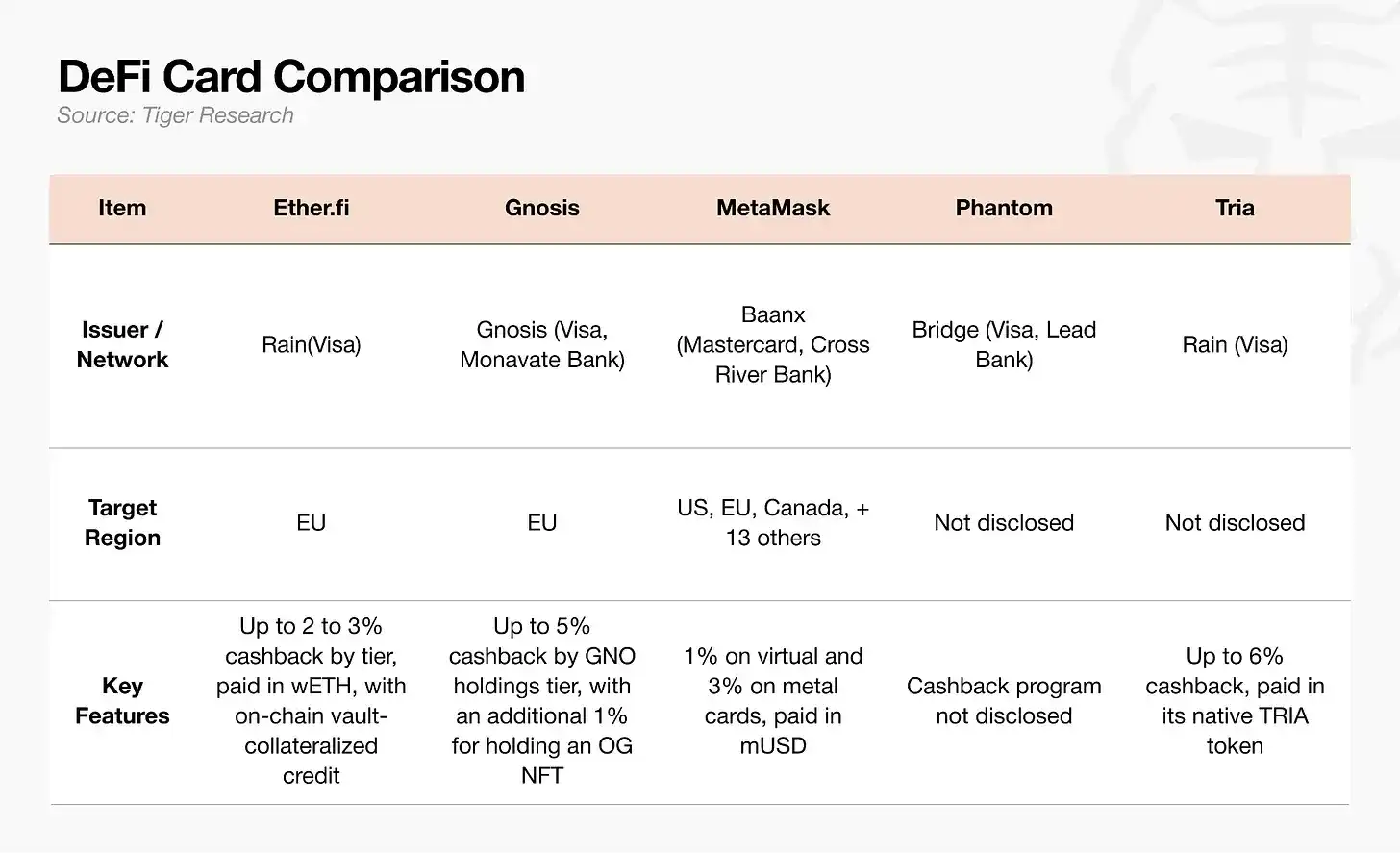
During payment, the system instantly converts on-chain assets to fiat for settlement, generating on-chain Gas fees for each transaction; when public chain throughput is insufficient or the network is congested, fees may exceed the spending amount, and transaction authorization delays are frequent.

For this reason, MetaMask Card opted for its self-developed Layer-2 network Linea, reducing per-transaction Gas fees to around $0.01, alleviating the pain points of high fees and delays for small payments. Tria employs a Gas-less top-up solution, with the platform covering fees generated during top-up, sparing users the operational cost of selecting blockchains and calculating fees.

However, until the user experience, balancing asset self-custody with spending convenience, is polished to the level of traditional debit cards, this model's users will remain confined to native crypto users.

Stablecoin Digital Bank

This is the segment with the highest share of current market transaction volume. Its focus is on account functionality rather than the card itself. Stablecoin balances integrate foreign exchange, cross-border remittance, and wealth management features, with the payment card merely serving as the top-level spending vehicle. In emerging markets with high local currency volatility, costly cross-border remittances, and difficult USD access, this model possesses strong competitiveness.
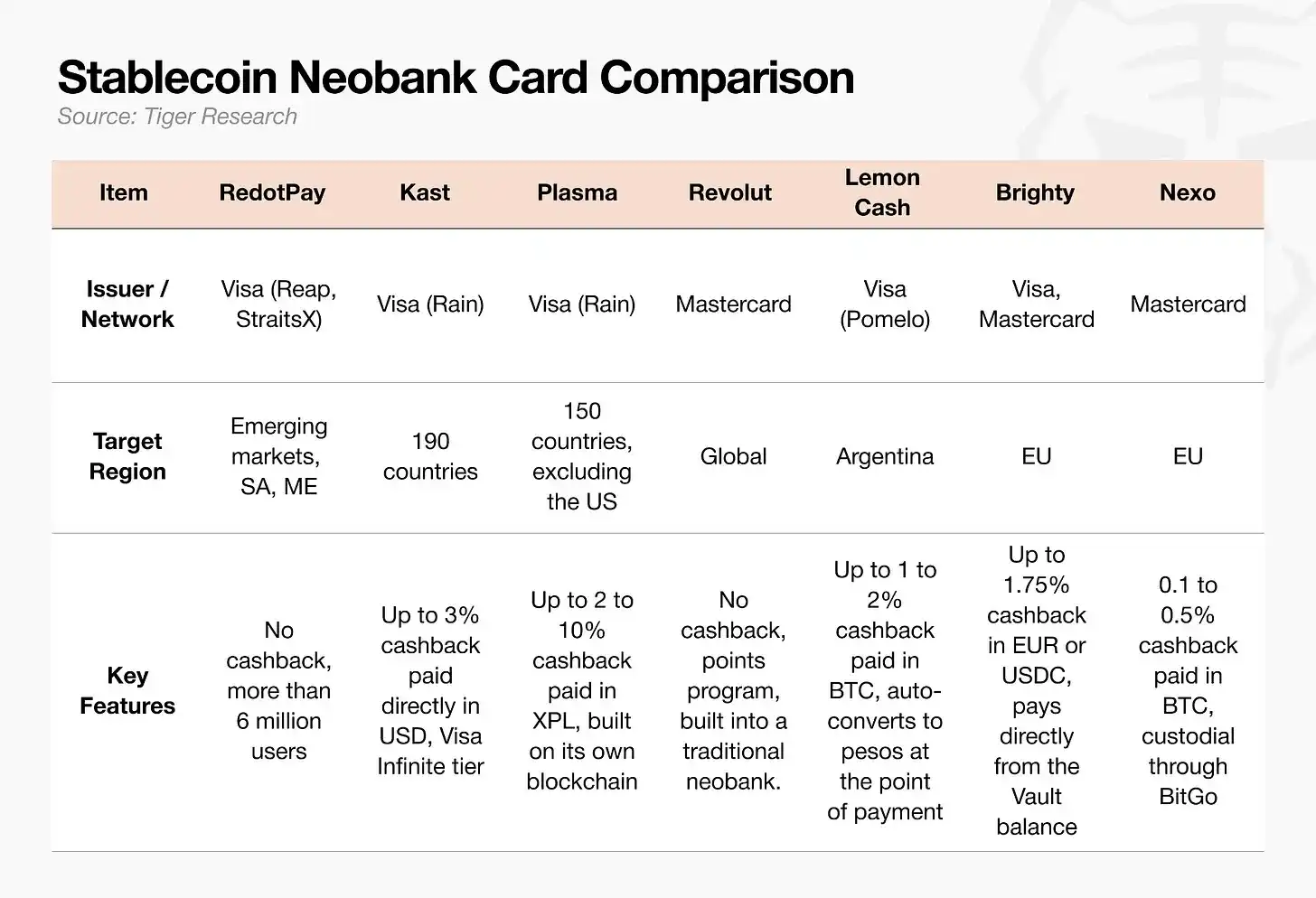
To sustain growth, this segment must move beyond the single form of a "prepaid card" model, where users autonomously purchase stablecoins and transfer them to their balance.

Cashback strategies across platforms have diverged based on market positioning. Industry leader RedotPay and established fintech player Revolut offer no cashback campaigns, while later entrants like Kast and Plasma One aggressively promote USD or platform token cashback to attract users.

However, relying solely on incentive subsidies cannot drive crypto payment cards to truly integrate into users' daily consumption habits.

Pure Payment Functionality Cannot Support Long-Term Development

The history of traditional bank cards and digital banks demonstrates that pure payment businesses have extremely low profitability ceilings. These enterprises only became profitable after incorporating concepts like the primary account and structural elements such as deposit-loan spreads into their business models. The crypto payment card industry has now reached the same critical development point. However, global regulatory frameworks like the US GENIUS Act and the EU's MiCA restrict the development of interest-bearing stablecoin and asset management services, making the path to breakthrough arduous.

Under these macro regulatory constraints, for industry players to survive long-term, they must grasp three core strategic imperatives:

  • Directly control the fund flow pathway.
  • Secure unique application scenarios in emerging markets.
  • Build proprietary user account systems that cannot be replaced by underlying infrastructure providers.

After industry standards solidify, companies unable to achieve the above will gradually fall behind.

Looking back at the history of debit cards, those who ultimately dominated the market were not the ones issuing the most cards, but those who first gained control of users' primary bank accounts. The crypto payment card industry now faces precisely the same proposition.

Crypto card operators need to directly control the fund flow upstream of the Visa payment process, seize first-mover advantage in niche markets, and, akin to the rise of bank accounts in traditional finance, take control of consumer infrastructure. This means establishing a global standard with no precedent to follow.

Without achieving the above, crypto payment cards will never become essential tools integrated into daily life, remaining merely prepaid cards used intermittently by niche groups for small cashback rewards.


Tiền kỹ thuật số thịnh hành

Câu hỏi Liên quan

QAccording to the article, what is the key difference between traditional payment cards and current crypto payment cards?

AThe key difference lies in whether they establish a user's normalized financial account relationship. Traditional debit cards became core banking tools after the popularization of payroll deposits in the 1990s. In contrast, most crypto payment cards today rely primarily on user self-topped-up stablecoins, lacking integration with payroll, recurring payments, and other daily financial flows, placing the industry at a development stage equivalent to debit cards around 1990.

QBased on the data from Artemis, what does the concentration of crypto payment card traffic reveal about its real-world demand?

AThe data reveals that the real demand for crypto payment cards is not from developed mainstream markets but primarily from developing regions with insufficient financial services and limited access to US dollars. Over half of the industry's transaction volume comes from a single provider, RedotPay. User traffic is highly concentrated in emerging markets like Bangladesh (11%), India (8%), Egypt (6%), and Nigeria (6%), with the US accounting for only 4%.

QWhat are the four mainstream business models for crypto payment cards outlined in the article?

AThe four mainstream business models are: 1) Issuing Infrastructure (e.g., Rain, Nium), 2) Exchange-based Payment Cards (e.g., products from major crypto exchanges), 3) Decentralized Wallet/DeFi Cards (e.g., MetaMask Card, Tria), and 4) Stablecoin Digital Banks (e.g., RedotPay, Revolut's crypto offerings).

QWhat major challenge does the article identify for DeFi-based crypto payment cards regarding user experience?

AThe major challenge is the high user experience barrier. For DeFi cards, each transaction requires on-chain gas fees for currency conversion, which can sometimes exceed the transaction amount itself during network congestion, leading to authorization delays. While solutions like using Layer-2 networks or absorbing gas fees exist, the overall interaction experience has not yet reached the seamless level of traditional debit cards, limiting adoption to native crypto users.

QWhat three core strategic imperatives does the article suggest for crypto payment card players to achieve long-term survival and growth?

AThe three core strategic imperatives are: 1) Directly control the capital flow within the payment chain. 2) Secure and defend unique application scenarios in emerging markets. 3) Build a proprietary user account system that cannot be easily replaced by underlying infrastructure providers.

Nội dung Liên quan

Ethereum Chuẩn Bị Nhẹ Nhàng? Những Người Ủng Hộ Ethereum Nghĩ Gì Về Triển Vọng Sau Nâng Cấp Lean Ethereum

Tác giả: Biteye Ethereum (ETH) đang có dấu hiệu phục hồi sau đợt giảm giá vào tháng Sáu, một phần nhờ kỳ vọng giảm lãi suất. Trong bối cảnh này, Vitalik Buterin đã công bố lộ trình "Lean Ethereum", được mô tả là bản nâng cấp lớn thứ ba của mạng lưới, nhằm thiết kế lại các lớp đồng thuận, dữ liệu và thực thi để trở nên đơn giản hơn, an toàn hơn (chống lượng tử), dễ xác minh và có khả năng mở rộng cao hơn. Cùng lúc, việc Quỹ Ethereum cắt giảm 20% nhân sự và sự xuất hiện của các tổ chức mới như EthLabs cho thấy một sự tái cơ cấu hướng tới vận hành tinh gọn hơn. **Quan điểm lạc quan:** Các nhân vật có ảnh hưởng như Sassal (The Daily Gwei), Ryan Sean Adams (Bankless), BITWU, Lanhu và gigi nhìn nhận Lean Ethereum là một tín hiệu tích cực. Họ cho rằng điều này giúp Ethereum tập trung trở lại vào nền tảng giao thức, tăng cường tính phi tập trung (ví dụ: giảm yêu cầu phần cứng chạy node), bảo mật và khả năng tồn tại lâu dài. Đây được xem là sự chuyển mình từ "mở rộng câu chuyện" sang "củng cố giao thức", trả lời cho câu hỏi về giá trị cốt lõi của Ethereum trong thập kỷ tới. **Quan điểm thận trọng:** Mặt khác, các chuyên gia như Ignas (nhà nghiên cứu DeFi) và Dankrad Feist (cựu nghiên cứu viên Quỹ Ethereum) thừa nhận lộ trình tốt nhưng lo ngại về tiến độ thực hiện kéo dài 3-4 năm. Họ nhấn mạnh thị trường cần thấy kết quả cụ thể và khả năng nắm bắt giá trị nhanh chóng, đặc biệt khi các đối thủ cạnh tranh trong lĩnh vực RWA đang gia tăng. **Tóm lại:** Dù còn những ý kiến về tốc độ triển khai, Lean Ethereum được kỳ vọng sẽ định hình lại chủ đề chính cho Ethereum, mang lại cảm giác chủ động hiếm có về mặt định hướng phát triển. Thành công cuối cùng sẽ phụ thuộc vào khả năng thực thi và điều kiện thị trường chung.

marsbit27 phút trước

Ethereum Chuẩn Bị Nhẹ Nhàng? Những Người Ủng Hộ Ethereum Nghĩ Gì Về Triển Vọng Sau Nâng Cấp Lean Ethereum

marsbit27 phút trước

AI Gấp Lại, Fable 5 Và GPT-5.6, Đang Trở Thành Đặc Quyền Của Một Số Ít Người

Chúng ta đang sống trong một thế giới “AI phân tầng”. Một bên là thiểu số tinh hoa công nghệ được tiếp cận những mô hình AI đỉnh cao như Fable 5 hay GPT-5.6 sắp ra mắt, có khả năng như một kiến trúc sư hay kỹ sư cấp cao, thậm chí phát hiện công thức toán học mới. Trong khi đó, đa số công chúng chỉ trải nghiệm các mô hình miễn phí, thông thường từ 8B đến 30B tham số, tương đương ChatGPT bản miễn phí hay Copilot cơ bản - những sản phẩm bị xem là "đồ chơi" AI với khả năng hạn chế. Sự chênh lệch trải nghiệm này tạo ra một hố sâu ngăn cách nhận thức. Giới bình thường không hiểu AI có thể thay thế công việc thế nào, trong khi giới tinh hoa đang tận hưởng lợi thế cạnh tranh khổng lồ. Khoảng cách này càng được nới rộng bởi chi phí: có người tiết lộ đã chi 1000 USD/ngày cho các dự án suy luận trên Fable. Hơn nữa, người dùng cao cấp không dùng một mô hình đơn lẻ mà xây dựng một ma trận đa mô hình, nơi mỗi AI đảm nhận một vai trò chuyên biệt (như lập kế hoạch, kiến trúc, lập trình, rà soát) để đạt hiệu quả tối đa. Sự phân tầng này đặc biệt nghiêm trọng trong lĩnh vực sức khỏe, nơi AI miễn phí có tỷ lệ sai sót cao (được cho là trên 51%) khi trả lời câu hỏi y tế, trong khi phiên bản Pro chính xác và an toàn hơn nhiều. Tuy nhiên, cũng có ý kiến cho rằng với 90% công việc văn phòng thông thường, các mô hình như ChatGPT 5.4/5.5 là đủ dùng; vấn đề nằm ở việc tích hợp ngữ cảnh và dữ liệu phù hợp vào quy trình làm việc hơn là trí thông minh thuần túy của AI. Tóm lại, sự bất bình đẳng trong tiếp cận AI mạnh mẽ đang âm thầm định hình tương lai. Khi các gã khổng lồ công nghệ nói về việc AI định hình lại xã hội, đừng chê bai AI là "ngu ngốc" chỉ vì chatbot miễn phí tính toán sai. Trong thế giới bị "gấp khúc" này, AI không ngu đi, mà là những AI thực sự mạnh mẽ đang ngày càng trở nên xa tầm với của số đông.

marsbit1 giờ trước

AI Gấp Lại, Fable 5 Và GPT-5.6, Đang Trở Thành Đặc Quyền Của Một Số Ít Người

marsbit1 giờ trước

Ark Invest của bà Cathie Wood mua vào 77 triệu USD trong tháng 6, liệu cổ phiếu crypto có phải là ‘phiên bản thay thế’ an toàn hơn Bitcoin?

ARK Invest của Cathie Wood đã mua vào 77 triệu USD cổ phiếu công ty tiền mã hóa trong tháng 6, trong bối cảnh Bitcoin có tháng tồi tệ nhất 4 năm. Tuy nhiên, phân tích của CryptoSlate cho thấy các cổ phiếu này không hẳn là "thay thế an toàn" cho Bitcoin. Các công ty như Circle, MSTR và Bullish có mức biến động cao gấp đôi Bitcoin (68%–103.6% so với ~37.6%–37.8%). Hơn nữa, mối tương quan giá của chúng với Bitcoin chỉ ở mức trung bình (0.55–0.85), nghĩa là biến động giá chịu ảnh hưởng lớn từ các rủi ro riêng như báo cáo tài chính, cạnh tranh ngành và pha loãng vốn cổ đông. MSTR là cổ phiếu duy nhất theo sát Bitcoin với beta 1.59. Coinbase có mối tương quan khá mạnh (beta 1.26) nhưng vẫn biến động cao hơn. Trong khi đó, Circle hay Robinhood chịu ảnh hưởng nhiều bởi mô hình kinh doanh riêng (ví dụ: cạnh tranh stablecoin, đa dạng hóa dịch vụ môi giới). Các công ty khai thác như RIOT hay MARA thậm chí tăng giá mạnh nhờ chuyển hướng sang kinh doanh dịch vụ điện toán AI, tách biệt với xu hướng giá Bitcoin. Trường hợp của Strategy minh họa rủi ro bổ sung khi đầu tư cổ phiếu: cơ cấu vốn và nhu cầu thanh khoản có thể buộc công ty bán Bitcoin dự trữ, một rủiro mà người nắm giữ Bitcoin trực tiếp không gặp phải. Tóm lại, đầu tư vào cổ phiếu tiền mã hóa không đơn giản là một cách tiếp xúc gián tiếp với Bitcoin. Nó có thể khuếch đại biến động hoặc mang thêm rủi ro kinh doanh đặc thù. Những cổ phiếu hoạt động tốt nhất năm nay chủ yếu nhờ các động lực tăng trưởng độc lập như AI hay dịch vụ tài chính đa dạng.

marsbit1 giờ trước

Ark Invest của bà Cathie Wood mua vào 77 triệu USD trong tháng 6, liệu cổ phiếu crypto có phải là ‘phiên bản thay thế’ an toàn hơn Bitcoin?

marsbit1 giờ trước

Thị trường tiền mã hóa đón 'bước ngoặt tháng Bảy'? Tín hiệu đáy hàng loạt hiện rõ, nhưng cần vượt 70.000 USD để đảo chiều xu hướng

Tín hiệu tích cực xuất hiện trên thị trường tiền mã hóa vào tháng 7, với Bitcoin dẫn đầu đợt phục hồi vượt mức 63.000 USD. Tổng vốn hóa thị trường tăng lên 2,28 nghìn tỷ USD. Động lực đến từ kỳ vọng chính sách tiền tệ Mỹ ít nghiêm ngặt hơn, dòng tiền quay trở lại ETF Bitcoin và hiện tượng bán tháo trong thị trường phái sinh. Nhiều chỉ số on-chain báo hiệu đáy tiềm năng: chỉ số sợ hãi-tham lam ở mức thấp, tỷ lệ Sharpe âm sâu, tỷ lệ lãi/lỗ UTXO cho thấy dấu hiệu "đầu hàng", và chỉ số AHR999 tiệm cận vùng cực kỳ hiếm gặp trong lịch sử. Áp lực bán từ thợ đào cũng đạt mức cao. Tuy nhiên, bức tranh tổng thể chưa hoàn toàn lạc quan. Nhu cầu giao dịch spot còn yếu, dòng vốn thể chế vẫn thận trọng với mức chiết khấu kéo dài trên Coinbase, và thị trường altcoin tiếp tục chịu áp lực bán. Các nhà phân tích cho rằng đợt tăng giá hiện tại có tính chất phục hồi kỹ thuật nhiều hơn là đảo chiều xu hướng thực sự. Mức giá 70.000 USD - tương ứng với giá thực hiện của nhà đầu tư ngắn hạn (STH-RP) - được xem là ngưỡng then chốt cần chinh phục để xác nhận đảo chiều tăng trưởng. Nếu không có sự cải thiện mạnh mẽ về dòng tiền thể chế và thanh khoản spot, thị trường vẫn có thể dao động và thử thách các vùng đáy tiềm năng trong khoảng 37.000 - 60.000 USD trước khi bước vào chu kỳ tăng giá mới.

marsbit1 giờ trước

Thị trường tiền mã hóa đón 'bước ngoặt tháng Bảy'? Tín hiệu đáy hàng loạt hiện rõ, nhưng cần vượt 70.000 USD để đảo chiều xu hướng

marsbit1 giờ trước

Giao dịch

Giao ngay

Bài viết Nổi bật

$BANK là gì

Ngân Hàng AI: Một Bước Đột Phá Cách Mạng Trong Tương Lai Ngành Ngân Hàng Giới thiệu Trong một thời đại được đánh dấu bởi những tiến bộ nhanh chóng trong công nghệ, Ngân hàng AI đứng tại giao điểm của trí tuệ nhân tạo (AI) và dịch vụ ngân hàng. Dự án đổi mới này nhằm định hình lại cảnh quan tài chính, nâng cao hiệu quả hoạt động, các biện pháp an ninh và trải nghiệm của khách hàng thông qua sức mạnh của AI. Khi chúng ta bắt đầu cuộc khám phá về Ngân hàng AI, chúng ta sẽ tìm hiểu về nội dung của dự án, động lực hoạt động của nó, bối cảnh lịch sử và những cột mốc quan trọng. Ngân Hàng AI là gì? Về bản chất, Ngân hàng AI đại diện cho một sáng kiến biến đổi nhằm tích hợp trí tuệ nhân tạo vào các hoạt động ngân hàng khác nhau. Dự án này tận dụng khả năng của AI để tự động hóa quy trình, cải thiện các quy trình quản lý rủi ro và nâng cao tương tác với khách hàng thông qua các dịch vụ cá nhân hóa. Mục tiêu chính của Ngân hàng AI bao gồm: Tự động hóa các chức năng ngân hàng: Bằng cách tận dụng công nghệ AI, Ngân hàng AI nhằm tự động hóa các nhiệm vụ thường nhật, giảm gánh nặng cho nhân lực và nâng cao hiệu quả. Quản lý rủi ro nâng cao: Dự án sử dụng các thuật toán AI để dự đoán và xác định rủi ro, từ đó củng cố các biện pháp an ninh chống lại gian lận và các mối đe dọa khác. Cá nhân hóa dịch vụ ngân hàng: Ngân hàng AI tập trung vào việc cung cấp các sản phẩm và dịch vụ tài chính được điều chỉnh theo nhu cầu của từng khách hàng bằng cách phân tích dữ liệu và hành vi của họ. Cải thiện trải nghiệm khách hàng: Việc triển khai các giải pháp sử dụng AI như chatbot và trợ lý ảo nhằm cung cấp cho người dùng những tương tác giống như con người hơn, cách mạng hóa cách khách hàng tương tác với ngân hàng. Với những mục tiêu này, Ngân hàng AI định vị mình như một nhân tố quan trọng trong việc làm cho ngân hàng trở nên hiệu quả hơn, an toàn hơn và tập trung vào người dùng. Ai là người sáng tạo ra Ngân Hàng AI? Thông tin về người sáng tạo ra Ngân hàng AI vẫn chưa rõ ràng. Do đó, không có cá nhân hay tổ chức cụ thể nào được xác định trong thông tin hiện có. Sự ẩn danh xung quanh sự ra đời của dự án đặt ra nhiều câu hỏi nhưng không giảm bớt tầm nhìn và mục tiêu đầy tham vọng của nó. Ai là nhà đầu tư của Ngân Hàng AI? Tương tự như người sáng tạo của dự án, thông tin cụ thể về các nhà đầu tư hoặc các tổ chức hỗ trợ Ngân hàng AI chưa được công bố. Thiếu thông tin này, thật khó để nêu rõ sự hỗ trợ tài chính và hỗ trợ từ các tổ chức có thể thúc đẩy dự án tiến triển. Tuy nhiên, tầm quan trọng của việc có một nền tảng đầu tư vững chắc là rất quan trọng để duy trì sự phát triển trong một lĩnh vực đổi mới như vậy. Ngân Hàng AI hoạt động như thế nào? Ngân hàng AI hoạt động trên nhiều lĩnh vực đổi mới, tập trung vào những yếu tố độc đáo phân biệt nó với các khuôn khổ ngân hàng truyền thống. Dưới đây là các đặc điểm hoạt động chính: Tự động hóa: Bằng cách áp dụng các thuật toán học máy, Ngân hàng AI tự động hóa nhiều quy trình thủ công trong ngân hàng. Điều này dẫn đến việc giảm chi phí hoạt động và cho phép nhân viên chuyển hướng nỗ lực của họ vào các hoạt động chiến lược hơn. Quản lý rủi ro nâng cao: Việc tích hợp AI vào các thực hành quản lý rủi ro trang bị cho các ngân hàng các công cụ để dự đoán chính xác các mối đe dọa tiềm ẩn như gian lận, đảm bảo rằng thông tin và tài sản của khách hàng luôn được bảo vệ. Khuyến nghị tài chính được cá nhân hóa: Thông qua việc học liên tục từ các tương tác của khách hàng

Tổng lượt xem 151Xuất bản vào 2024.04.06Cập nhật vào 2024.12.03

$BANK là gì

Làm thế nào để Mua BANK

Chào mừng bạn đến với HTX.com! Chúng tôi đã làm cho mua Lorenzo Protocol (BANK) trở nên đơn giản và thuận tiện. Làm theo hướng dẫn từng bước của chúng tôi để bắt đầu hành trình tiền kỹ thuật số của bạn.Bước 1: Tạo Tài khoản HTX của BạnSử dụng email hoặc số điện thoại của bạn để đăng ký tài khoản miễn phí trên HTX. Trải nghiệm hành trình đăng ký không rắc rối và mở khóa tất cả tính năng. Nhận Tài khoản của tôiBước 2: Truy cập Mua Crypto và Chọn Phương thức Thanh toán của BạnThẻ Tín dụng/Ghi nợ: Sử dụng Visa hoặc Mastercard của bạn để mua Lorenzo Protocol (BANK) ngay lập tức.Số dư: Sử dụng tiền từ số dư tài khoản HTX của bạn để giao dịch liền mạch.Bên thứ ba: Chúng tôi đã thêm những phương thức thanh toán phổ biến như Google Pay và Apple Pay để nâng cao sự tiện lợi.P2P: Giao dịch trực tiếp với người dùng khác trên HTX.Thị trường mua bán phi tập trung (OTC): Chúng tôi cung cấp những dịch vụ được thiết kế riêng và tỷ giá hối đoái cạnh tranh cho nhà giao dịch.Bước 3: Lưu trữ Lorenzo Protocol (BANK) của BạnSau khi mua Lorenzo Protocol (BANK), lưu trữ trong tài khoản HTX của bạn. Ngoài ra, bạn có thể gửi đi nơi khác qua chuyển khoản blockchain hoặc sử dụng để giao dịch những tiền kỹ thuật số khác.Bước 4: Giao dịch Lorenzo Protocol (BANK)Giao dịch Lorenzo Protocol (BANK) dễ dàng trên thị trường giao ngay của HTX. Chỉ cần truy cập vào tài khoản của bạn, chọn cặp giao dịch, thực hiện giao dịch và theo dõi trong thời gian thực. Chúng tôi cung cấp trải nghiệm thân thiện với người dùng cho cả người mới bắt đầu và người giao dịch dày dạn kinh nghiệm.

Tổng lượt xem 901Xuất bản vào 2025.05.09Cập nhật vào 2026.06.02

Làm thế nào để Mua BANK

Thảo luận

Chào mừng đến với Cộng đồng HTX. Tại đây, bạn có thể được thông báo về những phát triển nền tảng mới nhất và có quyền truy cập vào thông tin chuyên sâu về thị trường. Ý kiến ​​của người dùng về giá của BANK (BANK) được trình bày dưới đây.

活动图片