Planck Retracted? The Father of Quantum Tripped by an Algorithm

marsbitXuất bản vào 2026-06-30Cập nhật gần nhất vào 2026-06-30

Tóm tắt

The recent discovery that two articles (published in 1940 and 1942) by Max Planck, the Nobel laureate and founder of quantum theory, are marked as "retracted" on Springer's digital platform highlights a curious clash between historical publishing practices and modern automated systems. An investigation suggests these retractions are algorithmic errors, not due to fraud or misconduct. The papers, philosophical reflections on science published in *Die Naturwissenschaften*, were likely flagged by the platform's systems. One article, a republished lecture, may have been mistaken for duplicate publication. Another, sharing a title with a prior article by a different author (a common practice for continuing debates at the time), may have triggered a similar automated check. The digital versions have even been replaced with blank pages, contrary to normal practice of preserving retracted texts. This incident underscores how contemporary digital infrastructure, built around concepts like "self-plagiarism" and strict copyright, can misclassify and obscure legitimate historical scholarly communication. It serves as a warning that digital archives are not neutral mirrors of the past but are filtered by platform rules, potentially distorting the scientific record. As AI systems increasingly rely on such databases, such erroneous metadata could propagate, affecting how future tools interpret and access historical knowledge.

If one day you were to see the name Max Planck on a retraction list, you'd probably think you'd clicked on some academic parody site.

After all, this is no ordinary author. Planck was the founder of quantum theory, the 1918 Nobel Prize winner in Physics, and one of the most important names in 20th-century scientific history.

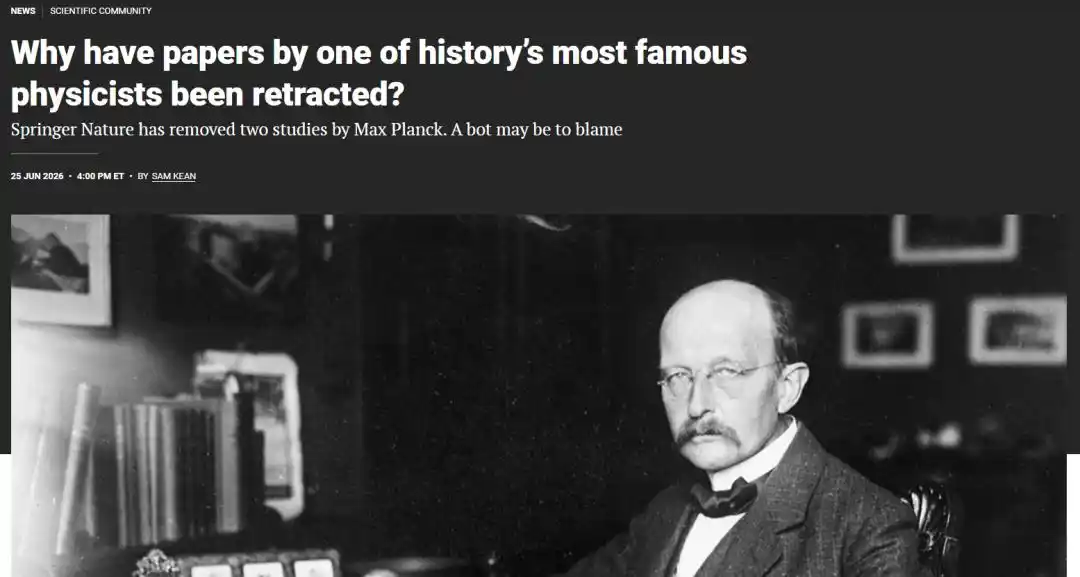
But a new paper points out that two of Planck's articles, published in 1940 and 1942, are actually marked as "retracted" on Springer's digital platform.
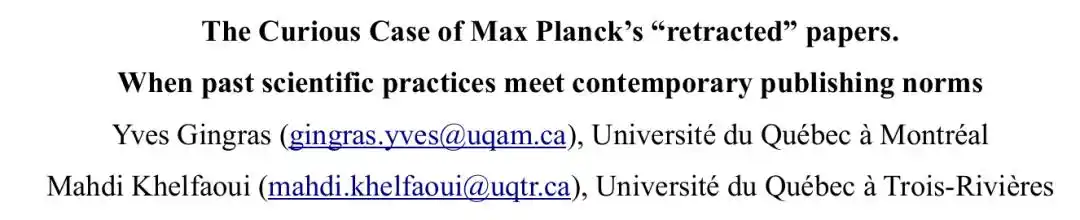
Paper Title: The Curious Case of Max Planck retracted papers. When past scientific practices meet contemporary publishing norms. Paper Address: https://arxiv.org/abs/2605.17534

Amusingly, according to the investigation by the paper's author, these two articles were not retracted due to fabrication, error, or academic misconduct, but were victims of an algorithmic error.

01

The story begins with a "Nobel Laureate Retraction List" from Retraction Watch, a website that tracks issues in academic publishing.

The author, as a researcher in the history of physics, was surprised to see Max Planck on the list because the two articles were published in the German science journal *Die Naturwissenschaften*. By then, Planck was already a world-renowned physicist, and the paper's author found it hard to believe these articles were truly retracted during his lifetime or that there were sufficient grounds for retraction later.
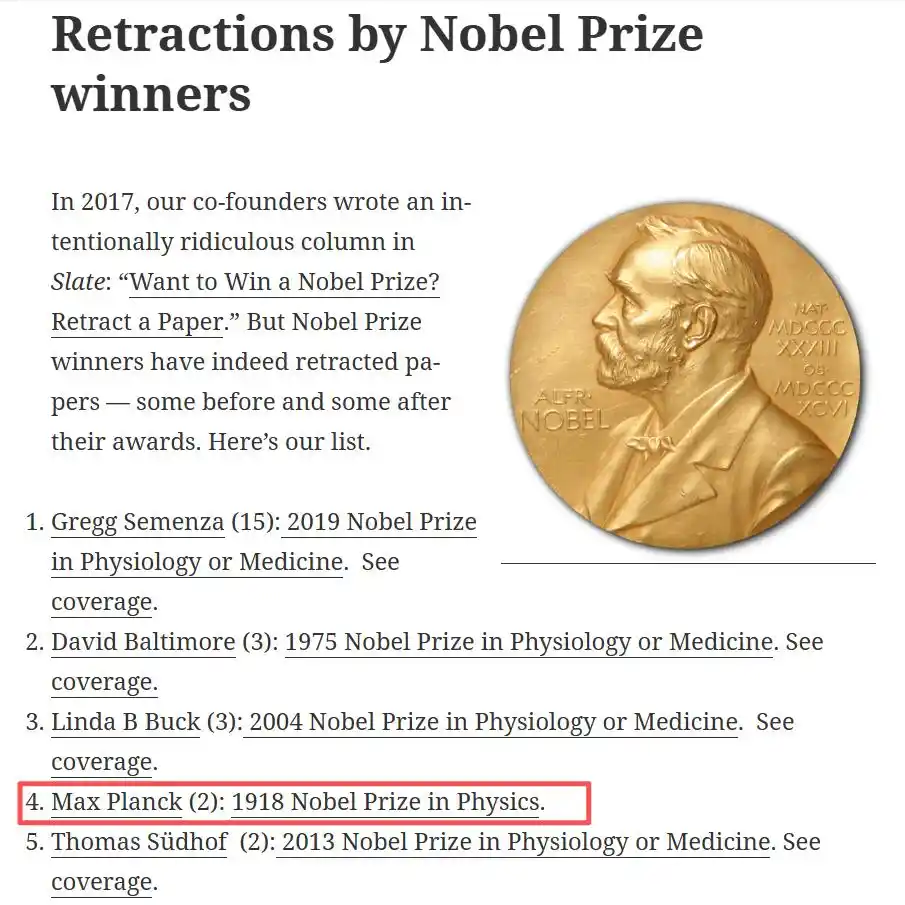
Link: https://retractionwatch.com/retractions-by-nobel-prize-winners/

The explanation given on the Springer platform is rather vague. The page title labels it as a "RETRACTED ARTICLE," but the statement in the PDF says, "This article has been withdrawn due to article violation"; the wording on the webpage is more specific, stating the articles were retracted due to "copyright violation."
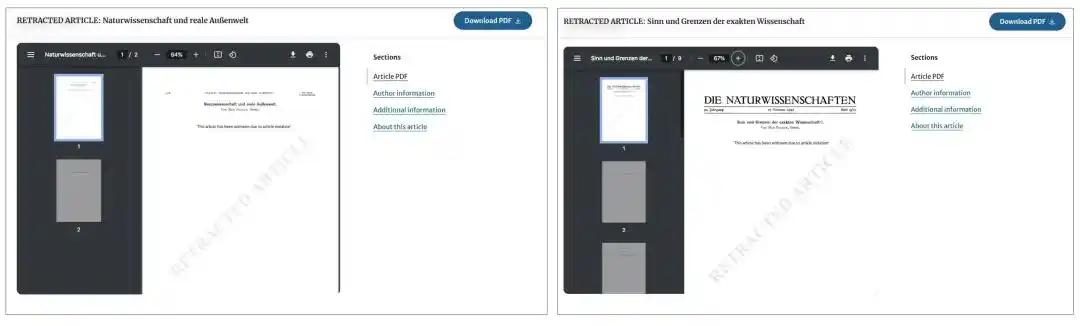
In other words, this is likely an accident manufactured by a combination of copyright, digital archiving, and platform metadata management—these old articles were processed by the system/publisher in modern databases as copyright or duplicate publication issues.

Let's first return to the ecology of scientific publishing in the first half of the 20th century. *Die Naturwissenschaften* was founded in 1913, published by Julius Springer Verlag, and positioned somewhat like the German-language equivalent of *Nature*: it was a comprehensive science weekly covering natural sciences, medicine, and technological advances. It published both technical papers and speeches, conference reports, as well as discussions on the philosophy of science and its cultural significance.

Planck's two articles themselves were not research papers reporting new experiments or theories, but rather philosophical reflections on the nature of scientific knowledge.

The 1942 article, "The Meaning and Limits of Exact Science," is particularly typical. It was originally a lecture Planck gave in 1941 at the Kaiser-Wilhelm-Gesellschaft in Berlin. It later circulated in multiple forms: published as a pamphlet in 1942, also appearing in *Europäische Revue* and *Die Naturwissenschaften*, and was included in a collection of Planck's speeches and essays in 1943.

Today, such a pathway could easily be identified by platforms or copyright systems as "duplicate publication." But at that time, multi-channel circulation—from lectures to journals, from pamphlets to essay collections—was simply part of how scientific ideas spread.

The case of the 1940 article, "Natural Science and the Real External World," is even more peculiar. The paper's author found no evidence of it being published elsewhere as a duplicate. One possible explanation proposed by the author is that a few months earlier in the same journal, another author, Aloys Müller, had published an article with the same title, discussing Planck's philosophical position. Planck then used the same title for a response, engaging in this intellectual debate.

Within the editorial culture of that era, this was clearly not a problem; it was even an explicit gesture of dialogue. But in later digital indexing, copyright management, and metadata systems, two identical titles might be flagged as a suspicious duplicate.

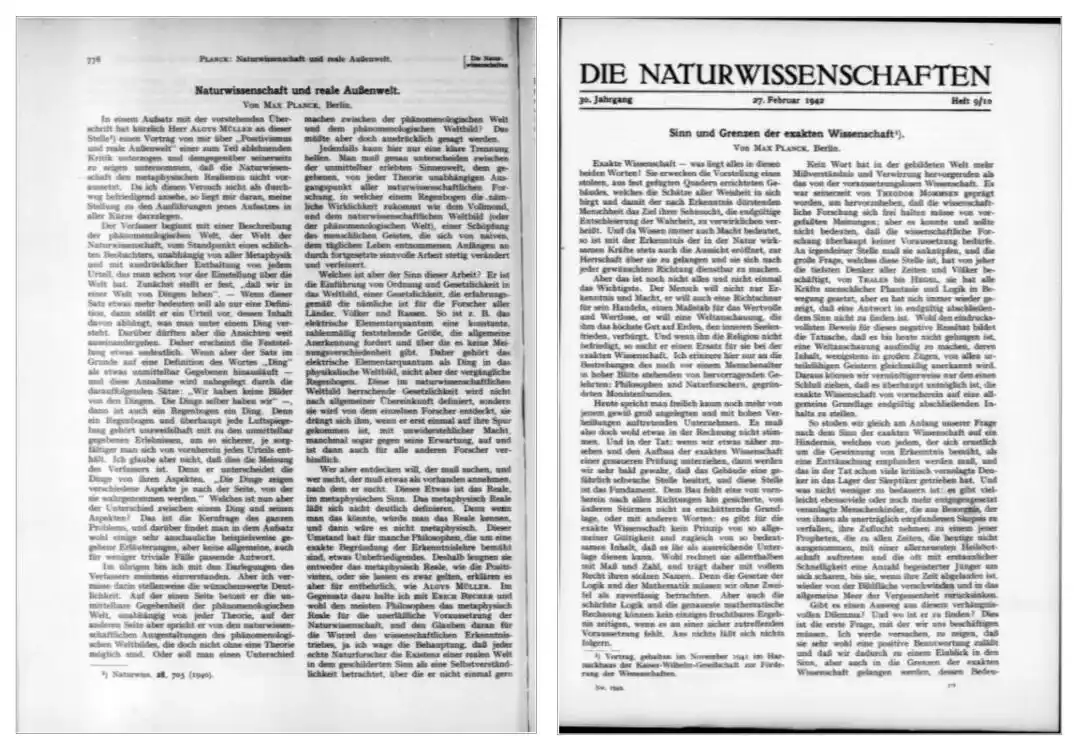
The paper also points out that these two "retracted" articles have even become blank pages on Springer's platform. Normally, even if a paper is retracted, the original text is preserved with a retraction notice added to maintain the integrity of the scientific record. But here, the two-page article from 1940 and the nine-page article from 1942 have both been erased on the digital platform. To read the original today, you can't find it at the original publisher Springer; you have to go to the non-profit Internet Archive.
02

At this point, the matter is no longer just the amusing story of "Planck being mistakenly retracted"; it's a failure of modern academic publishing infrastructure. When historical literature enters modern digital publishing platforms, who has the right to decide what counts as "duplicate publication," what counts as "copyright violation," and what should continue to be seen?

The paper's author argues that concepts like "duplicate publication" and "self-plagiarism" are not eternal, unchanging standards of academic ethics. They are modern categories bound up with bibliometrics, research evaluation, copyright transfer, and commercial publishing platforms from the late 20th century onwards. The paper explicitly states that "self-plagiarism" is a relatively recent concept that has gained prominence with the evaluation systems that measure academic productivity by paper counts since the 1990s.

This is also a point familiar to today's academic system: the issue isn't just "what the content is," but also "how the content is represented by the system."

Once a historical article enters a database, it is broken down into structured objects like DOI, title, author, copyright status, retraction labels, PDF files, citation records, etc. Once platforms process old literature automatically or semi-automatically according to contemporary rules, they may rewrite past normal publishing practices as today's violations.

This mismatch is particularly alarming in the AI era.

When we talk about training data, data cleaning, literature databases, knowledge graphs, and RAG today, we often assume that digital knowledge is stable, retrievable, and callable. But this incident reminds us that digital archives are not a neutral "mirror of the past"; they are a set of filters imbued with commercial logic, legal assumptions, and platform rules. Data can be renamed, re-categorized by platforms, or even replaced with blank pages.

A modern copyright and metrics system retroactively judged normal pre-digital scientific communication practices as suspicious operations. More seriously, this judgment didn't remain at the label level; it directly affected the accessibility of historical literature.

For the knowledge production systems entering the AI era, a wrong label, a missing PDF, or an opaque copyright handling can all be further amplified by models, search engines, and academic tools. Future AI assistants might not know that Planck's articles were "mistakenly retracted"; they might only see the cold, hard "retracted" marker in the database.

When scientific memory is increasingly entrusted to databases, publishers, platform rules, and commercial infrastructure, can we still accurately see science's past?

Reference Link: https://www.science.org/content/article/why-have-papers-one-history-s-most-famous-physicists-been-retracted

This article is from the WeChat public account "Almost Human" (ID: almosthuman2014), author: Focus on Academia


Tiền kỹ thuật số thịnh hành

Câu hỏi Liên quan

QWhat is the main reason Max Planck's articles from 1940 and 1942 were marked as 'retracted' on Springer's platform?

AThe primary reason is believed to be an error caused by automated algorithms or digital platform systems. They likely flagged the articles due to issues such as potential 'duplicate publication' or 'copyright violation' based on modern publishing norms, which misinterpreted the historical publication practices of that era.

QWhat was the original publication context of Max Planck's 1942 article 'The Meaning and Limits of Exact Science'?

AThe 1942 article was originally a lecture delivered by Max Planck in 1941 at the Berlin Kaiser-Wilhelm-Gesellschaft. It was subsequently published in multiple formats, including as a pamphlet, in the journals 'Europäische Revue' and 'Die Naturwissenschaften', and later included in a collection of Planck's speeches and essays. This was a normal method of disseminating scientific ideas at the time.

QWhat unusual outcome occurred for Planck's articles on Springer's platform besides the retraction label?

ABeyond being labeled as 'retracted,' the full texts of the articles were replaced with blank pages on Springer's digital platform. This removal of content is unusual, as standard practice for retracted articles is to keep the original text accessible with a retraction notice to preserve scientific record integrity.

QAccording to the article, why is the concept of 'self-plagiarism' considered a modern construct in relation to this incident?

AThe article argues that concepts like 'self-plagiarism' and 'duplicate publication' are relatively recent constructs tied to late-20th-century academic evaluation systems that emphasize paper counts. Planck's multi-format dissemination of his lecture was standard and acceptable scientific communication in his time but is judged by a different, contemporary set of digital platform rules.

QWhat broader concern does this case raise about digital archives and AI-era knowledge systems?

AThis case highlights that digital archives are not neutral mirrors of the past but are filtered through commercial logic, legal assumptions, and platform rules. An erroneous label or removal can distort the historical record. In the AI era, such errors in databases could be amplified by models, search engines, and tools, potentially leading to the loss or misinterpretation of scientific heritage as AI systems may uncritically accept platform metadata.

Nội dung Liên quan

Các Nhà Phân Tích Nhìn Thấy XRP Và BNB Đuổi Theo Vị Thế Vốn Hóa Thị Trường 100 Tỷ USD Vào Cuối Năm 2026

**TL;DR** Các nhà phân tích dự đoán XRP và BNB có thể gia nhập hoặc tái gia nhập câu lạc bộ vốn hóa thị trường 100 tỷ USD vào nửa cuối năm 2026. Dự báo này dựa trên phân tích biểu đồ lịch sử và cơ bản dự án, không phải là kết quả tài chính được đảm bảo. **Tóm tắt** Một báo cáo từ Finbold chỉ ra XRP và BNB là những ứng cử viên chính để đạt mốc vốn hóa 100 tỷ USD vào cuối năm 2026. Thông tin này đóng vai trò như một thước đo tâm lý thị trường, cho thấy nơi mà sự thèm ăn rủi ro có thể đang dịch chuyển. Tuy nhiên, cần nhấn mạnh đây là suy đoán từ các nhà phân tích, không phải sự đảm bảo. Thị trường tiền điện tử thường biến một điểm dữ liệu nhỏ thành một câu chuyện lan rộng. Bài viết lưu ý rằng câu chuyện này không chỉ ảnh hưởng đến riêng XRP hay BNB. Nó có thể tác động lan tỏa đến các giao dịch liên quan, tâm lý altcoin và định vị của các tổ chức, đặc biệt trong bối cảnh thanh khoản mỏng. Điều quan trọng tiếp theo là theo dõi liệu các luồng dữ liệu tiếp theo (như số liệu on-chain, lãi suất mở) có củng cố xu hướng này hay không, hay nó sẽ chỉ là một tín hiệu ngắn hạn. Cần đọc thông tin này cùng với các điều kiện thị trường rộng hơn về thanh khoản, vĩ mô và phái sinh.

bitcoinist1 giờ trước

Các Nhà Phân Tích Nhìn Thấy XRP Và BNB Đuổi Theo Vị Thế Vốn Hóa Thị Trường 100 Tỷ USD Vào Cuối Năm 2026

bitcoinist1 giờ trước

Vốn Hóa Thị Trường Altcoin Quay Về Gần 900 Ngày Khi Nhà Phân Tích Chỉ Ra Vùng Hỗ Trợ Chính

Nhà phân tích Michaël van de Poppe chỉ ra rằng vốn hóa thị trường altcoin đã mất gần như toàn bộ mức tăng trưởng tích lũy trong gần **900 ngày**, quay trở lại vùng giá đột phá từ cuối năm 2023. Điều này cho thấy một đợt điều chỉnh mạnh, khiến tâm lý thị trường trở nên tiêu cực vì nhiều altcoin về cơ bản không có lãi sau một thời gian dài. Mặt tích cực là đợt điều chỉnh sâu này đưa thị trường về một vùng hỗ trợ quan trọng. Vùng giá đột phá trước đây thường thu hút sự chú ý của những người mua dài hạn và có thể trở thành khu vực tích lũy, tạo nền tảng cho đợt tăng tiếp theo nếu được giữ vững. Tuy nhiên, đây cũng là một điểm quyết định: nếu vùng hỗ trợ này thất bại, triển vọng sẽ ảm đạm hơn. Altcoin rất nhạy cảm với thanh khoản và mức độ ưa thích rủi ro. Do đó, các nhà giao dịch cần theo dõi tín hiệu phục hồi bền vững của vốn hóa thị trường altcoin từ vùng này, đi kèm với khối lượng giao dịch được cải thiện và sự tham gia rộng rãi trên nhiều lĩnh vực (L1, DeFi, cơ sở hạ tầng, token AI...), chứ không chỉ các đợt bơm giá riêng lẻ. Tóm lại, thị trường altcoin đang ở thời điểm cần chứng minh bản thân: giữ được hỗ trợ sẽ mở ra cơ hội tích lũy, ngược lại sẽ làm trầm trọng thêm câu chuyện "gần 900 ngày không có tiến triển".

bitcoinist1 giờ trước

Vốn Hóa Thị Trường Altcoin Quay Về Gần 900 Ngày Khi Nhà Phân Tích Chỉ Ra Vùng Hỗ Trợ Chính

bitcoinist1 giờ trước

Chainlink tăng 8,000 chủ sở hữu mới – LINK có thể phá vỡ xu hướng giảm của nó không?

Chainlink (LINK) đã chứng kiến sự gia tăng mạnh về số lượng ví nắm giữ, với hơn 8.000 ví mới trong 5 ngày, nâng tổng số lên 892.8K ví. Điều này cho thấy sự áp dụng mạng lưới tiếp tục mở rộng bất chấp giá cả còn yếu, có thể nhờ vào sự quan tâm xung quanh token hóa tài sản thực và các sáng kiến blockchain thể chế. Hoạt động trên sàn giao dịch cho thấy dòng tiền ròng rút ra chiếm ưu thế, phản ánh việc giảm nguồn cung bán ngay lập tức khi nhà đầu tư chuyển token vào ví lưu trữ dài hạn, một dấu hiệu của việc tích lũy. Về mặt kỹ thuật, LINK vẫn giao dịch trong một kênh giảm giá, nhiều lần phòng thủ thành công vùng hỗ trợ quan trọng quanh mức 7.00 USD nhưng chưa đủ sức thử thách vùng kháng cự phía trên. Chỉ số RSI cho thấy áp lực bán đã giảm nhưng sức mua vẫn còn yếu. Đáng chú ý, tỷ lệ tài trợ (Funding Rate) vẫn duy trì ở vùng tích cực, cho thấy nhà giao dịch phái sinh vẫn giữ niềm tin vào triển vọng tăng giá trong tương lai. Tóm lại, mặc dù xu hướng giảm giá vẫn chiếm ưu thế, Chainlink đang xây dựng nền tảng vững chắc với sự gia tăng người nắm giữ, dấu hiệu tích lũy và tâm lý phái sinh lạc quan. Sự phục hồi mạnh mẽ hơn có thể xảy ra nếu nhu cầu mua spot tăng cường, giúp LINK thoát khỏi kênh giảm giá hiện tại.

ambcrypto1 giờ trước

Chainlink tăng 8,000 chủ sở hữu mới – LINK có thể phá vỡ xu hướng giảm của nó không?

ambcrypto1 giờ trước

Giao dịch

Giao ngay

Bài viết Nổi bật

Làm thế nào để Mua ONE

Chào mừng bạn đến với HTX.com! Chúng tôi đã làm cho mua Harmony (ONE) trở nên đơn giản và thuận tiện. Làm theo hướng dẫn từng bước của chúng tôi để bắt đầu hành trình tiền kỹ thuật số của bạn.Bước 1: Tạo Tài khoản HTX của BạnSử dụng email hoặc số điện thoại của bạn để đăng ký tài khoản miễn phí trên HTX. Trải nghiệm hành trình đăng ký không rắc rối và mở khóa tất cả tính năng. Nhận Tài khoản của tôiBước 2: Truy cập Mua Crypto và Chọn Phương thức Thanh toán của BạnThẻ Tín dụng/Ghi nợ: Sử dụng Visa hoặc Mastercard của bạn để mua Harmony (ONE) ngay lập tức.Số dư: Sử dụng tiền từ số dư tài khoản HTX của bạn để giao dịch liền mạch.Bên thứ ba: Chúng tôi đã thêm những phương thức thanh toán phổ biến như Google Pay và Apple Pay để nâng cao sự tiện lợi.P2P: Giao dịch trực tiếp với người dùng khác trên HTX.Thị trường mua bán phi tập trung (OTC): Chúng tôi cung cấp những dịch vụ được thiết kế riêng và tỷ giá hối đoái cạnh tranh cho nhà giao dịch.Bước 3: Lưu trữ Harmony (ONE) của BạnSau khi mua Harmony (ONE), lưu trữ trong tài khoản HTX của bạn. Ngoài ra, bạn có thể gửi đi nơi khác qua chuyển khoản blockchain hoặc sử dụng để giao dịch những tiền kỹ thuật số khác.Bước 4: Giao dịch Harmony (ONE)Giao dịch Harmony (ONE) dễ dàng trên thị trường giao ngay của HTX. Chỉ cần truy cập vào tài khoản của bạn, chọn cặp giao dịch, thực hiện giao dịch và theo dõi trong thời gian thực. Chúng tôi cung cấp trải nghiệm thân thiện với người dùng cho cả người mới bắt đầu và người giao dịch dày dạn kinh nghiệm.

Tổng lượt xem 578Xuất bản vào 2024.12.12Cập nhật vào 2026.06.02

Làm thế nào để Mua ONE

Thảo luận

Chào mừng đến với Cộng đồng HTX. Tại đây, bạn có thể được thông báo về những phát triển nền tảng mới nhất và có quyền truy cập vào thông tin chuyên sâu về thị trường. Ý kiến ​​của người dùng về giá của ONE (ONE) được trình bày dưới đây.

活动图片