US CFTC Launches Broad Investigation into Polymarket, Is the Prediction Market Party Coming to an End?

marsbitXuất bản vào 2026-06-30Cập nhật gần nhất vào 2026-06-30

Tóm tắt

The U.S. Commodity Futures Trading Commission (CFTC) is conducting a broad investigation into the prediction market platform Polymarket, focusing on its business practices including social media promotions. This follows a bipartisan letter from U.S. senators urging the CFTC to probe alleged fraudulent marketing tactics used to promote gambling-like products. The action coincides with a period of explosive growth for the prediction market sector, driven by events like the World Cup, with platforms like Kalshi and Robinhood reporting record trading volumes and revenue. The investigation signals a potential end to the sector's unregulated expansion and may lead to clearer federal oversight, particularly regarding investor protection and distinguishing prediction markets from traditional sports betting. The CFTC's move has also intensified a jurisdictional conflict with multiple U.S. states (including Kentucky and New York), which have sued platforms like Polymarket and Kalshi, accusing them of operating illegal sports betting and threatening state gambling tax revenues. Furthermore, the CME Group has sued the CFTC, challenging its approval of certain prediction market products. The report also highlights the political and capital interests intertwined with the industry. Donald Trump Jr. holds advisory and investment roles in both Kalshi and Polymarket, and the Trump administration has previously emphasized federal regulatory authority over these markets. The CFTC's investigati...

Original | Odaily Planet Daily (@OdailyChina)

Author | Wenser(@wenser2010 )
Polymarket's deceptive marketing has finally caught the attention of regulatory authorities.

Recently, the U.S. Commodity Futures Trading Commission (CFTC) has initiated a broad investigation into the prediction market platform Polymarket, covering its business activities including social media campaigns. Previously, U.S. Republican Senator John Curtis and Democratic Senator Adam Schiff co-signed a letter to CFTC Chairman Mike Selig, urging an investigation into Polymarket's practices of paying KOLs for deceptive marketing and using fraudulent marketing tactics to promote gambling-like products to American audiences.

At a time when the World Cup is driving a surge in prediction market trading volumes, this move may pour cold water on the development of this sector. More importantly, the CFTC's investigation into Polymarket has brought to light conflicts of interest between U.S. federal and state authorities, as well as between officials and capital. (Recommended reading: "WSJ: Fake Websites, Fake Trades, Real Promotion, Polymarket's Traffic Scam").

End of the Wild West Era for Prediction Market Marketing, Regulatory Policies May Enter Deep Waters

If the earlier incidents involving Polymarket—such as university students posting fake profit videos and paid KOLs exaggerating prediction profits—were seen as the wild attempts of the early expansion phase of prediction markets, then the formal CFTC investigation is clear proof that this wild growth period is over.

Prediction Market Platform Data Sees Explosive Growth, Attracting Strong Attention from Traditional Internet Giants

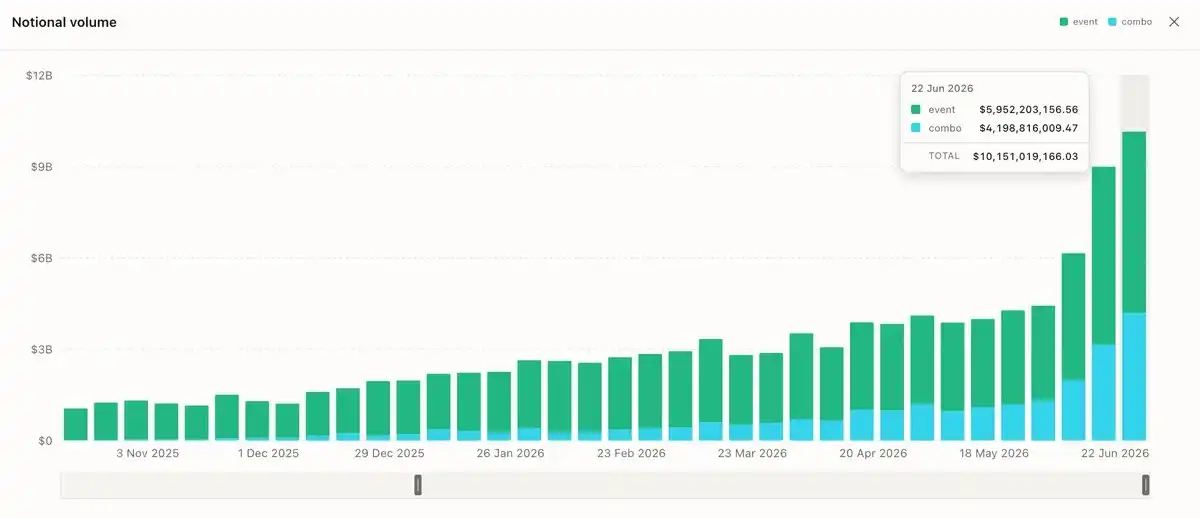
As we entered June 2026, with the official start of the World Cup, prediction markets have received unprecedented attention, leading to a continuous rise in trading volumes.

Data from a16z crypto shows that prediction market trading volume has hit record highs for three consecutive weeks. The total market trading volume reached a historic first of $144 billion last week, a significant increase from approximately $50–60 billion at the beginning of the year. The previous record high of around $100 billion was set just the week before. From the platform side, the data has also seen substantial growth:

  • Latest data shows Kalshi's weekly notional trading volume surpassed $100 billion for the first time.
  • Polymarket officially stated that its annualized revenue has significantly exceeded $1 billion, a development occurring just six weeks after the removal of the waitlist for its U.S. trading platform; data shows that the U.S. platform's daily trading volume grew from about $50 million in mid-May to over $200 million on June 20 (based on Dune Analytics data).
  • Robinhood's prediction market platform business is growing rapidly, with annualized revenue reaching $500 million. In Q2 as of June 25, Robinhood's active contract trading volume was approximately 12.3 billion contracts. Based on a standard rate of 1 cent per contract, the prediction market revenue for this quarter is estimated to be at least $123 million. Its recently launched Rothera prediction market platform achieved over 900 million contract trades in its first week, contributing nearly 60% growth in active contract trading volume for Robinhood.
Such impressive data has also attracted the attention of stock market giant Meta. According to media reports, Meta CEO Mark Zuckerberg has urged the company to explore partnerships with prediction markets Polymarket and Kalshi. Meanwhile, Meta is developing a similar prediction market application called Arena.

All signs indicate that prediction markets have leapt from a niche sector a few years ago to a hot industry experiencing exponential expansion. In the face of this trend, regulatory authorities are unlikely to stand idly by. The recent deceptive marketing incidents at Polymarket serve as a timely and fitting 'soft knife,' providing an opportunity for regulatory intervention. The author believes that subsequent regulations may gradually clarify the boundaries for prediction market platforms regarding marketing, event contract content, and trading fees, aiming to strengthen investor protection and clearly distinguish them from traditional gambling businesses.

Simultaneously, as the investigation deepens, the power struggle between federal regulatory agencies represented by the U.S. CFTC and state-level regulators is also coming to light.

When U.S. CFTC and Nine U.S. States Lock Horns: The Battle for Prediction Market Regulatory Power

Last Tuesday, the U.S. CFTC formally filed a lawsuit against Kentucky, attempting to reaffirm the agency's jurisdiction over prediction market platforms.

In the complaint filed with the U.S. District Court for the Eastern District of Kentucky, the CFTC stated that Kentucky's attempt to shut down federally regulated designated contract markets interferes with the federal regulatory system Congress established for the national swaps market. It claims "exclusive jurisdiction" over related event contracts and prediction market products.

Previously, Kentucky sued platforms like Kalshi and Polymarket, accusing them of operating unlicensed illegal sports betting and gambling businesses within the state. As of June, over 12 U.S. states, including Kentucky and New York, have taken legal action against Polymarket and Kalshi, alleging they operate illegal sports betting. Kentucky has become the ninth state sued by the CFTC in the prediction market regulatory dispute.

This action highlights the escalating conflict between federal derivatives regulation and state-level gambling regulation.

There are two main reasons behind this dispute:

  • First, the practical interests of state and local gambling industries, such as tax revenue. Traditional sports betting previously brought significant tax revenue to various states (e.g., high-tax-rate online gambling). If prediction markets completely replace the gambling industry, potential tax losses for states could amount to hundreds of millions of dollars annually (one estimate is around $600 million).
  • Second, the definition of the regulatory boundary between the gambling industry and prediction markets as an emerging industry. The CFTC seeks to maintain the classification of "event contracts" as commodity derivatives, futures, or swaps, enforcing a policy of federal law preemption.

The final outcome and specific definitions may depend on the interpretation and rulings by state courts, and potentially the U.S. Supreme Court, regarding the Commodity Exchange Act (CEA).

Furthermore, the battle between exchanges and the U.S. CFTC has also ignited. The CFTC's previous approval of Kalshi's application for perpetual futures trading triggered CME's lawsuit—

Reportedly, CME has sued the U.S. Commodity Futures Trading Commission and its Chairman Michael Selig in the U.S. District Court for the District of Columbia. Regarding the CFTC's May 29th approval for prediction market platform Kalshi to launch perpetual futures contracts linked to the Bitcoin spot price, among other actions, the CFTC's treatment of "futures" with expiration dates as "swaps" violates U.S. Congressional directives and the Commodity Exchange Act. CME requests the court to overturn the related perpetual futures actions. CME also claimed that Selig acted unilaterally without the presence of the full five-member panel of commissioners.

A CFTC spokesperson responded that CME is waging a "legal war" against the agency and the government's crypto policy, stating that "the act of filing the lawsuit is extremely imprudent." (Essentially saying "your lawsuit is filed too hastily" right on its forehead.)

Of course, it's no wonder CME is so agitated. The CFTC's move to allow Kalshi to trade crypto perpetual futures contracts essentially lets prediction market platforms like Kalshi, along with crypto exchanges like Coinbase and Kraken, encroach upon CME's "trading territory." As for the driving force behind this, it might have some connection to the Trump family.

The Trump Family's Prediction Market 'Double-Down Strategy': Don Jr. Bets on Kalshi and Polymarket

Recently, it was revealed that Kalshi is negotiating a new round of funding at a valuation of approximately $40 billion, with the deal potentially closing as early as Q3. Following a $10 billion financing round in May (investors included Sequoia Capital, Andreessen Horowitz, Coatue, and Morgan Stanley), Kalshi's valuation rose from its previous $12 billion to $22 billion. Now, that number is about to double.

Kalshi CEO Tarek Mansour stated that the company is considering an IPO no earlier than late 2027 or 2028. Kalshi officially stated that as of April 2026, its annualized trading volume reached $178 billion, a 32-fold increase year-over-year.

Such remarkable market data and the high enthusiasm from capital markets are hard to separate from one of the Trump family's prominent figures, Donald Trump Jr.

It is understood that Don Jr. is essentially "hedging his bets" in the prediction market sector:

On one hand, he served as a paid strategic advisor for Kalshi in early 2025, receiving approximately $300,000 worth of company equity at a time when Kalshi's valuation was less than $2 billion. That investment alone has yielded over a 10x return;

On the other hand, he also serves as an advisor to Polymarket and has made a strategic investment in the latter through his venture capital firm, 1789 Capital, where he is a partner.

Coupled with Trump's previous emphasis on federal government regulatory authority over prediction markets, and his mention that "Kalshi and Polymarket will thrive under his leadership,"

To some extent, the conflict of interest between capital and official regulatory agencies has been eased; and the Trump family serves as the "best lubricant" in this contradictory situation.

Thus, a network of interests connecting the U.S. CFTC and other federal regulatory agencies, U.S. state governments, and Trump family investment entities gradually takes shape.

As for the U.S. CFTC's investigation into Polymarket, it may just be an inevitable step in regulating the prediction market industry.

The era of wild growth, the 'Spring of Prediction Markets,' is coming to an end, while the 'Prosperous Summer' for the prediction market industry is slowly approaching.


Tiền kỹ thuật số thịnh hành

Câu hỏi Liên quan

QWhat is the US CFTC investigating regarding Polymarket?

AThe US Commodity Futures Trading Commission (CFTC) is conducting a broad investigation into the prediction market platform Polymarket, covering aspects of its business including social media activities. The investigation is prompted by concerns over paid KOLs engaging in deceptive marketing, using fraudulent methods to promote gambling-like products to a US audience.

QWhat is the core conflict highlighted between the US CFTC and certain US states in the article?

AThe core conflict is a jurisdictional battle between federal regulatory authority (the CFTC) and state-level power. The CFTC asserts exclusive federal jurisdiction over event contracts and prediction market products under the Commodity Exchange Act. However, states like Kentucky and New York are suing platforms like Polymarket and Kalshi, accusing them of operating illegal sports betting and gambling businesses within their borders, which are traditionally regulated by the states. This conflict involves both regulatory boundaries and potential state tax revenue losses from the traditional gambling industry.

QWhat role does Donald Trump Jr. play in the prediction market sector according to the article?

AAccording to the article, Donald Trump Jr. is involved with both major prediction market platforms. He serves as a paid strategic advisor for Kalshi, receiving company equity, and also acts as an advisor for Polymarket through his venture capital firm, 1789 Capital, which made a strategic investment in the platform. His involvement is presented as part of a network connecting capital, political influence, and regulatory bodies.

QWhat significant legal action did the CME Group take against the CFTC, and why?

AThe CME Group filed a lawsuit against the US CFTC and its Chairman, Michael Selig, in the US District Court for the District of Columbia. The lawsuit challenges the CFTC's approval for Kalshi to launch perpetual futures contracts tied to Bitcoin's spot price. CME argues the CFTC violated the Commodity Exchange Act by treating futures with expiration dates as 'swaps' and that Chairman Selig acted unilaterally without a full commission. The move is seen as CME protecting its trading turf from encroachment by prediction market and crypto exchanges.

QHow does the article characterize the current stage and future of the prediction market industry?

AThe article characterizes the current massive growth, driven by events like the World Cup, as the end of a 'wild spring' or野蛮生长期 (barbaric growth period) for prediction markets, marked by early expansion tactics like deceptive marketing. The CFTC's investigation is seen as the start of increased regulatory scrutiny. However, the conclusion suggests this is a necessary step, and a 'prosperous summer' for a more regulated and mature prediction market industry is slowly approaching.

Nội dung Liên quan

Đã được xác nhận: Claude Code lén kiểm tra người dùng, múi giờ và phòng thí nghiệm AI Trung Quốc đều là từ khóa

Hôm nay, Anthropic công bố Claude Sonnet 5 và thông báo Bộ Thương mại Mỹ dỡ bỏ lệnh hạn chế xuất khẩu đối với các mô hình Claude Fable 5 và Mythos 5. Tuy nhiên, cộng đồng nhà phát triển tập trung vào một vụ việc gây tranh cãi khác: Claude Code bị phát hiện thu thập thông tin người dùng một cách âm thầm. Theo báo cáo từ GitHub, Claude Code (các phiên bản 2.1.193 đến 2.1.196) chứa cơ chế ẩn tự động phát hiện múi giờ Trung Quốc (như Asia/Shanghai), cấu hình proxy mạng và kiểm tra xem người dùng có đang kết nối đến các tên miền liên quan đến phòng thí nghiệm AI Trung Quốc hay không (như của Baidu, Alibaba, ByteDance...). Thông tin này sau đó được mã hóa vào lời nhắc hệ thống gửi lên đám mây thông qua kỹ thuật steganography, cụ thể bằng cách thay đổi ký tự phân cách ngày tháng và sử dụng các ký tự Unicode gần giống nhau (như ', ʼ, ʹ) trong cụm từ "Today's date". Hành động này bị chỉ trích vì vi phạm sự tin cậy, khi người dùng không hề hay biết và không có tùy chọn từ chối. Một thành viên kỹ thuật của Anthropic (@trq212) đã phản hồi, thừa nhận đoạn mã này và cho biết nó sẽ bị xóa trong bản cập nhật tiếp theo. Sự việc làm dấy lên lo ngại về quyền riêng tư và tính minh bạch trong các công cụ trợ lý lập trình có quyền truy cập sâu vào hệ thống và mã nguồn.

marsbit39 phút trước

Đã được xác nhận: Claude Code lén kiểm tra người dùng, múi giờ và phòng thí nghiệm AI Trung Quốc đều là từ khóa

marsbit39 phút trước

Grayscale:Sau khi giảm một nửa, Bitcoin đã tiến gần đáy chu kỳ này

Bitcoin đã giảm hơn 50% từ mức đỉnh 125.000 USD vào tháng 10, xuống dưới 60.000 USD, đánh dấu mức thấp mới trong chu kỳ hiện tại. Zach Pandl, Giám đốc Nghiên cứu tại Grayscale, coi đây là một đợt điều chỉnh chu kỳ điển hình trong xu hướng tăng dài hạn của BTC chứ không phải sự đảo chiều. Các yếu tố chính gây áp lực bao gồm: kỳ vọng thắt chặt chính sách của Cục Dự trữ Liên bang Mỹ (Fed) dưới thời tân Chủ tịch Kevin Warsh, sự không chắc chắn xung quanh dự luật CLARITY tại Thượng viện Mỹ, áp lực lên bảng cân đối kế toán của các công ty như Strategy, và lo ngại về rủi ro bảo mật từ máy tính lượng tử. Bài viết đưa ra hai kịch bản chính để thoát khỏi thị trường gấu: * **Kịch bản lạc quan (cơ sở):** Dự luật CLARITY được thông qua, Fed không tăng lãi suất, và các biện pháp ổn định được thực hiện. Trong trường hợp này, Bitcoin có thể đã tiệm cận đáy. * **Kịch bản bi quan (xu hướng giảm):** Dự luật CLARITY thất bại, Fed buộc phải tăng lãi suất, và quá trình giảm đòn bẩy tiếp diễn. Điều này có thể khiến BTC giảm thêm, mặc dù mức giảm sâu 80% như lịch sử được cho là ít xảy ra do đợt tăng giá vừa qua ôn hòa hơn và nhu cầu thể chế vững chắc hơn. Dù các yếu tố chu kỳ gây ra biến động ngắn hạn, Grayscale vẫn lạc quan về triển vọng cấu trúc dài hạn, được hỗ trợ bởi việc áp dụng công nghệ blockchain bởi các tổ chức, sự phát triển của stablecoin, tài sản mã hóa, và các động lực cơ bản như nợ công cao, sự sụt giảm niềm tin vào các tổ chức trung gian và sự trỗi dậy của AI. Bài viết kết luận rằng mức định giá hiện tại tạo ra một điểm vào hấp dẫn cho các nhà đầu tư dài hạn, mặc dù đáy cuối cùng phụ thuộc vào các chất xúc tác chính sách sắp tới.

marsbit1 giờ trước

Grayscale:Sau khi giảm một nửa, Bitcoin đã tiến gần đáy chu kỳ này

marsbit1 giờ trước

Báo cáo tài chính 25 năm của Trump: Gia đình thu hơn 1 tỷ USD mỗi năm từ tiền điện tử, trong khi các nhà đầu tư nhỏ lẻ vẫn thua lỗ trên $TRUMP

Theo báo cáo tiết lộ tài chính năm 2025, các doanh nghiệp crypto liên quan đến gia đình cựu Tổng thống Trump đã thu về gần 12 tỷ USD, vượt xa nhiều danh mục bất động sản lâu năm. Nguồn thu chính đến từ hai nơi: World Liberty Financial kiếm được hơn 5 tỷ USD từ việc bán token quản trị và các sản phẩm mới, trong khi CIC Digital thu khoảng 6.35 tỷ USD tiền bản quyền từ meme coin $TRUMP. Tuy nhiên, trong khi Trump thu lợi lớn, nhiều nhà đầu tư nhỏ lẻ phải chịu thua lỗ. Giá token $TRUMP đã giảm từ mức đỉnh 74 USD xuống còn 1.68 USD, và token của World Liberty Financial cũng mất khoảng 80% giá trị kể từ khi giao dịch. Sự trỗi dậy của mảng kinh doanh crypto này diễn ra trong bối cảnh chính quyền Trump nới lỏng các quy định đối với ngành công nghiệp tiền số. Báo cáo cũng làm dấy lên các câu hỏi về xung đột lợi ích tiềm tàng, liên quan đến hàng loạt dự án bất động sản ở nước ngoài mang lại hàng triệu USD phí cho Trump khi ông tại nhiệm. Dù Nhà Trắng phủ nhận mọi xung đột, các giao dịch này vẫn tiếp tục được giám sát chặt chẽ.

marsbit1 giờ trước

Báo cáo tài chính 25 năm của Trump: Gia đình thu hơn 1 tỷ USD mỗi năm từ tiền điện tử, trong khi các nhà đầu tư nhỏ lẻ vẫn thua lỗ trên $TRUMP

marsbit1 giờ trước

Từ 'Phân cụm địa chỉ' đến 'Tiêu chuẩn bằng chứng': Tại sao Chainalysis muốn định nghĩa lại việc truy vết blockchain?

Vào cuối tháng 6 năm 2026, Chainalysis đã công bố một khung dữ liệu mang tên "Blockchain Tracing Ontology", nhằm thiết lập một hệ thống mô tả dữ liệu thống nhất hơn cho phân tích blockchain. Không giống như một thuật toán mới, đề xuất này tập trung vào việc tạo ra một "ngôn ngữ chung" để chuẩn hóa cách biểu đạt kết quả phân tích, giúp quá trình này minh bạch, có thể kiểm chứng và tái lập hơn. Vấn đề lâu nay là các công ty phân tích khác nhau thường đưa ra kết quả khác nhau cho cùng một địa chỉ do thiếu tiêu chuẩn chung, đặc biệt gây tranh cãi trong điều tra tư pháp hay chống rửa tiền. Chainalysis đề xuất chuyển từ mô hình "Cluster" (cụm địa chỉ) đơn giản sang cấu trúc phân lớp chi tiết hơn: Entity (thực thể) -> Wallet (ví) -> Wallet Segment (phân đoạn ví) -> Address (địa chỉ). Điều này phản ánh chính xác hơn cách quản lý ví phức tạp của các tổ chức lớn. Quan trọng hơn, Ontology nhấn mạnh vào tính minh bạch của quá trình suy luận, không chỉ kết quả cuối cùng. Mỗi kết luận cần đi kèm bằng chứng (Evidence) cụ thể (mẫu giao dịch, thông tin công khai...) và mức độ tin cậy (Confidence), giải thích rõ "tại sao" lại có nhận định đó. Cách tiếp cận này đáp ứng tốt hơn yêu cầu về tính có thể kiểm chứng của bằng chứng tư pháp, như đã thấy trong vụ án Bitcoin Fog. Chainalysis cũng nhấn mạnh rằng phân tích on-chain tự nó không thể nhận dạng danh tính thực; nó chỉ cung cấp suy luận về mối quan hệ giữa các địa chỉ và dòng tiền. Danh tính thực sự cần được xác định thông qua bằng chứng off-chain như thông tin KYC. Về lâu dài, đề xuất này đánh dấu bước chuyển của ngành từ "dựa trên kinh nghiệm" sang "dựa trên tiêu chuẩn". Nếu được chấp nhận rộng rãi, nó có thể tạo ra một nền tảng dữ liệu thống nhất, giảm chi phí giao tiếp và nâng cao độ tin cậy cho hoạt động giám sát, điều tra xuyên biên giới. Giá trị cạnh tranh trong tương lai sẽ không chỉ nằm ở độ chính xác thuật toán, mà còn ở khả năng giải thích, chất lượng dữ liệu và độ tin cậy của bằng chứng.

marsbit2 giờ trước

Từ 'Phân cụm địa chỉ' đến 'Tiêu chuẩn bằng chứng': Tại sao Chainalysis muốn định nghĩa lại việc truy vết blockchain?

marsbit2 giờ trước

Giao dịch

Giao ngay

Bài viết Nổi bật

Làm thế nào để Mua POL

Chào mừng bạn đến với HTX.com! Chúng tôi đã làm cho mua Polygon Ecosystem Token (POL) trở nên đơn giản và thuận tiện. Làm theo hướng dẫn từng bước của chúng tôi để bắt đầu hành trình tiền kỹ thuật số của bạn.Bước 1: Tạo Tài khoản HTX của BạnSử dụng email hoặc số điện thoại của bạn để đăng ký tài khoản miễn phí trên HTX. Trải nghiệm hành trình đăng ký không rắc rối và mở khóa tất cả tính năng. Nhận Tài khoản của tôiBước 2: Truy cập Mua Crypto và Chọn Phương thức Thanh toán của BạnThẻ Tín dụng/Ghi nợ: Sử dụng Visa hoặc Mastercard của bạn để mua Polygon Ecosystem Token (POL) ngay lập tức.Số dư: Sử dụng tiền từ số dư tài khoản HTX của bạn để giao dịch liền mạch.Bên thứ ba: Chúng tôi đã thêm những phương thức thanh toán phổ biến như Google Pay và Apple Pay để nâng cao sự tiện lợi.P2P: Giao dịch trực tiếp với người dùng khác trên HTX.Thị trường mua bán phi tập trung (OTC): Chúng tôi cung cấp những dịch vụ được thiết kế riêng và tỷ giá hối đoái cạnh tranh cho nhà giao dịch.Bước 3: Lưu trữ Polygon Ecosystem Token (POL) của BạnSau khi mua Polygon Ecosystem Token (POL), lưu trữ trong tài khoản HTX của bạn. Ngoài ra, bạn có thể gửi đi nơi khác qua chuyển khoản blockchain hoặc sử dụng để giao dịch những tiền kỹ thuật số khác.Bước 4: Giao dịch Polygon Ecosystem Token (POL)Giao dịch Polygon Ecosystem Token (POL) dễ dàng trên thị trường giao ngay của HTX. Chỉ cần truy cập vào tài khoản của bạn, chọn cặp giao dịch, thực hiện giao dịch và theo dõi trong thời gian thực. Chúng tôi cung cấp trải nghiệm thân thiện với người dùng cho cả người mới bắt đầu và người giao dịch dày dạn kinh nghiệm.

Tổng lượt xem 377Xuất bản vào 2024.12.11Cập nhật vào 2026.06.02

Làm thế nào để Mua POL

Thảo luận

Chào mừng đến với Cộng đồng HTX. Tại đây, bạn có thể được thông báo về những phát triển nền tảng mới nhất và có quyền truy cập vào thông tin chuyên sâu về thị trường. Ý kiến ​​của người dùng về giá của POL (POL) được trình bày dưới đây.

活动图片