One Year After the Crash of Crypto Treasury Companies, Copycats Are Already Making a Comeback

marsbitXuất bản vào 2026-06-29Cập nhật gần nhất vào 2026-06-29

Tóm tắt

One year after the collapse of digital asset treasury (DAT) companies, which wiped out up to 99% for early investors, the scheme has returned in a new guise. Recently, Triller Group announced it would become a "SpaceX treasury company," causing its market cap to surge. This follows the rebranding of another firm, LGHL, now targeting a token called HYPE. The original model, popularized by MicroStrategy (MSTR) and its "Bitcoin yield" narrative, saw companies trading at massive premiums to their underlying crypto holdings. However, most followers like TwentyOne, Metaplanet, and Nakamoto have crashed 80-95%+ from their peaks, erasing nearly all value for late investors. The author argues these structures have no fundamental reason to trade at premiums when low-fee Bitcoin ETFs or direct ownership exist. The cycle persists due to speculative demand driven by FOMO, gamification, and a belief the system is rigged, met by insiders and promoters who profit from the pump-and-dump dynamics. Drawing a parallel to the 1637 Tulip Mania, the piece concludes that such frenzies are not a bug but a recurring product of markets, where greater fools provide demand and insiders supply the schemes. Despite holding Bitcoin personally, the author condemns this specific packaging of assets into leveraged corporate vehicles marketed as innovation, a cycle seemingly unstoppable until a major crash.

Author: Rasheed Saleuddin

Compiled by: Deep Tide TechFlow

Deep Tide Guide: Last summer, the frenzy for Digital Asset Treasury (DAT) companies ended in a spectacular crash, with early investors losing up to 99%. One year later, the same scam is back under a new guise—this time packaged with SpaceX stock and the HYPE token. The cycle of greed and fear never ends, as retail investors continue to foot the bill for insiders' feasts.

Last Tuesday, the Triller Group (who?) announced it would become the world's first SpaceX treasury company. That is, it will use newly raised funds to buy and hold SpaceX stock. That's its business model: holding SpaceX. This news sent Triller's market cap soaring from $15 million to $63 million.

Matt Levine noticed this, and it caught my attention too. This announcement closely followed the rebranding of an "established" treasury company, LGHL—they previously bought crypto assets like SOL and SUI, and now they're buying the HYPE token. Because, well, hype.

We've seen this movie before. Just last summer. The ending was so bad you'd think it would never happen again. Worse, it was blatantly one of the most obvious scams, one I could see coming from a mile away.

The sequel is already showing. Because global speculators need their "spiritual opium," and pump-and-dump insiders are happy to supply it. Supply meets demand. When will they ever learn?

The Pioneer Made the Wrong Headlines

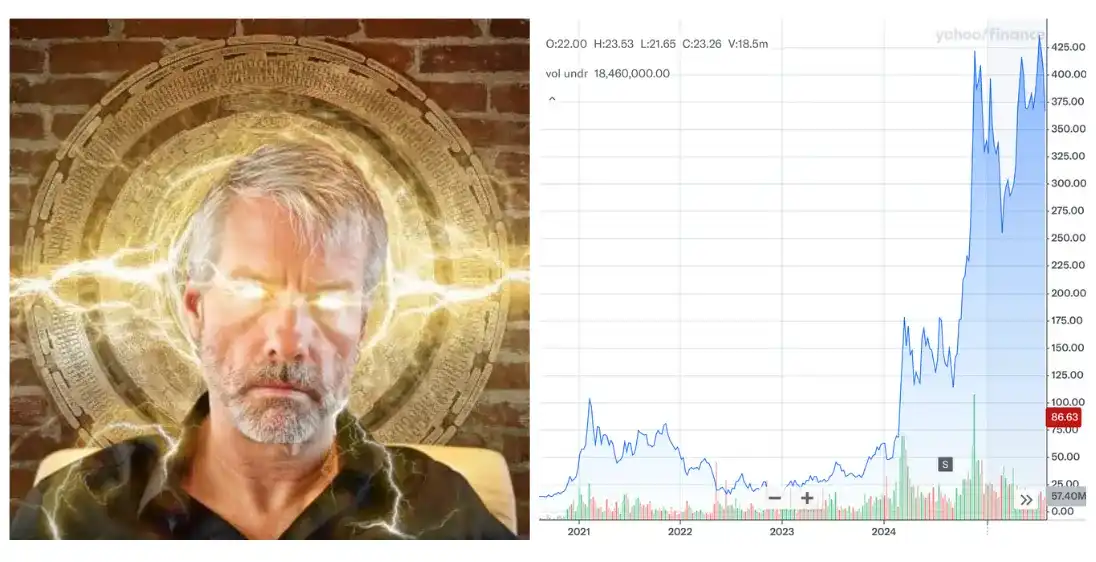
MicroStrategy/Strategy (MSTR) CEO Michael Saylor pioneered the concept of "Bitcoin yield." Through alchemy, a bitcoin held by a corporation somehow became worth more than a bitcoin held by someone not named Michael Saylor.

For a long and awkward period, the market agreed with him.

Not long ago, MSTR traded at 200% of the value of the Bitcoin on its balance sheet (Net Asset Value, NAV). You paid two dollars for one dollar's worth of Bitcoin. The sage Saylor, hailed as Satoshi Nakamoto reincarnated, frantically bought up all the Bitcoin he could, issuing expensive stock and even more complex financial instruments to new believers. The stock price looked like it would rise to infinity.
The Copycats

The premium on Strategy's stock attracted competitors, just as premiums always do. I documented this last May:

SPACs became Bitcoin buyers. Unprofitable operating companies ditched their original businesses to raise funds and buy BTC, ETH, or even more obscure crypto assets.

Spoiler alert: None performed as well as MSTR. And MSTR itself wasn't exactly a success story.

One year later, here's the situation:

Strategy (MSTR): Down 79% from its peak. This is the combined result of BTC falling 45% over the same period and the NAV premium compressing from 2x to 1x. Leverage magnifies gains and losses—that's how leverage works.

TwentyOne (XXI): Reached 5x NAV at its peak. Credit where it's due, it still trades above 1x NAV, though it's down 85% from its peak. Even some insiders got caught.

Metaplanet: Down 87% from a year ago, and down another 50% since the crash.

Nakamoto (NAKA) (formerly KindlyMD): Down 87% since October, after already falling 95% from its all-time high. If you put $100,000 into this stock a year ago, you'd have $650 left.
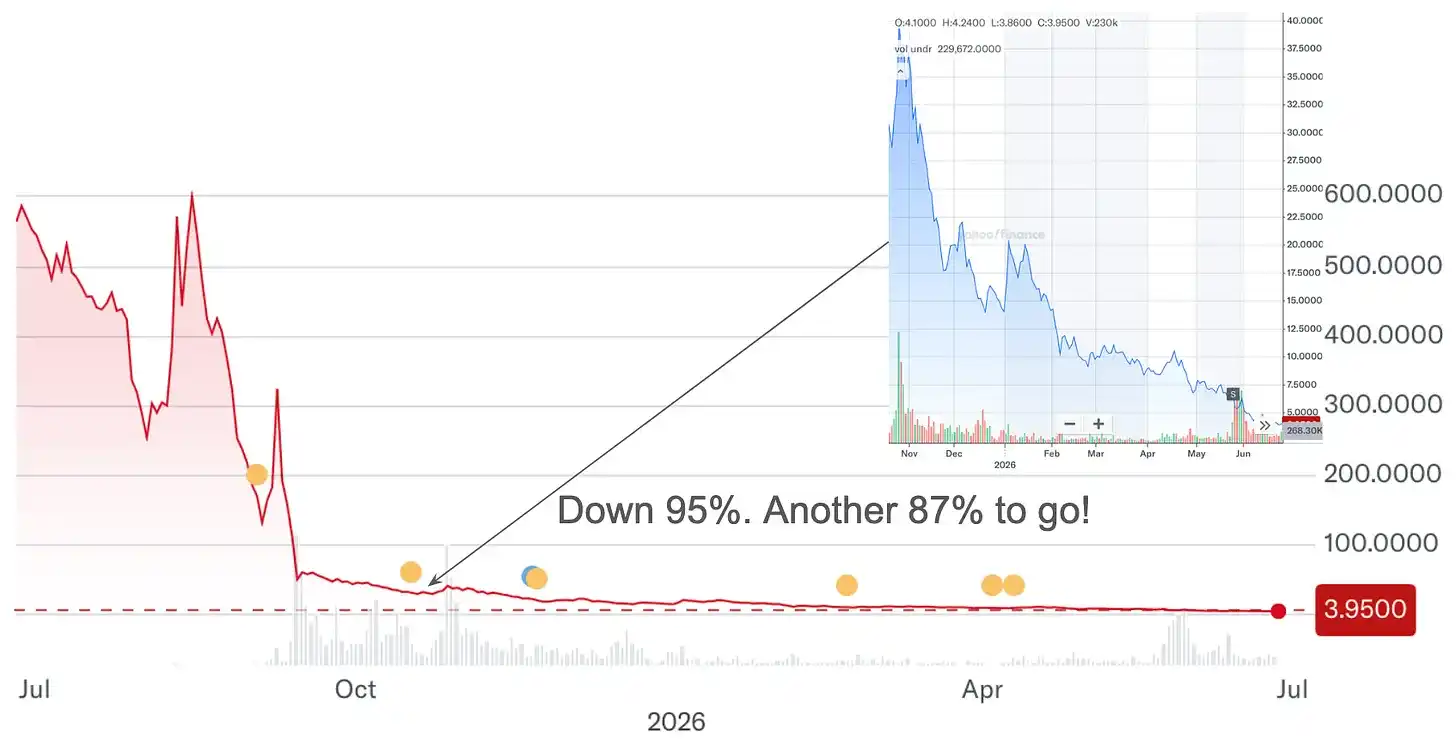
From $100,000 to $650. Enough for a (very) nice dinner. Speculators who "bought the dip," thinking "how much lower can it go," didn't fare much better than the original believers. The answer to "how much lower can it go" is often "quite a bit."

Why This Was Bound to Happen

Bitcoin ETFs exist. They charge only 9 basis points. Bitcoin itself exists. You can hold it yourself. There is no structural reason for DATs to trade at a premium—only greater fool theory, momentum trading, and a particular brand of financial nihilism where retail speculators, convinced the system is rigged, conclude they might as well play the rigged game with maximum aggression.

If you believe the traditional investment system doesn't work for you, the expected value of speculation looks different. FOMO plus dopamine plus gamification plus GameStop: Each alone is a manageable psychological condition. Together, they become a significant part of today's market structure.

Needless to say, insiders are always incentivized to meet the demand. They profit no matter which way the stock moves—another thing worth remembering.

About Tulips

The sad conclusion here is that no one cares when the market is irrational. This is a shame because the DAT crash is a perfect fable for the consequences of fear and greed. It should be a central case study for all bubble reporting. This is the Tulip Mania, only real and recent.

The 1637 dialogue "Waermondt and Gaergoedt" depicts two fictional Dutch weavers watching tulip prices collapse in real-time. One passage, spanning nearly four centuries, reads as if it were written last month:

"Things had gotten to the point that what used to be thrown into the dung heap to kill weeds in baskets was now selling for high prices. I thought I was rich enough. I thought I'd never have to weave again."

Polishing turds didn't work back then either. A flower that sold for 22 ducats in 1637 was trading at 400 ducats at its peak the year before. Then the liquidation came:

"I wish this country had never had flowers!"

I wonder how many retail investors, like those who turned an initial $100,000 into $650, wish they had never heard of Metaplanet, Nakamoto, or the phrase "Bitcoin yield."

One More Thing

I hold some Bitcoin. My venture fund holds crypto investments. I'm not against digital assets. I'm against this specific frenzy of packaging digital assets into companies, charging privileged fees, issuing debt for leverage, and then marketing the result as financial innovation.

I thought this frenzy was killed by the 2025 DAT crash. But the Golden Age of scams continues (with thanks to Shrubstack).

History repeats itself. Always. The pump-and-dump isn't a bug in the system; for those operating it, it's the product. Speculators provide the demand, insiders provide the product. Until we get the mother of all tulip crashes.

The pump-and-dump is the end in itself.

Tiền kỹ thuật số thịnh hành

Câu hỏi Liên quan

QWhat is a 'vault company' in the context of this article, and how did the first wave of such companies end?

AA 'vault company' in this article refers to a firm whose business model is to raise funds and use them primarily to buy and hold a specific asset, like Bitcoin (e.g., MicroStrategy) or other cryptocurrencies. The first wave of such companies, following the model of MicroStrategy's 'Bitcoin yield,' saw their stocks trade at huge premiums over the net asset value (NAV) of the crypto they held. This ended in a 'catastrophic crash' in the summer of 2025, where early investors in many Digital Asset Treasury (DAT) companies lost up to 99% of their money.

QAccording to the author, why did DAT companies trade at a large premium over the value of their underlying assets, and what eventually happened to that premium?

AThe author argues that DAT companies traded at a large premium to their Net Asset Value (NAV) not for any structural reason, but due to 'greater fool theory, momentum trading,' and a form of financial nihilism where retail speculators, believing the system is rigged, try to play the 'rigged game' aggressively. This premium eventually collapsed as the bubble burst, with stocks like MSTR seeing their premium compress from 200% to around 100%, contributing to their massive decline from peak prices.

QWhat are the two new examples of 'vault company' schemes mentioned in the article, and what assets do they plan to hold?

AThe article mentions two new 'vault company' schemes: 1) Triller Group announced it would become the world's first 'SpaceX vault company,' using newly raised funds to buy and hold SpaceX stock. 2) LGHL (a previously established vault company) rebranded to focus on buying HYPE tokens instead of its previous crypto assets (SOL and SUI).

QWhat historical event does the author compare the DAT crash to, and what is the key similarity?

AThe author compares the DAT crash to the 17th-century Dutch Tulip Mania. The key similarity is the extreme and irrational speculation on an asset (tulip bulbs then, shares of companies holding crypto now), where prices soared based on hype and greed before collapsing catastrophically, leaving investors with massive losses. The author cites a 1637 dialogue about the tulip crash that sounds 'like it was written last month.'

QWhat is the author's main argument about the relationship between retail speculators and insiders in these schemes?

AThe author's main argument is that a symbiotic cycle exists between retail speculators and insiders/promoters. Retail speculators, driven by FOMO and a belief the system is unfair, provide the demand for highly speculative products. Insiders and 'pump-and-dump' traders then meet this demand by creating and promoting these schemes (like vault companies), from which they profit regardless of the outcome for retail investors. The author concludes that for those running it, 'the pump-and-dump is the product itself.'

Nội dung Liên quan

Các Nhà Phân Tích Nhìn Thấy XRP Và BNB Đuổi Theo Vị Thế Vốn Hóa Thị Trường 100 Tỷ USD Vào Cuối Năm 2026

**TL;DR** Các nhà phân tích dự đoán XRP và BNB có thể gia nhập hoặc tái gia nhập câu lạc bộ vốn hóa thị trường 100 tỷ USD vào nửa cuối năm 2026. Dự báo này dựa trên phân tích biểu đồ lịch sử và cơ bản dự án, không phải là kết quả tài chính được đảm bảo. **Tóm tắt** Một báo cáo từ Finbold chỉ ra XRP và BNB là những ứng cử viên chính để đạt mốc vốn hóa 100 tỷ USD vào cuối năm 2026. Thông tin này đóng vai trò như một thước đo tâm lý thị trường, cho thấy nơi mà sự thèm ăn rủi ro có thể đang dịch chuyển. Tuy nhiên, cần nhấn mạnh đây là suy đoán từ các nhà phân tích, không phải sự đảm bảo. Thị trường tiền điện tử thường biến một điểm dữ liệu nhỏ thành một câu chuyện lan rộng. Bài viết lưu ý rằng câu chuyện này không chỉ ảnh hưởng đến riêng XRP hay BNB. Nó có thể tác động lan tỏa đến các giao dịch liên quan, tâm lý altcoin và định vị của các tổ chức, đặc biệt trong bối cảnh thanh khoản mỏng. Điều quan trọng tiếp theo là theo dõi liệu các luồng dữ liệu tiếp theo (như số liệu on-chain, lãi suất mở) có củng cố xu hướng này hay không, hay nó sẽ chỉ là một tín hiệu ngắn hạn. Cần đọc thông tin này cùng với các điều kiện thị trường rộng hơn về thanh khoản, vĩ mô và phái sinh.

bitcoinist1 giờ trước

Các Nhà Phân Tích Nhìn Thấy XRP Và BNB Đuổi Theo Vị Thế Vốn Hóa Thị Trường 100 Tỷ USD Vào Cuối Năm 2026

bitcoinist1 giờ trước

Vốn Hóa Thị Trường Altcoin Quay Về Gần 900 Ngày Khi Nhà Phân Tích Chỉ Ra Vùng Hỗ Trợ Chính

Nhà phân tích Michaël van de Poppe chỉ ra rằng vốn hóa thị trường altcoin đã mất gần như toàn bộ mức tăng trưởng tích lũy trong gần **900 ngày**, quay trở lại vùng giá đột phá từ cuối năm 2023. Điều này cho thấy một đợt điều chỉnh mạnh, khiến tâm lý thị trường trở nên tiêu cực vì nhiều altcoin về cơ bản không có lãi sau một thời gian dài. Mặt tích cực là đợt điều chỉnh sâu này đưa thị trường về một vùng hỗ trợ quan trọng. Vùng giá đột phá trước đây thường thu hút sự chú ý của những người mua dài hạn và có thể trở thành khu vực tích lũy, tạo nền tảng cho đợt tăng tiếp theo nếu được giữ vững. Tuy nhiên, đây cũng là một điểm quyết định: nếu vùng hỗ trợ này thất bại, triển vọng sẽ ảm đạm hơn. Altcoin rất nhạy cảm với thanh khoản và mức độ ưa thích rủi ro. Do đó, các nhà giao dịch cần theo dõi tín hiệu phục hồi bền vững của vốn hóa thị trường altcoin từ vùng này, đi kèm với khối lượng giao dịch được cải thiện và sự tham gia rộng rãi trên nhiều lĩnh vực (L1, DeFi, cơ sở hạ tầng, token AI...), chứ không chỉ các đợt bơm giá riêng lẻ. Tóm lại, thị trường altcoin đang ở thời điểm cần chứng minh bản thân: giữ được hỗ trợ sẽ mở ra cơ hội tích lũy, ngược lại sẽ làm trầm trọng thêm câu chuyện "gần 900 ngày không có tiến triển".

bitcoinist1 giờ trước

Vốn Hóa Thị Trường Altcoin Quay Về Gần 900 Ngày Khi Nhà Phân Tích Chỉ Ra Vùng Hỗ Trợ Chính

bitcoinist1 giờ trước

Chainlink tăng 8,000 chủ sở hữu mới – LINK có thể phá vỡ xu hướng giảm của nó không?

Chainlink (LINK) đã chứng kiến sự gia tăng mạnh về số lượng ví nắm giữ, với hơn 8.000 ví mới trong 5 ngày, nâng tổng số lên 892.8K ví. Điều này cho thấy sự áp dụng mạng lưới tiếp tục mở rộng bất chấp giá cả còn yếu, có thể nhờ vào sự quan tâm xung quanh token hóa tài sản thực và các sáng kiến blockchain thể chế. Hoạt động trên sàn giao dịch cho thấy dòng tiền ròng rút ra chiếm ưu thế, phản ánh việc giảm nguồn cung bán ngay lập tức khi nhà đầu tư chuyển token vào ví lưu trữ dài hạn, một dấu hiệu của việc tích lũy. Về mặt kỹ thuật, LINK vẫn giao dịch trong một kênh giảm giá, nhiều lần phòng thủ thành công vùng hỗ trợ quan trọng quanh mức 7.00 USD nhưng chưa đủ sức thử thách vùng kháng cự phía trên. Chỉ số RSI cho thấy áp lực bán đã giảm nhưng sức mua vẫn còn yếu. Đáng chú ý, tỷ lệ tài trợ (Funding Rate) vẫn duy trì ở vùng tích cực, cho thấy nhà giao dịch phái sinh vẫn giữ niềm tin vào triển vọng tăng giá trong tương lai. Tóm lại, mặc dù xu hướng giảm giá vẫn chiếm ưu thế, Chainlink đang xây dựng nền tảng vững chắc với sự gia tăng người nắm giữ, dấu hiệu tích lũy và tâm lý phái sinh lạc quan. Sự phục hồi mạnh mẽ hơn có thể xảy ra nếu nhu cầu mua spot tăng cường, giúp LINK thoát khỏi kênh giảm giá hiện tại.

ambcrypto1 giờ trước

Chainlink tăng 8,000 chủ sở hữu mới – LINK có thể phá vỡ xu hướng giảm của nó không?

ambcrypto1 giờ trước

Giao dịch

Giao ngay

Bài viết Nổi bật

Làm thế nào để Mua ONE

Chào mừng bạn đến với HTX.com! Chúng tôi đã làm cho mua Harmony (ONE) trở nên đơn giản và thuận tiện. Làm theo hướng dẫn từng bước của chúng tôi để bắt đầu hành trình tiền kỹ thuật số của bạn.Bước 1: Tạo Tài khoản HTX của BạnSử dụng email hoặc số điện thoại của bạn để đăng ký tài khoản miễn phí trên HTX. Trải nghiệm hành trình đăng ký không rắc rối và mở khóa tất cả tính năng. Nhận Tài khoản của tôiBước 2: Truy cập Mua Crypto và Chọn Phương thức Thanh toán của BạnThẻ Tín dụng/Ghi nợ: Sử dụng Visa hoặc Mastercard của bạn để mua Harmony (ONE) ngay lập tức.Số dư: Sử dụng tiền từ số dư tài khoản HTX của bạn để giao dịch liền mạch.Bên thứ ba: Chúng tôi đã thêm những phương thức thanh toán phổ biến như Google Pay và Apple Pay để nâng cao sự tiện lợi.P2P: Giao dịch trực tiếp với người dùng khác trên HTX.Thị trường mua bán phi tập trung (OTC): Chúng tôi cung cấp những dịch vụ được thiết kế riêng và tỷ giá hối đoái cạnh tranh cho nhà giao dịch.Bước 3: Lưu trữ Harmony (ONE) của BạnSau khi mua Harmony (ONE), lưu trữ trong tài khoản HTX của bạn. Ngoài ra, bạn có thể gửi đi nơi khác qua chuyển khoản blockchain hoặc sử dụng để giao dịch những tiền kỹ thuật số khác.Bước 4: Giao dịch Harmony (ONE)Giao dịch Harmony (ONE) dễ dàng trên thị trường giao ngay của HTX. Chỉ cần truy cập vào tài khoản của bạn, chọn cặp giao dịch, thực hiện giao dịch và theo dõi trong thời gian thực. Chúng tôi cung cấp trải nghiệm thân thiện với người dùng cho cả người mới bắt đầu và người giao dịch dày dạn kinh nghiệm.

Tổng lượt xem 578Xuất bản vào 2024.12.12Cập nhật vào 2026.06.02

Làm thế nào để Mua ONE

Thảo luận

Chào mừng đến với Cộng đồng HTX. Tại đây, bạn có thể được thông báo về những phát triển nền tảng mới nhất và có quyền truy cập vào thông tin chuyên sâu về thị trường. Ý kiến ​​của người dùng về giá của ONE (ONE) được trình bày dưới đây.

活动图片