Deconstructing HyperEVM: Which Applications Can Truly Reap the Core Benefits of Hyperliquid?

Foresight NewsXuất bản vào 2026-06-26Cập nhật gần nhất vào 2026-06-26

Tóm tắt

### Summary HyperEVM, positioned as a smart contract layer, enables applications to directly access and utilize HyperCore's trading, collateral, positions, and risk data. Its core value lies in making the exchange programmable, distinguishing it from typical "chain-first" approaches. Valuable HyperEVM-native applications must leverage EVM flexibility, rely on HyperCore's unique state, and enhance Hyperliquid's utility as a financial venue. Applications can be categorized within a 2x2 matrix based on their need for general EVM logic and integration with HyperCore. Key categories include: - **Local EVM Finance:** Portable DeFi primitives (e.g., AMMs, lending markets) that form the essential base layer. - **Core-Native Extensions:** Applications that tokenize or wrap Hyperliquid-native assets to enhance their utility. - **Programmable HyperCore:** The most promising category, where applications deeply integrate EVM logic with HyperCore's state and execution to create novel products. The ultimate vision is a unified financial account where a single user balance can seamlessly power trading, lending, yield generation, hedging, and payments, all built on HyperCore's robust infrastructure and controlled by the user via HyperEVM's open application layer.


Author: ponyo_fp (Four Pillars Research Team)

Compiled by: AididiaoJP, Foresight Newsna


Key Takeaways


HyperEVM should be viewed as a smart contract layer, whose core value lies in enabling applications to directly read and utilize HyperCore's trading, collateral, positions, and risk data.


The simplest way to judge whether a HyperEVM application is valuable is to ask two questions: Why does it need EVM? Why does it need Hyperliquid?


Basic functions like swaps, lending, and asset wrappers are certainly necessary, but what truly creates a competitive edge are products that cannot function properly without HyperCore.


In the long run, the ultimate form is a highly integrated account—users can perform all operations like trading, lending, yield farming, hedging, and payments using just one balance.


Exchange First


Most smart contract platforms follow the 'chain first, then find applications' route: first launch infrastructure, subsidize liquidity, attract developers, and finally hope that applications naturally create financial gravity.


Hyperliquid's path is completely opposite. It builds the exchange first, possessing a native spot and perpetual order book, trader mindshare, a protocol-owned liquidity system, and real trading volume already flowing through HyperCore. This fundamentally changes the positioning of HyperEVM—it is not another place to simply fork DeFi contracts, but rather to make the exchange itself programmable.


This article is not a comprehensive list of all factors that can drive Hyperliquid's growth (HIP 3 markets, builder codes, portfolio margin, native liquidity, Unit assets, fee recycling, etc., are also important). It focuses on just one question: What characteristics should truly worthwhile applications on HyperEVM possess?


A valuable native HyperEVM application needs to satisfy three points simultaneously:


  • Can express general logic not achievable by HyperCore itself (requiring EVM's flexibility);
  • Relies on unique states not available on other chains (HyperCore's composability);
  • Makes Hyperliquid more useful as a financial venue.


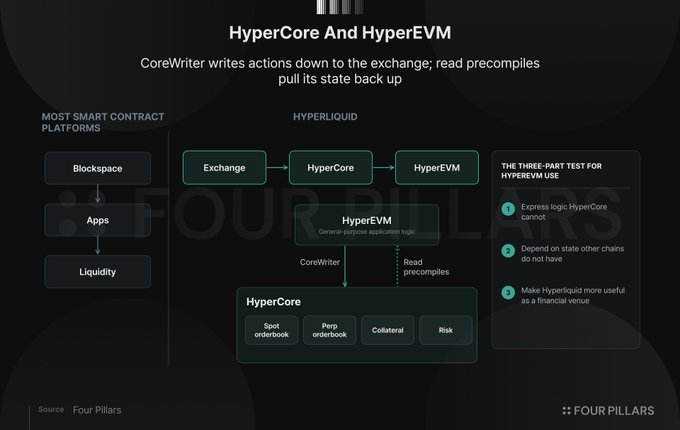
HyperCore is the home for trading, collateral, and risk engines. HyperEVM is the place to write application logic. Through precompiles, contracts can directly query HyperCore data such as balances, positions, prices, staking delegation, and vault equity; through CoreWriter, contracts can write operations back to HyperCore.


This design turns the exchange into a native input source for applications. Collateral, execution, settlement, and allocation can be more tightly integrated on the same ledger.


Of course, not all HyperEVM applications need to pursue 'novelty'. The ecosystem first needs familiar primitives for users to naturally perform swaps, lending, leveraging, rebalancing, and exits. A local financial surface can keep capital within the system, making the entire ecosystem truly usable.


But the deeper opportunity is definitely not simply forking existing lending protocols with a new front end. It's building credit, asset management, payments, and structured finance around the exchange ledger—things ordinary EVM chains cannot replicate even by issuing incentives.


CoreWriter will not turn HyperEVM into a synchronous extension of the order book either. Cross-environment operations have ordering constraints, delayed writes, and state coordination issues. Builders must handle failure rollbacks, delayed execution, cross-environment collateral accounting, and risk management. While this narrows some design spaces, it also forms a unique moat.


Understanding the HyperEVM Economy Through a 2×2 Matrix


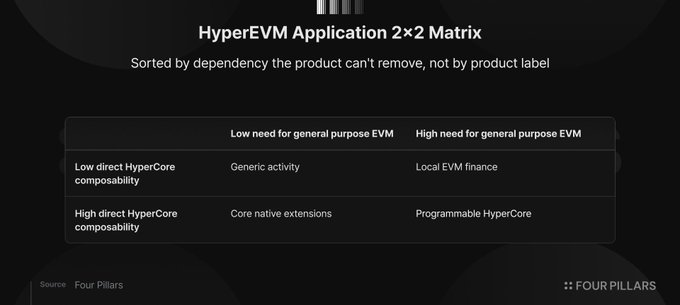
The best framework for evaluating HyperEVM applications is a two-dimensional matrix:


  • Horizontal Axis: Does the application require general EVM logic?
  • Vertical Axis: Does the application directly compose with HyperCore's state or execution?


Category labels are not important; the key is the product's non-removable dependencies.


Local EVM Finance


Applications in this category need smart contracts, but their product models are largely portable. AMMs, money markets, CDPs, routers, option venues, leverage products, and yield markets belong to this quadrant.


Felix is a typical example. HyperLend also started here, as one of the main credit venues on HyperEVM (its roadmap later evolves towards programmable HyperCore).


This quadrant is easily underestimated but is actually very important. Any financial center needs banks, brokers, liquidity venues, and risk transfer markets to support more complex balance sheet products. Portability makes them the foundational layer for user activity.


Core-Native Extensions


Applications in this category are more directly dependent on Hyperliquid, but EVM's role is mainly wrapping, tokenizing, or composing native primitives.


Typical examples include: Kinetiq, StakedHYPE, Kintsu, HLP wrappers, Unit-linked assets, etc. Their core task is to make assets inside Hyperliquid more useful.


This quadrant is crucial—collateral is the raw material for all financial activity. Money markets need assets users are willing to borrow, structured products need assets that can be staked or hedged, and unified accounts require balances that can freely flow between different functions.


Programmable HyperCore


This is the quadrant with the most imagination: applications require both the general logic of EVM and deeply depend on HyperCore's state and execution. Here, exchange activity truly begins to be 'productized'.


  • Rysk: Converts options into volatility income for assets users already own;
  • Liminal: Packages Hyperliquid strategies into tokenized products;
  • Hyperbeat: Delta-neutral strategies combining Core positions with ERC-20 composability.


Derive sits at the edge—it enables HYPE and kHYPE to be used as collateral for options/perpetuals via HyperEVM-vault bridging, but its core trading and settlement logic remains within its own stack. It expands HYPE collateral usage but does not strictly belong to the native programmable HyperCore category.


Currently, projects strictly meeting the 'contract-custodied assets + reading HyperCore state + using CoreWriter for execution' criteria are still early. Valantis Prime is a representative public beta case: it uses HyperEVM smart accounts as a control layer, operates HyperCore via CoreWriter, and sets constraints like permissions, proxies, session keys, and guardians, making the account itself a programmable interface to the exchange.


HyperLend and Rysk also point towards the same frontier from different angles, but ultimately must be measured against the standard of 'whether assets are truly custodied and CoreWriter is deeply integrated.'


The Financial Account is the Ultimate Form


The most valuable HyperEVM application might not look like an 'application' at all, but more like an account.


Today, crypto users still have to switch between multiple interfaces: exchange balances for trading, wallet balances for DeFi, vault shares for yield, borrowing capacity hidden in money markets, hedging requires opening another platform... This fragmentation is not just a user experience issue; it reflects the fact that liquidity, collateral, execution, and risk are scattered across different systems.


HyperEVM has the opportunity to compress these systems into the same account. Users can deposit assets like BTC, ETH, SOL, HYPE just once and start from the same balance: trade on HyperCore, lend on HyperEVM, earn yield through vaults, hedge with perpetuals, and directly spend from the payment account. The product is not a bridge; the product is that balance that can flow across functions.


Centralized exchanges have long understood this—their accounts feel unified because trading, margin, lending, and yield all exist in one controlled environment. But the problem is the closed ledger, opaque risk engines, and the inability for external developers to build freely.


General-purpose public chains are the opposite: users truly control accounts, but the financial stack is highly fragmented.


Hyperliquid sits at the sweet spot: HyperCore provides exchange-level liquidity and risk infrastructure, while HyperEVM provides an open application surface. The end result is a unified financial account completely controlled by the user yet backed by HyperCore as a powerful balance sheet engine—this is the strongest manifestation of the 'all-in-one financial home' vision.


Future evidence will appear at the account level: collateral follows users across trading, lending, saving, hedging, and spending; risk is priced in real-time from HyperCore state; liquidations are executed via HyperCore depth; structured products directly hedge with Core liquidity; ERC-20s represent claims on various financial activities within the system.


The first wave of HyperEVM makes the ecosystem usable; the next wave will make HyperCore truly programmable.


Tiền kỹ thuật số thịnh hành

Câu hỏi Liên quan

QWhat are the three criteria that a valuable native HyperEVM application must meet according to the article?

AA valuable native HyperEVM application must meet three criteria: 1) It must be able to express general logic that cannot be implemented by HyperCore itself (requiring EVM flexibility); 2) It must depend on unique states that are not available on other chains (HyperCore's composability); 3) It must make Hyperliquid more useful as a financial venue.

QWhat is the core value proposition of HyperEVM as described in the article?

AThe core value proposition of HyperEVM is that it should be seen as a smart contract layer, whose primary value lies in allowing applications to directly read and use HyperCore's trading, collateral, position, and risk data. It enables the programming of the exchange itself.

QAccording to the article's framework, what defines the most valuable and imaginative quadrant for HyperEVM applications?

AAccording to the article's 2x2 matrix framework, the most valuable and imaginative quadrant for HyperEVM applications is 'Programmable HyperCore.' Applications in this quadrant both require the general logic of the EVM and deeply depend on the state and execution of HyperCore, effectively 'productizing' exchange activity.

QWhat is the 'ultimate form' or 'ultimate shape' envisioned for the most valuable HyperEVM applications?

AThe ultimate form envisioned is not a typical 'application,' but rather a highly integrated, unified financial account. With just a single balance, a user can simultaneously perform all operations like trading, borrowing, yield farming, hedging, and payments, with liquidity and risk management seamlessly powered by HyperCore.

QHow is Hyperliquid's development path different from that of most smart contract platforms?

AHyperliquid's path is the opposite of most smart contract platforms. Instead of building the chain first and then looking for applications, Hyperliquid built the exchange first. It possesses a native spot and perpetual order book, trader mindshare, protocol-owned liquidity, and real trading volume already flowing through HyperCore. This fundamentally changes HyperEVM's role—it's not just another place to copy DeFi contracts, but to make the exchange itself programmable.

Nội dung Liên quan

Ripple Đẩy Mạnh Mở Rộng Tuân Thủ Toàn Cầu Trước Khi Thảo Luận Đạo Luật Rõ Ràng Ở Mỹ

Ripple đang tích cực mở rộng hoạt động tuân thủ quy định toàn cầu bằng cách xin cấp phép bổ sung tại Singapore và châu Âu, nhằm phát triển các sản phẩm thể chế dựa trên tiện ích. Động thái này diễn ra trong bối cảnh sắp tranh luận về Đạo luật Rõ ràng tại Mỹ, nhưng trọng tâm cần tách biệt với các diễn biến từ vụ kiện SEC. Đối với trader, câu chuyện này quan trọng vì nó phản ánh xu hướng phát triển hạ tầng và tiện ích, có khả năng ảnh hưởng đến dòng vốn, thanh khoản và tâm lý thị trường tiền điện tử rộng hơn, đặc biệt trong bối cảnh thị trường còn chịu tác động mạnh từ dòng ETF và sự luân chuyển vốn. Điều cần lưu ý là tránh diễn giải quá mức một tín hiệu đơn lẻ. Thông tin về giấy phép là một chỉ báo về định vị và sự tự tin của Ripple trong các thị trường được quản lý, chứ không phải một bảo đảm cho biến động giá. Cần theo dõi các dữ liệu tiếp theo như số liệu on-chain, lệnh mở (open interest) và dòng vốn để xác nhận liệu đây có phải một chủ đề bền vững hay chỉ là biến động ngắn hạn.

bitcoinist18 phút trước

Ripple Đẩy Mạnh Mở Rộng Tuân Thủ Toàn Cầu Trước Khi Thảo Luận Đạo Luật Rõ Ràng Ở Mỹ

bitcoinist18 phút trước

Giá XRP sẽ diễn biến thế nào trong tháng 7 năm 2026?

Giá XRP đã giảm xuống mức thấp nhất kể từ tháng 11/2024, chạm ngưỡng 1,009 USD vào ngày 26/6, gần sát mức tâm lý quan trọng 1 USD. Mặc dù dòng tiền vào quỹ ETF spot XRP vẫn tích cực, giúp thắt chặt nguồn cung, nhưng điều này có thể chưa đủ để đảo ngược xu hướng trong điều kiện thị trường chung đang yếu. Biểu đồ 1 ngày cho thấy XRP đang trong một xu hướng giảm dài hạn kể từ tháng 7/2025, với việc phá vỡ đáy trước đó ở 1,61 USD vào tháng 2. Mặc dù đã có một đợt phục hồi ngắn lên khoảng 1,3 USD vào giữa tháng 6, nhưng lực bán sau đó đã đẩy giá về quanh mức 1,05 USD. Dữ liệu phái sinh chỉ ra rằng thị trường đang ổn định và ít biến động, với Open Interest ổn định quanh 400 triệu XRP và tỷ lở Turnover khoảng 0,71. Điều này cho thấy hoạt động đầu cơ ngắn hạn đã chậm lại. Tuy nhiên, các nhà giao dịch cần cảnh giác với bất kỳ sự gia tăng đột biến nào trong các chỉ số này, vì chúng có thể báo hiệu biến động tăng cao. Phân tích kỹ thuật trên biểu đồ 4 giờ dự báo khả năng cao XRP sẽ tiếp tục giảm, hướng tới các mục tiêu mở rộng ở 0,975 USD và 0,854 USD. Do đó, khả năng giá XRP giảm xuống dưới ngưỡng 1 USD trong tháng 7 là rất lớn, với đà giảm có thể đẩy giá về mức 0,85 USD.

ambcrypto22 phút trước

Giá XRP sẽ diễn biến thế nào trong tháng 7 năm 2026?

ambcrypto22 phút trước

BNB Chain Tuyên Bố Dẫn Đầu Solana Về Khối Lượng Giao Dịch Cổ Phiếu Mã Hóa

BNB Chain tuyên bố đã vượt qua Solana về khối lượng giao dịch cổ phiếu được mã hóa (tokenized stocks), đạt 5,2 tỷ USD. Cột mốc này giúp BNB Chain củng cố vị thế trong lĩnh vực tài sản thế giới thực (RWA) - một trong những xu hướng tăng trưởng cạnh tranh nhất của crypto, nhằm kết nối tài chính truyền thống với blockchain. Khối lượng được thúc đẩy bởi các giao thức như Ondo, xStocks và bStocks, cho thấy một hệ sinh thái sản phẩm đang phát triển trên BNB Chain, không chỉ là một đợt phát hành token đơn lẻ. Trong khi đó, Solana vẫn mạnh ở các khía cạnh khác như hoạt động bán lẻ, meme coin và tốc độ DeFi. Sự kiện này có ý nghĩa quan trọng đối với BNB Chain, giúp mạng lưới mở rộng hình ảnh vượt ra ngoài các hoạt động giao dịch liên quan đến sàn tập trung, hướng tới một điểm nhấn thể chế hơn. Thách thức chính là tính bền vững: khối lượng giao dịch ổn định, thanh khoản sâu và nhiều tài sản được mã hóa hơn sẽ quyết định vị thế lâu dài của BNB Chain trong lĩnh vực RWA. Cuộc cạnh tranh về tài sản được mã hóa giữa các blockchain như Ethereum, Solana và BNB Chain đang trở nên thực tế hơn bao giờ hết.

bitcoinist1 giờ trước

BNB Chain Tuyên Bố Dẫn Đầu Solana Về Khối Lượng Giao Dịch Cổ Phiếu Mã Hóa

bitcoinist1 giờ trước

Giao dịch

Giao ngay

Bài viết Nổi bật

Làm thế nào để Mua CORE

Chào mừng bạn đến với HTX.com! Chúng tôi đã làm cho mua CORE (CORE) trở nên đơn giản và thuận tiện. Làm theo hướng dẫn từng bước của chúng tôi để bắt đầu hành trình tiền kỹ thuật số của bạn.Bước 1: Tạo Tài khoản HTX của BạnSử dụng email hoặc số điện thoại của bạn để đăng ký tài khoản miễn phí trên HTX. Trải nghiệm hành trình đăng ký không rắc rối và mở khóa tất cả tính năng. Nhận Tài khoản của tôiBước 2: Truy cập Mua Crypto và Chọn Phương thức Thanh toán của BạnThẻ Tín dụng/Ghi nợ: Sử dụng Visa hoặc Mastercard của bạn để mua CORE (CORE) ngay lập tức.Số dư: Sử dụng tiền từ số dư tài khoản HTX của bạn để giao dịch liền mạch.Bên thứ ba: Chúng tôi đã thêm những phương thức thanh toán phổ biến như Google Pay và Apple Pay để nâng cao sự tiện lợi.P2P: Giao dịch trực tiếp với người dùng khác trên HTX.Thị trường mua bán phi tập trung (OTC): Chúng tôi cung cấp những dịch vụ được thiết kế riêng và tỷ giá hối đoái cạnh tranh cho nhà giao dịch.Bước 3: Lưu trữ CORE (CORE) của BạnSau khi mua CORE (CORE), lưu trữ trong tài khoản HTX của bạn. Ngoài ra, bạn có thể gửi đi nơi khác qua chuyển khoản blockchain hoặc sử dụng để giao dịch những tiền kỹ thuật số khác.Bước 4: Giao dịch CORE (CORE)Giao dịch CORE (CORE) dễ dàng trên thị trường giao ngay của HTX. Chỉ cần truy cập vào tài khoản của bạn, chọn cặp giao dịch, thực hiện giao dịch và theo dõi trong thời gian thực. Chúng tôi cung cấp trải nghiệm thân thiện với người dùng cho cả người mới bắt đầu và người giao dịch dày dạn kinh nghiệm.

Tổng lượt xem 445Xuất bản vào 2024.12.13Cập nhật vào 2026.06.02

Làm thế nào để Mua CORE

Thảo luận

Chào mừng đến với Cộng đồng HTX. Tại đây, bạn có thể được thông báo về những phát triển nền tảng mới nhất và có quyền truy cập vào thông tin chuyên sâu về thị trường. Ý kiến ​​của người dùng về giá của CORE (CORE) được trình bày dưới đây.

活动图片