Channel Dividends Are Dwindling, What Can DeFi Protocols Rely on to Resist Giants' Harvesting?

Foresight NewsXuất bản vào 2026-06-22Cập nhật gần nhất vào 2026-06-22

Tóm tắt

As the era of channel-driven growth ends, major tech giants like Coinbase, Stripe, and Kraken are vertically integrating by acquiring or building core infrastructure, capturing profits from underlying protocols. For instance, Coinbase leverages its Base blockchain to earn sequencing fees from protocols like Morpho, while Stripe acquired Bridge to internalize stablecoin yields, and Kraken bought NinjaTrader for derivatives licenses. This trend creates a power imbalance: entities controlling distribution channels can extract value from open-source DeFi protocols. However, protocols are developing a defense through multi-chain expansion. Examples like Morpho (with significant TVL on Ethereum and Base) and Uniswap (dominant across many chains) show that by deploying across multiple blockchains, protocols reduce dependency on any single chain operator, making them costly and risky to replace. The article argues that the future landscape will be shaped by the race between institutional vertical integration and protocol horizontal, multi-chain scaling. Protocols that embed themselves deeply across ecosystems and become indispensable due to high switching costs are most likely to survive and thrive amidst this consolidation.


Author: Thejaswini M A

Compiled by: Saoirse, Foresight News


In Goodfellas, Ray Liotta has a line: 'Fuck you, pay me.' This line shreds the romanticized filter of mafia honor found in works like The Godfather, starkly revealing the cold, parasitic, and purely profit-driven essence of organized crime. Following a similar logic, let's talk about big tech companies.


You control value by controlling profits. To achieve this, you don't even need to build a public blockchain protocol or a project. It's a profit grab with no rules. But we can't blame Coinbase, Stripe, or Kraken for making such choices.


From the most fundamental business logic, their maneuvers are akin to a shrewd real estate play: be the first to secure the traffic distribution channels. Now holding the power of these channels, they look down and ask: 'Who exactly holds the bargaining power?'


Coinbase built its own blockchain; Stripe spent $1.1 billion acquiring infrastructure it could have rented; Kraken spent $1.5 billion acquiring a derivatives trading platform; Apple built the App Store. The logic of this playbook is: let others develop the market and bear the early risks, then acquire the underlying infrastructure when the profit potential in the sector becomes sufficiently attractive. The core question this article explores: Where will the industry head when traffic distribution channels are no longer the core value?


Coinbase has 110 million verified users. For years, its lending products for users were built on top of the open-source protocol Morpho, with all protocol fees going to Morpho. Later, Coinbase launched its own L2 blockchain, Base. Morpho chose to deploy on Base because Coinbase's massive user base could bring transaction volume. Now, the sequencer fee generated by every transaction on Base flows entirely into Coinbase's pockets, not Morpho's.


Base generated $76 million in net sequencer fee revenue in 2024 and $74 million in 2025. Until February 2026, per the licensing agreement, Coinbase had to share a portion of the revenue with Optimism. But eventually, Coinbase severed the partnership, switched to a self-developed underlying architecture, and now keeps the entire $64 million revenue. Meanwhile, Morpho remains rooted on Base, developing robustly with a Total Value Locked (TVL) of $2.5 billion. However, every transaction processed by Morpho now has to share profits with Coinbase.
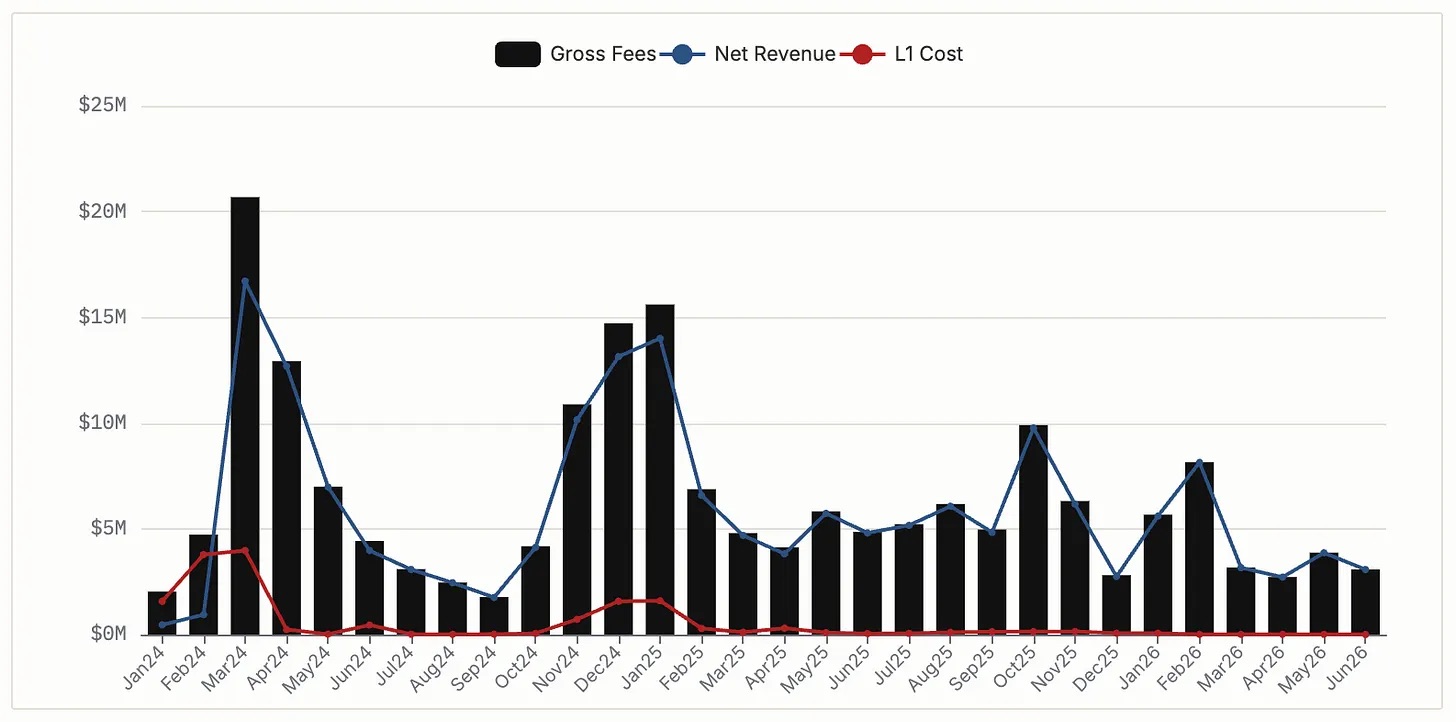

Base Monthly Sequencer Fee Revenue, source: DeFiLlama


Coinbase launched a $300 million Bitcoin-collateralized lending product, relying on Morpho's underlying architecture. Its wrapped Bitcoin, cbBTC, is the largest collateral asset within Morpho, accounting for 38% of the protocol's total TVL. This creates a mutually restraining dynamic: Morpho holds the core underlying capability for Coinbase's credit product, while Coinbase can extract a revenue share from all of Morpho's business, making it difficult for either to easily sever the partnership.


Look at Stripe's case: In early 2025, it spent $1.1 billion to acquire Bridge. Before this, Stripe's stablecoin business relied on Circle's infrastructure. Circle held the stablecoin issuance rights and earned the floating interest generated by the reserve collateral assets. At that time, all revenue from Stripe's trillion-level stablecoin transactions flowed to Circle. Acquiring Bridge completely reversed this situation. Bridge issues its own stablecoin, USDB, collateralized by a BlackRock money market fund. After switching to USDB, the massive interest income from these reserves stays entirely within the Stripe ecosystem. With annual payment processing volume of $1.4 trillion, Stripe was losing hundreds of millions in profit annually by long-term renting its competitor's profit-generating infrastructure.


Patrick Collison once called stablecoins 'the room-temperature superconductors of finance.' Spending $1.1 billion to own this underlying tool outright is far more economical than continuously paying tolls to a competitor.


A pure spot exchange has a natural growth ceiling, with users trading only hundreds of tokens. But Kraken wanted to attract institutional investors and professional retail traders, groups that primarily engage in trading via futures and clearing derivatives. Operating a derivatives business requires registration with the CFTC, NFA membership, and broker-dealer licenses—a compliance system that takes years to build. Even if built from scratch, regulators could reject the application for various uncontrollable reasons.


This is why Kraken set its sights on NinjaTrader. The $1.5 billion acquisition in January 2025 brought not just 1.7 million funded trading accounts, but more crucially, the full suite of broker-dealer licenses that Kraken would have found difficult to quickly develop and obtain on its own.


By acquiring ready-made compliant qualifications, Kraken completely shed its dependence on external partners. It now wholly owns the entire technology stack and licenses, needing neither to rely on others nor spend years waiting for regulatory approval.


Some might say: Large enterprises swallowing small protocols, isn't that just business as usual? What's new here?


Morpho's total TVL is $6.4 billion, with $3.308 billion deployed on Ethereum and $2.488 billion on Base. If Coinbase decided to delist Morpho and switch to a self-developed lending protocol, Morpho would immediately lose 39% of its TVL. However, it would still retain 52% on Ethereum, while continuously expanding to multiple chains like Hyperliquid L1, Monad, and Arbitrum, allowing its overall business to continue operating stably.
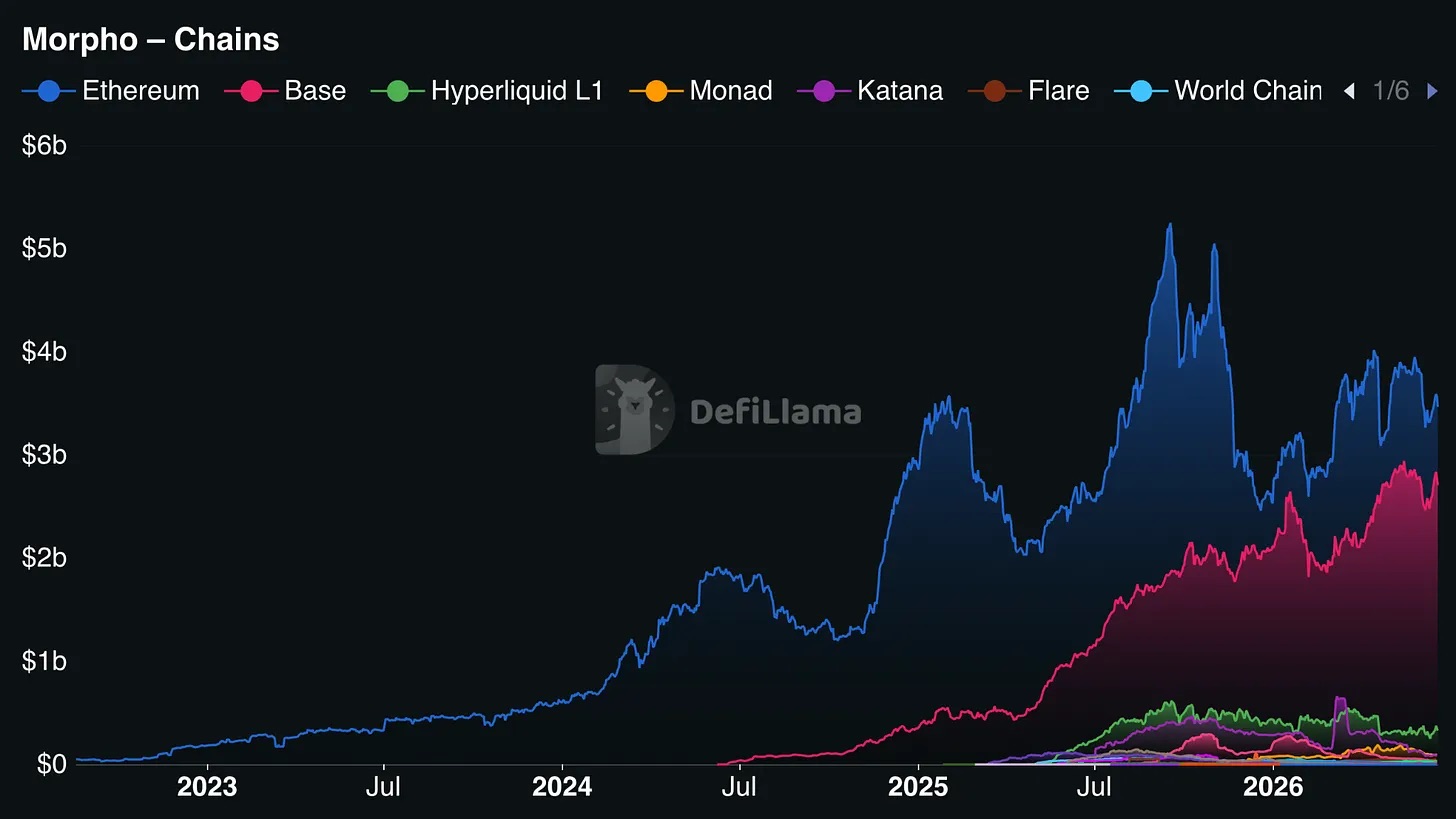

Morpho TVL Distribution Across Chains, source: DeFiLlama


The case of Aerodrome on the Base blockchain vividly demonstrates the impact when a chain operator promotes its own competitor. Aerodrome is Base's native decentralized exchange, optimized for Base's architecture. Coinbase Ventures holds approximately $20 million worth of AERO tokens, its largest liquidity token investment. Meanwhile, the project guides liquidity towards Coinbase's products, including the cbBTC pool, through AERO token lock-up voting. Aerodrome handles about 51% of Base's DEX volume, peaking at 77% in September 2024. Uniswap, deployed across 44 chains, is Base's second-largest DEX, holding 30% volume. Even after losing its leading position on a single chain, Uniswap hasn't perished: in 2025 it processed $212 billion in volume on Base, with estimated cross-chain monthly volume around $73 billion.
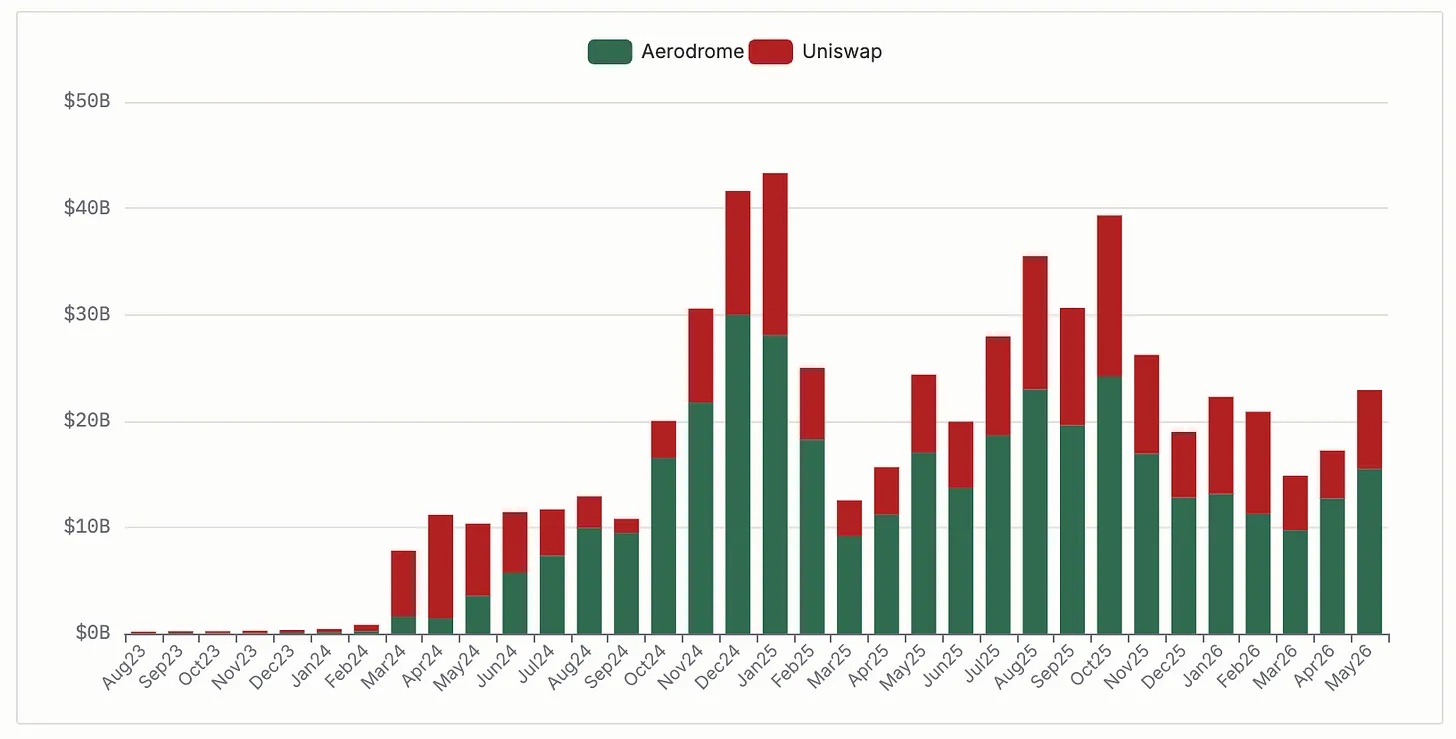

Base DEX Volume Share, source: DeFiLlama


This case confirms: Multi-chain deployment is a protocol's natural moat. A project deployed on a single chain is entirely at the mercy of the chain operator—they can always promote a competitor to squeeze your survival space. Conversely, a multi-chain protocol can continue normal operations in other sectors even after losing a particular chain's market. After witnessing Uniswap's traffic being diverted by Aerodrome on Base, Morpho rapidly expanded its multi-chain deployment. Large traffic platforms can vertically integrate into the underlying layer, while open-source protocols can horizontally expand across multiple chains to diversify risk.


If you rely on underlying infrastructure you don't own, you don't truly control your business. The party controlling the underlying layer holds overwhelming bargaining power over you, can define your product experience, and ultimately influence your operational stability. For enterprises of this scale, this dependency relationship translates into tangible profit losses every single day. This business logic isn't unique to crypto: Amazon built its moat relying on AWS; Apple, constrained by Intel's chip roadmap for years, spent many years developing custom chips to break free.


Everyone can check in real-time how much revenue Coinbase earns from Base sequencer fees, and clearly see Morpho's TVL across various chains. This value extraction process is fully transparent—something internal infrastructure profits at companies like Amazon, in the traditional internet space, cannot achieve.


There is a potential direction for the industry: the future market could be entirely controlled by giants like Coinbase, Stripe, Kraken, and a few banks. They control the entire industry chain from underlying protocols to payment cards, with open-source protocols only used to fill niche gaps the giants haven't yet covered. This is a fully plausible development path for fintech. Open-source technology would no longer be a free and vast fertile ground for innovation, but merely become patches of adhesive tape for the tiny crevices giant corporations haven't yet figured out how to monetize. Like a quip: 'Look at this high-quality little open-source protocol. Let's just build a commercial system on top of it to harvest the traffic.'


However, I lean towards an optimistic assessment: Considering the current wave of acquisitions, the probability of such a complete monopoly isn't as high as it seems. Underlying protocols are difficult to be monopolized by giants in the same way traffic channels can be. Morpho can deploy on a new chain in just weeks; replacing a battle-tested lending protocol deeply embedded in institutional operations carries an extremely high cost, not easily perceivable by outsiders. Coinbase's $300 million Bitcoin lending product still relies on Morpho because replicating Morpho's security system from scratch would take years and introduce security risks Coinbase is unwilling to bear.


Protocols that can survive this wave of giant consolidation all meet one core condition: they completed full multi-chain deployment before the traffic giants built their own ecosystems, deeply embedding themselves into the backend systems of major enterprises, making the economic cost of replacing them prohibitively high. Even Robinhood, a traffic giant with a massive user base, chose to integrate Lighter, a third-party zk-proof perpetuals exchange, as its trading backend. Robinhood Ventures participated in Lighter's $68 million funding round, and founder Vlad Tenev maintains close communication with the project.


If only traffic channels could build moats, Robinhood could have built its own underlying tech like Coinbase did. But it didn't: achieving a system that combines CEX-like trading speed with verifiable zk-proof matching logic is an extremely difficult, niche technical problem; the Lighter team spent over a year cracking it. After calculation, Robinhood concluded that purchasing the right to use mature technology is far more economical than building from scratch.


Currently, Morpho occupies this advantageous position of mutual restraint, while Uniswap was the pioneer of this path. The speed of institutional expansion and the speed of open-source protocol horizontal multi-chain expansion are in a game of chess; the final outcome will determine the direction of the industry landscape.


The underlying businesses of giants like Stripe and Coinbase still rely on open-source technology at this stage. In the short term, open-source protocols can still stand firm. We'll re-examine the industry landscape in two years.


Tiền kỹ thuật số thịnh hành

Câu hỏi Liên quan

QWhat is the main business strategy employed by large tech companies like Coinbase and Stripe in the crypto industry according to the article?

AThe article describes a strategy where large tech companies like Coinbase, Stripe, and Kraken act as distribution channels, capturing and controlling user traffic. They let smaller protocols bear the early risk and development costs, and then acquire or build competing infrastructure once the market becomes profitable. This allows them to capture the value and profits generated by the underlying protocols, exemplified by Coinbase capturing sequencer fees from protocols like Morpho on Base.

QHow does the acquisition of Bridge by Stripe change its business model in the stablecoin sector?

APrior to acquiring Bridge for $1.1 billion, Stripe's stablecoin business relied on Circle's infrastructure, meaning all interest from the reserve assets backing the stablecoins flowed to Circle. By acquiring Bridge, which issues its own stablecoin USDB backed by BlackRock money market funds, Stripe now keeps the substantial interest revenue generated by the massive reserves within its own ecosystem, rather than paying it to a competitor.

QWhy does the article argue that multi-chain deployment is a crucial defense for DeFi protocols against large platforms?

AMulti-chain deployment acts as a natural moat for protocols. If a protocol is only deployed on a single chain, its fate is tied to that chain's operator, who could favor or build a competing protocol. A multi-chain protocol, like Uniswap or Morpho, can survive the loss of dominance on one chain because its business on other chains continues to operate. This diversification reduces dependency and risk from any single entity.

QWhat example does the article use to show that even large platforms sometimes choose to rely on third-party protocols instead of building everything in-house?

AThe article cites Robinhood as an example. Instead of building its own perpetual futures exchange from scratch like Coinbase did with Base, Robinhood integrated with Lighter, a third-party zero-knowledge proof perpetual exchange. Robinhood determined that licensing this specialized, proven technology was more economical and efficient than developing it internally, despite having a massive user base.

QWhat is the "two-way checkmate" position that Morpho currently holds in its relationship with Coinbase, according to the article?

AMorpho is in a "two-way checkmate" with Coinbase. On one hand, Coinbase's $300 million Bitcoin-backed lending product is built on Morpho's infrastructure, making Morpho's security and technology core to that offering. Replacing it would be risky and costly for Coinbase. On the other hand, Morpho's significant deployment on Coinbase's Base chain means a large portion of its activity generates sequencer fees for Coinbase. This mutual dependency makes it difficult for either party to easily sever the relationship.

Nội dung Liên quan

Thời đại AI, Bitcoin còn lại gì?

Tác giả Sevclub từ Seven Research chia sẻ quan điểm rằng AI và Bitcoin là hai mặt của một đồng xu trong thời đại số hiện nay. Trong khi AI làm giảm chi phí sản xuất thông tin đến mức gần như bằng không, dẫn đến sự tràn ngập nội dung thật giả lẫn lộn và khó kiểm chứng, thì Bitcoin lại đóng vai trò ngược lại: nó là cỗ máy tạo ra "khả năng xác minh". Bằng cách tiêu thụ năng lượng (thường bị chỉ trích là lãng phí), mạng lưới Bitcoin không tạo ra nội dung hay năng lực tính toán như AI, mà đảm bảo tính bất biến và có thể xác minh độc lập cho một cuốn sổ cái phân tán. Mọi giao dịch đều được xác thực bằng toán học và mật mã học, không cần tin tưởng vào bất kỳ ngân hàng, nền tảng hay cá nhân trung tâm nào. Trong một thế giới mà AI có thể dễ dàng tạo ra văn bản, hình ảnh, video giả mạo, thì thứ trở nên khan hiếm và quý giá chính là những sự thật có thể kiểm chứng được. Tác giả so sánh: AI giống như máy in thời kỳ Phục Hưng, cách mạng hóa việc sản xuất và sao chép; còn blockchain (với Bitcoin là ứng dụng điển hình) giống như phương pháp kế toán kép mới, cách mạng hóa việc xác minh và ghi chép. Chúng không cạnh tranh mà bổ sung cho nhau — một bên giảm chi phí tạo lập, một bên giảm chi phí xác thực. Do đó, giá trị cốt lõi của Bitcoin trong kỷ nguyên AI có thể không nằm ở việc là "tiền" mà ở việc là một "cỗ máy tạo ra tính có thể xác minh" cho lịch sử và tài sản kỹ thuật số.

链捕手48 phút trước

Thời đại AI, Bitcoin còn lại gì?

链捕手48 phút trước

Nhãn mác "chuỗi ma" của Cardano bị bác bỏ? Tại sao 34 ứng dụng phi tập trung (dApp) của ADA không kể toàn bộ câu chuyện

Bài báo thảo luận về nhãn "ghost chain" (blockchain ma) thường bị gán cho Cardano (ADA) do số lượng dApp ít ỏi (chỉ 34) so với các đối thủ như Ethereum hay Solana. Dữ liệu cho thấy hoạt động on-chain và số người dùng hàng ngày của Cardano thấp hơn đáng kể. Tuy nhiên, bài viết lập luận rằng chỉ số này không kể câu chuyện toàn diện. Cardano sử dụng mô hình EUTXO (Extended Unspent Transaction Output) độc đáo, nơi các giao dịch được tổng hợp (batch) trước khi ghi vào sổ cái. Điều này mang lại lợi thế về bảo mật và tính xác định, nhưng cũng dẫn đến việc đánh giá thấp số liệu hoạt động thực tế trên chuỗi. Bên cạnh đó, Cardano tập trung vào phát triển bền vững, bảo mật và phương pháp nghiên cứu chuyên sâu, phù hợp cho các ứng dụng tuân thủ và doanh nghiệp. Mặc dù có những lo ngại như việc đóng cửa công cụ TapTools và cảnh báo về một số dApp có thể ngừng hoạt động, số liệu phát triển của Cardano vẫn rất mạnh. Do đó, bài viết kết luận rằng việc gọi Cardano là "ghost chain" chỉ dựa trên số lượng dApp là không đủ căn cứ, vì nó bỏ qua kiến trúc kỹ thuật và định hướng chiến lược riêng biệt của mạng lưới này.

ambcrypto1 giờ trước

Nhãn mác "chuỗi ma" của Cardano bị bác bỏ? Tại sao 34 ứng dụng phi tập trung (dApp) của ADA không kể toàn bộ câu chuyện

ambcrypto1 giờ trước

Cơ quan FCA của Anh công bố sổ tay quy định về tiền mã hóa: Phương pháp tiếp cận dựa trên rủi ro bắt đầu vào tháng 10/2027

Cơ quan Giám sát Tài chính Anh (FCA) đã công bố một khuôn khổ quy định mới cho tiền mã hóa, áp dụng từ tháng 10/2027, thay vì các quy định cứng nhắc, đồng loạt. Cách tiếp cận dựa trên rủi ro này yêu cầu các công ty tiền mã hóa duy trì vốn đủ để bù đắp tổn thất tiềm năng, nhưng số vốn sẽ thay đổi tùy theo mức độ rủi ro của từng doanh nghiệp. Các công ty nhỏ hơn và ít rủi ro hơn sẽ có yêu cầu công bố thông tin giảm bớt, giúp tiết kiệm chi phí tuân thủ. Các công ty sẽ tự đánh giá rủi ro trên bảng cân đối kế toán và thực hiện kiểm tra áp lực hàng năm, sau đó FCA sẽ xem xét các đánh giá này. Mục tiêu của những thay đổi này là tăng cường sự tin tưởng của thị trường và thu hút thêm 3-4 triệu người dùng tiền mã hóa tại Anh. Đối với stablecoin, FCA đã giữ cấu trúc cơ bản nhưng nới lỏng một số yêu cầu, đồng thời tăng cường bảo vệ người tiêu dùng bằng quy định tài sản dự trữ phải được nắm giữ trong một ủy thác theo luật định. Các quy tắc này tạo thành khuôn khổ cơ bản, trong đó những tổ chức phát hành lớn có thể phải đối mặt với giám sát chặt chẽ hơn.

ambcrypto3 giờ trước

Cơ quan FCA của Anh công bố sổ tay quy định về tiền mã hóa: Phương pháp tiếp cận dựa trên rủi ro bắt đầu vào tháng 10/2027

ambcrypto3 giờ trước

Giao dịch

Giao ngay

Bài viết Nổi bật

Làm thế nào để Mua VERONA

Chào mừng bạn đến với HTX.com! Chúng tôi đã làm cho mua VERONA (VERONA) trở nên đơn giản và thuận tiện. Làm theo hướng dẫn từng bước của chúng tôi để bắt đầu hành trình tiền kỹ thuật số của bạn.Bước 1: Tạo Tài khoản HTX của BạnSử dụng email hoặc số điện thoại của bạn để đăng ký tài khoản miễn phí trên HTX. Trải nghiệm hành trình đăng ký không rắc rối và mở khóa tất cả tính năng. Nhận Tài khoản của tôiBước 2: Truy cập Mua Crypto và Chọn Phương thức Thanh toán của BạnThẻ Tín dụng/Ghi nợ: Sử dụng Visa hoặc Mastercard của bạn để mua VERONA (VERONA) ngay lập tức.Số dư: Sử dụng tiền từ số dư tài khoản HTX của bạn để giao dịch liền mạch.Bên thứ ba: Chúng tôi đã thêm những phương thức thanh toán phổ biến như Google Pay và Apple Pay để nâng cao sự tiện lợi.P2P: Giao dịch trực tiếp với người dùng khác trên HTX.Thị trường mua bán phi tập trung (OTC): Chúng tôi cung cấp những dịch vụ được thiết kế riêng và tỷ giá hối đoái cạnh tranh cho nhà giao dịch.Bước 3: Lưu trữ VERONA (VERONA) của BạnSau khi mua VERONA (VERONA), lưu trữ trong tài khoản HTX của bạn. Ngoài ra, bạn có thể gửi đi nơi khác qua chuyển khoản blockchain hoặc sử dụng để giao dịch những tiền kỹ thuật số khác.Bước 4: Giao dịch VERONA (VERONA)Giao dịch VERONA (VERONA) dễ dàng trên thị trường giao ngay của HTX. Chỉ cần truy cập vào tài khoản của bạn, chọn cặp giao dịch, thực hiện giao dịch và theo dõi trong thời gian thực. Chúng tôi cung cấp trải nghiệm thân thiện với người dùng cho cả người mới bắt đầu và người giao dịch dày dạn kinh nghiệm.

Tổng lượt xem 78Xuất bản vào 2026.06.22Cập nhật vào 2026.06.22

Làm thế nào để Mua VERONA

Làm thế nào để Mua NES

Chào mừng bạn đến với HTX.com! Chúng tôi đã làm cho mua Nesa (NES) trở nên đơn giản và thuận tiện. Làm theo hướng dẫn từng bước của chúng tôi để bắt đầu hành trình tiền kỹ thuật số của bạn.Bước 1: Tạo Tài khoản HTX của BạnSử dụng email hoặc số điện thoại của bạn để đăng ký tài khoản miễn phí trên HTX. Trải nghiệm hành trình đăng ký không rắc rối và mở khóa tất cả tính năng. Nhận Tài khoản của tôiBước 2: Truy cập Mua Crypto và Chọn Phương thức Thanh toán của BạnThẻ Tín dụng/Ghi nợ: Sử dụng Visa hoặc Mastercard của bạn để mua Nesa (NES) ngay lập tức.Số dư: Sử dụng tiền từ số dư tài khoản HTX của bạn để giao dịch liền mạch.Bên thứ ba: Chúng tôi đã thêm những phương thức thanh toán phổ biến như Google Pay và Apple Pay để nâng cao sự tiện lợi.P2P: Giao dịch trực tiếp với người dùng khác trên HTX.Thị trường mua bán phi tập trung (OTC): Chúng tôi cung cấp những dịch vụ được thiết kế riêng và tỷ giá hối đoái cạnh tranh cho nhà giao dịch.Bước 3: Lưu trữ Nesa (NES) của BạnSau khi mua Nesa (NES), lưu trữ trong tài khoản HTX của bạn. Ngoài ra, bạn có thể gửi đi nơi khác qua chuyển khoản blockchain hoặc sử dụng để giao dịch những tiền kỹ thuật số khác.Bước 4: Giao dịch Nesa (NES)Giao dịch Nesa (NES) dễ dàng trên thị trường giao ngay của HTX. Chỉ cần truy cập vào tài khoản của bạn, chọn cặp giao dịch, thực hiện giao dịch và theo dõi trong thời gian thực. Chúng tôi cung cấp trải nghiệm thân thiện với người dùng cho cả người mới bắt đầu và người giao dịch dày dạn kinh nghiệm.

Tổng lượt xem 51Xuất bản vào 2026.06.24Cập nhật vào 2026.06.24

Làm thế nào để Mua NES

Làm thế nào để Mua CAP

Chào mừng bạn đến với HTX.com! Chúng tôi đã làm cho mua Cap (CAP) trở nên đơn giản và thuận tiện. Làm theo hướng dẫn từng bước của chúng tôi để bắt đầu hành trình tiền kỹ thuật số của bạn.Bước 1: Tạo Tài khoản HTX của BạnSử dụng email hoặc số điện thoại của bạn để đăng ký tài khoản miễn phí trên HTX. Trải nghiệm hành trình đăng ký không rắc rối và mở khóa tất cả tính năng. Nhận Tài khoản của tôiBước 2: Truy cập Mua Crypto và Chọn Phương thức Thanh toán của BạnThẻ Tín dụng/Ghi nợ: Sử dụng Visa hoặc Mastercard của bạn để mua Cap (CAP) ngay lập tức.Số dư: Sử dụng tiền từ số dư tài khoản HTX của bạn để giao dịch liền mạch.Bên thứ ba: Chúng tôi đã thêm những phương thức thanh toán phổ biến như Google Pay và Apple Pay để nâng cao sự tiện lợi.P2P: Giao dịch trực tiếp với người dùng khác trên HTX.Thị trường mua bán phi tập trung (OTC): Chúng tôi cung cấp những dịch vụ được thiết kế riêng và tỷ giá hối đoái cạnh tranh cho nhà giao dịch.Bước 3: Lưu trữ Cap (CAP) của BạnSau khi mua Cap (CAP), lưu trữ trong tài khoản HTX của bạn. Ngoài ra, bạn có thể gửi đi nơi khác qua chuyển khoản blockchain hoặc sử dụng để giao dịch những tiền kỹ thuật số khác.Bước 4: Giao dịch Cap (CAP)Giao dịch Cap (CAP) dễ dàng trên thị trường giao ngay của HTX. Chỉ cần truy cập vào tài khoản của bạn, chọn cặp giao dịch, thực hiện giao dịch và theo dõi trong thời gian thực. Chúng tôi cung cấp trải nghiệm thân thiện với người dùng cho cả người mới bắt đầu và người giao dịch dày dạn kinh nghiệm.

Tổng lượt xem 22Xuất bản vào 2026.06.26Cập nhật vào 2026.06.26

Làm thế nào để Mua CAP

Thảo luận

Chào mừng đến với Cộng đồng HTX. Tại đây, bạn có thể được thông báo về những phát triển nền tảng mới nhất và có quyền truy cập vào thông tin chuyên sâu về thị trường. Ý kiến ​​của người dùng về giá của M (M) được trình bày dưới đây.

活动图片