Original | Odaily Planet Daily (@OdailyChina)
Author | Wenser(@wenser2010 )
In this bull market for US stocks, besides the white-haired stock god "Serenity" active in public discourse as an individual, another independent investment research firm named Citrini has garnered significant attention—consistently ranking first in Substack's finance category with nearly 250,000 subscribers.
In February of this year, Citrini's publication of "The 2028 Global Intelligence Crisis" once triggered a "sell-off in US software stocks," exacerbating panic psychology surrounding Silicon Valley's unemployment wave. In April, the "Strait of Hormuz Research Report" penned by Citrini's Analyst#3 after an on-site visit generated strong external reactions, cutting through the layers of mist obscuring the true face of this conflict's critical point. Recently, Citrini's semiconductor analyst Jukan accurately highlighted the importance of copper foil in the AI and semiconductor industries, sparking a new wave of investment fervor.
Behind this investment research firm, however, is a founder without a traditional finance background: James van Geelen. Holding dual degrees in Biology and Psychology from UCLA, he has worked as an emergency medical technician, founded a healthcare company, and later ventured into the investment world, now hailed as the "God of Investment Research." In this issue, Odaily Planet Daily will unveil James's cross-border legend.
Citrini Founder: A Narrative Master with "Second-Order Thinking"
Mentioning Citrini, those in the crypto space might have first noticed this research account from a post this May, on the eve of Cerebras (CBRS)'s IPO, where he mentioned "fund managers conducting price discovery in advance on Trade.xyz (within the Hyperliquid ecosystem)." This tweet was later confirmed by a retweet from Trade.xyz founder Shokun.
Citrini: The "Whistleblower to Traditional Finance" for Hyperliquid and Trade.xyz
It is no exaggeration to say that, as a research account that once published the viral article "The 2028 Global Intelligence Crisis," Citrini's radiating influence on traditional financial circles is evident.
Its high regard for the Hyperliquid ecosystem and Trade.xyz's role in pre-market stock pricing has also brought crypto market RWA platforms, pre-market stock contract platforms, and on-chain stock trading platforms into the view of many, to some extent fueling this year's "RWA asset frenzy in US stocks."
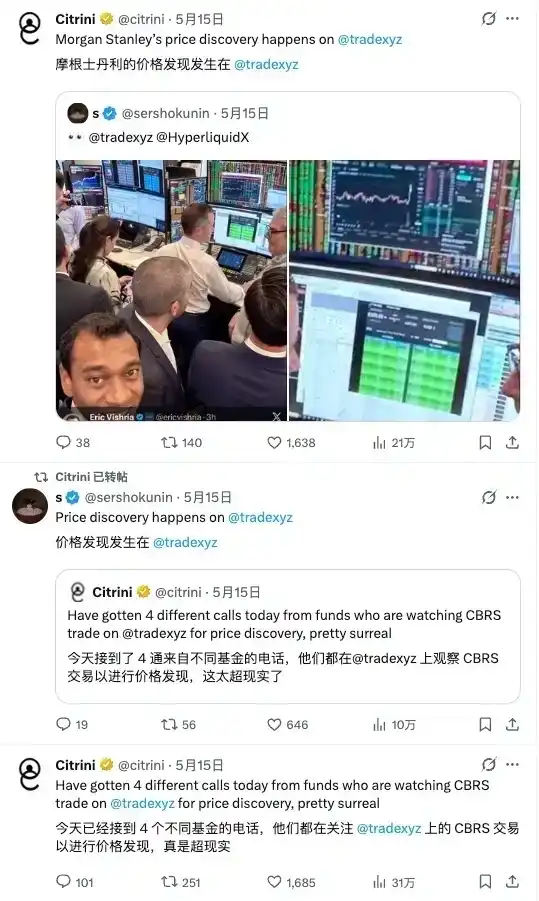
In a sense, Citrini can be considered a bellwether sending "warning signals" to traditional financial circles—it is using accurate information to warn traditional financial markets that previously unnoticed crypto players are setting their sights like barbarians on the "big cake" of traditional finance.
And behind Citrini is a founder who believes in "second-order thinking" and "long-termism"—James van Geelen.
Diverse Persona: Double Major in Biology & Psychology, Emergency Medical Practitioner, "AI Panic Whistleblower"
The 33-year-old James van Geelen (hereinafter Geelen) probably never imagined that an "AI discussion thread" could trigger the rapid evaporation of hundreds of billions of dollars in market value from US stock markets; earlier, his professional resume wasn't even remotely related to AI.
Public information shows Geelen graduated from the prestigious UCLA, earning dual degrees in Biology and Psychology during his studies. He also worked as an Emergency Medical Technician and Paramedic in downtown Los Angeles. Prestigious education and emergency medical experience shaped his character: pursuit of efficiency and adeptness at planning. As he himself said—"If you don't have a plan, you'll have a terrible life." Additionally, he prides himself as a "musical prodigy," though he doesn't have any notable works to show for it.
According to Geelen's original plan, he should have become a life-saving doctor, but by chance, he instead embarked on an entrepreneurial path: first founding a healthcare company and selling it to a private equity fund, successfully breaking free from the "prestigious school-job-professional manager" cycle; then founding the current Citrini.
Another noteworthy point, as mentioned by him in a 2023 Odd Lots podcast, is that he also co-founded one of the earliest medical marijuana dispensaries in Connecticut. From this, one can see he is far from the "proper doctor" perceived as rigid and rule-following.
In 2018, with some startup capital, Geelen began his personal investment career under the name Citrinitas Capital, capturing early opportunities in AI (like Nvidia) and GLP-1 weight-loss drugs (like Ozempic/Wegovy).
In 2023, Geelen formally founded Citrini Research, committed to "cross-asset, multi-dimensional thinking for investment analysis," providing in-depth reports on thematic stock investing and global macro trades. It quickly grew into a top creator in the finance field on the Substack platform. (Odaily Planet Daily Note: It offers both individual and institutional subscription models.)
On May 31, 2023, the model investment portfolio Citrindex, built on personal research, was formally launched with an annual subscription fee of $1250. Statistics show the portfolio has achieved cumulative returns exceeding 200%, with monthly gains repeatedly outperforming the S&P 500.
In March 2024, he boldly predicted Trump would win the election. In July 2025, amid the turmoil over former Fed Chair Powell's departure, he loudly advised over 50,000 subscribers to "buy two-year US Treasuries and short ten-year US Treasuries" to hedge policy risks.
In December 2025, according to PitchBook information, Citrini completed a seed funding round of approximately $5.05 million. With only about 10 employees, the company remains privately held.
Then, in February of this year, he co-authored with Alap Shah, who comes from a traditional finance background, that earth-shaking report for US markets: "The 2028 Global Intelligence Crisis." Although he repeatedly emphasized the report was merely a "thought experiment," a scenario assumption rather than a predictive analysis, the phenomena mentioned—"mass white-collar unemployment, declining consumer spending, economic contraction (Ghost GDP)"—still triggered panic and concern in capital markets, leading to significant declines in delivery, payment, and software stocks. Among them, IBM's stock price on February 23 recorded its largest single-day drop since 2025; American Express and Blackstone Group fell over 8%, the entire software stock sector dropped nearly 5%, while stocks of companies like DoorDash, Uber, Mastercard, Visa, Capital One, and Apollo Global Management Inc. fell up to 3%. Multiple US stock sectors were caught in the selling wave, with the Dow Jones once dropping over 800 points. Alap Shah later publicly stated his investment stance was "talking down while going long," meaning shorting companies they believe will be disrupted by AI while holding semiconductor tech stocks benefiting from AI.
It is no exaggeration to say that Citrini's single report directly caused the US stock market to "bleed profusely" for a time, evaporating hundreds of billions of dollars in market value overnight, triggering follow-up reports from overseas media like Bloomberg and The Wall Street Journal.
On April 6 this year, Citrini team's "Analyst #3" (code name Analyst#3) personally went to the critical strategic point in the US-Iran conflict—the Strait of Hormuz for research, disclosing many little-known frontline observations, revealing on the ground the specific operational model of Iran's "toll booth" in the Strait, and providing a series of counterintuitive conclusions, such as: Regardless of how the situation develops, shipping volume through the Strait will gradually increase; Iran does not wish to close the Strait of Hormuz. First, Strait shipping volume will continue to rise. Second, a diplomatic-style "toll booth"—surprisingly, transit order in the Strait is actually very regulated. Third, the paradox of escalation—even if ground operations commence, shipping volume through the Strait may still continue to increase. Fourth, realignment of power structures, not a decisive victory. This conflict is not a simple "two-party confrontation" but a multi-party game. Geographical disputes within great power games are also key subjects within Citrini's research "range."
When asked why he named the company "citrinitas," Geelen replied:"The naming inspiration comes from financial titan George Soros's 'The Alchemy of Finance.' This is actually a stage in alchemy, but what most people don't know is that in this transitional stage, lead begins to transform into gold, but hasn't fully become gold yet." This is also his favorite time to "make a difference"—seeing the birth of "gold" before others notice the change in lead.
Investment Style: Second-Order Thinking, Narrative-Driven, Reverse Scenario
As for Citrini's investment style, thanks to its cross-border experience and diverse persona, it highly advocates "second-order thinking."
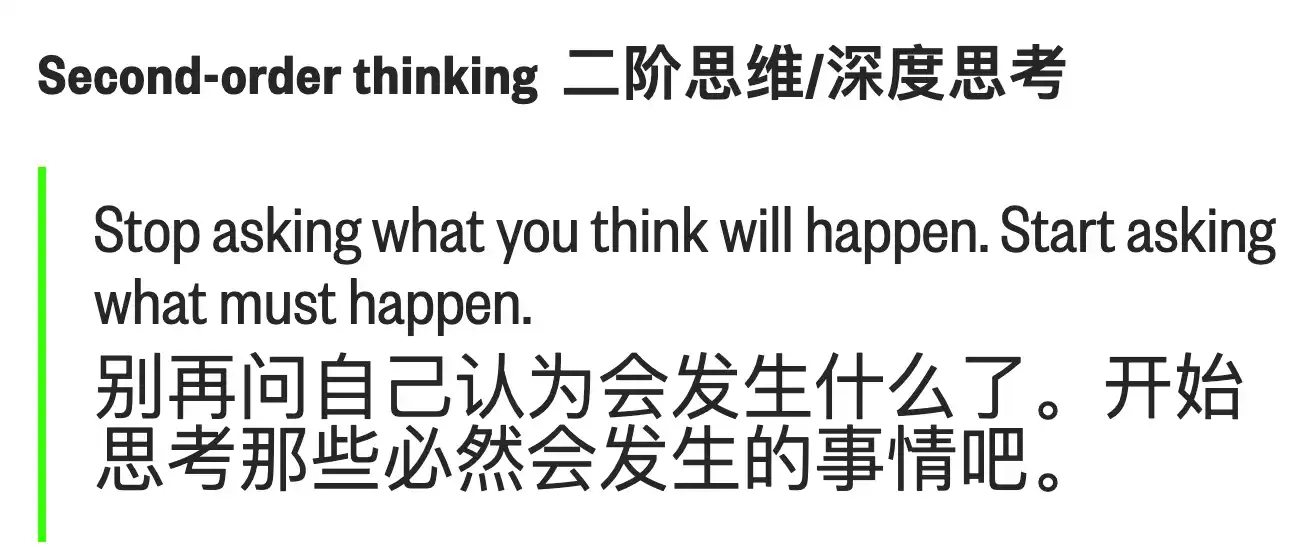
As Geelen himself said:"Most investors only focus on the ball itself, but I focus more on where the ball will bounce next."
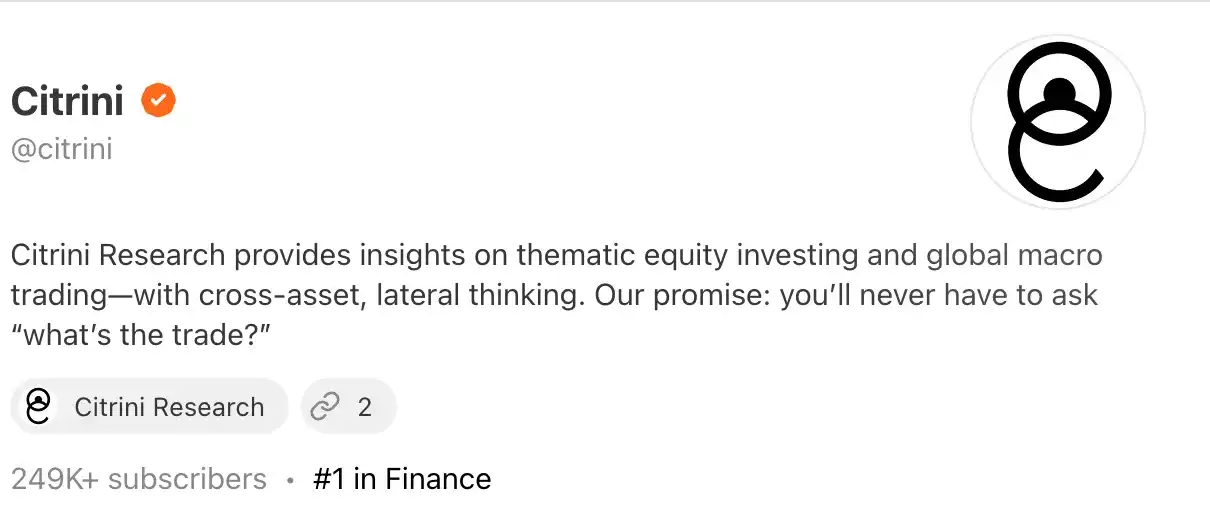
Judging from Citrini's past content and public information, this investment research firm focuses on long-term "super trends," such as AI, robotics, energy demand, fiscal policy, geopolitics, modern warfare, etc. Additionally, the firm is dedicated to providing actionable "bundled investment references" and tactical macro trade ideas, with analysis leaning towards long-term structural changes rather than short-term trades. In its Substack homepage bio, we can see its emphasis on practicality, stating: "You (the reader) will no longer need to ask 'what's the trade?'"
Furthermore, Citrini often uses "scenario assumptions" to help readers understand second/third-order effects. Geelen once mentioned: "Don't always think about what you think will happen. Instead, think about what is bound to happen. How will the market's reaction change the actual situation? What will be the secondary effects? What are the obstacles keeping a certain trend going? Where will capital flow to overcome these obstacles?" Previously, during the collapse of Silicon Valley Bank in March 2023, he boldly purchased overnight funding rate call options, easily reaping nearly 50x returns. Last December, before the US initiated military action in Venezuela, he shared insights on investment opportunities in Venezuelan sovereign bonds.
This year, Citrini has successively absorbed several independent analysts, including macro analyst Nick Reece, South Korean semiconductor industry analyst @jukan05, and AI chip industry analyst @zephyr_z9, to some extent filling gaps in industry details, technical processes, and directional changes.Currently, this investment research firm still maintains a founder-driven + anonymous elite team collaborative production model.