From Subsidies to Token-Based Pricing to Price Cuts: Is OpenAI Sparking a Price War? Is the Inflection Point for Token Economics Nearing?

marsbitXuất bản vào 2026-06-11Cập nhật gần nhất vào 2026-06-11

Tóm tắt

The commercialization of generative AI is facing a critical inflection point as a potential price war looms. According to The Wall Street Journal, OpenAI is considering a significant cut to its token fees to compete with rival Anthropic, signaling a shift from a growth-at-all-costs model focused on token consumption. This move comes as both companies, reportedly losing billions on compute, prepare for IPOs, and as enterprise customers face "bill shock" from switching to usage-based token billing. Reports indicate poor ROI, with one analysis finding only 18 cents of every dollar spent on AI tokens generates user-facing value. The industry's initial phases—from flat-rate subscriptions to aggressive subsidies—have given way to a reckoning with real costs. Analysts debate the future: some predict a bifurcation between premium, high-cost models for complex tasks and cheaper alternatives for routine work, while others believe overall spending will still rise as agentic AI increases tokens per task. Notably, Chinese model DeepSeek's low-cost API is gaining traction with U.S. enterprises, adding competitive pressure. The core challenge is redefining value beyond token volume ("tokenmaxxing") toward measurable productivity ("valuemaxxing"), as the entire AI value chain, from cloud providers to chipmakers, feels the ripple effects of unsustainable pricing.

When a real Token price war erupts, how will the AI industry make money? The entire valuation logic for AI commercialization is at a moment where it needs to be rewritten. The era of competing on "cost-effectiveness" and "scarcity" may have arrived. For OpenAI, "the situation is deteriorating further." Analysis points out that "if OpenAI goes into decline, it could very likely drag down Nvidia, Oracle, Coreweave, and others."

The commercialization narrative of generative AI is facing its most profound self-examination in three years. From exchanging subsidies for users, to monthly subscription plans that hide costs, to Token-based billing exposing enterprise bill crises, the AI industry has completed a three-stage leap in commercialization within three years—and a potential price war could reset this entire monetization logic back to zero.

According to The Wall Street Journal, OpenAI is considering significantly lowering the Token fees it charges users, in order to compete for enterprise clients from rival Anthropic. Sources familiar with the matter stated that this move is partly to "seize the initiative," as OpenAI expects Anthropic to take similar price-cutting actions. OpenAI CEO Sam Altman recently admitted at an event that AI usage costs have become "a huge problem," and said the company will "help people get more value for less money."

The timing of this news is particularly sensitive. OpenAI secretly filed for an IPO this week, while Anthropic is also in the final countdown to its own listing. Meanwhile, Bloomberg's Silicon Data LLM Token Expenditure Index has fallen for seven consecutive trading days, marking its longest losing streak since January this year, reflecting the market's deep-seated anxiety about the sustainability of AI bills. The report bluntly states that a price war would directly erode the profit margins of both companies—and both are already losing tens of billions of dollars due to the massive computing power required by AI systems.
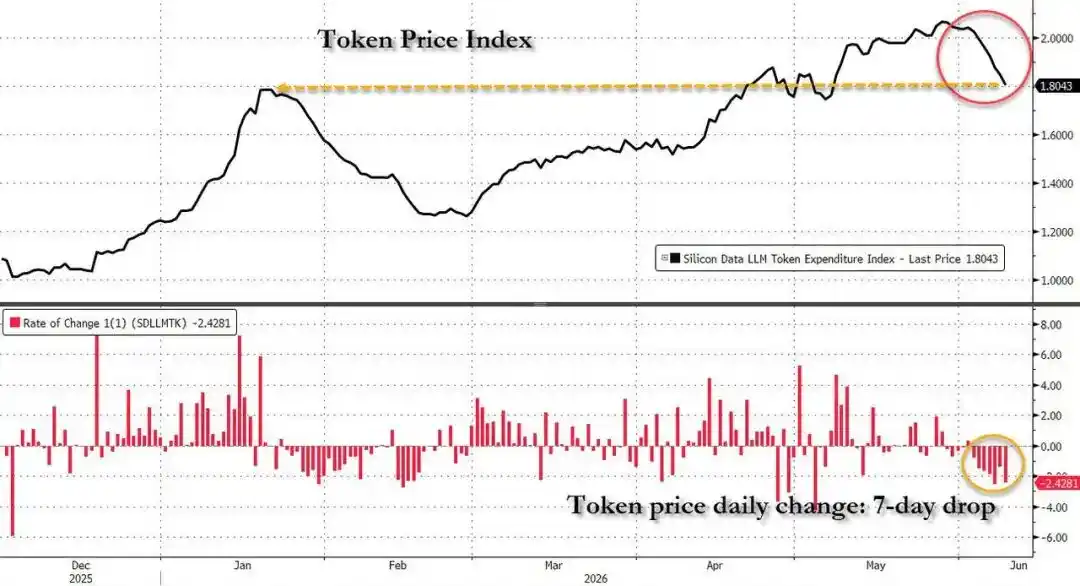
The core of this discussion is no longer just a single price-cut decision, but a more fundamental question: As the narrative of "more Token consumption is better" reaches its end, who will tell the next commercialization story for the AI industry, and how will it be told?

01

The Initial Three Stages: From Monthly Subsidies to Token Bills

The commercialization of generative AI has undergone a clear three-phase evolution in just three years.

Stage One: Monthly and Annual Subscriptions set the industry baseline. In February 2023, OpenAI launched ChatGPT Plus with a monthly fee of $19.99, pioneering paid C-end access for large models; Baidu, Alibaba, and Tencent followed suit, making fixed-fee subscriptions the standard for early-stage business models.

Stage Two: The subsidy war erupted in full force. To boost ARR (Annual Recurring Revenue), the core anchor for financing valuations, major players turned to large-scale subsidies: Google offered students 15 months of Gemini Advanced for free, OpenAI launched a Team membership plan at $1 for the first month, ByteDance's Doubao entered the market with pricing "99.3% lower than the industry standard," and Baidu announced its core models would be free. The essence of subsidies was trading losses for growth—reportedly, Microsoft lost an average of over $20 per user per month under the GitHub Copilot subscription model, with some heavy users costing up to $80 a month in losses.

Stage Three: The forced switch to usage-based billing. On June 1, 2026, Microsoft announced that all GitHub Copilot plans would officially transition to Token-based billing, converting the $19 monthly fee directly into an equivalent Token credit. This change brought the true costs long hidden by subscription models into the open—according to user calculations in the Reddit community, a single agent programming session could consume $30 to $40, depleting a monthly plan in just one use.

02

Bill Out of Control: When Tokens Cost More Than People

The implementation of Token-based pay-as-you-go billing fully revealed the true face of enterprise AI expenditure.

The numbers on the enterprise side are staggering. Uber COO Andrew Macdonald publicly stated in May 2026 that the link between the growth in Token consumption and substantive product improvement "does not yet exist," and even coined a term for it: "tokenmaxxing," describing employees performing valueless tasks to boost usage metrics.

More direct data: Uber exhausted its annual Token budget in just the first four months of 2026; Salesforce expects to pay Anthropic around $300 million for the full year.

Anthropic's own developer documentation shows that developers using Claude Code incur an average cost of about $13 per workday, with 90% of users having daily costs below $30—translating this, a 10-person development team could spend over $75,600 per year on Token fees alone.

The return on investment is equally alarming. Enterprise data platform Entelligence.AI, after aggregating data from 2,444 companies, found that for every $1 spent on AI Token fees, only 18 cents generated actual value that reached users; 44 cents were used to fix bugs introduced by the AI itself, 27 cents went towards rework, and 11 cents were consumed by review friction.
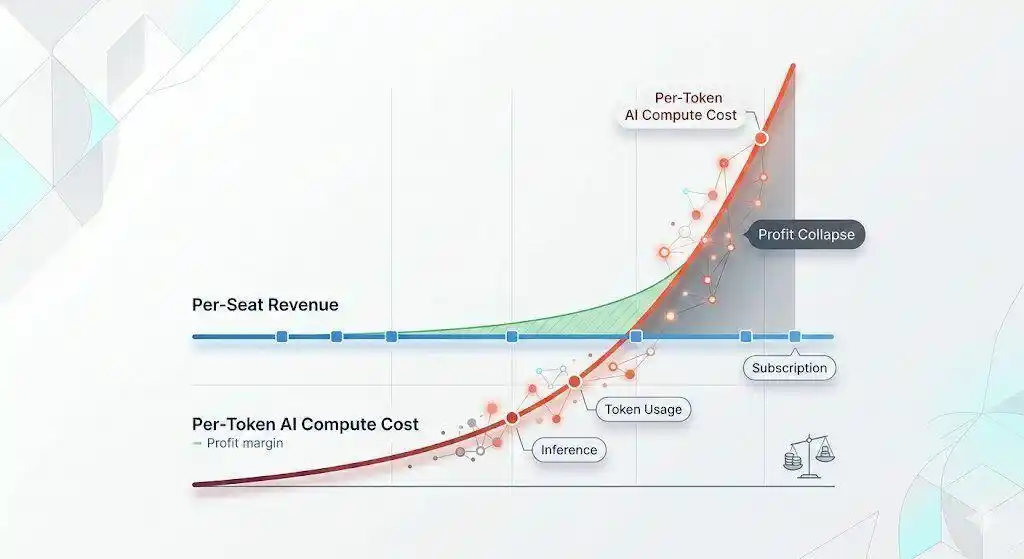
Faced with runaway bills, enterprises have begun proactive control measures. Amazon halted internal AI usage leaderboards, instructing employees "not to use AI just for the sake of using it"; Microsoft plans to gradually phase out Claude Code subscriptions for employees in some key product divisions. Goldman Sachs notes that some companies' spending on AI Tokens already accounts for 10% of their total employee labor costs, and this proportion could rise further in the coming quarters. This isn't about demand disappearing, but the end of the era of reckless AI spending.

03

Act Four: Price War Ignited, OpenAI Considers Major Price Cuts

It is against this backdrop that the fuse for a price war was lit.

According to The Wall Street Journal, Altman's consideration of price cuts was directly triggered by the pressure to catch up with Anthropic. Anthropic's revenue has grown significantly recently, its programming tool Claude Code has become popular among software engineers, and this five-year-old startup's valuation has even surpassed OpenAI's for the first time.

However, the cost of this price war will be exceptionally heavy. If prices are significantly lowered, it will further compress the already negative profit margins of both companies, and the competitive landscape offers very limited room for maneuver.

And a fundamental risk long identified by investors is that OpenAI and Anthropic's products are highly substitutable; clients can easily switch from one to the other—meaning price cuts, even if they retain customers in the short term, cannot truly build a moat and only delay market share loss.

This dilemma also transmits outwards through the financial cycle between cloud computing giants and AI labs.

According to corporate disclosure documents compiled by The Information, OpenAI and Anthropic together account for over half of the approximately $2 trillion in future cloud service commitments from Microsoft, Oracle, Google, and Amazon. If price cuts lead to downward revisions in revenue expectations, this transmission chain will face pressure from both ends.

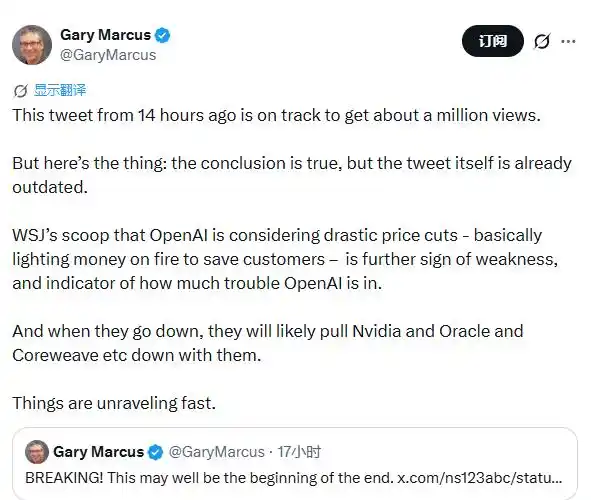
American neuroscientist and AI expert Gary Marcus said: "This further exposes the fragility of OpenAI and indicates how serious the predicament it faces is. If OpenAI goes into decline, it could very likely drag down companies like Nvidia, Oracle, Coreweave. The situation is deteriorating rapidly."
A divergence of views is playing out openly on Wall Street. JPMorgan TMT analyst Mark Schilsky believes the current billing anxiety is merely a "minimum speed bump on the road to higher spending": if the average price per million tokens falls, but the penetration rate of paid AI among US companies continues to rise, overall token usage will mathematically increase substantially; coupled with agentic AI pushing single-task token consumption to several times that of traditional Q&A modes, long-term total expenditure is expected to be significantly higher than current levels.

Goldman Sachs semiconductor analyst Jim Covello holds a more pessimistic view, believing that the current industry chain prosperity has directed almost all value towards semiconductor companies, a phenomenon "unprecedented in history and unsustainable." Once enterprises face the true price of usage-based billing, the capital flows supporting GPU procurement and model training could face a reversal.

04

Act Five: The Next Story for Token Economics?

After the price war, the next chapter of AI industry commercialization has yet to be written, but its outline is emerging.

A report from Citadel Securities offers a directional framework: tiered pricing and charging based on scarcity. Its core logic is that inference-intensive frontier AI won't disappear but will increasingly concentrate in the hands of a few large enterprises capable of bearing the compute costs; for the broader range of enterprises, simpler models might be a more productive path until physical constraints ease. This implies AI usage will move towards stratification—high-value, complex tasks will continue to use frontier models, while routine and batch tasks will shift towards cheaper or local models.

JPMorgan holds a relatively optimistic judgment: even if the per-unit token price falls, the proliferation of agentic AI will multiply token consumption per task—existing data shows that after agentification, token consumption per task can become 3.5 times the original—potentially still expanding the overall expenditure scale. The current billing anxiety might just be a "minimum speed bump on the road to higher spending."

Nebius Chief Revenue Officer Marc Boroditsky proposed the concept of "valuemaxxing," advocating for the industry to shift from pursuing Token consumption maximization to making every Token truly generate value. This direction is gradually becoming an industry consensus—but true commercial implementation still requires AI labs to find a pricing system that both reflects the true cost and is acceptable to enterprise clients. This is precisely the core unresolved proposition in all current debates.

However, perhaps the most overlooked variable in this price war is Chinese models.

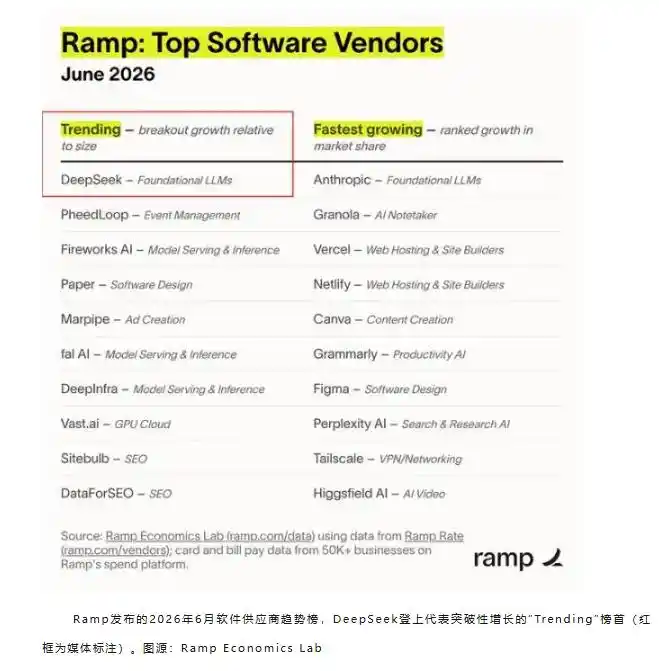
According to June data from American corporate spend management platform Ramp, DeepSeek has topped the list for growth in US enterprise software subscriptions. Ramp Chief Economist Ara Kharazian specifically emphasized that this is not about local deployment of open-source models, but rather "enterprises are directly sending and receiving data through DeepSeek," indicating real paid direct usage—he admitted "did not anticipate US companies would go and use DeepSeek." According to third-party estimates, DeepSeek V4-Pro's API price is about one-tenth that of GPT-5.5, and about one-eleventh that of Claude Opus 4.7.
As OpenAI and Anthropic, two tigers, fight, the ultimate beneficiary might be the player that has long embedded "accessible pricing" into its DNA and doesn't need to answer to IPO investors about profit margins. This may not be the most popular ending for this price war, but it is becoming an increasingly hard-to-ignore reality.

This article is from the WeChat public account "Hard AI," author: Xu Chao

Câu hỏi Liên quan

QAccording to the article, what are the three main stages of generative AI's commercialization evolution?

AThe article outlines three stages: 1) Monthly/annual subscription plans establishing the baseline, like ChatGPT Plus. 2) A comprehensive subsidy war to drive user growth and valuations, with companies offering free or heavily discounted access. 3) The mandatory switch to usage-based (Token) billing, which exposed the true costs previously hidden by flat-rate subscriptions.

QWhat is 'tokenmaxxing' as mentioned in the article, and what problem does it highlight for businesses?

A'Tokenmaxxing' is a term coined by Uber's COO, describing the behavior where employees perform valueless tasks just to increase AI Token usage. It highlights the problem that increased Token consumption does not necessarily correlate with meaningful productivity gains or product improvements, leading to wasteful and uncontrolled AI spending for enterprises.

QWhy is a potential price war between OpenAI and Anthropic described as particularly costly and risky in the article?

AA price war is risky because both companies are already losing billions on the massive compute power required for AI systems. Lowering prices would further squeeze their negative profit margins. Furthermore, their products are highly substitutable, meaning price cuts may temporarily retain customers but do not build a sustainable competitive moat, potentially just delaying market share loss without solving the core profitability issue.

QWhat new pricing or usage frameworks are suggested as potential next chapters for AI commercialization after a price war?

AThe article suggests frameworks like tiered pricing based on scarcity/value, where advanced, compute-intensive models are reserved for high-value tasks at large enterprises, while simpler, cheaper models handle routine tasks. Another concept is 'valuemaxxing'—shifting the industry focus from maximizing Token consumption to ensuring each Token delivers actual value. Morgan Stanley also suggests that the rise of agentic AI could multiply Token use per task, potentially offsetting unit price declines.

QHow does the article characterize the role of Chinese AI models, specifically DeepSeek, in the current competitive landscape?

AThe article presents Chinese models like DeepSeek as a significant and often overlooked variable. It notes DeepSeek's API is priced at roughly one-tenth of GPT-5.5 and one-eleventh of Claude Opus. Data shows DeepSeek topping U.S. enterprise software subscription growth, indicating real paid adoption. The article suggests that while OpenAI and Anthropic compete, the ultimate beneficiary might be a player like DeepSeek, which has 'inclusive pricing' in its DNA and less immediate pressure to show profitability to IPO investors.

Nội dung Liên quan

Kraken Lên Kế Hoạch Cung Cấp Hợp Đồng Tương Lai Vĩnh Viễn Được CFTC Quy Định Cho Nhà Giao Dịch Chuyên Nghiệp Hoa Kỳ

Kraken đang chuẩn bị ra mắt hợp đồng tương lai vĩnh viễn được CFTC quản lý cho các nhà giao dịch chuyên nghiệp đủ điều kiện tại Hoa Kỳ. Sản phẩm sẽ được cung cấp thông qua sàn phái sinh Bitnomial mà Kraken đã mua lại và dự kiến tích hợp vào nền tảng Kraken Pro. Hợp đồng tương lai vĩnh viễn là sản phẩm phái sinh crypto lớn toàn cầu, cho phép giao dịch không ngày đáo hạn. Tại Mỹ, các hạn chế quy định trước đây khiến nhà giao dịch có ít lựa chọn trong nước. Động thái của Kraken nhằm thu hẹp khoảng cách này, cung cấp một con đường được quản lý để tiếp cận sản phẩm chi phối khối lượng giao dịch crypto ở nước ngoài. Việc ra mắt sẽ tập trung vào các nhà giao dịch chuyên nghiệp đủ điều kiện. Các yếu tố cần theo dõi bao gồm điều khoản về tính đủ điều kiện, thiết kế hợp đồng, tài sản được hỗ trợ và quan trọng nhất là thanh khoản khi ra mắt. Thành công của sản phẩm có thể mở đường cho nhiều sản phẩm tương lai vĩnh viễn được quản lý khác tại thị trường Mỹ, đưa sản phẩm phái sinh chủ chốt này tiến gần hơn đến cơ sở hạ tầng thị trường nội địa được quản lý.

bitcoinist3 giờ trước

Kraken Lên Kế Hoạch Cung Cấp Hợp Đồng Tương Lai Vĩnh Viễn Được CFTC Quy Định Cho Nhà Giao Dịch Chuyên Nghiệp Hoa Kỳ

bitcoinist3 giờ trước

Sự Ra Mắt Của Warsh: Chủ Tịch Fed Hiểu Crypto Nhất Lịch Sử Sẽ Mang Đến Bất Ngờ Hay Cú Sốc Cho Thị Trường?

Tân Chủ tịch Cục Dự trữ Liên bang Kevin Warsh, người được mệnh danh là chủ tịch FED "hiểu rõ về Crypto nhất trong lịch sử", sắp có buổi họp báo chính sách đầu tiên trong bối cảnh thử thách ba mặt: lạm phát quay trở lại, áp lực giảm lãi suất từ Tổng thống Trump và kỳ vọng thị trường về việc tăng lãi suất. Khác với người tiền nhiệm, Warsh có cái nhìn sâu sắc về tài sản số, từng coi Bitcoin như "cảnh sát tốt cho chính sách" và nhấn mạnh giá trị sản xuất của ngành công nghiệp blockchain. Tuy nhiên, ông cũng nổi tiếng là người theo chủ nghĩa diều hâu về lạm phát. Sự kết hợp giữa "lãi suất chặt chẽ" và "quy định thân thiện" từ ông có thể trở thành yếu tố cốt lõi định giá tài sản mã hóa. Bài viết phân tích tác động từ ba khía cạnh: 1. **Chuyển đổi khuôn mẫu kỳ vọng quy định:** Từ phòng thủ sang tích hợp và đổi mới, có thể thúc đẩy các khung pháp lý rõ ràng hơn, hỗ trợ ổn định do khu vực tư nhân phát hành. 2. **Định giá lại lộ trình lãi suất và phần bù rủi ro:** Một chủ tịch hiểu biết và giao tiếp rõ ràng có thể giảm bớt phí bảo hiểm bất định, có lợi về cấu trúc cho thị trường. 3. **Tái phân bổ dòng vốn toàn cầu:** Kinh nghiệm đầu tư cá nhân của Warsh truyền tải tín hiệu về sự chấp nhận chính thống, có thể thúc đẩy các quỹ thể chế truyền thống phân bổ tài sản số. Hai kịch bản chính được đưa ra: * **Ngạc nhiên thú vị:** Nếu Warsh thể hiện thái độ ôn hòa và công nhận giá trị của tài sản số, thị trường có thể được tiếp thêm sức mạnh. * **Cú sốc:** Nếu ông phát tín hiệu tăng lãi suất mạnh mẽ, tài sản rủi ro, bao gồm crypto, có thể chịu áp lực bán. Mặc dù Warsh đã bán các khoản nắm giữ liên quan đến crypto để tuân thủ quy tắc đạo đức, nhưng sự hiểu biết thực sự của ông về công nghệ blockchain được kỳ vọng sẽ đặt nền tảng cho việc chính thống hóa tài sản số về lâu dài, vượt ra ngoài các phản ứng thị trường ngắn hạn.

marsbit3 giờ trước

Sự Ra Mắt Của Warsh: Chủ Tịch Fed Hiểu Crypto Nhất Lịch Sử Sẽ Mang Đến Bất Ngờ Hay Cú Sốc Cho Thị Trường?

marsbit3 giờ trước

XRP Ledger Ra Mắt Rebrand XRPLd Cùng Với Bản Nâng Cấp Phiên Bản 3.2.0

Phiên bản 3.2.0 của XRP Ledger đã chính thức ra mắt, đánh dấu một bước nâng cấp quan trọng cho cơ sở hạ tầng blockchain cốt lõi. Lần này, các nhà phát triển đã đổi tên phần mềm vận hành mạng từ "rippled" thành "xrpld" để phù hợp hơn với toàn bộ hệ sinh thái của dự án. Bản cập nhật tập trung chủ yếu vào các cải tiến back-end và hiệu suất thay vì tính năng người dùng mới. Các tối ưu hóa bộ nhớ được giới thiệu có khả năng tiết kiệm tới 40% lượng bộ nhớ máy chủ, đồng thời chuẩn bị kiến trúc phần mềm cho việc mở rộng quy mô trong tương lai. Về mặt bảo mật, bản sửa đổi `fixCleanup3_2_0` mang lại nhiều cải thiện cho các mô-đun như kho lưu ký tài sản đơn, giao thức cho vay, sàn giao dịch phi tập trung và mã thông báo đa năng. Các kiểm tra bất biến mới được thêm vào để đảm bảo tính toàn vẹn của sổ cái khi tài khoản bị xóa. Một khả năng mới cho nhà phát triển là ứng dụng có thể truy xuất thông tin định nghĩa giao thức và máy chủ XRP Ledger mà không cần kết nối trực tiếp, hỗ trợ đáng kể việc phát triển ví, công cụ khám phá chuỗi khối và API. Các thay đổi về khả năng mở rộng và ổn định bao gồm kích thước khối có thể cấu hình, hỗ trợ lưu trữ cơ sở dữ liệu hiệu quả qua nuDB, và việc hỗ trợ máy chủ gRPC cho TLS/mutual TLS trở thành tùy chọn. Cổng kết nối ngang hàng mặc định cũng được đổi từ 51235 sang 2459. Các tính năng kiểm tra bất biến giao dịch tạm thời bị vô hiệu hóa trong phiên bản 3.2.0 do ảnh hưởng đến hiệu suất, nhưng không gây rủi ro bảo mật.

TheNewsCrypto3 giờ trước

XRP Ledger Ra Mắt Rebrand XRPLd Cùng Với Bản Nâng Cấp Phiên Bản 3.2.0

TheNewsCrypto3 giờ trước

AGI không phải là điểm kết thúc, nghiên cứu mới của DeepMind: Hướng tới ASI, tiến bộ AI thực sự mới chỉ bắt đầu

DeepMind mới đây công bố nghiên cứu cho rằng AGI (Trí tuệ nhân tạo phổ quát) không phải là điểm cuối. AI sẽ tiếp tục phát triển vượt qua khả năng của các nhóm chuyên gia con người hàng đầu, hướng tới ASI (Trí tuệ siêu nhân tạo). Báo cáo phân biệt ba khái niệm: AGI (năng lực nhận thức tương đương mức trung bình của con người), ASI (vượt trội con người trong hầu hết lĩnh vực quan tâm), và UAI (giới hạn lý thuyết tối thượng). Nghiên cứu đề xuất bốn con đường tiềm năng để chuyển từ AGI sang ASI: 1. Mở rộng quy mô tính toán, mô hình và dữ liệu. 2. Tiến hóa thuật toán, có thể thay đổi mô hình mới. 3. Tự cải thiện đệ quy, tạo phản hồi tích cực. 4. Điều phối đa tác tử và trí tuệ tập thể. Đồng thời, báo cáo chỉ ra sáu điểm nghẽn chính: giới hạn dữ liệu chất lượng cao, áp lực tài nguyên và kinh tế, hạn chế của mô hình mạng nơ-ron hiện tại, nghiên cứu ngày càng khó khăn, rào cản trừu tượng, cùng các vấn đề quản lý và phản ứng xã hội. Khi AI vượt con người, các phương pháp đánh giá truyền thống sẽ mất ý nghĩa. Cần xây dựng hệ thống đánh giá mới cho thời kỳ hậu AGI. ASI không phải là hệ thống toàn năng, vẫn chịu ràng buộc bởi các quy luật vật lý, độ phức tạp tính toán, dữ liệu, tài nguyên và tốc độ phản hồi thực tế. Tương lai phát triển của AI vẫn chứa nhiều bất định, đòi hỏi một nỗ lực liên ngành quy mô lớn để theo dõi và ứng phó.

marsbit4 giờ trước

AGI không phải là điểm kết thúc, nghiên cứu mới của DeepMind: Hướng tới ASI, tiến bộ AI thực sự mới chỉ bắt đầu

marsbit4 giờ trước

Kraken Ra Mắt Hợp Đồng Perpetual Trước IPO Cho OpenAI Và Anthropic Với Đòn Bẩy Lên Đến 5x

Kraken đã ra mắt hợp đồng tương lai vĩnh viễn (perps) tiền IPO cho hai công ty trí tuệ nhân tạo hàng đầu là OpenAI và Anthropic. Các hợp đồng này cho phép các nhà giao dịch đủ điều kiện mở vị thế mua (long) hoặc bán (short) đối với các công ty tư nhân được theo dõi sát sao này trước khi họ lên sàn chứng khoán, với đòn bẩy lên tới 5x. Sản phẩm này đánh dấu một bước tiến trong việc mở rộng cơ sở hạ tầng phái sinh tiền mã hóa sang các tài sản ngoài chuỗi, cung cấp cho các nhà giao dịch một cách tiếp cận thay thế để có thể tiếp xúc với các công ty tư nhân vốn thường khó tiếp cận. Tuy nhiên, hợp đồng tiền IPO có những rủi ro đặc thù. Khác với các hợp đồng vĩnh viễn cho tiền mã hóa có giá cả minh bạch, định giá công ty tư nhân phụ thuộc vào nhiều yếu tố như các vòng gọi vốn, giao dịch thứ cấp và kỳ vọng về thời điểm IPO. Điều này khiến việc định giá và quản lý rủi ro trở nên phức tạp hơn. Việc sử dụng đòn bẩy cao có thể khuếch đại lợi nhuận nhưng cũng làm gia tăng đáng kể rủi ro thua lỗ và thanh lý. Do đó, các nhà giao dịch cần hiểu rõ bản chất của sản phẩm mới và các rủi ro độc đáo của thị trường tư nhân trước khi tham gia.

bitcoinist5 giờ trước

Kraken Ra Mắt Hợp Đồng Perpetual Trước IPO Cho OpenAI Và Anthropic Với Đòn Bẩy Lên Đến 5x

bitcoinist5 giờ trước

Giao dịch

Giao ngay
Hợp đồng Tương lai

Bài viết Nổi bật

Làm thế nào để Mua WAR

Chào mừng bạn đến với HTX.com! Chúng tôi đã làm cho mua WAR (WAR) trở nên đơn giản và thuận tiện. Làm theo hướng dẫn từng bước của chúng tôi để bắt đầu hành trình tiền kỹ thuật số của bạn.Bước 1: Tạo Tài khoản HTX của BạnSử dụng email hoặc số điện thoại của bạn để đăng ký tài khoản miễn phí trên HTX. Trải nghiệm hành trình đăng ký không rắc rối và mở khóa tất cả tính năng. Nhận Tài khoản của tôiBước 2: Truy cập Mua Crypto và Chọn Phương thức Thanh toán của BạnThẻ Tín dụng/Ghi nợ: Sử dụng Visa hoặc Mastercard của bạn để mua WAR (WAR) ngay lập tức.Số dư: Sử dụng tiền từ số dư tài khoản HTX của bạn để giao dịch liền mạch.Bên thứ ba: Chúng tôi đã thêm những phương thức thanh toán phổ biến như Google Pay và Apple Pay để nâng cao sự tiện lợi.P2P: Giao dịch trực tiếp với người dùng khác trên HTX.Thị trường mua bán phi tập trung (OTC): Chúng tôi cung cấp những dịch vụ được thiết kế riêng và tỷ giá hối đoái cạnh tranh cho nhà giao dịch.Bước 3: Lưu trữ WAR (WAR) của BạnSau khi mua WAR (WAR), lưu trữ trong tài khoản HTX của bạn. Ngoài ra, bạn có thể gửi đi nơi khác qua chuyển khoản blockchain hoặc sử dụng để giao dịch những tiền kỹ thuật số khác.Bước 4: Giao dịch WAR (WAR)Giao dịch WAR (WAR) dễ dàng trên thị trường giao ngay của HTX. Chỉ cần truy cập vào tài khoản của bạn, chọn cặp giao dịch, thực hiện giao dịch và theo dõi trong thời gian thực. Chúng tôi cung cấp trải nghiệm thân thiện với người dùng cho cả người mới bắt đầu và người giao dịch dày dạn kinh nghiệm.

Tổng lượt xem 729Xuất bản vào 2024.12.11Cập nhật vào 2026.06.02

Làm thế nào để Mua WAR

Thảo luận

Chào mừng đến với Cộng đồng HTX. Tại đây, bạn có thể được thông báo về những phát triển nền tảng mới nhất và có quyền truy cập vào thông tin chuyên sâu về thị trường. Ý kiến ​​của người dùng về giá của WAR (WAR) được trình bày dưới đây.

活动图片