a16z crypto Partner: Cash Flow Is the True Moat

Foresight NewsXuất bản vào 2026-06-11Cập nhật gần nhất vào 2026-06-11

Tóm tắt

Title: a16z Crypto Partner: Capital Flow is the True Moat In business history, enduringly successful enterprises often share a core logic: capturing value by facilitating its creation and transfer within an ecosystem, taking a share of the proceeds. The scale of value flowing through the ecosystem directly correlates with the company's growth. Cryptography is the first modern technology natively suited to this commercial logic. Startups that don't leverage this framework in product design and business model construction miss significant opportunities. Stablecoins enable internet-speed, 24/7 global settlement of value with end-to-end programmability. With open underlying channels for capital flow and transparent unit economics, every circulating dollar globally represents potential flow in this arena. Blockchain is inherently a network business model. All transactions are recorded on a shared ledger, and each new participant strengthens this foundational system for future developers. More users and applications increase the network's value for all. Crypto entrepreneurs start with built-in network effects, unlike traditional businesses that spend years building them on legacy infrastructure. Network tokens amplify this advantage. A well-designed token system aligns users, developers, service providers, and validators around a common goal—network growth—while distributing rewards based on contribution. All proceeds flow back to ecosystem participants, creating a virtuous cyc...


Author: Jason Rosenthal, Operating Partner at a16z crypto

Compiled by: Chopper, Foresight News


Throughout business history, the success logic of many enduring enterprises has been inseparable from the link of capital flow: undertaking businesses that create and transfer value within the ecosystem and extracting revenue from them. The larger the volume of value flowing through the ecosystem, the larger the scale of the enterprise tends to be.


Cryptographic technology is the first modern technology inherently suited to this business logic. If a startup does not base its product design and business model architecture on this logic during the planning stages, it misses out on tremendous opportunities. The proliferation of stablecoins has endowed capital and value with internet-level transfer speeds, enabling 24/7 global settlement with end-to-end programmability. Now, the underlying channels for capital flow are fully open, unit economic models are transparent, and every circulating dollar globally represents potential flow in this arena.


Underlying Business Logic


Blockchain is fundamentally a network-based business model. All transactions are uniformly recorded on a shared ledger, and each new participant reinforces this underlying system for subsequent developers. The more people who use the ecosystem and build applications, the greater the value of the entire network for all users.


Most traditional enterprises spend years building network effects on top of outdated infrastructure; whereas entrepreneurs in the crypto space start with inherent network effects from the outset.


Network tokens further amplify this advantage. A well-designed token system can bind users, developers, service providers, node validators, and the protocol ecosystem to a common goal—driving network growth—while distributing revenue according to each party's contributions. The revenue generated by the protocol ultimately belongs to all ecosystem participants. There are no secret rebates, no special deals, only the formation of a positive feedback loop: value circulates within the system, and returns flow back to everyone building the ecosystem.


This business logic is not new; it's just that the crypto industry is the first to enable startups to implement and scale it more easily.


The profit core of railroad companies was never selling locomotives, but charging a toll for every freight train transporting grain, coal, or steel. Standard Oil, U.S. Steel, and AT&T were all giants rooted in the links of value flow. Google and Meta replaced traditional print and television media not merely because their advertising formats were better, but because they occupied the critical node where attention converts into commercial transactions, taking a cut from trillions of dollars in commercial flow. Amazon Web Services occupies the central position for computing resources.
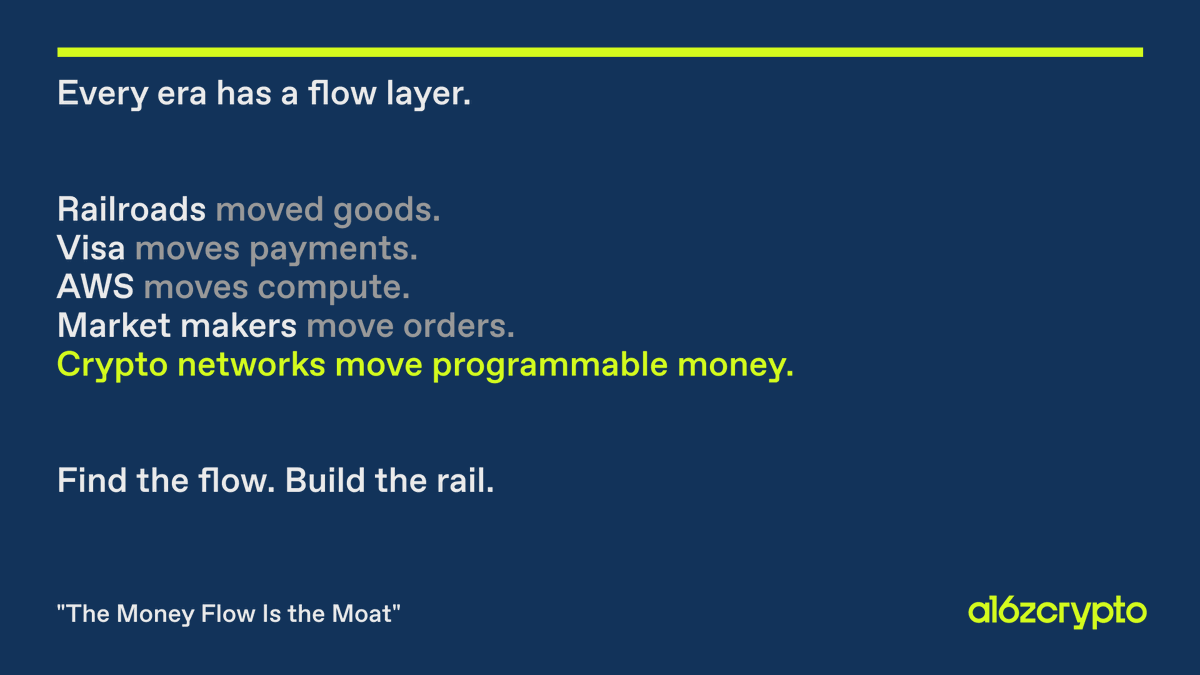


The pattern remains consistent: find the core path of value flow and occupy a key position within it.


This logic is vividly reflected in financial markets. In fiscal year 2024, Visa processed payment volumes totaling $15.7 trillion, generating net revenue of $35.9 billion. The well-known market maker Jane Street's trading net revenue reached $20.5 billion last year, surpassing Citibank and Bank of America. The top five market makers in the US handled 87% of order flow payments: they don't predict market ups and downs, they just need to reside in the flow path of every order; the higher the trading volume, the greater their earnings.


Such enterprises share another commonality: powerful network effects. The more merchants that accept Visa cards, the more valuable the card is to cardholders; conversely, the more cardholders, the more merchants are attracted to offer the service. The order flow market is similar: the more brokers connected, the narrower the bid-ask spread, which in turn attracts more brokers, bringing even larger order flow.


Cash flow coupled with network effects is one of the most robust business models in the commercial world.


Your Margin Is My Opportunity


Jeff Bezos once proposed a classic viewpoint: "Your margin is my opportunity." This statement originally targeted the retail industry, but it fits even more aptly in the traditional financial services sector—the industry with the largest scale of profit capture globally. This holds true across subsectors like payments, asset custody, lending, foreign exchange, asset securitization, trade settlement, and market making.


Visa and Mastercard, based on networks built in the 1960s, charge transaction fees of 2% to 3%; cross-border remittance channels have fees as high as 6% to 9%; prime brokers and asset custodians take a cut from every securities transaction. Even though the US shortened the securities settlement cycle to T+1 in 2024, funds can still sit idle overnight, which constitutes a structural cost borne by all market participants.


The existing profit margins in these industries are all potential entry points for disruption. Reducing transaction costs, improving capital flow efficiency, and potentially further expanding the overall market size. Stripe and Square have proven this model works in payments.
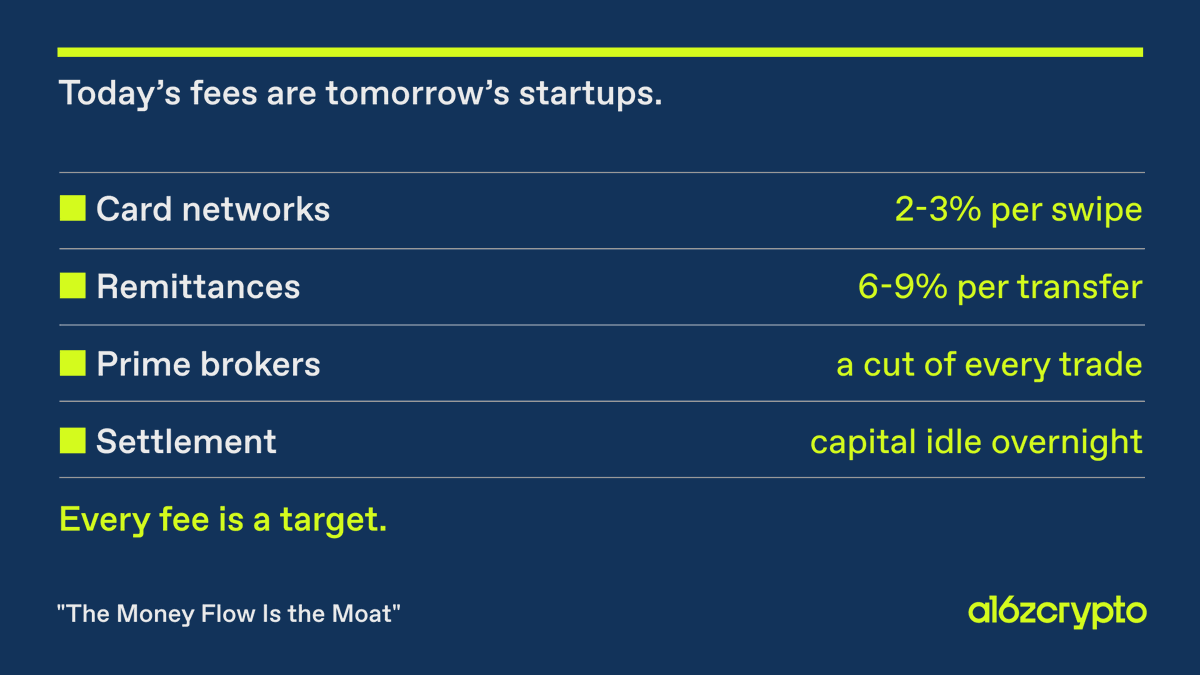


Entrepreneurs in the crypto industry have the opportunity to build the next-generation infrastructure: programmable, transactions settled instantly, globally accessible services, and rooted in the capital flow chain from its inception.


The opportunities also extend far beyond financial services. Markets for computing power and GPU trading, storage chips, AI training data, energy, robotics, aerospace, rare earth metals, and more are all on the verge of experiencing large-scale global value flow, for which existing traditional channels are completely inadequate.


The aforementioned sectors represent entirely new blue-ocean markets built on programmable infrastructure, centered on the cash flow model. Here, there are no deeply entrenched legacy platforms, no tangled webs of middlemen, and no old structures to defend.


As an entrepreneur, ask yourself a few questions: Is your current business positioned in the core link of value flow? When the transaction volume and value scale of your product ecosystem grow tenfold, can your revenue grow in sync? If you are developing a new product, in your target market, which link has the highest profit capture relative to the value it creates?


Where the answer lies, there lies the opportunity. Compress the costs of the original links, enter new value flow tracks, and then achieve sustained growth by leveraging network effects.

Câu hỏi Liên quan

QWhat is the core business logic shared by many enduring enterprises throughout business history, according to the article?

AThe core business logic is to occupy a key position in the flow of value, capturing a portion of the value as it moves through an ecosystem. The greater the volume of value flowing, the larger the enterprise typically becomes.

QHow does the article characterize the fundamental nature of blockchain technology in relation to business models?

AThe article characterizes blockchain as fundamentally a network-based business model. All transactions are recorded on a shared ledger, and each new participant strengthens this underlying system for subsequent developers. The more people who use and build on the ecosystem, the more valuable the entire network becomes for all users.

QAccording to the article, what creates one of the most durable business models in the commercial world?

AThe combination of capital flow and network effects creates one of the most durable business models in the commercial world.

QWhat is the meaning of Bezos's quote 'Your margin is my opportunity' in the context of traditional financial services?

AIn the context of traditional financial services, the quote means that the existing profit margins (or high fees) in sectors like payments, asset custody, and cross-border transfers represent opportunities for new, more efficient entrants to disrupt the industry by compressing those costs and capturing market share.

QWhat key questions should entrepreneurs ask themselves to identify opportunities, as suggested by the article?

AEntrepreneurs should ask: 1) Is my current business positioned at the core of a value flow? 2) If the transaction volume and value in my product's ecosystem grow tenfold, will my revenue grow correspondingly? 3) In my target market, which segment has the highest profit margin relative to the value it creates? The answers point to where the opportunities lie.

Nội dung Liên quan

AGI không phải là điểm kết thúc, nghiên cứu mới của DeepMind: Hướng tới ASI, tiến bộ AI thực sự mới chỉ bắt đầu

DeepMind mới đây công bố nghiên cứu cho rằng AGI (Trí tuệ nhân tạo phổ quát) không phải là điểm cuối. AI sẽ tiếp tục phát triển vượt qua khả năng của các nhóm chuyên gia con người hàng đầu, hướng tới ASI (Trí tuệ siêu nhân tạo). Báo cáo phân biệt ba khái niệm: AGI (năng lực nhận thức tương đương mức trung bình của con người), ASI (vượt trội con người trong hầu hết lĩnh vực quan tâm), và UAI (giới hạn lý thuyết tối thượng). Nghiên cứu đề xuất bốn con đường tiềm năng để chuyển từ AGI sang ASI: 1. Mở rộng quy mô tính toán, mô hình và dữ liệu. 2. Tiến hóa thuật toán, có thể thay đổi mô hình mới. 3. Tự cải thiện đệ quy, tạo phản hồi tích cực. 4. Điều phối đa tác tử và trí tuệ tập thể. Đồng thời, báo cáo chỉ ra sáu điểm nghẽn chính: giới hạn dữ liệu chất lượng cao, áp lực tài nguyên và kinh tế, hạn chế của mô hình mạng nơ-ron hiện tại, nghiên cứu ngày càng khó khăn, rào cản trừu tượng, cùng các vấn đề quản lý và phản ứng xã hội. Khi AI vượt con người, các phương pháp đánh giá truyền thống sẽ mất ý nghĩa. Cần xây dựng hệ thống đánh giá mới cho thời kỳ hậu AGI. ASI không phải là hệ thống toàn năng, vẫn chịu ràng buộc bởi các quy luật vật lý, độ phức tạp tính toán, dữ liệu, tài nguyên và tốc độ phản hồi thực tế. Tương lai phát triển của AI vẫn chứa nhiều bất định, đòi hỏi một nỗ lực liên ngành quy mô lớn để theo dõi và ứng phó.

marsbit39 phút trước

AGI không phải là điểm kết thúc, nghiên cứu mới của DeepMind: Hướng tới ASI, tiến bộ AI thực sự mới chỉ bắt đầu

marsbit39 phút trước

Kraken Ra Mắt Hợp Đồng Perpetual Trước IPO Cho OpenAI Và Anthropic Với Đòn Bẩy Lên Đến 5x

Kraken đã ra mắt hợp đồng tương lai vĩnh viễn (perps) tiền IPO cho hai công ty trí tuệ nhân tạo hàng đầu là OpenAI và Anthropic. Các hợp đồng này cho phép các nhà giao dịch đủ điều kiện mở vị thế mua (long) hoặc bán (short) đối với các công ty tư nhân được theo dõi sát sao này trước khi họ lên sàn chứng khoán, với đòn bẩy lên tới 5x. Sản phẩm này đánh dấu một bước tiến trong việc mở rộng cơ sở hạ tầng phái sinh tiền mã hóa sang các tài sản ngoài chuỗi, cung cấp cho các nhà giao dịch một cách tiếp cận thay thế để có thể tiếp xúc với các công ty tư nhân vốn thường khó tiếp cận. Tuy nhiên, hợp đồng tiền IPO có những rủi ro đặc thù. Khác với các hợp đồng vĩnh viễn cho tiền mã hóa có giá cả minh bạch, định giá công ty tư nhân phụ thuộc vào nhiều yếu tố như các vòng gọi vốn, giao dịch thứ cấp và kỳ vọng về thời điểm IPO. Điều này khiến việc định giá và quản lý rủi ro trở nên phức tạp hơn. Việc sử dụng đòn bẩy cao có thể khuếch đại lợi nhuận nhưng cũng làm gia tăng đáng kể rủi ro thua lỗ và thanh lý. Do đó, các nhà giao dịch cần hiểu rõ bản chất của sản phẩm mới và các rủi ro độc đáo của thị trường tư nhân trước khi tham gia.

bitcoinist45 phút trước

Kraken Ra Mắt Hợp Đồng Perpetual Trước IPO Cho OpenAI Và Anthropic Với Đòn Bẩy Lên Đến 5x

bitcoinist45 phút trước

Các giao dịch M&A trên thị trường tiền mã hóa đang diễn ra sôi động bất thường

Thị trường mua bán và sáp nhập (M&A) trong lĩnh vực tiền mã hóa đang trở nên sôi động bất thường. Theo số liệu từ RootData, trong tháng này, số vụ M&A đã lên tới 10, trong khi số vòng gọi vốn chỉ là 14. Tỷ lệ M&A trong tổng số giao dịch thị trường sơ cấp đã đạt khoảng 42%, mức cao nhất từ trước đến nay. Hiện tượng này phản ánh trước hết là sự suy giảm kéo dài của thị trường gọi vốn. Kể từ tháng 11/2024, số lượng giao dịch M&A hàng tháng duy trì ở mức 10-20 vụ, trong khi giao dịch gọi vốn giảm mạnh từ khoảng 100 xuống còn khoảng 50 vụ. Điều này có nghĩa là M&A không thay thế cho sự sôi động của thị trường vốn, mà trở thành hình thức giao dịch ổn định hơn khi thị trường vốn thu hẹp. Các công ty lớn như Coinbase, Kraken, Ripple, MoonPay... đang tận dụng thời kỳ giá trị định thấp để mua lại các đội ngũ, giấy phép, công nghệ với chi phí thấp hơn, ít cạnh tranh hơn và có thêm quyền thương lượng. Bốn lý do chính thúc đẩy M&A là: định giá đủ rẻ, tiết kiệm chi phí thời gian và thử sai, tiếp cận nguồn lực giấy phép/tuân thủ, và hợp nhất chuỗi giá trị thượng-nhượng nguồn. Các lĩnh vực trọng tâm của M&A hiện nay bao gồm: cơ sở hạ tầng giao dịch (đặc biệt là phái sinh), thanh toán & stablecoin, giấy phép tuân thủ, và phát hành/phân phối tài sản (RWA). Làn sóng M&A này đang viết lại logic thoái vốn cho thị trường sơ cấp, cung cấp một lối thoát khác ngoài việc phụ thuộc vào phát hành token. Nó buộc các dự án phải chú trọng hơn vào giá trị sản phẩm, doanh thu thực và khả năng tích hợp chiến lược thay vì chỉ đóng gói câu chuyện để gọi vốn. Tuy nhiên, xu hướng này cũng cho thấy ngành công nghiệp tiền mã hóa đang trở nên tập trung hơn. Các nền tảng lớn dần nắm giữ tài sản, thanh khoản và giấy phép, khiến việc gia nhập thị trường của các startup mới ngày càng khó khăn, đánh dấu sự kết thúc của thời kỳ khởi nghiệp dễ dàng.

链捕手1 giờ trước

Các giao dịch M&A trên thị trường tiền mã hóa đang diễn ra sôi động bất thường

链捕手1 giờ trước

Giao dịch mua lại và sáp nhập trên thị trường tiền mã hóa đang diễn ra cực kỳ sôi động

Thị trường M&A trong lĩnh vực tiền mã hóa đang hoạt động sôi động một cách bất thường, với tỷ lệ giao dịch mua lại chiếm khoảng 42% tổng số giao dịch thị trường sơ cấp, mức cao nhất từ trước đến nay. Điều này phản ánh xu hướng suy giảm rõ rệt của thị trường gọi vốn. Các giao dịch M&A không thực sự thay thế sự sôi động của thị trường vốn, mà trở thành hình thức giao dịch ổn định khi thị trường gọi vốn thu hẹp. Các công ty hàng đầu như Coinbase, Kraken, Ripple, MoonPay đang tích cực mua lại để bổ sung năng lực cốt lõi với chi phí thấp hơn. Động lực chính bao gồm: định giá mục tiêu rẻ hơn, tiết kiệm thời gian và chi phí thử sai, tiếp cận giấy phép/tài nguyên tuân thủ, và tích hợp chuỗi giá trị. Các lĩnh vực trọng tâm của M&A là: cơ sở hạ tầng giao dịch (đặc biệt là phái sinh), thanh toán & stablecoin, RWA & phát hành tài sản. Điều này cho thấy các gã khổng lồ đang mở rộng từ sản phẩm đơn lẻ sang mô hình tập đoàn tài chính. Sự gia tăng M&A đang viết lại logic thoát vốn cho thị trường sơ cấp, cung cấp một lối thoát thay thế ngoài việc phụ thuộc vào token, khuyến khích các startup tập trung vào giá trị sản phẩm và năng lực tích hợp thực tế. Tuy nhiên, nó cũng cho thấy ngành công nghiệp đang trở nên tập trung hơn, với rào cản gia nhập ngày càng cao do yếu tố tuân thủ và sức mạnh của các nền tảng lớn.

marsbit1 giờ trước

Giao dịch mua lại và sáp nhập trên thị trường tiền mã hóa đang diễn ra cực kỳ sôi động

marsbit1 giờ trước

Bức tranh toàn cảnh về hệ sinh thái bảo mật Solana: Chồng bảo mật hoàn chỉnh từ Máy tính đến AI

Solana vẫn đang ở giai đoạn đầu trong việc phát triển hệ sinh thái bảo mật, tập trung vào các lĩnh vực như Ngân hàng mới (Neobanks) và DeFi riêng tư. Bài viết cung cấp cái nhìn toàn cảnh về hệ sinh thái này, từ cơ sở hạ tầng tính toán đến các ứng dụng AI. **Cơ sở hạ tầng Tính toán Riêng tư:** Hai dự án chính là Arcium (sử dụng MPC - Tính toán Đa bên) và Magic Block (sử dụng TEE - Môi trường Thực thi Tin cậy) cung cấp nền tảng cho tính toán bảo mật trên Solana. Chúng cho phép tạo lập sổ lệnh, nhóm thanh khoản kín và các giao thức DeFi riêng tư. **Chuyển khoản & Số dư Riêng tư:** Các ứng dụng như Umbra (trên Arcium), Privacy Cash và Hush cung cấp giải pháp cho giao dịch và số dư riêng tư thông qua các kỹ thuật như mã hóa, nhóm che giấu (shielding pools) và bằng chứng không kiến thức (ZK-proof). **Giao dịch không để lại dấu vết:** Các giao thức như encifherio và VanishTrade bảo vệ chiến lược giao dịch khỏi front-running và MEV bằng cách ẩn chi tiết đặt lệnh thông qua mã hóa hoặc định tuyến thanh khoản được che giấu. Darklake phát triển cơ sở hạ tầng thanh khoản và nhóm giao dịch kín (dark pool) dựa trên ZK. **Ứng dụng Nâng cao:** Các thị trường dự đoán riêng tư (ví dụ: Melee Markets) sử dụng cơ sở hạ tầng như của Arcium để mã hóa sổ lệnh, bảo vệ chiến lược của người tham gia. Trong lĩnh vực AI, Loyal tạo ra các giao thức thông minh bảo mật, lưu trữ dữ liệu người dùng (hội thoại, truy vấn) ở dạng mã hóa trên Solana với các quy tắc truy cập nghiêm ngặt. Tầm nhìn cuối cùng là một "ngăn xếp bảo mật hoàn chỉnh" nơi các công nghệ như ZK và FHE (Mã hóa Đồng cấu hình Đầy đủ) kết hợp để mang lại tính bảo mật mạnh mẽ và có thể kết hợp trên quy mô lớn.

Foresight News1 giờ trước

Bức tranh toàn cảnh về hệ sinh thái bảo mật Solana: Chồng bảo mật hoàn chỉnh từ Máy tính đến AI

Foresight News1 giờ trước

Giao dịch

Giao ngay
Hợp đồng Tương lai

Bài viết Nổi bật

Làm thế nào để Mua FLOW

Chào mừng bạn đến với HTX.com! Chúng tôi đã làm cho mua Flow (FLOW) trở nên đơn giản và thuận tiện. Làm theo hướng dẫn từng bước của chúng tôi để bắt đầu hành trình tiền kỹ thuật số của bạn.Bước 1: Tạo Tài khoản HTX của BạnSử dụng email hoặc số điện thoại của bạn để đăng ký tài khoản miễn phí trên HTX. Trải nghiệm hành trình đăng ký không rắc rối và mở khóa tất cả tính năng. Nhận Tài khoản của tôiBước 2: Truy cập Mua Crypto và Chọn Phương thức Thanh toán của BạnThẻ Tín dụng/Ghi nợ: Sử dụng Visa hoặc Mastercard của bạn để mua Flow (FLOW) ngay lập tức.Số dư: Sử dụng tiền từ số dư tài khoản HTX của bạn để giao dịch liền mạch.Bên thứ ba: Chúng tôi đã thêm những phương thức thanh toán phổ biến như Google Pay và Apple Pay để nâng cao sự tiện lợi.P2P: Giao dịch trực tiếp với người dùng khác trên HTX.Thị trường mua bán phi tập trung (OTC): Chúng tôi cung cấp những dịch vụ được thiết kế riêng và tỷ giá hối đoái cạnh tranh cho nhà giao dịch.Bước 3: Lưu trữ Flow (FLOW) của BạnSau khi mua Flow (FLOW), lưu trữ trong tài khoản HTX của bạn. Ngoài ra, bạn có thể gửi đi nơi khác qua chuyển khoản blockchain hoặc sử dụng để giao dịch những tiền kỹ thuật số khác.Bước 4: Giao dịch Flow (FLOW)Giao dịch Flow (FLOW) dễ dàng trên thị trường giao ngay của HTX. Chỉ cần truy cập vào tài khoản của bạn, chọn cặp giao dịch, thực hiện giao dịch và theo dõi trong thời gian thực. Chúng tôi cung cấp trải nghiệm thân thiện với người dùng cho cả người mới bắt đầu và người giao dịch dày dạn kinh nghiệm.

Tổng lượt xem 421Xuất bản vào 2024.12.10Cập nhật vào 2026.06.02

Làm thế nào để Mua FLOW

Thảo luận

Chào mừng đến với Cộng đồng HTX. Tại đây, bạn có thể được thông báo về những phát triển nền tảng mới nhất và có quyền truy cập vào thông tin chuyên sâu về thị trường. Ý kiến ​​của người dùng về giá của FLOW (FLOW) được trình bày dưới đây.

活动图片