Humanity Loses $31 Million in Attack, Token Price Plummets 90% Due to a Single Private Key

marsbitXuất bản vào 2026-06-09Cập nhật gần nhất vào 2026-06-09

Tóm tắt

On June 9th, the digital identity project Humanity Protocol suffered a major security breach resulting in over $31 million in losses. According to on-chain analyst Specter, hundreds of wallets holding the project's H token were drained. The attack was confirmed by founder Terence Kwok to be caused by the compromise of a foundation member's private key. As a precaution, users are advised to avoid interacting with Humanity's cross-chain bridge or liquidity pools. The incident caused the H token price to crash over 90%, from around $0.70 to a low of $0.052, wiping its market cap from $2 billion to approximately $35.7 million. The attacker allegedly minted 100 million new H tokens and is selling them for BNB. This breach adds to existing controversies surrounding Humanity Protocol. Founded in 2024, it aimed to verify human users via palm-print biometrics and zero-knowledge proofs. However, a leaked conversation in 2025 revealed that only about 1 million of its 9 million claimed Human IDs had completed biometric verification, suggesting 88% might be bots. Furthermore, the project has faced allegations of being a repackaged product from a Chinese access control vendor, raising privacy and authenticity concerns. Founder Terence Kwok's previous venture, Tink Labs, a hotel smartphone startup that raised $170 million, failed and entered bankruptcy in 2020 after burning through its funding. The current attack highlights the persistent critical issue of private key management in cryp...

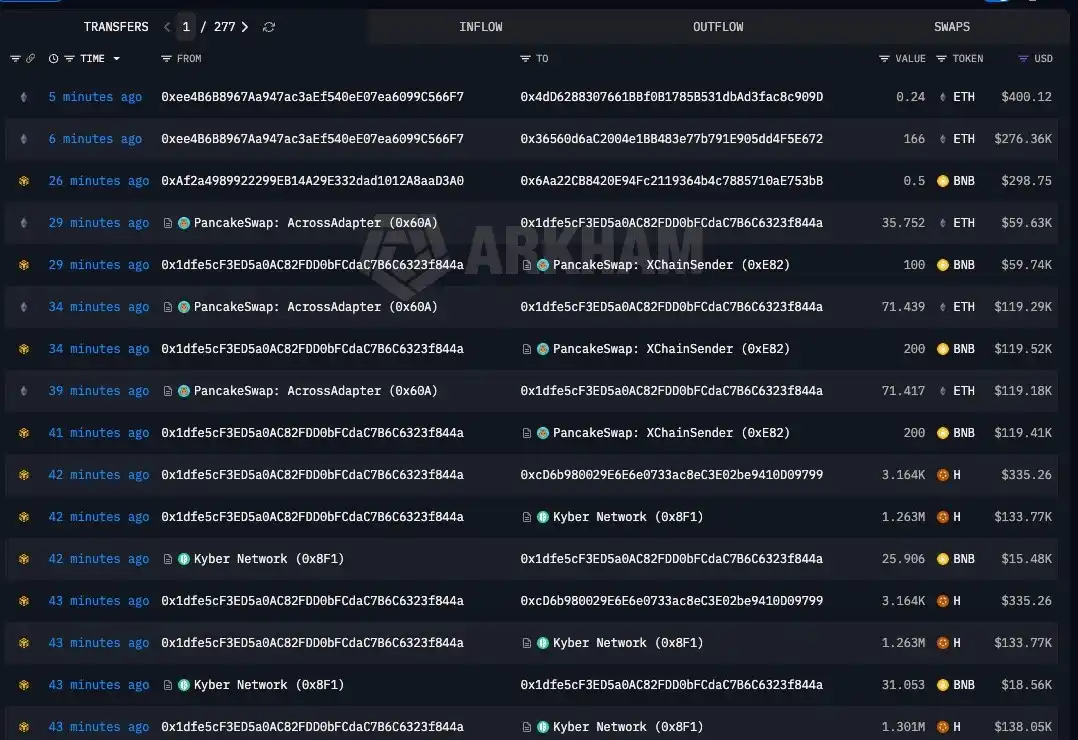
On June 9th, according to on-chain analyst Specter's monitoring, wallets that have interacted with the digital identity project Humanity are under sustained attack.

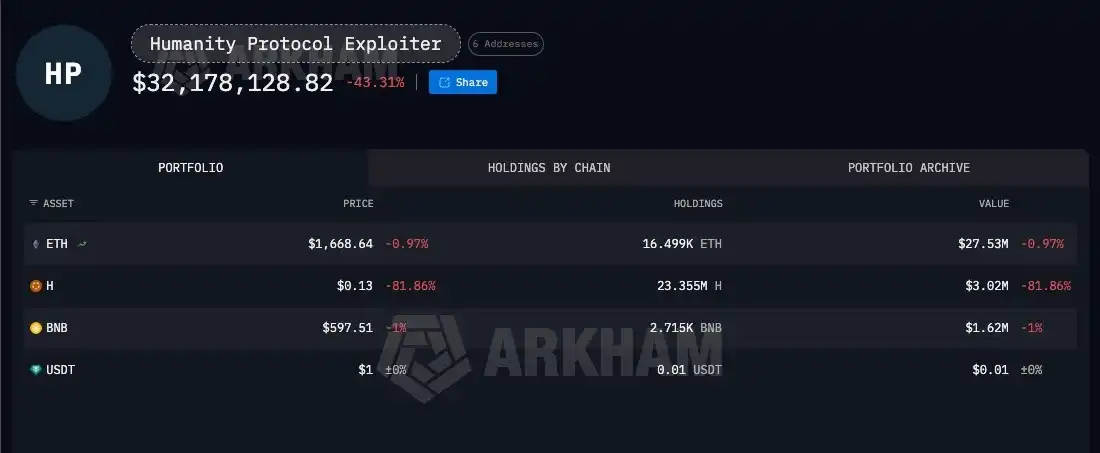
So far, hundreds of addresses holding H tokens have been stolen, with total losses exceeding $31 million. Approximately $9 million has already been converted to ETH, and about $9.9 million remains in the form of H tokens.
Humanity founder Terence Kwok later confirmed the security incident, which involved the leak of a private key belonging to a foundation member.

As a precautionary measure, he advised users to temporarily avoid interacting with the Humanity cross-chain bridge or any liquidity pools until further safety confirmation. The team is working with security experts and exchange partners to address the issue and will continue to update the community on progress.
The H token price plummeted from around 0.7 USDT to a low of 0.052 USDT, a drop of over 90% in 24 hours. As of the time of writing, H is trading at 0.1368301 USDT, with its market capitalization falling from around $2 billion to approximately $35.7 million.

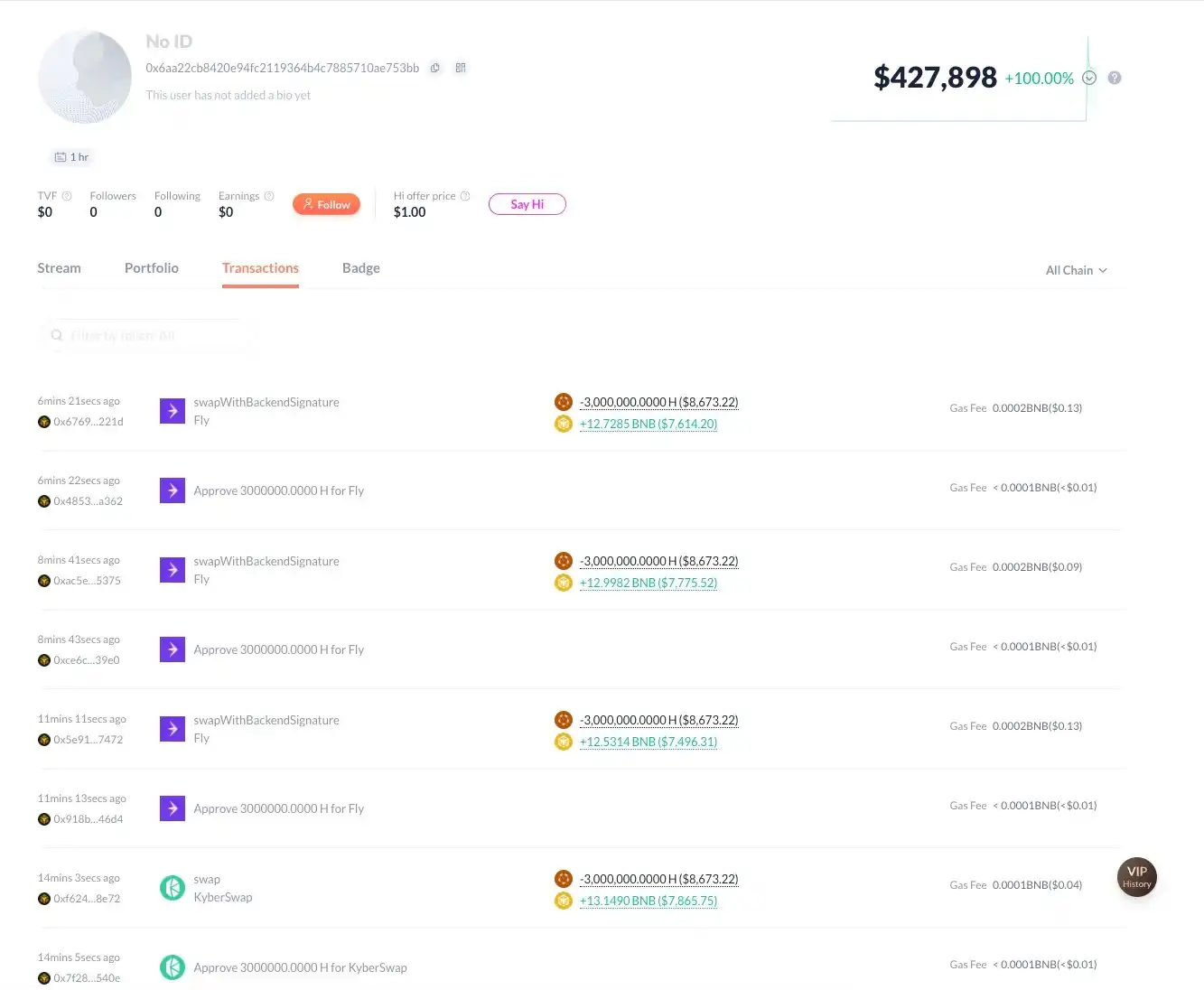
As of 11:00 on June 9th, the attacker allegedly newly minted 100 million Humanity Protocol H tokens and is dumping them in exchange for BNB.
A Project That Hasn't Truly "Proven Humanity"

Humanity Protocol was founded in 2024, positioning itself as a decentralized digital identity network. Its core selling point is verifying users as real humans using palm print biometrics and zero-knowledge proofs. The project is built on Polygon CDK (zkEVM), claiming to solve issues like Sybil attacks, fake accounts, and AI-generated identities without exposing personal information.

This narrative attracted significant capital attention in 2024. Humanity Protocol completed two rounds of funding totaling $50 million. A $30 million seed round valued the project at $1 billion, with investors including Kingsway Capital, Animoca Brands, Blockchain.com, and Shima Capital, among others.

In January 2025, a round led by Pantera Capital and Jump Crypto raised $20 million, increasing the valuation to $1.1 billion.

The Humanity Foundation also gathered many prominent figures, led by Animoca Brands Chairman Yat Siu. Co-founders include Mario Nawfal, founder of the international blockchain consulting firm, and Yeewai Chong, a senior investment expert from Morgan Stanley and Ortus Capital.

On June 25, 2025, the H token launched via a Fairdrop mechanism, touted as the first token distribution in Web 3.0 history exclusively for verified real humans. However, two days after launch, DL News reported leaked conversations from the founder. Kwok admitted in the dialogue that out of the 9 million Human IDs created on the network, only about 1 million had completed biometric verification, meaning up to 88% of users could be bots.

Furthermore, according to claims by users like SCoin(@ LianFang _) and AB Kuai . Dong(@_FOR AB) on platform X, Humanity Protocol (H) might be a "re-packaged Chinese project," with its app's code asset library still containing images from the Shenzhen access control manufacturer Zhang Teng Information, raising authenticity doubts. Netizens alleged that its social media hype was largely orchestrated by the project's own sock puppet accounts, with actual user engagement being questionable.
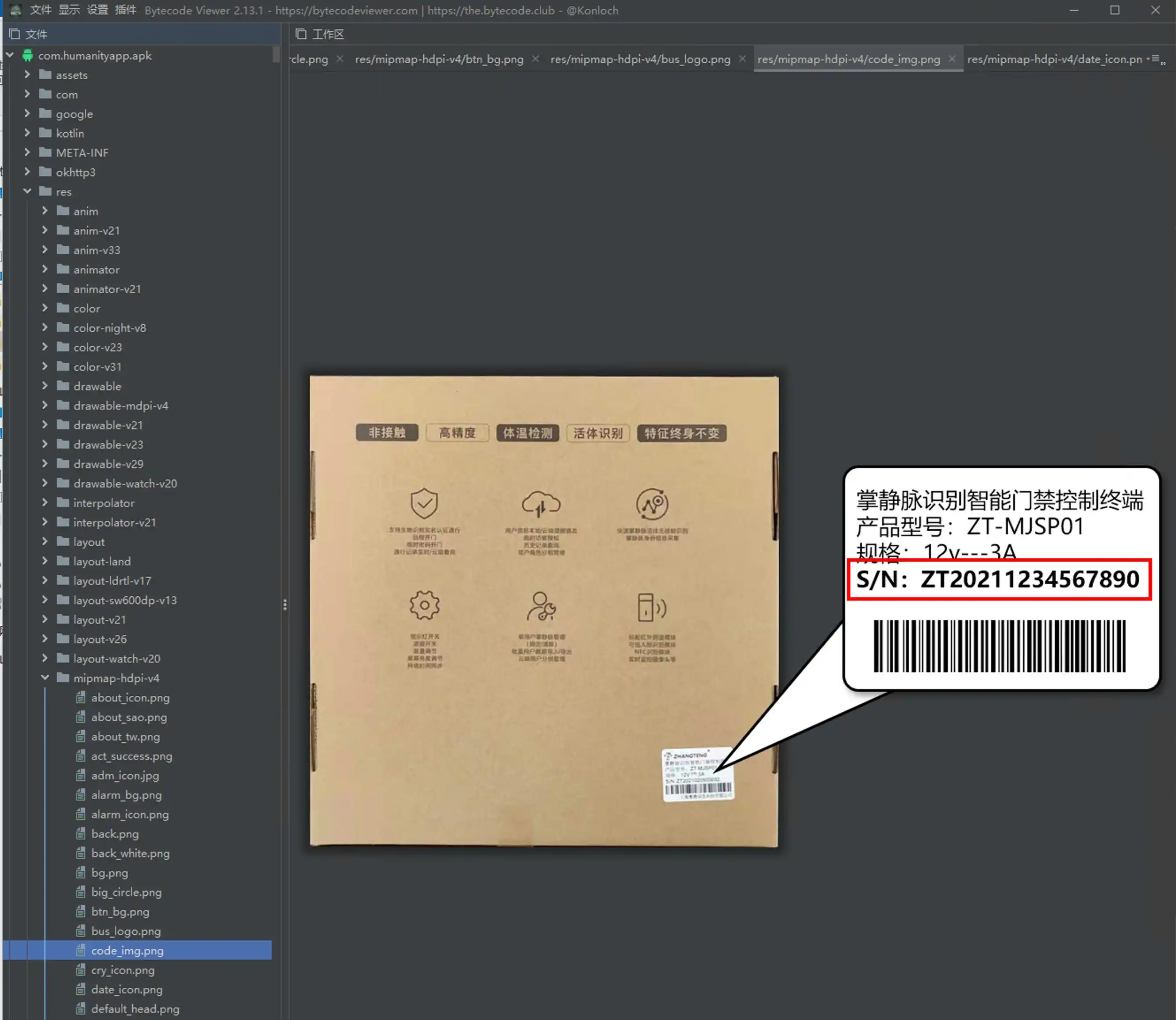
AB Kuai.Dong warned that those who previously did verification with Humanity should be careful. Zhang Teng Information is backed by a Shanghai outsourcing company specializing in full-service identity recognition outsourcing. Additionally, whistleblower SCoin claimed the project collected large amounts of user palm print information, raising privacy and security concerns.

This was fatal for a project whose core value proposition is "proving humanity." The H token fell over 61% within two days of launch, from around $0.05 to a low of $0.018.

The Founder's Previous Unicorn Burned Through $170 Million

Terence Kwok's personal history adds a risk footnote to this project. In 2012, 20-year-old Terence Kwok dropped out of the University of Chicago. After receiving a $900 roaming bill during a trip, he founded Tink Labs, which provided free smartphones (branded Handy) in hotel rooms for guests to use abroad to avoid high roaming fees.

This concept once captivated the capital market. Tink Labs raised $170 million in total from Foxconn, SoftBank, Innovation Works, and the founder of Meitu, reaching a valuation of $1.5 billion and becoming Hong Kong's first unicorn. At its peak, Handy devices covered 600,000 hotel rooms across 82 countries.

However, Kwok's aggressive expansion strategy soon met reality. Global roaming fees continued to fall, hotels were unwilling to pay for Handy devices, and the company began losing money from 2017. According to the Financial Times, after discovering that Tink Labs might have diverted funds from its Japanese joint venture to other loss-making markets, SoftBank cut off funding for the key project.

In July 2019, over 100 employees in European, Middle Eastern, and African offices did not receive their salaries. Laid-off employees smeared cake on the walls and floors as they left the Oxford office. On August 1st, Tink Labs officially shut down, entering bankruptcy liquidation in January 2020. A former HR executive told the FT that Kwok only cared about "making money," and the entire $170 million investment was lost.

Six years later, Kwok returned to the market with Humanity Protocol, securing a unicorn valuation once again from Pantera Capital and Jump Crypto.

Private Key Management: An Old Problem, A New Price

From the current information, this attack does not involve smart contract vulnerabilities or protocol-level security flaws. The attacker obtained a private key from a foundation member, representing a failure of the most traditional security management.

The security situation in the crypto industry was already severe in 2026. According to CCN statistics, losses from DeFi hacks in the first four months of 2026 exceeded $1 billion, with most stolen funds still unrecovered. The $286 million attack on Drift Protocol on April 1st was the single largest event this year.

Attackers are increasingly targeting validators, RPC nodes, and governance systems, not just smart contract vulnerabilities. However, private key leaks remain one of the most devastating attack types, as they bypass all on-chain security mechanisms and directly obtain asset control.

For a project already burdened with the controversy of 88% bot users and a token down over 90% from its high, a $31 million private key leak could be the final blow to trust.

As of the time of writing, Kwok stated in a declaration that the team is working with security experts and exchange partners, but did not mention any user compensation plan or explain why the foundation member's private key lacked basic protections like multi-signature or hardware isolation.

Câu hỏi Liên quan

QWhat is the main cause of the $31 million hack in the Humanity project according to the article?

AThe hack was caused by the compromise of a private key belonging to a foundation member, leading to unauthorized access and asset theft, not a smart contract vulnerability.

QHow did the price of the H token react immediately after the security incident?

AThe price of the H token plummeted from around $0.7 USDT to a low of $0.052 USDT, representing a drop of over 90% within 24 hours.

QWhat was a major controversy surrounding the Humanity Protocol's user verification prior to this hack?

AA leaked conversation revealed that only about 1 million out of 9 million created Human IDs had completed biometric verification, suggesting that up to 88% of the users might have been bots.

QWhat is the background of Humanity founder Terence Kwok's previous venture, Tink Labs?

ATerence Kwok's previous venture, Tink Labs (which provided Handy smartphones in hotel rooms), raised $170 million and reached a $1.5 billion valuation before collapsing in 2019, with the investment reportedly completely lost.

QWhat action did the attacker reportedly take with the stolen assets, and what precaution did the founder advise users to take?

AThe attacker reportedly converted about $9 million into ETH and was selling newly minted tokens for BNB. The founder advised users to temporarily avoid interacting with the Humanity cross-chain bridge or any liquidity pools until safety is confirmed.

Nội dung Liên quan

Từ 119 đến 176 USD: Phía sau vụ IPO của SpaceX, MSX một lần nữa chứng minh vòng khép kín Pre-IPO

Tiếp nối thành công từ Cerebras với lợi nhuận 300% vào tháng 5, MSX một lần nữa chứng minh mô hình Pre-IPO của mình qua vụ IPO lịch sử của SpaceX. Ngày 12 tháng 6, SpaceX (SPCX) chính thức lên sàn Nasdaq với mức vốn hóa đỉnh điểm đạt 2,3 nghìn tỷ USD. Đối với người dùng MSX, đây là thời điểm then chốt để hiện thực hóa lợi nhuận từ dự án Pre-IPO SpaceX được mở bán từ tháng 3 với giá 119 USD. Tính theo giá đóng cửa phiên đầu tiên (166,85 USD), lợi nhuận đạt khoảng 40%. Thành công này đánh dấu lần thứ hai MSX hoàn tất một cách trọn vẹn vòng khép kín Pre-IPO, từ đăng ký mua, nắm giữ, đến niêm yết, giao dịch và chốt lời. Quy trình 6 bước này đã được kiểm chứng trong đợt IPO SpaceX, khi một số nền tảng khác gặp sự cố về hạn ngạch và phải hoàn tiền cho người dùng. Trước đó, vào tháng 5, MSX đã giao dịch thành công cổ phiếu Cerebras (CBRS) ngay sau khi công ty này lên sàn, mang về lợi nhuận lên tới 300% cho những người tham gia từ giai đoạn Pre-IPO. Hai trường hợp liên tiếp này cho thấy giá trị thực sự của sản phẩm Pre-IPO không chỉ nằm ở việc cung cấp cổ phần sớm, mà quan trọng hơn là khả năng tạo ra một lộ trình rõ ràng và khả thi để chuyển đổi tài sản và thoát vốn sau khi công ty niêm yết. MSX tiếp tục mở rộng danh mục dự án Pre-IPO tiềm năng, tập trung vào các lĩnh vực như AI và công nghệ tiên phong, nhằm mang đến cho người dùng Web3 cơ hội tham gia vào các tài săng tăng trưởng toàn cầu trước khi chúng lên sàn chính thức.

Odaily星球日报3 giờ trước

Từ 119 đến 176 USD: Phía sau vụ IPO của SpaceX, MSX một lần nữa chứng minh vòng khép kín Pre-IPO

Odaily星球日报3 giờ trước

TRM Cảnh Báo Kẻ Lừa Đảo Tiền Mã Hóa Đang Gieo Rẫy Bẫy Vé Cá Cược World Cup 2026

Công ty phân tích blockchain TRM Labs cảnh báo những kẻ lừa đảo tiền mã hóa đang bắt đầu gieo rẫm các chiến dịch lừa đảo xung quanh World Cup 2026, bao gồm cổng bán vé giả, cá cược tỷ số cố định và các token meme kỷ niệm không chính thức. Báo cáo ngày 11/6 xác định bốn địa chỉ ví liên quan đến ba hoạt động lừa đảo đang diễn ra, nhắm vào người hâm mộ bóng đá. Số tiền thu được hiện còn nhỏ (ví dụ một địa chỉ trên Polygon nhận 1.562 USD), cho thấy đây là giai đoạn thử nghiệm hạ tầng lừa đảo ban đầu. Các rủi ro chính bao gồm: trang web bán vé giả dẫn người dùng đến luồng thanh toán tiền mã hóa do kẻ lừa đảo kiểm soát; các sơ đồ cá cược tỷ số cố định hứa hẹn thông tin nội bộ để chiếm đoạt tiền ứng trước; và các token theo chủ đề sự kiện (như $WORLDCUP) không có sự liên kết chính thức với FIFA, tiềm ẩn rủi ro "bơm thổi bóng". TRM nhấn mạnh những kẻ lừa đảo vẫn sử dụng các công cụ hoán đổi chuỗi chéo và sàn giao dịch để che giấu dấu vết. Cảnh báo được đưa ra sớm nhằm khuyến nghị người dùng cần thận trọng đặc biệt với các yêu cầu thanh toán bằng tiền mã hóa xung quanh vé, cá cược và token không chính thức trước khi làn sóng hype về World Cup 2026 gia tăng.

bitcoinist8 giờ trước

TRM Cảnh Báo Kẻ Lừa Đảo Tiền Mã Hóa Đang Gieo Rẫy Bẫy Vé Cá Cược World Cup 2026

bitcoinist8 giờ trước

Sau màn ra mắt đầu tiên của SpaceX: Giá trị vốn hóa 2,1 nghìn tỷ USD, có đáng để đầu tư?

Sau khi cổ phiếu SpaceX (SPCX) chính thức lên sàn Nasdaq vào ngày 12/6, định giá vốn hóa thị trường đạt 2,1 nghìn tỷ USD. Dù mở cửa ở mức 150 USD, cao hơn 11% so với giá IPO 135 USD và có lúc chạm 176 USD, màn trình diễn cuối cùng được đánh giá là thành công nhưng chưa thực sự ấn tượng so với kỳ vọng thị trường trước đó. Bài viết chỉ ra rằng định giá khổng lồ hiện tại khó có thể được chống đỡ bởi kết quả kinh doanh thực tế. SpaceX vẫn đang thua lỗ, với Starlink là nguồn doanh thu chính, trong khi hoạt động phóng tên lửa và các dự án tương lai như "năng lực tính toán không gian" vẫn đang trong giai đoạn đầu tư tốn kém và mang nhiều tính viễn tưởng. Tỷ lệ phân bổ cổ phần IPO cho nhà đầu tư nhỏ lẻ cao (khoảng 20%) cũng được nhắc đến như một yếu tố có thể làm tăng tính biến động cho cổ phiếu. Bài viết đồng thời nêu bật ba mốc thời gian quan trọng sắp tới: khả năng được đưa vào chỉ số Nasdaq 100 sau khoảng 15 ngày giao dịch (đầu tháng 7), công bố báo cáo tài chính Q2/2026 (giữa tháng 8) và đợt mở khóa cổ phiếu đầu tiên cho cổ đông nội bộ sau đó, có thể sẽ tạo ra những biến động giá đáng kể.

Odaily星球日报9 giờ trước

Sau màn ra mắt đầu tiên của SpaceX: Giá trị vốn hóa 2,1 nghìn tỷ USD, có đáng để đầu tư?

Odaily星球日报9 giờ trước

Giao dịch

Giao ngay
Hợp đồng Tương lai
活动图片