After Marvell's 32% Surge, the Chinese Chip Family Behind It Emerges

marsbitXuất bản vào 2026-06-03Cập nhật gần nhất vào 2026-06-03

Tóm tắt

The stock price of Marvell Technology surged 32.5% on June 2nd, driven by NVIDIA CEO Jensen Huang highlighting its custom ASICs and optical interconnects as core to AI data center architecture. This event brought attention to the Chinese semiconductor family behind Marvell: the Dai siblings. The story centers on three siblings, all UC Berkeley graduates, whose three-decade entrepreneurial journey aligns with major semiconductor industry shifts. In 1995, youngest sister Dai Wei Li co-founded Marvell with her husband Sehat Sutardja and his brother, focusing on storage controllers. Eldest brother Dai Wei Min founded EDA company Ultima, later sold to Cadence, and later founded VeriSilicon (芯原) in China, becoming a leading semiconductor IP provider. Second brother Dai Wei Jin co-founded EDA firm Silicon Perspective (sold to Cadence) and GPU IP company Vivante, later acquired by VeriSilicon. The combined "Dai-Sutardja" family network extends beyond Marvell. Their ventures and investments form a comprehensive ecosystem for the post-Moore's Law, chiplet era. Key holdings include: Dream Big Semiconductor (AI SuperNICs, acquired by Arm), Alphawave (high-speed SerDes IP, acquired by Qualcomm), and Silicon Box (a chiplet advanced packaging foundry). VeriSilicon itself thrives on the AI ASIC and IP boom in China. Collectively, the family's AI infrastructure-related portfolio is estimated at over $22 billion. Their strategy represents a distinct path: building critical components for op...

Author: Ada, Deep Tide TechFlow

On June 2nd, Marvell's stock surged 32.5% in a single day, closing at $290.79, a record high. Over the past 12 months, it has risen 265%. The direct catalyst was Jensen Huang naming Marvell's custom ASICs and optical interconnect as "the core of AI data center architecture" at Computex.

A company being personally endorsed by NVIDIA's CEO at a major conference is rare enough. This company was founded in 1995 by Weili Dai and her husband, Sehat Sutardja, in their living room. Weili Dai is the youngest of the three Dai siblings from Shanghai and one of the driving forces behind this family's thirty-year footprint in the chip industry.

The eldest brother, Weimin Dai, is in Shanghai, serving as the Chairman of VeriSilicon, known as the "first semiconductor IP stock" on the A-share market. Around 2026, VeriSilicon's market cap was approximately 150 billion RMB, with AI ASIC orders hitting record highs for six consecutive quarters. The second brother, Weijin Dai, is currently a director and General Manager of the IP Business Division at VeriSilicon. Vivante, which he founded in 2007, was acquired by VeriSilicon for $57.53 million.

Looking back over the past thirty years, the three Dai siblings founded six companies, with two going public and four being acquired. But that's only half the story. What truly flows beneath is the network woven within the chip industry following the marriage alliance between the "Dai" and "Sutardja" families. From the US to China, from EDA tools to factories or production lines for chiplet advanced packaging, from IP licensing to AI SuperNIC.

Three Siblings Made Six Bets Over Thirty Years, Hitting the Right Timing Each Time

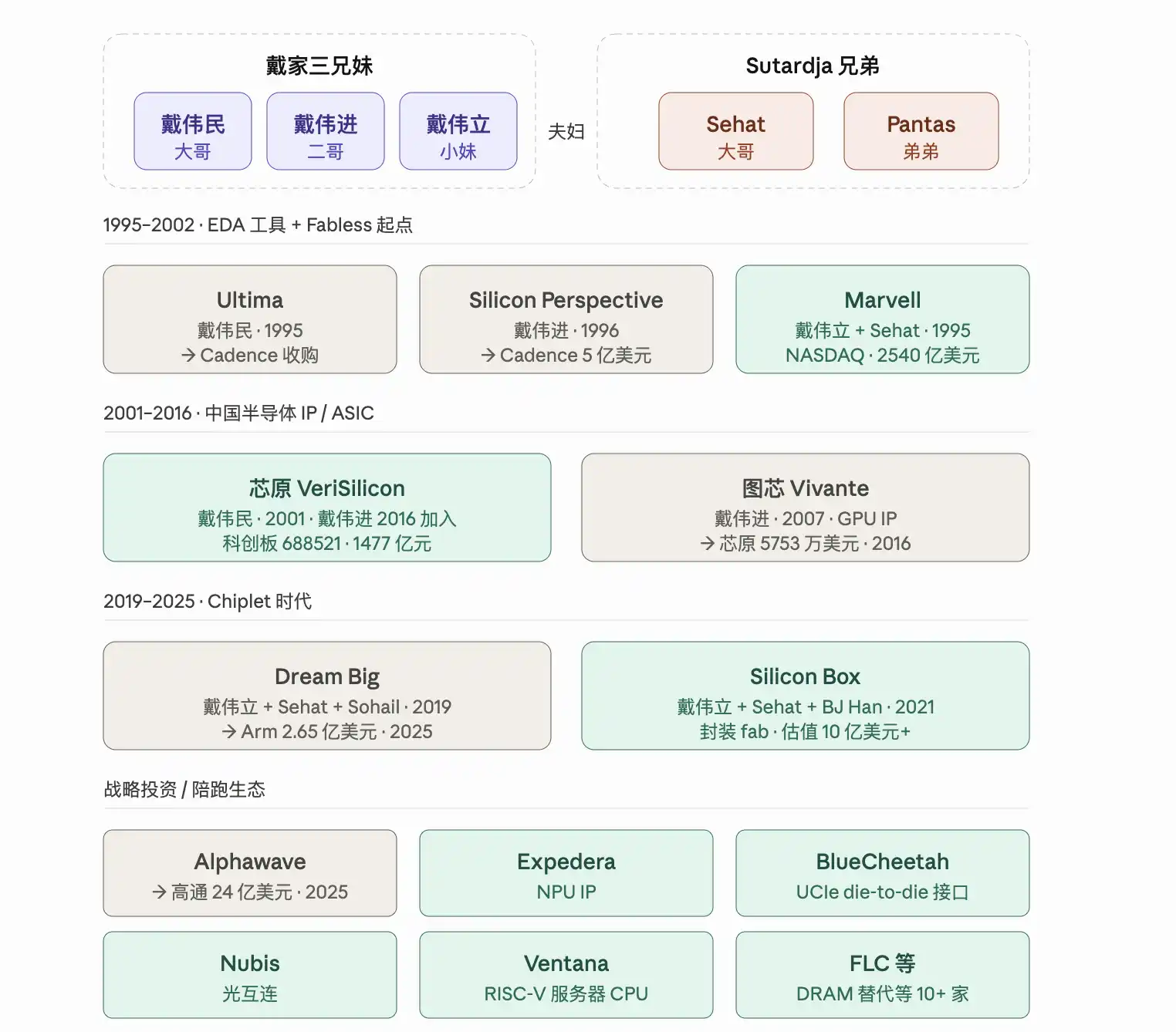
All three Dai siblings graduated with degrees in Electrical Engineering from UC Berkeley. Their entrepreneurial timelines perfectly align with three major paradigm shifts in the semiconductor industry.

1995: Weili Dai, along with her husband Sehat Sutardja and Sehat's brother Pantas Sutardja, founded Marvell in Silicon Valley, focusing on hard drive storage controllers, adopting a pure fabless model. The same year, the eldest brother, Weimin Dai, founded Ultima in Silicon Valley, developing EDA tools. This was the late stage of PC普及 (popularization), where fabless design and the move towards EDA tooling were core features of the semiconductor industry's first major restructuring. The Dai family bet on both trends simultaneously. Ultima was acquired by Cadence in 2000, and Marvell went public in 2000.

1996: Weijin Dai co-founded Silicon Perspective, developing digital implementation EDA, which was acquired by Cadence for approximately $500 million in 2002. Around the same period, the eldest brother, Weimin Dai, turned his attention to China. In 2001, he returned to Shanghai to found VeriSilicon, betting on the "IP licensing + one-stop chip customization" model, providing semi-finished products to nascent SoC design companies in China. That same year, China joined the WTO, and the number of local chip design companies exploded from over 100 to several thousand. VeriSilicon was the ammunition supplier for this wave.

2007: Weijin Dai founded Vivante, focusing on embedded GPU IP, targeting automotive and IoT applications. This was on the eve of the mobile internet boom, a time when all endpoints began requiring graphics capabilities. In 2016, Weimin Dai's VeriSilicon fully acquired Vivante for $57.53 million. Weijin Dai transitioned from CEO of Vivante to General Manager of VeriSilicon's IP Business Division. This internal family merger connected the "China IP leader" and "embedded GPU IP" lines.

2019: Weili Dai embarked on her third venture. After leaving Marvell, she, along with Sehat and former Marvell executive Sohail Syed, founded Dream Big Semiconductor in Silicon Valley, focusing on chip open platforms and AI SuperNICs. In 2021, Weili Dai, Sehat, and Korean semiconductor veteran Han Byung Joon co-founded Silicon Box in Singapore, a chiplet advanced packaging fab. Chiplets represent the only viable industry path to continue boosting single-chip performance as Moore's Law slows, betting on the post-Moore era.

August 2020: Weimin Dai's VeriSilicon went public on the STAR Market, raising 1.862 billion RMB, crowned by the market as the "first semiconductor IP stock." October 2025: Weili Dai's Dream Big was acquired by Arm for $265 million in cash.

Six companies over thirty years, two IPOs, four acquisitions by top-tier buyers. This is an impressive track record, but focusing solely on it misses the real other half of the story.
The Industrial Foundation Built by Two Families

The founding trio of Marvell in 1995 was Weili Dai, Sehat Sutardja, and Sehat's brother, Pantas Sutardja. Sehat was born in Jakarta, Indonesia, became a licensed radio technician at 13, and earned his Ph.D. in Electrical Engineering from Berkeley in 1988, where he met and married Weili Dai. Marvell was a product of the collaboration between the "Dai" and "Sutardja" families from day one, not just a husband-and-wife startup.

This advantage has amplified over the thirty years.

The Dai family has deep roots in China's semiconductor ecosystem. The eldest brother, Weimin Dai's VeriSilicon is a leading domestic IP provider. Its cooperation with SMIC and Huahong Grace can be traced back to the founding of SMIC. VeriSilicon's first 0.18-micron standard cell library for SMIC solved the IP export control issues SMIC faced at the time. The second brother, Weijin Dai, from Silicon Perspective to Vivante and back to VeriSilicon, layered networks in EDA, GPU IP, and IoT customers into China's local SoC ecosystem.

Looking at the Sutardja family, starting from the Marvell era, their engineering network extended to Southeast Asia and Europe. In 2021, when Weili Dai and Sehat co-founded Silicon Box in Singapore with Han Byung Joon, the company crossed the unicorn threshold by early 2024. It has a roughly $2 billion advanced semiconductor packaging factory in Tampines, Singapore, and is building a $3.6 billion new factory in Italy. Behind these factories lie industrial policy alignments with Singapore's Economic Development Board and the Italian government. This capacity-scheduling capability across East Asia and Europe is something the Dai family's connections in mainland China alone couldn't unlock.

More significant is the combined investment portfolio of the "Dai + Sutardja" families. Focusing on the chiplet ecosystem, there are at least 15 publicly traceable companies they have invested in or co-founded: Alphawave (high-speed SerDes interconnect IP, acquired by Qualcomm for $2.4 billion in December 2025); Expedera (NPU IP); BlueCheetah (UCIe die interface IP); Nubis (optical interconnect); Ventana (RISC-V server CPUs); FLC (DRAM alternative solutions). These companies, along with the previously mentioned VeriSilicon, Vivante, Dream Big, and Silicon Box, cover nearly every layer needed for the chiplet era: semiconductor IP, interconnect standards, packaging fabs, specialized compute chips. The two families have jointly built an entire industrial foundation for the post-Moore era.

Replicating Marvell's Rise Logic

What is the logic behind Marvell's current surge?

Over the past year, the bottlenecks in AI data centers have been quietly shifting. GPU compute shortages were the story of 2023-2024. By the second half of 2025, as hyper-scale training and inference ramped up, the real bottlenecks became three things: custom ASICs (allowing customers to not constantly buy NVIDIA's general-purpose GPUs), high-speed interconnect between chips, and the advanced packaging capability to pack these into the same package.

Marvell is positioned on the first two. Making custom ASICs like TPUs for Google and Amazon, and using optical communication chips for high-speed transmission. This is the real reason for its 265% rise over the year, and the real reason NVIDIA invested $2 billion in Marvell in March. Jensen Huang himself needs this interconnect thread.

Overlay the same map with the "Dai + Sutardja Family" marker, and the picture changes completely.

Dream Big bets on chiplet platforms and AI SuperNICs (800 Gbps bandwidth for lateral GPU interconnect). When Arm announced the $265 million cash acquisition in October 2025, Arm's intention was clear: to upgrade from selling CPU IP to becoming a "full-stack data center architect," mirroring NVIDIA's 2019 $6.9 billion acquisition of Mellanox.

Alphawave bets on high-speed SerDes interconnect IP, listed in London. On December 18, 2025, Qualcomm completed its $2.4 billion acquisition. The Dai+Sutardja family is Alphawave's second-largest shareholder, with Weili Dai cashing out approximately $237 million from the deal.

VeriSilicon in China operates on "IP + one-stop ASIC customization," similar to what Marvell does in the US, but with a customer structure of Chinese AI chip buyers like Alibaba, ByteDance, and Cambricon. AI compute accounted for 73% of new orders in 2025, and 91% of the 8.24 billion RMB new orders signed in the first four months of 2026. Its market cap is around 147.7 billion RMB ($20.5 billion), about 8% of Marvell's size, but with a steeper growth curve.

Silicon Box bets on chiplet advanced packaging fabs. Its valuation crossed the $1 billion threshold in early 2024. This company doesn't plan to IPO or sell, representing the heaviest piece on the board for the Dai+Sutardja families in the critical AI infrastructure capacity layer.

Additionally, there are over 10 invested/incubated companies like Expedera (NPU IP), BlueCheetah (UCIe die interface IP), Nubis (optical interconnect), Ventana (RISC-V server CPU), FLC (DRAM alternative). Each precisely occupies a position within the previously mentioned "three AI data center bottlenecks."

Adding these assets together, a conservative estimate places the scale of assets directly related to the two families in this AI wave at over $22 billion. This number won't appear on any list because it's dispersed across five jurisdictions, four company types, and over a dozen companies, but it exists.

From the perspective of a family industrial portfolio, the two families have placed at least six independent bets in this AI data center wave, each highly overlapping with the current logic driving Marvell's rise. Marvell is their loudest brand, but far from their only ticket in this round.

The Third Path: Key Components at Standard Transition Points

Currently, there are two mainstream narratives in the AI semiconductor industry.

One is platform-type giants reaping the benefits. NVIDIA sells GPUs + the CUDA ecosystem; Broadcom and Marvell sell custom ASICs + interconnect. This is the track for players with market caps above $150 billion.

The other is independent ASIC startups aiming for IPO. Companies like Tenstorrent, Cerebras, Groq, Etched bypass NVIDIA, focusing on acceleration for specific scenarios, betting on establishing a pole independent of GPUs.

The Dai+Sutardja families have taken a third path: creating key components for open standards, building their own packaging fabs, waiting for acquisition by giants, or becoming the domestic IP leader themselves. This path makes particular sense in the chiplet era because chiplets themselves are the antithesis of closed vertical integration. As long as standards are open, key IP + packaging capacity become scarce commodities, offering a much shorter path than independently building entire ASICs and aiming for IPO.

But the trade-off is clear. This path is destined not to produce the next NVIDIA. It allows founders multiple graceful exits and long-term retention of influence within the industrial ecosystem, but it won't place anyone on the final podium of AI infrastructure.

When Weili Dai and her husband founded Marvell in a Silicon Valley living room in 1995, the company was little-known. Today, Marvell is a $254 billion AI data center star. Although Weili Dai had exited most of her equity from thirty years ago at various points, simultaneously, she and her family still hold stakes in VeriSilicon, Silicon Box, cash from the Alphawave sale, cash from Dream Big's sale to Arm, and equity in over a dozen chiplet ecosystem companies.

Marvell was her most resounding victory, but not her only one, and likely not her last.

Câu hỏi Liên quan

QWhat was the direct catalyst for Marvell's single-day surge of 32.5% to a record high on June 2nd?

AThe direct catalyst was Nvidia CEO Jensen Huang's endorsement at Computex, where he highlighted Marvell's custom ASICs and optical interconnects as 'the core of AI data center architecture'.

QWhat is the core business model of the Chinese company VeriSilicon (芯原股份) founded by Dai Weimin?

AVeriSilicon's core business model is 'IP licensing + one-stop custom chip design'. It acts as an ammunition supplier by providing semi-finished products and IP to China's burgeoning SoC design companies.

QWhat are the three key bottlenecks in AI data centers that have emerged in the second half of 2025, according to the article?

AThe three key bottlenecks are: 1) Custom ASICs (to reduce reliance on Nvidia's general-purpose GPUs), 2) High-speed interconnects between chips, and 3) Advanced packaging capabilities to integrate these components.

QDescribe the third strategic path the Dai+Sutardja family has taken in the AI semiconductor industry, distinct from the two mainstream narratives.

AThe third path involves focusing on critical components for open standards (e.g., IP for interconnects, NPUs) and building key manufacturing capacity like advanced packaging fabs (Silicon Box). This strategy relies on acquisition by larger players or achieving leadership in a niche market (like IP in China), rather than building the next full-stack platform like Nvidia or an independent ASIC startup aiming for an IPO.

QWhat is the estimated total asset size related to the current AI wave that the Dai and Sutardja families hold across their portfolio, as per the article?

AThe article provides a conservative estimate that the two families' directly related asset portfolio in this AI wave exceeds $22 billion.

Nội dung Liên quan

43 phút của Trump: Cốt truyện người mạnh mất kiểm soát, chiến tranh truyền thông leo thang

Trong bài diễn văn kéo dài 43 phút sau hơn một tuần vắng bóng công chúng, Tổng thống Mỹ Donald Trump đã cố gắng thể hiện hình ảnh một nhà lãnh đạo mạnh mẽ và kiểm soát. Tuy nhiên, phần lớn thời gian được dành cho các chủ đề phụ như hồ phản chiếu trên National Mall, so sánh quy mô đám đông với Martin Luther King Jr., cùng những lời công kích nhắm vào phóng viên, đảng Dân chủ và các thành phố lớn. Ông còn ký sắc lệnh hành pháp hủy bỏ các biện pháp bảo vệ việc làm cho hàng nghìn công chức cấp cao liên bang, một động thái có thể gia tăng sự phụ thuộc vào lòng trung thành cá nhân hơn là năng lực chuyên môn trong chính phủ. Bài viết nêu bật trạng thái cá nhân đầy lo lắng và phòng thủ của Trump, thể hiện qua việc ông đột ngột kết thúc sự kiện và nhân viên nhanh chóng dọn dẹp hiện trường. Tác giả cũng phân tích cuộc tấn công của Trump vào nữ phóng viên CNN, Kaitlan Collins, coi đó là một phần của nỗ lực làm mất uy tín giới truyền thông. Bài báo cảnh báo về áp lực ngày càng lớn từ quyền lực chính trị và lợi ích thương mại lên các cơ quan báo chí chính thống, dẫn đến cuộc khủng hoảng về tính độc lập biên tập, như trường hợp Scott Pelley của CBS. Thông điệp chính kêu gọi công chúng ủng hộ các nhà báo và phương tiện truyền thông độc lập, những người được coi là lực lượng quan trọng duy trì sự thật khi các thể chế khác bị xâm phạm. Bài viết kết thúc với viễn cảnh lạc quan khi đề cập đến việc Hạ viện, với sự ủng hộ của một số thành viên đảng Cộng hòa, đã thông qua nghị quyết yêu cầu chấm dứt hành động quân sự ở Iran, cho thấy sự bất đồng ngày càng tăng ngay trong nội bộ đảng của Trump.

marsbit2 giờ trước

43 phút của Trump: Cốt truyện người mạnh mất kiểm soát, chiến tranh truyền thông leo thang

marsbit2 giờ trước

Kalshi, MTS và tham vọng của a16z

Trí tuệ thị trường dự đoán và tham vọng "Truyền thông Mới" của a16z Bài viết phân tích sự trỗi dậy của thị trường dự đoán (prediction markets), đặc biệt là công ty Kalshi được định giá 220 tỷ USD, dưới góc nhìn chiến lược đầu tư và truyền thông của quỹ mạo hiểm a16z. Tác giả điểm lại lịch sử tư tưởng của thị trường dự đoán, từ học thuyết của Hayek về việc thị trường tổng hợp tri thức phân tán, đến cơ chế khuyến khích của Robin Hanson (LMSR) và ý tưởng chính phủ dựa trên dự đoán (Futarchy). Trọng tâm bài viết nằm ở việc a16z, sau khi đầu tư vào Kalshi, đã định vị lại giá trị cốt lõi của thị trường dự đoán không chỉ là sòng bạc hay sàn giao dịch, mà là một phương tiện truyền thông mới mang lại "cảm giác hiện diện" (presence). Trong một thế giới ngày càng bị che khuất và bất lực, việc dùng tiền thật để đặt cược vào các sự kiện toàn cầu giúp cá nhân tái khẳng định vai trò "người quan sát tối thượng", can thiệp và diễn giải thực tại. Kalshi, theo logic này, sẽ trở thành nơi định đoạt tính xác thực và tầm quan trọng của sự kiện. Bài viết liên kết điều này với tầm nhìn "Truyền thông Mới" của a16z – một hệ thống truyền thông toàn diện từ định hình luận điệu, tài trợ, phát hành sản phẩm đến thu hút khách hàng với tốc độ và cường độ chưa từng có, nhằm "tiếp quản dòng thời gian". Ví dụ điển hình là MTS (Monitoring The Situation), một hãng truyền thông chuyên phát sóng tin tức 24/7 trên Twitter. Kết luận cho rằng sức hút thực sự của Kalshi và lý do định giá khổng lồ của nó nằm ở "trường lực bẻ cong hiện thực" – khả năng tạo ra một thực tại thay thế có sức thuyết phục cao nhờ vào khối lượng giao dịch bằng tiền thật, từ đó trở thành một mảnh ghép quyền lực trong đế chế truyền thông mới của a16z.

marsbit4 giờ trước

Kalshi, MTS và tham vọng của a16z

marsbit4 giờ trước

Bất Ngờ: Cựu Nhân Sự Trụ Cột Trong Dự Án Chip Của OpenAI Gia Nhập Anthropic

Chuyên gia chip "nhân viên số 002" của OpenAI, Clive Chan, vừa thông báo rời OpenAI để gia nhập Anthropic. Anh là một trong những thành viên sớm nhất của đội ngũ phát triển chip tự thiết kế của OpenAI, tham gia từ giai đoạn hình thành đến nay. Dù đánh giá cao đội ngũ chip tại OpenAI, Clive Chan chia sẻ anh luôn có mong muốn "chinh phục một ngọn núi mới từ chân núi", đó là lý do anh chuyển sang Anthropic. Tại Anthropic, anh ấn tượng với năng lực, giá trị cốt lõi và tham vọng của đội ngũ, đồng thời trải nghiệm cường độ làm việc rất cao. Khi được hỏi về tiến độ dự án chip của OpenAI, Clive Chan đề cập đến thông tin hợp tác công khai giữa OpenAI và Broadcom, với kế hoạch triển khai bắt đầu từ nửa cuối năm 2026. Clive Chan có kinh nghiệm làm việc tại nhiều công ty công nghệ hàng đầu như Tesla, Google, SpaceX trước khi gia nhập OpenAI vào đầu năm 2024. Việc chuyển đổi của anh là một ví dụ nữa cho thấy dòng chảy nhân tài đáng chú ý giữa OpenAI và Anthropic, sau sự kiện nhà nghiên cứu nổi tiếng Andrej Karpathy chuyển sang Anthropic hồi tháng 5. Động thái này càng thu hút sự chú ý khi Anthropic vừa hoàn thành vòng gọi vốn với định giá gần 1.000 tỷ USD.

marsbit4 giờ trước

Bất Ngờ: Cựu Nhân Sự Trụ Cột Trong Dự Án Chip Của OpenAI Gia Nhập Anthropic

marsbit4 giờ trước

a16z chuyển hướng toàn cầu hóa: VC đang trở thành "động lực thúc đẩy" của liên minh công nghệ Mỹ

Biên tập: Thông báo của Ben Horowitz cho thấy một bước chuyển quan trọng trong chiến lược toàn cầu hóa của a16z: họ không chỉ tìm kiếm dự án ở nước ngoài hay mở rộng đầu tư quốc tế, mà còn đặt mình vào khuôn khổ cạnh tranh công nghệ và hợp tác đồng minh rộng lớn hơn. Trong bối cảnh AI, robot, công nghệ quốc phòng, an ninh mạng và tái cấu trúc chuỗi cung ứng trở thành trọng tâm cạnh tranh quốc gia, con đường quốc tế hóa của startup trở nên phức tạp hơn. A16z đang phản ứng với sự thay đổi này thông qua việc thành lập văn phòng Tokyo, bổ nhiệm Anne Neuberger phụ trách các vấn đề toàn cầu, và nâng cấp nhóm quan hệ nhà đầu tư thành nhóm đối tác toàn cầu. Tín hiệu quan trọng nhất là a16z gắn kết mạng lưới toàn cầu của mình với năng lực lãnh đạo công nghệ của "Mỹ và các đồng minh". Đối với a16z, mạng lưới đầu tư mạo hiểm trong tương lai không chỉ giúp nhà sáng lập gọi vốn, tuyển dụng, bán hàng mà còn hỗ trợ họ tiếp cận thị trường trọng điểm, kết nối với chính phủ và các tổ chức chiến lược, cũng như hiểu rõ môi trường chính sách và quy định của các quốc gia khác nhau. Điều này có nghĩa vai trò của các tổ chức đầu tư mạo hiểm hàng đầu đang được định nghĩa lại. Họ không còn chỉ là trung gian vốn, mà là người tổ chức kết nối công ty khởi nghiệp, năng lực quốc gia, nguồn lực ngành, hệ thống đồng minh và vốn toàn cầu. Chiến lược toàn cầu hóa lần này của a16z có thể được xem như một sự chủ động định vị của vốn Silicon Valley trong cuộc cạnh tranh công nghệ toàn cầu mới.

marsbit4 giờ trước

a16z chuyển hướng toàn cầu hóa: VC đang trở thành "động lực thúc đẩy" của liên minh công nghệ Mỹ

marsbit4 giờ trước

Kalshi, MTS và Tham vọng của a16z

Bài viết phân tích tầm quan trọng của thị trường dự đoán (prediction markets), tập trung vào Kalshi, và tầm nhìn của quỹ đầu tư mạo hiểm a16z trong việc xây dựng một đế chế truyền thông mới. Tác giả điểm qua lịch sử tư tưởng đằng sau thị trường dự đoán, từ lý thuyết của Hayek về việc thị trường tổng hợp tri thức phân tán, đến cơ chế khuyến khích của Robin Hanson (LMSR) và ý tưởng "Futarchy". Trọng tâm bài viết là việc a16z đầu tư mạnh vào Kalshi (định giá 220 tỷ USD) và cách họ diễn giải giá trị cốt lõi của nó: mang lại "cảm giác hiện diện" (presence). Trong một thế giới mà con người ngày càng thụ động và xa cách với thực tại, thị trường dự đoán cho phép họ tham gia tích cực bằng cách dùng tiền thật để đặt cược vào các sự kiện, từ đó cảm thấy mình là người quan sát và dự báo lịch sử. a16z coi đây là mảnh ghép quan trọng cho tham vọng "truyền thông mới" của họ - một hệ thống toàn diện từ định hình narrative, tài trợ sản phẩm, đến tiếp cận khách hàng với tốc độ cực cao, nhằm "tiếp quản dòng thời gian". Công ty truyền thông MTS (Monitoring The Situation) là một ví dụ điển hình cho triết lý này. Bài viết kết luận rằng sức mạnh thực sự của Kalshi và thị trường dự đoán nằm ở "trường lực bẻ cong hiện thực" - khả năng định nghĩa tính xác thực và tầm quan trọng của sự kiện thông qua khối lượng giao dịch bằng tiền thật, từ đó giành được quyền giải thích tối cao về tương lai, một thứ quyền lực hiếm khi nằm trong tay một công ty tư nhân.

链捕手4 giờ trước

Kalshi, MTS và Tham vọng của a16z

链捕手4 giờ trước

Giao dịch

Giao ngay
Hợp đồng Tương lai

Bài viết Nổi bật

Làm thế nào để Mua CHIP

Chào mừng bạn đến với HTX.com! Chúng tôi đã làm cho mua USD.AI (CHIP) trở nên đơn giản và thuận tiện. Làm theo hướng dẫn từng bước của chúng tôi để bắt đầu hành trình tiền kỹ thuật số của bạn.Bước 1: Tạo Tài khoản HTX của BạnSử dụng email hoặc số điện thoại của bạn để đăng ký tài khoản miễn phí trên HTX. Trải nghiệm hành trình đăng ký không rắc rối và mở khóa tất cả tính năng. Nhận Tài khoản của tôiBước 2: Truy cập Mua Crypto và Chọn Phương thức Thanh toán của BạnThẻ Tín dụng/Ghi nợ: Sử dụng Visa hoặc Mastercard của bạn để mua USD.AI (CHIP) ngay lập tức.Số dư: Sử dụng tiền từ số dư tài khoản HTX của bạn để giao dịch liền mạch.Bên thứ ba: Chúng tôi đã thêm những phương thức thanh toán phổ biến như Google Pay và Apple Pay để nâng cao sự tiện lợi.P2P: Giao dịch trực tiếp với người dùng khác trên HTX.Thị trường mua bán phi tập trung (OTC): Chúng tôi cung cấp những dịch vụ được thiết kế riêng và tỷ giá hối đoái cạnh tranh cho nhà giao dịch.Bước 3: Lưu trữ USD.AI (CHIP) của BạnSau khi mua USD.AI (CHIP), lưu trữ trong tài khoản HTX của bạn. Ngoài ra, bạn có thể gửi đi nơi khác qua chuyển khoản blockchain hoặc sử dụng để giao dịch những tiền kỹ thuật số khác.Bước 4: Giao dịch USD.AI (CHIP)Giao dịch USD.AI (CHIP) dễ dàng trên thị trường giao ngay của HTX. Chỉ cần truy cập vào tài khoản của bạn, chọn cặp giao dịch, thực hiện giao dịch và theo dõi trong thời gian thực. Chúng tôi cung cấp trải nghiệm thân thiện với người dùng cho cả người mới bắt đầu và người giao dịch dày dạn kinh nghiệm.

Tổng lượt xem 398Xuất bản vào 2026.04.21Cập nhật vào 2026.06.02

Làm thế nào để Mua CHIP

Thảo luận

Chào mừng đến với Cộng đồng HTX. Tại đây, bạn có thể được thông báo về những phát triển nền tảng mới nhất và có quyền truy cập vào thông tin chuyên sâu về thị trường. Ý kiến ​​của người dùng về giá của CHIP (CHIP) được trình bày dưới đây.

活动图片