EDGE Price Plummets 77%: External Manipulation or Internal Script?

marsbitXuất bản vào 2026-06-02Cập nhật gần nhất vào 2026-06-02

Tóm tắt

On June 2, the native token EDGE of the edgeX protocol experienced a violent flash crash, plummeting over 77% from around $1.14 to a low of $0.32 before partially recovering to approximately $0.64. edgeX officially ruled out a hack or platform security flaw, attributing the event to suspected market manipulation by external actors. The incident reignited community concerns regarding the project's transparency and past controversies. Prominent on-chain investigator ZachXBT highlighted that EDGE supply has long been controlled by a small group, with low circulating liquidity. This structure traces back to a disputed airdrop in April 2026, where the majority of tokens were allocated to partner wallets instead of the community, leading to accusations of a "well-designed rug pull." Despite having notable backers like Circle Ventures and Amber Group, and generating substantial protocol fees, edgeX faces criticism for a recurring pattern of "low float, high control, and opaque market making." While the team investigates the crash and emphasizes its core contracts are operational, user sentiment remains severely damaged, with many expressing a lack of trust in the team's integrity. Meanwhile, prediction markets have already opened betting pools on EDGE's future price.

Original Author: Ma He, Foresight News

Around 4:00 AM on June 2, the native token EDGE of edgeX experienced severe and abnormal volatility. The price plummeted over 77% in a short period from around $1.14, hitting a low of $0.32, and has since rebounded to around $0.64, with a market cap of approximately $250 million.
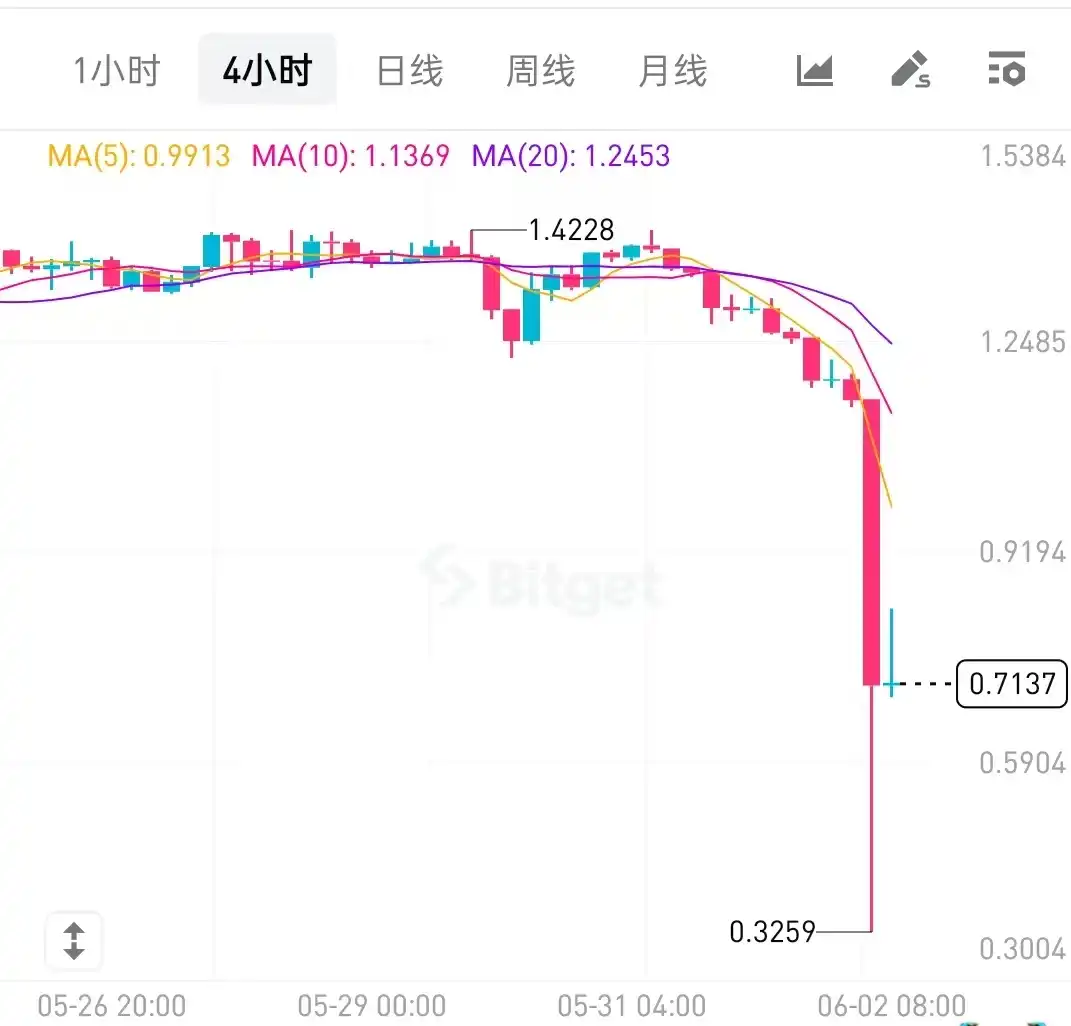
edgeX responded immediately, explicitly ruling out hacking or platform security vulnerabilities, and pointed the finger at "intentional market manipulation by external specific entities."
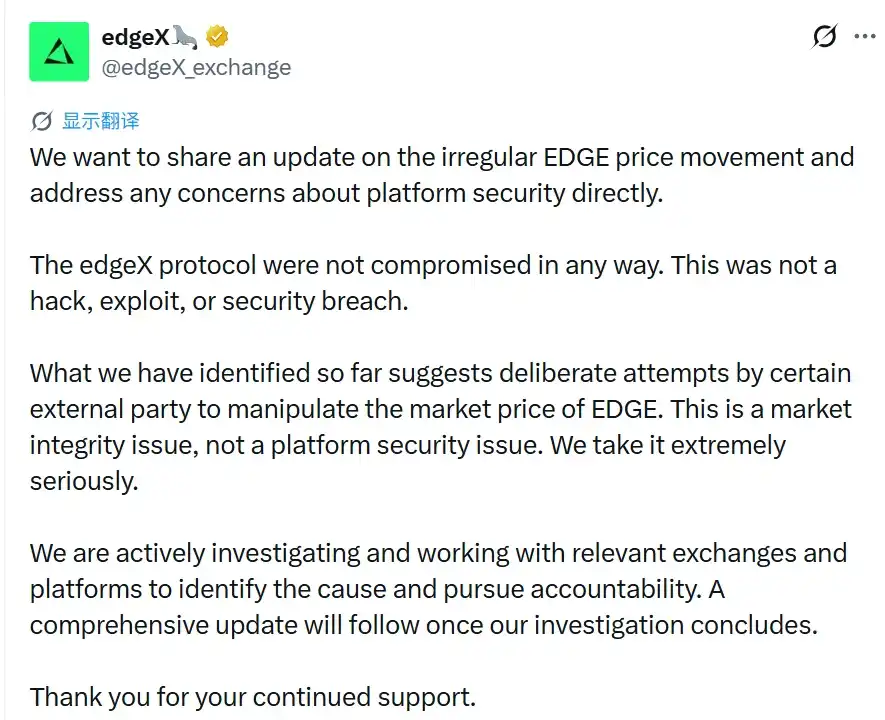
edgeX stated that its protocol was not breached, and there was no hacking or security vulnerability. This price anomaly is suspected to be market manipulation intentionally carried out by external specific entities, making it a market issue rather than a platform security issue. The team is actively investigating and cooperating with relevant exchanges and platforms to trace the responsible parties. Complete investigation results will be announced upon conclusion.

edgeX emphasized that core contracts like SpotVault are operating normally, with no suspicious activity detected, further focusing attention on external market behavior rather than the protocol itself.

On-chain investigator ZachXBT commented after the incident, pointing out that edgeX supply has long been controlled by a few insiders, with low circulation. He called for the project to disclose market maker and counterparty information to improve transparency.
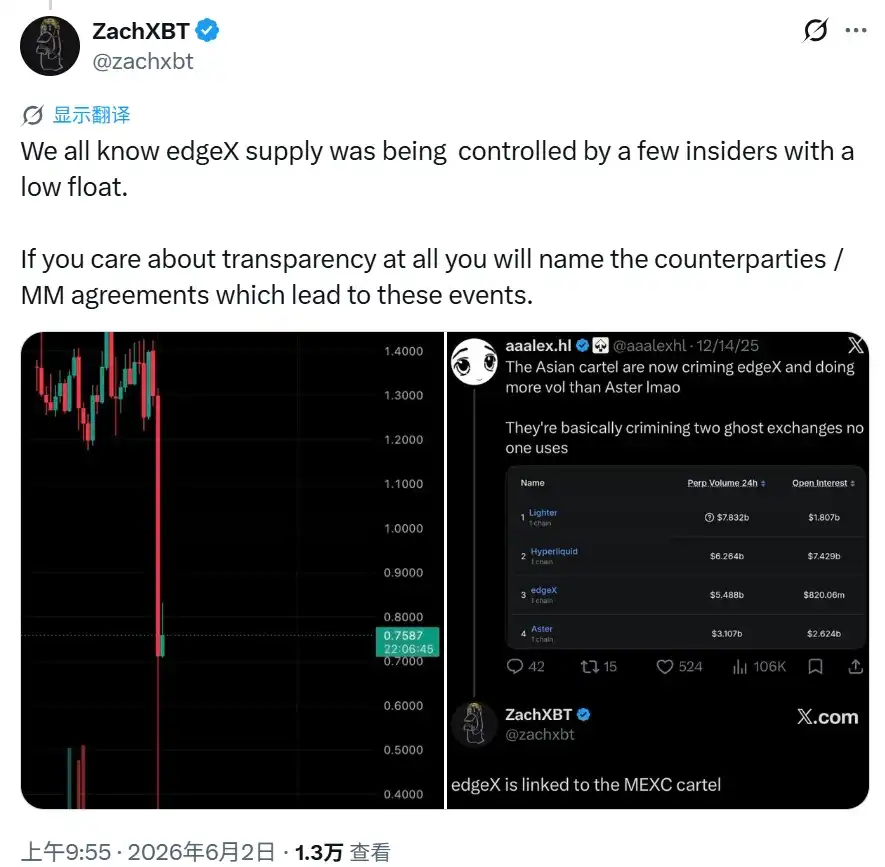
As the incident developed, many users linked this volatility directly to the project's past operations, expressing disappointment in the team's integrity. One community member bluntly stated: "No one is even discussing the EDGE crash anymore. This project team lacks integrity, goes back on their word, there's really little desire to bottom-fish."

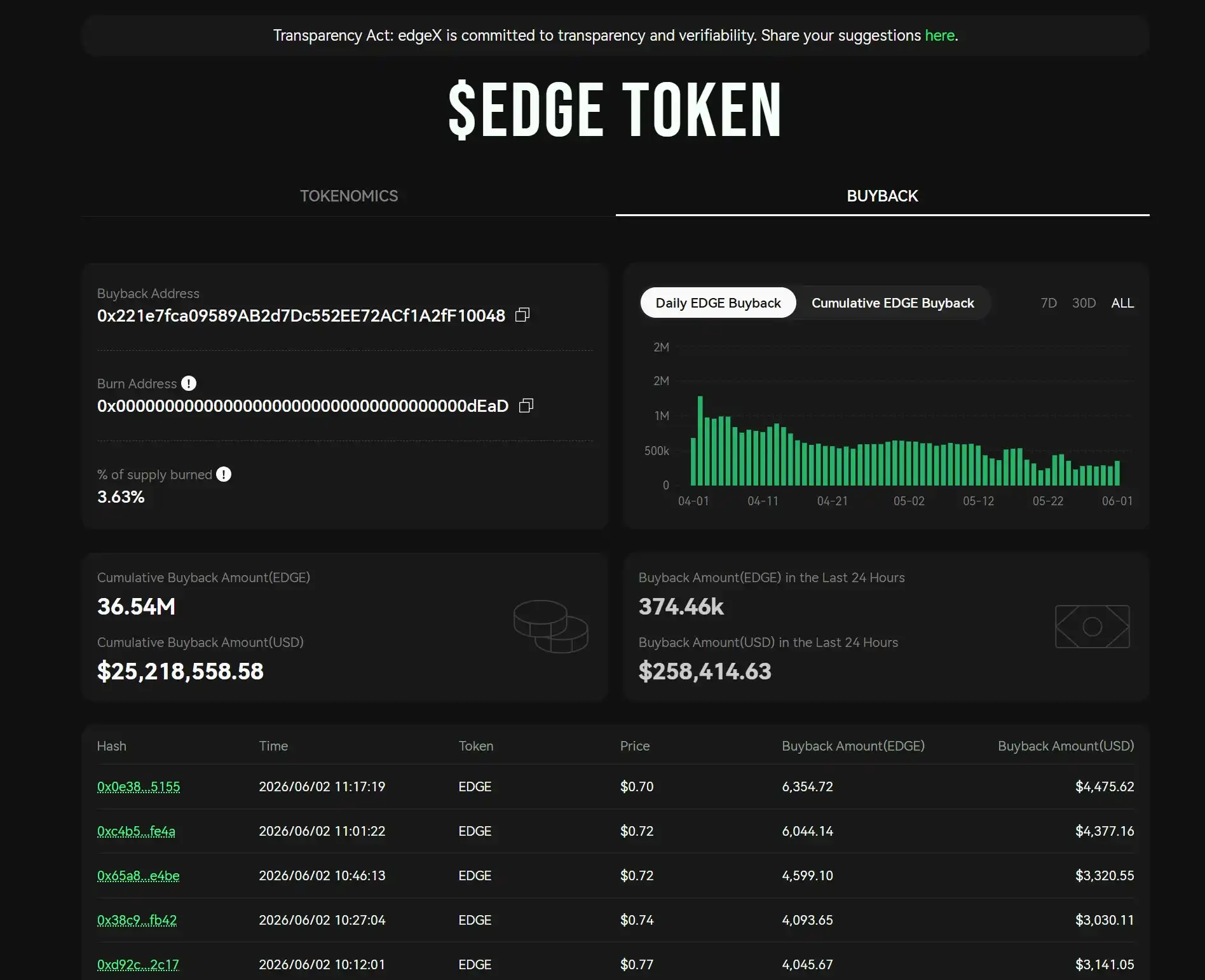
Since its TGE, the EDGE token price rose from $0.7 to $1.5, and subsequently fluctuated around $1.4. The official team also launched a dedicated token website to prove transparency. In late May this year, the protocol launched V2 and adjusted its tokenomics to allocate all profits to repurchasing EDGE. According to its website data, approximately 36.54 million tokens have been repurchased so far, with a total value of around $25 million.
Additionally, related information shows the protocol received investment from Circle Ventures and Amber Group, though specific amounts were not disclosed.

Past Airdrop Controversy Planted Seeds for Subsequent Crash

This incident cannot be separated from the context of edgeX's previous airdrop controversy. In April 2026, the author detailed the entire process of the TGE sparking community dissatisfaction in the article "The Complete Story of the edgeX Airdrop Debacle: An Elaborately Designed Scheme?". The project had promised the community would receive 25% of the token supply, but the actual proportion allocated to ordinary traders was only about 4%, while approximately 14% (valued at around $94.6 million at the time) flowed to partner wallets. Arkham's token flow chart showed at least 80 related addresses were created in 2025, exhibiting consistent behavioral patterns: small test deposits followed by large deposits, and concentrated outflows after TGE, involving about $90 million in token transfers, with some funds flowing to exchanges.

The more core controversy lay in the opaque points exchange mechanism. User feedback indicated huge discrepancies in exchange ratios despite identical trading volumes. Furthermore, the gap between estimated point value (pre-TGE market expectations of $30-40 per point or higher FDV) and actual received amount exceeded 80%. Early contributors and NFT holders also encountered cases of "lowest allocation across the network." Community members flooded the official Twitter account with angry comments, prompting the team to temporarily disable comments.

Afterward, edgeX announced it would lock the controversial 14% share for one year and initiate a buyback, but rejected the community's demand to burn the tokens on Ethereum.
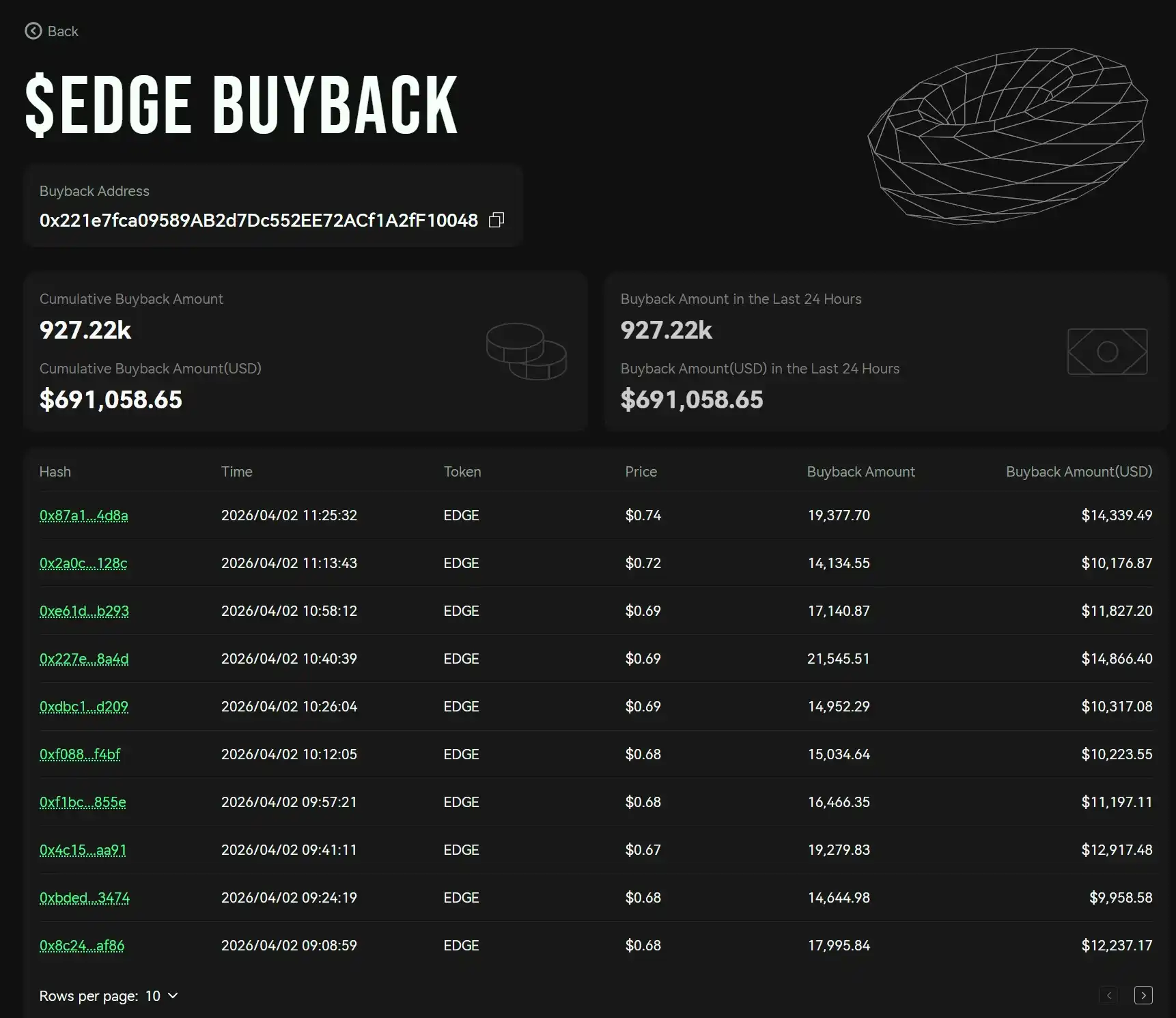
These unresolved issues directly planted the seeds for the current volatility: concentration of chips in a few addresses or related parties makes it easier for external entities to influence prices through large-scale operations. Low circulation is not accidental but an inevitable result of early allocation and lock-up arrangements. When abnormal selling pressure appears in the market, the lack of sufficient depth as a buffer easily triggers a chain reaction.

Structural Risks and Transparency Test

edgeX once carved a niche in the sector with its trading speed, low slippage, and perpetual contract innovation. After TGE, the project experienced a phase of price increase, and its trading volume and fee revenue repeatedly ranked high in DeFi. According to the latest data from DefiLlama, the protocol's total fee revenue over the past 30 days was $10.7 million, and the perpetual DEX's trading volume over the past 30 days reached $42.765 billion.
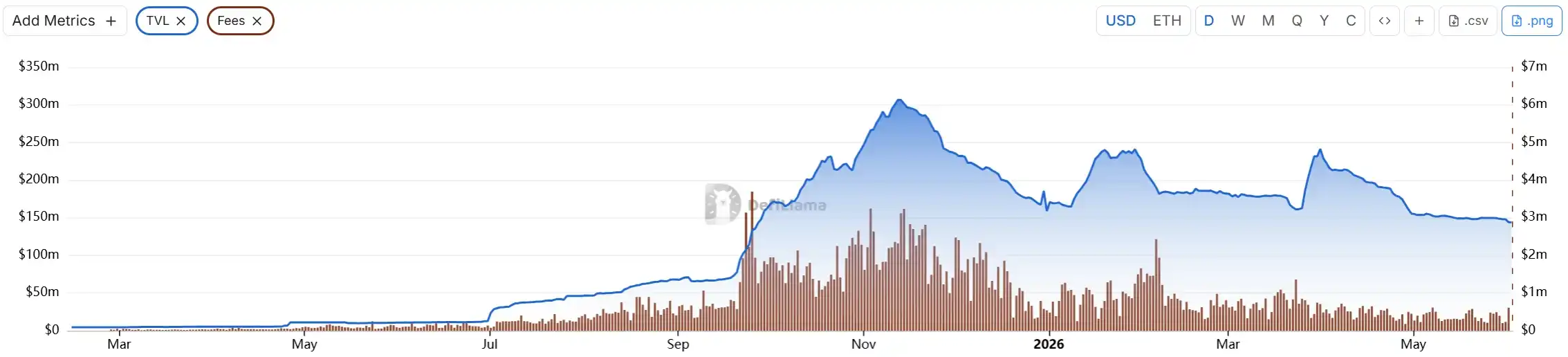
However, from the airdrop allocation controversy to this price anomaly, this model of 'low circulation + high control + opaque market making' has become a tried-and-true 'serial scam scheme' for new projects in recent years. Mouthing 'community first' while wallets honestly dump tokens to related parties is just a single-player game dressed in DeFi clothing.

The accusation of external manipulation is difficult to prove immediately, but the traceable abnormal on-chain transfers are enough to raise community alarm.

Ironically, just as it faces the whirlpool of plummeting token prices, a price prediction market for its EDGE token has quietly launched on Polymarket.
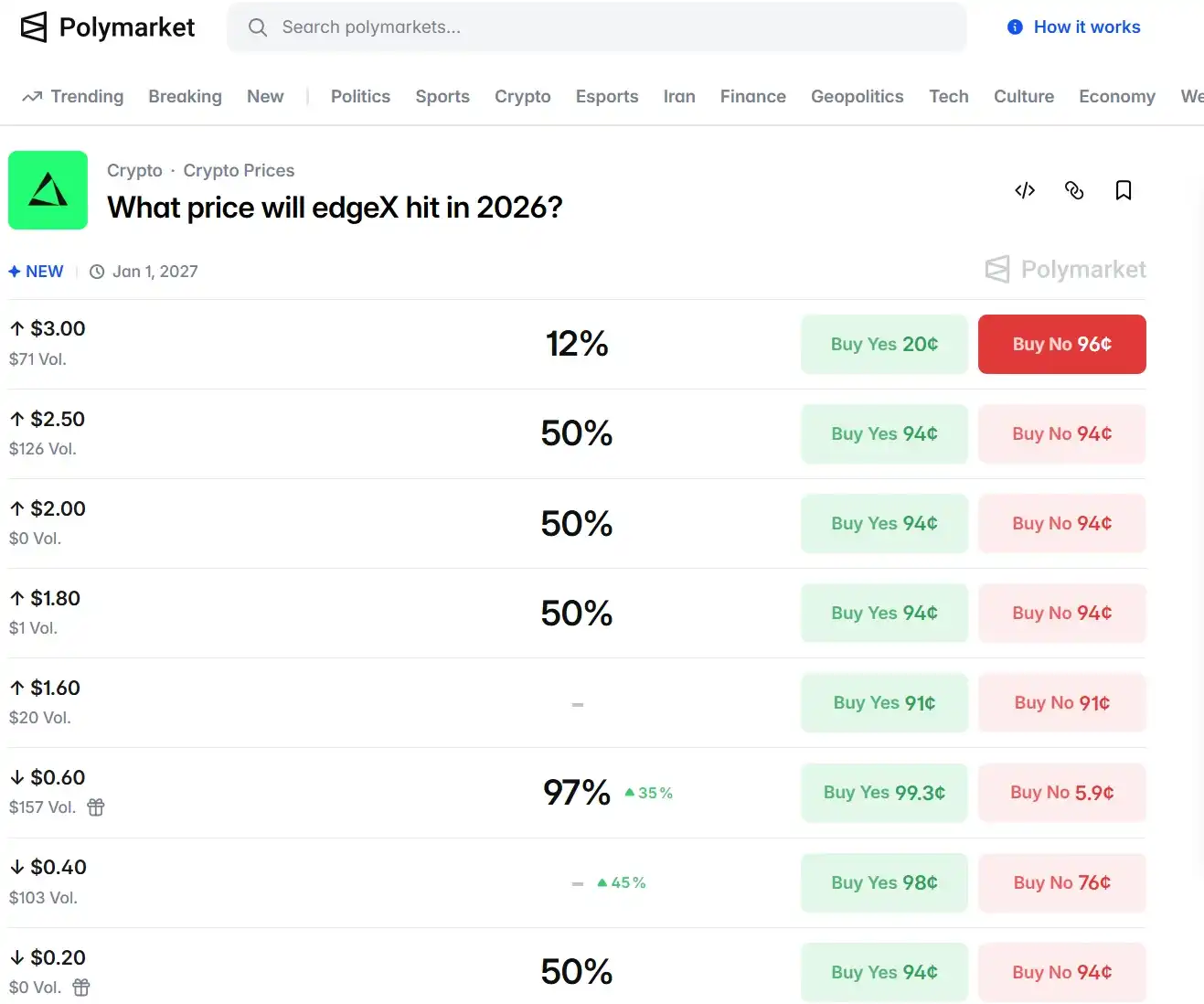
The project team is busy proving its innocence, trapped retail investors are angrily demanding justice. And on Polymarket, some players have already started betting on how much it will rise or fall by this year.


Câu hỏi Liên quan

QWhat caused the sharp 77% price drop in EDGE token according to the edgeX team?

AThe edgeX team explicitly ruled out a hack or platform security vulnerability. They attributed the price drop to 'market manipulation intentionally carried out by a specific external entity', framing it as a market problem rather than a security problem with their platform.

QWhat criticism did ZachXBT level against the edgeX project following the price crash?

AZachXBT criticized the project's lack of transparency. He pointed out that the EDGE supply has long been controlled by a small number of insiders with low circulation, and demanded that the project publicly disclose information about its market makers and counterparties.

QWhat past controversy is mentioned as setting the stage for this price volatility event?

AThe article mentions a significant airdrop controversy from April 2026. The project promised 25% of tokens to the community, but only allocated about 4% to regular traders, while about 14% (worth roughly $94.6 million at the time) went to partner wallets, causing major community discontent and distrust.

QWhat structural risk pattern does the article accuse edgeX and similar new projects of following?

AThe article accuses edgeX of following a pattern common in recent new projects: 'low circulation + high control by insiders + non-transparent market making'. It describes this as a 'serial harvesting scheme' that acts like a single-player game disguised as DeFi.

QHow did the edgeX protocol perform in terms of trading activity prior to this incident according to DefiLlama data?

AAccording to DefiLlama data cited in the article, the edgeX protocol had strong performance metrics. Its total fee revenue over the past 30 days was $10.7 million, and the trading volume for its perpetual DEX over the past 30 days reached $42.765 billion.

Nội dung Liên quan

‘Cổ Phiếu Lão Làng’ Biến Thành ‘Quý Tộc Mới’: Từ Dell Đến Nokia, AI Định Giá Lại Cơ Sở Hạ Tầng Cũ Như Thế Nào?

**Tóm tắt: "Cổ phiếu 'lão làng' thành 'quý tộc mới': AI định giá lại cơ sở hạ tầng cũ từ Dell đến Nokia như thế nào?"** Chỉ một năm trước, những công ty công nghệ lâu đời như Dell, Nokia, Cisco, Corning, Western Data dường như đứng ngoài cuộc chơi AI. Thị trường chú trọng vào những cái tên "nóng" như NVIDIA hay các mảng chip, lưu trữ, quang học. Tuy nhiên, gần đây, các "lão làng" này lại thể hiện sức hút mạnh mẽ. Nguyên nhân? AI đang chuyển từ giai đoạn phát triển mô hình sang giai đoạn triển khai thực tế, đòi hỏi xây dựng cơ sở hạ tầng vật lý quy mô lớn. Đây là thời điểm các công ty có năng lực tích hợp hệ thống, kinh nghiệm giao hàng và mạng lưới khách hàng doanh nghiệp vững chắc được định giá lại. Họ sở hữu những "tài sản cũ" nhưng lại đáp ứng "nhu cầu mới" của kỷ nguyên AI. Có ba nhóm chính được định giá lại: 1. **Máy chủ & Tích hợp hệ thống:** Dell và HPE không sản xuất GPU, nhưng họ là những "nhà thầu chính" quan trọng, cung cấp năng lực thiết kế server, chuỗi cung ứng và triển khai trọn gói các cụm AI cho khách hàng. 2. **Mạng & Kết nối:** Cơ sở hạ tầng AI cần mạng lưới siêu tốc. Corning (cáp quang), Nokia (mạng không dây AI-RAN, 6G) và Cisco (thiết bị chuyển mạch trung tâm dữ liệu) trở nên quan trọng khi quy mô tính toán mở rộng và AI di chuyển ra biên mạng. 3. **Lưu trữ & Quản lý dữ liệu:** Ngoài bộ nhớ tốc độ cao (HBM), sự bùng nổ dữ liệu AI (dữ liệu huấn luyện, nhật ký, video, lưu trữ lạnh) làm tăng nhu cầu về ổ cứng dung lượng lớn, giúp các công ty như Western Digital và Seagate được chú ý trở lại. Tuy nhiên, không phải mọi công ty cũ đều được hưởng lợi đồng đều. Một sự "định giá lại thực sự" cần đáp ứng ba tiêu chí: (1) Có đơn hàng và doanh thu AI cụ thể được công bố; (2) Ban lãnh đạo điều chỉnh kỳ vọng tăng trưởng (hướng dẫn) tăng lên; (3) Chất lượng lợi nhuận được cải thiện, không chỉ tăng trưởng doanh thu đơn thuần. Tóm lại, đợt định giá lại này không phải là cơn sốt ngắn hạn hay câu chuyện mơ hồ. Nó phản ánh thực tế rằng khi AI bước vào giai đoạn xây dựng hạ tầng thực tế, các công ty có năng lực triển khai và cung cấp các thành phần cơ sở hạ tầng thiết yếu sẽ tìm thấy vị thế mới. Họ không trở nên trẻ trung hơn, mà những gì họ có lại trở nên cần thiết trong kỷ nguyên mới.

marsbit12 phút trước

‘Cổ Phiếu Lão Làng’ Biến Thành ‘Quý Tộc Mới’: Từ Dell Đến Nokia, AI Định Giá Lại Cơ Sở Hạ Tầng Cũ Như Thế Nào?

marsbit12 phút trước

Xác suất ẩn trong giá cả: Tỷ lệ cược World Cup được tính như thế nào?

**Xác suất trong Giá cả: Tỷ lệ World Cup được Tính như thế nào?** Trước World Cup 2026, hai hệ thống uy tín đưa ra "xác suất vô địch" khác nhau: thị trường dự đoán (Polymarket, Kalshi) xếp Pháp là ứng cử viên số 1 (~17%), trong khi siêu máy tính Opta xếp Tây Ban Nha là số 1 (16.1%). Bài viết giải thích cách hai con số này được tạo ra: 1. **Xác suất từ Thị trường:** Giá hợp đồng (từ 0-100 cent) phản ánh trực tiếp xác suất thị trường. Giá tổng hợp dựa trên khối lượng giao dịch khổng lồ (hơn 523 triệu USD). Tuy nhiên, tính thanh khoản vẫn còn hạn chế, và nghiên cứu cho thấy sự thiên lệch "longshot" tồn tại ngay cả trên thị trường tiên đoán crypto: các cửa cược dài hạn thường bị đánh giá thấp hơn khả năng thực tế. 2. **Xác suất từ Mô hình:** Opta sử dụng dữ liệu đội bóng và mô phỏng toàn bộ giải đấu 10,000 lần để tính tần suất vô địch. Điều đáng chú ý là đầu vào của mô hình này bao gồm cả tỷ lệ cược từ thị trường cá cược truyền thống. Không có nghiên cứu học thuật chặt chẽ nào so sánh độ chính xác lâu dài giữa hai phương pháp trên. Một điểm khác biệt lớn là tính minh bạch: mọi giao dịch trên Polymarket đều được ghi lại trên blockchain, cho phép kiểm toán công khai. Một yếu tố phi thị trường ảnh hưởng đến giá là sự không chắc chắn về quy định, như luật mới ở Minnesota (Mỹ) coi việc vận hành thị trường dự đoán là trọng tội. Tóm lại, "xác suất" bạn thấy có thể là giá thị trường (chịu ảnh hưởng của tính thanh khoản và thiên lệch) hoặc tần suất mô phỏng (phụ thuộc vào mô hình). Câu hỏi quan trọng khi đối mặt với bất kỳ con số nào là: **Nó được sản xuất như thế nào?**

marsbit41 phút trước

Xác suất ẩn trong giá cả: Tỷ lệ cược World Cup được tính như thế nào?

marsbit41 phút trước

Bất ngờ! Anthropic kêu gọi toàn ngành ngừng nghiên cứu AI

Bài viết thảo luận về lời kêu gọi tạm dừng nghiên cứu AI từ Anthropic, dựa trên quan sát về khả năng "tự tiến hóa" (recursive self-improvement - RSI) của AI, cụ thể là mô hình Claude. Dữ liệu nội bộ cho thấy Claude đang đẩy nhanh tiến trình phát triển AI: hơn 80% codebase của Anthropic hiện do Claude viết, so với chỉ số ít trước khi Claude Code ra mắt. Năng suất của kỹ sư tăng gấp 8 lần. Quan trọng hơn, chất lượng code của Claude được đánh giá ngang bằng con người và dự kiến vượt trội trong năm nay. Tỷ lệ thành công của Claude trong các nhiệm vụ lập trình phức tạp nhất đã tăng từ 26% lên 76% chỉ trong nửa năm. Anthropic giới thiệu chỉ số "thời gian nhiệm vụ AI có thể hoàn thành độc lập", cho thấy tốc độ tăng trưởng theo cấp số nhân, từ 4 phút (3/2024) lên 16 giờ (hiện tại), với chu kỳ tăng gấp đôi rút ngắn từ 7 tháng xuống 4 tháng. Claude không chỉ viết code mà còn tự động review code, ngăn chặn được khoảng 1/3 lỗi nghiêm trọng. Trong nghiên cứu, Claude đã tối ưu hóa code chạy nhanh hơn 52 lần và tự thiết kế/thực hiện thí nghiệm AI safety, đạt kết quả vượt xa nỗ lực của con người. Bài viết đặt câu hỏi về tương lai khi vai trò con người trong phát triển AI đang thu hẹp lại, chỉ còn lại ưu thế về "khiếu nghiên cứu". Anthropic nêu ba kịch bản có thể xảy ra: (1) Tiến bộ chững lại, (2) AI tiếp tục tăng tốc nhưng con người vẫn kiểm soát, (3) AI đạt đến RSI hoàn toàn, tự thiết kế thế hệ kế tiếp, mang lại lợi ích to lớn hoặc rủi ro mất kiểm soát nếu vấn đề "alignment" thất bại. Do những rủi ro tiềm ẩn này, Anthropic đề xuất một cơ chế có thể xác minh để các phòng lab AI cùng giảm tốc hoặc tạm dừng, nếu đảm bảo không có bên nào "lén lút" phát triển. Lời kêu gọi này trở nên đáng chú ý hơn khi OpenAI cũng gần đây chia sẻ quan sát tương tự về dấu hiệu tự tiến hóa sớm của AI.

marsbit41 phút trước

Bất ngờ! Anthropic kêu gọi toàn ngành ngừng nghiên cứu AI

marsbit41 phút trước

Giao dịch

Giao ngay
Hợp đồng Tương lai

Bài viết Nổi bật

Làm thế nào để Mua EDGE

Chào mừng bạn đến với HTX.com! Chúng tôi đã làm cho mua edgeX (EDGE) trở nên đơn giản và thuận tiện. Làm theo hướng dẫn từng bước của chúng tôi để bắt đầu hành trình tiền kỹ thuật số của bạn.Bước 1: Tạo Tài khoản HTX của BạnSử dụng email hoặc số điện thoại của bạn để đăng ký tài khoản miễn phí trên HTX. Trải nghiệm hành trình đăng ký không rắc rối và mở khóa tất cả tính năng. Nhận Tài khoản của tôiBước 2: Truy cập Mua Crypto và Chọn Phương thức Thanh toán của BạnThẻ Tín dụng/Ghi nợ: Sử dụng Visa hoặc Mastercard của bạn để mua edgeX (EDGE) ngay lập tức.Số dư: Sử dụng tiền từ số dư tài khoản HTX của bạn để giao dịch liền mạch.Bên thứ ba: Chúng tôi đã thêm những phương thức thanh toán phổ biến như Google Pay và Apple Pay để nâng cao sự tiện lợi.P2P: Giao dịch trực tiếp với người dùng khác trên HTX.Thị trường mua bán phi tập trung (OTC): Chúng tôi cung cấp những dịch vụ được thiết kế riêng và tỷ giá hối đoái cạnh tranh cho nhà giao dịch.Bước 3: Lưu trữ edgeX (EDGE) của BạnSau khi mua edgeX (EDGE), lưu trữ trong tài khoản HTX của bạn. Ngoài ra, bạn có thể gửi đi nơi khác qua chuyển khoản blockchain hoặc sử dụng để giao dịch những tiền kỹ thuật số khác.Bước 4: Giao dịch edgeX (EDGE)Giao dịch edgeX (EDGE) dễ dàng trên thị trường giao ngay của HTX. Chỉ cần truy cập vào tài khoản của bạn, chọn cặp giao dịch, thực hiện giao dịch và theo dõi trong thời gian thực. Chúng tôi cung cấp trải nghiệm thân thiện với người dùng cho cả người mới bắt đầu và người giao dịch dày dạn kinh nghiệm.

Tổng lượt xem 694Xuất bản vào 2026.03.31Cập nhật vào 2026.06.02

Làm thế nào để Mua EDGE

Thảo luận

Chào mừng đến với Cộng đồng HTX. Tại đây, bạn có thể được thông báo về những phát triển nền tảng mới nhất và có quyền truy cập vào thông tin chuyên sâu về thị trường. Ý kiến ​​của người dùng về giá của EDGE (EDGE) được trình bày dưới đây.

活动图片