Crypto GPs' Midlife Crisis: No PMF, No LP's Next Check

链捕手Xuất bản vào 2026-06-01Cập nhật gần nhất vào 2026-06-01

Tóm tắt

The article "The Midlife Crisis of Crypto GPs: No PMF, No LP's Next Check" analyzes the shifting crypto fundraising landscape. It argues that the era of LPs funding vague "vision" is over; GPs must now offer products with clear Product-Market Fit (PMF) to secure capital. The market has matured. LPs, disillusioned by the last cycle's failures and wary of long lock-up periods, now demand tangible, near-term returns rather than speculative narratives. The proliferation of accessible crypto ETFs and other liquid products has reduced the need for VC blind pools as an entry point. The author categorizes crypto fundraising products into three types: Primary (VC funds, with blind pools or clear pipelines), Liquid (alpha/beta, directional/market-neutral strategies), and CeFi/DeFi Native Yield (crypto-specific mechanisms like staking, farming). Focusing on the Primary market, the piece details why traditional LP rationales for investing in crypto VCs have weakened: easier beta access via ETFs, diminished "access" and "judgement" premiums as LPs build internal teams, and a widespread lack of proven superior returns from GPs. Ultimately, only specific players are likely to remain at the primary VC table: large funds with access to patient endowment capital, family offices/HNWIs investing proprietary capital, the few funds with demonstrable excess returns from the last cycle, and those with clear "deal-making" or ecosystem resource advantages. For others, the path forward is to rebuil...

Author: Yi.Pineapple

LPs no longer buy dreams; GPs must sell products. This article will attempt to categorize current crypto fundraising products into three types: Primary, Liquid, and CeFi / DeFi Native Yield. The first part will focus on Primary: After VC blind pools lose their appeal, who remains at this table, and who must prove themselves anew? The answer is at the end; feel free to scroll down.

Note: This article aims to provide a landscape description of the entire crypto fundraising market. The first part mainly categorizes and explains the market status from a product perspective, while the next part will analyze it more from the LP's perspective. As the author is primarily in the Asian market, this article may have a regional bias.

Market Status

After losing the grand vision, most Crypto GPs who failed to earn excess returns this cycle must now ground themselves and launch a product with PMF (Product-Market Fit). They must either re-prove their ability to generate excess returns for LPs in niche markets or demonstrate their capacity to solve specific problems for LPs/partners to survive.

  • For most GPs, the market has long transitioned from a phase of "buying a future vision" to one of "buying a specific product."
  • LPs have lost patience and no longer want to gaze at the stars and the ocean; they want to see immediate, tangible, and relatively certain opportunities to make money.
  • Crypto LPs have lost trust in the market and are no longer willing to easily believe the "next cycle" narrative (this has been discussed too much and won't be elaborated here). Moreover, many haven't made easy money this cycle; when money becomes harder to earn, investment actions tend to become more cautious and conservative.
  • Most traditional LPs have also completed a round of learning, moving past the storytelling phase. The 2020/2021 bull market was the peak of market FOMO. Dollar funds were cheap (Treasury yield near 0), LPs were making relatively easy money (on the eve of the economic downturn), and Crypto was in an explosive growth phase (with numerous rags-to-riches stories and dreams to sell). Back then, many were willing to impulse buy into the dream even if they didn't fully understand crypto, or they entered strategically to learn.
  • AI and declining labor costs have also changed GPs' niche. The cost for LPs to learn, hire, analyze data, trade, and make small direct investments is decreasing. The trend of LPs transforming into GPs is significant. GPs who only offer vague capabilities like "I understand crypto" will find their value increasingly precarious.
  • In terms of storytelling, unless it's a strong US-based fund with a proven track record pitching visions in specific niches (like a16z leveraging its AI advantage to pitch crypto * AI, or Dragonfly pitching internet capital markets based on its investments in Ethena/Polymarket), opportunities remain. In Asia, this niche is already difficult, as both crypto projects and funds, to some extent, only get the chance to tell stories if they are "White Papers."

Product Landscape

This article divides crypto fundraising products into three main categories for discussion: Primary, Liquid, and CeFi / DeFi Native Yield (Note: This classification is not entirely precise, with some blurry areas between the three). (*This part covers Primary first)

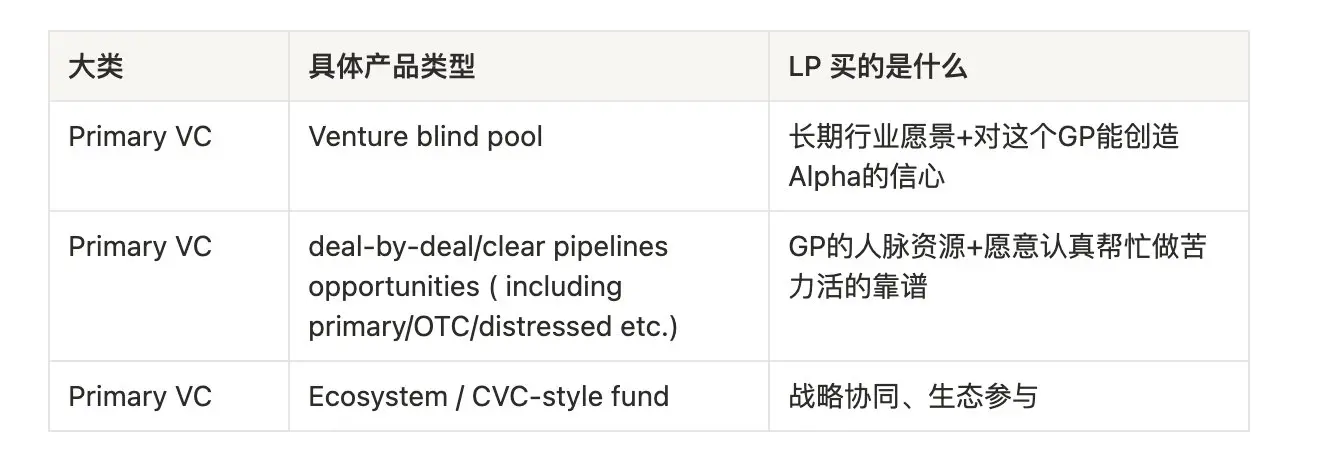
Primary VC:

In terms of transparency, they can roughly be divided into blind pools and those with clear pipelines.

In terms of liquidity, they can roughly be divided into primary and primary-secondary markets.
Liquid:

Divided by source of returns, roughly into alpha-focused (buying the GP's personal skill) and beta-focused (buying industry trends).

Divided by directionality, roughly into directional (buying cycle timing) and market neutral (buying market inefficiencies in immature markets).
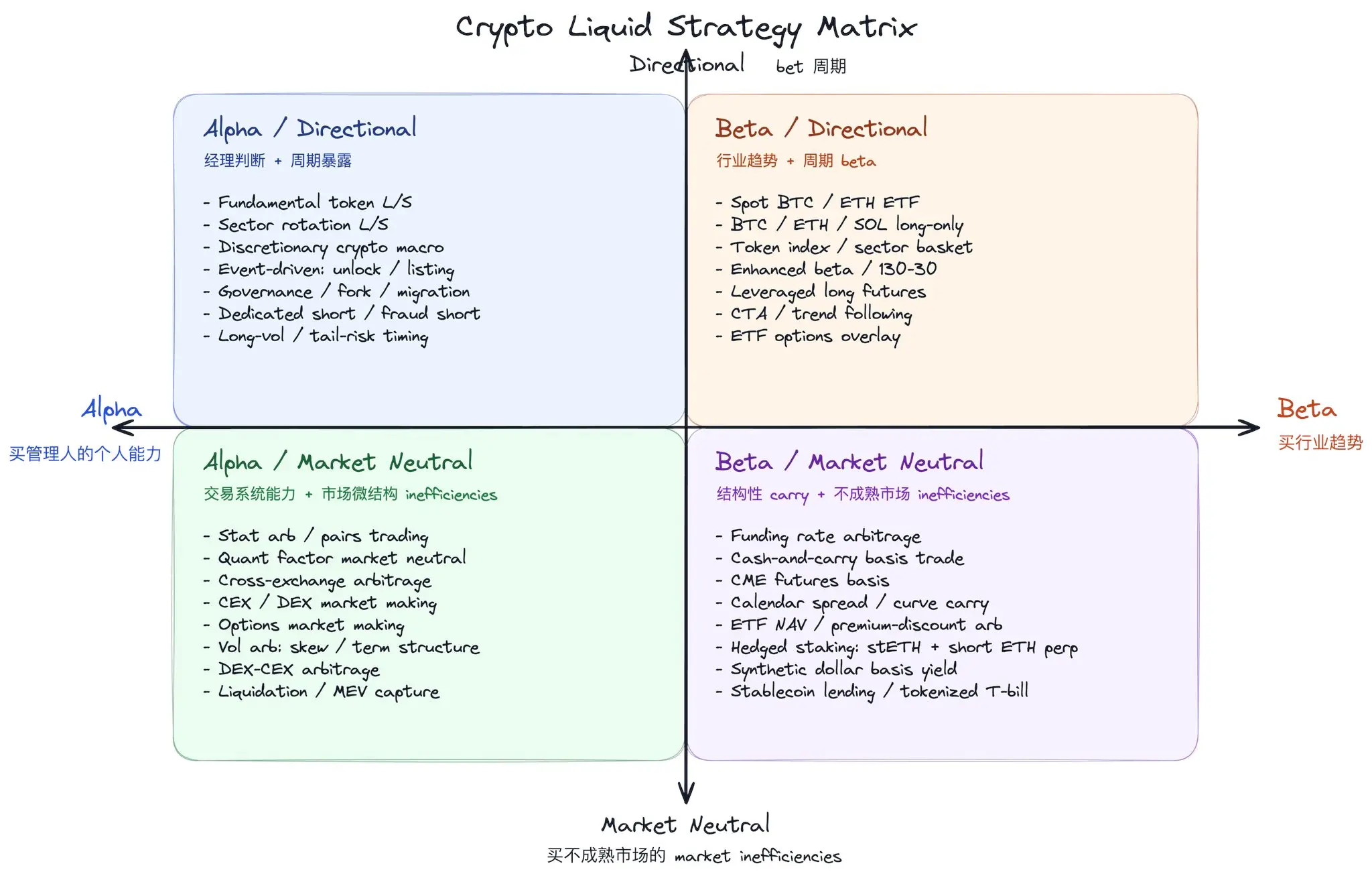
There are many ways to categorize; this is just one idea.

CeFi/DeFi Native Yield:

Theoretically, CeFi/DeFi Native Yield could be seen as a source of returns within or spanning both the crypto primary and liquid markets. The main reason for separating it is that from a TradFi investor's perspective, they usually use traditional financial frameworks to understand crypto: for example, crypto VC can be seen as a sub-sector of VC, and staking/lending yield can be analogous to fixed income or cash management products.

However, crypto does have some mechanisms and playbooks not fully mirrored in traditional finance, such as farm-and-dump, points/airdrop farming, protocol incentives, and on-chain liquidity mining. These are more like crypto-native distribution, customer acquisition, and incentive mechanisms, warranting separate discussion.

Secondly, for many Crypto Native Investors, their initial entry point to understanding financial markets was not the traditional equity/bond market, but crypto-native scenarios like exchange wealth management products, staking, DeFi lending, providing liquidity, points/airdrop farming, and basis trades. Therefore, they might not first translate this yield into TradFi terms like fixed income, cash management, or alternative yield. Instead, they more naturally understand it from angles like protocol incentives, liquidity provision, token emission, on-chain risks, counterparty risk, and capital efficiency.

For Crypto Native LPs, accessing this yield doesn't require a GP, maybe just a reliable key account manager.

For TradFi LPs, some institutions are now packaging this yield into fund products to sell to them.

Primary Market

From the perspective of the entire primary market, crypto VC is just a sub-sector under the broad VC category. 2021 was a crazy year; whether crypto or non-crypto, the real returns from that vintage are poor. As a cruel fact, LPs have learnt their lessons and are tired of any product with ultra-long lock-ups (traditional VC often 10 years, crypto VC often 5-10 years). Because without hard locks, they at least have a chance to withdraw some money if circumstances change.

In some sense, crypto is worse off than traditional VC because the grand vision has collapsed. It is not a new industrial revolution, at most a revolution in financial infrastructure. This judgment is not to disparage crypto; financial infrastructure revolution is still important, but it's not as grand as many imagined in the last bull run. Worse, the market was too immature back then; many projects were funded without sufficient due diligence and legal protection. Many failures are a combination of investment failure and founder exit. Too many articles in the industry describe the current misery, so we won't elaborate here.

Investing in VC is like VC investing in startups: it's a power-law business, a lottery-like business. As long as someone is willing to buy lottery tickets, this table won't disappear.

Why LPs invested in crypto VC back then, and why these reasons have weakened now:

1. Invest to capture the beta of the industry

This reason was particularly true for TradFi LPs. It held early on because market choices were few. For outsiders, onboarding, buying tokens, going on-chain, using CEXs, and managing wallets were difficult. They feared losing private keys and CEXs running away. Investing in VC seemed like a more reliable access point.

But today, a traditional LP entering crypto has a full suite of choices: BTC ETF, ETH ETF, crypto ETPs, DATs, custody accounts, SMAs, structured products. More importantly, these products don't require learning on-chain operations; they trade like stocks.

According to CoinShares, global digital asset investment products AUM (ETF/ETP/trust/closed-end funds, etc.) reached about $156.9B in mid-May 2026. This number isn't total industry AUM, just a tally of listed or quotable products, but it shows: gaining crypto exposure no longer requires investing in a VC blind pool.

However, for long-term capital with clear mandates (e.g., endowments, etc.), this reason still applies. For them, positioning in an industry often involves a basket of assets, so there's still likely a 1~2% allocation to Crypto VC.

2. Invest for deal accessibility

This typically applied to crypto LPs and some TradFi LPs with strategic layout visions. Many such LPs didn't have the resources/time/capability to build their own investment teams, so they gave money to GPs hoping for good deal access.

But they later found this reason unstable. When the market was good, GPs themselves had insufficient allocation, and LPs struggled to get real access. When the market was bad, competition wasn't fierce; if you were willing to reach out, getting allocation wasn't that hard.

For traditional LPs, access had another meaning: they knew nothing initially but hoped to enter the ecosystem and gain insider information by investing in crypto-native GPs. It was a form of strategic investment when there was no clear strategic target. Now the situation has changed. Many traditional LPs have either left for hotter fields like AI, or have developed their own internal teams. AI and cheap analysts have narrowed the knowledge gap. New learners still exist, but they learn faster and have more paths. Investing in the primary market with ultra-long lock-ups is not necessarily the optimal choice for them anymore.

3. Invest for superior judgment

This is the trickiest part. In a rapidly evolving market, unless a GP can continuously self-iterate, the judgment premium disappears quickly. The rules change every cycle, but people don't change easily (is this another form of "old habits die hard").

We must face a harsh reality: Most GPs did not prove to LPs they had superior judgment in the last cycle.

For traditional LPs, part of the reason for investing in crypto-native GPs was to educate themselves and learn the industry through the GP's judgment. This typically applied to two types: companies wanting to strategically enter Web3 (like internet giants, etc.), and sophisticated TradFi investors (like traditional GPs or family offices) who wanted to later do their own direct Web3 investments. The learning phase is over. Only a few GPs who have truly proven superior judgment remain on their investment lists.
For crypto LPs, they found it better to lose money themselves than to bet on a GP's judgment. Losing money yourself at least has emotional value, and you don't pay management fees.

4. Invest for deal-making ability

From an investment return perspective, deal-making ability primarily manifests as whether it can achieve good final exits for projects. Ideally, it's best to help projects achieve healthy growth for good secondary market returns. Failing that, the ability to organize the next round of financing is also important (essentially, the difference between relying on retail or large investors to take over).

However, as a form of financial innovation, Crypto sometimes resembles a large-scale capital game. Sometimes, investment is just a form of interest exchange, ensuring aligned interests to make money together relatively safely.

5. Invest for reputation

For some large LPs, money invested in a single VC might only be 1% of their overall portfolio, insignificant. Sometimes they invest in a GP just to be cool (like investing in A16Z). But most GPs aren't in this category.

Who can still stay at the primary table

From a pure capital source perspective, the players most likely to remain at the primary table are:

Funds large enough to enter the mandate of endowments/other similar long-term patient capital. These institutions buy crypto VC as lottery tickets without short-term funding pressure.

FOs, companies, and HNW individuals investing proprietary capital in primary crypto investments. FOs/HNWs are more likely to run accelerator-like, very early-stage funds; companies are more likely to make direct strategic investments/acquisitions.

The few funds that struck gold/bought BTC this cycle and genuinely delivered excess returns to LPs. LPs believe they can win next time.

Funds with clear deal-making ability, possessing ecosystem resources to exchange interests with LPs.

For other players, if trust is lost, it might be better to restart mentally and rebuild trust. Re-prove the ability to generate excess returns for investors in a niche, or provide some specific service/value, then scale based on that.


Câu hỏi Liên quan

QAccording to the article, why must crypto GPs shift from selling visions to selling products with PMF?

ABecause LPs have lost patience and trust. They no longer want to buy distant 'future visions' or 'next cycle' stories, especially after many failed to achieve outsized returns in the last cycle. LPs now demand immediate, relatively certain opportunities to make money. Therefore, GPs must offer concrete products with Product-Market Fit (PMF) to survive.

QWhat are the three broad categories of crypto fundraising products mentioned in the article?

AThe three broad categories are: 1) Primary (e.g., VC blind pools, funds with clear pipelines, primary and secondary deals), 2) Liquid (e.g., funds focused on alpha/beta, directional/market-neutral strategies), and 3) CeFi / DeFi Native Yield (e.g., staking, lending, airdrop farming, protocol incentives).

QWhy is the 'CeFi/DeFi Native Yield' category discussed separately from Primary and Liquid markets?

AIt's discussed separately for two main reasons. First, from a TradFi perspective, these yields (like staking) are often analogized to fixed income, but crypto has unique mechanics (like airdrop farming) not fully present in traditional finance. Second, for Crypto Native investors, these were their first entry points into finance, so they view them through a crypto-native lens of protocol incentives and on-chain risks, not just as traditional yield products.

QWhat are two reasons mentioned for why LPs' original motivations for investing in crypto VC funds have weakened?

ATwo key reasons are: 1) **Invest to Capture Industry Beta**: This is less valid now as traditional LPs have many easier alternatives for crypto exposure (like BTC/ETH ETFs, ETPs, SMA) without the long lock-ups of VC funds. 2) **Invest for Accessibility/Judgement**: LPs found that during bull markets, good deal access wasn't guaranteed, and during bear markets, it's easier to get. Furthermore, most GPs failed to demonstrate superior investment judgement in the last cycle, and LPs can now build internal teams or learn faster using AI, reducing their reliance on GPs for access and insight.

QBased on the article, which types of players are most likely to remain active in the crypto primary (VC) market?

AThe players most likely to remain are: 1) Large funds that can secure mandates from endowments or other long-term patient capital, treating crypto VC as a lottery ticket. 2) Family offices (FOs), high-net-worth individuals (HNWIs), or companies investing their own capital, often in very early-stage or strategic investments. 3) The few funds that delivered outsized returns in this cycle (e.g., by betting on successful projects like Bitcoin), thus maintaining LP trust. 4) Funds with clear ecosystem resources and deal-making ('攒局') capabilities that can offer value exchange to LPs.

Nội dung Liên quan

Tín hiệu đáy lịch sử tái xuất? Messari từng định giá 3 tỷ USD bị bán tháo với 10 triệu USD

Tín hiệu đáy lịch sử tái xuất hiện? Messari từng định giá 300 triệu USD giờ chỉ bán được hơn 10 triệu. Nền tảng dữ liệu hàng đầu ngành crypto này, cùng nhiều công ty khác như DappRadar, Parsec, CoinDesk đang đóng cửa, bán rẻ hoặc cắt giảm nhân sự. Nguyên nhân đến từ sự xói mòn mô hình kinh doanh do AI và sự rút lui của vốn đầu tư mạo hiểm (VC). VC đang dồn tiền vào AI, khiến đầu tư vào crypto lao dốc hơn 80% trong 6 tháng. Các quỹ crypto cũ hoạt động khó khăn, quỹ mới khó gọi vốn. Nhiều nhân vật chủ chốt như Kyle Samani (Multicoin) cũng rời bỏ lĩnh vực này. Tuy nhiên, đây có thể là tín hiệu tích cực. Bitcoin đã giảm gần 50% từ đỉnh, chỉ số Sợ hãi & Tham lam xuống mức cực thấp, nhà đầu tư dài hạn nắm giữ gần 80% nguồn cung. Lịch sử cho thấy, khi những tín hiệu bi quan này đồng thời xuất hiện (như năm 2018, 2020), thường đánh dấu đáy của chu kỳ và mở ra đợt tăng trưởng mới. Một số quỹ như Dragonfly vẫn lạc quan, tiếp tục gọi vốn và đầu tư, trong khi Blockworks mua lại Messari để củng cố ngành. Sự sụp đổ của những gã khổng lồ một thời có thể là dấu hiệu cho một khởi đầu mới.

marsbit55 phút trước

Tín hiệu đáy lịch sử tái xuất? Messari từng định giá 3 tỷ USD bị bán tháo với 10 triệu USD

marsbit55 phút trước

Khối lượng xuất xưởng TPU của Google được điều chỉnh tăng 50%

Gần đây, giới AI tính toán đã chứng kiến một sự điều chỉnh kỳ vọng quan trọng. Nhiều tổ chức nước ngoài âm thầm nâng dự báo sản lượng xuất xưởng cho TPU của Google, trực tiếp thay đổi quan điểm bảo thủ trước đó của thị trường về nhu cầu phần cứng tính toán năm 2027. Dự báo ngành từ mức dưới 10 triệu chip TPU đã được điều chỉnh lên khoảng 15 triệu chip, tương ứng mức tăng mới 50%. Việc sản lượng TPU tăng mạnh sẽ lan tỏa đến toàn bộ chuỗi cung ứng, mang lại lợi ích đồng thời cho các lĩnh vực then chốt như động cơ quang NPO, mô-đun quang 1.6T, chuyển mạch quang OCS, nguồn server, cáp quang & MPO, và đặc biệt là làm mát bằng chất lỏng (liquid cooling). Trong đó, làm mát bằng chất lỏng là hướng thay đổi lớn nhất và được kỳ vọng mang lại lợi nhuận vượt trội. Công suất chip TPU thế hệ mới tăng cao khiến giải pháp tản nhiệt truyền thống không đáp ứng được, thúc đẩy việc áp dụng rộng rãi giải pháp làm mát bằng chất lỏng. Dự kiến năm 2026 sẽ là năm bùng nổ thực sự cho lĩnh vực này tại Google. Cửa sổ cạnh tranh cũng được định hình lại khi các nhà sản xuất nước ngoài gặp khó khăn về công nghệ và năng lực giao hàng, tạo cơ hội lớn cho các nhà sản xuất trong nước với ưu thế về tốc độ lặp, ổn định giao hàng và đủ công suất. Lĩnh vực cáp quang cũng có logic mới, chuyển từ sản phẩm chu kỳ sang nguồn tài nguyên chiến lược quan trọng cho các cụm tính toán AIDC. Nhu cầu bùng nổ từ việc xây dựng trung tâm dữ liệu AI vượt xa năng lực sản xuất trong ngắn hạn, dẫn đến tình trạng thiếu hụt. Các nhà sản xuất trong nước đang tận dụng lợi thế về năng lực và chi phí để chiếm thị phần lớn. Các mảng phụ trợ khác như động cơ quang NPO (tỷ lệ 1:1 với TPU), mô-đun quang 1.6T, chuyển mạch quang OCS và nguồn server cũng đều được hưởng lợi từ làn sóng này. Trọng tâm đầu tư trong chuỗi cung ứng AI đang dần chuyển từ "cạnh tranh sức mạnh chip" sang "sự tăng trưởng ổn định của cơ sở hạ tầng hỗ trợ tính toán". Việc điều chỉnh tăng mạnh dự báo cung ứng TPU của Google giúp củng cố tính chắc chắn về hiệu suất cho toàn bộ ngành trong 2-3 năm tới.

marsbit1 giờ trước

Khối lượng xuất xưởng TPU của Google được điều chỉnh tăng 50%

marsbit1 giờ trước

Cơn sốt tiền điện tử qua đi, Phố Wall thực sự muốn gì?

Tác giả: Bạch Thoại Khu Công Nghệ Sau cơn sốt tiền điện tử, Phố Wall không còn theo đuổi các câu chuyện đầu cơ hay tư tưởng "phi tập trung". Thay vào đó, họ đang kiên trì xây dựng một hệ thống tài chính tuân thủ, có thể kiểm soát và tạo ra thu nhập trên nền tảng sổ cái phân tán. Các ví dụ điển hình bao gồm: 1. **Chứng khoán hóa tài sản truyền thống:** Quỹ BUIDL của BlackRock (quản lý 25-28 tỷ USD) đầu tư vào trái phiếu kho bạc ngắn hạn và hoạt động trên blockchain, cung cấp tài sản thế chấp an toàn. Securitize, với định giá 12,5 tỷ USD, chuẩn bị niêm yết trên NYSE và hợp tác xây dựng hệ thống thanh toán chứng khoán hoạt động 24/7 trên chuỗi. 2. **Tạo thu nhập từ Bitcoin:** BlackRock sắp ra mắt ETF BITA, sử dụng chiến lược bán quyền chọn mua có bảo hiểm trên danh mục nắm giữ Bitcoin để tạo ra dòng thu nhập (cổ tức) ổn định cho nhà đầu tư, biến Bitcoin thành tài sản sinh lời. 3. **Ổn định tiền tệ như công cụ thanh toán:** Các stablecoin tuân thủ (như USDC) đang được Stripe và Mastercard tích hợp để xử lý thanh toán xuyên biên giới tức thì với chi phí thấp. SWIFT cũng công bố kế hoạch phát triển sổ cái phân tán để giải quyết tình trạng kẹt vốn trong thanh toán toàn cầu. Đạo luật GENIUS 2025 định hình stablecoin là công cụ thanh toán thuần túy (không trả cổ tức) và tăng cường kiểm soát tuân thủ. Tóm lại, Phố Wall đang sử dụng công nghệ blockchain để tái tạo và nâng cấp các sản phẩm tài chính truyền thống (quỹ trái phiếu, quyền chọn, mạng lưới thanh toán), gắn chúng với uy tín của đồng USD và hệ thống quy định hiện có, nhằm xây dựng các kênh dẫn vốn hiệu quả và có lợi nhuận.

marsbit1 giờ trước

Cơn sốt tiền điện tử qua đi, Phố Wall thực sự muốn gì?

marsbit1 giờ trước

Đặt Cược Tương Lai Trên Chiến Xa SpaceX: Con Đường Tăng Trưởng 600 Tỷ Đô Của Cursor

Tóm tắt: Câu chuyện về sự trỗi dậy nhanh chóng của Cursor, công ty khởi nghiệp AI lập trình do Michael Truell (CEO) đồng sáng lập. Từ một công cụ chỉnh sửa mã dựa trên mô hình AI của Anthropic, Cursor đã phát triển với tốc độ chóng mặt, đạt doanh thu hàng tỷ USD. Tuy nhiên, họ sớm đối mặt với thách thức cấu trúc khi Anthropic - nhà cung cấp mô hình then chốt - tự ra mắt công cụ cạnh tranh Claude Code. Để giảm sự phụ thuộc và đảm bảo tương lai, Cursor bắt đầu phát triển mô hình tự lập Composer. Nhu cầu về sức mạnh tính toán khổng lồ đã dẫn họ đến với thỏa thuận hợp tác chiến lược, đồng thời là thương vụ mua lại tiềm năng trị giá 600 tỷ USD với SpaceX của Elon Musk. Thỏa thuận này mang lại cho Cursor nguồn lực chip AI, đổi lại hỗ trợ khả năng lập trình cho Grok (AI của Musk). Hành trình của Cursor đặt ra câu hỏi lớn: Liệu họ sẽ trở thành một công ty phần mềm thế hệ mới độc lập, hay cuối cùng sẽ trở thành một mảnh ghép trong cuộc chiến AI giữa các gã khổng lồ? Dù kết quả thế nào, Cursor đã định hình lại cách các nhà phát triển viết mã và trở thành một hiện tượng đáng chú ý trong làn sóng AI.

marsbit1 giờ trước

Đặt Cược Tương Lai Trên Chiến Xa SpaceX: Con Đường Tăng Trưởng 600 Tỷ Đô Của Cursor

marsbit1 giờ trước

Kraken Lên Kế Hoạch Cung Cấp Hợp Đồng Tương Lai Vĩnh Viễn Được CFTC Quy Định Cho Nhà Giao Dịch Chuyên Nghiệp Hoa Kỳ

Kraken đang chuẩn bị ra mắt hợp đồng tương lai vĩnh viễn được CFTC quản lý cho các nhà giao dịch chuyên nghiệp đủ điều kiện tại Hoa Kỳ. Sản phẩm sẽ được cung cấp thông qua sàn phái sinh Bitnomial mà Kraken đã mua lại và dự kiến tích hợp vào nền tảng Kraken Pro. Hợp đồng tương lai vĩnh viễn là sản phẩm phái sinh crypto lớn toàn cầu, cho phép giao dịch không ngày đáo hạn. Tại Mỹ, các hạn chế quy định trước đây khiến nhà giao dịch có ít lựa chọn trong nước. Động thái của Kraken nhằm thu hẹp khoảng cách này, cung cấp một con đường được quản lý để tiếp cận sản phẩm chi phối khối lượng giao dịch crypto ở nước ngoài. Việc ra mắt sẽ tập trung vào các nhà giao dịch chuyên nghiệp đủ điều kiện. Các yếu tố cần theo dõi bao gồm điều khoản về tính đủ điều kiện, thiết kế hợp đồng, tài sản được hỗ trợ và quan trọng nhất là thanh khoản khi ra mắt. Thành công của sản phẩm có thể mở đường cho nhiều sản phẩm tương lai vĩnh viễn được quản lý khác tại thị trường Mỹ, đưa sản phẩm phái sinh chủ chốt này tiến gần hơn đến cơ sở hạ tầng thị trường nội địa được quản lý.

bitcoinist12 giờ trước

Kraken Lên Kế Hoạch Cung Cấp Hợp Đồng Tương Lai Vĩnh Viễn Được CFTC Quy Định Cho Nhà Giao Dịch Chuyên Nghiệp Hoa Kỳ

bitcoinist12 giờ trước

Giao dịch

Giao ngay
Hợp đồng Tương lai

Bài viết Nổi bật

Làm thế nào để Mua CHECK

Chào mừng bạn đến với HTX.com! Chúng tôi đã làm cho mua Checkmate (CHECK) trở nên đơn giản và thuận tiện. Làm theo hướng dẫn từng bước của chúng tôi để bắt đầu hành trình tiền kỹ thuật số của bạn.Bước 1: Tạo Tài khoản HTX của BạnSử dụng email hoặc số điện thoại của bạn để đăng ký tài khoản miễn phí trên HTX. Trải nghiệm hành trình đăng ký không rắc rối và mở khóa tất cả tính năng. Nhận Tài khoản của tôiBước 2: Truy cập Mua Crypto và Chọn Phương thức Thanh toán của BạnThẻ Tín dụng/Ghi nợ: Sử dụng Visa hoặc Mastercard của bạn để mua Checkmate (CHECK) ngay lập tức.Số dư: Sử dụng tiền từ số dư tài khoản HTX của bạn để giao dịch liền mạch.Bên thứ ba: Chúng tôi đã thêm những phương thức thanh toán phổ biến như Google Pay và Apple Pay để nâng cao sự tiện lợi.P2P: Giao dịch trực tiếp với người dùng khác trên HTX.Thị trường mua bán phi tập trung (OTC): Chúng tôi cung cấp những dịch vụ được thiết kế riêng và tỷ giá hối đoái cạnh tranh cho nhà giao dịch.Bước 3: Lưu trữ Checkmate (CHECK) của BạnSau khi mua Checkmate (CHECK), lưu trữ trong tài khoản HTX của bạn. Ngoài ra, bạn có thể gửi đi nơi khác qua chuyển khoản blockchain hoặc sử dụng để giao dịch những tiền kỹ thuật số khác.Bước 4: Giao dịch Checkmate (CHECK)Giao dịch Checkmate (CHECK) dễ dàng trên thị trường giao ngay của HTX. Chỉ cần truy cập vào tài khoản của bạn, chọn cặp giao dịch, thực hiện giao dịch và theo dõi trong thời gian thực. Chúng tôi cung cấp trải nghiệm thân thiện với người dùng cho cả người mới bắt đầu và người giao dịch dày dạn kinh nghiệm.

Tổng lượt xem 419Xuất bản vào 2026.01.19Cập nhật vào 2026.06.02

Làm thế nào để Mua CHECK

Thảo luận

Chào mừng đến với Cộng đồng HTX. Tại đây, bạn có thể được thông báo về những phát triển nền tảng mới nhất và có quyền truy cập vào thông tin chuyên sâu về thị trường. Ý kiến ​​của người dùng về giá của CHECK (CHECK) được trình bày dưới đây.

活动图片