The Revived Codex, Carrying OpenAI's Hopes for IPO

marsbitXuất bản vào 2026-05-24Cập nhật gần nhất vào 2026-05-24

Tóm tắt

This article analyzes the intense recent development of OpenAI's Codex, positioning it as a crucial component for OpenAI's impending IPO. Over the past two months, Codex has seen a rapid series of major updates focused on integrating into real enterprise workflows. Key new features include enhanced context capture (Appshots, file previews, built-in browser), long-running task execution ("Goal Mode"), remote operation (phone control, lock-screen access), and enterprise management tools (plugin sharing, access tokens, automated risk review). These updates aim to make Codex a comprehensive AI workbench that can "see the scene, push tasks, and manage risks." The author argues that while ChatGPT proves OpenAI's massive user base and API provides foundational revenue, Codex represents OpenAI's clearest path to demonstrating tangible, high-value commercial viability. It targets developers and engineering teams—a segment already accustomed to paying for efficiency gains in costly software development cycles. This is critical because, despite higher overall revenue, OpenAI's adjusted operating margins remain deeply negative, highlighting the challenge of outrunning immense compute costs. The pressure is amplified by competitor Anthropic's success with Claude Code, which has shown that a focused approach on high-value enterprise and developer workflows can lead to a path toward profitability. Codex's aggressive evolution is thus seen as OpenAI's strategic move to capture a similar en...

Codex's update frequency has been utterly insane recently.

Over the past two months, OpenAI has been cramming new features into Codex almost every few days.

First came plugins, a built-in browser, computer operation, PR review, remote SSH, mobile access... Then on May 21st, Codex had its own "Crazy Thursday," releasing several major features in one go: one-click screen sharing with Codex, letting Codex work persistently on a goal, continued remote use after computer lock, and support for team-shared plugins and usage data viewing.

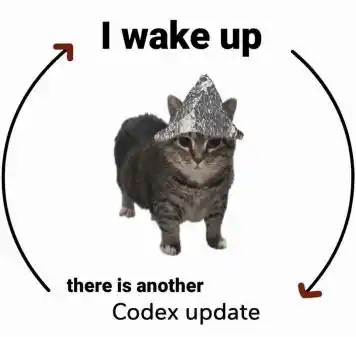
There was a widely circulated meme online before: waking up to see another Claude update. Now Codex is following suit.

It's just that Claude's updates are more "fragmented" and refined, while Codex has released more major features.
Notably, their updates are all heading in the same direction—enterprise entry points and real-world workflows.

Claude Code has already proven the value of this path. Anthropic has even started to make the market believe that frontier model companies don't necessarily have to burn cash forever; they also have a chance to turn their profit statements positive.

Codex is doing the same thing. At this juncture, it's backed by OpenAI, which is preparing for an IPO.

ChatGPT has proven that OpenAI has users, but users do not equal business, and popularity doesn't necessarily bring profits. Especially for a frontier model company, compute costs, training investments, and inference overhead are all significant. OpenAI needs to prove to the market that it's not just good at making hit chatbots, but can also integrate AI into the production processes that enterprises are truly willing to pay for.

Codex's high-frequency updates are precisely filling this gap.

It's not just a development tool; it's the card that most easily articulates commercial value for OpenAI right now.

01

What has Codex been doing these past two months?

We used ChatGPT Images 2.0 to create a chart showing Codex's recent updates over the past two months.
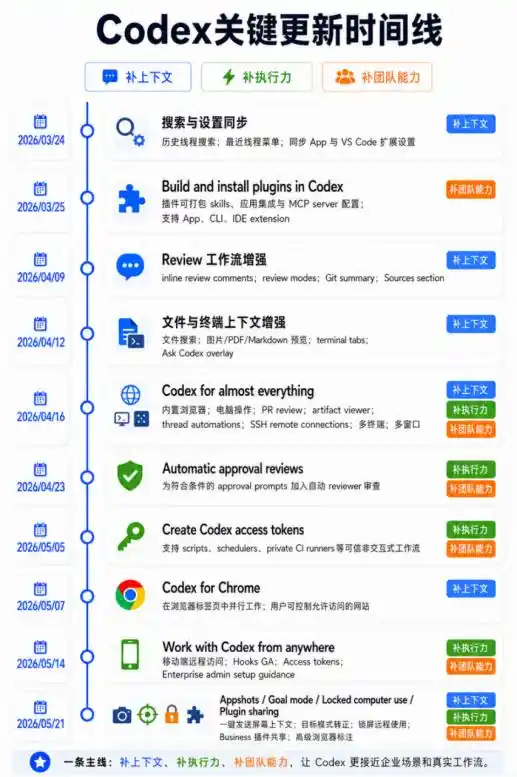
March 24th, Search & Settings Sync.

The Codex App added historical thread search, quick jump to recent threads, and synchronized key settings between the Codex App and VS Code extension. Basically foundational experience optimization: letting users quickly retrieve past tasks and ensuring a more consistent experience between desktop and editor usage.

March 25th, Plugin System Launched.

Codex began supporting plugins. Plugins can package skills, application integrations, and MCP server configurations to reuse workflows, supporting the Codex App, CLI, and IDE extension.

April 9th, Code Review Workflow Enhancement.

The Codex App added collapsible inline review comments, different review modes, Git summaries, and source blocks. Codex started delving deeper into code review and PR collaboration.

April 12th, File & Terminal Context Enhancement.

Codex added file search in the command menu, support for previewing images, PDFs, and Markdown in the sidebar, added a terminal tab for each thread, and supported directly asking Codex about selected text.

April 16th, Codex for almost everything.

This was the first major milestone in the past two months. OpenAI began pushing Codex to become a more comprehensive AI workbench. This wave of updates included a built-in browser, computer operation, thread automation, task sidebar, PR workflows, result previews, SSH remote connections, multi-terminal, multi-window, Intel Mac support, and a batch of new plugins.

April 23rd, Auto-Approve Reviews.

Codex could send eligible approval requests to an auto-review agent for risk assessment first, then display review status and risk level, ultimately leaving the decision to approve or not to the user.

May 5th, Codex Access Tokens Launched.

ChatGPT Enterprise workspace owners and administrators could allow members to create Codex access tokens for use in trusted non-interactive local workflows like scripts, schedulers, and private CI runners. Codex started approaching CI, automation, and enterprise engineering systems.

May 7th, Codex Enters Chrome.

Codex launched a Chrome extension, allowing parallel work in browser tabs without directly taking over the user's browser. Users could also control which websites allow Codex usage. The browser is the entry point for many backend systems, internal tools, and web debugging scenarios. This step brought Codex closer to the real office environment.

May 14th, Codex Supports Phone Control.

OpenAI supported users using Codex from the ChatGPT mobile app, connecting to a Mac running the Codex App. Users could check task progress, approve actions, view code diffs, and test results on their phones. This wave also included Hooks becoming generally available, access tokens, and enterprise admin setup guides. Codex started becoming a work agent that could be monitored remotely.

May 21st, Appshots, Goal Mode, Lock Screen Remote Use, and Plugin Sharing.

This was the second major milestone. Appshots could directly send a screenshot of the current Mac window and available text to Codex; Goal Mode officially launched, allowing users to give Codex a goal and have it work persistently on it for hours or even days; Lock Screen Remote Use allowed Codex to continue operating desktop apps after the Mac was locked, no longer needing to "leave a window open."

Simultaneously, ChatGPT Business began supporting team-shared plugins; the built-in browser's annotation capabilities were further enhanced, allowing direct adjustment of fonts, colors, spacing, and other styles.

The features themselves are important, but the overall update trend is equally noteworthy. Whether it's Appshots or Goal Mode, or the Chrome extension, access tokens, and plugin sharing, they are all filling the basic requirements for entering real workflows: seeing the field, pushing tasks forward, and managing risks.

To see the field, what needs to be complemented is contextual capability.

Real development tasks rarely happen only in code editors. File search, file preview, terminal tabs, built-in browser, browser annotation, Chrome extension, Appshots—essentially, these are all about reducing the user's cost of describing context to the AI.

Previously, you had to tell the AI what the problem was via description or Ctrl+C/V. Now, OpenAI wants Codex to see these things directly.

To push tasks forward, long-running task and remote execution capabilities are crucial.

Goal Mode solves "whether it can keep going." Mobile remote access and lock screen remote use allow tasks to continue even when the user isn't at the computer. Access tokens and Hooks further integrate Codex into enterprise engineering systems like scripts, schedulers, and CI runners.

Managing risks is a matter of enterprise and team management.

For individual developers using tools, the core concern is usability. But enterprise tools involve more complex issues: how to manage permissions, how to distribute plugins, who is using them and how much, how to review risks, whether they can integrate with CI, whether they can be managed uniformly by the team.

Codex has also done a lot of work in this area. The plugin system allows workflows to be packaged and reused; plugin sharing allows teams to distribute tools uniformly; auto-approve reviews are about controlling agent execution risks; access tokens and enterprise admin settings are about integrating Codex into existing enterprise engineering and governance processes.

02

"The Hope of the Whole Village"

Codex's updates have brought it a very impressive user growth rate.

In early March, Codex's weekly active users were around 1.6 million. By May 14th, OpenAI officially mentioned while introducing the mobile version of Codex that over 4 million people use Codex weekly. This means that in about two months, Codex's weekly active user count increased significantly again.

This growth trajectory is inseparable from the underlying model's capabilities. The premise for users being willing to entrust real tasks to Codex more frequently is that it can actually get the job done. Especially after GPT-5.5, Codex's coding, tool use, long-context, and multi-step task capabilities have a better foundation.

But having a model alone isn't enough. The market won't pay just because a model's benchmark improves; it cares more about whether these capabilities can translate into revenue.

This is what OpenAI must clarify before its IPO.

OpenAI holds many cards, but each has its own uncertainties.

ChatGPT is the largest user entry point, proving OpenAI has global users and consumer subscription capabilities. The problem is, the larger the user base, the heavier the inference costs; whether consumer subscriptions can sustain a frontier model company's long-term investments still needs further proof.

API is a fundamental revenue source, selling model capabilities to developers and enterprises. But the API market can easily become a price war, and enterprise clients may not bind themselves to just one model supplier. The more general the model capabilities, the more likely clients are to use multiple models.

ChatGPT Enterprise, Agents, and industry solutions are OpenAI's direct entry into the enterprise market. But these products need time, sales, integration, and industry-specific implementation to truly penetrate enterprise processes.

Looking further ahead, OpenAI also has hardware, data centers, multi-cloud partnerships, and compute infrastructure. These stories have great imaginative potential but are also heavier, more distant, and more capital-intensive. They can support the long-term vision but struggle to immediately explain short-term commercial returns.

In contrast, Codex's commercial value is easier to explain. It targets a very clear group: developers and engineering teams.

This is a group already willing to pay for services. Engineer time is expensive, software project cycles are long, and code maintenance costs are high. Bug fixes, testing, code reviews—each stage has a calculable cost.

Software development itself is also one of the most core production processes for enterprises. Financial companies have risk control and trading systems, retail companies have supply chain and membership systems, healthcare companies have data and compliance systems, media companies have content backends and distribution systems... Even non-tech companies have vast internal tools, data pipelines, automation scripts, and business systems that need maintenance—virtually every company today relies on software systems.

In other words, Codex is cutting into where companies spend money and consume manpower every single day.

In a sense, it's the hope for OpenAI to articulate a compelling IPO narrative. This becomes particularly important as OpenAI prepares to enter the capital markets.

Because in the IPO narrative, OpenAI no longer faces questions like "Does AI have a future?" The truly difficult question to answer is another one: Can a frontier model company find a clear, stable, and profitable enough commercial path beyond massive compute investments?

What's more troublesome is that Anthropic has already taken a step forward on this issue.

03

Anthropic Has Already Taken the Lead

There's another crucial reason Codex must be pushed to the forefront: OpenAI's biggest competitor, Anthropic, has already paved a path on the enterprise side.

Although in terms of revenue scale, OpenAI still leads—The Information reported OpenAI's Q1 2026 revenue at approximately $5.7 billion, higher than Anthropic's $4.8 billion for the same period—the issue now isn't just about revenue size. The real pressure for frontier model companies is whether revenue growth can outpace cost growth.

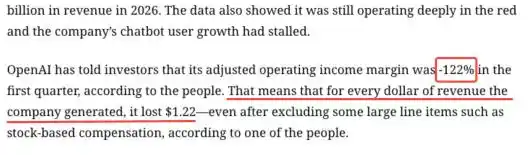
OpenAI's Q1 revenue was high, but its adjusted operating margin was approximately -122%. Calculated on this basis, for every $1 of revenue, adjusted operating costs might be about $2.22, ultimately losing $1.22.
Over the past few years, the outside world has consistently questioned the capital intensity of large model companies: training, inference, GPUs, talent expenses—each is a bottomless pit. The more users, the more calls, the heavier the costs.

The signal recently released by Anthropic has changed the imagination around this issue.

According to The Wall Street Journal, Anthropic expects Q2 2026 revenue to exceed $10.9 billion and is approaching its first quarterly operating profit, estimated at around $559 million.

While this doesn't mean Anthropic has forever escaped the burn problem, it gives the market a very important signal: Frontier model companies don't necessarily have to rely on fundraising to survive forever. As long as the model capabilities are strong enough and the products are close enough to high-value enterprise scenarios, revenue growth can potentially outpace costs.

Anthropic doesn't have a mass-market entry point like ChatGPT, nor does it have as many simultaneous narratives. Its path is narrower and purer: directly enter areas enterprises are willing to pay for, especially high-value scenarios like developers, finance, law, research, data analysis, and internal knowledge work.

Claude Code is the most typical card in this deck. It started as a coveted tool among developers, focusing on programming scenarios. Later, it progressively added long-running tasks, plugins, permissions, team management, and enterprise governance, gradually becoming an important entry point for Anthropic into enterprise workflows. Developers adopt it first, teams follow, eventually turning into enterprise procurement and budgets.

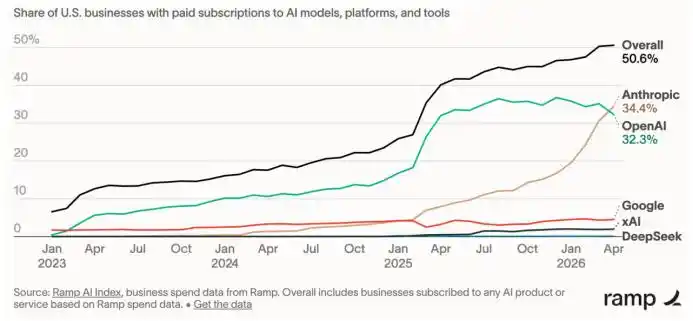
In April 2026, among sample enterprises on the Ramp platform, Anthropic's adoption rate rose to 34.4%, while OpenAI's fell to 32.3%. Although this is only a sample based on enterprise spending on the Ramp platform and not a full-market statistic, this data at least indicates that Anthropic's momentum in enterprise-paid scenarios is strengthening.
This is precisely where the pressure lies for Codex.

OpenAI's revenue scale still leads, but if it's to enter the capital markets, it can't just talk about user scale or model capabilities. It needs a product closer to enterprise production to prove it can turn AI into stable enterprise revenue.

If Claude Code has proven that developer workflows can become Anthropic's enterprise entry point, then Codex must prove that OpenAI can also walk this path.

Codex lead Tibo Sottiaux recently half-jokingly summarized the company's "master plan": release better, more efficient models, release better products every week, then acquire more compute (and increase time surfing on X).

Better models determine whether Codex can truly work; higher-frequency product updates determine whether Codex can enter real workflows; more compute determines whether all of this can support growing usage.

All of this is very important for the IPO.

In other words, Codex's recent intensive updates aren't just about chasing features; they're also chasing the enterprise-oriented path that Anthropic has already carved out.

ChatGPT has already proven OpenAI has users.

And Codex must prove that OpenAI is a business that can make money.

This article is from WeChat public account "字母AI", author: Yuan Xinyue

Câu hỏi Liên quan

QWhat is the main role of Codex in OpenAI's current strategic positioning?

ACodex serves as OpenAI's product with the most easily articulated commercial value, aimed at proving OpenAI can integrate AI into genuine, paid enterprise production workflows, which is crucial for its IPO narrative.

QAccording to the article, what are the three core capabilities Codex's recent updates have focused on enhancing?

AThe updates focus on three key capabilities: 1) Contextual Awareness (seeing the work environment), 2) Long-task and Remote Execution (pushing tasks forward), and 3) Enterprise and Team Management (controlling risk and governance).

QWhy is the enterprise/developer market segment specifically important for Codex's commercial success?

ADevelopers and engineering teams represent a segment already willing to pay for productivity tools. Their time is expensive, and software development is a core, costly production环节 in nearly every modern company, making it a high-value, monetizable market for AI tools.

QHow does the competitive pressure from Anthropic relate to Codex's development?

AAnthropic's Claude Code has demonstrated a viable path to profitability by deeply integrating into enterprise developer workflows. Codex's rapid feature development is, in part, a response to prove OpenAI can also successfully capture this lucrative enterprise market segment.

QWhat key financial challenge for frontier AI companies does the article highlight, and how does Codex address it?

AThe challenge is that revenue growth must outpace the heavy costs of compute, training, and inference. Codex addresses this by targeting a specific, high-value enterprise use case (software development) where businesses are accustomed to paying for efficiency gains, aiming to create a clear and stable revenue stream.

Nội dung Liên quan

Chính phủ Mỹ lần đầu tiên bỏ lệnh cấm hợp đồng vĩnh viễn tiền mã hóa, điều này có ý nghĩa gì với thị trường?

Vào ngày 29/5, Ủy ban Giao dịch Hàng hóa Tương lai Hoa Kỳ (CFTC) đã ban hành hướng dẫn giám sát giao dịch 24/7, trong đó nhấn mạnh rằng do có cơ sở hạ tầng kỹ thuật số và đặc điểm giao dịch liên tục toàn cầu, các công cụ phái sinh liên quan đến tài sản mã hóa phù hợp hơn cho việc giao dịch và thanh toán suốt ngày đêm. Động thái này đánh dấu lần đầu tiên Hoa Kỳ mở cửa cho hợp đồng vĩnh viễn (perpetual contracts) về tiền mã hóa. Các nền tảng giao dịch như Kalshi, Coinbase và CME (Chicago Mercantile Exchange) là những bên hưởng lợi trực tiếp. Kalshi được phê duyệt niêm yết hợp đồng vĩnh viễn Bitcoin, Coinbase trở thành nhà môi giới hợp đồng tương lai (FCM) đầu tiên được CFTC giám sát, cho phép khách hàng Mỹ tiếp cận thị trường phái sinh toàn cầu, còn CME chuyển đổi giao dịch hợp đồng tương lai và quyền chọn Bitcoin sang hoạt động 24/7. CFTC cũng thể hiện thái độ thận trọng, chỉ rõ các hàng hóa truyền thống như nông sản có thể không phù hợp với mô hình giao dịch 24/7 do đặc thù khu vực và cấu trúc giao dịch. Cơ quan này yêu cầu các sàn giao dịch được quản lý phải tuân thủ luật và đánh giá rủi ro khi mở rộng hình thức giao dịch này, đồng thời xem xét từng trường hợp cụ thể. Giới chuyên môn trong người phần lớn hoan nghênh động thái này, cho rằng nó giúp thu hút dòng tiền từ người dùng Mỹ, nâng cao hiệu quả vốn và giảm chi phí quản lý rủi ro. Tuy nhiên, tổ chức bảo vệ người tiêu dùng Better Markets đã chỉ trích CFTC vì cho rằng cơ quan này đã bỏ qua lợi ích công cộng và sự bảo vệ nhà đầu tư, đồng thời nghi ngờ có mối quan hệ lợi ích với các công ty như Coinbase và Kalshi. Dù vậy, cánh cửa vào thị trường phái sinh vĩnh viễn trị giá hàng chục nghìn tỷ USD đang mở ra cho người dùng và các tổ chức Hoa Kỳ, với Kraken cũng thông báo kế hoạch ra mắt sản phẩm hợp đồng vĩnh viễn được quản lý trong vòng 30 ngày tới.

Odaily星球日报7 giờ trước

Chính phủ Mỹ lần đầu tiên bỏ lệnh cấm hợp đồng vĩnh viễn tiền mã hóa, điều này có ý nghĩa gì với thị trường?

Odaily星球日报7 giờ trước

Dự luật CLARITY Tái Định Hình Nền Kinh tế Thu Nhập Ổn định (Stablecoin) như thế nào

Tác giả: @BlazingKevin_ , Nhà nghiên cứu Blockbooster Tháng 5 năm 2026, Ủy ban Ngân hàng Thượng viện Mỹ thông qua Dự luật CLARITY, trong đó Mục 404 đánh dấu một sự thay đổi mô hình quan trọng. Nó mở rộng lệnh cấm trả lãi ổn định (stablecoin) cho tất cả các nhà cung cấp dịch vụ tài sản kỹ thuật số (DASP), đóng các lỗ hổng pháp lý từ Đạo luật GENIUS trước đó. Quan trọng hơn, luật mới phân biệt giữa phần thưởng "thụ động" (bị cấm) và phần thưởng dựa trên "hoạt động thực" như giao dịch, tiêu dùng (được phép). Điều này thúc đẩy ngành công nghiệp chuyển từ mô hình "hold-to-earn" (nắm giữ để kiếm lời) sang "use-to-earn" (sử dụng để kiếm lời). Trong bối cảnh đó, các gã khổng lồ quản lý tài sản như Morgan Stanley, BlackRock và JPMorgan đã nhanh chóng giới thiệu các quỹ thị trường tiền tệ được mã hóa (tokenized MMF) - chẳng hạn như BRSRV của BlackRock hay JLTXX của JPMorgan. Các sản phẩm này được thiết kế đặc biệt làm tài sản dự trữ cho stablecoin, trở thành lớp cơ sở hạ tầng tuân thủ vững chắc để truyền tải lợi nhuận trong mô hình mới. Bài viết phân tích ba con đường có thể để chuyển lợi nhuận đến người dùng: (A) phần thưởng dựa trên hoạt động từ các sàn giao dịch, (B) lợi suất từ các giao thức DeFi phi giám sát, và (C) lợi nhuận thông qua lớp tài sản dự trữ được mã hóa. Con đường (C) được coi là ổn định nhất về mặt tuân thủ. Tuy nhiên, nó cũng làm dấy lên lo ngại về rủi ro tập trung hệ thống, như việc quỹ BUIDL của BlackRock chiếm tới hơn 90% dự trữ của stablecoin USDtb. Cuộc đấu tranh xung quanh đề xuất giới hạn 20% của OCC đối với tài sản dự trữ được mã hóa sẽ là yếu tố then chốt quyết định con đường nào chiến thắng. CLARITY có thể làm suy yếu lập luận cho giới hạn này, mở đường cho sự mở rộng quy mô của các quỹ được mã hóa. Tóm lại, CLARITY đang định hình lại nền kinh tế lợi nhuận stablecoin, với các nhà cung cấp tài sản dự trữ được mã hóa nổi lên như những "Visa và Mastercard" mới trong nền kinh tế đô la mã hóa.

marsbit9 giờ trước

Dự luật CLARITY Tái Định Hình Nền Kinh tế Thu Nhập Ổn định (Stablecoin) như thế nào

marsbit9 giờ trước

Giải Phóng Token Trong Tuần: HYPE Giải Phóng Token Trị Giá 650 Triệu Đô La Mỹ

**Hyperliquid (HYPE)** * Dự án: Hyperliquid – Một blockchain hiệu suất cao hướng tới xây dựng hệ thống tài chính mở hoàn toàn trên chuỗi. * Lượng token mở khóa lần này: 9.92 triệu HYPE. * Giá trị mở khóa lần này: ~650 triệu USD. * Mục tiêu: Tạo ra một nền tảng thống nhất tích hợp thanh khoản, ứng dụng người dùng và hoạt động giao dịch cho mọi hoạt động tài chính. **EigenLayer (EIGEN)** * Dự án: EigenLayer – Giao thức trên Ethereum giới thiệu khái niệm "tái stake" (restaking). * Lượng token mở khóa lần này: 36.86 triệu EIGEN. * Giá trị mở khóa lần này: ~8.22 triệu USD. * Cơ chế: Cho phép người dùng đã stake ETH có thể tái cam kết tài sản này thông qua hợp đồng thông minh của EigenLayer để mở rộng lớp bảo mật kinh tế mã hóa cho các ứng dụng khác trong hệ sinh thái. **Tóm tắt:** Tuần này chứng kiến đợt mở khóa token lớn từ hai dự án. Đáng chú ý nhất là Hyperliquid (HYPE) với khối lượng mở khóa trị giá khoảng 6.5 tỷ USD, một con số rất đáng kể. Song song đó, EigenLayer (EIGEN) cũng mở khóa một lượng token với giá trị thấp hơn nhiều, khoảng 8.22 triệu USD. Cả hai dự án đều tập trung vào các khái niệm cốt lõi của DeFi và cơ sở hạ tầng blockchain: Hyperliquid nhắm đến một nền tài chính mở toàn diện, trong khi EigenLayer tập trung vào việc tái sử dụng bảo mật của Ethereum thông qua cơ chế tái stake.

marsbit12 giờ trước

Giải Phóng Token Trong Tuần: HYPE Giải Phóng Token Trị Giá 650 Triệu Đô La Mỹ

marsbit12 giờ trước

Kalshi và Coinbase cùng được CFTC phê duyệt, ngành công nghiệp tiền mã hóa đang bước vào thời đại thân thiện nhất với quy định?

Vào ngày 29/5, Ủy ban Giao dịch Hàng hóa Tương lai Hoa Kỳ (CFTC) đã công bố hai động thái quan trọng: chính thức phê duyệt hợp đồng vĩnh viễn Bitcoin của sàn Kalshi và cấp thư không hành động thực thi cho Coinbase, cho phép công ty con của họ cung cấp một số sản phẩm hợp đồng tương lai vĩnh viễn cho khách hàng Mỹ. CFTC cũng ban hành Tuyên bố chính sách về niêm yết hợp đồng vĩnh viễn, thiết lập khuôn khổ pháp lý rõ ràng. Các phê duyệt này đánh dấu bước tiến quan trọng trong việc đưa hợp đồng vĩnh viễn - công cụ phổ biến chiếm tới 78% khối lượng giao dịch phái sinh crypto toàn cầu - vào khuôn khổ quy định tại Mỹ. Chủ tịch CFTC Mike Selig nhấn mạnh đây là bước quan trọng để thúc đẩy Mỹ trở thành trung tâm crypto toàn cầu, đồng thời cảnh báo khung pháp lý vẫn có thể điều chỉnh. Động thái này được xem như một "cuộc phòng thủ trong nước" của giới quản lý trước sự phát triển mạnh mẽ của các nền tảng phái sinh vĩnh viễn ngoài khơi như Hyperliquid. Nó mở ra cơ hội cho các nhà đầu tư tổ chức truyền thống tham gia thị trường thông qua kênh hợp pháp, thu hút dòng vốn từ các sàn giao dịch ngoài khơi quay trở lại, và có thể thúc đẩy sự ra mắt của nhiều sản phẩm phái sinh khác như ETH. Sự kiện này được coi là dấu hiệu cho thấy kỷ nguyên quản lý thân thiện nhất có thể đang đến với ngành công nghiệp crypto.

marsbit13 giờ trước

Kalshi và Coinbase cùng được CFTC phê duyệt, ngành công nghiệp tiền mã hóa đang bước vào thời đại thân thiện nhất với quy định?

marsbit13 giờ trước

Giao dịch

Giao ngay
Hợp đồng Tương lai

Bài viết Nổi bật

AGENT S là gì

Agent S: Tương Lai của Tương Tác Tự Động trong Web3 Giới thiệu Trong bối cảnh không ngừng phát triển của Web3 và tiền điện tử, các đổi mới đang liên tục định nghĩa lại cách mà cá nhân tương tác với các nền tảng kỹ thuật số. Một dự án tiên phong như vậy, Agent S, hứa hẹn sẽ cách mạng hóa tương tác giữa con người và máy tính thông qua khung tác nhân mở của nó. Bằng cách mở đường cho các tương tác tự động, Agent S nhằm đơn giản hóa các nhiệm vụ phức tạp, cung cấp các ứng dụng chuyển đổi trong trí tuệ nhân tạo (AI). Cuộc khám phá chi tiết này sẽ đi sâu vào những phức tạp của dự án, các tính năng độc đáo của nó và những tác động đối với lĩnh vực tiền điện tử. Agent S là gì? Agent S đứng vững như một khung tác nhân mở đột phá, được thiết kế đặc biệt để giải quyết ba thách thức cơ bản trong việc tự động hóa các nhiệm vụ máy tính: Thu thập Kiến thức Cụ thể theo Miền: Khung này học một cách thông minh từ nhiều nguồn kiến thức bên ngoài và kinh nghiệm nội bộ. Cách tiếp cận kép này giúp nó xây dựng một kho lưu trữ phong phú về kiến thức cụ thể theo miền, nâng cao hiệu suất của nó trong việc thực hiện nhiệm vụ. Lập Kế Hoạch Qua Các Tầm Nhìn Nhiệm Vụ Dài Hạn: Agent S sử dụng lập kế hoạch phân cấp tăng cường kinh nghiệm, một cách tiếp cận chiến lược giúp phân chia và thực hiện các nhiệm vụ phức tạp một cách hiệu quả. Tính năng này nâng cao đáng kể khả năng quản lý nhiều nhiệm vụ con một cách hiệu quả và hiệu suất. Xử Lý Các Giao Diện Động, Không Đều: Dự án giới thiệu Giao Diện Tác Nhân-Máy Tính (ACI), một giải pháp đổi mới giúp nâng cao tương tác giữa các tác nhân và người dùng. Sử dụng các Mô Hình Ngôn Ngữ Lớn Đa Phương Thức (MLLMs), Agent S có thể điều hướng và thao tác các giao diện người dùng đồ họa đa dạng một cách liền mạch. Thông qua những tính năng tiên phong này, Agent S cung cấp một khung vững chắc giải quyết các phức tạp liên quan đến việc tự động hóa tương tác giữa con người với máy móc, mở ra nhiều ứng dụng trong AI và hơn thế nữa. Ai là Người Tạo ra Agent S? Mặc dù khái niệm về Agent S là hoàn toàn đổi mới, thông tin cụ thể về người sáng lập vẫn còn mơ hồ. Người sáng lập hiện vẫn chưa được biết đến, điều này làm nổi bật giai đoạn sơ khai của dự án hoặc sự lựa chọn chiến lược để giữ kín các thành viên sáng lập. Bất chấp sự ẩn danh, sự chú ý vẫn tập trung vào khả năng và tiềm năng của khung này. Ai là Các Nhà Đầu Tư của Agent S? Vì Agent S còn tương đối mới trong hệ sinh thái mã hóa, thông tin chi tiết về các nhà đầu tư và những người tài trợ tài chính của nó không được ghi chép rõ ràng. Sự thiếu vắng thông tin công khai về các nền tảng đầu tư hoặc tổ chức hỗ trợ dự án dấy lên câu hỏi về cấu trúc tài trợ và lộ trình phát triển của nó. Hiểu biết về sự hỗ trợ là rất quan trọng để đánh giá tính bền vững và tác động tiềm năng của dự án. Agent S Hoạt Động Như Thế Nào? Tại cốt lõi của Agent S là công nghệ tiên tiến cho phép nó hoạt động hiệu quả trong nhiều bối cảnh khác nhau. Mô hình hoạt động của nó được xây dựng xung quanh một số tính năng chính: Tương Tác Giống Như Con Người: Khung này cung cấp lập kế hoạch AI tiên tiến, cố gắng làm cho các tương tác với máy tính trở nên trực quan hơn. Bằng cách bắt chước hành vi của con người trong việc thực hiện nhiệm vụ, nó hứa hẹn nâng cao trải nghiệm người dùng. Ký Ức Tường Thuật: Được sử dụng để tận dụng các trải nghiệm cấp cao, Agent S sử dụng ký ức tường thuật để theo dõi lịch sử nhiệm vụ, từ đó nâng cao quy trình ra quyết định của nó. Ký Ức Tình Huống: Tính năng này cung cấp cho người dùng hướng dẫn từng bước, cho phép khung này cung cấp hỗ trợ theo ngữ cảnh khi các nhiệm vụ diễn ra. Hỗ Trợ OpenACI: Với khả năng chạy cục bộ, Agent S cho phép người dùng duy trì quyền kiểm soát đối với các tương tác và quy trình làm việc của họ, phù hợp với tinh thần phi tập trung của Web3. Tích Hợp Dễ Dàng với Các API Bên Ngoài: Tính linh hoạt và khả năng tương thích với nhiều nền tảng AI khác nhau đảm bảo rằng Agent S có thể hòa nhập liền mạch vào các hệ sinh thái công nghệ hiện có, làm cho nó trở thành lựa chọn hấp dẫn cho các nhà phát triển và tổ chức. Những chức năng này cùng nhau góp phần vào vị trí độc đáo của Agent S trong không gian tiền điện tử, khi nó tự động hóa các nhiệm vụ phức tạp, nhiều bước với sự can thiệp tối thiểu của con người. Khi dự án phát triển, các ứng dụng tiềm năng của nó trong Web3 có thể định nghĩa lại cách mà các tương tác kỹ thuật số diễn ra. Thời Gian Phát Triển của Agent S Sự phát triển và các cột mốc của Agent S có thể được tóm tắt trong một dòng thời gian nêu bật các sự kiện quan trọng của nó: 27 tháng 9, 2024: Khái niệm về Agent S được ra mắt trong một bài nghiên cứu toàn diện mang tên “Một Khung Tác Nhân Mở Sử Dụng Máy Tính Như Một Con Người,” trình bày nền tảng cho dự án. 10 tháng 10, 2024: Bài nghiên cứu được công bố công khai trên arXiv, cung cấp một cái nhìn sâu sắc về khung và đánh giá hiệu suất của nó dựa trên tiêu chuẩn OSWorld. 12 tháng 10, 2024: Một video trình bày được phát hành, cung cấp cái nhìn trực quan về khả năng và tính năng của Agent S, thu hút thêm sự quan tâm từ người dùng và nhà đầu tư tiềm năng. Những dấu mốc trong dòng thời gian không chỉ minh họa sự tiến bộ của Agent S mà còn chỉ ra cam kết của nó đối với sự minh bạch và sự tham gia của cộng đồng. Những Điểm Chính Về Agent S Khi khung Agent S tiếp tục phát triển, một số thuộc tính chính nổi bật, nhấn mạnh tính đổi mới và tiềm năng của nó: Khung Đổi Mới: Được thiết kế để cung cấp cách sử dụng máy tính trực quan giống như tương tác của con người, Agent S mang đến một cách tiếp cận mới cho việc tự động hóa nhiệm vụ. Tương Tác Tự Động: Khả năng tương tác tự động với máy tính thông qua GUI đánh dấu một bước tiến tới các giải pháp tính toán thông minh và hiệu quả hơn. Tự Động Hóa Nhiệm Vụ Phức Tạp: Với phương pháp mạnh mẽ của nó, nó có thể tự động hóa các nhiệm vụ phức tạp, nhiều bước, làm cho các quy trình nhanh hơn và ít sai sót hơn. Cải Tiến Liên Tục: Các cơ chế học tập cho phép Agent S cải thiện từ các trải nghiệm trước đó, liên tục nâng cao hiệu suất và hiệu quả của nó. Tính Linh Hoạt: Khả năng thích ứng của nó trên các môi trường hoạt động khác nhau như OSWorld và WindowsAgentArena đảm bảo rằng nó có thể phục vụ một loạt các ứng dụng rộng rãi. Khi Agent S định vị mình trong bối cảnh Web3 và tiền điện tử, tiềm năng của nó để nâng cao khả năng tương tác và tự động hóa quy trình đánh dấu một bước tiến quan trọng trong công nghệ AI. Thông qua khung đổi mới của mình, Agent S minh họa cho tương lai của các tương tác kỹ thuật số, hứa hẹn một trải nghiệm liền mạch và hiệu quả hơn cho người dùng trên nhiều ngành công nghiệp khác nhau. Kết luận Agent S đại diện cho một bước nhảy vọt táo bạo trong sự kết hợp giữa AI và Web3, với khả năng định nghĩa lại cách chúng ta tương tác với công nghệ. Mặc dù vẫn còn ở giai đoạn đầu, những khả năng cho ứng dụng của nó là rộng lớn và hấp dẫn. Thông qua khung toàn diện của mình giải quyết các thách thức quan trọng, Agent S nhằm đưa các tương tác tự động lên hàng đầu trong trải nghiệm kỹ thuật số. Khi chúng ta tiến sâu hơn vào các lĩnh vực tiền điện tử và phi tập trung, các dự án như Agent S chắc chắn sẽ đóng một vai trò quan trọng trong việc định hình tương lai của công nghệ và sự hợp tác giữa con người với máy tính.

Tổng lượt xem 838Xuất bản vào 2025.01.14Cập nhật vào 2025.01.14

AGENT S là gì

Làm thế nào để Mua S

Chào mừng bạn đến với HTX.com! Chúng tôi đã làm cho mua Sonic (S) trở nên đơn giản và thuận tiện. Làm theo hướng dẫn từng bước của chúng tôi để bắt đầu hành trình tiền kỹ thuật số của bạn.Bước 1: Tạo Tài khoản HTX của BạnSử dụng email hoặc số điện thoại của bạn để đăng ký tài khoản miễn phí trên HTX. Trải nghiệm hành trình đăng ký không rắc rối và mở khóa tất cả tính năng. Nhận Tài khoản của tôiBước 2: Truy cập Mua Crypto và Chọn Phương thức Thanh toán của BạnThẻ Tín dụng/Ghi nợ: Sử dụng Visa hoặc Mastercard của bạn để mua Sonic (S) ngay lập tức.Số dư: Sử dụng tiền từ số dư tài khoản HTX của bạn để giao dịch liền mạch.Bên thứ ba: Chúng tôi đã thêm những phương thức thanh toán phổ biến như Google Pay và Apple Pay để nâng cao sự tiện lợi.P2P: Giao dịch trực tiếp với người dùng khác trên HTX.Thị trường mua bán phi tập trung (OTC): Chúng tôi cung cấp những dịch vụ được thiết kế riêng và tỷ giá hối đoái cạnh tranh cho nhà giao dịch.Bước 3: Lưu trữ Sonic (S) của BạnSau khi mua Sonic (S), lưu trữ trong tài khoản HTX của bạn. Ngoài ra, bạn có thể gửi đi nơi khác qua chuyển khoản blockchain hoặc sử dụng để giao dịch những tiền kỹ thuật số khác.Bước 4: Giao dịch Sonic (S)Giao dịch Sonic (S) dễ dàng trên thị trường giao ngay của HTX. Chỉ cần truy cập vào tài khoản của bạn, chọn cặp giao dịch, thực hiện giao dịch và theo dõi trong thời gian thực. Chúng tôi cung cấp trải nghiệm thân thiện với người dùng cho cả người mới bắt đầu và người giao dịch dày dạn kinh nghiệm.

Tổng lượt xem 1.5kXuất bản vào 2025.01.15Cập nhật vào 2025.03.21

Làm thế nào để Mua S

Thảo luận

Chào mừng đến với Cộng đồng HTX. Tại đây, bạn có thể được thông báo về những phát triển nền tảng mới nhất và có quyền truy cập vào thông tin chuyên sâu về thị trường. Ý kiến ​​của người dùng về giá của S (S) được trình bày dưới đây.

活动图片