Why Did Zhipu Surge Nearly 30% in a Single Day?

marsbitXuất bản vào 2026-05-23Cập nhật gần nhất vào 2026-05-23

Tóm tắt

"Global AI Model Unicorn" Zhipu's stock surged nearly 30% in a single day, reaching a new market cap high. The catalyst was the launch of its GLM-5.1-highspeed API, boasting a generation speed of **400 tokens per second**, setting a new global benchmark. This speed, roughly 3-5 times faster than industry leaders like OpenAI's GPT-4o and Anthropic's Claude, is achieved **without compromising the full-scale model's capabilities**. In the era of AI Agents requiring dozens of self-calls, such latency reduction is critical, transforming speed from a system metric into a determinant of intelligence limits. The breakthrough stems from a three-layer technical overhaul: 1. **TileRT Inference Engine**: Compiles the entire model into a continuous, always-on computation pipeline using "Warp Specialization," minimizing GPU idle time by having different processor groups handle data loading, computation, and communication in parallel. 2. **Heterogeneous Parallelism for MLA**: To efficiently run the GLM-5.1 model using the MLA attention mechanism, TileRT employs a heterogeneous strategy. One GPU handles sparse indexing/routing, while the others perform dense computation, optimizing for MLA's unique workflow. 3. **ZCube Network Architecture**: Replaces the standard Spine-Leaf (ROFT) network topology with a flat, dual-group interconnect. This design creates a single optimal path between any two GPUs, eliminating network congestion at scale and reducing latency. The business impact is sig...

By AIDeepDive

Today, Zhipu (02513.HK), hailed as the "world's first listed large language model company," surged once again.

Its intraday increase once exceeded 30%. It closed at HK$1,282, up over 26% for the day, with its market capitalization reaching HK$571.57 billion, setting another historical high.
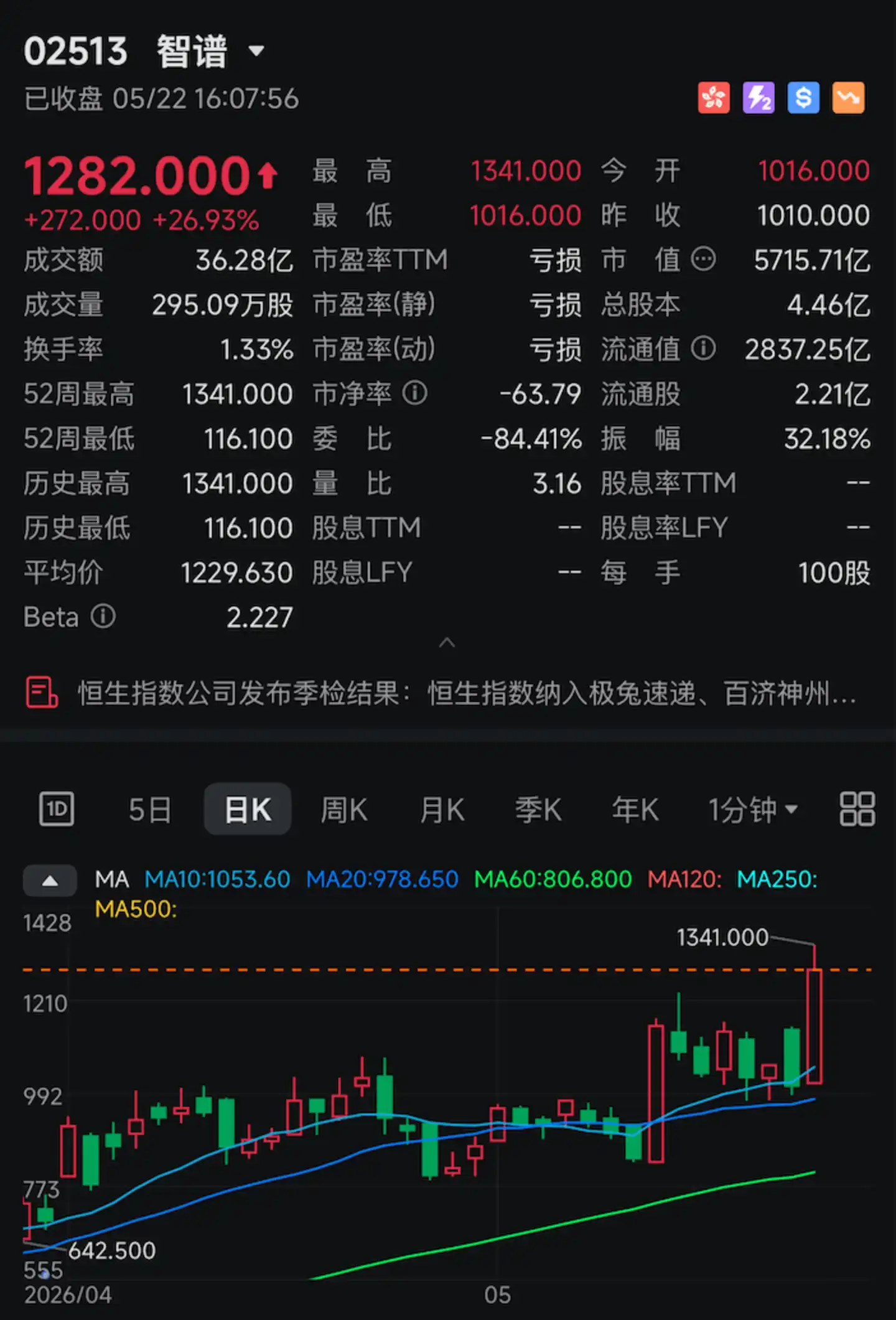
The trigger for this surge was a specific technical metric: 400 tokens/s.

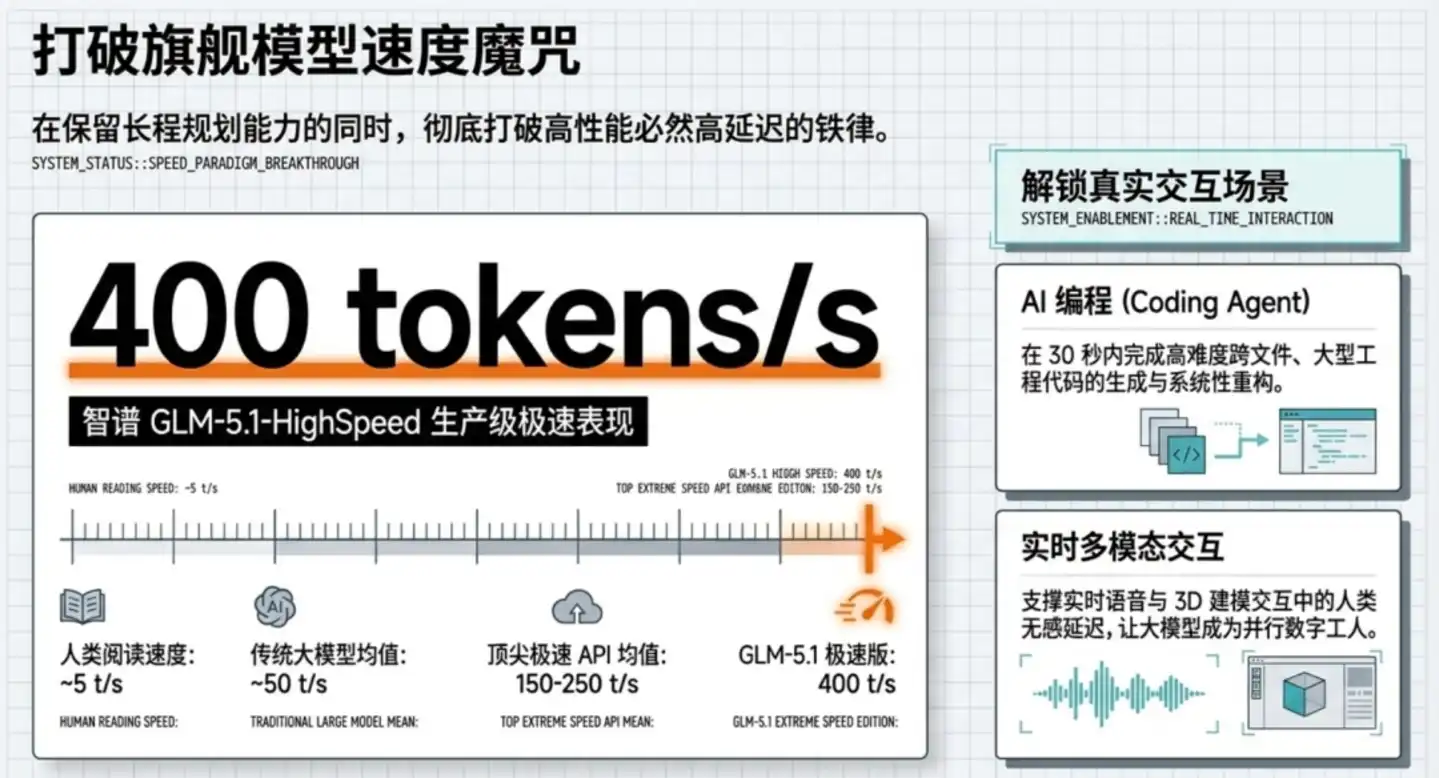
On May 22, Zhipu officially opened access to the GLM-5.1 Highspeed API (GLM-5.1-highspeed) for enterprise clients. The most critical core parameter is just one: model output speed reaching 400 tokens per second, setting a new global upper limit for API speed among major LLM providers.

I initially thought this was just another public relations stunt by a domestic LLM company, but after examining the technical details, I finally understood the logic behind the capital market's reaction.

What does 400 tokens/s mean?

The model can generate approximately 200 Chinese characters per second, equivalent to the high-intensity output of a professional writer in one minute, compressed into just one second.

A volume of text that would take a creator several days of desk work to complete can be delivered by the GLM-5.1 Highspeed in just 1 minute; a system refactoring task that would occupy an engineer for 3 days can be completed in the time it takes to drink a cup of coffee.

01 Speed Is More Important Than You Think

Speed has historically been the most easily overlooked dimension in AI model competition.

Over the past three years, the LLM arms race has centered on two tracks: parameter scale (making models larger and smarter) and price wars (making tokens cheaper and more accessible). "Speed" was never the protagonist.

This is because, in the past, "speed" was typically achieved by reducing model parameters. To increase speed, one had to use smaller, more streamlined models, at the cost of diminished capabilities.

The significance of the GLM-5.1 Highspeed lies in its achievement of pushing speed to 400 tokens/s while retaining the capabilities of the flagship full-size base model.

For both domestic and international models, "flagship-level capability" and "ultra-low latency" have been achieved without compromise for the first time.
Why is speed so critical? Because the main battlefield for AI is undergoing a fundamental shift.

As AI moves from the ChatBot era into the Agent era, Q&A is no longer the primary scenario. For an Agent to complete a task, it often requires the model to make dozens or even hundreds of self-calls: writing code, calling APIs, searching for information, utilizing tools...

In this operational mode, the latency between each call is mercilessly magnified. For a task requiring 50 calls, saving 1 second per call speeds up the entire task by nearly 1 minute. For AI programming assistants, voice interaction, and commercial decision systems, this difference can be a matter of life or death.

At a deeper level, within a fixed time budget, faster inference means the model can explore deeper reasoning paths and perform more rounds of self-verification. Speed is transforming from a system metric into an upper limit of intelligence itself.

02 How Difficult Is Achieving Speed?

So, what's the current industry standard for speed?

Among leading providers, OpenAI's GPT-4o is around 100–150 tokens/s, Anthropic's Claude Sonnet series around 80–120 tokens/s, while mainstream domestic flagship model APIs mostly fall within the 50–100 tokens/s range. 400 tokens/s is approximately 3 to 5 times the industry average.

More crucially, this gap cannot be bridged simply by throwing more computing power at it.

A server equipped with 8 H200 GPUs can theoretically move up to 38TB of data per second. For GLM-5.1, generating a single token only requires reading about 42GB of activation parameters. Purely theoretical calculation suggests it should approach 1000 tokens/s.

But real-world systems often only achieve a few dozen tokens/s.
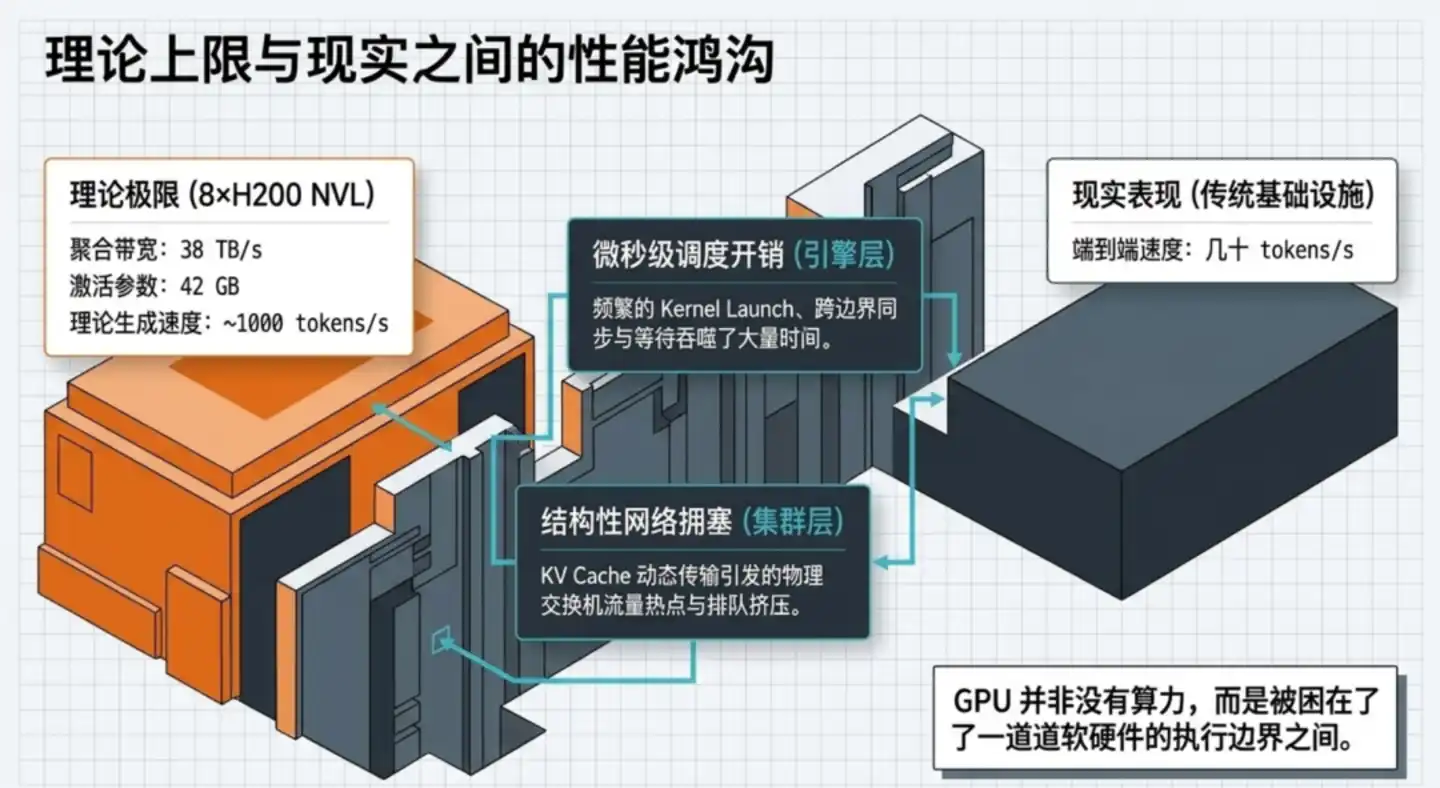
This is a gap of an order of magnitude. The GPUs aren't inherently too slow; rather, a significant amount of time is wasted on waiting, idling, and inefficient scheduling.

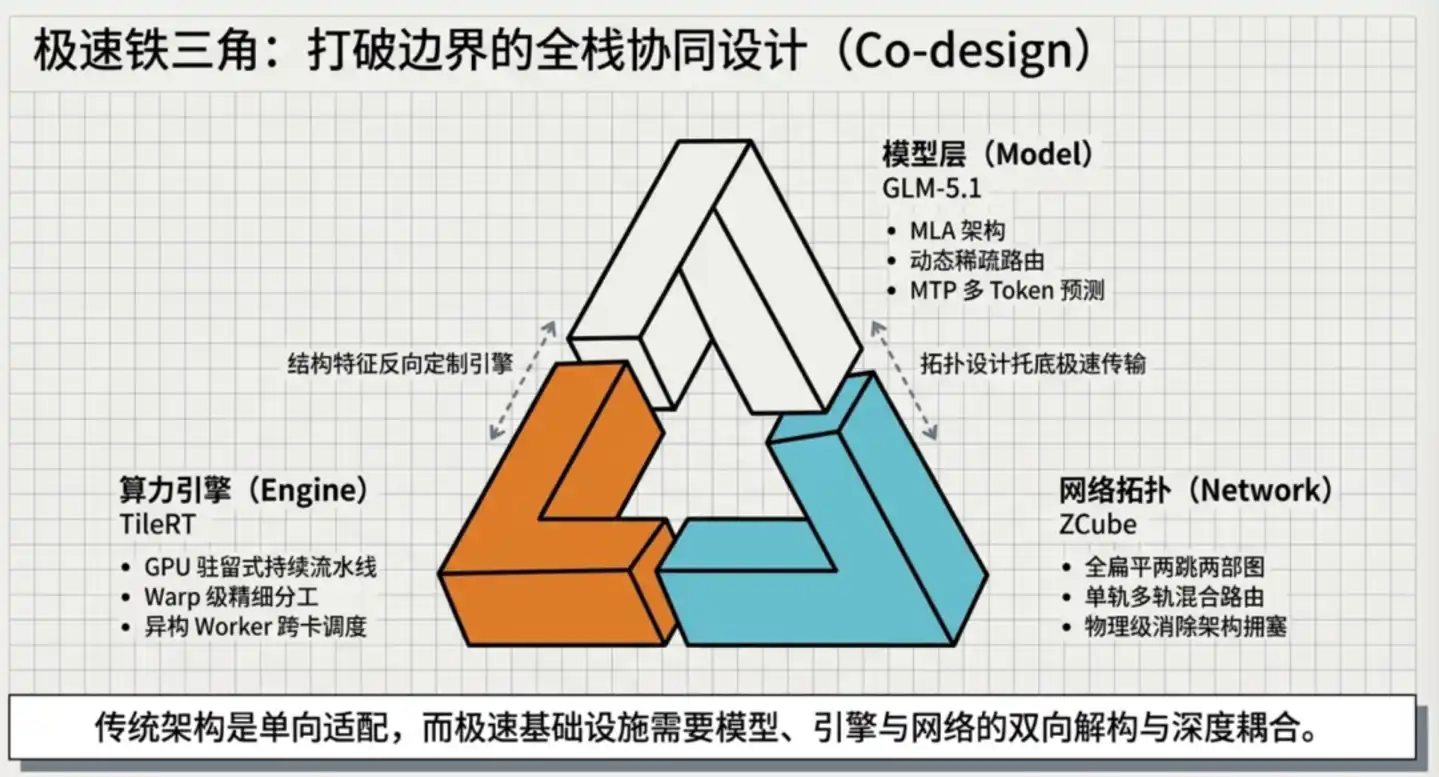
Zhipu's breakthrough this time stems from simultaneous innovations at three levels: the inference engine, parallelization strategy, and network architecture.
03 Three-Layer Technology Stack, Approaching Hardware Physical Limits

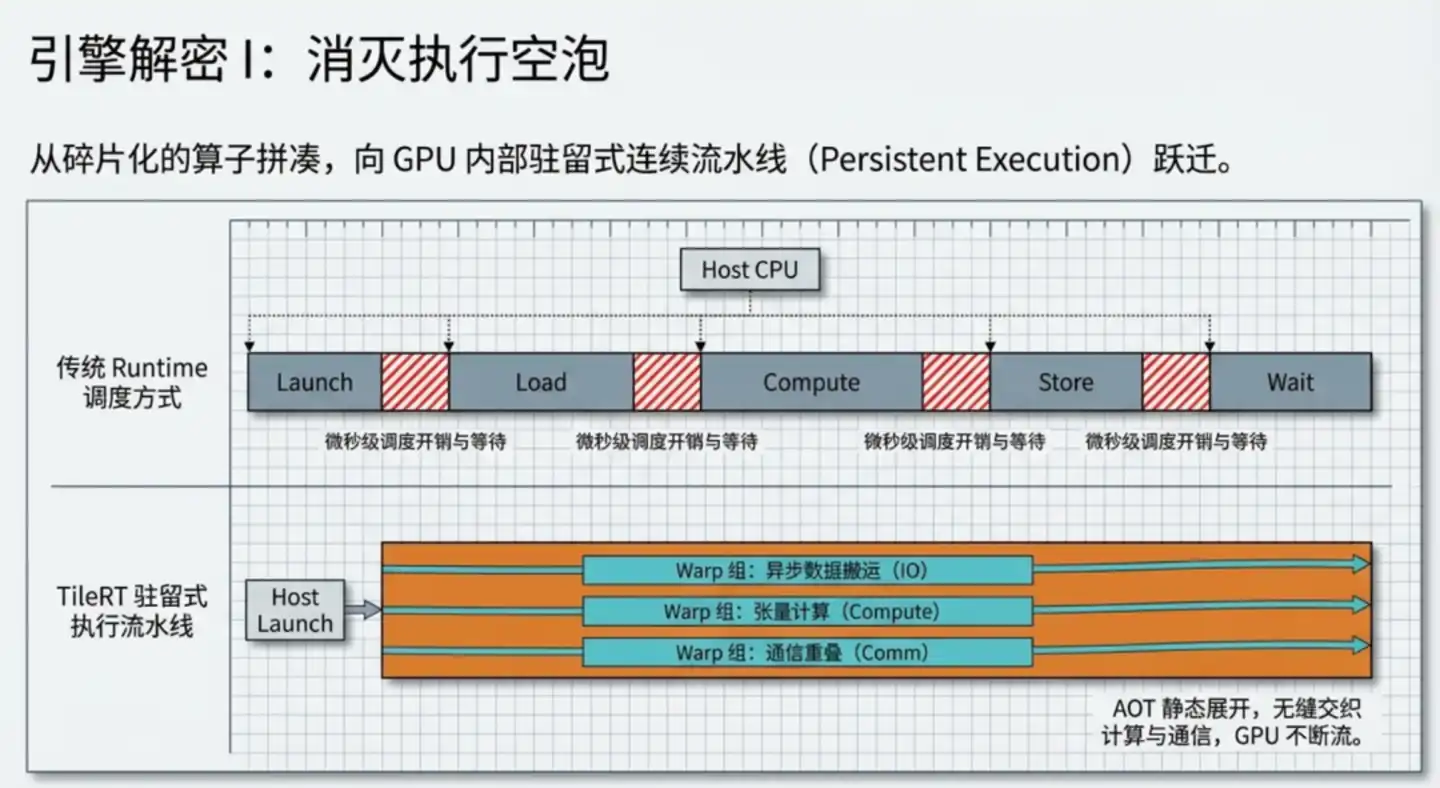
Here's how traditional LLMs operate: the model is decomposed into independent operators (kernels). Each operator launches a computing kernel, computes, stops, synchronizes and waits, then launches the next one.

During the training phase, each computation takes seconds or even minutes, making these startup and wait overheads negligible. But during inference, generating a single token, a key step might only require tens of microseconds, making the startup and wait overheads proportionally significant.

TileRT's Core Idea: Compile the entire model into a continuously running engine, start once, run perpetually.

TileRT statically unfolds all of the model's computational logic into a continuous pipeline during the code compilation phase. At runtime, the GPU maintains high-speed operation, with computation, data movement, and communication proceeding in parallel. Intermediate results are kept within the GPU's high-speed cache as much as possible, avoiding repeated writes to slow VRAM and subsequent re-reads.
There's a crucial design detail here: Warp Specialization.

Understanding Warp requires first understanding GPU operation. The biggest difference between a GPU and a CPU is that a GPU contains thousands of relatively simple computing units, bundled together in groups of 32. This group is called a Warp.

All 32 units within the same Warp must always act synchronously, executing the same instruction, like a squad in the army where the squad leader orders everyone to perform the same action simultaneously.

In traditional frameworks, all Warps execute the same sequence of instructions. TileRT assigns different Warp groups different responsibilities: some specialize in prefetching the next batch of data, some in mathematical computation, some in communicating with other GPUs. The three groups work simultaneously, pipelining seamlessly without waiting for each other.

It's akin to moving from "one worker moving bricks, laying walls, and inspecting serially" to "a brick-moving group, a wall-laying group, and an inspection group operating concurrently."

With single-GPU efficiency solved, multi-GPU parallelism presents a new challenge.

The industry standard approach is Tensor Parallelism (TP): Split the model's weight matrices into several parts, with each GPU responsible for one part. After computing, results are aggregated via high-speed interconnects (NVLink).

This solution works well for regular, dense computations like matrix multiplication and is the standard multi-GPU solution for almost all current LLM inference frameworks.

GLM-5.1 employs **MLA (Multi-head Latent Attention), an attention mechanism proposed by DeepSeek.

Traditional attention mechanisms require storing large amounts of intermediate data (KV Cache) generated at each step for later use, which consumes significant VRAM. MLA's approach is to first compress this intermediate data into a compact "latent vector" for storage, then expand and restore it when needed, drastically reducing VRAM requirements and improving inference efficiency.

However, MLA's computational flow has a special step: performing sparse indexing from a large amount of historical information: similar to quickly finding the most relevant few books in a vast library before carefully reading them.

The "book-finding" step relies on global information and is not well-suited for distribution across multiple GPUs; the "careful reading" is the dense computation suitable for multi-GPU parallelism. If all 8 GPUs are forced to participate in "book-finding," a lot of time would be wasted on inter-GPU synchronization communication.

TileRT's solution is to have GPUs operate heterogeneously: GPU 0 specializes as the "library retriever," handling sparse indexing and routing decisions; GPUs 1–7 act as "detailed analysts," responsible for dense attention computation and matrix operations. The two types of workers each adopt the parallelization strategy best suited to them, collaborating to complete the entire computational layer.
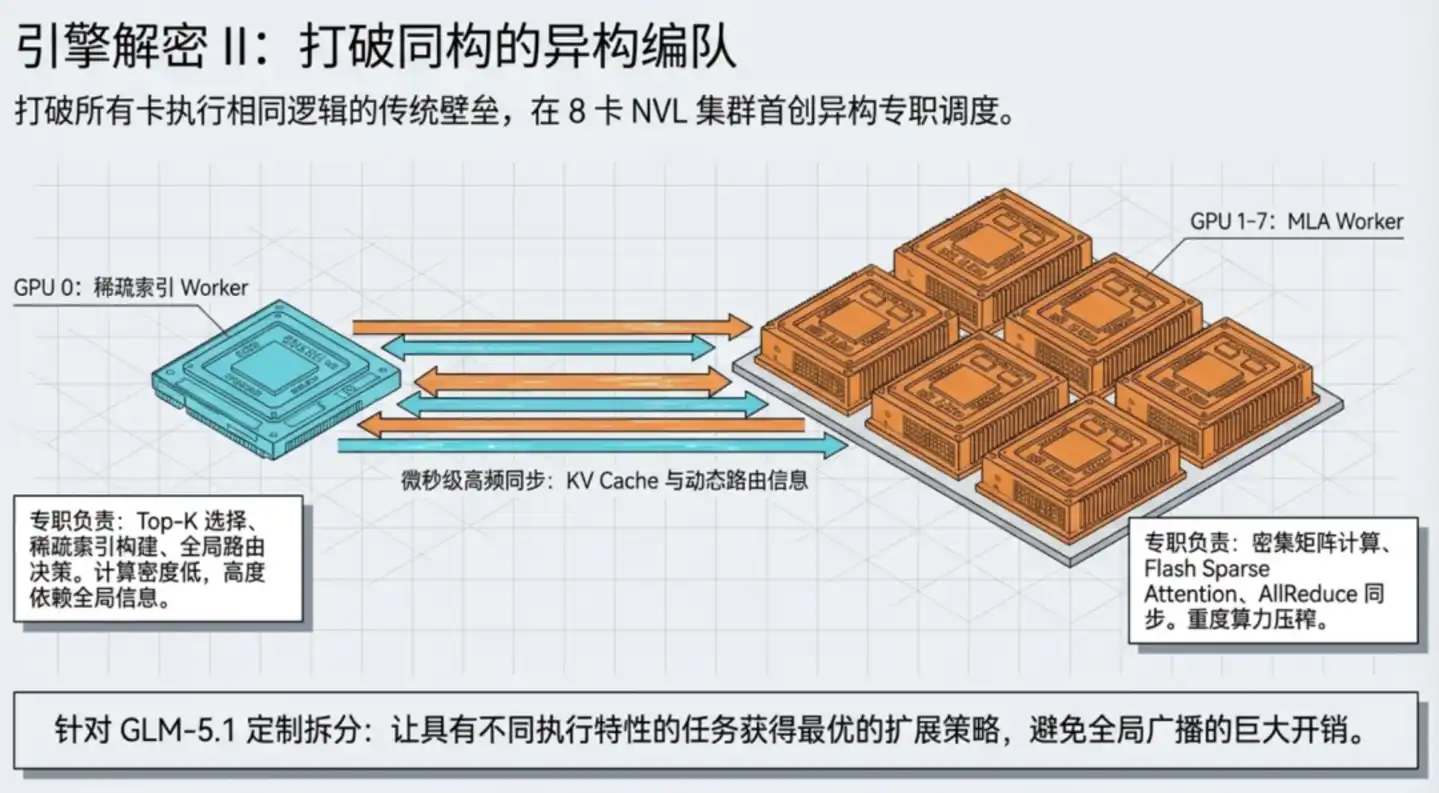
Next, TileRT embeds inter-GPU communication operations directly into the execution pipeline, no longer treating them as separate steps. Externally, the entire 8-GPU system completing one layer of attention computation requires only one kernel launch; internal communication and computation are all seamlessly completed within the continuous pipeline.

The above two layers address problems within a single server. When scaling clusters to hundreds or thousands of GPUs, data transmission between GPUs itself becomes the new bottleneck.

The industry standard approach is ROFT (Rail-Optimized Fat-Tree), NVIDIA's officially recommended solution and the absolute industry standard.

Its structure is like a tree: servers connect first to underlying Leaf switches (access layer, directly facing servers). Leaf switches then connect upward to Spine switches (backbone layer, responsible for interconnecting different Leafs, like highway hubs). Data transmission between two GPUs must "go up to a Spine, then down to the target Leaf," traversing at least 3 hops.

To prevent traffic from concentrating on a few links, this architecture relies on the ECMP algorithm to distribute data across multiple paths, functioning well under the premise of "statistically uniform" internet traffic.

But inference traffic is completely non-uniform. Context lengths between different requests can vary by tens of times, and the direction of KV Cache transmission between GPUs is almost random. A few Leaf switches periodically become hotspots, triggering backpressure mechanisms that spread congestion from local to the entire link. This congestion cannot be solved by protocol parameter tuning; it's inherent to the topology structure.
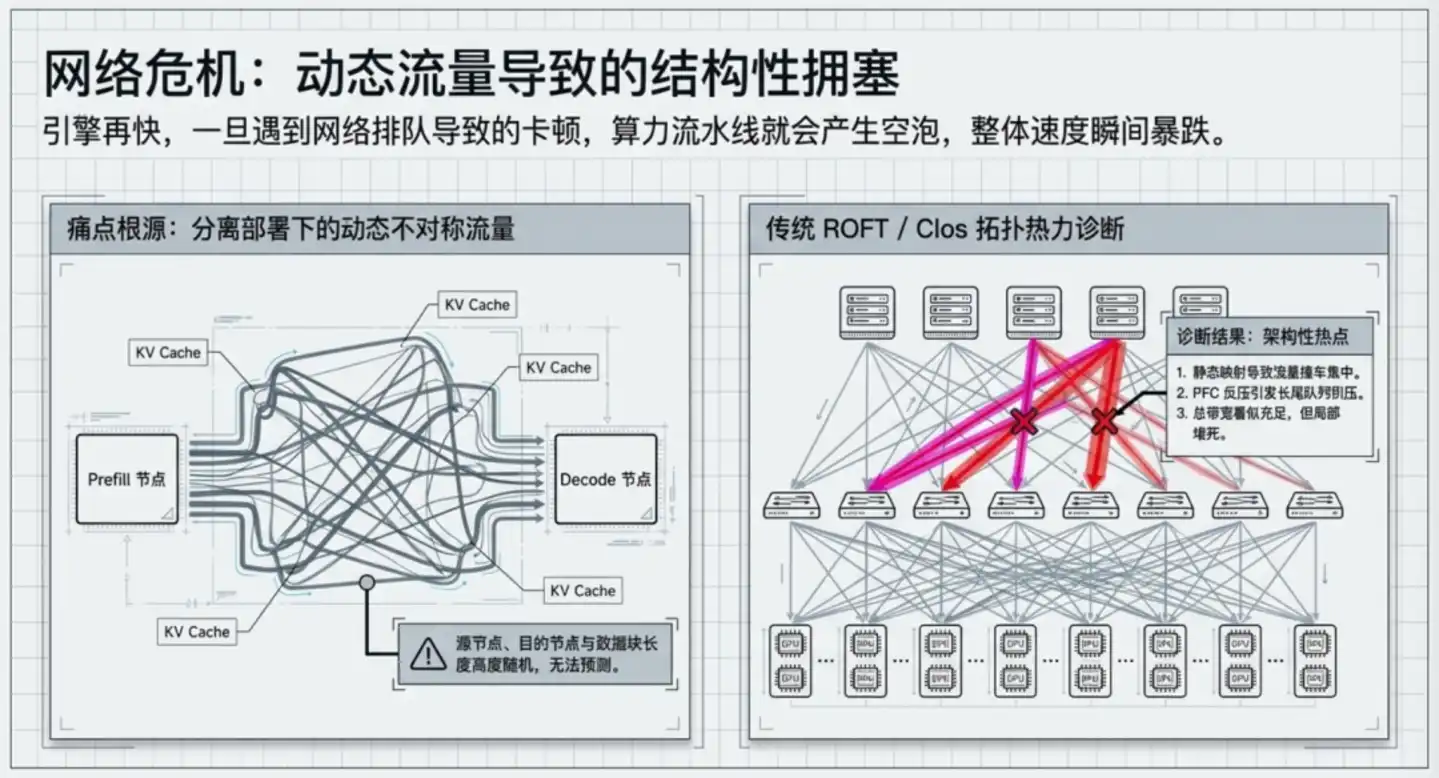
ZCube's fundamental breakthrough: Architecturally preventing this type of congestion from physically occurring.

The core design consists of two steps:

First, eliminate the Spine backbone layer, flatten the entire network. Divide all Leaf switches into two groups based on odd/even numbering, with the two groups fully interconnected. Any odd-numbered switch connects to all even-numbered switches, and vice versa. Any two GPUs can reach each other via at most two switches, reducing hops from 3 to 2.
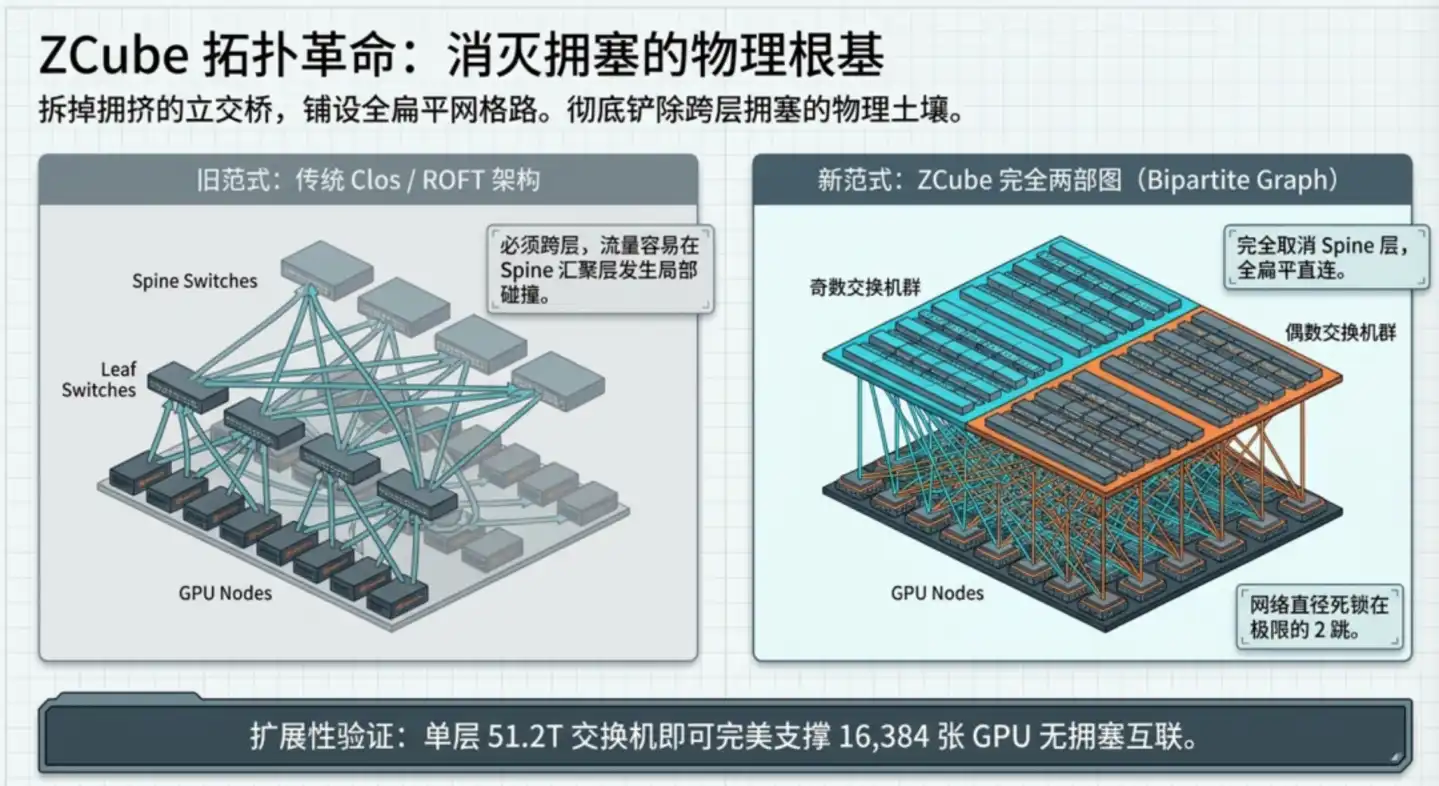
The second step, and the most ingenious part: Connect each GPU network card to the two groups of switches in two completely different ways. This special topology yields a key mathematical property: Between any two GPUs in the entire network, there is one and only one optimal path.
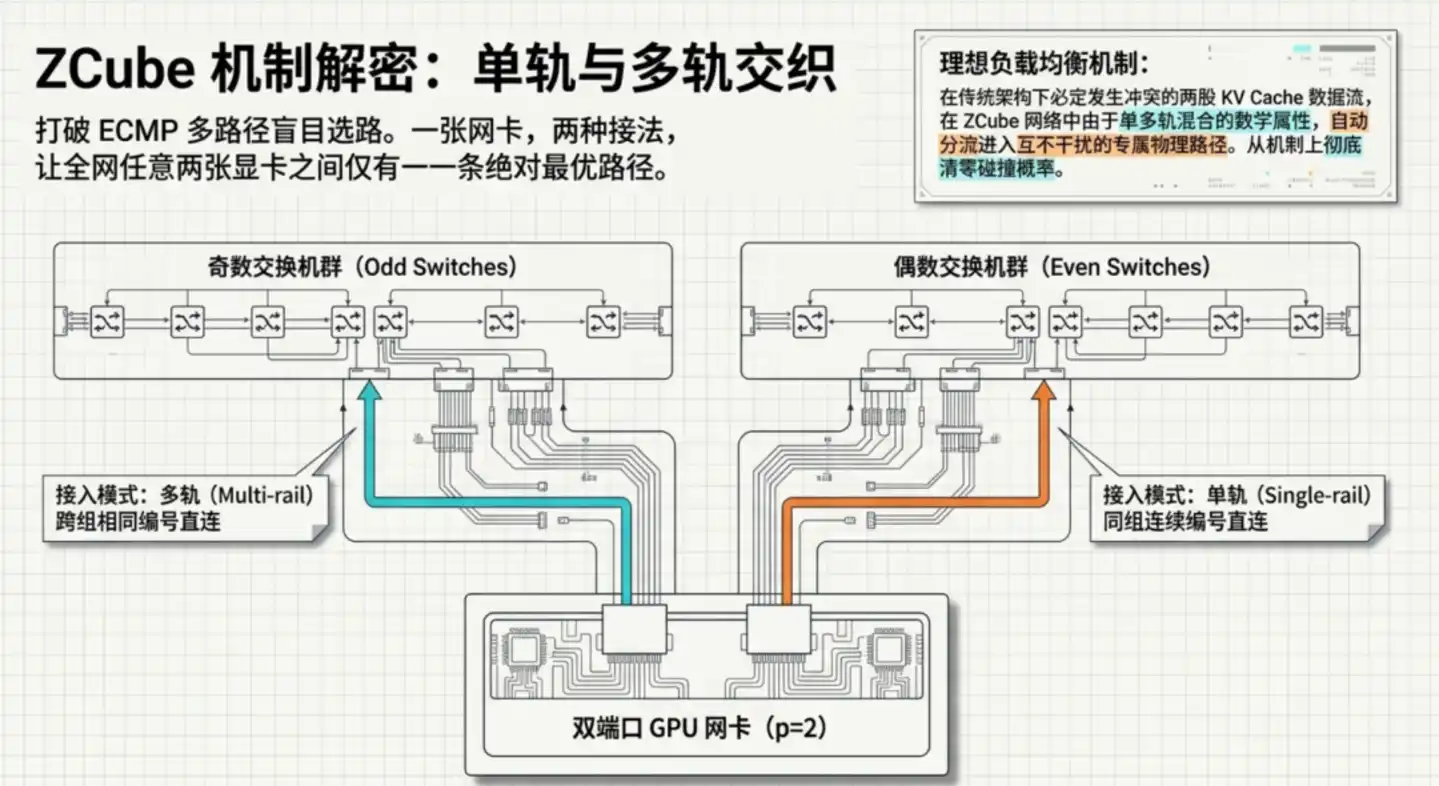
The "single path" directly eliminates the root cause of congestion. Traditional architectures are prone to hotspots precisely because there are multiple paths to choose from; if the load-balancing algorithm makes a wrong choice, traffic concentrates. ZCube eliminates "choice" itself by design: no balancing is needed because there are no forks.

04 Under the Same Hardware Conditions, How Does the Math Work?

After upgrading the GLM-5.1 production cluster from traditional ROFT to ZCube, Zhipu obtained three key numbers:

In summary, with the same GPU investment, the cluster can serve more users; with the same user experience requirements, the cluster can purchase one-third fewer network devices. Efficiency and cost are improved in both directions.
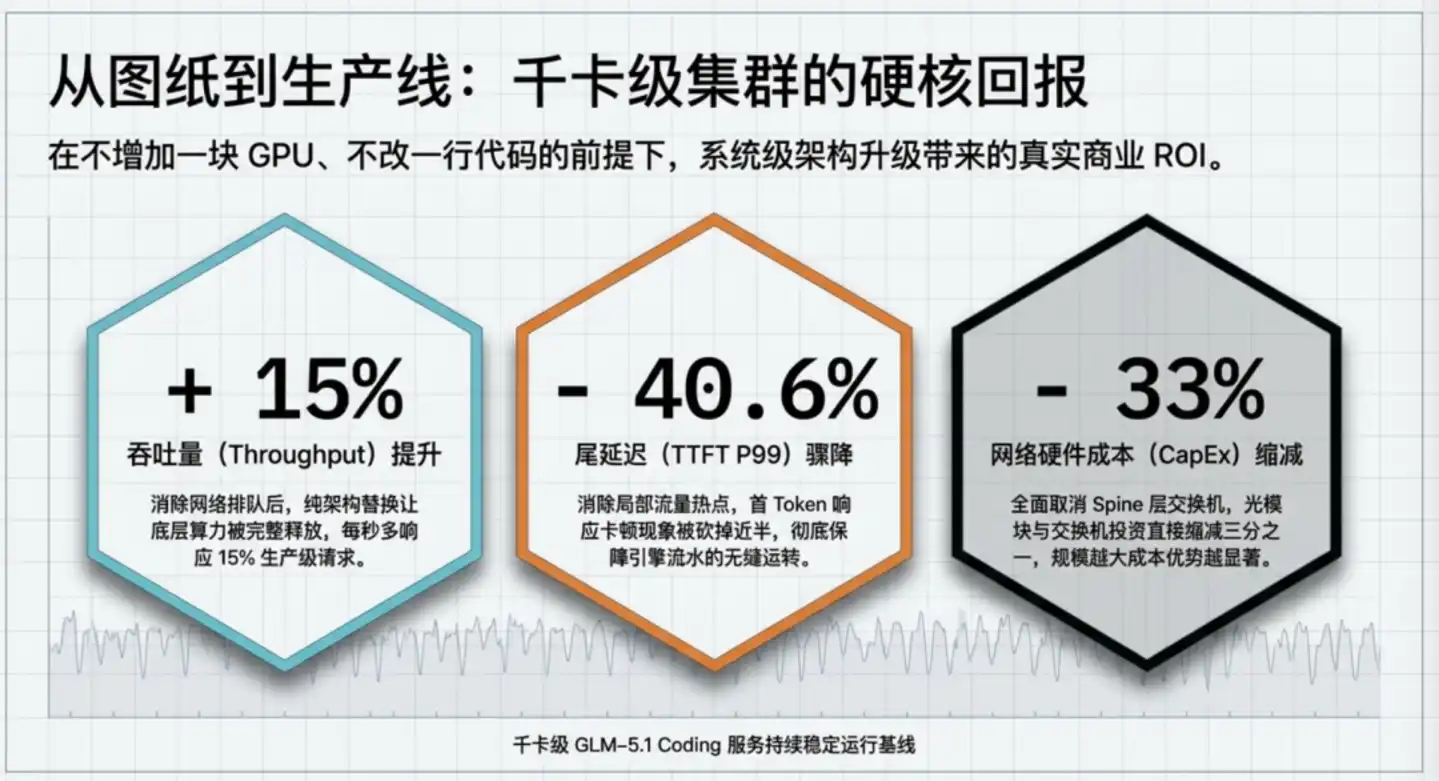
Specifically, throughput increased by 15%, equivalent to gaining 15% more computing power for free. With the same number of GPUs, a 15% higher throughput is equivalent to approximately a 13% reduction in the amortized hardware cost per token, or the ability to serve 15% more users at the same cost.

If a cluster has 1000 GPUs, this upgrade is equivalent to gaining the productive capacity of 150 additional cards for free. Based on current high-end inference GPU market prices, this represents computing power value in the billions of yuan.

A 40.6% reduction in tail latency addresses stability, not average speed. For an Agent task requiring 50 calls, if tail latency is reduced by 1 second per call, the worst-case completion time for the entire task is compressed by nearly 1 minute.

A one-third cost reduction is a direct saving at the construction level. ZCube eliminates the Spine layer, directly reducing the number of switches and optical modules required for the same cluster scale by one-third. According to Zhipu's calculations, in a ten-thousand-GPU scale cluster, this alone could save approximately 210 million to 640 million yuan.

In the long term, as cluster sizes expand exponentially, the complexity of inter-GPU communication grows manifold, and the probability and impact of congestion amplify accordingly. This means the value of architectural innovations like ZCube will accelerate as inference clusters continue to expand. The gains for tomorrow's ten-thousand-GPU clusters may far exceed today's 15%.

05 Final Thoughts

After reading Zhipu's technical report, I wondered: Could this bring a storm to the industry, much like DeepSeek's sudden emergence?

Upon careful consideration, their impacts seem to lie in different aspects. When DeepSeek emerged, it proved that the same level of intelligence could be achieved with far less computing power. The market worried that "fewer GPUs would be needed," causing NVIDIA's market cap to evaporate nearly $600 billion that day.

But Zhipu's technology today proves: The same computing power can produce more output. It is reshaping "what other infrastructure outside of GPUs should look like."

In the short term, NVIDIA may not be affected. But in the long run, the moat of GPU + NVLink interconnect + InfiniBand network + CUDA software ecosystem is being "loosened," especially the InfiniBand technology NVIDIA acquired with its $6.9 billion purchase of Mellanox in 2019. NVIDIA's premium on the network side will be significantly eroded.

Furthermore, while ZCube eliminates the Spine layer, it actually imposes higher requirements on the port density of Leaf switches. This benefits manufacturers capable of producing high-density, large-port Leaf switches (like Ruijie, Arista, Broadcom switching chips) and disadvantages those who primarily rely on high-end Spine layer switches for premium pricing.

In 2025, Celestica and NVIDIA together held about 50% of the AI backend network switch market share. This landscape faces a potential reshuffle if the ZCube paradigm proliferates.

Optical modules are the most directly beneficial segment in this industry chain change, with a very clear logic. For domestic optical module manufacturers (like Zhongji Innolight, Tianfu Communications, etc.), this is a structural positive: not only is the total volume growing, but the demand for high-speed optical modules (800G, 1.6T) under the ZCube paradigm is more concentrated and urgent compared to traditional architectures.

Whether it's TileRT or the ZCube architecture, this is a set of pure software inference engines running on standard GPUs, not reliant on NVIDIA's proprietary hardware features. In theory, they can be ported to domestic chips like Huawei's Ascend. Once this direction is viable, it will significantly lower the software stack barrier for domestic AI chips in inference scenarios.

This is perhaps the even greater significance behind this technological innovation.

Câu hỏi Liên quan

QWhat specific technical indicator triggered the surge in Zhipu AI's stock price?

AThe specific technical indicator that triggered the stock surge was the public availability of the GLM-5.1-highspeed API with an output speed of 400 tokens per second (tokens/s).

QWhy is the speed of 400 tokens/s considered a significant breakthrough according to the article?

AThe speed of 400 tokens/s is significant because it achieves extreme low latency while preserving the flagship-level full-scale base model capabilities, which is a first both domestically and internationally. This speed is crucial for AI Agent workflows involving many self-calls, where cumulative latency reduction directly impacts performance and user experience.

QWhat are the key technical innovations behind the GLM-5.1-highspeed performance, as mentioned in the text?

AThe key technical innovations are a three-layer optimization: 1) The TileRT inference engine, which compiles the model into a continuously running pipeline and uses Warp specialization for GPU efficiency. 2) Heterogeneous GPU parallelism strategies optimized for MLA's sparse indexing patterns. 3) The ZCube network architecture, which eliminates the Spine layer and creates a flat topology with unique optimal paths between GPUs to prevent congestion.

QWhat were the three key performance improvements Zhipu observed after upgrading to the ZCube architecture?

AAfter upgrading to the ZCube architecture, Zhipu observed three key improvements: 1) Throughput increased by 15%. 2) Tail latency decreased by 40.6%. 3) Infrastructure costs (for switches and optical modules) were reduced by approximately one-third.

QHow does the article differentiate the market impact of DeepSeek's arrival from that of Zhipu's current speed breakthrough?

AThe article differentiates the impacts as follows: DeepSeek demonstrated that the same level of AI intelligence could be achieved with significantly less computational power (fewer GPUs), which threatened the demand for Nvidia's hardware. In contrast, Zhipu's breakthrough demonstrates that the same amount of computational power (GPUs) can now produce more output, fundamentally redefining the infrastructure around the GPUs (like networks and switches) and potentially eroding the premium of Nvidia's integrated ecosystem, particularly in networking.

Nội dung Liên quan

CEO của Bit Digital: Tại sao tôi vẫn đang mua thêm ETH

Tác giả Sam Tabar, CEO của Bit Digital, giải thích lý do ông tiếp tục mua thêm ETH. Ông nhấn mạnh đây không phải là quyết định dựa trên chu kỳ thị trường hay các câu chuyện đầu cơ, mà là kết quả của việc phân tích dữ liệu và nhận thấy tài sản này đang bị định giá sai lệch. Ông cho rằng việc đánh giá ETH dưới góc độ "tiền tệ" là một sai lầm. Trong khi Bitcoin tập trung vào cuộc chơi đồng thuận tiền tệ, Ethereum đã lựa chọn tính hữu dụng - trở thành một lớp thanh toán có thể lập trình, nơi cả thế giới đang xây dựng. Giá trị của ETH đã hiện hữu thực tế: nó là nền tảng để phát hành stablecoin, token hóa trái phiếu kho bạc Mỹ và xử lý giao dịch cho các tác nhân AI. Đây chính là cơ sở hạ tầng thanh toán và giải quyết giao dịch mà tài chính truyền thống cần khi chuyển lên chuỗi. Theo tác giả, chất xúc tác thực sự cho việc định giá lại ETH sẽ đến từ nhu cầu thể chế, xuất hiện khi khung pháp lý, hệ thống lưu ký và môi trường quản lý đã sẵn sàng - một khoảnh khắc đang đến gần hơn so với những gì giá cả phản ánh hiện tại. Lý do cuối cùng cho việc mua vào là ETH tạo ra lợi nhuận (như lợi nhuận gộp 94,7% từ hoạt động staking trong quý I), bảo mật cho nền tảng hợp đồng thông minh hàng đầu xử lý hàng nghìn tỷ USD giao dịch mỗi năm, và đang được giao dịch ở mức chiết khấu đáng kể so với giá trị thực của cơ sở hạ tầng mà nó vận hành. Tác giả không cần ETH trở thành tiền dự trữ toàn cầu; chỉ cần nó duy trì hoạt động như hiện tại, điều đó đã đủ để ông mua và nắm giữ.

marsbit17 phút trước

CEO của Bit Digital: Tại sao tôi vẫn đang mua thêm ETH

marsbit17 phút trước

Sự Phát Triển Của Hệ Sinh Thái Cardano (ADA) Thúc Đẩy Hoạt Động Staking Tăng Mạnh

Sự tự tin và mối quan tâm của các nhà đầu tư vào Cardano (ADA) và khả năng mạng lưới của nó đang tăng mạnh, đặc biệt trong lĩnh vực staking. Trong khi giá tiếp tục chịu áp lực giảm, hoạt động staking ADA lại gia tăng đáng kể, một xu hướng góp phần tạo nên một blockchain an toàn hơn. Hoạt động staking trên Cardano đang tăng tốc. Theo dữ liệu từ nhà cung cấp cơ sở hạ tầng staking Everstake, hơn 21,75 tỷ ADA trong tổng nguồn cung 37,01 tỷ ADA hiện đang được staked, tương đương gần 58%. Con số này phản ánh mức độ tham gia lớn từ cộng đồng Cardano và là dấu hiệu vững chắc về sự gắn kết lâu dài trong hệ sinh thái. Sự gia tăng này trùng khớp với việc mở rộng cơ sở hạ tầng và hệ sinh thái của Cardano, cho thấy sự phát triển vẫn đang diễn ra mạnh mẽ. Song song đó, các "cá voi" ADA (ví giữ ít nhất 1 triệu ADA) đang tích lũy trở lại. Dữ liệu on-chain từ Santiment cho thấy các ví này hiện nắm giữ hơn 25,11 tỷ ADA, mức cao nhất kể từ tháng 12/2017, chiếm tới 67% nguồn cung ADA. Hành động tích lũy của các bên liên quan chủ chốt này thường được coi là dấu hiệu của sự tự tin và có thể là tín hiệu tăng giá trong dài hạn. Tóm lại, bất chấp biến động giá, Cardano đang chứng kiến sự tham gia staking mạnh mẽ và sự tích lũy gia tăng từ các nhà đầu tư lớn, cho thấy niềm tin vào tương lai phát triển của mạng lưới.

bitcoinist1 giờ trước

Sự Phát Triển Của Hệ Sinh Thái Cardano (ADA) Thúc Đẩy Hoạt Động Staking Tăng Mạnh

bitcoinist1 giờ trước

Claude Opus4.8 phát hành, Anthropic bắt đầu biến 'sự tin cậy' thành điểm bán hàng của sản phẩm

Claude Opus 4.8 chính thức ra mắt, giữ nguyên giá và đạt vị trí dẫn đầu trong năm trên sáu bài kiểm tra chuẩn mực. Điểm nổi bật của bản phát hành này không nằm ở việc tăng hiệu suất đơn thuần, mà nằm ở việc Anthropic bắt đầu định vị "độ tin cậy" là ưu tiên cốt lõi của mô hình tiên phong. Đáng chú ý, tỷ lệ báo cáo thiếu về lỗi của chính mô hình trong các tác vụ mã đã giảm mạnh từ 19.7% xuống còn 3.7%. Claude Code giờ đây tích hợp luồng công việc động, cho phép điều phối nhiều tác nhân con và thực hiện kiểm tra đối kháng tự động trước khi giao kết quả. Những cải tiến này nhằm giải quyết nỗi lo ngại thực tế: khi AI chuyển từ cửa sổ trò chuyện sang quy trình công việc thực, nguy cơ lớn nhất thường là nó đưa ra câu trả lời trông có vẻ hoàn chỉnh nhưng lại sai. Ngoài ra, Opus 4.8 có những cải thiện đáng kể trong các bài kiểm tra trách nhiệm, toán học và xử lý ngữ cảnh dài. Mặc dù vậy, báo cáo hệ thống cũng ghi nhận một số điểm yếu so với phiên bản trước, như khả năng kháng prompt injection và hiệu suất trong một số bài kiểm tra chuyên môn. Bản phát hành này đánh dấu sự chuyển hướng trong cuộc đua mô hình: từ việc chỉ theo đuổi điểm số chuẩn mực sang việc tranh giành độ tin cậy, khả năng xác minh và thừa nhận sai sót. Điều này là tiền đề để các Agent AI thực sự trở nên hữu dụng. Anthropic cũng xác nhận một mô hình cấp độ "Mythos" mạnh hơn nhiều, hiện đang bị hạn chế truy cập, sẽ được ra mắt trong vài tuần tới, với Opus 4.8 đóng vai trò là bước đệm công khai hướng tới nó.

marsbit2 giờ trước

Claude Opus4.8 phát hành, Anthropic bắt đầu biến 'sự tin cậy' thành điểm bán hàng của sản phẩm

marsbit2 giờ trước

Giao dịch

Giao ngay
Hợp đồng Tương lai

Bài viết Nổi bật

AGENT S là gì

Agent S: Tương Lai của Tương Tác Tự Động trong Web3 Giới thiệu Trong bối cảnh không ngừng phát triển của Web3 và tiền điện tử, các đổi mới đang liên tục định nghĩa lại cách mà cá nhân tương tác với các nền tảng kỹ thuật số. Một dự án tiên phong như vậy, Agent S, hứa hẹn sẽ cách mạng hóa tương tác giữa con người và máy tính thông qua khung tác nhân mở của nó. Bằng cách mở đường cho các tương tác tự động, Agent S nhằm đơn giản hóa các nhiệm vụ phức tạp, cung cấp các ứng dụng chuyển đổi trong trí tuệ nhân tạo (AI). Cuộc khám phá chi tiết này sẽ đi sâu vào những phức tạp của dự án, các tính năng độc đáo của nó và những tác động đối với lĩnh vực tiền điện tử. Agent S là gì? Agent S đứng vững như một khung tác nhân mở đột phá, được thiết kế đặc biệt để giải quyết ba thách thức cơ bản trong việc tự động hóa các nhiệm vụ máy tính: Thu thập Kiến thức Cụ thể theo Miền: Khung này học một cách thông minh từ nhiều nguồn kiến thức bên ngoài và kinh nghiệm nội bộ. Cách tiếp cận kép này giúp nó xây dựng một kho lưu trữ phong phú về kiến thức cụ thể theo miền, nâng cao hiệu suất của nó trong việc thực hiện nhiệm vụ. Lập Kế Hoạch Qua Các Tầm Nhìn Nhiệm Vụ Dài Hạn: Agent S sử dụng lập kế hoạch phân cấp tăng cường kinh nghiệm, một cách tiếp cận chiến lược giúp phân chia và thực hiện các nhiệm vụ phức tạp một cách hiệu quả. Tính năng này nâng cao đáng kể khả năng quản lý nhiều nhiệm vụ con một cách hiệu quả và hiệu suất. Xử Lý Các Giao Diện Động, Không Đều: Dự án giới thiệu Giao Diện Tác Nhân-Máy Tính (ACI), một giải pháp đổi mới giúp nâng cao tương tác giữa các tác nhân và người dùng. Sử dụng các Mô Hình Ngôn Ngữ Lớn Đa Phương Thức (MLLMs), Agent S có thể điều hướng và thao tác các giao diện người dùng đồ họa đa dạng một cách liền mạch. Thông qua những tính năng tiên phong này, Agent S cung cấp một khung vững chắc giải quyết các phức tạp liên quan đến việc tự động hóa tương tác giữa con người với máy móc, mở ra nhiều ứng dụng trong AI và hơn thế nữa. Ai là Người Tạo ra Agent S? Mặc dù khái niệm về Agent S là hoàn toàn đổi mới, thông tin cụ thể về người sáng lập vẫn còn mơ hồ. Người sáng lập hiện vẫn chưa được biết đến, điều này làm nổi bật giai đoạn sơ khai của dự án hoặc sự lựa chọn chiến lược để giữ kín các thành viên sáng lập. Bất chấp sự ẩn danh, sự chú ý vẫn tập trung vào khả năng và tiềm năng của khung này. Ai là Các Nhà Đầu Tư của Agent S? Vì Agent S còn tương đối mới trong hệ sinh thái mã hóa, thông tin chi tiết về các nhà đầu tư và những người tài trợ tài chính của nó không được ghi chép rõ ràng. Sự thiếu vắng thông tin công khai về các nền tảng đầu tư hoặc tổ chức hỗ trợ dự án dấy lên câu hỏi về cấu trúc tài trợ và lộ trình phát triển của nó. Hiểu biết về sự hỗ trợ là rất quan trọng để đánh giá tính bền vững và tác động tiềm năng của dự án. Agent S Hoạt Động Như Thế Nào? Tại cốt lõi của Agent S là công nghệ tiên tiến cho phép nó hoạt động hiệu quả trong nhiều bối cảnh khác nhau. Mô hình hoạt động của nó được xây dựng xung quanh một số tính năng chính: Tương Tác Giống Như Con Người: Khung này cung cấp lập kế hoạch AI tiên tiến, cố gắng làm cho các tương tác với máy tính trở nên trực quan hơn. Bằng cách bắt chước hành vi của con người trong việc thực hiện nhiệm vụ, nó hứa hẹn nâng cao trải nghiệm người dùng. Ký Ức Tường Thuật: Được sử dụng để tận dụng các trải nghiệm cấp cao, Agent S sử dụng ký ức tường thuật để theo dõi lịch sử nhiệm vụ, từ đó nâng cao quy trình ra quyết định của nó. Ký Ức Tình Huống: Tính năng này cung cấp cho người dùng hướng dẫn từng bước, cho phép khung này cung cấp hỗ trợ theo ngữ cảnh khi các nhiệm vụ diễn ra. Hỗ Trợ OpenACI: Với khả năng chạy cục bộ, Agent S cho phép người dùng duy trì quyền kiểm soát đối với các tương tác và quy trình làm việc của họ, phù hợp với tinh thần phi tập trung của Web3. Tích Hợp Dễ Dàng với Các API Bên Ngoài: Tính linh hoạt và khả năng tương thích với nhiều nền tảng AI khác nhau đảm bảo rằng Agent S có thể hòa nhập liền mạch vào các hệ sinh thái công nghệ hiện có, làm cho nó trở thành lựa chọn hấp dẫn cho các nhà phát triển và tổ chức. Những chức năng này cùng nhau góp phần vào vị trí độc đáo của Agent S trong không gian tiền điện tử, khi nó tự động hóa các nhiệm vụ phức tạp, nhiều bước với sự can thiệp tối thiểu của con người. Khi dự án phát triển, các ứng dụng tiềm năng của nó trong Web3 có thể định nghĩa lại cách mà các tương tác kỹ thuật số diễn ra. Thời Gian Phát Triển của Agent S Sự phát triển và các cột mốc của Agent S có thể được tóm tắt trong một dòng thời gian nêu bật các sự kiện quan trọng của nó: 27 tháng 9, 2024: Khái niệm về Agent S được ra mắt trong một bài nghiên cứu toàn diện mang tên “Một Khung Tác Nhân Mở Sử Dụng Máy Tính Như Một Con Người,” trình bày nền tảng cho dự án. 10 tháng 10, 2024: Bài nghiên cứu được công bố công khai trên arXiv, cung cấp một cái nhìn sâu sắc về khung và đánh giá hiệu suất của nó dựa trên tiêu chuẩn OSWorld. 12 tháng 10, 2024: Một video trình bày được phát hành, cung cấp cái nhìn trực quan về khả năng và tính năng của Agent S, thu hút thêm sự quan tâm từ người dùng và nhà đầu tư tiềm năng. Những dấu mốc trong dòng thời gian không chỉ minh họa sự tiến bộ của Agent S mà còn chỉ ra cam kết của nó đối với sự minh bạch và sự tham gia của cộng đồng. Những Điểm Chính Về Agent S Khi khung Agent S tiếp tục phát triển, một số thuộc tính chính nổi bật, nhấn mạnh tính đổi mới và tiềm năng của nó: Khung Đổi Mới: Được thiết kế để cung cấp cách sử dụng máy tính trực quan giống như tương tác của con người, Agent S mang đến một cách tiếp cận mới cho việc tự động hóa nhiệm vụ. Tương Tác Tự Động: Khả năng tương tác tự động với máy tính thông qua GUI đánh dấu một bước tiến tới các giải pháp tính toán thông minh và hiệu quả hơn. Tự Động Hóa Nhiệm Vụ Phức Tạp: Với phương pháp mạnh mẽ của nó, nó có thể tự động hóa các nhiệm vụ phức tạp, nhiều bước, làm cho các quy trình nhanh hơn và ít sai sót hơn. Cải Tiến Liên Tục: Các cơ chế học tập cho phép Agent S cải thiện từ các trải nghiệm trước đó, liên tục nâng cao hiệu suất và hiệu quả của nó. Tính Linh Hoạt: Khả năng thích ứng của nó trên các môi trường hoạt động khác nhau như OSWorld và WindowsAgentArena đảm bảo rằng nó có thể phục vụ một loạt các ứng dụng rộng rãi. Khi Agent S định vị mình trong bối cảnh Web3 và tiền điện tử, tiềm năng của nó để nâng cao khả năng tương tác và tự động hóa quy trình đánh dấu một bước tiến quan trọng trong công nghệ AI. Thông qua khung đổi mới của mình, Agent S minh họa cho tương lai của các tương tác kỹ thuật số, hứa hẹn một trải nghiệm liền mạch và hiệu quả hơn cho người dùng trên nhiều ngành công nghiệp khác nhau. Kết luận Agent S đại diện cho một bước nhảy vọt táo bạo trong sự kết hợp giữa AI và Web3, với khả năng định nghĩa lại cách chúng ta tương tác với công nghệ. Mặc dù vẫn còn ở giai đoạn đầu, những khả năng cho ứng dụng của nó là rộng lớn và hấp dẫn. Thông qua khung toàn diện của mình giải quyết các thách thức quan trọng, Agent S nhằm đưa các tương tác tự động lên hàng đầu trong trải nghiệm kỹ thuật số. Khi chúng ta tiến sâu hơn vào các lĩnh vực tiền điện tử và phi tập trung, các dự án như Agent S chắc chắn sẽ đóng một vai trò quan trọng trong việc định hình tương lai của công nghệ và sự hợp tác giữa con người với máy tính.

Tổng lượt xem 838Xuất bản vào 2025.01.14Cập nhật vào 2025.01.14

AGENT S là gì

Làm thế nào để Mua S

Chào mừng bạn đến với HTX.com! Chúng tôi đã làm cho mua Sonic (S) trở nên đơn giản và thuận tiện. Làm theo hướng dẫn từng bước của chúng tôi để bắt đầu hành trình tiền kỹ thuật số của bạn.Bước 1: Tạo Tài khoản HTX của BạnSử dụng email hoặc số điện thoại của bạn để đăng ký tài khoản miễn phí trên HTX. Trải nghiệm hành trình đăng ký không rắc rối và mở khóa tất cả tính năng. Nhận Tài khoản của tôiBước 2: Truy cập Mua Crypto và Chọn Phương thức Thanh toán của BạnThẻ Tín dụng/Ghi nợ: Sử dụng Visa hoặc Mastercard của bạn để mua Sonic (S) ngay lập tức.Số dư: Sử dụng tiền từ số dư tài khoản HTX của bạn để giao dịch liền mạch.Bên thứ ba: Chúng tôi đã thêm những phương thức thanh toán phổ biến như Google Pay và Apple Pay để nâng cao sự tiện lợi.P2P: Giao dịch trực tiếp với người dùng khác trên HTX.Thị trường mua bán phi tập trung (OTC): Chúng tôi cung cấp những dịch vụ được thiết kế riêng và tỷ giá hối đoái cạnh tranh cho nhà giao dịch.Bước 3: Lưu trữ Sonic (S) của BạnSau khi mua Sonic (S), lưu trữ trong tài khoản HTX của bạn. Ngoài ra, bạn có thể gửi đi nơi khác qua chuyển khoản blockchain hoặc sử dụng để giao dịch những tiền kỹ thuật số khác.Bước 4: Giao dịch Sonic (S)Giao dịch Sonic (S) dễ dàng trên thị trường giao ngay của HTX. Chỉ cần truy cập vào tài khoản của bạn, chọn cặp giao dịch, thực hiện giao dịch và theo dõi trong thời gian thực. Chúng tôi cung cấp trải nghiệm thân thiện với người dùng cho cả người mới bắt đầu và người giao dịch dày dạn kinh nghiệm.

Tổng lượt xem 1.5kXuất bản vào 2025.01.15Cập nhật vào 2025.03.21

Làm thế nào để Mua S

Thảo luận

Chào mừng đến với Cộng đồng HTX. Tại đây, bạn có thể được thông báo về những phát triển nền tảng mới nhất và có quyền truy cập vào thông tin chuyên sâu về thị trường. Ý kiến ​​của người dùng về giá của S (S) được trình bày dưới đây.

活动图片