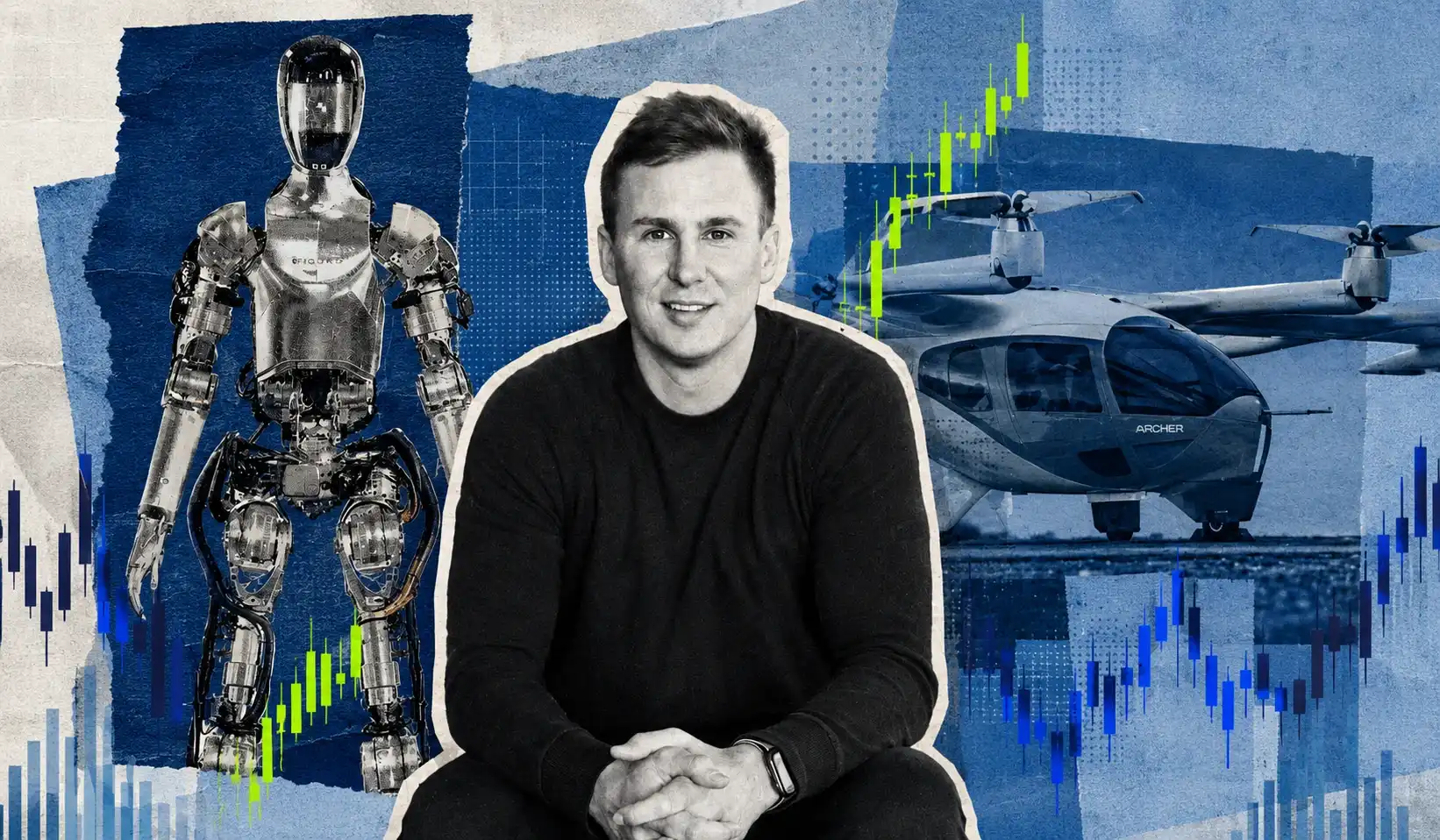
From Farm to Entrepreneur: After Building Flying Cars, He Bet on the Robot Sector and Created a $39 Billion Giant

marsbitXuất bản vào 2026-05-20Cập nhật gần nhất vào 2026-05-20

Tóm tắt

From Farm to Tech Tycoon: Brett Adcock's Journey to a $39B Robot Giant Brett Adcock, a serial entrepreneur from an Illinois farm, has built his third major venture, humanoid robotics company Figure AI, into a $39 billion behemoth backed by NVIDIA, Intel, and others. His path began with the sale of his recruiting platform Vettery for $110 million in 2018. He then co-founded and took electric air taxi company Archer Aviation public in 2021 before departing over strategic differences. Adcock founded Figure AI in 2022 with a 30-year vision to create general-purpose humanoid robots that can work in human-designed environments, aiming to address labor shortages in manufacturing, logistics, and retail. The company gained attention through live-streamed robot sorting challenges and a viral demo, though it faces skepticism over its high valuation versus early commercial progress. A key moment was Figure's split from OpenAI in 2024 after a brief collaboration, with Adcock claiming OpenAI provided limited value and deciding to develop AI models internally—a move OpenAI contested. Adcock's pattern is tackling capital-intensive, long-term tech frontiers, moving from software to aviation to robotics, betting on AI and automation as the future of labor.

Author: Zen, PANews

Humanoid robotics company Figure AI recently initiated a "Human vs. Robot" parcel sorting challenge, attracting global attention. This competition, narrowly won by humans, led many to conclude that "humans won the present but lost the future." This statement is not baseless. Before the competition began, Figure had already started a live stream of robot sorting, which has now been broadcasting continuously for seven days. In terms of tireless endurance and continuous work capability, robots far surpass humans.

This sorting challenge live stream, along with the earlier heavyweight promotional video for a home robot, has also earned Figure the label of being a showman. However, there is no doubt that Figure AI is becoming one of Silicon Valley's most-watched humanoid robotics companies. This company, founded just three years ago, saw its valuation soar to $39 billion after a new round of financing, with investors including top-tier corporations and capital such as NVIDIA, Intel Capital, Salesforce, LG, and Qualcomm.

Standing behind this company is serial entrepreneur Brett Adcock, who hails from a farm. Before founding Figure, he had already had two distinct entrepreneurial experiences. First, he built the recruitment platform Vettery, selling it to the Adecco Group for $110 million in 2018. Subsequently, he co-founded electric vertical takeoff and landing (eVTOL) aircraft company Archer Aviation, driving its listing on the New York Stock Exchange in 2021.

Brett Adcock is not a founder who has dug deep in one industry over a long period. Instead, he continuously ventures into more complex, capital-intensive, and harder-to-validate fields. Figure is his most high-profile bet to date, placing him at the center of the AI robotics boom.

Surrounding this company, there are grand visions about a general-purpose robotic workforce, as well as skepticism regarding overvaluation, premature commercialization, safety risks, and technological approaches. To understand Figure, one must first understand how its founder has progressed step by step to reach this point.

Serial Entrepreneur from a Corn and Soybean Farm

Brett Adcock was born in 1986 on a corn and soybean farm in central Illinois. Growing up in this multi-generational farming family environment instilled in Adcock a strong emphasis on "how to create value for the world from scratch." He began starting internet companies at the age of 16. By the time he graduated as valedictorian of his high school class, his family clearly understood that he should perhaps leave the farm and venture into the world of entrepreneurship and business.

Brett Adcock during childhood

During university, Adcock continued to independently develop various software, initially creating a website selling outdoor electronics. Later, he focused his efforts on the job recruitment sector, developing content websites to help job seekers prepare for interviews in fields like finance ("Street of Walls"), a mobile job search app ("Working App"), and a video interview website. These projects were not successful and resembled early, immature entrepreneurial experiments.

In 2012, while striving in New York, Adcock turned his attention back to the recruitment market. He co-founded Vettery with Adam Goldstein. Initially, Vettery was a platform targeting third-party recruitment agencies, but this model was quickly proven uncompetitive. After several adjustments, Adcock and the team decided to pivot, placing job seekers and companies directly on the same platform and improving matching efficiency through software and machine learning.

Brett Adcock (5th from right) with his team

After the Vettery platform launched, growth accelerated. Adcock later recalled that platform users experienced consecutive weeks of doubling growth. By 2017, Vettery's employee count had grown to 300, with about 20,000 clients and approximately 30,000 interviews conducted monthly through the system. The company also caught the attention of the world's largest recruitment company, the Adecco Group, and was acquired by the latter for $110 million in 2018.

This transaction provided Adcock, just past his thirties, with a substantial personal fortune. He began looking for more complex, longer-cycle problems that also required capital and engineering prowess, specifically in hardware and sustainable development. Thus, he moved west to California, heading to Silicon Valley to seek the next opportunity.

In Three Years, Building a Flying Car Startup into a Public Company

Aiming to tackle more challenging problems, Adcock could no longer randomly throw out ideas and conduct low-cost experiments like he did in university. After careful consideration, he chose to focus on solving transportation problems by entering the three-dimensional airspace. Adcock wanted to try creating the flying cars seen in sci-fi movies, making electric vertical takeoff and landing (eVTOL) aircraft the most suitable choice.

In 2018, Adcock teamed up with Adam Goldstein again to co-found Archer Aviation. Compared to Vettery, Archer was an entirely different world. It required a top-tier engineering team, hardware R&D, supply chain management, engineering manufacturing, aviation certification, public safety, and long-term patience from capital markets.

The founding of Archer Aviation also involved a fortuitous opportunity. At the time, French aviation giant Airbus was relocating all its flying car "Vahana" business to France, and flight car company Kitty Hawk's cost-cutting measures due to its partnership with Boeing caused dissatisfaction among some engineering team members (Kitty Hawk later dissolved in 2022). Seizing the opportunity, Adcock absorbed a large number of personnel from these two projects, rapidly assembling a seasoned team.

In 2021, Adcock and his team successfully conducted the maiden flight of the full-scale, two-seat, autonomous prototype aircraft "Maker." They also partnered with automotive giant Fiat Chrysler on supply chain, advanced composite materials, and engineering, design, and production aspects, and secured a $1 billion order from United Airlines. That same year, Archer Aviation went public on the New York Stock Exchange via a SPAC merger, valued at approximately $2.7 billion. Today, the company's market capitalization stands at $4.5 billion and it is part of Cathie Wood's Ark Invest portfolio.
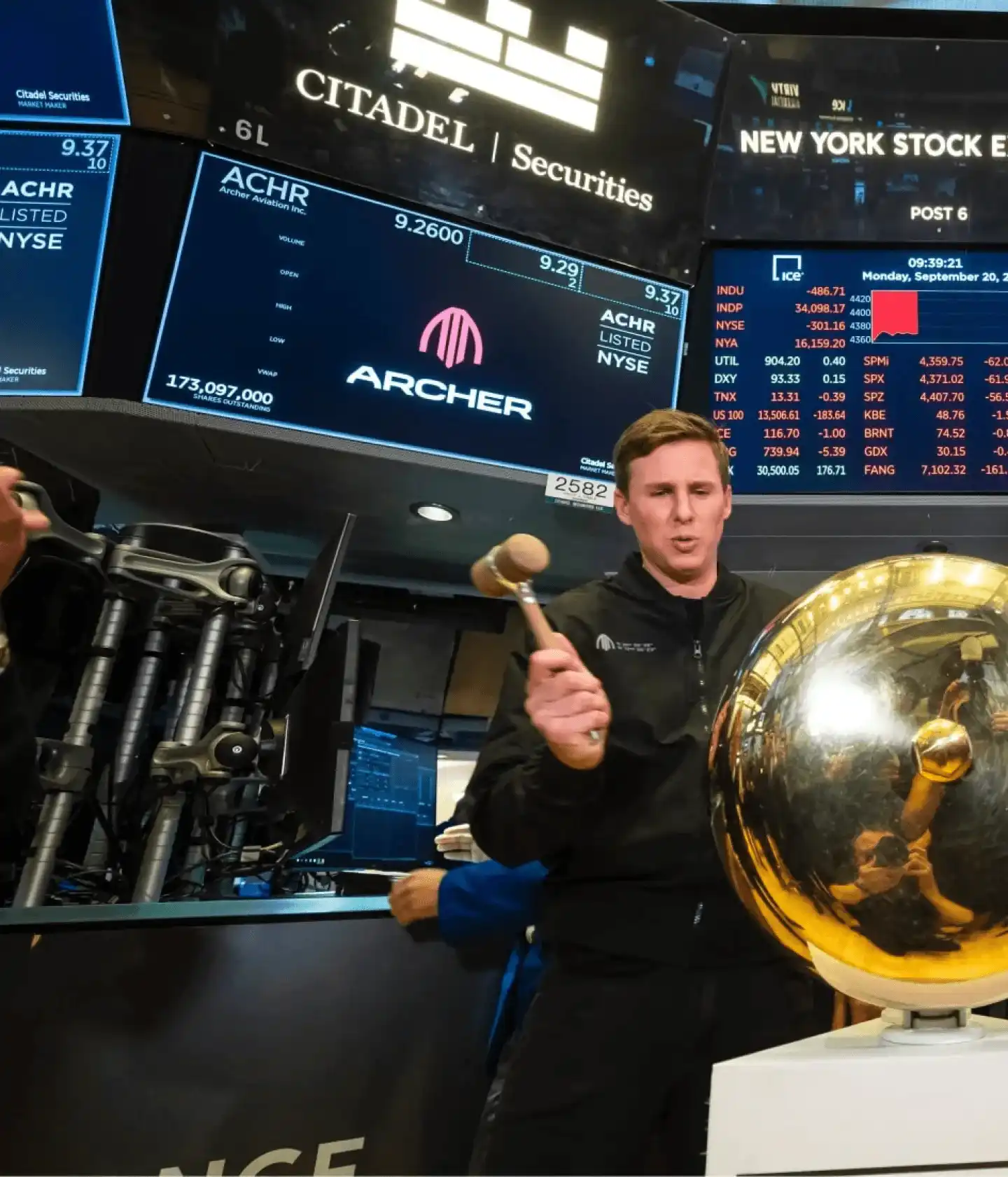
Brett Adcock rings the opening bell at the NYSE

Despite entering the market relatively late, Archer Aviation's rapid rise has made it a major contender in the emerging eVTOL industry. In November 2022, Archer's five-seater "Midnight" aircraft made a stunning debut. Once it receives type certification from the Federal Aviation Administration (FAA), it will become the company's first air taxi product.

However, Adcock quietly left the company shortly after its IPO. In April 2022, Archer announced that Adam Goldstein would serve as the sole CEO, with Adcock stepping down as co-CEO but remaining on the board. The company explained at the time that the move was to simplify the operating structure and advance flight testing, certification, and commercialization.

The real reason for his departure may be more complex and is unknown to the public. Judging by the company's stock performance, it was indeed in a post-IPO slump. Adcock later stated that he left Archer due to "differences" with the board, especially after the company went public, regarding what he wanted to do versus what the team wanted to do.

Perhaps for him, the governance of a public company, the regulatory path, and the pace of commercialization no longer suited a founder who always wanted to leap into the next technological revolution.

Final Venture? Adcock Plans to Build Figure with a 30-Year Vision

After leaving Archer, Adcock quickly entered the next equally sci-fi and currently even larger bet. In 2022, he founded Figure AI, entering the field of general-purpose humanoid robotics. In Figure's Master Plan, he wrote that his goal is to build the company with a 30-year vision, investing time and resources into "maximizing utility impact on humanity."

Regarding team composition, Adcock adopted a strategy similar to when he founded Archer. He rapidly assembled a team of 60 people, with members primarily hailing from renowned companies and projects such as Boston Dynamics, Tesla, Apple's autonomous vehicle project, and Google DeepMind.
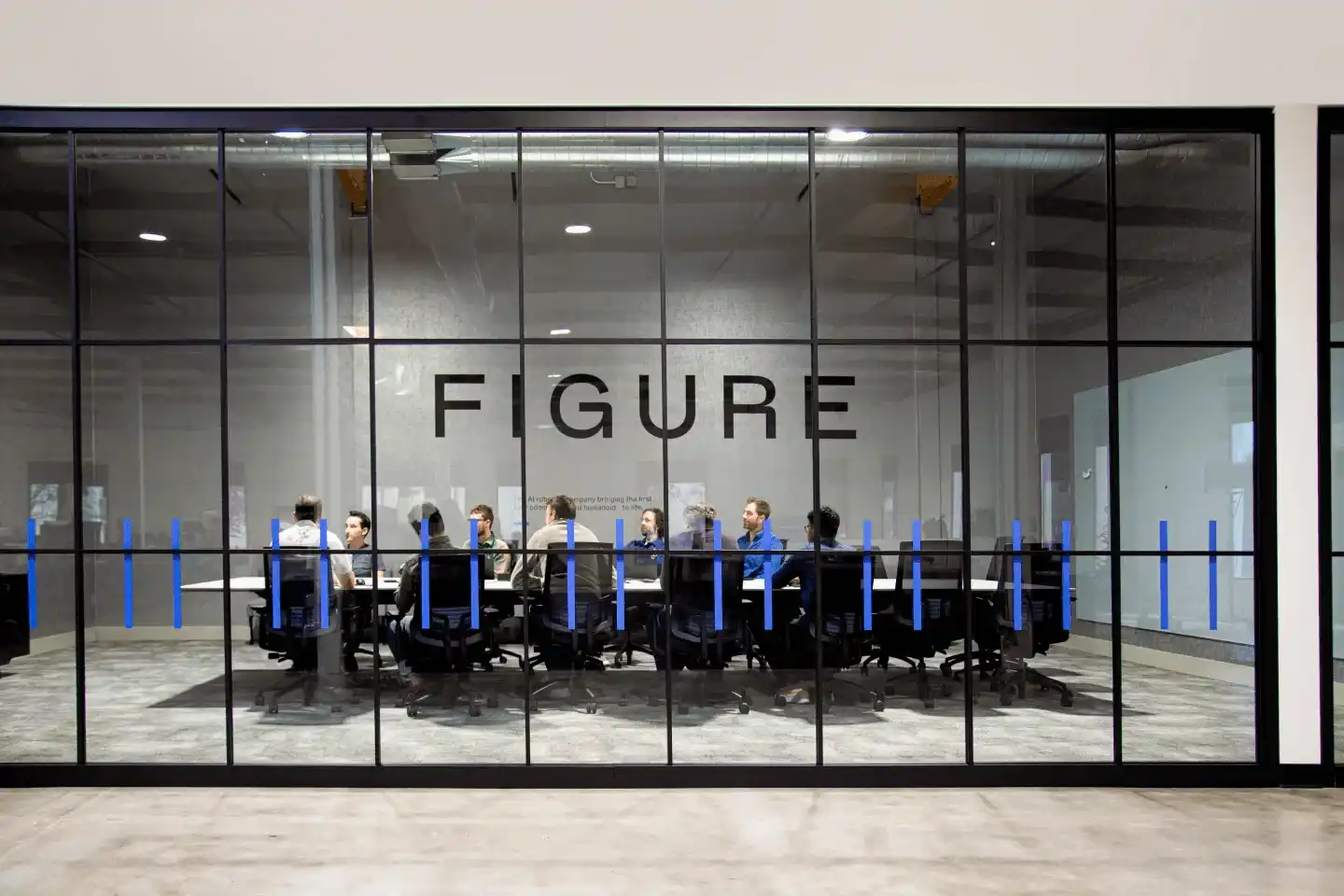
Giving AI a physical body is the proposition Adcock set for Figure. Figure aims not to create industrial robotic arms or service robots, but rather general-purpose humanoid robots capable of entering human environments, using human tools, and performing a variety of tasks. Adcock believes that the world is inherently designed for the human body; therefore, creating robots that interact with the world in a similar way can automate a vast amount of work.

The underlying rationale for this vision is Adcock's assessment of the labor market. In Figure's Master Plan, he writes that the United States has over 10 million "unsafe or undesirable" jobs, and an aging population will further exacerbate the difficulty for businesses to expand their workforce. If the economy is to continue growing, it requires more productivity, which in turn demands more automation. Consequently, Figure has identified manufacturing, logistics, warehousing, retail, and home scenarios as its long-term directions.

As Figure's valuation rises, the skepticism directed at Adcock intensifies. The first category of doubt centers on the vast gap between commercialization and valuation. Essentially, the market is buying a distant future expectation. While Figure has attracted market enthusiasm with a valuation nearing $40 billion, its revenue scale and mass production capabilities remain limited. Its future revenue projections heavily rely on the ability to deploy a large number of robots before 2029.

Furthermore, Figure's split with OpenAI has attracted significant attention and controversy. In 2024, Figure partnered with OpenAI to develop next-generation robot AI models and received investment support from OpenAI, Microsoft, NVIDIA, Jeff Bezos, and others. However, less than a year later, Adcock decided to terminate the partnership and instead develop the models internally.

According to Business Insider, Adcock later stated that OpenAI brought little value to Figure beyond its brand, and that robot AI requires a different technical approach than chatbots. He also mentioned that when OpenAI indicated it wanted to build its own humanoid robots, he considered the partnership over. The report also noted that a technical employee from OpenAI shared a related clip, calling Adcock's claims "untrue."

"Preference" for More Difficult Problems and Larger Narratives

Looking back at Adcock's three main entrepreneurial ventures, Vettery, Archer, and Figure appear unrelated on the surface—one is a recruitment platform, one is a flying car company, and one is a humanoid robot company. However, they share the same entrepreneurial philosophy: targeting a massive, inefficient market where a technological inflection point is emerging, and advancing simultaneously with capital, engineering teams, and bold narratives.

With Vettery, he bet that machine learning could improve recruitment matching efficiency. With Archer, he bet that batteries, motors, and aerospace engineering could unlock urban air mobility. With Figure, he is betting that AI models, robotic hardware, and manufacturing capabilities can fuse into a new type of labor force. Adcock's thinking does not start from a single-point product but works backward from "how the future world should operate" to determine what kind of company to build today.

Brett Adcock's career resembles a curve of increasing asset intensity: from software platforms to aircraft, and then to humanoid robots. He is not a technical expert who has dug deep in a single field for decades. He is more like an "entrepreneurial hunter," sensing opportunities, organizing resources, recruiting teams, amplifying the narrative, and then moving on.

Now, standing under the spotlight of Figure AI, he faces skepticism as loud as the applause. But regardless of the outcome, he has already etched his name into the first chapter of AI robotics business history.


Câu hỏi Liên quan

QWhat is Figure AI and why has it attracted significant attention recently?

AFigure AI is a humanoid robotics company. It recently gained global attention by hosting a 'Human vs. Robot' parcel sorting challenge and conducting a 7-day live stream of its robots performing sorting tasks. The company, founded just three years ago, reached a valuation of $390 billion after a new funding round, attracting investments from top-tier firms like NVIDIA, Intel Capital, Salesforce, LG, and Qualcomm.

QWho is Brett Adcock and what are his previous entrepreneurial ventures?

ABrett Adcock is a serial entrepreneur and the founder of Figure AI. His previous ventures include co-founding Vettery, a recruitment platform sold to the Adecco Group for $110 million in 2018, and co-founding Archer Aviation, an electric vertical takeoff and landing (eVTOL) aircraft company that went public on the NYSE in 2021.

QWhat is the core mission and long-term vision Brett Adcock has for Figure AI?

ABrett Adcock's mission for Figure AI is to build general-purpose humanoid robots that can operate in human environments, use human tools, and perform a variety of tasks. He views this as a 30-year project aimed at maximizing utility for humanity by automating labor in sectors like manufacturing, logistics, warehousing, retail, and eventually homes, to address workforce shortages and boost productivity.

QWhy did Brett Adcock leave Archer Aviation shortly after it went public?

AAdcock left his co-CEO role at Archer Aviation due to what he later described as a 'misalignment' with the board. After the company went public, he felt that what he wanted to do differed from what the team wanted to do. This suggests disagreements over the company's direction, governance, and commercialization pace post-IPO.

QWhat are some of the major challenges and criticisms facing Figure AI?

AFigure AI faces several criticisms: 1) Its $390 billion valuation is seen as extremely high compared to its current commercial scale and production capabilities. 2) Its revenue projections depend heavily on deploying large numbers of robots by 2029, which is uncertain. 3) It ended a high-profile partnership with OpenAI on robot AI models, citing a divergence in technical needs and OpenAI's own robotics ambitions, a move that was publicly disputed.

Nội dung Liên quan

Nền tảng định giá nghìn tỷ của SpaceX: Ai đang chia phần trăm tỷ chi tiêu vốn hàng năm của Musk?

Bài viết phân tích cơ hội đầu tư vào chuỗi cung ứng của SpaceX, cho rằng thay vì mua cổ phiếu SpaceX trực tiếp với định giá cao, nhà đầu tư có thể xem xét các công ty cung cấp linh kiện, vật liệu và dịch vụ quan trọng cho tập đoàn này. Bài viết chia các nhà cung cấp thành ba loại dựa trên mức độ thay thế: 1. **Khó thay thế trong ngắn hạn:** Bao gồm NVIDIA (GPU và nền tảng CUDA), Eutelsat (phổ tần số vệ tinh), Filtronic (bộ khuếch đại tín hiệu milimet), Materion (kim loại beryllium) và STMicroelectronics (chip cho ăng-ten phased array). 2. **Có thể thay thế về kỹ thuật nhưng chi phí chuyển đổi cao:** Bao gồm Honeywell (hệ thống điều khiển chuyến bay và dẫn đường), Carpenter Technology (hợp kim thép đặc biệt cho động cơ), Hexcel (sợi carbon), Broadcom (chuyển mạch dữ liệu) và Linde (khí công nghiệp). 3. **Đòi hỏi sản xuất ổn định với chi phí thấp:** Đây chủ yếu là các nhà sản xuất linh kiện điện tử và cơ khí, như Wistron NeWeb (gia công thiết bị đầu cuối Starlink), cùng một số công ty Trung Quốc (như Sunway Communication, Paike New Materials, Western Superconducting, Yingliu Shares) cung cấp các bộ phận kết nối, rèn, hợp kim và đúc then chốt. Ngoài ra còn có các công ty chuyên về cảm biến, ăng-ten, đồng hồ, phân phối điện và tản nhiệt. Bài viết lập luận rằng cơ hội hiện tại đến từ việc khối lượng mua hàng của SpaceX mới chỉ bắt đầu tăng (với mục tiêu 100 lần phóng vào năm 2026 và 30 triệu thiết bị đầu cuối Starlink), tính minh bạch được cải thiện sau khi SpaceX lên sàn, và chu kỳ phát triển tương tự các chuỗi cung ứng Apple hay Tesla trong quá khứ. Lưu ý: Bài viết không phải là lời khuyên đầu tư và cảnh báo về các rủi ro như tính chu kỳ của nguyên liệu, rủi ro địa chính trị hay sự thay đổi công nghệ.

链捕手3 phút trước

Nền tảng định giá nghìn tỷ của SpaceX: Ai đang chia phần trăm tỷ chi tiêu vốn hàng năm của Musk?

链捕手3 phút trước

Chính phủ Mỹ cấm mô hình Anthropic, hoàn toàn không phải vì 'vượt rào'

Tuần trước, Bộ Thương mại Hoa Kỳ đã ra lệnh cho Anthropic ngừng cung cấp hai mô hình AI mạnh nhất là Fable 5 và Mythos 5, viện dẫn lo ngại an ninh quốc gia. Dù Anthropic ban đầu suy đoán lý do liên quan đến việc bỏ qua "hàng rào an toàn" của mô hình, nhiều chi tiết mới cho thấy động cơ thực sự có thể là sự trả đũa từ chính quyền Trump sau mối quan hệ rạn nứt với công ty, chứ không phải vấn đề kỹ thuật. Lệnh cấm, được ban hành nhanh chóng và đơn phương mà không cần phê chuẩn của tòa án, buộc Anthropic phải gỡ toàn bộ sản phẩm. Các chuyên gia an ninh mạng, như Katie Moussouris, chỉ ra rằng lỗ hổng được báo cáo trong nghiên cứu của Anthropic là rất nhỏ và không đáng để áp dụng biện pháp kiểm soát xuất khẩu nghiêm ngặt như vậy. Bà cùng hàng chục chuyên gia khác kêu gọi thu hồi lệnh này, cảnh báo việc tước đi công cụ AI tiên tiến khỏi các chuyên gia phòng thủ mạng Mỹ là nguy hiểm. Hành động của chính phủ được nhận định là thiếu cân nhắc, có thể làm giảm niềm tin của các quốc gia khác vào tính ổn định của AI Mỹ và tạo ra tiền lệ đáng lo ngại về việc chính phủ can thiệp vào hoạt động của công ty công nghệ. Sự việc này được xem như một hồi chuông cảnh báo cho toàn bộ ngành công nghệ Mỹ về quyền lực mà chính phủ có thể sử dụng để đóng cửa sản phẩm của họ.

marsbit8 phút trước

Chính phủ Mỹ cấm mô hình Anthropic, hoàn toàn không phải vì 'vượt rào'

marsbit8 phút trước

Ray Dalio: Thị trường tăng giá AI tiếp tục tăng tốc, nhà đầu tư nên All In hay thoát vốn rút lui?

Bài viết thảo luận về cách nhà đầu tư nên tiếp cận thị trường tài chính hiện nay, đặc biệt trong bối cảnh AI đang thúc đẩy sự tăng trưởng mạnh mẽ nhưng cũng làm gia tăng mức độ tập trung rủi ro. Ray Dalio chỉ ra rằng, mặc dù công nghệ mang tính cách mạng, nhưng cổ phiếu trong ngành không phải lúc nào cũng hấp dẫn. Lịch sử cho thấy các công ty công nghệ lớn như Microsoft hay Apple cũng từng trải qua những đợt điều chỉnh mạnh. Cốt lõi bài viết nhấn mạnh vào sự nguy hiểm của việc đầu tư tập trung vào một số ít cổ phiếu AI khi thị trường đang ở trạng thái kích thích, định giá cao và chứa đựng nhiều bất ổn như cạnh tranh gia tăng, rủi ro địa chính trị, chính sách thuế và khả năng bị công nghệ mới lật đổ. Thay vì đặt cược lớn, Dalio khuyên các nhà đầu tư nên áp dụng triết lý "đa dạng hóa" – xây dựng một danh mục gồm khoảng 15 khoản đầu tư chất lượng, có mối tương quan thấp và được cân bằng rủi ro. Ông lập luận rằng một danh mục đa dạng hóa tốt sẽ mang lại tỷ lệ lợi nhuận/rủi ro vượt trội về mặt toán học so với một khoản đầu tư tập trung. Điều quan trọng là nhận thức được những gì mình không biết, và không nên nhầm lẫn giữa sự phấn khích với công nghệ mới với sự hấp dẫn thực sự của cổ phiếu. Trong môi trường hiện tại, việc tránh tập trung và duy trì đa dạng hóa được xem là cách tiếp cận khôn ngoan nhất.

marsbit11 phút trước

Ray Dalio: Thị trường tăng giá AI tiếp tục tăng tốc, nhà đầu tư nên All In hay thoát vốn rút lui?

marsbit11 phút trước

World Cup mới đá được vài ngày, AI dự đoán đã có mô hình trở thành 'thần', có mô hình 'đắm thuyền'

Giải đấu World Cup mới chỉ bắt đầu được vài ngày, nhưng các mô hình AI dự đoán kết quả bóng đá đã cho thấy sự khác biệt rõ rệt: có mô hình tỏ ra "thần thánh", có mô hình lại "lật kèo". Nơi sôi động nhất không chỉ là trên sân cỏ. Khi thị trường dự đoán World Cup nóng lên, người dùng ngày càng sử dụng tiền thật để giao dịch các sự kiện dự đoán như đội thắng, tỷ số, bàn thắng hay thẻ đỏ. Trong bối cảnh này, các mô hình AI lớn như Qwen (Thiên Vấn), ChatGPT, Gemini, Claude, DeepSeek và Copilot đã thường xuyên được đưa vào hỗ trợ phân tích, cung cấp thêm một lớp tham khảo bên cạnh tỷ lệ cược và dữ liệu đội bóng. Kết quả những trận đầu tiên đã cho thấy sự khác biệt: * **Qwen (Thiên Vấn)** gây ấn tượng mạnh ngay ngày khai mạc, dự đoán chính xác tỷ số 2-0 của Mexico thắng Nam Phi và 2-1 của Hàn Quốc thắng Cộng hòa Séc, đồng thời cảnh báo được nguy cơ nhận thẻ đỏ. * **Copilot** có những dự đoán tỷ số chính xác đáng chú ý (Mexico 2-0 Nam Phi, Hàn Quốc 2-1 CH Séc, Brazil 1-1 Morocco) nhưng cũng "lật kèo" ở một số trận, đặc biệt là các trận có kết quả lạc hướng so với sức mạnh trên giấy tờ như Úc thắng Thổ Nhĩ Kỳ hay Nhật Bản cầm hòa Hà Lan. * **ChatGPT** thể hiện khả năng phân tích toàn diện với các lý do chi tiết (như lợi thế sân nhà, độ cao, phong độ) và cũng đoán đúng một số tỷ số, nhưng có vẻ vẫn thiên về các đội cửa trên và chưa thực sự nhạy bén trong việc phát hiện các khả năng gây bất ngờ. * Các mô hình khác như **Gemini, Grok, Claude** cũng được thử nghiệm cho cùng một trận đấu và đưa ra các kịch bản tỷ số khác nhau, cho thấy sự đa dạng trong cách tiếp cận. Tóm lại, với số lượng mẫu dự đoán có thể kiểm chứng còn hạn chế, chưa thể kết luận mô hình nào "hiểu bóng đá" nhất. Tuy nhiên, AI đã chứng minh có thể trở thành một công cụ tham khảo hữu ích cho người tham gia thị trường dự đoán, dù vẫn còn rất xa để được coi là câu trả lời chuẩn mực. Khả năng nắm bắt các chi tiết cụ thể (tỷ số, thẻ đỏ, diễn biến trận đấu) và dự cảm về các kết quả bất ngờ vẫn là thách thức lớn với các mô hình hiện tại.

marsbit12 phút trước

World Cup mới đá được vài ngày, AI dự đoán đã có mô hình trở thành 'thần', có mô hình 'đắm thuyền'

marsbit12 phút trước

Giao dịch

Giao ngay
Hợp đồng Tương lai

Bài viết Nổi bật

Làm thế nào để Mua ZEN

Chào mừng bạn đến với HTX.com! Chúng tôi đã làm cho mua Horizen (ZEN) trở nên đơn giản và thuận tiện. Làm theo hướng dẫn từng bước của chúng tôi để bắt đầu hành trình tiền kỹ thuật số của bạn.Bước 1: Tạo Tài khoản HTX của BạnSử dụng email hoặc số điện thoại của bạn để đăng ký tài khoản miễn phí trên HTX. Trải nghiệm hành trình đăng ký không rắc rối và mở khóa tất cả tính năng. Nhận Tài khoản của tôiBước 2: Truy cập Mua Crypto và Chọn Phương thức Thanh toán của BạnThẻ Tín dụng/Ghi nợ: Sử dụng Visa hoặc Mastercard của bạn để mua Horizen (ZEN) ngay lập tức.Số dư: Sử dụng tiền từ số dư tài khoản HTX của bạn để giao dịch liền mạch.Bên thứ ba: Chúng tôi đã thêm những phương thức thanh toán phổ biến như Google Pay và Apple Pay để nâng cao sự tiện lợi.P2P: Giao dịch trực tiếp với người dùng khác trên HTX.Thị trường mua bán phi tập trung (OTC): Chúng tôi cung cấp những dịch vụ được thiết kế riêng và tỷ giá hối đoái cạnh tranh cho nhà giao dịch.Bước 3: Lưu trữ Horizen (ZEN) của BạnSau khi mua Horizen (ZEN), lưu trữ trong tài khoản HTX của bạn. Ngoài ra, bạn có thể gửi đi nơi khác qua chuyển khoản blockchain hoặc sử dụng để giao dịch những tiền kỹ thuật số khác.Bước 4: Giao dịch Horizen (ZEN)Giao dịch Horizen (ZEN) dễ dàng trên thị trường giao ngay của HTX. Chỉ cần truy cập vào tài khoản của bạn, chọn cặp giao dịch, thực hiện giao dịch và theo dõi trong thời gian thực. Chúng tôi cung cấp trải nghiệm thân thiện với người dùng cho cả người mới bắt đầu và người giao dịch dày dạn kinh nghiệm.

Tổng lượt xem 321Xuất bản vào 2024.12.12Cập nhật vào 2026.06.02

Làm thế nào để Mua ZEN

Thảo luận

Chào mừng đến với Cộng đồng HTX. Tại đây, bạn có thể được thông báo về những phát triển nền tảng mới nhất và có quyền truy cập vào thông tin chuyên sâu về thị trường. Ý kiến ​​của người dùng về giá của ZEN (ZEN) được trình bày dưới đây.

活动图片