Nvidia's Wednesday Earnings Night: The Battle That Decides the Fate of the AI Bull Market is Here

marsbitXuất bản vào 2026-05-18Cập nhật gần nhất vào 2026-05-18

Tóm tắt

NVIDIA is set to report its quarterly earnings after the U.S. market closes on Wednesday, May 20. This event is widely seen as a crucial test for the current AI-driven bull market. The semiconductor sector is exhibiting severe technical overbought conditions, with the Philadelphia Semiconductor Index (SOX) trading approximately 60% above its 200-day moving average—the most extreme deviation since the dot-com bubble peak of 1999/2000. Market sentiment is highly concentrated on a few AI-related stocks, raising concerns about overall market breadth. Analysts highlight a key contradiction: while fundamentals for AI and semiconductors remain strong, significant technical pressures are building. Option market activity reflects this tension. Positions are heavily skewed towards bullish calls, yet there is also notable hedging activity through put options on broad indices and sector ETFs, signaling preparation for potential downside volatility. An unusual pattern of rising stock prices alongside rising implied volatility further underscores the market's expectation for a major move. For NVIDIA specifically, the market's primary focus will be on its forward guidance for the next quarter, which is deemed more critical than the immediate earnings results. Despite a recent seven-day rally adding roughly $1.7 trillion in market cap, historical data shows NVIDIA's stock has often declined the day after its past five earnings reports. The outcome of this report is expected to have a signi...

Original Author: Zhang Yaqi

Original Source: Wall Street Insights

Nvidia is set to release its quarterly report after the US market closes on Wednesday, May 20th (Eastern Time), serving as a crucial stress test for the current AI bull market cycle. The semiconductor sector's technically overbought condition, heavily bullish options positioning, and the rare signal of "stock price and implied volatility rising simultaneously" have significantly amplified the two-way risk around this earnings window compared to the past.

In a briefing titled "Yellow Light" issued on Monday, Peter Callahan, Goldman Sachs' TMT Chief Specialist, pointed out that the Nasdaq 100 Index (NDX) and the Philadelphia Semiconductor Index (SOX) recorded their first weekly decline of the quarter last week; the 10-year Treasury yield rose to around 4.60%, marking its largest weekly increase in over a year; oil prices rebounded to approximately $109 per barrel; and the VIX moved higher concurrently. He noted that the core contradiction currently facing the AI and semiconductor themes is: fundamentals remain robust, while technical pressure continues to accumulate.

Options analytics firm SpotGamma highlighted in a recent report that the market is exhibiting a rare parallel pattern of "rising stock prices alongside climbing volatility"—typically, these two should have an inverse relationship. This signal indicates that traders are chasing gains while simultaneously paying a premium for protection against significant volatility. The implied move around Nvidia's earnings is currently priced at +/-6%, with market attention highly focused on this event.
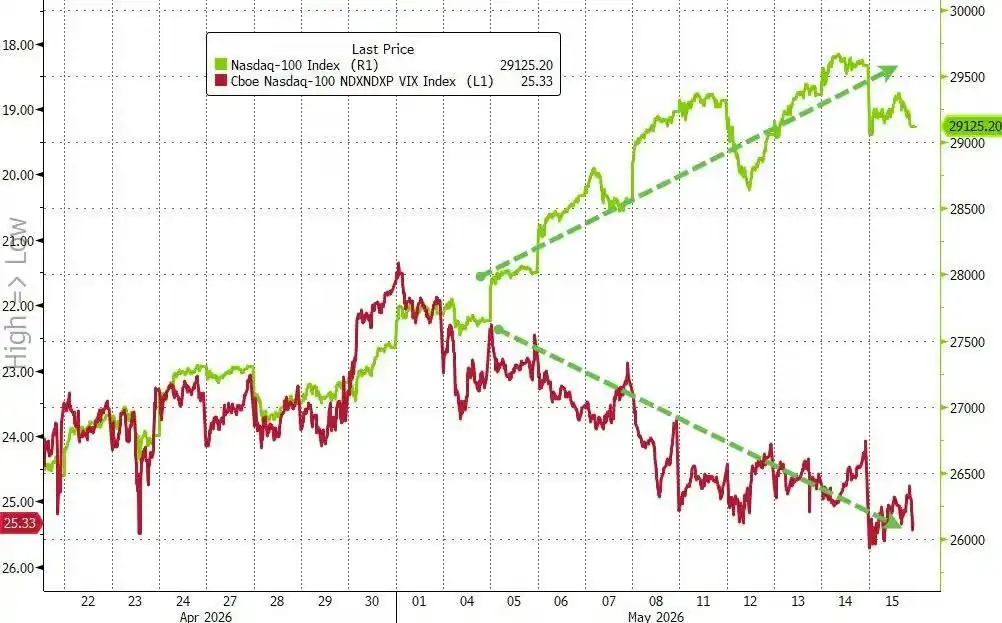
The earnings results and forward guidance will directly test the market's conviction in the AI computing super-cycle thesis. Given Nvidia's high correlation with the semiconductor sector and broader tech market, its earnings performance, whether positive or negative, is expected to trigger widespread ripple effects across the market.

Technical Indicators Flash Most Extreme Warning Since 1999/2000

The magnitude and speed of the recent semiconductor rally have pushed technical indicators to historically overbought extremes.

Goldman Sachs data shows the SOX index has surged approximately 70% from its late March low, adding over $5 trillion in market value along the way. Driving factors include a temporary easing of geopolitical tensions, better-than-expected corporate earnings—such as AMAT raising its full-year guidance more than anticipated and CSCO achieving 35% year-over-year growth in product orders—as well as investor confidence in AI computing demand; earnings expectations for the semiconductor industry have been revised upwards by over 25% year-to-date.

However, Peter Callahan specifically pointed out that the SOX index currently trades about 60% above its 200-day moving average, a deviation not seen since the peak of the 1999/2000 internet bubble. He also noted that Goldman Sachs' high momentum factor portfolio has experienced 12 trading days with daily moves of ±5% or more this year, accounting for nearly 15% of all trading days; the rapid expansion of leveraged ETFs and options products further amplifies this two-way volatility.
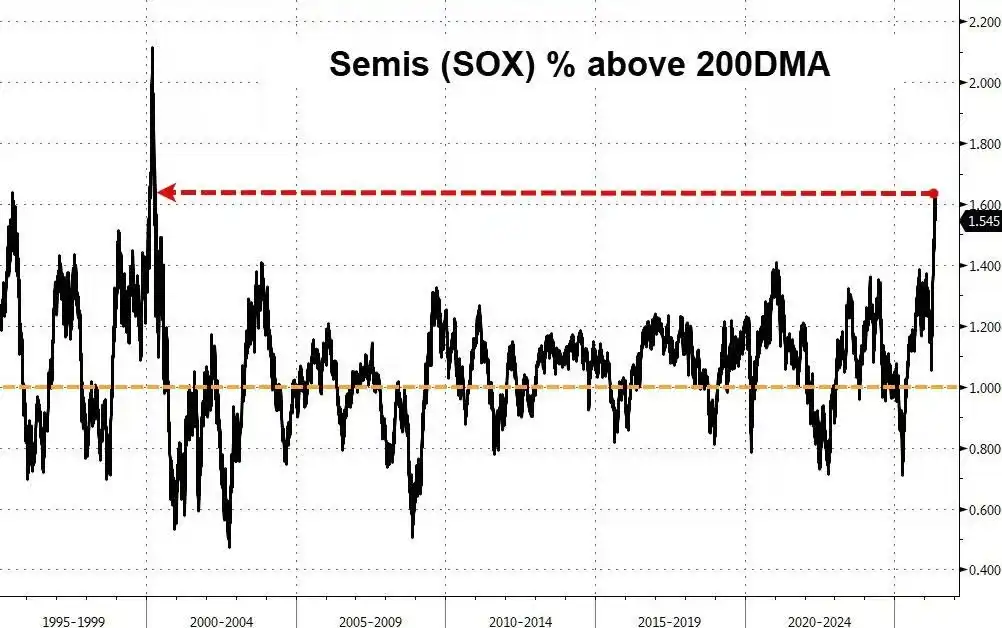
"It's worth keeping these tactical dynamics in mind ahead of the summer trading period, after this week's key earnings event (Nvidia on May 20) concludes," Callahan wrote. While Goldman's trading desk maintains a constructive medium-term view on the AI and semiconductor themes, it tactically advises investors to remain cautious regarding technical headwinds.

Nvidia Earnings: Forward Guidance May Be More Crucial Than Quarterly Results

Market optimism about Nvidia's fundamental prospects remains, but recent stock price movements have already priced in some of these expectations.

According to Goldman Sachs' Nvidia earnings preview, analysts generally expect the company's revenue for this quarter to exceed consensus estimates by approximately $2 billion—its typical historical beat margin has been around 2% to 3%. The market is more focused on forward guidance for the next quarter, with the current analyst consensus around $86 billion, implying a sequential increase of about 9%. Other key areas of focus include: potential for further upward revision to Nvidia's ~$1 trillion cumulative data center revenue target, and the narrative of accelerating Agentic AI inference demand—particularly its pure CPU rack product expected to begin shipments in the second half of 2026.

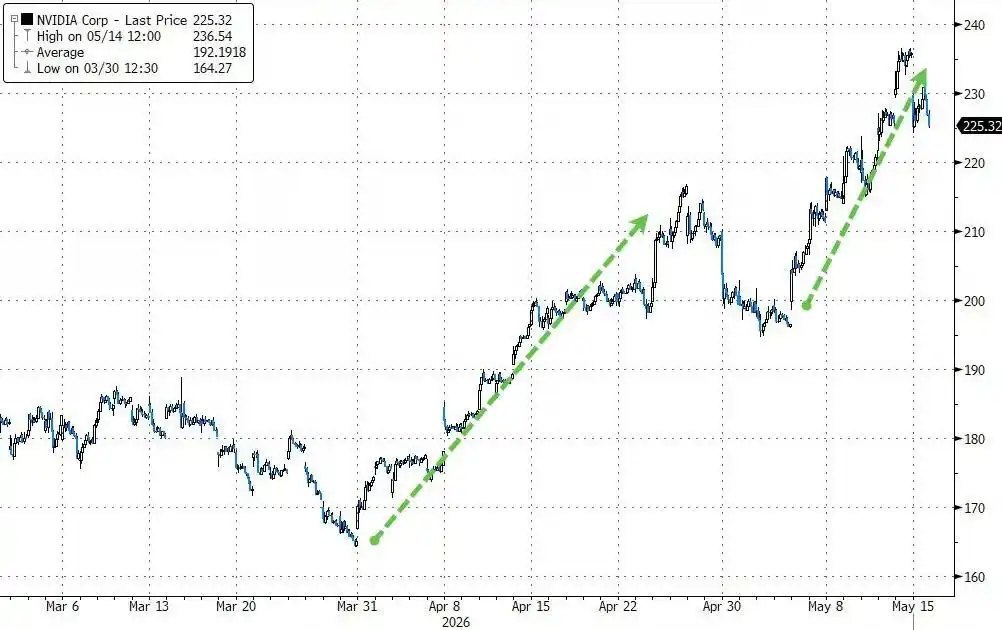
From a recent price action perspective, Nvidia has risen for seven consecutive trading days, gaining 20% during this stretch, marking its longest winning streak in nearly two years; it has added roughly $1.7 trillion in market capitalization since its late March low. However, Goldman data also shows that on the trading day following Nvidia's last five earnings reports (T+1), the stock declined four times. Since May 2022, a single-day surge triggered by earnings has not occurred.
Options Market: Extreme Bullish Bets and Tail Hedging Deployed Simultaneously

Options positioning reveals a set of inherently contradictory signals.

According to SpotGamma data, overall positioning remains heavily skewed towards bullish bets, with traders consistently rolling Nvidia call options to higher strike prices. The call skew remains at the high end of its 90-day historical range, while demand for downside protection is extremely limited. Data cited by 22V Research shows that nominal S&P 500 call option trading volume hit a record $2.6 trillion last Friday, with call volume accounting for 60% of total options activity; the RSI for the Philadelphia Semiconductor Index also rose to its highest level since March 2000.
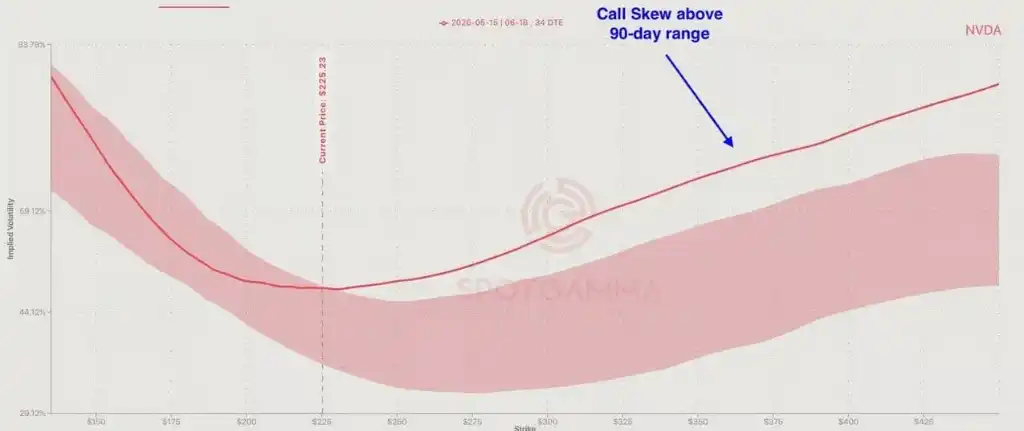
Meanwhile, hedging against downside risks is also quietly underway. SpotGamma points out that significant put option structures and buying activity have increased noticeably around the S&P 500 (SPY), semiconductor ETF (SMH), and DRAM-related assets, concentrated in deep out-of-the-money strike price ranges, indicating their function is more akin to tail risk hedging rather than pure directional bets. "Market participants are not bearish on Nvidia, but preparation for downside scenarios is non-trivial," SpotGamma wrote in its report, "Any directional shift is likely to quickly spill over into the broader market."

SpotGamma adds that Nvidia has rallied over 35% from its March low, and the size of current call option positions implies that disappointing earnings or a large-scale profit-taking event could potentially trigger a significant directional reversal.

Market Breadth Concerns: Rally Supported by a Handful of Stocks

Beneath the strong performance of semiconductor and large-cap tech stocks, the lack of broad market participation is forming a structural worry.

Peter Callahan noted in his report that although the S&P 500 is up about 8% year-to-date, only about 52% of its constituents are in positive territory. Sectors significantly lagging this year include residential real estate, medical devices, engineering & construction without government business exposure, federal IT services, software & services, independent power producers, restaurant chains, commercial real estate brokerage, and insurance brokerage, among others.

Callahan admits that when examining the charts of these sectors, it makes him question whether the current market performance reflects overall "health" or simply a "funding source" effect, where investors are forced to concentrate capital in a few large-cap AI stocks. Oppenheimer's equity derivatives team similarly pointed out that only about one-fifth of S&P 500 constituents have outperformed the index over the past month, with the dispersion index rising to its highest level in over a year, while implied correlation remains near year-to-date lows. Latest data from Goldman Sachs' Prime Brokerage (PB) desk also shows a clear "risk-off" move in the tech sector recently.

Câu hỏi Liên quan

QWhy is Nvidia's upcoming earnings report on May 20th considered a critical stress test for the current AI bull market?

ANvidia's earnings report is considered a critical stress test because it directly tests the market's confidence in the AI compute super-cycle. The company is highly correlated with the semiconductor and broader tech sectors, meaning its results will likely trigger significant market-wide reactions regardless of whether they are positive or negative. The market is technically overextended, with extreme bullish positioning in options, making the event a key pressure point that could determine the near-term fate of the AI bull cycle.

QWhat is the core contradiction identified by Goldman Sachs' Peter Callahan regarding the AI and semiconductor theme?

AThe core contradiction is that the fundamentals remain strong (e.g., strong corporate earnings, upward revisions to profit expectations), while technical pressures are continuously accumulating. Key technical pressures include the SOX index trading at its most extreme deviation from its 200-day moving average since the 1999/2000 internet bubble peak and heightened market concentration in a few large-cap stocks.

QWhat is the unusual market signal that SpotGamma reports, and what does it indicate about trader behavior?

ASpotGamma reports the unusual signal of stock prices rising while implied volatility simultaneously climbs. Normally, these two have an inverse relationship. This pattern indicates that while traders are chasing the rally (buying stocks/calls), they are also paying a premium to hedge against significant volatility, preparing for a potential sharp move in either direction around high-stakes events like Nvidia's earnings.

QAccording to the article, what aspect of Nvidia's report might be more crucial than the quarterly results themselves?

AThe forward guidance for the next quarter is potentially more crucial than the immediate quarterly results. While analysts expect quarterly revenue to beat estimates by a significant margin, the market's primary focus is on the guidance for the upcoming quarter (estimated at around $86 billion) and whether there is further upside to Nvidia's cumulative data center revenue target of approximately $1 trillion.

QWhat does the data on market breadth and the 'funding source' effect suggest about the health of the current U.S. stock market rally?

AThe data on market breadth suggests underlying weakness and a lack of broad participation. While the S&P 500 is up year-to-date, only about 52% of its constituents have posted gains. The rally is being driven by a narrow concentration of capital in a few large-cap AI stocks like Nvidia, creating a 'funding source' effect. This raises questions about whether the market's performance reflects overall economic health or is simply a consequence of investors being forced to crowd into a shrinking pool of high-performing names.

Nội dung Liên quan

43 phút của Trump: Cốt truyện người mạnh mất kiểm soát, chiến tranh truyền thông leo thang

Trong bài diễn văn kéo dài 43 phút sau hơn một tuần vắng bóng công chúng, Tổng thống Mỹ Donald Trump đã cố gắng thể hiện hình ảnh một nhà lãnh đạo mạnh mẽ và kiểm soát. Tuy nhiên, phần lớn thời gian được dành cho các chủ đề phụ như hồ phản chiếu trên National Mall, so sánh quy mô đám đông với Martin Luther King Jr., cùng những lời công kích nhắm vào phóng viên, đảng Dân chủ và các thành phố lớn. Ông còn ký sắc lệnh hành pháp hủy bỏ các biện pháp bảo vệ việc làm cho hàng nghìn công chức cấp cao liên bang, một động thái có thể gia tăng sự phụ thuộc vào lòng trung thành cá nhân hơn là năng lực chuyên môn trong chính phủ. Bài viết nêu bật trạng thái cá nhân đầy lo lắng và phòng thủ của Trump, thể hiện qua việc ông đột ngột kết thúc sự kiện và nhân viên nhanh chóng dọn dẹp hiện trường. Tác giả cũng phân tích cuộc tấn công của Trump vào nữ phóng viên CNN, Kaitlan Collins, coi đó là một phần của nỗ lực làm mất uy tín giới truyền thông. Bài báo cảnh báo về áp lực ngày càng lớn từ quyền lực chính trị và lợi ích thương mại lên các cơ quan báo chí chính thống, dẫn đến cuộc khủng hoảng về tính độc lập biên tập, như trường hợp Scott Pelley của CBS. Thông điệp chính kêu gọi công chúng ủng hộ các nhà báo và phương tiện truyền thông độc lập, những người được coi là lực lượng quan trọng duy trì sự thật khi các thể chế khác bị xâm phạm. Bài viết kết thúc với viễn cảnh lạc quan khi đề cập đến việc Hạ viện, với sự ủng hộ của một số thành viên đảng Cộng hòa, đã thông qua nghị quyết yêu cầu chấm dứt hành động quân sự ở Iran, cho thấy sự bất đồng ngày càng tăng ngay trong nội bộ đảng của Trump.

marsbit42 phút trước

43 phút của Trump: Cốt truyện người mạnh mất kiểm soát, chiến tranh truyền thông leo thang

marsbit42 phút trước

Kalshi, MTS và tham vọng của a16z

Trí tuệ thị trường dự đoán và tham vọng "Truyền thông Mới" của a16z Bài viết phân tích sự trỗi dậy của thị trường dự đoán (prediction markets), đặc biệt là công ty Kalshi được định giá 220 tỷ USD, dưới góc nhìn chiến lược đầu tư và truyền thông của quỹ mạo hiểm a16z. Tác giả điểm lại lịch sử tư tưởng của thị trường dự đoán, từ học thuyết của Hayek về việc thị trường tổng hợp tri thức phân tán, đến cơ chế khuyến khích của Robin Hanson (LMSR) và ý tưởng chính phủ dựa trên dự đoán (Futarchy). Trọng tâm bài viết nằm ở việc a16z, sau khi đầu tư vào Kalshi, đã định vị lại giá trị cốt lõi của thị trường dự đoán không chỉ là sòng bạc hay sàn giao dịch, mà là một phương tiện truyền thông mới mang lại "cảm giác hiện diện" (presence). Trong một thế giới ngày càng bị che khuất và bất lực, việc dùng tiền thật để đặt cược vào các sự kiện toàn cầu giúp cá nhân tái khẳng định vai trò "người quan sát tối thượng", can thiệp và diễn giải thực tại. Kalshi, theo logic này, sẽ trở thành nơi định đoạt tính xác thực và tầm quan trọng của sự kiện. Bài viết liên kết điều này với tầm nhìn "Truyền thông Mới" của a16z – một hệ thống truyền thông toàn diện từ định hình luận điệu, tài trợ, phát hành sản phẩm đến thu hút khách hàng với tốc độ và cường độ chưa từng có, nhằm "tiếp quản dòng thời gian". Ví dụ điển hình là MTS (Monitoring The Situation), một hãng truyền thông chuyên phát sóng tin tức 24/7 trên Twitter. Kết luận cho rằng sức hút thực sự của Kalshi và lý do định giá khổng lồ của nó nằm ở "trường lực bẻ cong hiện thực" – khả năng tạo ra một thực tại thay thế có sức thuyết phục cao nhờ vào khối lượng giao dịch bằng tiền thật, từ đó trở thành một mảnh ghép quyền lực trong đế chế truyền thông mới của a16z.

marsbit2 giờ trước

Kalshi, MTS và tham vọng của a16z

marsbit2 giờ trước

Bất Ngờ: Cựu Nhân Sự Trụ Cột Trong Dự Án Chip Của OpenAI Gia Nhập Anthropic

Chuyên gia chip "nhân viên số 002" của OpenAI, Clive Chan, vừa thông báo rời OpenAI để gia nhập Anthropic. Anh là một trong những thành viên sớm nhất của đội ngũ phát triển chip tự thiết kế của OpenAI, tham gia từ giai đoạn hình thành đến nay. Dù đánh giá cao đội ngũ chip tại OpenAI, Clive Chan chia sẻ anh luôn có mong muốn "chinh phục một ngọn núi mới từ chân núi", đó là lý do anh chuyển sang Anthropic. Tại Anthropic, anh ấn tượng với năng lực, giá trị cốt lõi và tham vọng của đội ngũ, đồng thời trải nghiệm cường độ làm việc rất cao. Khi được hỏi về tiến độ dự án chip của OpenAI, Clive Chan đề cập đến thông tin hợp tác công khai giữa OpenAI và Broadcom, với kế hoạch triển khai bắt đầu từ nửa cuối năm 2026. Clive Chan có kinh nghiệm làm việc tại nhiều công ty công nghệ hàng đầu như Tesla, Google, SpaceX trước khi gia nhập OpenAI vào đầu năm 2024. Việc chuyển đổi của anh là một ví dụ nữa cho thấy dòng chảy nhân tài đáng chú ý giữa OpenAI và Anthropic, sau sự kiện nhà nghiên cứu nổi tiếng Andrej Karpathy chuyển sang Anthropic hồi tháng 5. Động thái này càng thu hút sự chú ý khi Anthropic vừa hoàn thành vòng gọi vốn với định giá gần 1.000 tỷ USD.

marsbit2 giờ trước

Bất Ngờ: Cựu Nhân Sự Trụ Cột Trong Dự Án Chip Của OpenAI Gia Nhập Anthropic

marsbit2 giờ trước

a16z chuyển hướng toàn cầu hóa: VC đang trở thành "động lực thúc đẩy" của liên minh công nghệ Mỹ

Biên tập: Thông báo của Ben Horowitz cho thấy một bước chuyển quan trọng trong chiến lược toàn cầu hóa của a16z: họ không chỉ tìm kiếm dự án ở nước ngoài hay mở rộng đầu tư quốc tế, mà còn đặt mình vào khuôn khổ cạnh tranh công nghệ và hợp tác đồng minh rộng lớn hơn. Trong bối cảnh AI, robot, công nghệ quốc phòng, an ninh mạng và tái cấu trúc chuỗi cung ứng trở thành trọng tâm cạnh tranh quốc gia, con đường quốc tế hóa của startup trở nên phức tạp hơn. A16z đang phản ứng với sự thay đổi này thông qua việc thành lập văn phòng Tokyo, bổ nhiệm Anne Neuberger phụ trách các vấn đề toàn cầu, và nâng cấp nhóm quan hệ nhà đầu tư thành nhóm đối tác toàn cầu. Tín hiệu quan trọng nhất là a16z gắn kết mạng lưới toàn cầu của mình với năng lực lãnh đạo công nghệ của "Mỹ và các đồng minh". Đối với a16z, mạng lưới đầu tư mạo hiểm trong tương lai không chỉ giúp nhà sáng lập gọi vốn, tuyển dụng, bán hàng mà còn hỗ trợ họ tiếp cận thị trường trọng điểm, kết nối với chính phủ và các tổ chức chiến lược, cũng như hiểu rõ môi trường chính sách và quy định của các quốc gia khác nhau. Điều này có nghĩa vai trò của các tổ chức đầu tư mạo hiểm hàng đầu đang được định nghĩa lại. Họ không còn chỉ là trung gian vốn, mà là người tổ chức kết nối công ty khởi nghiệp, năng lực quốc gia, nguồn lực ngành, hệ thống đồng minh và vốn toàn cầu. Chiến lược toàn cầu hóa lần này của a16z có thể được xem như một sự chủ động định vị của vốn Silicon Valley trong cuộc cạnh tranh công nghệ toàn cầu mới.

marsbit2 giờ trước

a16z chuyển hướng toàn cầu hóa: VC đang trở thành "động lực thúc đẩy" của liên minh công nghệ Mỹ

marsbit2 giờ trước

Kalshi, MTS và Tham vọng của a16z

Bài viết phân tích tầm quan trọng của thị trường dự đoán (prediction markets), tập trung vào Kalshi, và tầm nhìn của quỹ đầu tư mạo hiểm a16z trong việc xây dựng một đế chế truyền thông mới. Tác giả điểm qua lịch sử tư tưởng đằng sau thị trường dự đoán, từ lý thuyết của Hayek về việc thị trường tổng hợp tri thức phân tán, đến cơ chế khuyến khích của Robin Hanson (LMSR) và ý tưởng "Futarchy". Trọng tâm bài viết là việc a16z đầu tư mạnh vào Kalshi (định giá 220 tỷ USD) và cách họ diễn giải giá trị cốt lõi của nó: mang lại "cảm giác hiện diện" (presence). Trong một thế giới mà con người ngày càng thụ động và xa cách với thực tại, thị trường dự đoán cho phép họ tham gia tích cực bằng cách dùng tiền thật để đặt cược vào các sự kiện, từ đó cảm thấy mình là người quan sát và dự báo lịch sử. a16z coi đây là mảnh ghép quan trọng cho tham vọng "truyền thông mới" của họ - một hệ thống toàn diện từ định hình narrative, tài trợ sản phẩm, đến tiếp cận khách hàng với tốc độ cực cao, nhằm "tiếp quản dòng thời gian". Công ty truyền thông MTS (Monitoring The Situation) là một ví dụ điển hình cho triết lý này. Bài viết kết luận rằng sức mạnh thực sự của Kalshi và thị trường dự đoán nằm ở "trường lực bẻ cong hiện thực" - khả năng định nghĩa tính xác thực và tầm quan trọng của sự kiện thông qua khối lượng giao dịch bằng tiền thật, từ đó giành được quyền giải thích tối cao về tương lai, một thứ quyền lực hiếm khi nằm trong tay một công ty tư nhân.

链捕手2 giờ trước

Kalshi, MTS và Tham vọng của a16z

链捕手2 giờ trước

Giao dịch

Giao ngay
Hợp đồng Tương lai

Bài viết Nổi bật

Làm thế nào để Mua NIGHT

Chào mừng bạn đến với HTX.com! Chúng tôi đã làm cho mua Midnight (NIGHT) trở nên đơn giản và thuận tiện. Làm theo hướng dẫn từng bước của chúng tôi để bắt đầu hành trình tiền kỹ thuật số của bạn.Bước 1: Tạo Tài khoản HTX của BạnSử dụng email hoặc số điện thoại của bạn để đăng ký tài khoản miễn phí trên HTX. Trải nghiệm hành trình đăng ký không rắc rối và mở khóa tất cả tính năng. Nhận Tài khoản của tôiBước 2: Truy cập Mua Crypto và Chọn Phương thức Thanh toán của BạnThẻ Tín dụng/Ghi nợ: Sử dụng Visa hoặc Mastercard của bạn để mua Midnight (NIGHT) ngay lập tức.Số dư: Sử dụng tiền từ số dư tài khoản HTX của bạn để giao dịch liền mạch.Bên thứ ba: Chúng tôi đã thêm những phương thức thanh toán phổ biến như Google Pay và Apple Pay để nâng cao sự tiện lợi.P2P: Giao dịch trực tiếp với người dùng khác trên HTX.Thị trường mua bán phi tập trung (OTC): Chúng tôi cung cấp những dịch vụ được thiết kế riêng và tỷ giá hối đoái cạnh tranh cho nhà giao dịch.Bước 3: Lưu trữ Midnight (NIGHT) của BạnSau khi mua Midnight (NIGHT), lưu trữ trong tài khoản HTX của bạn. Ngoài ra, bạn có thể gửi đi nơi khác qua chuyển khoản blockchain hoặc sử dụng để giao dịch những tiền kỹ thuật số khác.Bước 4: Giao dịch Midnight (NIGHT)Giao dịch Midnight (NIGHT) dễ dàng trên thị trường giao ngay của HTX. Chỉ cần truy cập vào tài khoản của bạn, chọn cặp giao dịch, thực hiện giao dịch và theo dõi trong thời gian thực. Chúng tôi cung cấp trải nghiệm thân thiện với người dùng cho cả người mới bắt đầu và người giao dịch dày dạn kinh nghiệm.

Tổng lượt xem 381Xuất bản vào 2025.12.08Cập nhật vào 2026.06.02

Làm thế nào để Mua NIGHT

Thảo luận

Chào mừng đến với Cộng đồng HTX. Tại đây, bạn có thể được thông báo về những phát triển nền tảng mới nhất và có quyền truy cập vào thông tin chuyên sâu về thị trường. Ý kiến ​​của người dùng về giá của NIGHT (NIGHT) được trình bày dưới đây.

活动图片