Circle's Second Growth Curve: After the $222 Million ARC Financing, CRCL or ARC?

链捕手Xuất bản vào 2026-05-14Cập nhật gần nhất vào 2026-05-14

Tóm tắt

Circle, the issuer of USDC, announced that its new public blockchain Arc completed a $222 million private sale for its native token ARC, with the network's fully diluted valuation reaching $3 billion. The funding round was led by a16z crypto, with participation from major institutions including BlackRock, Apollo, and ICE. The article explains Circle's rationale for building its own L1 blockchain, Arc. Existing chains like Ethereum and Solana are seen as lacking native support for large-scale institutional needs, such as regulatory compliance, predictable transaction costs, and asset issuance/redemption workflows. Arc is designed to fill this gap as a foundational layer for the on-chain economy, moving beyond Circle's reliance on USDC reserve interest for revenue. It details the dual-token model of Arc: USDC serves as the stable gas token for predictable transactions, while ARC is the network's native asset used for staking in the planned transition to Proof-of-Stake, governance, and aligning long-term incentives among participants. ARC's total supply is 10 billion, with 60% allocated to ecosystem development, 25% to Circle, and 15% to a long-term reserve. All protocol fees are converted to ARC, with portions burned and distributed to stakers. The piece contrasts the value proposition of Circle's public stock (CRCL) and the ARC token. CRCL captures the company's core cash flows from USDC interest and other business lines. ARC captures the growth potential of the Arc network...

Author: Zhou, ChainCatcher

On May 11th, while releasing its Q1 2026 financial report, Circle announced that the ARC native token of its public blockchain Arc had completed a $222 million presale, with a fully diluted valuation of $3 billion for the network.

The round was led by a16z crypto with a $75 million investment, followed by top-tier institutions including BlackRock, Apollo, ICE (parent company of NYSE), SBI Group, SC Ventures, and ARK Invest.

CRCL's stock price surged nearly 16% that day, with its market cap rebounding above $30 billion.
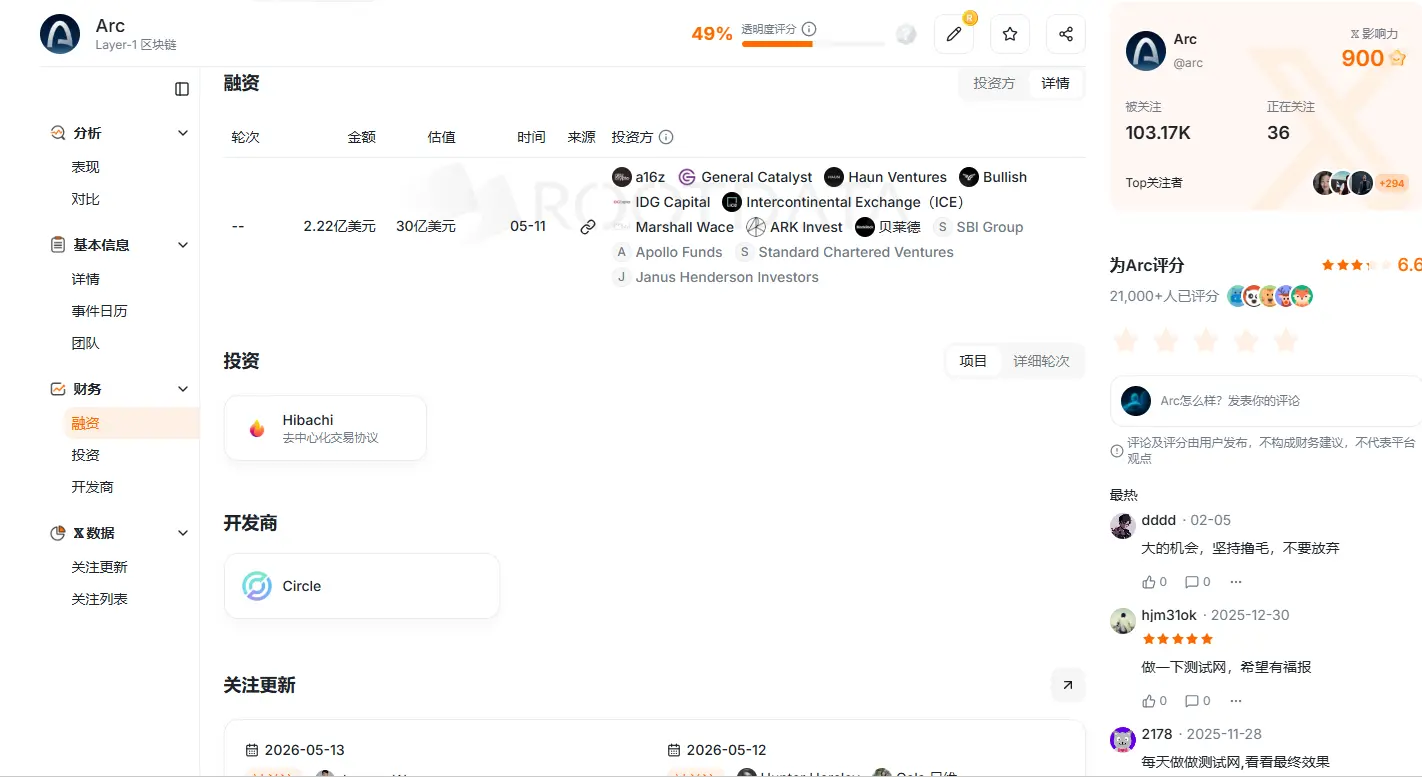
Image source: RootData

This development raises a core market question: Circle is already a public company; if investors are optimistic about its future, why not simply hold CRCL stock? Why issue the ARC token as well? Both are capturing the value of the Arc network. What exactly does each represent?

1. Why Did Circle Build Arc Itself?

Why did Circle choose to invest massive resources into building its own public blockchain instead of continuing to issue and use USDC on Ethereum or Solana?

a16z Crypto explains that as global finance gradually moves on-chain, only a few public blockchains will be able to serve as the "foundational base for an on-chain economic system."

Stablecoin transaction volume approached $9 trillion last year, placing it in the same league as global payment networks like Visa and PayPal. Cross-border payments, B2B settlement, and forex trading are becoming core use cases for stablecoins, which have upgraded to become a core layer of global financial infrastructure.

However, existing blockchain infrastructure is still primarily geared towards crypto-native users and individual developers, lacking native support for large-scale institutional-level demands.

Industry insiders point out that institutions face several core pain points when conducting business on-chain, including: the need for fully closed-loop on-chain/off-chain validation for asset issuance and redemption; payments requiring deterministic finality; compliance capabilities needing to be embedded at the foundational layer; configurable privacy protection; and the need for predictable Gas costs using USDC, among others.

Ethereum, Solana, and other existing public blockchains struggle to natively meet these demands.

For Circle, the company has historically relied primarily on USDC reserve interest for profitability. In Q1, USDC circulation reached $77 billion, a 28% year-over-year increase. As its business scale continues to expand, relying solely on existing public chains can no longer fully meet the deeper needs of institutional clients.

Therefore, Circle's launch of Arc aims precisely to fill this gap. The underlying logic is that having a stablecoin circulate on someone else's chain does not mean owning the stablecoin financial ecosystem—which is why Circle decided to build its own L1.
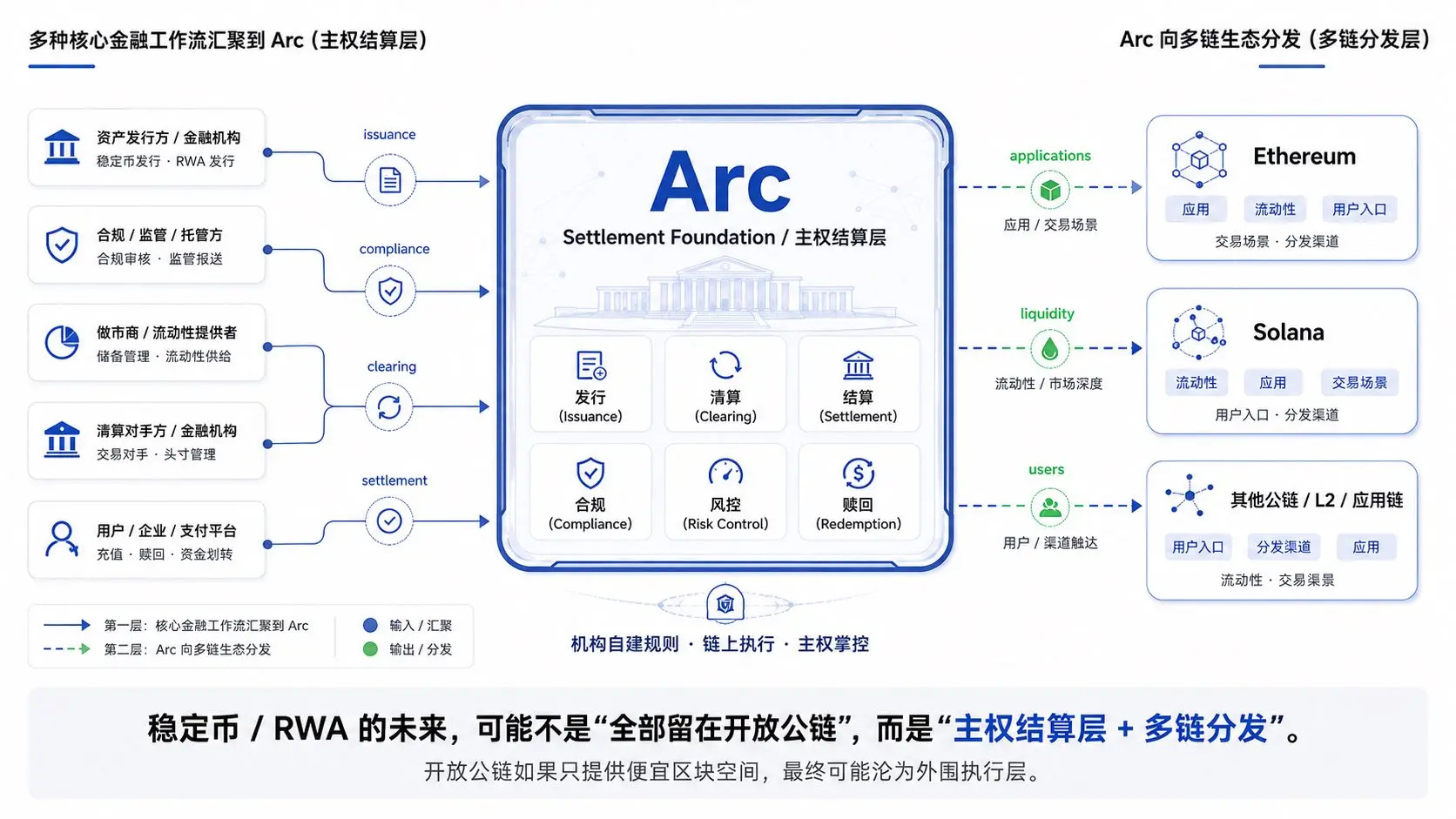
Image source: X user @vanisaxxm

2. USDC Solves the Transaction Problem, ARC Solves the Coordination Problem

Since USDC is already the Gas token for Arc, why is another ARC token needed?

USDC has effectively solved the stability issue at the transaction level. Institutions can pay fees directly priced in USD, with predictable costs that can be accounted for, avoiding the troubles caused by crypto asset price volatility for finance departments.

However, for a network to operate healthily in the long term, solving the transaction problem alone is not enough. It also needs to address coordination problems.

According to the official whitepaper, Arc will gradually transition from its current Proof-of-Authority to Proof-of-Stake. Validator nodes need to stake assets to secure the network, with the core principle of staking being to bind node behavior through economic incentives; malicious actions risk slashing. USDC's value is pegged at $1, making it unable to truly bind node interests to the network's success or failure. Only the native ARC token can provide such dynamic economic incentives.
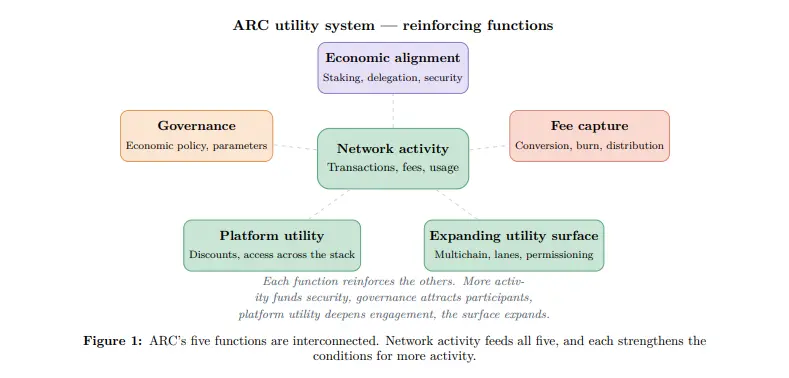
Governance also requires interest alignment. Key decisions such as fee rates, inflation parameters, and burn ratios require participants to adopt a long-term perspective. If voting were based solely on USDC, holders could easily lack sustained motivation, potentially voting and then exiting. ARC holders' asset value is directly tied to network performance, giving them stronger motivation to make choices beneficial for the network's long-term development.

The whitepaper also clarifies that ARC's governance authority has phased boundaries. Economic parameters are determined by token holder votes, but important matters like protocol upgrades, security incident handling, and validator qualification reviews initially remain under Circle's control, with gradual decentralization planned as governance matures.

In simple terms, USDC is the lifeblood of the Arc network, responsible for efficient daily flow; ARC is the equity of the network, responsible for aligning the long-term interests of all parties. This dual-token design also partially transforms the cost of ecosystem development from Circle's fixed cash expenditures into incentive arrangements tied to the network's success or failure.

3. CRCL and ARC: Which Pieces of the Pie Do They Capture?

Thus, Circle now holds both the publicly listed equity CRCL and the network's native token ARC, both capturing the value of the same Arc network. So, which pieces of the pie do they respectively capture?

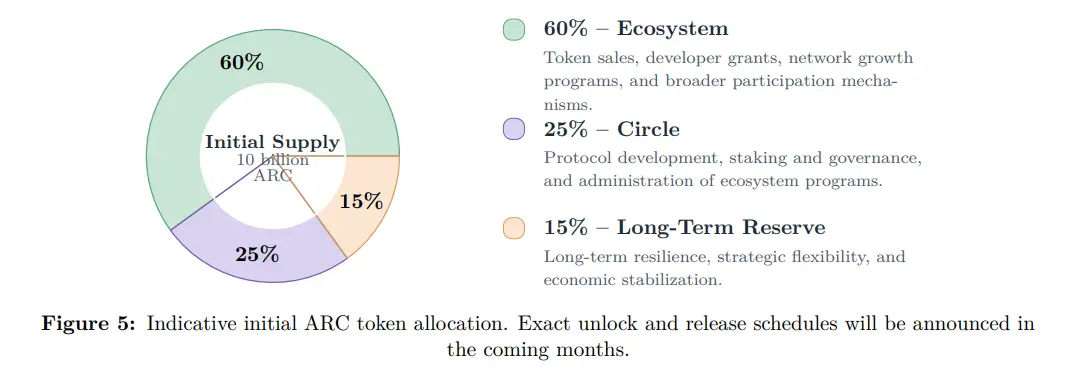
According to the whitepaper, the total supply of ARC is 10 billion tokens, with a clear allocation: 60% for the ecosystem, including developer incentives, network growth programs, and user participation rewards; 25% allocated to Circle for operating validator nodes, staking, and governance; 15% as a long-term reserve for network stability and strategic flexibility.
Regarding the fee mechanism, all protocol fees on Arc, regardless of the asset used for payment, will be fully converted to ARC at the protocol layer, with a portion permanently burned and a portion distributed to stakers and validators. The more active the network, the stronger the value capture by ARC.

CRCL shareholders primarily benefit through Circle as a company. The company continues to enjoy the core revenue from USDC reserve interest, along with gains from the growth of other businesses like the payment network CPN. Simultaneously, Circle's 25% ARC holdings allow it to indirectly share in network-level rewards.

Crypto analyst BTCdayu proposes a three-dimensional valuation framework for CRCL: The first dimension is reserve interest income, the most stable current cash flow and the valuation floor. The second dimension is payment network revenue, which, as CPN scales, could approach a Visa-like network fee model. The third dimension is the network option value brought by Arc, reflecting market expectations for Circle's transformation from a stablecoin issuer to a financial infrastructure platform.

Simply put, CRCL captures the company's overall stable cash flow and existing business growth, while ARC captures the growth elasticity at the network level, including Gas fee conversion, ecosystem expansion, and long-term network effects.

This forms a clear dual-track structure. The more successful the Arc network, the greater the USDC usage and business synergies, benefiting Circle at the corporate level. Concurrently, the rising value of the ARC token increases the value of Circle's 25% share, ultimately benefiting CRCL shareholders.

However, the two are legally completely separate. As mentioned officially, ARC does not represent equity in Circle and does not grant any claim to Circle's revenue, profits, assets, or CRCL shares. This means ARC holders lack the fiduciary duty protections afforded to public company shareholders; their returns depend entirely on the network's actual adoption and the tokenomics design.

4. How Can Ordinary Users Participate?

Having understood the value distribution between CRCL and ARC, a practical question arises: Who exactly is the ARC token being sold to? And how can ordinary users participate at low cost?

The first category of buyers is strategic institutional investors. They entered via the $222 million presale at a unit price of $0.3, with lock-up periods ranging from 1 to 4 years. These institutions not only provide capital but are also potential users and builders of Arc. For example, BlackRock is already testing tokenized asset settlement on the testnet; ICE, as the parent of NYSE, and SBI Group, as Japan's largest financial group, are strategically positioning themselves for future business on Arc.

The second category is ecosystem builders and long-term holders. Developers and liquidity providers receive ARC incentives for their contributions; the 60% ecosystem allocation is for this purpose. They prioritize the network's long-term growth, akin to early employees holding company equity.

The third category is retail speculators and participants. They focus on early narrative opportunities and ecosystem incentives, anticipating price volatility post-mainnet launch.

For ordinary users without presale access, Arc offers several low-cost participation paths.

The Arc Testnet launched in October 2025 and has processed over 244 million test transactions to date. The mainnet is expected to launch in the summer of 2026. Users can claim free test tokens to perform operations like Swaps, bridging, and contract deployment to familiarize themselves with network interaction.

The Arc House community is the primary entry point for ordinary users. Users can accumulate points by registering, staying active, posting, reading content, and participating in Q&A. Having an answer accepted yields extra points.

Advanced methods include content contribution, video sharing, event organization, and even hosting offline Meetups. Additionally, users with teams or products can apply for Circle Developer Grants.

It should be noted that Arc House points merely represent community contribution recognition; they hold no monetary value, nor do they guarantee any specific rights allocation. Specific rules are subject to the latest official announcements.

Conclusion

Currently, competition in the institutional on-chain sector is fierce, and Arc is not alone. Canton Network, under Digital Asset, is reportedly completing a new funding round at a valuation of around $2 billion, led by a16z crypto; Plasma positions itself as a stablecoin-native settlement layer with a relatively more attractive valuation; Visa included Arc, Canton, Plasma, Base, Tempo, and others as stablecoin settlement test points in April. This indicates the sector is still in a phase of parallel development with multiple competitors.

Against this backdrop, Arc's $3 billion presale FDV (Fully Diluted Valuation) sits at a relatively high level. Retail investors considering secondary market participation need to thoroughly evaluate the project's narrative potential and the competitive landscape within the sector.

From a long-term perspective, holding ARC, which carries an annual inflation of 2% to 3%, requires the network to generate sufficient real transaction fees to offset the inflation pressure for value appreciation. CRCL, in contrast, relies on USDC reserve interest and payment network revenue, supported by relatively clear cash flows. They represent different risk-return structures.

Short-term, market sentiment often follows its own logic. Around the mainnet launch, concentrated narrative hype could bring periodic opportunities. During such times, the value of Circle's 25% ARC holdings would also appreciate, benefiting CRCL shareholders.

On the regulatory front, the passage of the GENIUS Act has solidified Circle's moat, while the CLARITY Act's new draft version has been made public and is advancing in Congress, potentially providing clearer regulatory certainty for the digital asset ecosystem—a significant positive for Circle.

Overall, Arc is currently one of Circle's key strategic initiatives. As the whitepaper states, "A global economic operating system cannot be coordinated by a single entity; it transforms participants who use Arc into participants who sustain Arc." Whether this vision ultimately materializes still depends on the network's ability to attract sufficient real institutional transactions and economic activity after the mainnet launch.

Until all data lands, all narratives remain just narratives.

Tiền kỹ thuật số thịnh hành

Câu hỏi Liên quan

QWhat is the purpose of Circle launching its own Layer 1 blockchain, Arc, instead of continuing to operate on established chains like Ethereum or Solana?

ACircle launched Arc to address the core needs of institutional clients, such as asset issuance/redemption with on/off-chain settlement, deterministic finality for payments, embedded compliance, configurable privacy, and predictable Gas costs paid in USDC. These needs are not natively met by existing public chains. Arc is designed to be an economic infrastructure base capable of hosting a global financial system on-chain, allowing Circle to capture more value from the stablecoin ecosystem it facilitates.

QWhy does the Arc network need a native ARC token when it already uses USDC for transaction fees?

AUSDC is used as a stable gas token for predictable transaction costs. The ARC token is needed to solve network coordination problems. It provides economic incentives for staking in the planned Proof-of-Stake security model, aligns long-term interests for governance decisions, and binds participants to the network's success. While USDC handles the flow of value, ARC acts as the network's 'equity', facilitating security and decentralized governance.

QHow do the CRCL stock and ARC token capture value differently from the Arc network and Circle's business?

ACRCL stock captures the value of Circle the company, primarily through stable revenue streams like USDC reserve interest and its payment network (CPN). It also benefits indirectly from Circle's 25% holding of ARC tokens. The ARC token directly captures the value of the Arc network itself, including gas fees converted to ARC (partly burned, partly distributed), ecosystem growth, and long-term network effects. CRCL offers stable cash flows, while ARC offers growth elasticity tied to network adoption.

QWhat are the main ways for ordinary users to participate in the Arc ecosystem early, such as for potential airdrops or rewards?

AOrdinary users can participate through several low-cost methods: 1) Using the Arc Testnet to perform transactions and interact with dApps. 2) Joining the Arc House community to earn contribution points through activities like registration, posting, reading content, and answering questions. 3) More advanced participation includes content creation, video sharing, event organization, and applying for Circle Developer Grants. Note that Arc House points are for community recognition and do not guarantee specific token rewards.

QWhat are some of the competitive challenges and considerations for Arc mentioned in the article?

AThe institutional on-chain sector is highly competitive. Key competitors include Canton Network (backed by Digital Asset), Plasma (positioned for stablecoin-native settlement), and others like Base and Tempo. Visa is testing multiple networks including Arc. The article notes that Arc's $3 billion fully diluted valuation (FDV) from its presale is relatively high. For long-term value, the ARC token needs to generate sufficient real transaction fees to offset its 2-3% annual inflation. Success depends on attracting substantial real institutional activity post-mainnet launch.

Nội dung Liên quan

Trump tự nhận là 'người hâm mộ cuồng nhiệt của tiền mã hóa', Bitcoin có thể được đưa vào 'Tài khoản Trump'?

Cựu Tổng thống Mỹ Donald Trump mới đây tuyên bố Bitcoin có thể được đưa vào kế hoạch tiết kiệm "Tài khoản Trump" mới ra mắt, và tự nhận mình là "siêu fan của tiền mã hóa". Ông đưa ra tín hiệu tích cực này tại lễ khởi động kế hoạch ở Phòng Bầu dục, nơi ông cùng các nhân vật quan trọng như Bộ trưởng Tài chính và lãnh đạo NYSE, NASDAQ chứng kiến sự kiện. Trump không đưa ra lộ trình cụ thể nhưng khẳng định khả năng xảy ra, đồng thời giải thích sự thay đổi quan điểm của mình. Ông cho biết ban đầu không hiểu nhiều về lĩnh vực này, nhưng nhận thấy sự yêu thích của công chúng và dòng tiền lớn đổ vào Bitcoin. Ông nhấn mạnh quy mô sử dụng Bitcoin đã rất lớn và liên kết vấn đề với cạnh tranh Mỹ-Trung, cho rằng Mỹ phải giữ vị thế dẫn đầu để không tụt lại phía sau. "Tài khoản Trump" là tài khoản đầu tư ưu đãi thuế được thành lập theo Đạo luật Một Đẹp Lớn năm 2025, bắt đầu hoạt động từ ngày 4/7/2026. Mỗi trẻ em đủ điều kiện được chính phủ cấp 1000 USD ban đầu, gia đình có thể gửi thêm tối đa 5000 USD mỗi năm. Số tiền bị khóa cho đến khi trẻ 18 tuổi. Tuyên bố này phù hợp với chính sách thân thiện với tiền mã hóa của Trump trong nhiệm kỳ thứ hai, bao gồm lệnh hành pháp năm 2025 thành lập dự trữ Bitcoin chiến lược và ký Đạo luật Thiên tài. Việc ủng hộ Bitcoin vào tài khoản tiết kiệm trẻ em củng cố thêm quyết tâm của Mỹ trong việc thống lĩnh lĩnh vực tiền mã hóa toàn cầu.

Foresight News15 phút trước

Trump tự nhận là 'người hâm mộ cuồng nhiệt của tiền mã hóa', Bitcoin có thể được đưa vào 'Tài khoản Trump'?

Foresight News15 phút trước

Tại sao năm 2026 có thể định nghĩa lại Ethereum, Solana, Base và Avalanche

Đến quý 3 năm 2026, ngành cơ sở hạ tầng blockchain đang trải qua quá trình chuyển đổi lớn nhất từ trước đến nay, tập trung đáp ứng nhu cầu thể chế thay vì thu hút người dùng bán lẻ. Với hơn 30 tỷ USD tài sản thực (RWA) hiện trên các blockchain công khai, các yêu cầu về thông lượng, tốc độ thanh toán, tuân thủ và độ tin cậy đã trở thành ưu tiên hàng đầu. Các blockchain lớn như Ethereum, Solana, Base và Avalanche đang thiết kế lại nền tảng của họ để phục vụ hoạt động tài chính quy mô thể chế. Ethereum dẫn đầu với bản nâng cấp Glamsterdam (dự kiến triển khai nửa đầu năm 2026), tăng giới hạn gas và giới thiệu PBS để chuẩn bị cho việc thực thi song song. Solana tập trung vào cơ chế đồng thuận với Alpenglow (dự kiến nửa cuối 2026), giảm đáng kể thời gian xác nhận cuối cùng và loại bỏ giao dịch bỏ phiếu gây tốn tài nguyên. Song song với cải thiện hiệu suất, tuân thủ quy định là trọng tâm mới. Base phát triển Beryl (dự kiến Q3/2026) với tiêu chuẩn token B20 cho tài sản được quản lý. Avalanche nâng cấp Octane để tăng tốc xử lý giao dịch và giảm chi phí cho các ứng dụng doanh nghiệp. Bitcoin cũng có tiến triển với OP_CAT, dự kiến kích hoạt cuối 2026 hoặc đầu 2027. Cuộc đua cơ sở hạ tầng giờ đây bước vào giai đoạn quan trọng: khả năng thực thi đã được chứng minh sẽ quyết định vị thế. Trong khi Ethereum duy trì lợi thế nhờ thanh khoản sâu và tiêu chuẩn tuân thủ trưởng thành, Base củng cố lợi thế đó, Solana thu hẹp khoảng cách và Avalanche thu hút các thể chế cần môi trường chuyên biệt. Từ năm 2026 đến 2027, mạng lưới nào cung cấp dịch vụ ổn định, tương thích quy định và đáng tin cậy nhất trong mọi điều kiện thị trường sẽ thu hút phần lớn vốn token hóa trong tương lai.

ambcrypto20 phút trước

Tại sao năm 2026 có thể định nghĩa lại Ethereum, Solana, Base và Avalanche

ambcrypto20 phút trước

Tiger Research: Đưa việc mã hóa tài sản RWA ra nước ngoài trước

Bài viết từ Tiger Research phân tích chiến lược cho các tổ chức tài chính tại các khu vực thiếu khung pháp lý về mã hóa tài sản thực (RWA). Thay vì chờ đợi luật trong nước hoặc thử nghiệm hạn chế trong "sandbox", một lựa chọn chủ động là tiến ra thị trường nước ngoài nơi đã có khung quy định rõ ràng để tích lũy kinh nghiệm thực tế và giành lợi thế cạnh tranh. Việc kinh doanh RWA xuyên biên giới đòi hỏi sự chuẩn bị kỹ lưỡng trên 6 lĩnh vực chính: lựa chọn khu vực pháp lý, giấy phép, xác định loại tài sản, phạm vi nhà đầu tư mục tiêu, phương thức thanh toán và các yêu cầu vận hành. Bài viết so sánh hai con đường chính. Con đường trực tiếp là thiết lập cơ sở tại các thị trường có quy định trưởng thành như Hồng Kông, Singapore hay Mỹ, tận dụng nền tảng địa phương để đẩy nhanh tiến độ. Con đường thứ hai là "bản địa trên chuỗi" (chain-native), hợp tác với các nền tảng tích hợp sẵn khả năng tuân thủ (như Ondo, Plume) để phát hành và lưu thông token ngay trên môi trường blockchain, giúp tiếp cận thị trường nhanh hơn và rộng hơn, mặc dù phức tạp về cấu trúc. Thông qua một ví dụ giả định về một công ty chứng khoán triển khai trái phiếu mã hóa từ Hồng Kông, bài viết minh họa các bước thực tế từ đánh giá giấy phép, chọn nền tảng, thiết kế sản phẩm, đến phát hành và vận hành. Thông điệp then chốt là thị trường sẽ không chờ đợi khung pháp lý hoàn chỉnh; khả năng vạch ra lộ trình khả thi và hành động ngay để tích lũy kinh nghiệm là yếu tố sống còn để thành công trong lĩnh vực RWA toàn cầu.

marsbit31 phút trước

Tiger Research: Đưa việc mã hóa tài sản RWA ra nước ngoài trước

marsbit31 phút trước

Bitcoin Suisse Thúc Đẩy Mở Rộng Khu Vực Trung Đông, Nhận Được Giấy Phép Dịch Vụ Tài Chính Tại Abu Dhabi

Bitcoin Suisse, nhà cung cấp dịch vụ tài chính tiền mã hóa hàng đầu Thụy Sĩ, đã có bước tiến quan trọng trong chiến lược mở rộng toàn cầu bằng việc chính thức được cấp phép hoạt động tại Trung Đông. Công ty con BTCS (Middle East) Ltd. của tập đoàn vừa nhận được Giấy phép Dịch vụ Tài chính (FSP) từ Cơ quan Quản lý Dịch vụ Tài chính (FSRA) thuộc Trung tâm Tài chính Quốc tế Abu Dhabi (ADGM). Giấy phép này cho phép BTCS ME cung cấp một bộ dịch vụ tài sản kỹ thuật số được quy định đầy đủ cho các khách hàng tổ chức và chuyên nghiệp tại Các Tiểu vương quốc Ả Rập Thống nhất. Bitcoin Suisse mang đến hơn một thập kỷ kinh nghiệm, hiện đang quản lý và bảo vệ 3,7 tỷ USD tài sản tiền mã hóa. Các dịch vụ chính bao gồm giao dịch, lưu ký, staking, cho vay và trong tương lai là hỗ trợ tiếp cận tài sản thế giới thực được mã hóa. Lãnh đạo Bitcoin Suisse cho biết đây là cột mốc lớn, phản ánh kinh nghiệm xây dựng cơ sở hạ tầng và mối quan hệ khách hàng tin cậy. Phía ADGM cũng chúc mừng và nhấn mạnh việc này củng cố hệ sinh thái tài sản số trưởng thành của Abu Dhabi, thu hút các định chế toàn cầu tìm kiếm môi trường pháp lý rõ ràng và cơ hội tăng trưởng.

TheNewsCrypto44 phút trước

Bitcoin Suisse Thúc Đẩy Mở Rộng Khu Vực Trung Đông, Nhận Được Giấy Phép Dịch Vụ Tài Chính Tại Abu Dhabi

TheNewsCrypto44 phút trước

Giao dịch

Giao ngay

Bài viết Nổi bật

Làm thế nào để Mua ARC

Chào mừng bạn đến với HTX.com! Chúng tôi đã làm cho mua AI Rig Complex (ARC) trở nên đơn giản và thuận tiện. Làm theo hướng dẫn từng bước của chúng tôi để bắt đầu hành trình tiền kỹ thuật số của bạn.Bước 1: Tạo Tài khoản HTX của BạnSử dụng email hoặc số điện thoại của bạn để đăng ký tài khoản miễn phí trên HTX. Trải nghiệm hành trình đăng ký không rắc rối và mở khóa tất cả tính năng. Nhận Tài khoản của tôiBước 2: Truy cập Mua Crypto và Chọn Phương thức Thanh toán của BạnThẻ Tín dụng/Ghi nợ: Sử dụng Visa hoặc Mastercard của bạn để mua AI Rig Complex (ARC) ngay lập tức.Số dư: Sử dụng tiền từ số dư tài khoản HTX của bạn để giao dịch liền mạch.Bên thứ ba: Chúng tôi đã thêm những phương thức thanh toán phổ biến như Google Pay và Apple Pay để nâng cao sự tiện lợi.P2P: Giao dịch trực tiếp với người dùng khác trên HTX.Thị trường mua bán phi tập trung (OTC): Chúng tôi cung cấp những dịch vụ được thiết kế riêng và tỷ giá hối đoái cạnh tranh cho nhà giao dịch.Bước 3: Lưu trữ AI Rig Complex (ARC) của BạnSau khi mua AI Rig Complex (ARC), lưu trữ trong tài khoản HTX của bạn. Ngoài ra, bạn có thể gửi đi nơi khác qua chuyển khoản blockchain hoặc sử dụng để giao dịch những tiền kỹ thuật số khác.Bước 4: Giao dịch AI Rig Complex (ARC)Giao dịch AI Rig Complex (ARC) dễ dàng trên thị trường giao ngay của HTX. Chỉ cần truy cập vào tài khoản của bạn, chọn cặp giao dịch, thực hiện giao dịch và theo dõi trong thời gian thực. Chúng tôi cung cấp trải nghiệm thân thiện với người dùng cho cả người mới bắt đầu và người giao dịch dày dạn kinh nghiệm.

Tổng lượt xem 370Xuất bản vào 2025.01.09Cập nhật vào 2026.06.02

Làm thế nào để Mua ARC

Thảo luận

Chào mừng đến với Cộng đồng HTX. Tại đây, bạn có thể được thông báo về những phát triển nền tảng mới nhất và có quyền truy cập vào thông tin chuyên sâu về thị trường. Ý kiến ​​của người dùng về giá của ARC (ARC) được trình bày dưới đây.

活动图片