Crypto CLARITY Act Faces 100-Plus Amendments As Stablecoin, Banking Fight Intensifies

bitcoinistXuất bản vào 2026-05-13Cập nhật gần nhất vào 2026-05-13

Tóm tắt

The U.S. Senate Banking Committee's CLARITY Act faces over 100 proposed amendments ahead of a key markup vote, intensifying debates on stablecoins, banking, and crypto regulation. Key points of contention include stablecoin rewards, with proposed bans on yield for idle balances and bank-backed amendments seeking stricter rules. Senator Elizabeth Warren filed over 40 amendments, including one to block crypto firms from Federal Reserve accounts, while another from Senator Jack Reed aims to prohibit using crypto for tax payments, countering industry goals for broader adoption. The bill, positioned as a consumer protection measure, also proposes treating crypto exchanges as financial institutions under anti-money laundering laws and creating exemptions for small fundraising. Banking industry groups are actively lobbying for tighter restrictions. Despite some Democratic leadership support, the bill's path remains uncertain due to ongoing negotiations on ethics and conflict-of-interest provisions, with critics warning of risks to investors and financial stability.

The US Senate Banking Committee’s crypto market structure push is running into a dense wall of amendments ahead of Thursday’s markup, with lawmakers filing more than 100 proposed changes to the CLARITY Act. The amendment rush puts stablecoin rewards, crypto firms’ access to the Federal Reserve system and even the use of digital assets for tax payments at the center of Washington’s latest fight over crypto regulation.

According to Politico, committee members submitted more than 100 amendments before the markup vote. Crypto journalist Eleanor Terrett reported that Senator Elizabeth Warren alone filed more than 40 amendments, including one that would prevent the Federal Reserve from issuing master accounts to crypto companies. Terrett also flagged an amendment from Senator Jack Reed that would “prohibit crypto from being used as legal tender, for example, to pay taxes.”

That language would cut directly against one of the industry’s longer-running policy goals: expanding digital assets beyond investment and trading into payments, settlement and public-sector use cases. Terrett noted the contrast with prior pro-Bitcoin tax-payment proposals, writing that Representative Warren Davidson had introduced a bill last year “to do that very thing” with BTC.

Crypto Bill Enters High-Stakes Senate Markup

The latest clash comes after Senate Banking Committee Chairman Tim Scott, Senator Cynthia Lummis and Senator Thom Tillis released new market structure text that will serve as the basis for the committee markup. The committee said the text reflects negotiations with Democrats and input from lawmakers, regulators, law enforcement, financial institutions, innovators and consumer advocates. Scott framed the bill as a consumer-protection and national-competitiveness measure.

“Over the past year, we have listened, negotiated, and strengthened this bill because families, small businesses, investors, and innovators all benefit from clear rules of the road,” Scott said. “This bill reflects serious, good-faith work across the Committee and delivers the certainty, safeguards, and accountability Americans deserve.”

The most immediate fault line remains stablecoin rewards. The Senate text would ban rewards on idle stablecoin balances that closely resemble bank deposits, while allowing rewards tied to transaction-based activity, such as stablecoin payments. The SEC, CFTC and Treasury Department would be tasked with issuing joint rules to implement that provision.

Banks are not satisfied. Brendan Pedersen reported that Reed and Senator Tina Smith filed an amendment that would incorporate bank-requested changes to stablecoin yield restrictions, forcing lawmakers to choose between the crypto and banking industries. The amendment would target rewards “substantially similar” to deposit interest, a phrase that goes to the core of the banking lobby’s argument: that crypto platforms should not be allowed to compete with deposits through yield-like incentives while avoiding bank-style regulation.

Terrett reported separately that American Bankers Association members had sent more than 8,000 letters to Senate offices urging lawmakers to revise the stablecoin-yield compromise. The ABA has argued that the current language does not adequately close what it calls a loophole allowing exchanges and other digital asset service providers to bypass the GENIUS Act’s ban on interest or yield on payment stablecoins.

The bill also reaches well beyond stablecoins. Digital commodity exchanges, brokers and dealers would be treated as financial institutions under the Bank Secrecy Act, bringing them into anti-money-laundering, customer-identification and due-diligence regimes. The text would also allow crypto companies to raise up to $50 million annually, and up to $200 million total, without SEC registration, while clarifying that tokenized securities remain subject to securities law.

The political path is still fragile. Terrett said Senate Minority Leader Chuck Schumer appeared engaged in a Democratic member meeting and eager for members to reach a “yes” on the CLARITY Act, but stressed that ethics negotiations needed to move further before Thursday’s markup. Warren, the committee’s top Democrat, has been pressing that issue hard, saying the bill “puts investors, our national security and our entire financial system at risk” and would “turbocharge Donald Trump’s crypto corruption” without stronger conflict-of-interest provisions.

At press time, the total crypto market cap stood at $2.67 trillion.
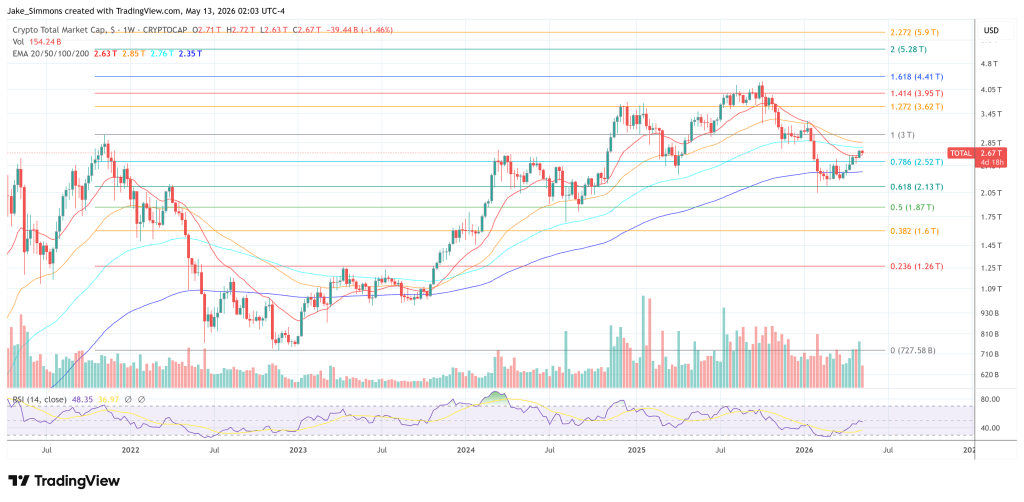
Total crypto market cap faces the 100-week EMA, 1-week chart | Source: TOTAL on TradingView.com

Câu hỏi Liên quan

QWhat is the CLARITY Act, and what key issues are highlighted by the large number of amendments it faces?

AThe CLARITY Act is a crypto market structure bill under consideration by the US Senate Banking Committee. The large number of amendments (over 100) highlights intense debate over key issues including: banning or restricting stablecoin rewards that resemble bank deposit interest, crypto firms' access to Federal Reserve master accounts, and whether digital assets can be used for payments like tax settlements.

QWhich specific amendment proposed by Senator Elizabeth Warren is mentioned, and what would it prevent?

AThe article mentions that Senator Elizabeth Warren filed an amendment that would prevent the Federal Reserve from issuing master accounts to crypto companies. Master accounts are crucial for financial institutions to access Fed payment and settlement services directly.

QAccording to the article, what is the core argument of the banking lobby regarding stablecoin rewards?

AThe banking lobby's core argument is that crypto platforms should not be allowed to offer rewards 'substantially similar' to bank deposit interest while avoiding the stringent regulations that banks face. They view this as an unfair competitive loophole.

QHow does the current Senate bill text propose to handle stablecoin rewards?

AThe Senate bill text proposes to ban rewards on idle stablecoin balances that closely resemble bank deposits. However, it would allow rewards tied to transaction-based activities, such as making stablecoin payments. Regulatory agencies would be tasked with creating joint rules to implement this provision.

QBeyond stablecoins, what are two other significant regulatory changes proposed in the bill's text?

ATwo other significant changes are: 1) Treating digital commodity exchanges, brokers, and dealers as financial institutions under the Bank Secrecy Act, subjecting them to AML, KYC, and due diligence rules. 2) Allowing crypto companies to raise up to $50 million annually (up to $200M total) without SEC registration, while clarifying that tokenized securities remain under securities law.

Nội dung Liên quan

Bitcoin Giữ Trên 77.000 USD khi Nhà Đầu Tư Tìm Kiếm Tín Hiệu Đáy

Sau khi không thể vượt qua mức 83.000 USD vào tuần trước, thị trường tiền điện tử vẫn diễn biến trầm lắng vào thứ Tư khi vật lộn với một mức hỗ trợ quan trọng. Bitcoin, đồng tiền điện tử lớn nhất, đã tăng 0,7% tính từ nửa đêm UTC và hiện được giao dịch quanh mức 77.400 USD. Các đồng tiền chính như XRP, Solana và Bitcoin đã tăng nhẹ trong phiên giao dịch châu Á, một phần nhờ phiếu bầu của Thượng viện Mỹ nhằm hạn chế quyền của Tổng thống Trump tiến hành chiến tranh với Iran, giúp giảm bớt bất ổn thị trường. Tâm lý tích cực cũng được hỗ trợ khi giới đầu tư chờ đợi biên bản cuộc họp tháng 4 của Cục Dự trữ Liên bang Mỹ (Fed). Mặc dù khó xác định chắc chắn, một số chỉ số on-chain và phái sinh, cùng với sự phục hồi gần đây của Bitcoin lên trên 77.000 USD, cho thấy giai đoạn tồi tệ nhất của đợt giảm giá hiện tại có thể đã qua. Chỉ số Vốn hóa Thực tế (Realized Cap), đo lường tổng giá trị Bitcoin dựa trên giá giao dịch cuối cùng của mỗi đồng xu trên chuỗi, đã giảm từ đỉnh 1.120 tỷ USD xuống khoảng 1.080 tỷ USD. Hiện tại, chỉ số này đang có dấu hiệu ổn định và tạo đáy, tương tự như ở các mức đáy của thị trường gấu năm 2022.

TheNewsCrypto11 phút trước

Bitcoin Giữ Trên 77.000 USD khi Nhà Đầu Tư Tìm Kiếm Tín Hiệu Đáy

TheNewsCrypto11 phút trước

Người tin tưởng nhất vào AGI, tại sao lại mua điên cuồng quyền chọn bán của NVIDIA?

Bài viết phân tích động thái của quỹ Situational Awareness LP (SALP) do Leopold Aschenbrenner, cựu thành viên OpenAI, điều hành. Dù là người tin tưởng mạnh mẽ vào AGI và tập trung đầu tư vào hạ tầng cơ sở AI (như điện lực, trung tâm dữ liệu, chip, bộ nhớ), báo cáo 13F mới nhất cho thấy quỹ này đã mở các vị thế quyền chọn bán (PUT) quy mô lớn cho các mã chủ chốt như ETF bán dẫn SMH, NVIDIA, Oracle, Broadcom, AMD. Bài viết lý giải đây không phải là hành động bán khống AI, mà là một chiến lược "mua bảo hiểm" để phòng ngừa rủi ro cho danh mục đầu tư vốn có độ biến động cao, trong bối cảnh vĩ mô có nhiều yếu tố bất ổn như giá dầu tăng, lạm phát và lãi suất cao. SALP vẫn giữ và tăng mua cổ phiếu của các công ty trong chuỗi hạ tầng AI (như CoreWeave, IREN, Applied Digital), cho thấy niềm tin dài hạn vào xu hướng này. Thông điệp chính là giao dịch AI đang chuyển dịch: từ "mua câu chuyện" sang "mua khả năng hiện thực hóa lợi nhuận"; từ đầu tư đồng loạt sang tìm kiếm các điểm nghẽn thực sự trong chuỗi cung ứng (từ sức mạnh tính toán -> kết nối -> lưu trữ -> điện năng -> cơ sở hạ tầng); và từ tấn công đơn thuần sang một chiến lược "tấn công có phòng thủ", quản lý rủi ro biến động một cách chủ động.

marsbit28 phút trước

Người tin tưởng nhất vào AGI, tại sao lại mua điên cuồng quyền chọn bán của NVIDIA?

marsbit28 phút trước

Trump Thúc Đẩy Tài Sản Số Thâm Nhập Hệ Thống Ngân Hàng Mỹ

Tổng thống Mỹ Donald Trump đã ban hành một sắc lệnh hành pháp yêu cầu chính phủ liên bang sửa đổi khung quy định nhằm tích hợp "tài sản kỹ thuật số và công nghệ sáng tạo vào các dịch vụ tài chính và hệ thống thanh toán truyền thống." Sắc lệnh nhấn mạnh chính sách của Hoa Kỳ là đơn giản hóa quy trình, giảm bớt rào cản không cần thiết và khuyến khích hợp tác giữa các công ty fintech, tổ chức tài chính được liên bang quản lý và các cơ quan quản lý tài chính liên bang. Một trọng tâm chính là mở rộng khả năng tiếp cận các dịch vụ thanh toán của Cục Dự trữ Liên bang (Fed) cho các thực thể liên quan đến tiền mã hóa. Các cơ quan quản lý được yêu cầu đánh giá và sửa đổi các quy định có thể cản trở quan hệ đối tác giữa ngân hàng và fintech. Fed cũng được chỉ thị xem xét hệ thống cung cấp tài khoản thanh toán cho các doanh nghiệp tài chính phi ngân hàng và các tổ chức nhận tiền gửi không được bảo hiểm. Điều này có thể mang lại lợi ích cho các tổ chức như Kraken ở Wyoming, vốn đã được cấp quyền truy cập hạn chế vào tài khoản chủ (master account) của Fed. Fed hiện đang phát triển một phiên bản "master account" chính thức hơn cho các công ty đủ điều kiện.

TheNewsCrypto41 phút trước

Trump Thúc Đẩy Tài Sản Số Thâm Nhập Hệ Thống Ngân Hàng Mỹ

TheNewsCrypto41 phút trước

AI đã cứu giúp một nhóm nhà đầu tư năng lượng mới

Khi thị trường chứng khoán biến động mạnh, ngành điện đã bùng nổ. Điều này không chỉ thể hiện ở việc nhiều mã cổ phiếu như Điện lực Kinh Năng, Điện lực Thượng Hải tăng mạnh, mà còn ở làn sóng IPO của các doanh nghiệp năng lượng mới như Tư Cách Năng Lượng Mới, Thái Kim Tân Năng, mang lại lợi nhuận khổng lồ cho các nhà đầu tư. Nguyên nhân sâu xa của đợt tăng này không phải là bù đắp đơn thuần, mà là sự định giá lại tài sản năng lượng mới trong kỷ nguyên AI. Sau một thời gian dài trầm lắng với định giá sụt giảm và khó khăn trong huy động vốn, ngành năng lượng tái tạo (điện xanh, lưu trữ năng lượng) giờ đây được coi là tài sản hạ tầng cốt lõi, đáng tin cậy nhất cho AI, nhờ chính sách "phối hợp tính toán - điện lực" và các quy định mới yêu cầu các trung tâm dữ liệu lớn phải đi kèm nguồn điện xanh và hệ thống lưu trữ. Sự thay đổi logic này đã kích hoạt thị trường đầu tư. Dữ liệu giao dịch M&A và huy động vốn tăng mạnh, định giá của các dự án hàng đầu như Hoa Nhuận Năng Lượng Mới đã phục hồi khoảng 62%. Dòng tiền đang chảy rõ ràng vào các tài sản liên quan đến "nền tảng tính toán" như lưới điện thông minh, giải pháp lưu trữ năng lượng. Các nhà đầu tư nhận định, AI đang tạo ra nhu cầu điện khổng lồ (dự báo thiếu hụt 55GW vào năm 2026), biến điện từ phụ phẩm thành động lực chính kéo theo đầu tư vào lưới điện, lưu trữ và điện xanh. Các lĩnh vực như làm mát bằng chất lỏng, tích hợp hệ thống lưu trữ quy mô lớn, nhà máy điện ảo, lưới điện siêu cao áp, điện hạt nhân và điện xanh hiện là những điểm nóng đầu tư. Các gã khổng lồ đầu tư như KKR đã thu về lợi nhuận khổng lồ từ việc đầu tư sớm vào hạ tầng năng lượng cho AI. Tóm lại, AI đang mở ra một chương mới cho các nhà đầu tư năng lượng tái tạo. Những người kiên trì trong giai đoạn khó khăn trước đây giờ đây đang đón nhận một mùa bội thu, khi điện xanh và lưu trữ năng lượng trở thành trụ cột không thể thiếu của nền tảng hạ tầng AI.

marsbit59 phút trước

AI đã cứu giúp một nhóm nhà đầu tư năng lượng mới

marsbit59 phút trước

Giao dịch

Giao ngay
Hợp đồng Tương lai
活动图片





