Can the Solana Foundation and Google's Collaboration on Pay.sh Bridge the Payment Link Between Web2 and Web3 in the Agent Economy?

marsbitXuất bản vào 2026-05-12Cập nhật gần nhất vào 2026-05-12

Tóm tắt

Solana Foundation, in collaboration with Google Cloud, has launched Pay.sh, a payment gateway designed to bridge the gap between AI agents and enterprise-grade service infrastructure. The initiative aims to solve a key bottleneck in the "agent economy": existing payment systems are ill-suited for autonomous AI agents. Traditional methods like credit cards require human verification, while newer on-chain protocols like x402 and MPP create a separate, Web3-native system that raises barriers for service providers. Pay.sh functions as a universal payment layer. It allows users to fund a Solana wallet via credit card or stablecoin, which then acts as an identity and payment proxy for AI agents. When an agent needs to access a paid API service (e.g., Google Cloud, Alibaba Cloud), Pay.sh handles the transaction seamlessly. It leverages the HTTP 402 status code ("Payment Required") to initiate payments, intelligently choosing between one-time transfers (x402-style) or session-based authorizations (MPC-style) based on the service's billing model. This spares agents from manual account registration and API key management. A key feature for service providers is low integration effort. They can adopt Pay.sh by providing a declarative configuration file, enabling features like tiered pricing, free tiers, and automatic revenue splitting to multiple addresses (e.g., for royalties, cloud costs). Providers can also list their APIs in a central Pay Skill Registry for agent discovery. The co...

Original Author: Hendrix, Researcher, Web3Caff Research

How to easily grasp the market hotspots, technological trends, ecological progress, and governance dynamics happening in the Web3 industry...? The "Market Pulse Analysis" column launched by Web3Caff Research will delve into the front lines to explore and filter current hot events, providing value interpretation, commentary, and principle analysis. See the essence through the phenomenon. Follow us now to quickly capture the front-line market trends in Web3.

As AI agents' capabilities continue to strengthen and cover an increasing number of end-to-end tasks, building payment systems for agents has become a necessary change for traditional merchants and service providers. However, existing solutions have their own limitations: traditional payment systems, such as credit cards and third-party payment platforms, were originally designed for real human users, requiring complex identity verification, risk assessment, etc., which are not suitable for agents. Emerging agent payment protocols, such as x402 (promoted by Coinbase) and MPP (the Machine Payment Protocol developed by Tempo and Stripe), are like building separate portals, entirely constructed for on-chain payments, processed on-chain and secured by on-chain verification. Service providers need to build a different payment system besides traditional payment channels, increasing the barrier to entry. Traditional payment solutions and emerging agent payment protocols are like two parallel lanes that are not well integrated. This limits the services agents can autonomously purchase, typically to Web3-friendly ranges, hindering the large-scale connection of workflows. To address this, the Solana Foundation and Google Cloud jointly launched Pay.sh, positioned as a "payment gateway between agents and enterprise-grade service infrastructure" to complete the final step in enabling agents to call more services.

Compliance Note: The following content is merely an objective analysis of Pay.sh, its technical principles, and design rules. It does not constitute any proposal or offer. Please do not make related decisions based on this information and strictly adhere to the laws and regulations of your country or region (readers from Mainland China are strongly advised to read Mainland China's Relevant Laws and Regulations on Blockchain and Virtual Currency Arrangement and Key Points), and do not participate in any financial behaviors prohibited by the laws and regulations of your country or region.

Pay.sh allows users to quickly top up a Solana wallet via credit card or stablecoin. Subsequently, the Solana wallet can act as the identity and payment account proxy for agents in the Web2 resource world. When an agent needs to call a service, there is no need to register an account or enter an API key. The Pay.sh gateway will declare the agent's legitimate identity, similar to Google's identity system, allowing the agent to use a unified account identity to purchase development resources like Google Cloud and Alibaba Cloud that were previously difficult to access.
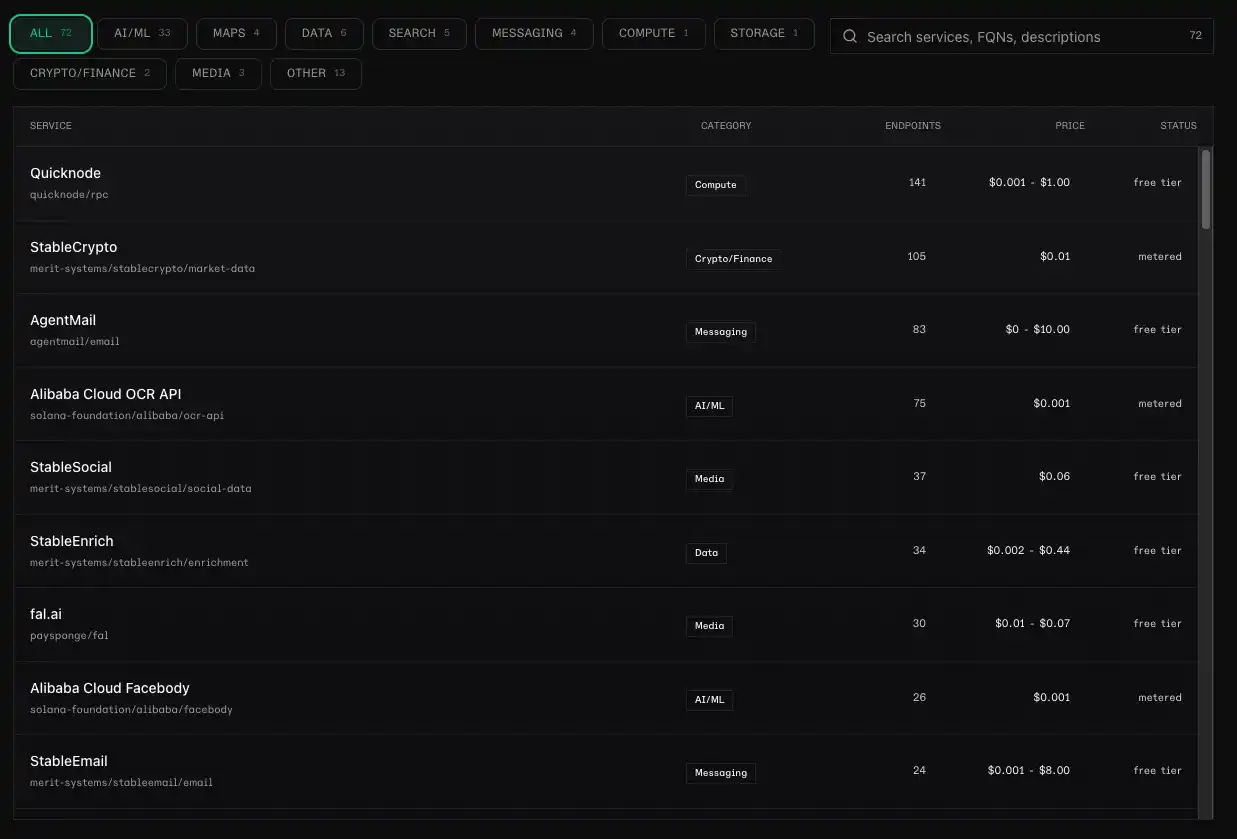
Currently supported API services by Pay.sh Source: Project official website

The payment flow of Pay.sh is similar to the recently popular x402 protocol, both built on the HTTP 402 status code: when an agent discovers an external service that needs to be called, it makes a request for the paid resource. The server returns status code 402 (Payment Required), along with payment details, including payment amount, pricing plan, recipient address, payment validity period, etc. Pay.sh parses this content and initiates an authorization request to the wallet. After the wallet completes the payment and generates a payment proof, Pay.sh carries the proof and initiates the service request again to obtain a normal response. However, to cover various API usage scenarios, Pay.sh is compatible with both x402 and MPP payment logics: when the server returns status code 402, Pay.sh further determines the target service's payment method. For one-time data access (payment grants one-time access) or usage-based access (payment grants a fixed amount of access), Pay.sh constructs a one-time fixed-amount transfer and broadcasts it on-chain. For continuous billing or session-based billing (unified bill for usage paid at once), Pay.sh supports the session authorization token introduced by the MPP (Machine Payment Protocol), writing the budget cap into the authorization and sending it back to the server. The agent can then repeatedly call a certain service within a short time, avoiding frequent similar authorization requests. Pay.sh updates the remaining balance with each call and automatically re-initiates session authorization when the balance is depleted or the service expires. Pay.sh automatically selects the more appropriate payment rail based on the target service's requirements, potentially reducing usage and management costs. Pay.sh also ensures the wallet remains securely stored locally, requesting user confirmation only when payment is needed. When information is returned, Pay.sh distinguishes between data and instructions. All external content returned by the service provider (including titles, body text, and API descriptions) is treated by Pay.sh as untrusted input. The agent must not directly execute instructions returned by the service provider to prevent malicious prompt injection or other attacks.

The biggest advantage of Pay.sh is that it provides a gateway for service providers to easily deploy. Service providers can integrate the payment gateway into their service network without significant modifications to their payment pathways or APIs. By simply providing a declarative file specifying payment-related parameters, service providers can adapt to various complex usage scenarios. For example, by defining routing rules, agents can use a service for free up to a certain limit, with charges applied beyond that quota, or even implement tiered pricing (different prices for different usage levels). Additionally, Pay.sh offers payment splitting functionality. The fees received by the service provider can be automatically sent to multiple addresses, e.g., 2% for data royalty fees, 5% for cloud costs, and the remainder for their own operations. Service providers only need to define different percentages or amounts when setting up the receiving addresses to achieve multi-account settlement at once. After registration, service providers can publish their API service data to the Pay Skill Registry, where agents can discover and select suitable API services by querying the registry.

Pay.sh itself is not a competitor to x402 and MPP. While the x402 and MPP protocols strive to make on-chain agent payments more reliable, Pay.sh aims to bridge the Web2 and Web3 payment ecosystems, providing agents with corresponding identities for resource acquisition. An agent's wallet serves as both identity and payment method. It no longer needs to register accounts on service provider websites to obtain services (currently, some providers might treat agents imitating human registration as a violation). Furthermore, Pay.sh's collaboration with Google enables API proxy and traffic scheduling for agents to be completed on Google Cloud, ensuring access control and log compliance, keeping agent behavior within reasonable bounds. Pay.sh can provide a curated service directory and pricing discovery. Agents do not need to randomly discover services in an unprotected network environment. It can leverage both x402 and MPP payment methods. The service process can meet enterprise compliance requirements on Google Cloud. These aspects complement the agent payment capabilities that the singular payment channels of x402 and MPP cannot cover, while also opening an entry point for agent commerce to flow into Web3. Additionally, Pay.sh can complete the final payment step for multiple agent commerce protocols launched by Google, such as A2A (Agent2Agent Protocol) for agent communication and task delegation, AP2 (Agent Payments Protocol) for compliance verification, and UCP (Universal Commerce Protocol) for service discovery and execution. Pay.sh is responsible for the final, seamless settlement of service value. The emergence of Pay.sh also simultaneously perfects the Web2 agent commerce cycle, becoming the convergence point for value flow between the two worlds. This step also represents an upgrade opportunity for the Solana public chain ecosystem itself. In the x402 protocol environment, there are numerous shell APIs, where service providers might violate the original service provider's terms and resell their services, such as maliciously scraping and reselling data from database websites or encapsulating and reselling large model APIs to others. Agents in such an environment have no way to distinguish between authorized services and malicious, spam services. Through the Pay.sh payment gateway and Google's collaboration, agents using services via Pay.sh are expected to have reduced potential risks. The launch of Pay.sh marks the Solana public chain stepping in to provide endorsement and infrastructure support for agent payments. This can not only attract more Web2 payment traffic to Solana itself but also further enhance the capabilities and accelerate the adoption of Solana wallets.

However, Pay.sh is currently far from being a perfect payment gateway solution. Pay.sh's service provider registry currently lacks admission mechanisms and decentralized verification mechanisms, making it still difficult to effectively distinguish between unauthorized third-party shell services and malicious services. Agents run a significant risk of connecting to counterfeit services, potentially causing losses for users. Moreover, since Pay.sh itself does not design the underlying payment protocols, the security of the payment process relies more on the design of those underlying protocols. This introduces uncontrollable external risks to Pay.sh and could also lead to potential payment failures due to insufficient adaptation to different protocols. From the service provider's perspective, despite Google's platform endorsement, API suppliers in different countries and regions might still hesitate to adopt the services provided by Pay.sh due to compliance requirements related to data privacy management inherent to their services and payment compliance requirements. This could not only limit the number of service providers using Pay.sh but might also require Pay.sh to make more compliance efforts in the future. Nonetheless, the launch of Pay.sh marks a step forward in the fusion and practical implementation of Web2 and Web3 for agent payment infrastructure. On-chain wallets will have the opportunity to become the endorsement for agents participating in diverse tasks. Therefore, we can continue to observe the subsequent development of Pay.sh.

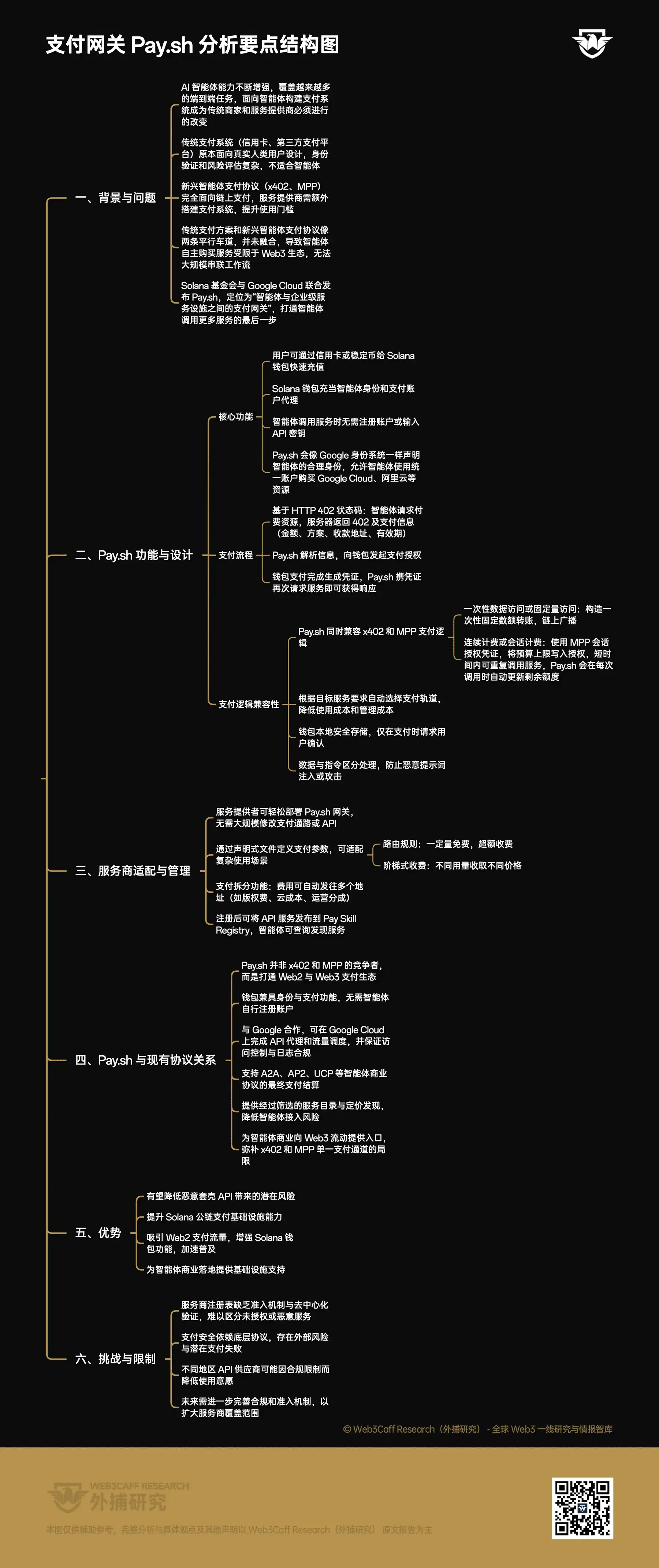
Key Points Structure Diagram:
Disclaimer: This report is compiled by Web3Caff Research. The information contained herein is for reference only and does not constitute any prediction, investment advice, proposal, or offer. Investors should not rely on such information to purchase, sell any securities, cryptocurrencies, or adopt any investment strategy. The terminology used and views expressed in this report are intended to help understand industry trends and promote the responsible development of the Web3, including the blockchain industry, and should not be interpreted as definitive legal opinions or the views of Web3Caff Research. The opinions in this report reflect only the personal views of the author as of the stated date, are independent of the position of Web3Caff Research, and may change following subsequent circumstances. The information and opinions contained in this report come from proprietary and non-proprietary sources that Web3Caff Research considers reliable, do not necessarily cover all data, and do not guarantee their accuracy. Therefore, Web3Caff Research makes no guarantee of their accuracy or reliability in any form and assumes no responsibility for errors and omissions arising in any other way (including liability to any person arising from negligence). This report may contain "forward-looking" information, which may include predictions and forecasts. This article does not constitute a guarantee of any prediction. Whether to rely on the information contained in this report is entirely up to the reader's discretion. This report is for reference only and does not constitute investment advice, a proposal, or an offer to buy or sell any securities, cryptocurrencies, or adopt any investment strategy. Please strictly comply with the relevant laws and regulations of your country or region.


Câu hỏi Liên quan

QWhat is the primary purpose of Pay.sh as introduced by the Solana Foundation and Google Cloud?

AThe primary purpose of Pay.sh is to act as a 'payment gateway between intelligent agents and enterprise-grade service infrastructure,' aiming to bridge the payment gap between Web2 and Web3 for intelligent agents. It allows agents to pay for services (like Google Cloud or Alibaba Cloud resources) using a Solana wallet funded by credit cards or stablecoins, without needing separate accounts or API keys for each service.

QHow does the Pay.sh payment process fundamentally work when an intelligent agent requests a paid service?

AWhen an intelligent agent requests a paid service, the server responds with an HTTP 402 status code (Payment Required), which includes payment details. Pay.sh parses this information, requests authorization from the user's wallet, and processes the payment. Once payment is confirmed, Pay.sh resends the request with a payment proof to access the service. It adapts its payment logic, supporting both one-time payments (akin to x402 protocol) and session-based billing with budget limits (akin to MPP protocol).

QWhat key advantage does Pay.sh offer to service providers who want to accept payments from intelligent agents?

APay.sh offers service providers an easily deployable gateway that requires minimal changes to their existing payment systems or APIs. By providing a declarative file defining payment parameters, providers can support complex billing scenarios (e.g., free tiers, usage-based or tiered pricing) and automatic payment splitting to multiple addresses. They can also list their APIs in the Pay Skill Registry for agents to discover.

QWhat role does the collaboration with Google Cloud play in the Pay.sh system, according to the article?

AThe collaboration with Google Cloud allows Pay.sh to handle API proxying and traffic routing on Google's infrastructure. This ensures compliance with access control, logging, and enterprise regulations, keeping agent behavior within legitimate bounds. It also helps integrate Pay.sh as the final payment settlement layer within Google's broader suite of agent commerce protocols (like A2A, AP2, UCP).

QWhat are some of the current limitations or challenges facing Pay.sh mentioned in the article?

ACurrent limitations include: 1) Its service registry lacks rigorous vetting and decentralized verification, making it hard to distinguish authorized services from unauthorized or malicious ones. 2) Payment security relies on underlying protocols (x402, MPP), introducing external risks and potential payment failures due to integration issues. 3) Service providers in different regions may hesitate to adopt Pay.sh due to data privacy regulations and payment compliance concerns, potentially limiting its growth and requiring further compliance efforts.

Nội dung Liên quan

43 phút của Trump: Cốt truyện người mạnh mất kiểm soát, chiến tranh truyền thông leo thang

Trong bài diễn văn kéo dài 43 phút sau hơn một tuần vắng bóng công chúng, Tổng thống Mỹ Donald Trump đã cố gắng thể hiện hình ảnh một nhà lãnh đạo mạnh mẽ và kiểm soát. Tuy nhiên, phần lớn thời gian được dành cho các chủ đề phụ như hồ phản chiếu trên National Mall, so sánh quy mô đám đông với Martin Luther King Jr., cùng những lời công kích nhắm vào phóng viên, đảng Dân chủ và các thành phố lớn. Ông còn ký sắc lệnh hành pháp hủy bỏ các biện pháp bảo vệ việc làm cho hàng nghìn công chức cấp cao liên bang, một động thái có thể gia tăng sự phụ thuộc vào lòng trung thành cá nhân hơn là năng lực chuyên môn trong chính phủ. Bài viết nêu bật trạng thái cá nhân đầy lo lắng và phòng thủ của Trump, thể hiện qua việc ông đột ngột kết thúc sự kiện và nhân viên nhanh chóng dọn dẹp hiện trường. Tác giả cũng phân tích cuộc tấn công của Trump vào nữ phóng viên CNN, Kaitlan Collins, coi đó là một phần của nỗ lực làm mất uy tín giới truyền thông. Bài báo cảnh báo về áp lực ngày càng lớn từ quyền lực chính trị và lợi ích thương mại lên các cơ quan báo chí chính thống, dẫn đến cuộc khủng hoảng về tính độc lập biên tập, như trường hợp Scott Pelley của CBS. Thông điệp chính kêu gọi công chúng ủng hộ các nhà báo và phương tiện truyền thông độc lập, những người được coi là lực lượng quan trọng duy trì sự thật khi các thể chế khác bị xâm phạm. Bài viết kết thúc với viễn cảnh lạc quan khi đề cập đến việc Hạ viện, với sự ủng hộ của một số thành viên đảng Cộng hòa, đã thông qua nghị quyết yêu cầu chấm dứt hành động quân sự ở Iran, cho thấy sự bất đồng ngày càng tăng ngay trong nội bộ đảng của Trump.

marsbit26 phút trước

43 phút của Trump: Cốt truyện người mạnh mất kiểm soát, chiến tranh truyền thông leo thang

marsbit26 phút trước

Kalshi, MTS và tham vọng của a16z

Trí tuệ thị trường dự đoán và tham vọng "Truyền thông Mới" của a16z Bài viết phân tích sự trỗi dậy của thị trường dự đoán (prediction markets), đặc biệt là công ty Kalshi được định giá 220 tỷ USD, dưới góc nhìn chiến lược đầu tư và truyền thông của quỹ mạo hiểm a16z. Tác giả điểm lại lịch sử tư tưởng của thị trường dự đoán, từ học thuyết của Hayek về việc thị trường tổng hợp tri thức phân tán, đến cơ chế khuyến khích của Robin Hanson (LMSR) và ý tưởng chính phủ dựa trên dự đoán (Futarchy). Trọng tâm bài viết nằm ở việc a16z, sau khi đầu tư vào Kalshi, đã định vị lại giá trị cốt lõi của thị trường dự đoán không chỉ là sòng bạc hay sàn giao dịch, mà là một phương tiện truyền thông mới mang lại "cảm giác hiện diện" (presence). Trong một thế giới ngày càng bị che khuất và bất lực, việc dùng tiền thật để đặt cược vào các sự kiện toàn cầu giúp cá nhân tái khẳng định vai trò "người quan sát tối thượng", can thiệp và diễn giải thực tại. Kalshi, theo logic này, sẽ trở thành nơi định đoạt tính xác thực và tầm quan trọng của sự kiện. Bài viết liên kết điều này với tầm nhìn "Truyền thông Mới" của a16z – một hệ thống truyền thông toàn diện từ định hình luận điệu, tài trợ, phát hành sản phẩm đến thu hút khách hàng với tốc độ và cường độ chưa từng có, nhằm "tiếp quản dòng thời gian". Ví dụ điển hình là MTS (Monitoring The Situation), một hãng truyền thông chuyên phát sóng tin tức 24/7 trên Twitter. Kết luận cho rằng sức hút thực sự của Kalshi và lý do định giá khổng lồ của nó nằm ở "trường lực bẻ cong hiện thực" – khả năng tạo ra một thực tại thay thế có sức thuyết phục cao nhờ vào khối lượng giao dịch bằng tiền thật, từ đó trở thành một mảnh ghép quyền lực trong đế chế truyền thông mới của a16z.

marsbit2 giờ trước

Kalshi, MTS và tham vọng của a16z

marsbit2 giờ trước

Bất Ngờ: Cựu Nhân Sự Trụ Cột Trong Dự Án Chip Của OpenAI Gia Nhập Anthropic

Chuyên gia chip "nhân viên số 002" của OpenAI, Clive Chan, vừa thông báo rời OpenAI để gia nhập Anthropic. Anh là một trong những thành viên sớm nhất của đội ngũ phát triển chip tự thiết kế của OpenAI, tham gia từ giai đoạn hình thành đến nay. Dù đánh giá cao đội ngũ chip tại OpenAI, Clive Chan chia sẻ anh luôn có mong muốn "chinh phục một ngọn núi mới từ chân núi", đó là lý do anh chuyển sang Anthropic. Tại Anthropic, anh ấn tượng với năng lực, giá trị cốt lõi và tham vọng của đội ngũ, đồng thời trải nghiệm cường độ làm việc rất cao. Khi được hỏi về tiến độ dự án chip của OpenAI, Clive Chan đề cập đến thông tin hợp tác công khai giữa OpenAI và Broadcom, với kế hoạch triển khai bắt đầu từ nửa cuối năm 2026. Clive Chan có kinh nghiệm làm việc tại nhiều công ty công nghệ hàng đầu như Tesla, Google, SpaceX trước khi gia nhập OpenAI vào đầu năm 2024. Việc chuyển đổi của anh là một ví dụ nữa cho thấy dòng chảy nhân tài đáng chú ý giữa OpenAI và Anthropic, sau sự kiện nhà nghiên cứu nổi tiếng Andrej Karpathy chuyển sang Anthropic hồi tháng 5. Động thái này càng thu hút sự chú ý khi Anthropic vừa hoàn thành vòng gọi vốn với định giá gần 1.000 tỷ USD.

marsbit2 giờ trước

Bất Ngờ: Cựu Nhân Sự Trụ Cột Trong Dự Án Chip Của OpenAI Gia Nhập Anthropic

marsbit2 giờ trước

a16z chuyển hướng toàn cầu hóa: VC đang trở thành "động lực thúc đẩy" của liên minh công nghệ Mỹ

Biên tập: Thông báo của Ben Horowitz cho thấy một bước chuyển quan trọng trong chiến lược toàn cầu hóa của a16z: họ không chỉ tìm kiếm dự án ở nước ngoài hay mở rộng đầu tư quốc tế, mà còn đặt mình vào khuôn khổ cạnh tranh công nghệ và hợp tác đồng minh rộng lớn hơn. Trong bối cảnh AI, robot, công nghệ quốc phòng, an ninh mạng và tái cấu trúc chuỗi cung ứng trở thành trọng tâm cạnh tranh quốc gia, con đường quốc tế hóa của startup trở nên phức tạp hơn. A16z đang phản ứng với sự thay đổi này thông qua việc thành lập văn phòng Tokyo, bổ nhiệm Anne Neuberger phụ trách các vấn đề toàn cầu, và nâng cấp nhóm quan hệ nhà đầu tư thành nhóm đối tác toàn cầu. Tín hiệu quan trọng nhất là a16z gắn kết mạng lưới toàn cầu của mình với năng lực lãnh đạo công nghệ của "Mỹ và các đồng minh". Đối với a16z, mạng lưới đầu tư mạo hiểm trong tương lai không chỉ giúp nhà sáng lập gọi vốn, tuyển dụng, bán hàng mà còn hỗ trợ họ tiếp cận thị trường trọng điểm, kết nối với chính phủ và các tổ chức chiến lược, cũng như hiểu rõ môi trường chính sách và quy định của các quốc gia khác nhau. Điều này có nghĩa vai trò của các tổ chức đầu tư mạo hiểm hàng đầu đang được định nghĩa lại. Họ không còn chỉ là trung gian vốn, mà là người tổ chức kết nối công ty khởi nghiệp, năng lực quốc gia, nguồn lực ngành, hệ thống đồng minh và vốn toàn cầu. Chiến lược toàn cầu hóa lần này của a16z có thể được xem như một sự chủ động định vị của vốn Silicon Valley trong cuộc cạnh tranh công nghệ toàn cầu mới.

marsbit2 giờ trước

a16z chuyển hướng toàn cầu hóa: VC đang trở thành "động lực thúc đẩy" của liên minh công nghệ Mỹ

marsbit2 giờ trước

Kalshi, MTS và Tham vọng của a16z

Bài viết phân tích tầm quan trọng của thị trường dự đoán (prediction markets), tập trung vào Kalshi, và tầm nhìn của quỹ đầu tư mạo hiểm a16z trong việc xây dựng một đế chế truyền thông mới. Tác giả điểm qua lịch sử tư tưởng đằng sau thị trường dự đoán, từ lý thuyết của Hayek về việc thị trường tổng hợp tri thức phân tán, đến cơ chế khuyến khích của Robin Hanson (LMSR) và ý tưởng "Futarchy". Trọng tâm bài viết là việc a16z đầu tư mạnh vào Kalshi (định giá 220 tỷ USD) và cách họ diễn giải giá trị cốt lõi của nó: mang lại "cảm giác hiện diện" (presence). Trong một thế giới mà con người ngày càng thụ động và xa cách với thực tại, thị trường dự đoán cho phép họ tham gia tích cực bằng cách dùng tiền thật để đặt cược vào các sự kiện, từ đó cảm thấy mình là người quan sát và dự báo lịch sử. a16z coi đây là mảnh ghép quan trọng cho tham vọng "truyền thông mới" của họ - một hệ thống toàn diện từ định hình narrative, tài trợ sản phẩm, đến tiếp cận khách hàng với tốc độ cực cao, nhằm "tiếp quản dòng thời gian". Công ty truyền thông MTS (Monitoring The Situation) là một ví dụ điển hình cho triết lý này. Bài viết kết luận rằng sức mạnh thực sự của Kalshi và thị trường dự đoán nằm ở "trường lực bẻ cong hiện thực" - khả năng định nghĩa tính xác thực và tầm quan trọng của sự kiện thông qua khối lượng giao dịch bằng tiền thật, từ đó giành được quyền giải thích tối cao về tương lai, một thứ quyền lực hiếm khi nằm trong tay một công ty tư nhân.

链捕手2 giờ trước

Kalshi, MTS và Tham vọng của a16z

链捕手2 giờ trước

Giao dịch

Giao ngay
Hợp đồng Tương lai

Bài viết Nổi bật

Làm thế nào để Mua LINK

Chào mừng bạn đến với HTX.com! Chúng tôi đã làm cho mua ChainLink (LINK) trở nên đơn giản và thuận tiện. Làm theo hướng dẫn từng bước của chúng tôi để bắt đầu hành trình tiền kỹ thuật số của bạn.Bước 1: Tạo Tài khoản HTX của BạnSử dụng email hoặc số điện thoại của bạn để đăng ký tài khoản miễn phí trên HTX. Trải nghiệm hành trình đăng ký không rắc rối và mở khóa tất cả tính năng. Nhận Tài khoản của tôiBước 2: Truy cập Mua Crypto và Chọn Phương thức Thanh toán của BạnThẻ Tín dụng/Ghi nợ: Sử dụng Visa hoặc Mastercard của bạn để mua ChainLink (LINK) ngay lập tức.Số dư: Sử dụng tiền từ số dư tài khoản HTX của bạn để giao dịch liền mạch.Bên thứ ba: Chúng tôi đã thêm những phương thức thanh toán phổ biến như Google Pay và Apple Pay để nâng cao sự tiện lợi.P2P: Giao dịch trực tiếp với người dùng khác trên HTX.Thị trường mua bán phi tập trung (OTC): Chúng tôi cung cấp những dịch vụ được thiết kế riêng và tỷ giá hối đoái cạnh tranh cho nhà giao dịch.Bước 3: Lưu trữ ChainLink (LINK) của BạnSau khi mua ChainLink (LINK), lưu trữ trong tài khoản HTX của bạn. Ngoài ra, bạn có thể gửi đi nơi khác qua chuyển khoản blockchain hoặc sử dụng để giao dịch những tiền kỹ thuật số khác.Bước 4: Giao dịch ChainLink (LINK)Giao dịch ChainLink (LINK) dễ dàng trên thị trường giao ngay của HTX. Chỉ cần truy cập vào tài khoản của bạn, chọn cặp giao dịch, thực hiện giao dịch và theo dõi trong thời gian thực. Chúng tôi cung cấp trải nghiệm thân thiện với người dùng cho cả người mới bắt đầu và người giao dịch dày dạn kinh nghiệm.

Tổng lượt xem 1.2kXuất bản vào 2024.12.13Cập nhật vào 2026.06.02

Làm thế nào để Mua LINK

Thảo luận

Chào mừng đến với Cộng đồng HTX. Tại đây, bạn có thể được thông báo về những phát triển nền tảng mới nhất và có quyền truy cập vào thông tin chuyên sâu về thị trường. Ý kiến ​​của người dùng về giá của LINK (LINK) được trình bày dưới đây.

活动图片