Musk vs. Altman: Who Will Be the 'Fisherman'?

marsbitXuất bản vào 2026-05-09Cập nhật gần nhất vào 2026-05-09

Tóm tắt

Elon Musk and Sam Altman are locked in a fierce legal and commercial battle. Musk, a co-founder of OpenAI, has sued the company and Altman, alleging they betrayed its original non-profit, open-source mission by transforming into a for-profit entity with significant Microsoft backing, now valued at $852 billion. He demands damages, a return to a non-profit structure, and management changes. The lawsuit hinges on whether OpenAI's founding charter was a legally binding charitable trust or merely an idealistic statement. OpenAI counters that Musk himself pushed for a for-profit model in 2017 but left when he couldn't gain full control, and now acts as a commercial rival with his xAI venture. Despite the high-profile feud, the article suggests the real winners (the "fishermen") may be others in the AI race. While Musk has folded xAI into SpaceX to pursue a "space-based computing" vision, his Grok chatbot lags in market share and user growth compared to leaders. OpenAI faces its own challenges, notably from rival Anthropic, which is rapidly catching up in revenue and enterprise adoption. Musk is reportedly leasing significant computing power to Anthropic, creating an "enemy of my enemy" dynamic. Furthermore, Chinese AI models like DeepSeek are quickly closing the capability gap. Ultimately, the lawsuit is seen as setting a precedent for AI governance, but the intense competition between Musk and Altman may primarily benefit other players, infrastructure providers like Nvidia, an...

By | TingtongTech (ID:tingtongtech),Author | Yang Lin,Editor | Rao Xiafei

The showdown between Elon Musk and Sam Altman is intensifying.

Their feud, which has been brewing for a decade, has escalated from public spats on platform X to direct competition between their companies' product lines, and now to a courtroom confrontation.

Musk accuses Altman of "stealing a charity," arguing that OpenAI, now valued at approximately $852 billion and planning an IPO, has betrayed its founding principles.

The world's richest man believes Altman and others swindled him out of $38 million in donations and personal assistance. In his lawsuit, he has two core demands: one, seeking $130-150 billion in damages; two, requesting the court to order OpenAI to revert to a non-profit status and replace its current management.

The market defines this duel as the "AI Century Lawsuit." For the AI era, in a sense, whether discussing legal principles, capital competition, or discourse power, the essence of this game is no longer merely a personal grudge between the two men.

In the market's view, the true significance of this lawsuit lies in the fact that the judgment will essentially anchor the basic industry rules for the global AI ecosystem.

Although the final winner will not change the rules of the AI game, this is a microcosm of an era of global industry differentiation and fierce competition.

Especially, behind the scenes of frantic pursuit, there is an even more important question to ask: while Musk and Altman are tearing each other apart in court and competing fiercely outside, who will be the real "fisherman"?

A Courtroom Battle Exposing More Than Just a Personal Feud

"Without me, OpenAI would never have existed," Musk has repeatedly emphasized.

In 2015, Musk invested about $38 million in seed funding and co-authored the founding manifesto for OpenAI with Altman, pledging to "build safe, beneficial AGI (artificial general intelligence) for humanity, unconstrained by the need for financial return."

Musk poached top researchers from Google and personally contacted Nvidia CEO Jensen Huang to secure early supercomputers for the startup. However, in February 2018, he left the board due to disagreements over direction.

A decade later, OpenAI is no longer a non-profit lab. It has established a for-profit subsidiary, brought in Microsoft investment, and rapidly grown into a tech empire valued at around $852 billion and planning an IPO.

All disputes between the two revolve around that initial pledge. The core controversy is whether it was a charitable trust agreement or a legally non-binding "idealistic slogan."

In fact, from a legal interpretation perspective, if it is deemed merely a visionary statement, it holds no legal binding force. Then OpenAI's for-profit transformation would have no legal flaws, Musk's accusations would completely collapse, and the lawsuit would end immediately.

However, if the founding manifesto is deemed to constitute a legally effective "charitable trust" or an enforceable "public welfare commitment," then every subsequent step by OpenAI could constitute a fundamental violation of the original promise.

Musk's accusation is that OpenAI transformed from a "non-profit organization" into a "for-profit entity." He wants Altman and his AI empire to face the consequences: a $150 billion compensation demand, dissolution of OpenAI's for-profit structure, removal of Altman and Brockman, forced disclosure of technology, and cancellation of Microsoft's licensing agreement.
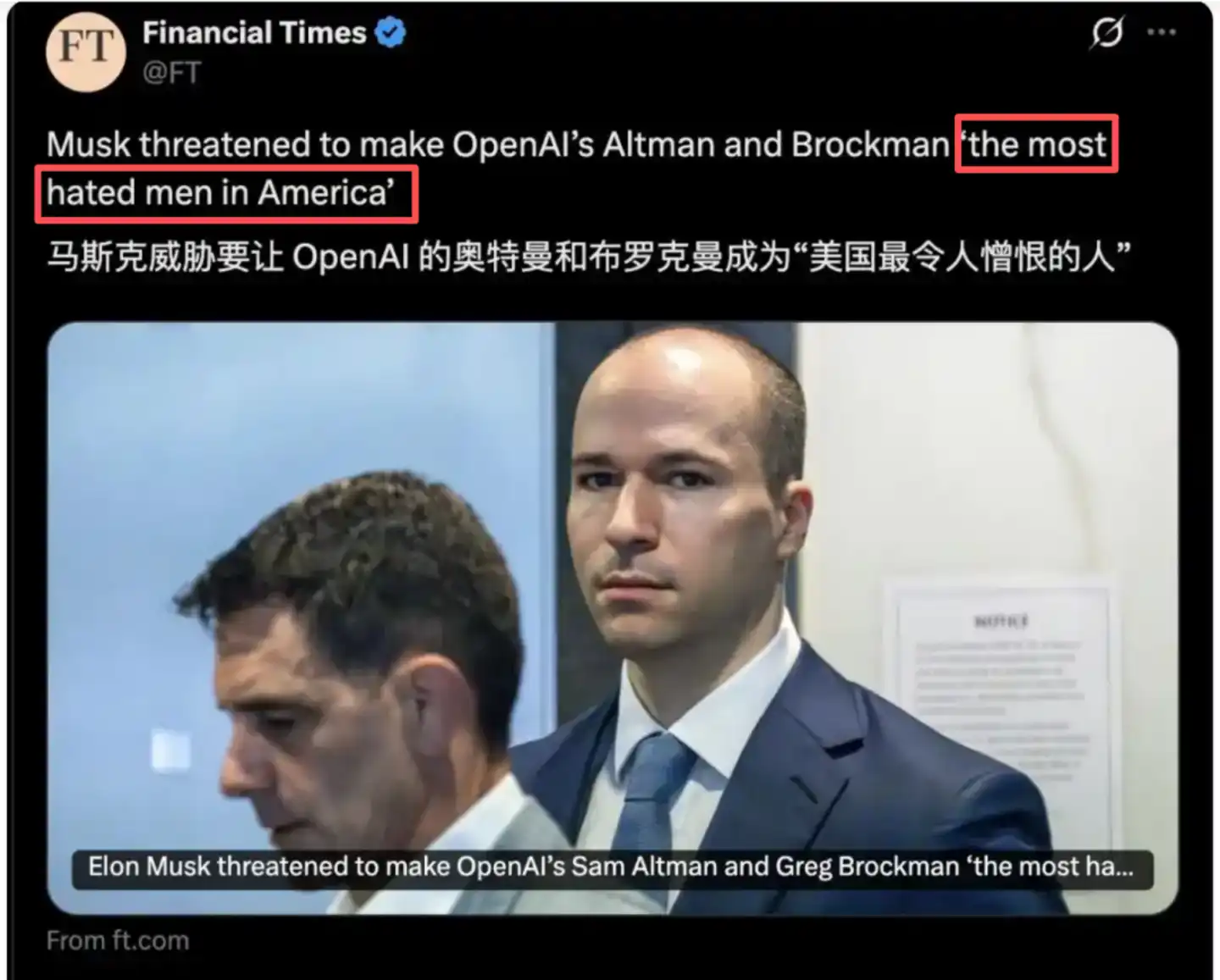
But OpenAI has presented a counter-narrative pointing in a different direction.

In their view, Musk was once a power-holder and is now a business rival. According to media reports, OpenAI lawyers also believe Musk filed the lawsuit not to guard any non-profit mission, but because "he didn't get the outcome he wanted."

For instance, court documents from OpenAI show that Musk himself had suggested establishing a for-profit entity as early as 2015, and in 2017 not only engaged in control struggles but also secretly registered a for-profit company in OpenAI's name.

OpenAI President Greg Brockman testified that in 2017, Musk himself had pushed for OpenAI to transform into a for-profit company, but with the condition that he have "complete control."

In fact, Musk also admitted that his xAI had used OpenAI's models to train its own Grok, which, in the market's view, corroborates OpenAI's assertion of "commercial rivals suppressing each other."

Some market commentary also points out: If Musk is truly fighting for the benefit of all humanity, why did he angrily exit in 2018 after failing to gain control when proposing a for-profit entity? Why publicly mock OpenAI and then found xAI in 2023?

In other words, what Musk wants—is it a "non-profit organization," or an AI enterprise/dominance he can control?

Or perhaps, Musk just wants to "defeat Altman"?

The AI Game Between Two Companies

Indeed, judging from the scope of Musk's empire, he certainly wants to "defeat Altman." After all, Musk's journey in AI has not been easy.

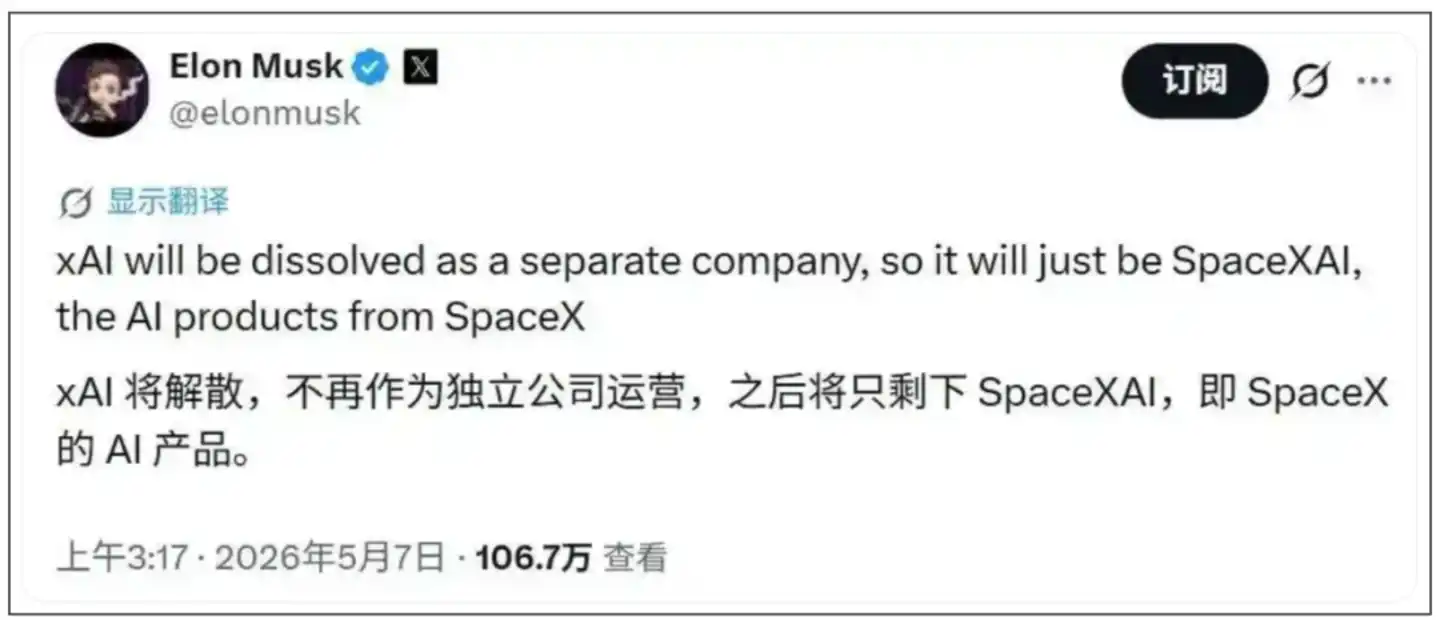
On the product side, Musk had high hopes for xAI. But during the second week of the trial, Musk dropped a bombshell on X: xAI would be fully integrated into SpaceX, renamed SpaceXAI, completely abandoning its independent identity.

"xAI will no longer exist as an independent company; it will simply be SpaceXAI, the AI product of SpaceX," Musk defined this move.
In the market's view, this move might be Musk's attempt to deeply integrate his AI business with aerospace. After all, Musk's X platform can provide over 500 million real-time data points daily to train his Grok model.

Musk's vision is: X provides usable data, Starlink provides global communications, and SpaceX rockets send computing equipment into space. In his view, Earth's energy and heat dissipation limits will soon constrain AI development; he estimates that within two to three years, the minimum cost for generative AI computation will shift to space. Thus, he aims to link AI from Earth to space, creating a closed-loop commercial ecosystem.

However, more analysis suggests this might be Musk's "smokescreen," because, on the product side, Musk's AI performance is not as "excellent" as he describes.

In fact, Grok, which Musk considers "the smartest AI on Earth," has shown increasingly mediocre market performance.

By late 2025, Grok was the runner-up globally among AI chat apps, second only to ChatGPT. But now, it has been overtaken by Claude, Gemini, and even DeepSeek.

Looking at global AI tool traffic, a year ago, Grok could still occupy the second spot in the US AI market with a 7.03% share. By early 2026, it had shrunk to 3.44%, surpassed by DeepSeek's 3.7% share.

Public data shows that in April 2026, Grok's global mobile daily active users dropped from 13.9 million to 12.2 million, a 12.5% decline. The drop was more significant in the US market, falling from 1.4 million to 1.1 million, a 15.6% reduction.

During the same period, however, Claude's daily active users surged from 16 million to 23 million, a 44% month-over-month spike, leaving Grok far behind.

Most embarrassing for xAI is its user composition. Public reports state that over the past six months, Grok's user base has been "overwhelmingly male," a gender imbalance extremely rare among mainstream AI products.

Market analysis points out this directly reflects that Grok's user scenarios primarily come from traffic diversion from social platform X, rather than establishing independent brand recognition and user ecosystems. Much analysis suggests that once the traffic红利 from platform X diminishes or user interest shifts, Grok's growth engine will face severe challenges.

Behind the user data lies the worrying operational status of xAI.

Although xAI was valued at $250 billion in its independent funding round, its core AI business scale remains relatively small, with no public independent ARR (Annual Recurring Revenue) data released yet.

Meanwhile, in Q1 2026, OpenAI's ARR had already reached $25 billion.

In March 2026, Musk himself publicly admitted that xAI would need until the end of 2026 to catch up with leading AI firms and might only achieve a significant lead by 2029.

This, perhaps, is the fundamental reason behind Musk's decision to disband xAI.

In contrast, OpenAI's market data performance is clearly better than xAI's.

Just a month before the trial, OpenAI pulled off a move significant enough to shake Silicon Valley, announcing the completion of a $122 billion financing round, with a post-money valuation of $852 billion, setting a record for the highest private financing in business history.

Moreover, OpenAI's annualized revenue exceeds $25 billion, with monthly revenue of $2 billion. ChatGPT boasts over 900 million weekly active users and over 50 million paying subscribers.

Musk has to face the fact that, despite his AI ambition lying in "space-based computing," at least on the product side, OpenAI's growth has indeed left xAI far behind.

Who Will Be the Real 'Fisherman'?

Of course, regardless of how Musk and Altman compete, and regardless of the trial's final outcome, the AI field will certainly not pause because of the feud between two individuals.

Especially, both Musk and Altman must realize that in this "two tigers fighting" war of attrition, the real "fisherman" is making an entrance.

At least for now, OpenAI's biggest challenger is not Musk's xAI, but its arch-rival Anthropic.

As is well known, Anthropic's announced annualized revenue of $30 billion in April 2026 already exceeds OpenAI's $25 billion level from February. Claude's global downloads tripled year-over-year, while ChatGPT's US weekly active users saw their first year-on-year decline.

Particularly in OpenAI's core enterprise user segment, Anthropic is catching up and might even surpass it. Data shows that in March 2026, nearly one-third of US enterprises used Anthropic's Claude tools, an increase of over 6 percentage points month-over-month, almost neck and neck with OpenAI's 35%.

On May 8th, according to media reports, Anthropic is considering raising tens of billions of dollars this summer to significantly expand computing capacity. If realized, Anthropic's valuation would approach $1 trillion, surpassing OpenAI.

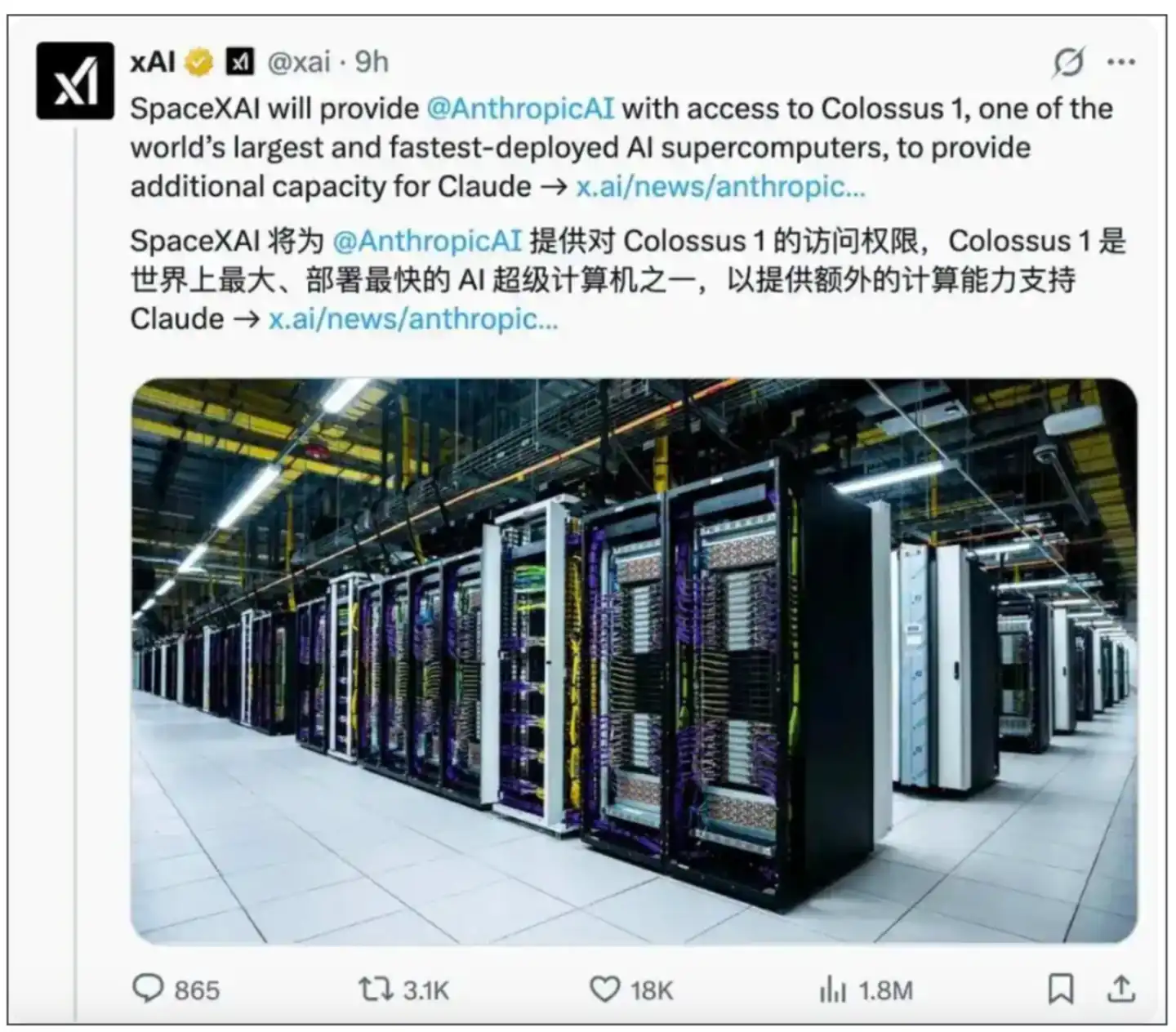
More interestingly, after disbanding xAI, Musk will lease all 300 megawatts of computing power and 220,000 GPUs from the Colossus 1 supercomputer to Anthropic to support model training and inference. The market jokes that Musk has turned "the enemy of my enemy into an ally."
It is worth noting that Anthropic's founders also left OpenAI to start their venture. In a way, this mirrors the story of Altman breaking away from Musk.

Another reality is that China's large language models are demonstrating rapid iterative capabilities.

Public data shows that the gap between top-tier Chinese and US AI in human evaluation tests has narrowed to 2.7%, almost negligible.

Especially, DeepSeek's low-cost, high-quality model once surpassed ChatGPT in download rankings on the Apple App Store.

Although the release of DeepSeek R2 has been repeatedly delayed, in terms of foundational capabilities, Chinese AI is no longer just a "follower." Moreover, China's other large models are also rapidly catching up.

Of course, in the market's view, regardless of who wins between the two, looking back at computing power, there are more winners behind the scenes, such as Nvidia and Google.

Returning to the lawsuit itself, at least for the market, this litigation has subjected the governance structures, ethical commitments, and business logic of all AI companies to public scrutiny. Regardless of the final verdict, its symbolic significance for AI governance rules has been established.

Especially, beyond legal victory or defeat, a more thought-provoking question is: In the AI race, involving hundreds of billions of dollars and capturing the entire industry's attention, who will be the ultimate winner?

Perhaps, in the AI industry, the real "fisherman" is never a single company or individual.

The true beneficiaries might be other players who, leveraging this century-defining duel to hype the market, are quietly accumulating strength elsewhere; they might be the sellers of computing infrastructure, the "water vendors," or the rising "third forces."

When the snipe and the clam grapple, the fisherman profits. And this fisherman is quietly watching it all.

(All images are from the internet, contact for removal if infringement.)

(Disclaimer: This article is for information exchange only and does not constitute any investment advice.)


Câu hỏi Liên quan

QWhat is the core legal dispute between Elon Musk and Sam Altman regarding OpenAI's origins?

AThe core dispute centers on whether the founding declaration of OpenAI, which promised to 'build safe and broadly beneficial AGI for humanity, unfettered by the need to generate financial return,' constituted a legally binding charitable trust or was merely an unenforceable 'idealistic slogan.' Musk argues it was the former, while OpenAI contends it was the latter.

QHow has OpenAI's financial and market position changed since its founding, according to the article?

AOpenAI has transformed from a non-profit lab into a for-profit tech empire with a valuation of approximately $852 billion (planning an IPO). It recently completed a record $122 billion private funding round. Its annual recurring revenue (ARR) has reached $25 billion, with over 900 million weekly active ChatGPT users and more than 50 million subscribers.

QWhat were the key factors behind Elon Musk's decision to disband xAI and merge it into SpaceX as 'SpaceXAI'?

AKey factors include Grok's declining market performance (being surpassed by competitors like Claude and DeepSeek), its shrinking user base and gender imbalance, its relatively small business scale with no public ARR data compared to OpenAI's $25 billion, and Musk's strategic vision to integrate AI with SpaceX's space-based computing and communication infrastructure to overcome Earth's energy and thermal limits.

QWho are the potential 'beneficiaries' or 'fishermen' mentioned in the article that could gain from the Musk-Altman rivalry?

AThe potential 'fishermen' include Anthropic (OpenAI's direct competitor, which is growing rapidly and may receive compute resources from Musk), Chinese AI models like DeepSeek (which are rapidly closing the capability gap), and foundational infrastructure providers like NVIDIA and Google who supply the essential computing power (the 'water sellers').

QWhat significance does the article attribute to the Musk vs. Altman lawsuit beyond their personal conflict?

AThe article states that the lawsuit's true significance lies in its potential to substantially anchor the basic industry rules for the global AI ecosystem. Regardless of the verdict, it has already subjected the governance structures, ethical commitments, and business logic of all AI companies to intense public scrutiny, establishing a landmark precedent for AI governance.

Nội dung Liên quan

Kraken Lên Kế Hoạch Cung Cấp Hợp Đồng Tương Lai Vĩnh Viễn Được CFTC Quy Định Cho Nhà Giao Dịch Chuyên Nghiệp Hoa Kỳ

Kraken đang chuẩn bị ra mắt hợp đồng tương lai vĩnh viễn được CFTC quản lý cho các nhà giao dịch chuyên nghiệp đủ điều kiện tại Hoa Kỳ. Sản phẩm sẽ được cung cấp thông qua sàn phái sinh Bitnomial mà Kraken đã mua lại và dự kiến tích hợp vào nền tảng Kraken Pro. Hợp đồng tương lai vĩnh viễn là sản phẩm phái sinh crypto lớn toàn cầu, cho phép giao dịch không ngày đáo hạn. Tại Mỹ, các hạn chế quy định trước đây khiến nhà giao dịch có ít lựa chọn trong nước. Động thái của Kraken nhằm thu hẹp khoảng cách này, cung cấp một con đường được quản lý để tiếp cận sản phẩm chi phối khối lượng giao dịch crypto ở nước ngoài. Việc ra mắt sẽ tập trung vào các nhà giao dịch chuyên nghiệp đủ điều kiện. Các yếu tố cần theo dõi bao gồm điều khoản về tính đủ điều kiện, thiết kế hợp đồng, tài sản được hỗ trợ và quan trọng nhất là thanh khoản khi ra mắt. Thành công của sản phẩm có thể mở đường cho nhiều sản phẩm tương lai vĩnh viễn được quản lý khác tại thị trường Mỹ, đưa sản phẩm phái sinh chủ chốt này tiến gần hơn đến cơ sở hạ tầng thị trường nội địa được quản lý.

bitcoinist9 giờ trước

Kraken Lên Kế Hoạch Cung Cấp Hợp Đồng Tương Lai Vĩnh Viễn Được CFTC Quy Định Cho Nhà Giao Dịch Chuyên Nghiệp Hoa Kỳ

bitcoinist9 giờ trước

Sự Ra Mắt Của Warsh: Chủ Tịch Fed Hiểu Crypto Nhất Lịch Sử Sẽ Mang Đến Bất Ngờ Hay Cú Sốc Cho Thị Trường?

Tân Chủ tịch Cục Dự trữ Liên bang Kevin Warsh, người được mệnh danh là chủ tịch FED "hiểu rõ về Crypto nhất trong lịch sử", sắp có buổi họp báo chính sách đầu tiên trong bối cảnh thử thách ba mặt: lạm phát quay trở lại, áp lực giảm lãi suất từ Tổng thống Trump và kỳ vọng thị trường về việc tăng lãi suất. Khác với người tiền nhiệm, Warsh có cái nhìn sâu sắc về tài sản số, từng coi Bitcoin như "cảnh sát tốt cho chính sách" và nhấn mạnh giá trị sản xuất của ngành công nghiệp blockchain. Tuy nhiên, ông cũng nổi tiếng là người theo chủ nghĩa diều hâu về lạm phát. Sự kết hợp giữa "lãi suất chặt chẽ" và "quy định thân thiện" từ ông có thể trở thành yếu tố cốt lõi định giá tài sản mã hóa. Bài viết phân tích tác động từ ba khía cạnh: 1. **Chuyển đổi khuôn mẫu kỳ vọng quy định:** Từ phòng thủ sang tích hợp và đổi mới, có thể thúc đẩy các khung pháp lý rõ ràng hơn, hỗ trợ ổn định do khu vực tư nhân phát hành. 2. **Định giá lại lộ trình lãi suất và phần bù rủi ro:** Một chủ tịch hiểu biết và giao tiếp rõ ràng có thể giảm bớt phí bảo hiểm bất định, có lợi về cấu trúc cho thị trường. 3. **Tái phân bổ dòng vốn toàn cầu:** Kinh nghiệm đầu tư cá nhân của Warsh truyền tải tín hiệu về sự chấp nhận chính thống, có thể thúc đẩy các quỹ thể chế truyền thống phân bổ tài sản số. Hai kịch bản chính được đưa ra: * **Ngạc nhiên thú vị:** Nếu Warsh thể hiện thái độ ôn hòa và công nhận giá trị của tài sản số, thị trường có thể được tiếp thêm sức mạnh. * **Cú sốc:** Nếu ông phát tín hiệu tăng lãi suất mạnh mẽ, tài sản rủi ro, bao gồm crypto, có thể chịu áp lực bán. Mặc dù Warsh đã bán các khoản nắm giữ liên quan đến crypto để tuân thủ quy tắc đạo đức, nhưng sự hiểu biết thực sự của ông về công nghệ blockchain được kỳ vọng sẽ đặt nền tảng cho việc chính thống hóa tài sản số về lâu dài, vượt ra ngoài các phản ứng thị trường ngắn hạn.

marsbit10 giờ trước

Sự Ra Mắt Của Warsh: Chủ Tịch Fed Hiểu Crypto Nhất Lịch Sử Sẽ Mang Đến Bất Ngờ Hay Cú Sốc Cho Thị Trường?

marsbit10 giờ trước

XRP Ledger Ra Mắt Rebrand XRPLd Cùng Với Bản Nâng Cấp Phiên Bản 3.2.0

Phiên bản 3.2.0 của XRP Ledger đã chính thức ra mắt, đánh dấu một bước nâng cấp quan trọng cho cơ sở hạ tầng blockchain cốt lõi. Lần này, các nhà phát triển đã đổi tên phần mềm vận hành mạng từ "rippled" thành "xrpld" để phù hợp hơn với toàn bộ hệ sinh thái của dự án. Bản cập nhật tập trung chủ yếu vào các cải tiến back-end và hiệu suất thay vì tính năng người dùng mới. Các tối ưu hóa bộ nhớ được giới thiệu có khả năng tiết kiệm tới 40% lượng bộ nhớ máy chủ, đồng thời chuẩn bị kiến trúc phần mềm cho việc mở rộng quy mô trong tương lai. Về mặt bảo mật, bản sửa đổi `fixCleanup3_2_0` mang lại nhiều cải thiện cho các mô-đun như kho lưu ký tài sản đơn, giao thức cho vay, sàn giao dịch phi tập trung và mã thông báo đa năng. Các kiểm tra bất biến mới được thêm vào để đảm bảo tính toàn vẹn của sổ cái khi tài khoản bị xóa. Một khả năng mới cho nhà phát triển là ứng dụng có thể truy xuất thông tin định nghĩa giao thức và máy chủ XRP Ledger mà không cần kết nối trực tiếp, hỗ trợ đáng kể việc phát triển ví, công cụ khám phá chuỗi khối và API. Các thay đổi về khả năng mở rộng và ổn định bao gồm kích thước khối có thể cấu hình, hỗ trợ lưu trữ cơ sở dữ liệu hiệu quả qua nuDB, và việc hỗ trợ máy chủ gRPC cho TLS/mutual TLS trở thành tùy chọn. Cổng kết nối ngang hàng mặc định cũng được đổi từ 51235 sang 2459. Các tính năng kiểm tra bất biến giao dịch tạm thời bị vô hiệu hóa trong phiên bản 3.2.0 do ảnh hưởng đến hiệu suất, nhưng không gây rủi ro bảo mật.

TheNewsCrypto10 giờ trước

XRP Ledger Ra Mắt Rebrand XRPLd Cùng Với Bản Nâng Cấp Phiên Bản 3.2.0

TheNewsCrypto10 giờ trước

AGI không phải là điểm kết thúc, nghiên cứu mới của DeepMind: Hướng tới ASI, tiến bộ AI thực sự mới chỉ bắt đầu

DeepMind mới đây công bố nghiên cứu cho rằng AGI (Trí tuệ nhân tạo phổ quát) không phải là điểm cuối. AI sẽ tiếp tục phát triển vượt qua khả năng của các nhóm chuyên gia con người hàng đầu, hướng tới ASI (Trí tuệ siêu nhân tạo). Báo cáo phân biệt ba khái niệm: AGI (năng lực nhận thức tương đương mức trung bình của con người), ASI (vượt trội con người trong hầu hết lĩnh vực quan tâm), và UAI (giới hạn lý thuyết tối thượng). Nghiên cứu đề xuất bốn con đường tiềm năng để chuyển từ AGI sang ASI: 1. Mở rộng quy mô tính toán, mô hình và dữ liệu. 2. Tiến hóa thuật toán, có thể thay đổi mô hình mới. 3. Tự cải thiện đệ quy, tạo phản hồi tích cực. 4. Điều phối đa tác tử và trí tuệ tập thể. Đồng thời, báo cáo chỉ ra sáu điểm nghẽn chính: giới hạn dữ liệu chất lượng cao, áp lực tài nguyên và kinh tế, hạn chế của mô hình mạng nơ-ron hiện tại, nghiên cứu ngày càng khó khăn, rào cản trừu tượng, cùng các vấn đề quản lý và phản ứng xã hội. Khi AI vượt con người, các phương pháp đánh giá truyền thống sẽ mất ý nghĩa. Cần xây dựng hệ thống đánh giá mới cho thời kỳ hậu AGI. ASI không phải là hệ thống toàn năng, vẫn chịu ràng buộc bởi các quy luật vật lý, độ phức tạp tính toán, dữ liệu, tài nguyên và tốc độ phản hồi thực tế. Tương lai phát triển của AI vẫn chứa nhiều bất định, đòi hỏi một nỗ lực liên ngành quy mô lớn để theo dõi và ứng phó.

marsbit11 giờ trước

AGI không phải là điểm kết thúc, nghiên cứu mới của DeepMind: Hướng tới ASI, tiến bộ AI thực sự mới chỉ bắt đầu

marsbit11 giờ trước

Kraken Ra Mắt Hợp Đồng Perpetual Trước IPO Cho OpenAI Và Anthropic Với Đòn Bẩy Lên Đến 5x

Kraken đã ra mắt hợp đồng tương lai vĩnh viễn (perps) tiền IPO cho hai công ty trí tuệ nhân tạo hàng đầu là OpenAI và Anthropic. Các hợp đồng này cho phép các nhà giao dịch đủ điều kiện mở vị thế mua (long) hoặc bán (short) đối với các công ty tư nhân được theo dõi sát sao này trước khi họ lên sàn chứng khoán, với đòn bẩy lên tới 5x. Sản phẩm này đánh dấu một bước tiến trong việc mở rộng cơ sở hạ tầng phái sinh tiền mã hóa sang các tài sản ngoài chuỗi, cung cấp cho các nhà giao dịch một cách tiếp cận thay thế để có thể tiếp xúc với các công ty tư nhân vốn thường khó tiếp cận. Tuy nhiên, hợp đồng tiền IPO có những rủi ro đặc thù. Khác với các hợp đồng vĩnh viễn cho tiền mã hóa có giá cả minh bạch, định giá công ty tư nhân phụ thuộc vào nhiều yếu tố như các vòng gọi vốn, giao dịch thứ cấp và kỳ vọng về thời điểm IPO. Điều này khiến việc định giá và quản lý rủi ro trở nên phức tạp hơn. Việc sử dụng đòn bẩy cao có thể khuếch đại lợi nhuận nhưng cũng làm gia tăng đáng kể rủi ro thua lỗ và thanh lý. Do đó, các nhà giao dịch cần hiểu rõ bản chất của sản phẩm mới và các rủi ro độc đáo của thị trường tư nhân trước khi tham gia.

bitcoinist11 giờ trước

Kraken Ra Mắt Hợp Đồng Perpetual Trước IPO Cho OpenAI Và Anthropic Với Đòn Bẩy Lên Đến 5x

bitcoinist11 giờ trước

Giao dịch

Giao ngay
Hợp đồng Tương lai

Bài viết Nổi bật

Làm thế nào để Mua ID

Chào mừng bạn đến với HTX.com! Chúng tôi đã làm cho mua SPACE ID (ID) trở nên đơn giản và thuận tiện. Làm theo hướng dẫn từng bước của chúng tôi để bắt đầu hành trình tiền kỹ thuật số của bạn.Bước 1: Tạo Tài khoản HTX của BạnSử dụng email hoặc số điện thoại của bạn để đăng ký tài khoản miễn phí trên HTX. Trải nghiệm hành trình đăng ký không rắc rối và mở khóa tất cả tính năng. Nhận Tài khoản của tôiBước 2: Truy cập Mua Crypto và Chọn Phương thức Thanh toán của BạnThẻ Tín dụng/Ghi nợ: Sử dụng Visa hoặc Mastercard của bạn để mua SPACE ID (ID) ngay lập tức.Số dư: Sử dụng tiền từ số dư tài khoản HTX của bạn để giao dịch liền mạch.Bên thứ ba: Chúng tôi đã thêm những phương thức thanh toán phổ biến như Google Pay và Apple Pay để nâng cao sự tiện lợi.P2P: Giao dịch trực tiếp với người dùng khác trên HTX.Thị trường mua bán phi tập trung (OTC): Chúng tôi cung cấp những dịch vụ được thiết kế riêng và tỷ giá hối đoái cạnh tranh cho nhà giao dịch.Bước 3: Lưu trữ SPACE ID (ID) của BạnSau khi mua SPACE ID (ID), lưu trữ trong tài khoản HTX của bạn. Ngoài ra, bạn có thể gửi đi nơi khác qua chuyển khoản blockchain hoặc sử dụng để giao dịch những tiền kỹ thuật số khác.Bước 4: Giao dịch SPACE ID (ID)Giao dịch SPACE ID (ID) dễ dàng trên thị trường giao ngay của HTX. Chỉ cần truy cập vào tài khoản của bạn, chọn cặp giao dịch, thực hiện giao dịch và theo dõi trong thời gian thực. Chúng tôi cung cấp trải nghiệm thân thiện với người dùng cho cả người mới bắt đầu và người giao dịch dày dạn kinh nghiệm.

Tổng lượt xem 303Xuất bản vào 2024.12.12Cập nhật vào 2026.06.02

Làm thế nào để Mua ID

Thảo luận

Chào mừng đến với Cộng đồng HTX. Tại đây, bạn có thể được thông báo về những phát triển nền tảng mới nhất và có quyền truy cập vào thông tin chuyên sâu về thị trường. Ý kiến ​​của người dùng về giá của ID (ID) được trình bày dưới đây.

活动图片












