Understanding $UORE in One Article: The V4 Hook Project That Packs Mining, Lottery, and NFTs into a Single Transaction

marsbitXuất bản vào 2026-05-08Cập nhật gần nhất vào 2026-05-08

Tóm tắt

The article discusses the emergence of a new Ethereum project, $UORE, which leverages Uniswap V4's "Hook" mechanism to combine multiple DeFi and NFT functions into a single transaction. $UORE integrates on-chain mining, a lottery system, and generative pixel NFTs (called Orelings) directly into its Uniswap V4 liquidity pool. Each whole UORE token held automatically generates an Oreling NFT, with its rarity and a random "Hash" value determining its "Mining Power" for staking rewards. A daily token emission, subject to a 1% decay, is distributed to stakers. The project also includes a "Motherlode" lottery triggered by purchases and a deflationary mechanism with buy/sell taxes funding automatic buybacks and burns. The project is a fork of the earlier uPEG V4 Hook project, incorporating ideas from Solana's ORE. However, it faces challenges including high transaction gas fees (2-3x a normal swap due to multiple contract actions), significant complexity for users, and a potentially narrowing attention window as it is the fourth project in a trending but possibly cooling V4 Hook narrative. The founder's message, "Read the contracts and understand the mechanics before deploying capital," underscores its experimental and high-risk nature.

Curry, Shenchao TechFlow

Still FOMOing over Slonk, the hot Ethereum on-chain project from yesterday? Actually, a new narrative has arrived:

V4 Hook.

Over the past two weeks, Uniswap V4's Hook mechanism suddenly caught fire. SATO used Hooks to create an on-chain bonding curve, pushing its market cap to $40 million. uPEG rode the viral story of an unused Uniswap name draft to over $30 million in two weeks. Slonks crammed an AI model into a smart contract to mimic CryptoPunks, achieving 586 ETH in trading volume six days after launch.

Although these three projects have different playstyles, they all leverage Uniswap's V4 mechanism.

Now the fourth one is here.
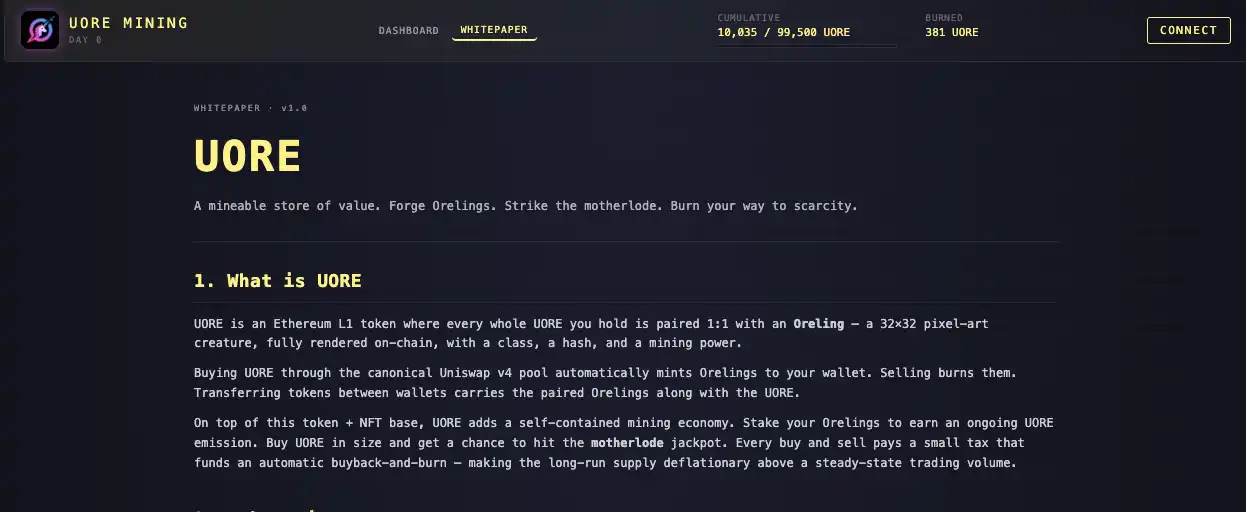
The new project is called $UORE, launched just yesterday. In one sentence, what it does is: Packaging on-chain mining, token-buying lottery, pixel NFT auto-generation, and a deflationary burn mechanism all into a single Uniswap V4 trading pool.

Because when you buy tokens in this pool, the contract will execute the aforementioned six things in the background simultaneously, the gas fee for one transaction is two to three times that of a regular swap...

Currently, if you open CT, you'll see everyone complaining about this high gas.

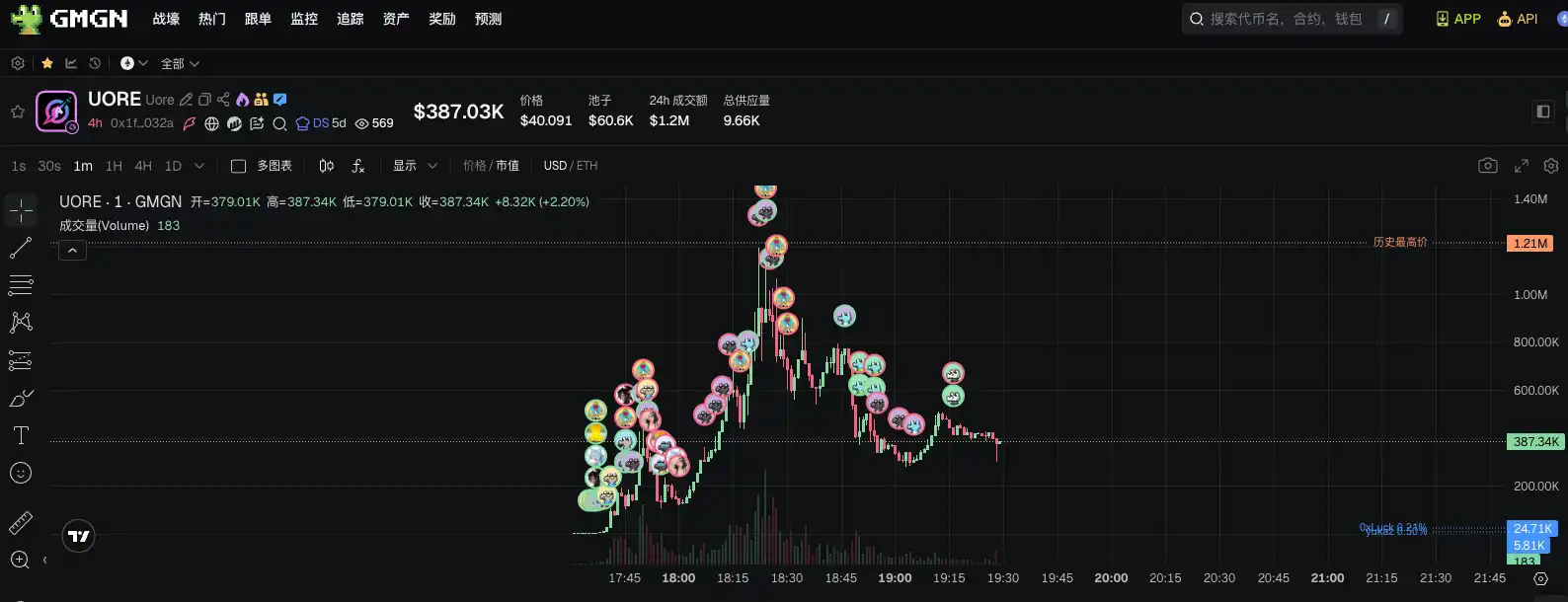
Regarding the token, according to GMGN data at the time of writing, $UORE reached a market cap of $1.2 million within hours of launch, then quickly dropped to $440k. The pool liquidity is only $64k, but the 24-hour trading volume is $1.2 million, meaning the money in the pool has turned over nearly twenty times.

However, there are only 741 holders, with a total supply of less than ten thousand tokens.
Currently, the risk appears extremely high. After some preliminary research, I personally think it's the most complex mechanism-wise among the V4 Hook ecosystem projects (the recent wave of new on-chain plays tends to make their mechanisms hard to understand...).

It is simultaneously a token, an NFT collection, a staking mine, and a lottery system. Moreover, these four things aren't independent; they are welded together.

Four-in-One Mine

For most NFT projects, the token and the NFT are separate things, bought and sold separately.

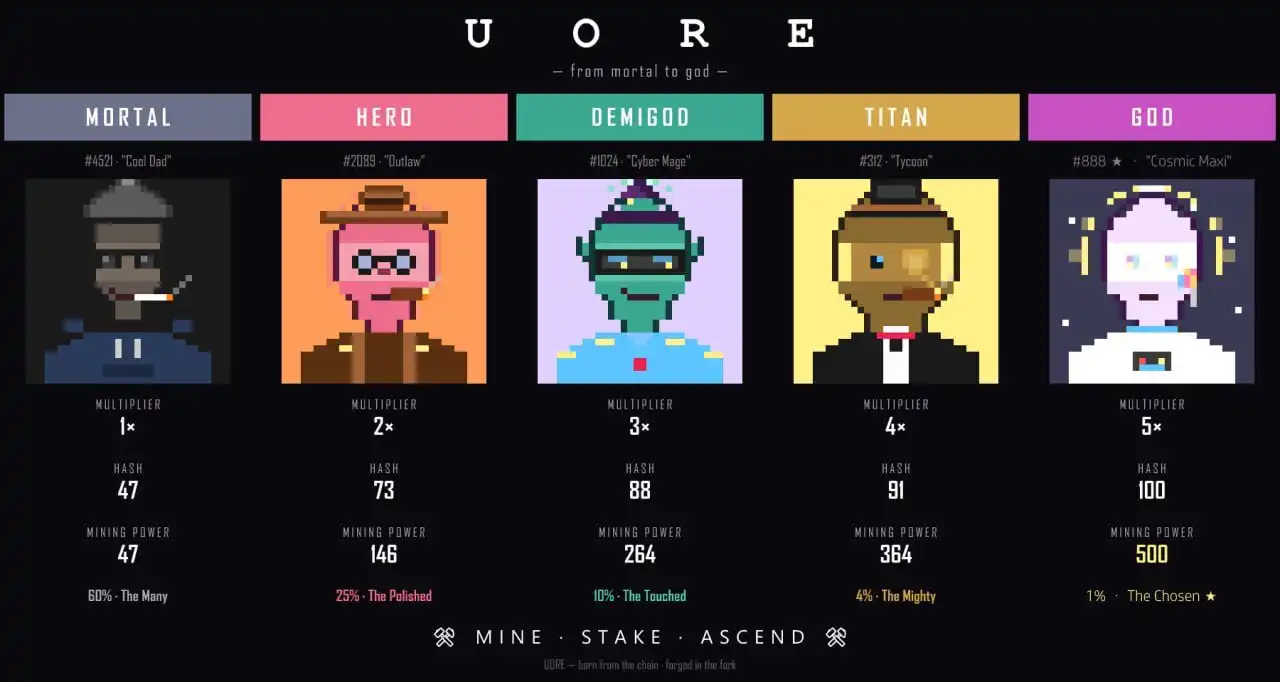
UORE is different. Its NFT is called Oreling, a 32×32 pixel miner character, embedded directly within the token. For every whole integer UORE token you hold in your wallet, you automatically have one corresponding Oreling.
The contract mints it for you when you buy tokens, burns it when you sell, and the Oreling moves with the token when transferred. You cannot buy an Oreling separately, nor can you detach it from UORE.

The traits of each Oreling are determined by the hash of the next block at the moment of minting. This means you don't know what kind of character you'll get when buying, not even the validators can see the result beforehand.

The differences between these characters aren't just about looks.

Each Oreling has a Class (rarity) and a Hash (a random number from 1 to 100). Multiplying the two gives its Mining Power.

The most common Mortal makes up 60% with a 1x multiplier; the rarest God has only a 1% chance with a 5x multiplier. If you're lucky and mint a God with Hash 100, its power is 500, over ten times that of a common miner.

What's the use of mining power? Classic play: staking.

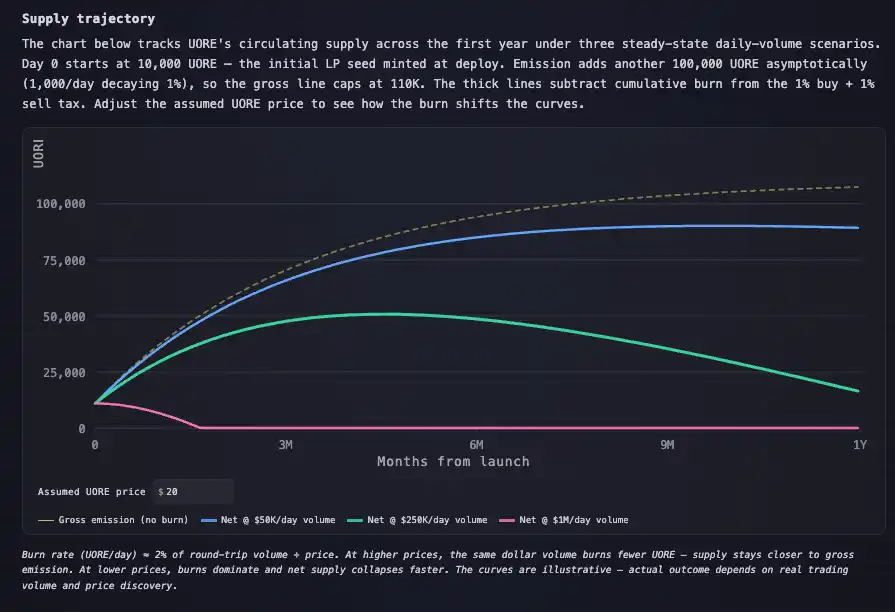
Stake your Oreling into the mine pool, and you start receiving a share of the daily UORE release proportional to your mining power. According to the project's whitepaper, 1000 UORE are released on the first day, then decaying by 1% daily, with a half-life of roughly 69 days. 80% of the release goes to stakers, 20% goes into the Motherlode prize pool.

This decay rate means 97% of the total emissions will be released within a year. The earlier you enter the mining game, the bigger your share of the pie.

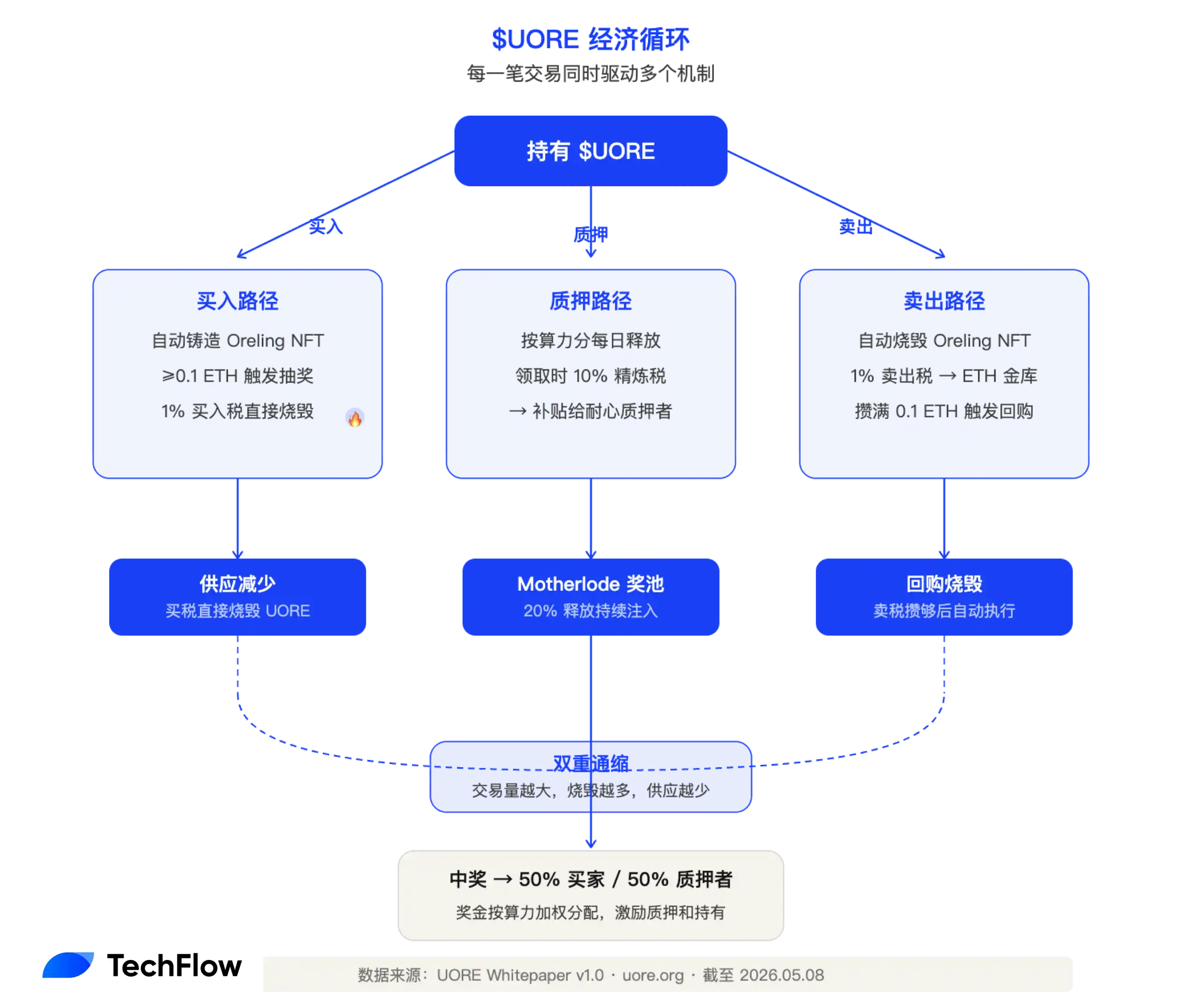
There's a noteworthy design when claiming rewards: a 10% "refining tax" is deducted and redistributed to all stakers who haven't claimed yet. The whitepaper calls this the refined-ore boost.

In plain terms, those who claim later eat more of the taxes paid by others. People in a hurry to withdraw are subsidizing the patient ones.
Then there's the Motherlode, which translates to "lode prize".

Every time you buy UORE worth ≥ 0.1 ETH through the official channel, you automatically get a lottery ticket. The winning probability is linked to the purchase amount: 0.1 ETH gives about a 1/600 chance, 0.5 ETH about 1/200, and 1 ETH caps at 1/100. Buying over 1 ETH doesn't increase the probability further, preventing whales from farming chances.

If you win, the prize pool is split in half: 50% goes directly to the buyer, and 50% is randomly distributed to one staker (weighted by mining power). As of writing, there have only been 4 wins historically, with the largest prize being 6.4 UORE.

Finally, the deflationary flywheel.

Buying incurs a 1% tax directly burned, selling incurs a 1% tax sent to a buyback treasury. When the treasury accumulates 0.1 ETH, anyone can trigger an automatic buyback, and the bought-back UORE are all burned. As of writing, 58 buybacks have been executed, cumulatively burning 358 UORE.
Looking at the entire design, it's a minor innovation in token-NFT play, an old trick for creating scarcity, yet another Ponzi in economic model design.

The Project's Code is Forked, Its Playstyle is Frankensteined

UORE wasn't written from scratch.

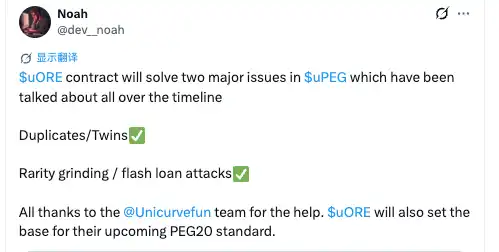
People in the community looked at the source code and found a folder named `reference/unipeg-hook-source/`. The founder, Noah, didn't hide it either. He directly stated on Twitter that UORE's contracts are forked from uPEG, and that he fixed two known issues with uPEG: duplicate NFT generation and flash loan attacks for farming rarity.
A quick look at this founder's profile shows a bio: "Ethereum dev & BAYC holder". On May 2nd, he tweeted his first post about UORE, saying the project combines the mining concept from Solana's ORE with the V4 Hook architecture of uPEG.

He also proactively @ mentioned Unicurvefun and Openpeg, asking if they could support Orelings trading once their markets go live.

From this public information, UORE's lineage is clear:

Solana ORE provided the "on-chain mining + lottery" gameplay template, uPEG provided the V4 Hook code skeleton, and Noah made improvements and assembled on top of these two.

Forking itself isn't the issue. I think the current problems are:

  1. Gas. There are reports on CT that each UORE transaction requires the Hook to execute six steps, consuming two to three times the gas of a normal swap. Swapping back and forth might leave little to no profit.
  2. Time window. The V4 Hook narrative was affected by uPEG's price drop, and subsequent projects will likely have lower ceilings. UORE is the fourth project in this wave of Hook hype, with the heat from the first three already cooling. The attention window for this sector waits for no one.
  3. Complexity. UORE is probably the most mechanically dense among these four projects. For an average user to understand the whole set of rules—Oreling rarity, mining power calculation, staking decay, refining tax, Motherlode probability, buyback trigger conditions—the barrier is high, and the official website is cryptic.

And the project's whitepaper is also interesting:
Read the contracts and understand the mechanics before deploying capital.

Translated into Chinese, this roughly means "Understand it first, don't blame me if you don't."

Combining insights from previous Hook projects, we can see this wave of on-chain trends features complex mechanism designs + massive information asymmetry. They have alpha potential, but the shelf life of that alpha is getting shorter.

SATO gave you a week, uPEG gave you a few days, and by the time it's UORE's turn, the time you have to understand the rules might be down to just a few hours...

By the time you understand it, the market move might be over.

Tiền kỹ thuật số thịnh hành

Câu hỏi Liên quan

QWhat is the core innovation or 'hook' of the $UORE project on Uniswap V4?

AThe $UORE project packages multiple mechanics into a single Uniswap V4 pool transaction. With one buy or sell, the contract simultaneously handles token swapping, NFT (Oreling) minting/burning, staking power calculation, participation in the Motherlode lottery, token buyback for burning, and applying transaction taxes.

QHow does the $UORE project integrate an NFT (Oreling) with its token?

AThe Oreling NFT is directly embedded into the $UORE token. Each whole number of $UORE tokens held in a wallet automatically corresponds to one Oreling. The NFT is minted when tokens are bought and burned when tokens are sold, and it cannot be traded separately from the token.

QWhat is the 'Motherlode' mechanism in $UORE and how does it work?

AThe Motherlode is a lottery prize pool. Buying $UORE through the official pool with ≥ 0.1 ETH automatically grants a lottery ticket. The winning probability scales with purchase amount up to a 1% max chance for 1 ETH purchases. If a buyer wins, 50% of the prize pool goes to them, and the other 50% is randomly distributed to a staker, weighted by their mining power.

QWhat are the main criticisms or potential risks mentioned about the $UORE project?

AThe article highlights several risks: very high gas fees (2-3x a normal swap), a short attention window as it's the fourth V4 Hook project in a fading trend, and high complexity which creates a barrier for understanding. Additionally, its liquidity is low, token distribution is concentrated, and the economic model is described as a Ponzi.

QAccording to the article, what existing projects did $UORE fork or draw inspiration from?

A$UORE's smart contracts are forked from the uPEG project, fixing known issues. Its core 'on-chain mining + lottery' gameplay concept is inspired by the ORE project on Solana. The founder combined these two templates to create $UORE on the Uniswap V4 Hook framework.

Nội dung Liên quan

Sau ba quý liên tiếp suy giảm, thị trường tiền điện tử có thể đón cửa sổ ổn định trong quý III?

Thị trường tiền mã hóa vừa trải qua quý tồi tệ nhất kể từ năm 2022, với vốn hóa giảm 12.6% xuống 2.1 nghìn tỷ USD, khối lượng giao dịch sụt giảm và dòng tiền rút mạnh khỏi các quỹ ETF Bitcoin. Bitcoin và Ethereum lần lượt giảm 14.2% và 25.4% trong quý, đánh dấu sự đảo ngược so với mối tương quan trước đây với các tài sản rủi ro như Nasdaq. Dòng vốn ETF chứng khoán Mỹ ghi nhận dòng ròng rút khoảng 46.7 tỷ USD trong quý II, báo hiệu áp lực bán. Tuy nhiên, dấu hiệu tích cực ban đầu xuất hiện khi các nhà đầu tư dài hạn bắt đầu tích lũy trở lại và dòng ETF có đợt thu hút ngắn hạn. Toàn bộ thị trường hiện tập trung vào cuộc họp của Cục Dự trữ Liên bang Mỹ (FOMC) vào cuối tháng 7. Các tín hiệu chính sách tiền tệ sẽ quyết định xu hướng: tín hiệu ôn hòa có thể đẩy Bitcoin lên vùng 68,000-84,000 USD, trong khi lập trường cứng rắn có thể kéo giá về vùng 50,000-56,000 USD. Tiến trình pháp lý của Đạo luật CLARITY gần như đình trệ, làm giảm kỳ vọng và gia tăng phí rủi ro cho toàn ngành. Trong bối cảnh ảm đạm, hai lĩnh vực nổi bật là thị trường dự đoán (tăng trưởng 48.7%) và bộ sưu tập kỹ thuật số được mã hóa (tăng ~143%), cho thấy sự chuyển dịch nhu cầu thực tế. Nhìn chung, thị trường thiếu động lực cho một đợt tăng trưởng mạnh dựa trên tâm lý. Các quyết định giao dịch trong quý III sẽ chủ yếu xoay quanh diễn biến giá, lựa chọn chính sách và kỳ vọng lãi suất.

marsbit23 giờ trước

Sau ba quý liên tiếp suy giảm, thị trường tiền điện tử có thể đón cửa sổ ổn định trong quý III?

marsbit23 giờ trước

Giao Dịch SpaceX, Đã Mở Khóa: SPCXON Được Giao Dịch Trên WEEX

SpaceX đã thực hiện đợt IPO lớn nhất lịch sử vào tháng 6/2026, nhưng nhiều nhà giao dịch không thể tiếp cận do các rào cản như hạn chế môi giới và khu vực. Sàn giao dịch tiền điện tử WEEX đã giới thiệu SPCXON/USDT, một công cụ token hóa cho phép tiếp cận biến động giá của SpaceX thông qua tài khoản crypto được quyết toán bằng USDT, mà không cần môi giới Mỹ hay tài khoản ngân hàng. Sản phẩm này, xây dựng trên nền tảng cổ phiếu token hóa của Ondo, dành cho các nhà giao dịch bên ngoài Hoa Kỳ. Trường hợp đầu tư dựa trên đà tăng doanh thu Starlink và các cột mốc Starship, trong khi các yếu tố cần thận trọng bao gồm định giá cao, lượng cổ phiếu lưu hành công chúng ít và sự kiện mở khóa cổ phiếu nội bộ sắp tới. Lưu ý quan trọng: SPCXON cung cấp mức tiếp xúc với hiệu quả kinh tế, không phải quyền sở hữu cổ phiếu trực tiếp, và có thể giao dịch ở mức cao hơn hoặc thấp hơn giá trị tài sản ròng. WEEX tích hợp SPCXON cùng các sản phẩm TradFi token hóa khác như MicroStrategy (MSTRON) và Micron (MUON) vào một tài khoản thống nhất, cho phép luân chuyển giữa crypto và cổ phiếu dễ dàng. Sàn cũng đang chạy chiến dịch TradFi Trading Challenge với quỹ thưởng $50,000.

TheNewsCryptoHôm qua 08:32

Giao Dịch SpaceX, Đã Mở Khóa: SPCXON Được Giao Dịch Trên WEEX

TheNewsCryptoHôm qua 08:32

BIT Trading Hours: BTC Vẫn Chịu Áp Lực Từ Đường MA 200 Tuần, Bị Từ Chối Có Thể Tái Khởi Động Đợt Giảm, Ngành Lưu Trữ và Bán Dẫn Tăng Mạnh Đêm Qua Bắt Đầu Giảm Trong Khung Giờ Giao Dịch Ban Đêm

Bitcoin (BTC) hiện giao dịch quanh mức $66,000, đối mặt với vùng kháng cự mạnh gần $68,000 - nơi tập trung nhiều lệnh mua trước đó có thể chốt lời. Về mặt kỹ thuật, BTC đang nằm giữa đường trung bình động 200 tuần (MA ~$63,333) và đường trung bình động hàm mũ 200 tuần (EMA ~$68,328). Việc không thể vượt qua mức $68,000 có thể kéo giá về kiểm tra lại vùng hỗ trợ $63,000. Thị trường hiện có tính thanh khoản thấp và được xem là đang trong đợt phục hồi nhẹ. Trên thị trường chứng khoán Mỹ, các chỉ số tương lai giảm nhẹ. Nhóm cổ phiếu bán dẫn và lưu trữ, vốn tăng mạnh vào đêm trước, đã điều chỉnh giảm trong phiên giao dịch ngoài giờ. Tuy nhiên, Super Micro Computer (SMCI) tăng mạnh sau báo cáo doanh thu và đơn đặt hàng tích cực. Dầu thô tăng (trên $91) và lợi suất trái phiếu kho bạc Mỹ tăng cao tiếp tục gây áp lực lên thị trường cổ phiếu và làm dấy lên lo ngại lạm phát. Tại châu Á, thị trường Hàn Quốc phục hồi nhẹ cùng với cổ phiếu công nghệ, trong khi Nhật Bản thận trọng do đồng Yên yếu kỷ lục. Các sự kiện quan trọng sắp tới bao gồm báo cáo thu nhập từ các gã khổng lồ công nghệ như Alphabet, Tesla, IBM; sự kiện AI của AMD; và cuộc họp chính sách tiền tệ của Ngân hàng Trung ương châu Âu.

marsbitHôm qua 08:31

BIT Trading Hours: BTC Vẫn Chịu Áp Lực Từ Đường MA 200 Tuần, Bị Từ Chối Có Thể Tái Khởi Động Đợt Giảm, Ngành Lưu Trữ và Bán Dẫn Tăng Mạnh Đêm Qua Bắt Đầu Giảm Trong Khung Giờ Giao Dịch Ban Đêm

marsbitHôm qua 08:31

Chủ tịch CFTC cũ, Chủ tịch Circle Tarbert: Một mặt khuyên bạn chủ nghĩa dài hạn, mặt kia tự mình thoái vốn 30 triệu USD

Tác giả: Zen, PANews Trước tình cảnh cổ phiếu Circle (CRCL) giảm 70% so với đỉnh và bị hạ xếp hạng, Chủ tịch Heath Tarbert - cựu Chủ tịch CFTC - trong một cuộc phỏng vấn ngày 14/7 đã kêu gọi các nhà đầu tư kiên nhẫn và tập trung vào tầm nhìn dài hạn của công ty. Tuy nhiên, hành động của ông lại trái ngược hoàn toàn. Kể từ khi Circle IPO, Tarbert đã không ngừng bán cổ phiếu CRCL thông qua kế hoạch giao dịch 10b5-1 được lập trước, thu về tổng cộng khoảng 30 triệu USD. Ông chưa từng mua lại cổ phiếu trên thị trường mở, ngay cả khi giá cổ phiếu lao dốc. Bài viết nêu bật sự mâu thuẫn giữa lời nói "chủ nghĩa dài hạn" và hành động "thoái vốn" mạnh tay của Tarbert. Sự nghiệp của ông được mô tả là điển hình của "cánh cửa xoay" chính trị-thương mại Mỹ: từ các vị trí cấp cao tại Bộ Tài chính và CFTC, ông nghỉ hưu chỉ 27 ngày trước khi gia nhập Citadel Securities - một nhà tạo lập thị trường lớn - vào thời điểm công ty này đang đối mặt với cuộc điều tra của Quốc hội sau sự kiện GameStop. Sau đó, ông chuyển sang Circle, nơi ông được cho là đã sử dụng kinh nghiệm và quan hệ quản lý để giúp công ty vượt qua các rào cản pháp lý và niêm yết thành công. Bài báo đặt câu hỏi liệu Tarbert có thực sự tin vào tương lai dài hạn của Circle hay không, khi mà ông liên tục chốt lời trong khi lại khuyên các cổ đông nhỏ lẻ giữ vị thế. Nó gợi ý rằng mô hình của ông là tận dụng tối đa kiến thức về chu kỳ chính sách và cơ hội thị trường để biến các nguồn lực và uy tín tích lũy được thành lợi thế nghề nghiệp và tài chính cá nhân, trong khi rủi ro dài hạn được chuyển sang cho các nhà đầu tư tin tưởng vào những tường thuật công khai của ông.

marsbitHôm qua 08:08

Chủ tịch CFTC cũ, Chủ tịch Circle Tarbert: Một mặt khuyên bạn chủ nghĩa dài hạn, mặt kia tự mình thoái vốn 30 triệu USD

marsbitHôm qua 08:08

Gate Research: Làn sóng "phố Wall hóa" trong các sản phẩm tài chính tiền điện tử - Cạnh tranh hay Hội tụ?

Gate Research Institute: Sự hòa hợp hay cạnh tranh trong làn sóng "phố Wall hóa" các sản phẩm tài chính tiền mã hóa? Từ tầm nhìn ban đầu về một hệ thống tài chính phi tập trung, loại bỏ trung gian của Bitcoin, thị trường tiền mã hóa đang chứng kiến sự hội tụ mạnh mẽ với tài chính truyền thống (TradFi). Các quỹ ETF Bitcoin, tài sản thế giới thực được mã hóa (RWA) và trái phiếu chính phủ trên chuỗi cho thấy các tổ chức như BlackRock, Fidelity đang đưa tài sản mã hóa vào hệ thống phát hành, định giá, lưu ký và phân phối truyền thống. Tuy nhiên, đây không phải là một trò chơi tổng bằng không. Xu hướng này thể hiện sự bổ sung lẫn nhau: TradFi cung cấp khung pháp lý, mạng lưới phân phối rộng và sự tin cậy, trong khi Crypto mang lại tính mở, thanh khoản toàn cầu 24/7 và khả năng thanh toán lập trình được. Hai hướng đi tiêu biểu minh chứng cho sự hội tụ hai chiều: các sàn giao dịch tiền mã hóa (CEX) như Gate mở rộng sang giao dịch cổ phiếu thực, ETF thông qua cơ sở hạ tầng môi giới truyền thống; trong khi các công ty môi giới truyền thống như Robinhood tích hợp tài sản mã hóa và phát triển tài sản mã hóa (như cổ phiếu mã hóa) để thu hút người dùng. Mục tiêu chung của cả hai hướng là tranh giành "tài khoản tài chính tổng hợp" thế hệ tiếp theo - một điểm vào duy nhất nơi người dùng có thể giao dịch đa dạng tài sản từ cổ phiếu, tiền mã hóa đến RWA. Sự tăng trưởng mạnh mẽ của thị trường RWA, đặc biệt là cổ phiếu mã hóa, bất chấp xu hướng thị trường giảm, cho thấy đây là một xu hướng cấu trúc thực sự. Kết luận, "phố Wall hóa" không có nghĩa là thị trường tiền mã hóa bị TradFi thôn tính. Thay vào đó, đây là một sự chuyển đổi hai chiều, nơi cả hai hệ thống đang cùng nhau định hình lại thị trường vốn thành một cấu trúc hỗn hợp hiệu quả và toàn cầu hơn, với trải nghiệm người dùng liền mạch cho nhiều loại tài sản khác nhau.

marsbitHôm qua 08:06

Gate Research: Làn sóng "phố Wall hóa" trong các sản phẩm tài chính tiền điện tử - Cạnh tranh hay Hội tụ?

marsbitHôm qua 08:06

Giao dịch

Giao ngay

Bài viết Nổi bật

Làm thế nào để Mua ONE

Chào mừng bạn đến với HTX.com! Chúng tôi đã làm cho mua Harmony (ONE) trở nên đơn giản và thuận tiện. Làm theo hướng dẫn từng bước của chúng tôi để bắt đầu hành trình tiền kỹ thuật số của bạn.Bước 1: Tạo Tài khoản HTX của BạnSử dụng email hoặc số điện thoại của bạn để đăng ký tài khoản miễn phí trên HTX. Trải nghiệm hành trình đăng ký không rắc rối và mở khóa tất cả tính năng. Nhận Tài khoản của tôiBước 2: Truy cập Mua Crypto và Chọn Phương thức Thanh toán của BạnThẻ Tín dụng/Ghi nợ: Sử dụng Visa hoặc Mastercard của bạn để mua Harmony (ONE) ngay lập tức.Số dư: Sử dụng tiền từ số dư tài khoản HTX của bạn để giao dịch liền mạch.Bên thứ ba: Chúng tôi đã thêm những phương thức thanh toán phổ biến như Google Pay và Apple Pay để nâng cao sự tiện lợi.P2P: Giao dịch trực tiếp với người dùng khác trên HTX.Thị trường mua bán phi tập trung (OTC): Chúng tôi cung cấp những dịch vụ được thiết kế riêng và tỷ giá hối đoái cạnh tranh cho nhà giao dịch.Bước 3: Lưu trữ Harmony (ONE) của BạnSau khi mua Harmony (ONE), lưu trữ trong tài khoản HTX của bạn. Ngoài ra, bạn có thể gửi đi nơi khác qua chuyển khoản blockchain hoặc sử dụng để giao dịch những tiền kỹ thuật số khác.Bước 4: Giao dịch Harmony (ONE)Giao dịch Harmony (ONE) dễ dàng trên thị trường giao ngay của HTX. Chỉ cần truy cập vào tài khoản của bạn, chọn cặp giao dịch, thực hiện giao dịch và theo dõi trong thời gian thực. Chúng tôi cung cấp trải nghiệm thân thiện với người dùng cho cả người mới bắt đầu và người giao dịch dày dạn kinh nghiệm.

Tổng lượt xem 617Xuất bản vào 2024.12.12Cập nhật vào 2026.06.02

Làm thế nào để Mua ONE

Thảo luận

Chào mừng đến với Cộng đồng HTX. Tại đây, bạn có thể được thông báo về những phát triển nền tảng mới nhất và có quyền truy cập vào thông tin chuyên sâu về thị trường. Ý kiến ​​của người dùng về giá của ONE (ONE) được trình bày dưới đây.

活动图片