Behind the MiniMax 'Pseudo-Open Source' Controversy: Has Yan Junjie's Ideal Succumbed to Capital Anxiety?

marsbitXuất bản vào 2026-04-16Cập nhật gần nhất vào 2026-04-16

Tóm tắt

The article discusses the controversy surrounding MiniMax's "pseudo-open-source" release of its flagship M2.7 model. Initially presented as open-source, the model was later released under a "Modified-MIT" license that restricts commercial use without written permission, sparking backlash from the developer community. This move is seen as a departure from true open-source principles and reflects the tension between technological idealism and commercial pressures. MiniMax, which recently went public, faces significant financial challenges, with substantial losses despite growing revenues. The company’s decision to limit commercial use is interpreted as an effort to protect its revenue streams and control how its models are deployed, especially after instances of third-party misuse affected its reputation. The incident highlights a broader industry trend where "open-weight" models are increasingly distinguished from fully open-source ones, raising concerns about trust and legal certainty for developers and enterprises. The author concludes that MiniMax’s shift represents a pragmatic, if controversial, business strategy aimed at ensuring profitability, even at the cost of community trust.

By | Big Model Home

In the jungle law of artificial intelligence, trust is often more expensive than computing power and more likely to be shattered in the trade-offs of business.

On April 12, MiniMax officially open-sourced its flagship model M2.7, released on March 18, on the HuggingFace platform. The model boasts 229 billion parameters, adopts a MoE (Mixture of Experts) architecture, and requires activating only 10 billion parameters to perform, a series of metrics that point directly to top-tier global closed-source models. On its first day online, it completed adaptations including Huawei Ascend, NVIDIA, and vLLM, sparking industry attention.

However, when developers attempted to deeply engage with the weight files, the appearance of the words "Modified-MIT" in the protocol section instantly dragged this technological feast back into the reality of commercial博弈.

This highly contentious change not only cast a shadow of profit distribution over the "free lunch" but also stung developers seeking a technological safe haven amidst the ecosystems of large companies and startups. For technical leads grappling with workplace anxiety, a legal department's statement that "commercial use requires written authorization" turned the highly anticipated top-tier model's commercial application scenarios into zones of legal uncertainty.

The Trust Hunt of "Open Source" vs. "Open Weight"

In the open-source world, the MIT License symbolizes ultimate freedom and low barriers to entry. Previously, MiniMax's M2 and M2.5 followed this path, and founder Yan Junjie借此 established an image as a promoter of "technology普惠" in the domestic open-source field.

However, the "Modified-MIT" protocol adopted by M2.7 is being questioned by the industry as a form of "nominal openness,实质上的管控" (nominal openness,实质上的 control). Records disclosed by the developer community show that six hours before the weight files went live, the repository protocol still maintained a commercially friendly open-source form similar to Llama 3, but at the moment of official release, it was changed to a modified version requiring "written authorization for commercial use."

This practice essentially alters the契约 spirit of open source. For technical骨干 experiencing an "AI midlife crisis" and trying to use open-source models for internal innovation or entrepreneurship, this "legal uncertainty" is fatal—the final interpretation of so-called "written authorization" rests entirely with the vendor.

In the view of Big Model Home, the core of this controversy is essentially the industry's long-term confusion between two concepts "open source" as defined by the OSI, and merely opening model files, "open weight". The Modified-MIT protocol, by explicitly restricting commercial use, no longer符合 the globally accepted open-source definition and belongs only to the "open weight" category.

Some netizens stated, "This is not open source at all; this is just公开了模型文件 (公开了 model files)." This gap between name and reality feels more frustrating than simply announcing it as closed source from the start. They指责 that if every vendor uses the MIT name to create "private property," the consensus system of the open-source community will completely collapse.

What's more致命 for developers and enterprises is: MiniMax is already a listed company, and all protocol changes must服从财报与合规 (服从 financial reports and compliance). Today it changes the protocol for "narrowing losses," tomorrow it might charge per Token for "quarterly performance"—the "certainty" of a listed company is always written in the financial reports, not in community promises.

When Technological Ideals Hit the Wall of Commercialization

From an enterprise operation perspective, MiniMax's shift is not without trace. Training a MoE model with 229 billion parameters is a multi-million dollar gamble involving投入的电力、算力集群折旧以及高昂的人力成本 (invested electricity, computing cluster depreciation, and high human costs).

Yan Junjie once publicly stated, "Open source can force us to improve algorithm innovation efficiency and also enhance our global technology brand."

But after MiniMax officially landed on the main board of the Hong Kong Stock Exchange IPO on January 9, 2026, hailed as the "first stock of general artificial intelligence," MiniMax, stepping into the capital market, also had to modify its own rules of the game. With the stock price experiencing剧烈波动 after hitting a high of 1330 HKD (as of April 14 close, the stock price was 951 HKD, down 28% from the peak), the focus of investors is no longer the number of likes on HuggingFace or community reputation, but the hard revenue growth rate and profit inflection point in the financial reports.
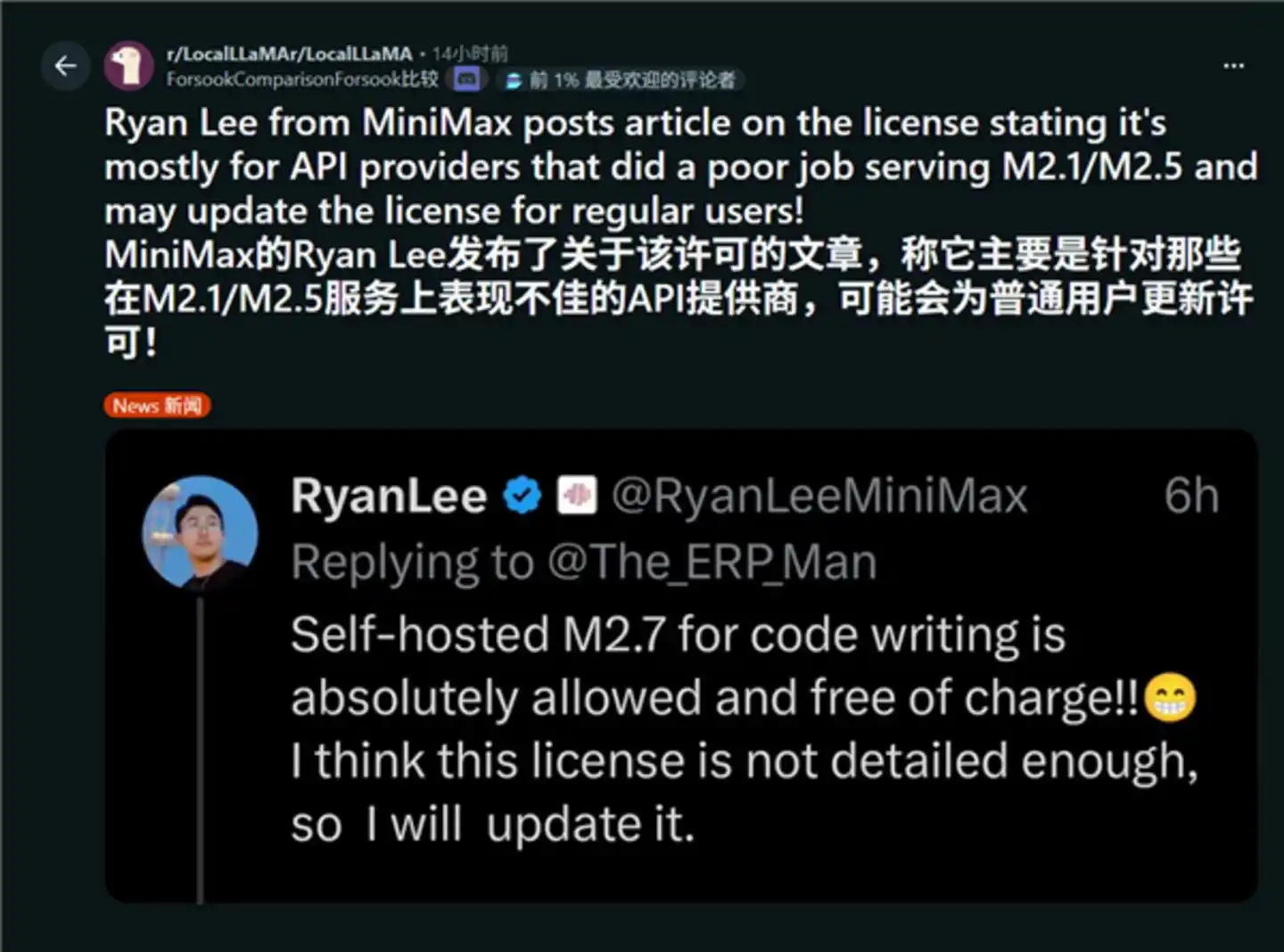
MiniMax Developer Relations负责人 Ryan Lee responded on X regarding the reason for prohibiting commercial use. He mentioned that (under the previous open-source protocol) MiniMax's models appeared on some hosting sites, but some users found the quality to be worse than the official ones after trying them—there was excessive quantization, template errors, silent replacements, or they weren't even their models, leading these users to believe MiniMax's quality was mediocre. The protocol adjustment was due to "third-party hosting platforms胡乱修改模型, causing reputational damage."

This is also a pain point for leading AI companies like MiniMax: sometimes investing money and people in technology普惠 ends up handing a knife to competitors. The anxiety of watching others use your model to create commercial shell products, sell them to clients for huge profits, while you bear the huge server costs, is enough to destroy any idealist's mindset.

For Minimaxes: Is it the羽毛 of the brand, or the活路 of business? It's a painful multiple-choice question.

Undoubtedly, Yan Junjie's ideal ultimately succumbed to the survival anxiety of commercialization.

On March 2, Minimax's first full-year financial report showed: 2025 revenue of $79.04 million, a surge of 158.9% year-on-year, but behind this, the annual loss widened from $465 million in 2024 to $1.872 billion in 2025. The adjusted net loss was still as high as $250 million, meaning for every $1 earned, they still lost over $3. More critically: over 60% of expenditure was directed towards computing power and model training. Training a model like M2.7 costs tens of millions of dollars per round. Meanwhile, the B-end open platform (API/commercial authorization) is Minimax's only high-growth, high-margin sector, with 2025 revenue of $25.96 million, a year-on-year increase of 197.8%, growing much faster than the C-end.

The tightening of the M2.7 protocol is essentially MiniMax circling its wagons. It allows research and individual developers to continue using it for free to retain the seeds of the ecosystem; but it strictly prevents commercial use to ensure every blade of grass grows in its own field during the upcoming commercialization harvest period.

Riding the "open source" traffic wave while keeping legal risks and income interpretation rights firmly in hand. This is not "ideal succumbing to reality," but "securing profit expectations first, then talking about community sentiment." From a business management perspective, it's无可厚非, but it also taints the originally pure open-source spirit with a strong whiff of "client mindset."

The Polarization of Rule-Followers and Performance-Seekers

In the game of large models, certainty is far more important than pure performance parameters.

Developers are a simple group; they are willing to stay up late tuning parameters for you, willing to fix bugs for you on GitHub, provided you respect their rules of the game. After the M2.7 open-source incident, the global developer community experienced severe polarization.

Pragmatic "performance-seekers" believe: Since the performance rivals GPT and it's free for research, it's无可厚非 for vendors to seek commercial收益.

However, in global open-source developer communities, the vocal majority of "rule-followers" felt a severe "trust幻灭" (trust disillusionment). On mainstream communities like Reddit, many voices have already turned to fully open-source series like Qwen.

Why? Because for enterprise users, "certainty" is far more important than "performance".

If a company's open-source promise can be微调 at any time based on "commercial anxiety," then who dares to build their core business on its foundation? Changing the protocol name today, will it charge per Token tomorrow? This fear of future uncertainty is quickly反噬 the technology brand that MiniMax worked hard to build.

The once most radical, purest open-source benchmark has now become a typical case of "definition confusion" in the global community. This shattering of trust is clearly not something a few PR responses can mend.

Survival Rules for Developers in the AI "Post-Open Source Era"

It's not just MiniMax's M2.7 protocol modification; previously, Ali's Lin Junyang's departure also caused震动 in the AI open-source industry. As more large model companies step into the capital market, many worry that the large-scale open-source era of "contributing for love" is accelerating towards its end.

The future large model industry might evolve into two ecosystems: one is the true "public good," like Llama, Qwen, backed by large consortia, using open source to exchange for monopoly on underlying standards; the other is conditional gifts like M2.7, which are more like "commercial show flats"—you can look, you can try staying, but to move in (commercial use), please turn the corner and pay the service fee.

In fact, in the context of large companies, survival itself is a morality. But if you choose pragmatism, please put down the banner of lofty ideals; if you choose commercial licensing, please stop蹭 the光环 of MIT.

This incident demonstrates three survival rules for all AI practitioners in the "post-open source era":

First, all "free" things have an expiration date. When selecting an architecture, the first step is not to test parameters, but to have legal review the protocol. Especially for those responsible for promoting projects within large companies, every word in the protocol could become a stain on your review six months later.

Second, "OpenWeights" does not equal "OpenSource". Future industry narratives will revolve more around the former. We must learn to get used to these "gifts with locks" and reassess their value within商业 logic.

Third, trust itself is an asset. Vendors焦虑 revenue, developers焦虑 changes. This bidirectional anxiety is precisely the阵痛 of the current AI industry bubble being squeezed out.

As of publication, Yan Junjie himself has not publicly responded. Perhaps in his calculation logic, compared to the虚无缥缈 community reputation, obtaining real commercial authorization contracts is the ticket to growth that MiniMax pursues.

Câu hỏi Liên quan

QWhat is the core controversy surrounding MiniMax's release of the M2.7 model on HuggingFace?

AThe core controversy is that MiniMax released the model under a 'Modified-MIT' license, which restricts commercial use without written authorization, rather than a true open-source license. This was seen as a 'nominal openness with substantive control' that violates the spirit of open-source and creates legal uncertainty for commercial developers.

QHow did the change in licensing agreement for the M2.7 model impact developer trust and the open-source community?

AThe last-minute license change from a commercially friendly open-source license to the restrictive 'Modified-MIT' caused a 'trust disillusionment' in the global open-source developer community. Many developers felt betrayed, leading some to shift to fully open-source alternatives like Qwen, as the move undermined the foundational trust and consensus of the open-source ecosystem.

QWhat were the stated business reasons behind MiniMax's decision to restrict commercial use of the M2.7 model?

AMiniMax's developer relations lead, Ryan Lee, stated the restriction was due to third-party hosting platforms improperly modifying their models (e.g., excessive quantization, template errors, or model substitution), which led to poor performance and damaged MiniMax's reputation. Financially, as a publicly traded company, MiniMax faces pressure to monetize its high-cost models, and its B2B platform is its fastest-growing, highest-margin revenue segment.

QWhat does the article suggest is the fundamental difference between 'Open Source' and 'Open Weight' in the context of this event?

AThe article clarifies that 'Open Source' (as defined by OSI) involves licenses like the standard MIT license that grant full freedom, including commercial use. 'Open Weight' merely means the model files are publicly available but come with usage restrictions, such as the 'Modified-MIT' license that prohibits commercial use. MiniMax's M2.7 is an 'Open Weight' model, not a true 'Open Source' one.

QAccording to the article, what are the three survival rules for AI developers in the 'post-open-source era' highlighted by this incident?

A1. All 'free' offerings have an expiration date; legal review of licenses is the first step in architectural selection. 2. 'Open Weight' (OpenWeights) is not the same as 'Open Source' (OpenSource); the value of 'gifts with locks' must be reassessed within a commercial logic. 3. Trust is an asset itself; the current mutual anxiety between vendors and developers is a growing pain as the AI industry bubble deflates.

Nội dung Liên quan

World Cup đến gần, cuộc chiến lối vào thị trường dự đoán đã bắt đầu

Giải bóng đá World Cup 2026 đã khởi tranh, mang đến một điểm nhấn ngoài sân cỏ: sự nổi lên của các thị trường dự đoán (Prediction Market) như một công cụ cá cược phi tập trung mới. Mặc dù đã chứng minh được khả năng phản ánh trí tuệ đám đông và dự báo chính xác trong nhiều sự kiện, thị trường dự đoán vẫn vấp phải rào cản lớn về trải nghiệm phức tạp liên quan đến ví tiền điện tử và giao dịch trên chuỗi, khiến số đông người dùng tiềm năng khó tiếp cận. Để giải quyết vấn đề này, các sàn giao dịch tập trung (CEX) như Gate đang đóng vai trò cầu nối quan trọng. Gate, đối tác chính thức của Polymarket, cho phép người dùng tham gia thị trường dự đoán trực tiếp bằng tài khoản sàn và USDT, loại bỏ các bước rườm rà như tạo ví hay trả phí gas. Nền tảng cung cấp hai chế độ: "Dự đoán" đơn giản (chọn Có/Không) cho người mới và "Giao dịch" chuyên sâu với bảng lệnh cho người có kinh nghiệm. Người dùng có thể giao dịch linh hoạt nhiều sự kiện thể thao, tiền điện tử và tài chính truyền thống. Đặc biệt, nhân World Cup, Gate đã ra mắt chuyên trang tổng hợp lịch thi đấu, bảng xếp hạng và các thị trường dự đoán liên quan, giúp người hâm mộ vừa theo dõi vừa tham gia dự đoán kết quả một cách liền mạch. Bên cạnh công cụ giao dịch, Gate còn xây dựng hệ thống hỗ trợ thông tin như bảng xếp hạng "tiền thông minh", theo dõi động thái thị trường và phân tích AI, nhằm hình thành một chuỗi trải nghiệm đầy đủ từ phát hiện thông tin đến ra quyết định. Bài viết nhấn mạnh, cuộc cạnh tranh tiếp theo của thị trường dự đoán không nằm ở công nghệ lõi mà ở khả năng thu hút người dùng đại chúng. Bằng cách giảm thiểu rào cản kỹ thuật và tối ưu hóa trải nghiệm, các nền tảng như Gate đang mở đường để biến thị trường dự đoán từ công cụ chuyên biệt của cộng đồng crypto thành một thị trường mở mà bất kỳ ai cũng có thể tham gia, đánh dấu một chương mới cho sự phát triển của lĩnh vực này.

Odaily星球日报8 phút trước

World Cup đến gần, cuộc chiến lối vào thị trường dự đoán đã bắt đầu

Odaily星球日报8 phút trước

Tây Ban Nha bị Cabo Verde cầm hòa, thị trường dự đoán Jucom chứng kiến bất ngờ lớn nhất lịch sử

Vào rạng sáng ngày 16 tháng 6 theo giờ Bắc Kinh, trận đấu vòng bảng H World Cup 2026 giữa Tây Ban Nha và Cabo Verde đã tạo nên cú sốc lớn nhất tính đến thời điểm hiện tại. Dù áp đảo với 27 cú dứt điểm và 74% thời gian kiểm soát bóng, đội tuyển được đánh giá cao Tây Ban Nha đã bị đội tuyển lần đầu dự World Cup là Cabo Verde cầm hòa với tỷ số 0-0. Thị trường dự đoán Jucom trước trận đấu cho thấy xác suất thắng của Tây Ban Nha lên tới 92%, trong khi xác suất hòa là 6,3% và xác suất thắng của Cabo Verde chỉ là 2,6%. Kết quả thực tế trái ngược hoàn toàn đã gây ra những biến động mạnh về giá cả đối với các chủ đề dự đoán liên quan. Sau trận đấu, thị trường dự đoán đang điều chỉnh đáng kể kỳ vọng trên nhiều khía cạnh: xác suất Tây Ban Nha đứng đầu bảng H, xác suất vô địch của họ, và xác suất vượt qua vòng bảng của Cabo Verde (vốn trước đó gần như bằng 0) đang được định giá lại. Sự kiện này cho thấy giá trị cốt lõi của thị trường dự đoán không nằm ở việc dự báo chính xác mọi kết quả, mà ở khả năng phản ánh cách những người tham gia thị trường liên tục đưa thông tin mới vào định giá, từ đó hình thành nên sự đồng thuận mới. Jucom, với các chủ đề giao dịch đa dạng từ kết quả trận đấu đến nhà vô địch, tiếp tục cung cấp góc nhìn động về diễn biến giải đấu thông qua những thay đổi giá cả theo thời gian thực.

链捕手13 phút trước

Tây Ban Nha bị Cabo Verde cầm hòa, thị trường dự đoán Jucom chứng kiến bất ngờ lớn nhất lịch sử

链捕手13 phút trước

USDe Bỏ Qua Lệnh Cấm Lợi Nhuận Của Đạo Luật GENIUS: Đô La Tổng Hợp Đã Trở Thành Vùng Xám Thành Công Nhất Trong Tiền Mã Hóa Như Thế Nào?

Khi Quốc hội Mỹ soạn thảo Đạo luật GENIUS, họ đã cấm các nhà phát hành stablecoin thanh toán được cấp phép trả lãi hoặc lợi nhuận cho người nắm giữ. Tuy nhiên, USDe của Ethena - đồng stablecoin tổng hợp tăng trưởng nhanh nhất - đã hoàn toàn bỏ qua điều khoản này. USDe không phải là stablecoin dự trữ pháp định. Nó là một đô la tổng hợp delta-neutral: giao thức nhận tài sản thế chấp tiền mã hóa và đồng thời mở các vị thế phòng hộ futures vĩnh viễn, từ đó duy trì giá trị ổn định và kiếm lợi nhuận từ các vị thế này. Vì cơ chế cơ bản là giao dịch phái sinh phòng hộ chứ không phải dự trữ tiền mặt, USDe không đáp ứng định nghĩa pháp lý về stablecoin thanh toán trong GENIUS Act, khiến lệnh cấm trở nên vô hiệu với nó. Điều này tạo ra một khoảng trống quy định. USDe từng đạt đỉnh hơn 14 tỷ USD vào năm 2025, trở thành tài sản tiền mã hóa định giá bằng USD lớn thứ ba. Lợi nhuận của nó đến từ việc thu phí funding (khi phí funding dương) và lợi tức từ tài sản thế chấp. Về mặt pháp lý, nhà phát hành không trả lãi trên khoản dự trữ (bị cấm), mà là một chiến lược tạo ra lợi nhuận và token truyền tải nó - điều mà GENIUS Act chưa từng quy định. Trong khi đó, Ethena cũng phát hành USDtb, một stablecoin được hỗ trợ bằng pháp định tuân thủ đầy đủ GENIUS Act. Các quan điểm quản lý chia rẽ: Đức (BaFin) đã cấm bán USDe, coi đó là chứng khoán chưa đăng ký, trong khi các tổ chức Mỹ như Janus Henderson lại hợp tác tích hợp USDe. Mô hình này có rủi ro thất bại, chủ yếu phụ thuộc vào việc phí funding duy trì dương trong dài hạn. Sự sụt giảm tháng 10/2025 cho thấy rủi ro khi cửa sổ phí funding âm kéo dài trùng với việc giảm đòn bẩy toàn mạng. Câu hỏi cơ bản là: USDe và USDC được tiếp thị dưới cùng tên gọi "stablecoin" nhưng thực chất rất khác biệt. GENIUS Act chỉ quy định một loại và bỏ ngỏ loại kia. Vấn đề đặt ra cho các nhà quản lý Mỹ là liệu họ sẽ đặt ra quy tắc mới cho đô la tổng hợp hay để lợi nhuận tiếp tục di chuyển đến những nơi nằm ngoài ranh giới họ đã vẽ.

Foresight News17 phút trước

USDe Bỏ Qua Lệnh Cấm Lợi Nhuận Của Đạo Luật GENIUS: Đô La Tổng Hợp Đã Trở Thành Vùng Xám Thành Công Nhất Trong Tiền Mã Hóa Như Thế Nào?

Foresight News17 phút trước

Lido V3 Mở Rộng Hoạt Động Staking Ethereum Cho Tổ Chức Với Luganodes stVaults

Lido đang đẩy mạnh chiến lược thu hút staking thể chế thông qua việc tích hợp với nhà vận hành node chuyên nghiệp Luganodes trên phiên bản V3 của mình. Hợp tác này ra mắt các kho staking Ethereum (stVaults) được xây dựng dựa trên nguyên thủy stVaults mới của giao thức, nhắm đến các tổ chức muốn kiểm soát nhiều hơn về việc tiếp xúc với validator, cài đặt rủi ro, cấu trúc phí và yêu cầu vận hành, trong khi vẫn giữ được kết nối với hệ sinh thái stETH rộng lớn. Lido V3 hướng tới mô hình staking mô-đun linh hoạt hơn, cho phép cấu hình tùy chỉnh thay vì bắt mọi người dùng vào chung một nhóm chung. Điều này là cần thiết cho các tổ chức như quản lý tài sản, kho bạc doanh nghiệp, những đối tượng có yêu cầu cụ thể về nhà vận hành, chính sách, báo cáo và khung tuân thủ mà các sản phẩm staking bán lẻ thông thường không đáp ứng. Sự phát triển này phản ánh xu hướng trưởng thành của hệ sinh thái staking Ethereum, chuyển từ giai đoạn thu hút người dùng cá nhân sang xây dựng các sản phẩm hỗ trợ người dùng thể chế lớn, có yêu cầu phức tạp hơn. Mục tiêu là kết hợp giữa staking được thiết kế riêng với khả năng tiếp cận thanh khoản từ stETH. Điều này cho thấy thị trường staking Ethereum đang trở nên phân khúc, có thể cấu hình cao hơn và phù hợp hơn với dòng vốn thể chế, góp phần củng cố vị thế của mạng lưới với tư cách là lớp giải quyết chính cho DeFi và cơ sở hạ tầng thể chế.

bitcoinist31 phút trước

Lido V3 Mở Rộng Hoạt Động Staking Ethereum Cho Tổ Chức Với Luganodes stVaults

bitcoinist31 phút trước

Ngân hàng Standard Chartered đưa ra "bàn cược" 40 lần, kêu gọi mua UNI tăng lên 100 USD

Tác giả: Jae, PANews Một báo cáo nghiên cứu từ ngân hàng truyền thống Standard Chartered (Ngân hàng TNHH Thương mại Cổ phần Chuẩn Tước) đã thu hút sự chú ý đến lĩnh vực DeFi. Geoff Kendrick, Trưởng bộ phận Nghiên cứu Tài sản Kỹ thuật số Toàn cầu của ngân hàng này, trong báo cáo lần đầu tiên về sàn giao dịch phi tập trung (DEX) Uniswap vào ngày 15/6, đã đưa ra dự đoán đáng chú ý: giá token quản trị UNI của Uniswap có khả năng tăng khoảng 40 lần, chạm mốc 100 USD trước cuối năm 2030, khi UNI chỉ giao dịch quanh 2,6 USD. Lý lẽ chính của Standard Chartered dựa trên bốn yếu tố: 1. **Mở rộng quy mô tài sản thế giới thực được mã hóa (RWA):** Quy mô tài sản được mã hóa trên chuỗi dự kiến tăng mạnh từ khoảng 340 tỷ USD lên 4 nghìn tỷ USD vào năm 2028. 2. **Tăng tỷ lệ thâm nhập DeFi:** Tỷ lệ tài sản mã hóa được sử dụng trong DeFi dự kiến tăng từ 3,5% lên 30% vào năm 2030, đẩy Tổng giá trị bị khóa (TVL) của DeFi lên khoảng 2,7 nghìn tỷ USD. 3. **Chuyển đổi UNI thành tài sản sinh lời:** Việc kích hoạt "công tắc phí" và cơ chế đốt token đã biến UNI từ một token quản trị thuần túy thành một tài sản có tính sản xuất với áp lực giảm phát, thu hẹp khoảng cách định giá với các sàn giao dịch tập trung như Coinbase. 4. **Mô hình mạng lưới mở:** Uniswap được so sánh với mô hình YouTube - một cơ sở hạ tầng thị trường mở mà các tổ chức tài chính có thể tích hợp để giao dịch RWA, tạo hiệu ứng mạng lưới mạnh mẽ. **Thách thức trên đường đi:** Mặc dù Uniswap vẫn giữ vị thế dẫn đầu và đang trở thành cổng giao dịch ưa thích cho các tài sản hợp quy từ các tổ chức như BlackRock và Fidelity, nó phải đối mặt với những rủi ro: - **Cạnh tranh:** Các DEX mới nổi (như trên Solana) và các công cụ tổng hợp thanh khoản đang cạnh tranh giành thị phần người dùng. - **Rủi ro vĩ mô:** Lộ trình mã hóa tài sản toàn cầu có thể bị trì hoãn nếu tiến độ pháp lý chậm hoặc xảy ra sự cố an ninh nghiêm trọng. Giá UNI hiện vẫn thấp hơn nhiều so với mức đỉnh lịch sử. Việc Standard Chartered đưa ra mục tiêu giá 100 USD mang ý nghĩa biểu tượng, phản ánh sự thay đổi trong cách nhìn nhận của Phố Wall về DeFi - từ một lĩnh vực đầu cơ sang một mô hình kinh doanh có hiệu quả vốn và giá trị dòng tiền. Tuy nhiên, hành trình đến năm 2030 vẫn đầy thách thức và phụ thuộc vào khả năng cân bằng giữa nguyên tắc phi tập trung và sự tuân thủ quy định toàn cầu của Uniswap.

marsbit36 phút trước

Ngân hàng Standard Chartered đưa ra "bàn cược" 40 lần, kêu gọi mua UNI tăng lên 100 USD

marsbit36 phút trước

Giao dịch

Giao ngay
Hợp đồng Tương lai

Bài viết Nổi bật

Làm thế nào để Mua HOME

Chào mừng bạn đến với HTX.com! Chúng tôi đã làm cho mua Defi.app (HOME) trở nên đơn giản và thuận tiện. Làm theo hướng dẫn từng bước của chúng tôi để bắt đầu hành trình tiền kỹ thuật số của bạn.Bước 1: Tạo Tài khoản HTX của BạnSử dụng email hoặc số điện thoại của bạn để đăng ký tài khoản miễn phí trên HTX. Trải nghiệm hành trình đăng ký không rắc rối và mở khóa tất cả tính năng. Nhận Tài khoản của tôiBước 2: Truy cập Mua Crypto và Chọn Phương thức Thanh toán của BạnThẻ Tín dụng/Ghi nợ: Sử dụng Visa hoặc Mastercard của bạn để mua Defi.app (HOME) ngay lập tức.Số dư: Sử dụng tiền từ số dư tài khoản HTX của bạn để giao dịch liền mạch.Bên thứ ba: Chúng tôi đã thêm những phương thức thanh toán phổ biến như Google Pay và Apple Pay để nâng cao sự tiện lợi.P2P: Giao dịch trực tiếp với người dùng khác trên HTX.Thị trường mua bán phi tập trung (OTC): Chúng tôi cung cấp những dịch vụ được thiết kế riêng và tỷ giá hối đoái cạnh tranh cho nhà giao dịch.Bước 3: Lưu trữ Defi.app (HOME) của BạnSau khi mua Defi.app (HOME), lưu trữ trong tài khoản HTX của bạn. Ngoài ra, bạn có thể gửi đi nơi khác qua chuyển khoản blockchain hoặc sử dụng để giao dịch những tiền kỹ thuật số khác.Bước 4: Giao dịch Defi.app (HOME)Giao dịch Defi.app (HOME) dễ dàng trên thị trường giao ngay của HTX. Chỉ cần truy cập vào tài khoản của bạn, chọn cặp giao dịch, thực hiện giao dịch và theo dõi trong thời gian thực. Chúng tôi cung cấp trải nghiệm thân thiện với người dùng cho cả người mới bắt đầu và người giao dịch dày dạn kinh nghiệm.

Tổng lượt xem 375Xuất bản vào 2025.06.10Cập nhật vào 2026.06.10

Làm thế nào để Mua HOME

Thảo luận

Chào mừng đến với Cộng đồng HTX. Tại đây, bạn có thể được thông báo về những phát triển nền tảng mới nhất và có quyền truy cập vào thông tin chuyên sâu về thị trường. Ý kiến ​​của người dùng về giá của HOME (HOME) được trình bày dưới đây.

活动图片