KuCoin Consensus Hong Kong 2026 Participation Benefits LiquidChain and the L3 Narrative

bitcoinistXuất bản vào 2026-02-09Cập nhật gần nhất vào 2026-02-09

Tóm tắt

The pivot of crypto's center of gravity to Asia is accelerating, highlighted by events like Consensus Hong Kong 2026 and participation from major players like KuCoin. A key challenge in Asian markets is fragmented liquidity across major chains like Bitcoin, Ethereum, and Solana, leading to inefficiencies and risks with wrapped assets. LiquidChain ($LIQUID) emerges as a Layer 3 (L3) solution designed to unify these liquidity pools into a single execution layer, eliminating reliance on bridges and wrapped tokens. It offers a "deploy-once" model for developers to access users across all three chains seamlessly. The project’s presale has raised over $532K, with tokens priced at $0.0136, attracting early capital focused on infrastructure and interoperability. The $LIQUID token serves as transaction fuel and offers staking rewards, positioning it as a potential key player in the cross-chain narrative leading up to 2026.

The pivot of crypto’s center of gravity from West to East isn’t just a forecast anymore; it’s an active migration. With Consensus, the industry’s premier gathering, planting its flag in Hong Kong for 2025 and setting the stage for future iterations, the narrative has firmly shifted toward Asian liquidity dominance.

This momentum is further solidified by major players like KuCoin, which recently announced its participation in Consensus Hong Kong 2026. On February 12, Edwin Wong, KuCoin’s Vice President and Head of Risk Control, will join the featured panel ‘Turning Intelligence Into Action’ on the Explorations Stage to discuss how on-chain signals and AI capabilities can be translated into trust-first infrastructure and practical governance.

Hong Kong’s aggressive regulatory clarity has created a vacuum for liquidity hubs. While major exchanges figure out the licensing maze, the underlying trend is the unification of fragmented markets. Traders in the Asian session historically drive massive volume across Bitcoin, Ethereum, and increasingly, Solana. But there’s a catch: the friction of moving capital between these chains remains the industry’s glaring inefficiency.

Context matters. Bitcoin recently tested the $100K psych-level before retracing, while Ethereum struggles to maintain dominance against Solana’s monolithic speed. This ‘chain tribalism’ fractures liquidity, making execution expensive and slow. The winners of the 2026 cycle won’t be the L1s fighting for dominance. It’ll be the L3s that connect them. (It’s somewhat ironic that while users argue over which chain is ‘best,’ smart money is quietly funding the protocols that make the underlying chain irrelevant to the end-user.)

This infrastructure gap is where new interoperability layers enter the chat. As exchanges and institutions look toward the 2026 horizon, they need ‘deploy-once’ architectures. This macroeconomic setup creates a perfect storm for LiquidChain ($LIQUID), a project designed to dissolve the barriers between the industry’s three largest liquidity pools.

LiquidChain Solves the ‘Wrapped Asset’ Risk Plaguing Asian Markets

Fragmentation defines the current market structure. To trade $BTC on Solana, users rely on wrapped assets, derivatives that introduce counterparty risk and bridge vulnerability. LiquidChain flips this dynamic by operating as a Layer 3 (L3) infrastructure that fuses Bitcoin, Ethereum, and Solana liquidity into a single execution environment.

That matters for one big reason: institutional capital, the kind courted at events like Consensus Hong Kong, can’t tolerate bridge exploits. LiquidChain offers verifiable settlement without the complex user flows that currently plague DeFi. By enabling a ‘single-step execution’ model, it allows developers to build apps that access users on all three chains simultaneously.
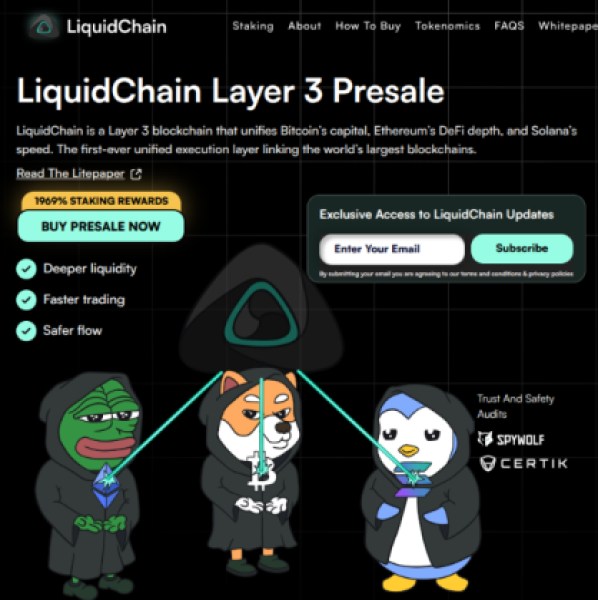
For a developer, the pitch is efficiency: deploy code once on LiquidChain, and instantly access liquidity from the top three ecosystems. No need to maintain fragmented liquidity pools across different networks, a redundancy that currently bleeds capital efficiency. As the dialogue moves toward the 2026 institutional horizon, protocols offering this level of unification are positioning themselves as the ‘TCP/IP’ of the blockchain era, invisible, essential, and highly valued.

CHECK OUT THE UNIFIED LIQUIDITY LAYER

Early Capital Flows into $LIQUID Presale Signal Infrastructure Demand

While headlines fixate on meme coin volatility, capital allocators are rotating into infrastructure plays that solve the interoperability crisis. The LiquidChain presale data reflects this methodical accumulation. It has already raised over $532K, and tokens are priced at $0.0136. Early investors also have access to staking rewards, currently sitting at 1943%.

This sub-million market cap entry point is notable compared to legacy interoperability protocols, which often trade in the billions. The pricing suggests the project is still in a discovery phase, distinct from the retail mania that usually follows major exchange listings.

The utility of the $LIQUID token extends beyond simple governance. It functions as the transaction fuel for the cross-chain VM and is required for liquidity staking. The tokenomics are designed to incentivize bonding assets from $BTC, $ETH, and $SOL into the LiquidChain ecosystem, rewarding users who provide the ‘glue’ for this unified layer. We see it as one of the next crypto to explode, due to its offering.

Investors are eyeing the $0.0136 price point not just for immediate gains, but as a derivative bet on cross-chain volume growth. If the thesis holds, that Asia will demand seamless execution across chains, LiquidChain’s ability to merge these ecosystems places it in a prime position to capture value from every transaction it facilitates.

CHECK OUT THE $LIQUID PRESALE

This article is for informational purposes only and does not constitute financial advice. Cryptocurrency investments, including presales like LiquidChain, carry high risks. Always conduct independent due diligence before participating.


Tiền kỹ thuật số thịnh hành

Câu hỏi Liên quan

QWhat is the significance of KuCoin's participation in Consensus Hong Kong 2026?

AKuCoin's participation, with its Vice President Edwin Wong joining the 'Turning Intelligence Into Action' panel, signifies the exchange's commitment to discussing and shaping the future of trust-first infrastructure and practical governance using on-chain signals and AI, aligning with the event's focus on Asia's growing dominance in the crypto space.

QAccording to the article, what is the primary market inefficiency that LiquidChain aims to solve?

ALiquidChain aims to solve the industry's glaring inefficiency of friction and high cost when moving capital between major blockchains like Bitcoin, Ethereum, and Solana, which fractures liquidity and makes execution expensive and slow.

QHow does LiquidChain function to unify liquidity from Bitcoin, Ethereum, and Solana?

ALiquidChain operates as a Layer 3 (L3) infrastructure that fuses liquidity from Bitcoin, Ethereum, and Solana into a single execution environment, eliminating the need for wrapped assets and their associated counterparty risk by enabling verifiable settlement and a 'single-step execution' model.

QWhat are some key details about the LiquidChain ($LIQUID) presale mentioned in the article?

AThe LiquidChain presale has raised over $532,000, with tokens priced at $0.0136. Early investors have access to staking rewards, currently at 1943% APY, and the project's low market cap entry point is seen as a discovery phase distinct from typical retail mania.

QWhat is the core utility of the $LIQUID token within its ecosystem?

AThe $LIQUID token functions as the transaction fuel for the cross-chain Virtual Machine (VM), is required for liquidity staking, and is used to incentivize users to bond assets from $BTC, $ETH, and $SOL into the LiquidChain ecosystem, rewarding those who provide liquidity for the unified layer.

Nội dung Liên quan

Hàn Quốc Hành Động Quy Định Chuyển Tiền Xuyên Biên Giới Bằng Tiền Mã Hóa Theo Khuôn Khổ Mới

Hàn Quốc dự kiến đưa các công ty fintech vào khuôn khổ cấp phép mới cho chuyển tiền bằng tài sản ảo, có hiệu lực từ tháng 12. Theo quy định sửa đổi, các công ty thực hiện chuyển tiền xuyên biên giới qua tài sản ảo phải đăng ký với Bộ Kinh tế & Tài chính và báo cáo giao dịch qua hệ thống hối đoái. Khung pháp lý này được lập ra để đưa các giao dịch dựa trên tiền mã hóa vào diện giám sát chính thức, nhằm ngăn chặn rửa tiền và tội phạm do nhiều giao dịch trước đây hoạt động ngoài hệ thống giám sát. Ban đầu, quy định chỉ giới hạn cho các sàn giao dịch tiền mã hóa như Upbit hay Bithumb. Tuy nhiên, ngân hàng trung ương Hàn Quốc cho biết có thể mở rộng đối tượng đủ điều kiện sang các thực thể phi truyền thống nếu họ đáp ứng yêu cầu. Bộ Kinh tế & Tài chính và Ngân hàng Trung ương đang phối hợp với các bên để hoàn thiện quy tắc thực thi trước tháng 12. Động thái này nằm trong bối cảnh Hàn Quốc đang tăng cường giám sát tài sản số, bao gồm cả việc sắp công bố quy tắc mới về chứng khoán token hóa vào tháng 7.

TheNewsCrypto1 giờ trước

Hàn Quốc Hành Động Quy Định Chuyển Tiền Xuyên Biên Giới Bằng Tiền Mã Hóa Theo Khuôn Khổ Mới

TheNewsCrypto1 giờ trước

Microsoft Xác Định Phần Mềm Độc Hại Mới Nhắm Vào Địa Chỉ Ví Và Khóa Riêng Tư

Vào tháng 2/2026, Microsoft đã phát hiện một chiến dịch mã độc nhắm mục tiêu vào người dùng tiền điện tử, được đặt tên là Trojan/CryptoBandits.A. Mã độc này lây lan chủ yếu qua các file shortcut .lnk độc hại trên ổ USB. Sau khi xâm nhập hệ thống, phần mềm độc hại hoạt động như một "crypto clipper". Nó liên tục theo dõi nội dung clipboard để tìm kiếm các cụm từ khôi phục ví (12 hoặc 24 từ), khóa cá nhân Bitcoin/Ethereum và địa chỉ ví. Khi phát hiện, nó sẽ thay thế địa chỉ ví người dùng sao chép bằng địa chỉ do kẻ tấn công kiểm soát, đánh cắp tiền. Ngoài ra, mã độc còn chụp màn hình, thực thi lệnh từ xa và duy trì quyền truy cập qua các tác vụ đã lên lịch. Điểm đáng chú ý là mã độc không cần máy chủ điều khiển trực tiếp mà sử dụng Windows Script Host, ActiveX và một proxy Tor ẩn để giao tiếp. Microsoft khuyến nghị các tổ chức vô hiệu hóa tính năng auto-run, hạn chế script từ USB và giám sát các hành vi đáng ngờ như hoạt động proxy localhost:9050, theo dõi clipboard hay chụp màn hình bằng PowerShell. Chiến dịch này cho thấy mối đe dọa ngày càng tinh vi đối với lĩnh vực tiền điện tử.

TheNewsCrypto2 giờ trước

Microsoft Xác Định Phần Mềm Độc Hại Mới Nhắm Vào Địa Chỉ Ví Và Khóa Riêng Tư

TheNewsCrypto2 giờ trước

Không có đội ngũ bán hàng vẫn thu về 20 triệu đô la, AI nhân viên Viktor dựa vào điều gì để chinh phục 30.000 doanh nghiệp?

AI nhân viên Viktor đạt doanh thu 20 triệu USD/năm với hơn 30.000 doanh nghiệp mà không cần đội ngũ bán hàng, bằng cách nào? Sản phẩm "Tier 3 AI Coworker" này, do đội ngũ từ DeepMind phát triển, hoạt động như một nhân viên kỹ thuật số. Người dùng chỉ cần đề cập @Viktor trong Slack hoặc Teams và yêu cầu bằng ngôn ngữ tự nhiên (ví dụ: tạo báo cáo bán hàng), nó sẽ tự động truy cập CRM, tạo biểu đồ và gửi kết quả. Ngoài phản hồi, Viktor còn tự động kích hoạt tác vụ như đối chiếu sổ sách ban đêm hay tổng hợp dữ liệu từ nhiều công cụ để làm PowerPoint. Thành công của Viktor đến từ mô hình PLG (Product-Led Growth) thuần túy. Thay vì bán theo số ghế, họ tính phí theo tín dụng hoặc nhiệm vụ, giúp giảm chi phí thử nghiệm. Người dùng có 100 USD miễn phí để trải nghiệm, từ đó lan truyền tự nhiên trong nội bộ. Viktor phá vỡ rào cản "kỹ thuật nhắc lệnh" (prompt engineering) bằng cách chuyển từ hỗ trợ soạn thảo sang thực thi đầu-cuối. Tuy nhiên, cơ chế ra quyết định tự động cũng tiềm ẩn rủi ro khi hiểu sai yêu cầu mơ hồ. Sản phẩm đang chuyển từ Slack sang Microsoft Teams (3.2 tỷ người dùng), đối mặt với thách thức tuân thủ và kiểm soát của bộ phận IT tại các tập đoàn lớn. Rào cản chính là cân bằng giữa tự động hóa hoàn toàn và kiểm soát rủi ro (như ghi sai dữ liệu), đòi hỏi khung quản trị chặt chẽ về quyền hạn, nhật ký kiểm toán để xây dựng lòng tin.

marsbit2 giờ trước

Không có đội ngũ bán hàng vẫn thu về 20 triệu đô la, AI nhân viên Viktor dựa vào điều gì để chinh phục 30.000 doanh nghiệp?

marsbit2 giờ trước

Phương án mua lại Manus hé lộ: Bên đầu tư Trung Quốc dự kiến bỏ ra 2 tỷ USD mua lại cổ phần, lộ trình IPO tại Hồng Kông dần sáng tỏ

Bài báo ngày 18/6 từ The Information tiết lộ, các nhà đầu tư Trung Quốc ban đầu của Manus, bao gồm Tencent, Sequoia China và ZhenFund, có kế hoạch mua lại công ty từ Meta với giá 20 tỷ USD, bằng đúng số tiền Meta đã chi trả vào tháng 12 năm ngoái. Động thái này là phản ứng trực tiếp sau khi cơ quan chức năng Trung Quốc vào tháng 4 ra lệnh dừng thương vụ mua lại do lo ngại an ninh. Theo kế hoạch, Manus sẽ được tái cấu trúc thành một doanh nghiệp liên doanh trong nước để đáp ứng các quy định và mở đường cho một đợt IPO tiềm năng tại Hong Kong. Các nhà đầu tư Trung Quốc dự kiến sẽ tăng vốn bằng USD. Benchmark, một nhà đầu tư khác, sẽ không tham gia mua lại, dẫn đến việc cổ phần của Manus tập trung nhiều hơn vào tay các quỹ Trung Quốc. Manus đã chứng kiến tốc độ tăng trưởng doanh thu ấn tượng, từ mức 1 tỷ USD khi bị mua lại lên 4-5 tỷ USD hiện tại, củng cố niềm tin của các nhà đầu tư vào việc mua lại theo giá cũ. Các điều khoản chi tiết như tỷ lệ góp vốn và cơ cấu công ty liên doanh vẫn đang được đàm phán. Kịch bản "mua lại + liên doanh + IPO tại Hong Kong" này có thể trở thành một khuôn mẫu tham khảo cho các startup AI Trung Quốc trong các thương vụ M&A xuyên biên giới.

marsbit3 giờ trước

Phương án mua lại Manus hé lộ: Bên đầu tư Trung Quốc dự kiến bỏ ra 2 tỷ USD mua lại cổ phần, lộ trình IPO tại Hồng Kông dần sáng tỏ

marsbit3 giờ trước

Giao dịch

Giao ngay
Hợp đồng Tương lai

Bài viết Nổi bật

Làm thế nào để Mua L3

Chào mừng bạn đến với HTX.com! Chúng tôi đã làm cho mua Layer3 (L3) trở nên đơn giản và thuận tiện. Làm theo hướng dẫn từng bước của chúng tôi để bắt đầu hành trình tiền kỹ thuật số của bạn.Bước 1: Tạo Tài khoản HTX của BạnSử dụng email hoặc số điện thoại của bạn để đăng ký tài khoản miễn phí trên HTX. Trải nghiệm hành trình đăng ký không rắc rối và mở khóa tất cả tính năng. Nhận Tài khoản của tôiBước 2: Truy cập Mua Crypto và Chọn Phương thức Thanh toán của BạnThẻ Tín dụng/Ghi nợ: Sử dụng Visa hoặc Mastercard của bạn để mua Layer3 (L3) ngay lập tức.Số dư: Sử dụng tiền từ số dư tài khoản HTX của bạn để giao dịch liền mạch.Bên thứ ba: Chúng tôi đã thêm những phương thức thanh toán phổ biến như Google Pay và Apple Pay để nâng cao sự tiện lợi.P2P: Giao dịch trực tiếp với người dùng khác trên HTX.Thị trường mua bán phi tập trung (OTC): Chúng tôi cung cấp những dịch vụ được thiết kế riêng và tỷ giá hối đoái cạnh tranh cho nhà giao dịch.Bước 3: Lưu trữ Layer3 (L3) của BạnSau khi mua Layer3 (L3), lưu trữ trong tài khoản HTX của bạn. Ngoài ra, bạn có thể gửi đi nơi khác qua chuyển khoản blockchain hoặc sử dụng để giao dịch những tiền kỹ thuật số khác.Bước 4: Giao dịch Layer3 (L3)Giao dịch Layer3 (L3) dễ dàng trên thị trường giao ngay của HTX. Chỉ cần truy cập vào tài khoản của bạn, chọn cặp giao dịch, thực hiện giao dịch và theo dõi trong thời gian thực. Chúng tôi cung cấp trải nghiệm thân thiện với người dùng cho cả người mới bắt đầu và người giao dịch dày dạn kinh nghiệm.

Tổng lượt xem 367Xuất bản vào 2024.12.06Cập nhật vào 2026.06.02

Làm thế nào để Mua L3

Thảo luận

Chào mừng đến với Cộng đồng HTX. Tại đây, bạn có thể được thông báo về những phát triển nền tảng mới nhất và có quyền truy cập vào thông tin chuyên sâu về thị trường. Ý kiến ​​của người dùng về giá của L3 (L3) được trình bày dưới đây.

活动图片