346% Surge vs 20.8% Decline, CoinGecko: DEX Perpetuals Are Taking Market Share from CEX

marsbitXuất bản vào 2026-03-04Cập nhật gần nhất vào 2026-03-04

Tóm tắt

CoinGecko's 2025 report highlights a dramatic shift in the crypto derivatives market, with DEX perpetual contract volume surging 346% to $6.7 trillion, while CEX open interest declined by 20.8%. This signals a systemic capital migration from centralized to decentralized platforms, driven by superior capital efficiency, mature market mechanisms, and enhanced DEX usability. Key factors include the ability to trade with leverage, hedge positions, and profit in both bull and bear markets. Hyperliquid, ranking as the seventh-largest global exchange with $2.9 trillion in volume—surpassing Coinbase International—exemplifies this trend. Its custom L1 blockchain enables high-speed, low-cost trading, while HIP-3’s permissionless listing mechanism allows trading of commodities, equities, and alternative assets, transforming DEXs into 24/7 global financial infrastructure. The data confirms perpetual contracts are reshaping crypto market structure, with DEXs becoming competitive in performance, fees, and user experience, positioning them as the future of decentralized finance.

Author: CoinGecko

Compiled by: Deep Tide TechFlow

Guide: The core data from CoinGecko's annual report is telling enough: DEX perpetual contract trading volume surged by 346% year-on-year, while CEX open interest fell by 20.8% during the same period. Capital is systematically migrating from centralized to decentralized platforms.

This article is not just about numbers; it clearly explains why this migration is happening, how Hyperliquid managed to surpass Coinbase International, and what these platforms are evolving into post-HIP-3.

Full Text Below:

In 2025, perpetual contract exchanges—especially decentralized platforms—experienced explosive growth, with total trading volume reaching $92.9 trillion (a 64.6% year-on-year increase), fundamentally shifting the crypto market from spot trading to a derivatives-led price discovery mechanism.

Key Points:

  • DEX perps grew by 346%, reaching $6.7 trillion; meanwhile, CEX open interest declined by 20.8%. This represents a massive capital migration from centralized to decentralized infrastructure, driven by platforms like Hyperliquid (ranked 7th globally with $2.9 trillion in volume).
  • Capital efficiency drives adoption: Perps allow traders to gain exposure with less capital through leverage, profit in both directions (crucial during the Q4 2025 downturn), and avoid the friction of physical settlement.
  • HIP-3 enables permissionless listing of any asset with a price feed, transforming platforms like Hyperliquid from "crypto exchanges" into 24/7 global financial infrastructure capable of trading everything from commodities to pre-IPO equity.

Why Perps Are Outpacing Spot Trading
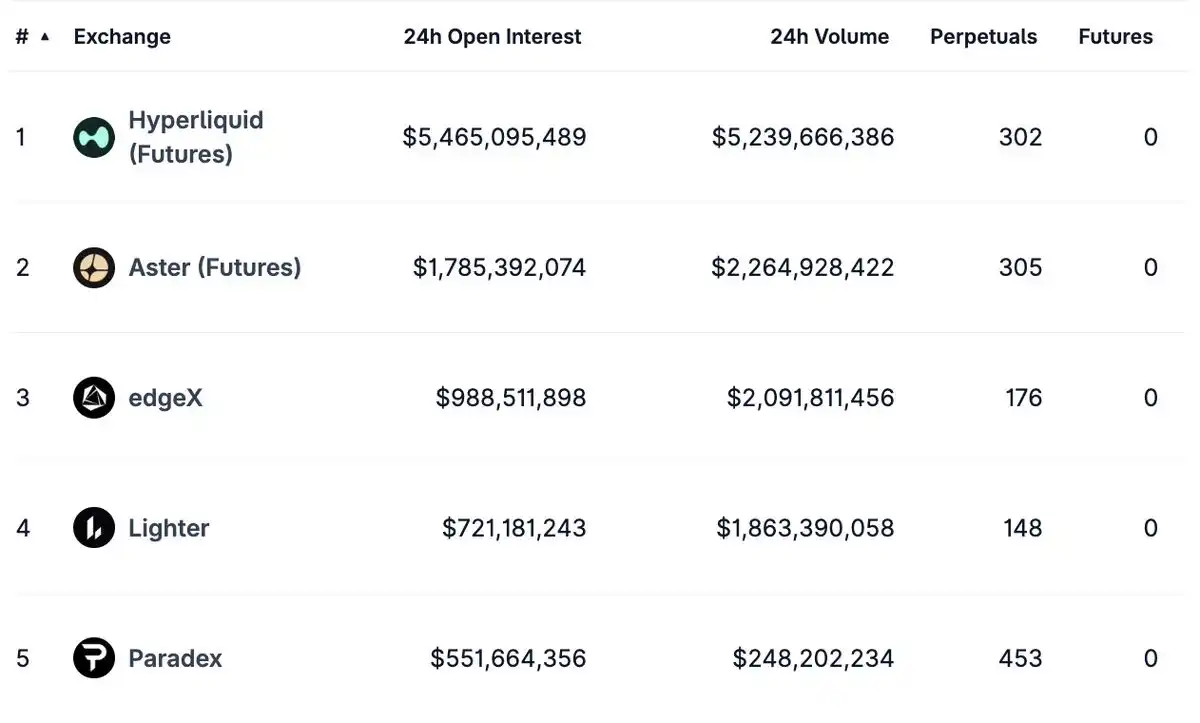
Figure: Top 5 Decentralized Perpetual Exchanges by 24h Trading Volume on CoinGecko as of March 2, 2026

Capital Efficiency: Doing More with Less

The fundamental advantage of perpetual contracts is capital efficiency. In the spot market, buying $10,000 worth of Bitcoin requires $10,000 in capital, which is locked up during the holding period. In the perpetual market, leverage allows for the same exposure with only a fraction of the capital, freeing up liquidity for other positions or strategies.

Beyond speculation, perpetual contracts enable market participants to:

Hedge existing positions without selling the underlying asset (thus avoiding taxable events); arbitrage price differences across trading venues; express directional views without the friction of physical settlement; deploy capital across multiple opportunities simultaneously.

Every dollar in the perpetual market works harder than a dollar in spot. For traders, funds, and institutions optimizing capital returns, the scale is tipping toward perps.

Market Maturation: Following the Path of Traditional Finance

The explosive growth of crypto derivatives mirrors a pattern seen in every mature financial market. In traditional finance, the derivatives market size far exceeds the underlying spot market, often by 10 to 50 times. Take the interest rate swap market, for example, with a notional value exceeding $400 trillion, compared to the bond market's ~$130 trillion.

The crypto market is just catching up. As the market matures and more experienced participants flood in, the derivatives-to-spot trading volume ratio continues to expand. The top ten exchanges alone generated $92.9 trillion in perpetual contract volume, far exceeding the total spot trading volume across all crypto exchanges.

The Hedging Factor: Resilience in a Downturn

Perhaps the most compelling evidence of the perpetual contract value proposition emerged during the Q4 2025 downturn. While spot markets contracted and investor sentiment soured, trading volume at the top ten perpetual exchanges grew 64.6% year-on-year.

Why? Because perpetual contracts allow traders to profit in both directions. When prices fall, short positions profit significantly, and hedging activity intensifies. The market's ability to express bearish views keeps capital active, volumes high, even as spot buying dries up.

In traditional, spot-only markets, price declines mean reduced activity. This is evident from the drop in CEX spot volume from $2.21 trillion in January 2025 to a low of $0.95 trillion in December.

In the perpetual market, however, volatility in any direction means opportunity. The 2025 data proves this dynamic has fundamentally altered crypto market structure.
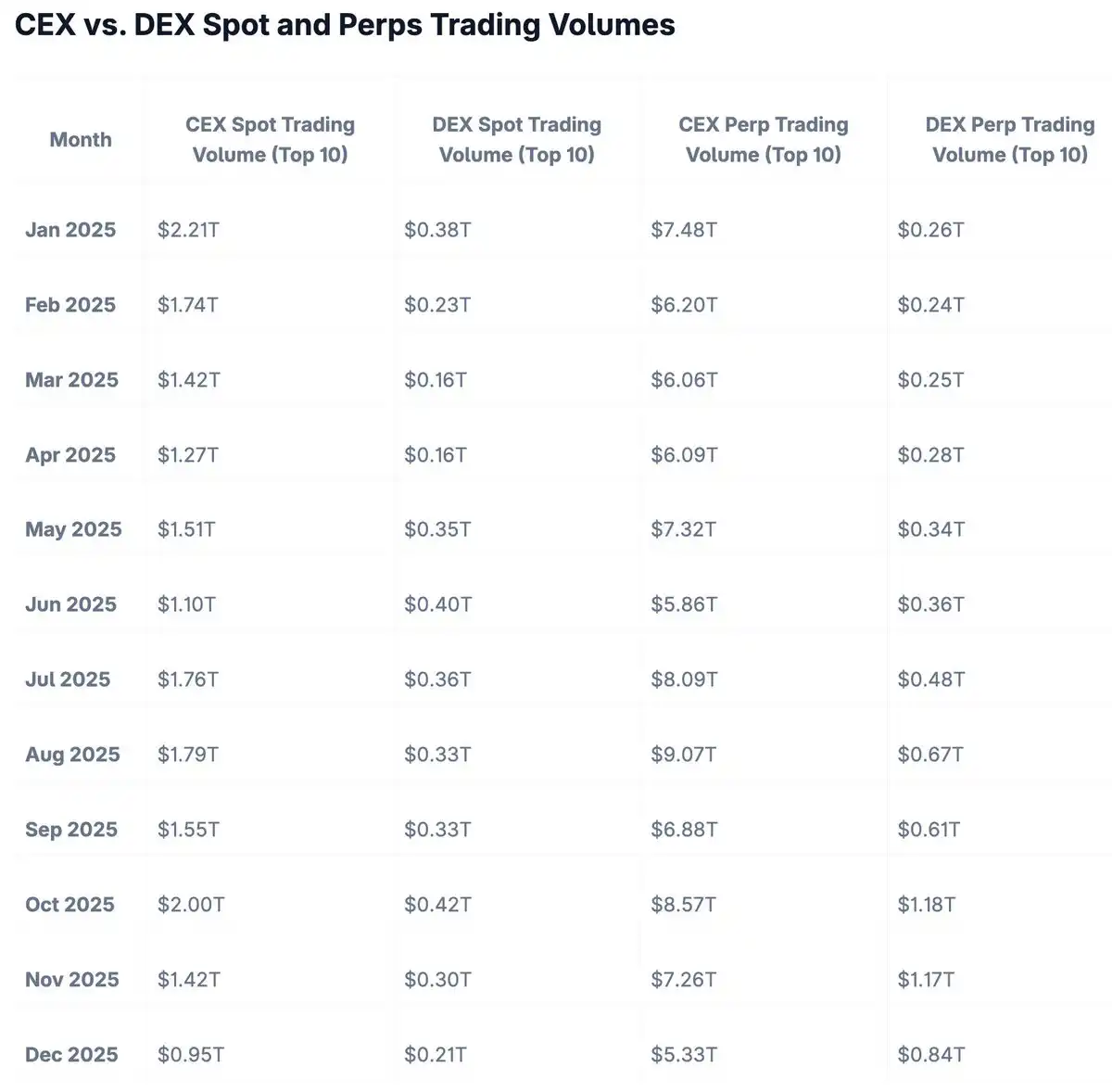
Figure: CEX vs. DEX Spot and Perpetual Contract Trading Volume Comparison

The Great Migration: DEX vs. CEX
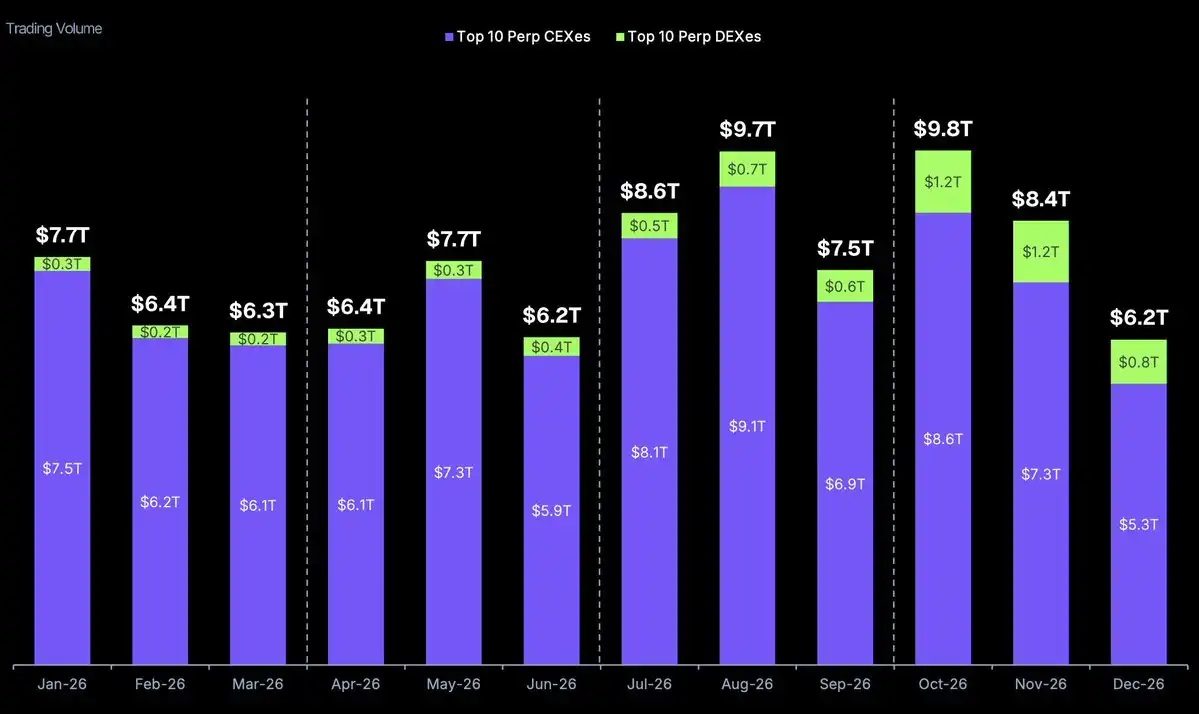
Figure: Top 10 Perp CEX and Perp DEX Trading Volume

Source: CoinGecko 2025 Crypto Industry Annual Report

Although centralized exchanges still dominate in absolute size, the real story of 2025 is the meteoric rise of decentralized perpetual exchanges. Perp DEX volume surged 346%, reaching a record $6.7 trillion for the year.

To put this leap into perspective: In the peak month of October 2025 alone, Perp DEXs processed $1.18 trillion in volume, more than four times the volume of January 2025.

DEX's Breakthrough

By 2025, Perp DEXs had solved the fundamental usability issues that previously kept users on centralized platforms:

  1. User Experience Parity: The narrative of "clunky DEX operation" ended in 2025. Hyperliquid and Lighter offered interfaces nearly indistinguishable from Binance or Coinbase's. Order book depth was sufficient, execution near-instantaneous—the average trader could no longer tell they were on a decentralized platform.
  2. Competitive Fee Structures: Early DEXs charged a premium for decentralization. By 2025, competition and technological advancement pushed Perp DEX fees to match or undercut CEX rates. Platforms like Hyperliquid even began offering up to 90% taker rebates, rivaling the most competitive CEX fee structures.
  3. Scaled Performance: Early blockchain-based DEXs couldn't handle the volume required for serious derivatives trading. The emergence of dedicated Layer 1 chains and optimized rollups solved this. Hyperliquid's custom L1, for example, processes thousands of transactions per second with sub-second confirmation times—performance comparable to centralized infrastructure.

The Divergence in Open Interest
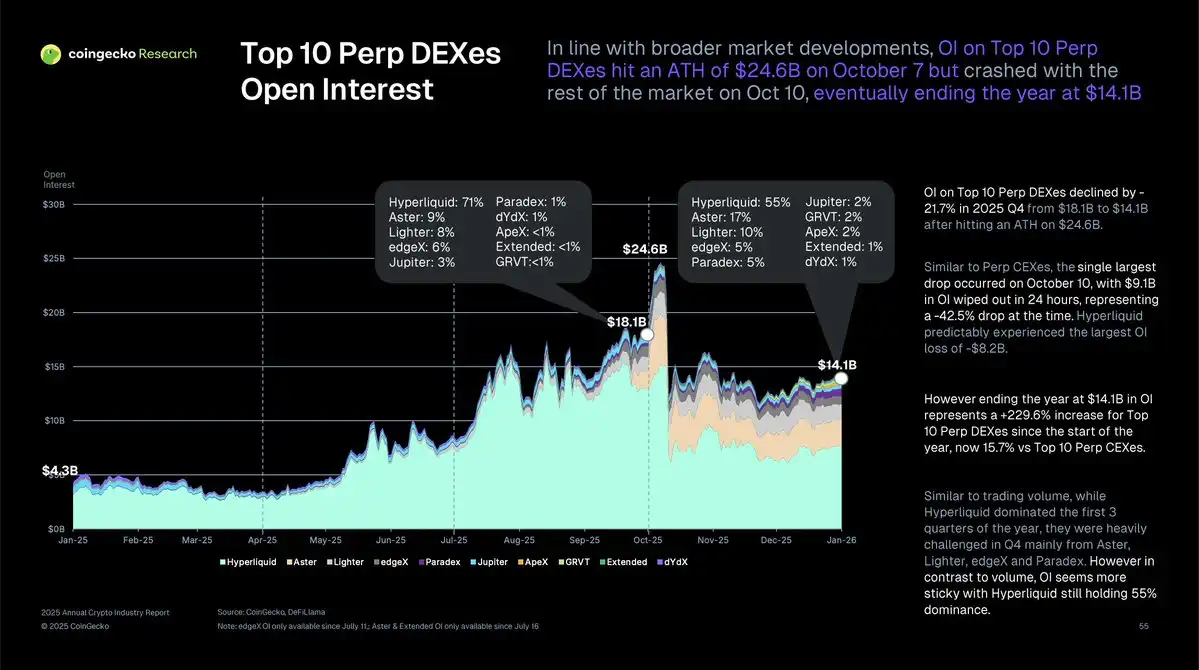
According to CoinGecko's "2025 Annual Crypto Industry Report," CEX open interest declined 20.8% in 2025, while DEX open interest surged 229.6%.

Open interest—the total value of outstanding derivative contracts—represents committed capital and conviction. This divergence tells us traders aren't just "trying out" DEXs for quick trades; they are establishing substantial long-term positions on-chain.

This shift represents a reallocation of capital from centralized to decentralized infrastructure. Once this migration begins, network effects accelerate it. More liquidity attracts more traders, which attracts more market makers, further deepening liquidity.

The Rise of Hyperliquid and Lighter

The 2025 perpetual exchange rankings reveal a significant shift in market structure. Two decentralized platforms forcefully entered the top ten, displacing established centralized players:

  • @HyperliquidX: Ranked 7th globally, with annual volume of $2.9 trillion;
  • @Lighter_xyz: Ranked 10th globally, with annual volume of $1.3 trillion.

In 2025, Hyperliquid's volume surpassed that of Coinbase International. This decentralized platform, less than two years old, overtook a publicly-listed, institutionally-backed exchange with billions in capital and years of operational history.

Coinbase International processed approximately $1.4 trillion in 2025. Hyperliquid reached $2.9 trillion—more than double.

Winning with Infrastructure

Hyperliquid's secret to success isn't clever marketing or token incentives, but infrastructure. The platform built its own Layer 1 blockchain (HyperCore) specifically optimized for perpetual contract trading.

This architectural decision彻底 (thoroughly) ended the "DEXs are slow" narrative. By controlling the full technology stack from consensus mechanism to matching engine, Hyperliquid achieved: sub-second trade confirmation; zero gas fees for market makers; throughput of 20,000+ orders per second; 100% uptime throughout 2025.

In contrast, Ethereum-based DEXs suffered from network congestion and variable gas costs, and other L2 solutions relied on external infrastructure. Hyperliquid's vertical integration delivered a user experience indistinguishable from centralized exchanges, while retaining the security guarantees of full decentralization.

Lighter followed a similar path, albeit with different technical implementation. The conclusion is clear: to compete with CEXs, DEXs must control their own infrastructural destiny.

Beyond Crypto: Hyperliquid's HIP-3 Revolution

In late 2025, Hyperliquid implemented HIP-3 (Hyperliquid Improvement Proposal 3), fundamentally altering its market structure.

Permissionless Listings

Previously, opening a new perpetual market required validator approval—a semi-centralized process. HIP-3 introduced a mechanism for permissionless perpetual market deployment.

Any builder can now create a perpetual market for any asset with a reliable price feed. No token required, no permission needed, no listing fees.

The immediate impact was explosive. Within weeks, perpetual markets for assets never before traded on-chain appeared on the platform.

A Bridge to Traditional Finance

By February 2026, the impact of HIP-3 became increasingly clear. Platforms like Hyperliquid are no longer just "crypto derivatives exchanges"; they are becoming global financial market infrastructure.

Perpetual markets now on Hyperliquid include:

  • Commodities: Gold and Silver perpetuals tracking COMEX futures; Crude Oil and Natural Gas; Agricultural products (Wheat, Corn, Soybeans).
  • Equity-like: Pre-IPO companies like SpaceX and OpenAI; Synthetic exposure to major tech stocks; Index perpetuals (S&P 500, Nasdaq 100).
  • Alternative Assets: Prediction markets (election outcomes, economic indicators); Sports betting derivatives; Weather derivatives.

This expansion means Perp DEXs are becoming the infrastructure for 24/7 global price discovery.

Markets That Never Close

Traditional financial markets close—the NYSE closes at 4 PM ET, CME futures markets halt Sunday evening. This creates friction, information gaps, and opportunity costs.

Blockchain-based perpetual markets never close. While traditional markets are offline, on-chain markets continue operating, incorporating new information in real-time.

Imagine: Major news hits on a Sunday evening—a geopolitical crisis, a corporate bankruptcy, an unexpected central bank move. Traditional markets cannot price this information until Monday morning, creating potential gaps and mispricing.

Perpetual contracts on platforms like Hyperliquid price the information immediately. As liquidity in these markets deepens, they may begin to influence traditional market opening prices—the 24/7 on-chain price becoming the reference point traditional markets catch up to on Monday morning.

Conclusion: The New Frontier of Perpetuals

The 2025 data tells an unmistakable story: Perpetual contracts have become the dominant force in crypto trading, and decentralized platforms are rapidly closing the gap with their centralized counterparts.

The numbers speak for themselves: $92.9 trillion volume from the top 10 perpetual exchanges; 346% DEX perpetual trading growth; 229.6% surge in DEX open interest; Leading DEXs have displaced major CEXs in the rankings.

With permissionless market creation enabled, blockchain infrastructure achieving performance parity with centralized systems, the line between "crypto exchange" and "global financial market" is blurring. These platforms are evolving into "on-chain financial markets"—where any asset with a price feed can be traded 24/7, fully self-custodied, with transparent settlement.

The spot trading model—buying and physically settling assets—will persist. But for price discovery, hedging, and capital-efficient speculation, perpetual contracts will dominate.


Câu hỏi Liên quan

QAccording to the CoinGecko report, what was the percentage growth in DEX perpetual contract trading volume in 2025, and what was the corresponding change in CEX open interest?

ADEX perpetual contract trading volume surged by 346% in 2025, while CEX open interest declined by 20.8%.

QWhat are the three main reasons cited for the explosive growth of perpetual contracts over spot trading?

AThe three main reasons are: 1) Capital efficiency (using leverage to get more exposure with less capital), 2) Market maturity (mirroring the pattern in traditional finance where derivatives markets are much larger than spot markets), and 3) The ability to hedge and profit in both rising and falling markets, which provided resilience during the Q4 2025 downturn.

QWhich two DEX perpetual platforms broke into the top 10 global rankings in 2025, and what were their respective trading volumes?

AHyperliquid (ranked 7th globally with $2.9 trillion in annual volume) and Lighter (ranked 10th globally with $1.3 trillion in annual volume) broke into the top 10.

QWhat key infrastructure feature was fundamental to Hyperliquid's success, allowing it to overcome the 'DEX' narrative and achieve performance comparable to CEXs?

AHyperliquid built its own purpose-built Layer 1 blockchain (HyperCore) optimized for perpetual trading. This allowed for sub-second trade confirmations, zero gas fees for market makers, throughput of 20,000+ orders per second, and 100% uptime.

QWhat was the significance of Hyperliquid's HIP-3 implementation, and how did it change the nature of the platform?

AHIP-3 introduced permissionless perpetual market deployment. This allowed any builder to create a perpetual market for any asset with a reliable price feed, transforming Hyperliquid from a crypto exchange into a 24/7 global financial infrastructure for trading assets like commodities, pre-IPO equities, and indices.

Nội dung Liên quan

43 phút của Trump: Cốt truyện người mạnh mất kiểm soát, chiến tranh truyền thông leo thang

Trong bài diễn văn kéo dài 43 phút sau hơn một tuần vắng bóng công chúng, Tổng thống Mỹ Donald Trump đã cố gắng thể hiện hình ảnh một nhà lãnh đạo mạnh mẽ và kiểm soát. Tuy nhiên, phần lớn thời gian được dành cho các chủ đề phụ như hồ phản chiếu trên National Mall, so sánh quy mô đám đông với Martin Luther King Jr., cùng những lời công kích nhắm vào phóng viên, đảng Dân chủ và các thành phố lớn. Ông còn ký sắc lệnh hành pháp hủy bỏ các biện pháp bảo vệ việc làm cho hàng nghìn công chức cấp cao liên bang, một động thái có thể gia tăng sự phụ thuộc vào lòng trung thành cá nhân hơn là năng lực chuyên môn trong chính phủ. Bài viết nêu bật trạng thái cá nhân đầy lo lắng và phòng thủ của Trump, thể hiện qua việc ông đột ngột kết thúc sự kiện và nhân viên nhanh chóng dọn dẹp hiện trường. Tác giả cũng phân tích cuộc tấn công của Trump vào nữ phóng viên CNN, Kaitlan Collins, coi đó là một phần của nỗ lực làm mất uy tín giới truyền thông. Bài báo cảnh báo về áp lực ngày càng lớn từ quyền lực chính trị và lợi ích thương mại lên các cơ quan báo chí chính thống, dẫn đến cuộc khủng hoảng về tính độc lập biên tập, như trường hợp Scott Pelley của CBS. Thông điệp chính kêu gọi công chúng ủng hộ các nhà báo và phương tiện truyền thông độc lập, những người được coi là lực lượng quan trọng duy trì sự thật khi các thể chế khác bị xâm phạm. Bài viết kết thúc với viễn cảnh lạc quan khi đề cập đến việc Hạ viện, với sự ủng hộ của một số thành viên đảng Cộng hòa, đã thông qua nghị quyết yêu cầu chấm dứt hành động quân sự ở Iran, cho thấy sự bất đồng ngày càng tăng ngay trong nội bộ đảng của Trump.

marsbit2 giờ trước

43 phút của Trump: Cốt truyện người mạnh mất kiểm soát, chiến tranh truyền thông leo thang

marsbit2 giờ trước

Kalshi, MTS và tham vọng của a16z

Trí tuệ thị trường dự đoán và tham vọng "Truyền thông Mới" của a16z Bài viết phân tích sự trỗi dậy của thị trường dự đoán (prediction markets), đặc biệt là công ty Kalshi được định giá 220 tỷ USD, dưới góc nhìn chiến lược đầu tư và truyền thông của quỹ mạo hiểm a16z. Tác giả điểm lại lịch sử tư tưởng của thị trường dự đoán, từ học thuyết của Hayek về việc thị trường tổng hợp tri thức phân tán, đến cơ chế khuyến khích của Robin Hanson (LMSR) và ý tưởng chính phủ dựa trên dự đoán (Futarchy). Trọng tâm bài viết nằm ở việc a16z, sau khi đầu tư vào Kalshi, đã định vị lại giá trị cốt lõi của thị trường dự đoán không chỉ là sòng bạc hay sàn giao dịch, mà là một phương tiện truyền thông mới mang lại "cảm giác hiện diện" (presence). Trong một thế giới ngày càng bị che khuất và bất lực, việc dùng tiền thật để đặt cược vào các sự kiện toàn cầu giúp cá nhân tái khẳng định vai trò "người quan sát tối thượng", can thiệp và diễn giải thực tại. Kalshi, theo logic này, sẽ trở thành nơi định đoạt tính xác thực và tầm quan trọng của sự kiện. Bài viết liên kết điều này với tầm nhìn "Truyền thông Mới" của a16z – một hệ thống truyền thông toàn diện từ định hình luận điệu, tài trợ, phát hành sản phẩm đến thu hút khách hàng với tốc độ và cường độ chưa từng có, nhằm "tiếp quản dòng thời gian". Ví dụ điển hình là MTS (Monitoring The Situation), một hãng truyền thông chuyên phát sóng tin tức 24/7 trên Twitter. Kết luận cho rằng sức hút thực sự của Kalshi và lý do định giá khổng lồ của nó nằm ở "trường lực bẻ cong hiện thực" – khả năng tạo ra một thực tại thay thế có sức thuyết phục cao nhờ vào khối lượng giao dịch bằng tiền thật, từ đó trở thành một mảnh ghép quyền lực trong đế chế truyền thông mới của a16z.

marsbit3 giờ trước

Kalshi, MTS và tham vọng của a16z

marsbit3 giờ trước

Bất Ngờ: Cựu Nhân Sự Trụ Cột Trong Dự Án Chip Của OpenAI Gia Nhập Anthropic

Chuyên gia chip "nhân viên số 002" của OpenAI, Clive Chan, vừa thông báo rời OpenAI để gia nhập Anthropic. Anh là một trong những thành viên sớm nhất của đội ngũ phát triển chip tự thiết kế của OpenAI, tham gia từ giai đoạn hình thành đến nay. Dù đánh giá cao đội ngũ chip tại OpenAI, Clive Chan chia sẻ anh luôn có mong muốn "chinh phục một ngọn núi mới từ chân núi", đó là lý do anh chuyển sang Anthropic. Tại Anthropic, anh ấn tượng với năng lực, giá trị cốt lõi và tham vọng của đội ngũ, đồng thời trải nghiệm cường độ làm việc rất cao. Khi được hỏi về tiến độ dự án chip của OpenAI, Clive Chan đề cập đến thông tin hợp tác công khai giữa OpenAI và Broadcom, với kế hoạch triển khai bắt đầu từ nửa cuối năm 2026. Clive Chan có kinh nghiệm làm việc tại nhiều công ty công nghệ hàng đầu như Tesla, Google, SpaceX trước khi gia nhập OpenAI vào đầu năm 2024. Việc chuyển đổi của anh là một ví dụ nữa cho thấy dòng chảy nhân tài đáng chú ý giữa OpenAI và Anthropic, sau sự kiện nhà nghiên cứu nổi tiếng Andrej Karpathy chuyển sang Anthropic hồi tháng 5. Động thái này càng thu hút sự chú ý khi Anthropic vừa hoàn thành vòng gọi vốn với định giá gần 1.000 tỷ USD.

marsbit3 giờ trước

Bất Ngờ: Cựu Nhân Sự Trụ Cột Trong Dự Án Chip Của OpenAI Gia Nhập Anthropic

marsbit3 giờ trước

a16z chuyển hướng toàn cầu hóa: VC đang trở thành "động lực thúc đẩy" của liên minh công nghệ Mỹ

Biên tập: Thông báo của Ben Horowitz cho thấy một bước chuyển quan trọng trong chiến lược toàn cầu hóa của a16z: họ không chỉ tìm kiếm dự án ở nước ngoài hay mở rộng đầu tư quốc tế, mà còn đặt mình vào khuôn khổ cạnh tranh công nghệ và hợp tác đồng minh rộng lớn hơn. Trong bối cảnh AI, robot, công nghệ quốc phòng, an ninh mạng và tái cấu trúc chuỗi cung ứng trở thành trọng tâm cạnh tranh quốc gia, con đường quốc tế hóa của startup trở nên phức tạp hơn. A16z đang phản ứng với sự thay đổi này thông qua việc thành lập văn phòng Tokyo, bổ nhiệm Anne Neuberger phụ trách các vấn đề toàn cầu, và nâng cấp nhóm quan hệ nhà đầu tư thành nhóm đối tác toàn cầu. Tín hiệu quan trọng nhất là a16z gắn kết mạng lưới toàn cầu của mình với năng lực lãnh đạo công nghệ của "Mỹ và các đồng minh". Đối với a16z, mạng lưới đầu tư mạo hiểm trong tương lai không chỉ giúp nhà sáng lập gọi vốn, tuyển dụng, bán hàng mà còn hỗ trợ họ tiếp cận thị trường trọng điểm, kết nối với chính phủ và các tổ chức chiến lược, cũng như hiểu rõ môi trường chính sách và quy định của các quốc gia khác nhau. Điều này có nghĩa vai trò của các tổ chức đầu tư mạo hiểm hàng đầu đang được định nghĩa lại. Họ không còn chỉ là trung gian vốn, mà là người tổ chức kết nối công ty khởi nghiệp, năng lực quốc gia, nguồn lực ngành, hệ thống đồng minh và vốn toàn cầu. Chiến lược toàn cầu hóa lần này của a16z có thể được xem như một sự chủ động định vị của vốn Silicon Valley trong cuộc cạnh tranh công nghệ toàn cầu mới.

marsbit3 giờ trước

a16z chuyển hướng toàn cầu hóa: VC đang trở thành "động lực thúc đẩy" của liên minh công nghệ Mỹ

marsbit3 giờ trước

Kalshi, MTS và Tham vọng của a16z

Bài viết phân tích tầm quan trọng của thị trường dự đoán (prediction markets), tập trung vào Kalshi, và tầm nhìn của quỹ đầu tư mạo hiểm a16z trong việc xây dựng một đế chế truyền thông mới. Tác giả điểm qua lịch sử tư tưởng đằng sau thị trường dự đoán, từ lý thuyết của Hayek về việc thị trường tổng hợp tri thức phân tán, đến cơ chế khuyến khích của Robin Hanson (LMSR) và ý tưởng "Futarchy". Trọng tâm bài viết là việc a16z đầu tư mạnh vào Kalshi (định giá 220 tỷ USD) và cách họ diễn giải giá trị cốt lõi của nó: mang lại "cảm giác hiện diện" (presence). Trong một thế giới mà con người ngày càng thụ động và xa cách với thực tại, thị trường dự đoán cho phép họ tham gia tích cực bằng cách dùng tiền thật để đặt cược vào các sự kiện, từ đó cảm thấy mình là người quan sát và dự báo lịch sử. a16z coi đây là mảnh ghép quan trọng cho tham vọng "truyền thông mới" của họ - một hệ thống toàn diện từ định hình narrative, tài trợ sản phẩm, đến tiếp cận khách hàng với tốc độ cực cao, nhằm "tiếp quản dòng thời gian". Công ty truyền thông MTS (Monitoring The Situation) là một ví dụ điển hình cho triết lý này. Bài viết kết luận rằng sức mạnh thực sự của Kalshi và thị trường dự đoán nằm ở "trường lực bẻ cong hiện thực" - khả năng định nghĩa tính xác thực và tầm quan trọng của sự kiện thông qua khối lượng giao dịch bằng tiền thật, từ đó giành được quyền giải thích tối cao về tương lai, một thứ quyền lực hiếm khi nằm trong tay một công ty tư nhân.

链捕手3 giờ trước

Kalshi, MTS và Tham vọng của a16z

链捕手3 giờ trước

Giao dịch

Giao ngay
Hợp đồng Tương lai

Bài viết Nổi bật

Làm thế nào để Mua CORE

Chào mừng bạn đến với HTX.com! Chúng tôi đã làm cho mua CORE (CORE) trở nên đơn giản và thuận tiện. Làm theo hướng dẫn từng bước của chúng tôi để bắt đầu hành trình tiền kỹ thuật số của bạn.Bước 1: Tạo Tài khoản HTX của BạnSử dụng email hoặc số điện thoại của bạn để đăng ký tài khoản miễn phí trên HTX. Trải nghiệm hành trình đăng ký không rắc rối và mở khóa tất cả tính năng. Nhận Tài khoản của tôiBước 2: Truy cập Mua Crypto và Chọn Phương thức Thanh toán của BạnThẻ Tín dụng/Ghi nợ: Sử dụng Visa hoặc Mastercard của bạn để mua CORE (CORE) ngay lập tức.Số dư: Sử dụng tiền từ số dư tài khoản HTX của bạn để giao dịch liền mạch.Bên thứ ba: Chúng tôi đã thêm những phương thức thanh toán phổ biến như Google Pay và Apple Pay để nâng cao sự tiện lợi.P2P: Giao dịch trực tiếp với người dùng khác trên HTX.Thị trường mua bán phi tập trung (OTC): Chúng tôi cung cấp những dịch vụ được thiết kế riêng và tỷ giá hối đoái cạnh tranh cho nhà giao dịch.Bước 3: Lưu trữ CORE (CORE) của BạnSau khi mua CORE (CORE), lưu trữ trong tài khoản HTX của bạn. Ngoài ra, bạn có thể gửi đi nơi khác qua chuyển khoản blockchain hoặc sử dụng để giao dịch những tiền kỹ thuật số khác.Bước 4: Giao dịch CORE (CORE)Giao dịch CORE (CORE) dễ dàng trên thị trường giao ngay của HTX. Chỉ cần truy cập vào tài khoản của bạn, chọn cặp giao dịch, thực hiện giao dịch và theo dõi trong thời gian thực. Chúng tôi cung cấp trải nghiệm thân thiện với người dùng cho cả người mới bắt đầu và người giao dịch dày dạn kinh nghiệm.

Tổng lượt xem 417Xuất bản vào 2024.12.13Cập nhật vào 2026.06.02

Làm thế nào để Mua CORE

Thảo luận

Chào mừng đến với Cộng đồng HTX. Tại đây, bạn có thể được thông báo về những phát triển nền tảng mới nhất và có quyền truy cập vào thông tin chuyên sâu về thị trường. Ý kiến ​​của người dùng về giá của CORE (CORE) được trình bày dưới đây.

活动图片