2 Days, 20x: A Quick Look at the Automated Market Making Mechanism of the New Gem Snowball

marsbitXuất bản vào 2025-12-22Cập nhật gần nhất vào 2025-12-22

Tóm tắt

The meme token Snowball" launched on pump.fun on December 18 and gained significant traction in the English-speaking crypto community, reaching a $10 million market cap within four days while largely flying under the radar in Chinese crypto circles. Its core innovation is an automated market-making mechanism: instead of the typical "creator fee" (usually 0.5%–1% per transaction) going to the developer’s wallet—a common setup that often leads to rug pulls—Snowball directs 100% of this fee to an on-chain bot. This bot periodically: 1. Buys back tokens to create buy pressure, 2. Adds the purchased tokens and corresponding SOL to the liquidity pool to improve depth, 3. Burns 0.1% of tokens to induce deflation. The fee rate also adjusts dynamically based on market cap (0.05%–0.95%) to balance accumulation and transaction friction. The idea is a "snowball effect": trading generates fees → fees fuel buybacks → buybacks may push price up → higher prices attract more trading. On-chain data shows 7,270 holders, with the top 10 holding ~20% of supply. Trading volume has been relatively balanced between buys and sells. However, the token remains highly speculative. While the structure reduces dev exit risk, it doesn’t eliminate other meme coin risks like low liquidity, narrative fatigue, or large holder dumps. Similar projects like FIREBALL are emerging, suggesting a trend toward "mechanism-driven memes." But as past examples like OlympusDAO and Safemoon show, complex t...

The crypto market in December is as cold as the weather.

On-chain transactions have been dormant for a long time, and new narratives are hard to come by. Just look at the drama and gossip circulating in the Chinese CT (Crypto Twitter) these past few days, and you'll know hardly anyone is playing in this market anymore.

But the English-speaking community has been discussing something new.

A meme coin called Snowball launched on pump.fun on December 18th. In four days, its market cap surged to $10 million and is still hitting new highs; yet it's barely mentioned in Chinese circles.
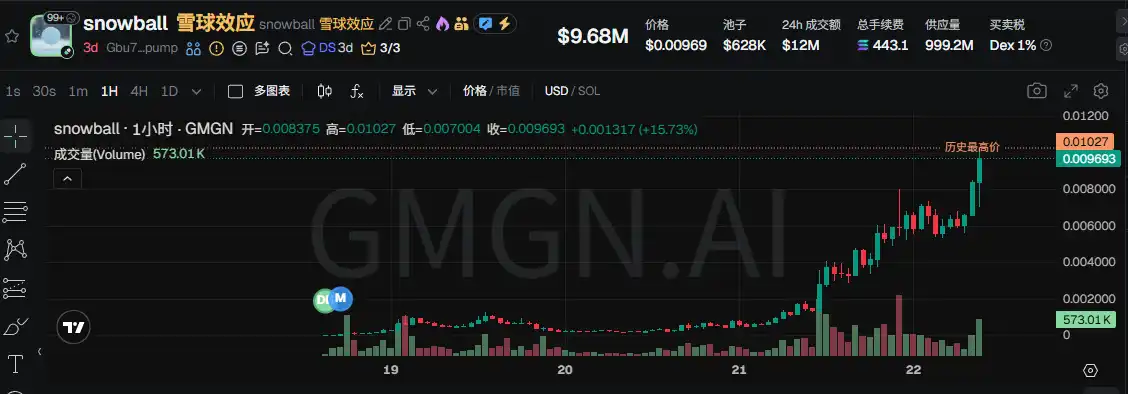
In the current environment, lacking new narratives and where even memes are considered unplayable, this is one of the few things that catches the eye and shows some localized wealth effect.

And the name Snowball itself tells the story it wants to convey:

A mechanism that allows the token to "roll and grow bigger by itself."

Turning Transaction Fees into Buying Pressure, Rolling the Snowball for Market Making

To understand what Snowball is doing, you first need to know how pump.fun tokens typically make money.

On pump.fun, anyone can create a token in minutes. The token creator can set a "creator fee," essentially taking a cut of every transaction into their own wallet, usually between 0.5% and 1%.

This money could theoretically be used for community building and marketing, but in practice, most Devs choose to: accumulate enough and then rug.

This is part of the typical life cycle of a shitcoin. Launch, pump, harvest fees, rug. Investors aren't betting on the token itself, but on the developer's conscience.

Snowball's approach is to not take this creator fee money.

To be precise, 100% of the creator fees do not go to anyone's wallet but are automatically transferred to an on-chain market-making bot.

This bot performs three actions at regular intervals:

First, it uses the accumulated funds to buy tokens on the market, creating buying support;

Second, it adds the bought tokens and the corresponding SOL to the liquidity pool, improving trading depth;

Third, it burns 0.1% of the tokens with each operation, creating deflation.
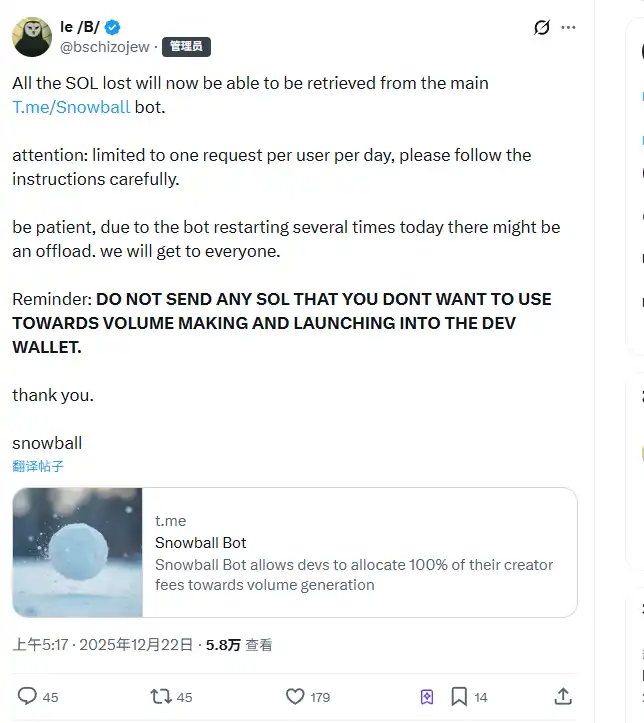
Additionally, the percentage of creator fees this coin charges is not fixed; it fluctuates between 0.05% and 0.95% based on market cap.

It takes a higher percentage when the market cap is low, allowing the bot to accumulate ammunition faster; it reduces the fee when the market cap is high, decreasing transaction friction.

In one sentence, the logic of this mechanism is: every time you trade, a portion of the money automatically becomes buying pressure and liquidity, instead of going into the developer's pocket.

Therefore, you can easily understand this snowball effect:

Transactions generate fees → Fees become buying pressure → Buying pressure pushes up the price → Higher price attracts more transactions → More fees... theoretically, it can roll on by itself.

On-Chain Data Situation

Now that we've covered the mechanism, let's look at the on-chain data.

Snowball launched on December 18th, four days ago. Its market cap grew from zero to $10 million, with a 24-hour trading volume exceeding $11 million.

For a shitcoin on pump.fun, this performance is considered relatively long-lasting in the current environment.

In terms of token distribution, there are currently 7,270 holder addresses. The top ten holders combined account for about 20% of the total supply, with the single largest holder holding 4.65%.
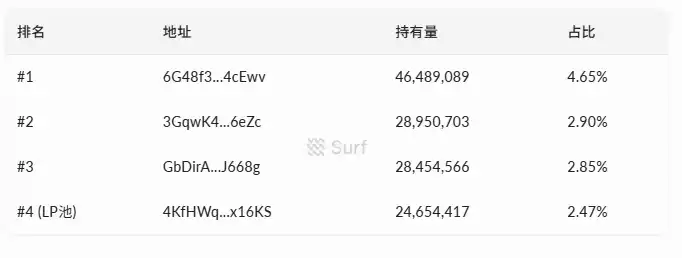
(Data source: surf.ai)

There's no address holding 20-30% of the supply; the distribution is relatively decentralized.

Regarding transaction data, there have been over 58,000 transactions since launch, with 33,000 buys and 24,000 sells. The total buy volume is $4.4 million, and the sell volume is $4.3 million, resulting in a net inflow of about $100,000. Buying and selling are basically balanced, with no one-sided selling pressure.

The liquidity pool holds about $380,000, half in tokens and half in SOL. For a market cap of this size, the depth isn't very thick, and large orders would still experience significant slippage.

Another noteworthy point is that Bybit Alpha announced listing the token less than 96 hours after launch, which to some extent confirms the short-term hype.

Perpetual Motion Meets a Cold Market

After looking around, you can see that the English community's discussion about Snowball mainly focuses on the mechanism itself. Supporters' logic is straightforward:

This is the first meme coin that locks 100% of the creator fees into the protocol, preventing developers from rugging, making it structurally safer than other shitcoins, at least.

The Dev is also playing into this narrative. The developer wallet, market-making bot wallet, and transaction logs are all public, emphasizing "verifiable on-chain."

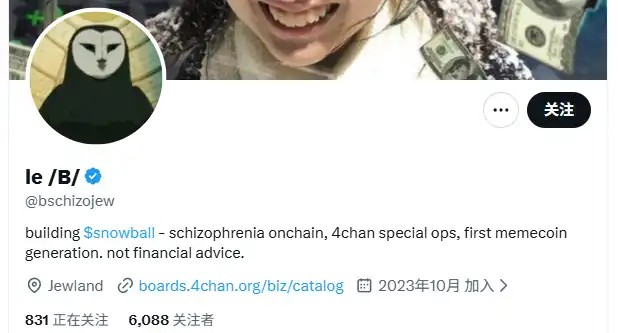
@bschizojew labels himself as "on-chain schizophrenic, 4chan special forces, first-generation meme coin veteran," radiating a self-deprecating degen vibe that strongly appeals to the crypto-native community.
But a safe mechanism and making money are two different things.

The snowball effect relies on the premise that there is sufficient trading volume to continuously generate fees to feed the bot for buybacks. More trades mean more ammunition for the bot, stronger buying pressure, higher prices, attracting more people to trade...

This is the ideal state where any meme coin's so-called buyback flywheel spins up in a bull market.

The problem is, the flywheel needs external force to start.

What is the current crypto market environment? On-chain activity is sluggish, overall meme coin hype is down, and there's already little capital willing to chase shitcoins. In this context, if new buying pressure doesn't keep up and trading volume shrinks, the fees the bot receives will become less and fewer, buybacks will weaken, price support will diminish, and trading willingness will decline further.

The flywheel can spin forward, but it can also spin in reverse.

A more realistic problem is that the mechanism solves only one risk point—"developers taking the money and running"—but meme coins face far more risks than that.

Whales dumping, insufficient liquidity, narratives going out of style—any one of these happening would render the 100% fee buyback largely ineffective.

Everyone is tired of being rugged. A Chinese crypto brother summarized it quite well:

Play if you want, but don't get in over your head.

More Than One Snowball is Rolling

Snowball isn't the only project telling this automated market-making story.

Within the pump.fun ecosystem, a token called FIREBALL is doing something similar: automatic buybacks and burns, packaged as a protocol other tokens can plug into. But its market cap is much smaller than Snowball's.
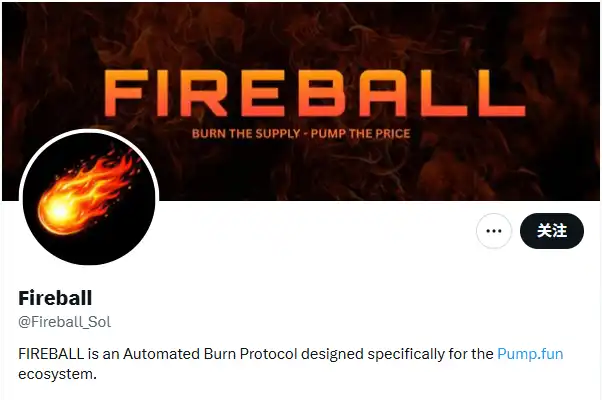
This indicates the market is currently responsive to the direction of "mechanism-based meme coins."

The traditional玩法 of shilling, pumping, and community hype is finding it harder to attract capital. Using mechanism design to tell a "structurally safe" story might be one of the recent trends for meme coins.

That said, artificially creating a specific mechanism isn't a new玩法.

The most typical case in 2021 was OlympusDAO's (3,3), which used game theory to package a staking mechanism, telling the story "if everyone holds, everyone profits," reaching a peak market cap of billions of dollars. The ending, as everyone knows, was a death spiral, dropping over 90%.

Even earlier, there was Safemoon's玩法 of "taxing every transaction and distributing it to holders," also a narrative of mechanism innovation, which ended with the SEC suing and charging the founders with fraud.

Mechanisms can be great narrative hooks, capable of gathering capital and attention in the short term, but the mechanism itself does not create value.

When external capital stops flowing in, even the most精巧designed flywheel will stop turning.

Finally, let's recap what this little gem is actually doing:

Turning the meme coin's creator fees into an "automated market-making bot." The mechanism itself isn't complicated, and the problem it solves is very clear: preventing developers from directly taking the money and running.

The developer not being able to rug doesn't mean you will make money.

If after reading this you find the mechanism interesting and want to participate, remember one thing: it is first and foremost a meme coin, and only secondly an experiment with a new mechanism.


Tiền kỹ thuật số thịnh hành

Câu hỏi Liên quan

QWhat is the core mechanism that Snowball uses to create a 'self-rolling' effect?

ASnowball uses a mechanism where 100% of the creator fees from each transaction are automatically sent to an on-chain market-making bot. This bot periodically uses the accumulated funds to buy tokens (creating buy pressure), adds the purchased tokens and corresponding SOL to the liquidity pool, and burns 0.1% of the tokens to create deflation.

QHow does the creator fee in Snowball differ from a typical pump.fun token?

AIn a typical pump.fun token, the creator fee (usually 0.5% to 1%) goes directly into the developer's wallet, which they can withdraw and potentially abandon the project with. In Snowball, 100% of this fee is automatically sent to an on-chain market-making bot instead of going to any individual, making it structurally harder for the developer to 'rug pull'.

QWhat are the potential risks of investing in a meme coin like Snowball, according to the article?

AThe risks include a general decline in market activity and meme coin hype, which could lead to reduced trading volume. If new buying pressure doesn't materialize, the bot's funding from fees decreases, weakening buy support and price stability. Other risks not solved by the mechanism include large holders (whales) dumping, insufficient liquidity, and the narrative simply falling out of fashion.

QWhat precedent does the article mention for meme coins with innovative mechanisms, and what was their outcome?

AThe article mentions OlympusDAO's (3,3) staking mechanism, which promised mutual gains if holders sold, but its市值 eventually fell over 90%. It also references Safemoon, which used a transaction tax redistribution mechanism and whose founders were later charged with fraud by the SEC. These examples show that mechanisms can be a good narrative but don't inherently create value if external capital stops flowing in.

QWhat key piece of advice does the article give to potential participants interested in Snowball's mechanism?

AThe key advice is to remember that Snowball is first and foremost a meme coin, and only secondly an experiment with a new mechanism. While the mechanism addresses developer rug pulls, it does not guarantee profits. Participants are advised to 'play but don't get too carried away' or 'don't go overboard'.

Nội dung Liên quan

Dylan Patel: Người sáng lập SemiAnalysis được Jensen Huang ca ngợi, từng là 'người nuôi ong' và 'anh bạn diễn đàn'

Dylan Patel, người sáng lập SemiAnalysis, đã biến một blog cá nhân thành một cơ quan nghiên cứu đầu tư chuyên sâu về chất bán dẫn có doanh thu hàng năm có thể đạt 100 triệu USD. Xuất thân từ một người nuôi ong ở vùng nông thôn Georgia và là một "chiến binh diễn đàn" đam mê công nghệ, Dylan đã tự học các kiến thức về chip thông qua việc sửa chữa phần cứng và thảo luận trực tuyến từ khi còn nhỏ. Năm 2020, anh thành lập SemiAnalysis trên WordPress, sau đó chuyển sang mô hình trả phí trên Substack. Đến năm 2025, SemiAnalysis đã phát triển thành một công ty toàn cầu với khoảng 60 nhân viên, có phòng thí nghiệm tháo rời chip riêng tại Oregon. Các báo cáo kỹ thuật chi tiết và độc lập của họ đã nhận được sự công nhận cao từ những nhân vật lớn trong ngành như Jensen Huang (CEO NVIDIA) và Lisa Su (CEO AMD). Một báo cáo chỉ trích về phần mềm ROCm của AMD đã dẫn đến cuộc trao đổi trực tiếp kéo dài 90 phút giữa Lisa Su và Dylan, và sau đó AMD đã cải thiện đáng kể. Gần đây, các báo cáo của SemiAnalysis về chuỗi cung ứng bộ nhớ và cấu hình máy chủ AI của NVIDIA cũng có tác động đáng chú ý đến thị trường chứng khoán. Dylan nhấn mạnh trọng tâm của SemiAnalysis là phân tích các ràng buộc thực tế trong ngành, cung cấp thông tin chi tiết để hỗ trợ các quyết định đầu tư và công nghiệp cụ thể.

marsbit36 phút trước

Dylan Patel: Người sáng lập SemiAnalysis được Jensen Huang ca ngợi, từng là 'người nuôi ong' và 'anh bạn diễn đàn'

marsbit36 phút trước

Dylan Patel: Người sáng lập SemiAnalysis được Jensen Hoàng khen ngợi, là 'người nuôi ong kiêm anh lão làng diễn đàn'

Bài viết giới thiệu về Dylan Patel, người sáng lập SemiAnalysis - một công ty nghiên cứu đầu tư độc lập có ảnh hưởng lớn trong ngành bán dẫn và AI. Xuất thân từ vùng nông thôn Georgia, từng làm nghề nuôi ong, Dylan bắt đầu sự nghiệp như một "chiến binh diễn đàn", tự học kiến thức về chip và viết blog ẩn danh. Năm 2020, anh thành lập kênh blog cá nhân SemiAnalysis, sau đó phát triển thành một công ty toàn cầu với khoảng 60 nhân viên và doanh thu dự kiến đạt 1 tỷ USD trong năm nay. SemiAnalysis nổi tiếng với các báo cáo phân tích kỹ thuật chuyên sâu, đã tác động đáng kể đến thị trường và nhận được sự công nhận từ các lãnh đạo hàng đầu như Jensen Huang (NVIDIA) và Lisa Su (AMD). Điển hình, báo cáo chỉ ra điểm yếu trong phần mềm ROCm của AMD đã dẫn đến cuộc trao đổi trực tiếp kéo dài 90 phút với CEO Lisa Su, người sau đó đánh giá cao những phản hồi mang tính xây dựng. Một báo cáo khác về việc NVIDIA có thể giảm cấu hình bộ nhớ đã ảnh hưởng đến cổ phiếu của các hãng như Micron. Câu chuyện của Dylan Patel minh họa cho con đường từ một chuyên gia nghiệp dư đam mê công nghệ trở thành người có tiếng nói quan trọng trong ngành công nghiệp bán dẫn toàn cầu.

Odaily星球日报41 phút trước

Dylan Patel: Người sáng lập SemiAnalysis được Jensen Hoàng khen ngợi, là 'người nuôi ong kiêm anh lão làng diễn đàn'

Odaily星球日报41 phút trước

Báo cáo Q1 Ethereum: Hoạt động trên chuỗi đạt mức cao kỷ lục, Tài sản mã hóa dẫn đầu toàn ngành

Bài báo báo cáo về tình hình của Ethereum trong Quý 1 năm 2026, được tổng hợp từ dữ liệu của Token Terminal. Mặc dù quý này chứng kiến sự sụt giảm về tổng giá trị tài sản khóa (TVL) 11% xuống 3162 tỷ USD, khối lượng giao dịch DEX giảm 24% xuống 1345 tỷ USD và vốn hóa thị trường của ETH giảm mạnh, nhưng hoạt động trên chuỗi lại đạt mức cao kỷ lục. Số lượng người dùng hoạt động hàng tháng (MAU) tăng 53.5% lên 13.2 triệu, tổng số giao dịch trên Lớp 1 tăng 38% lên 200.4 triệu giao dịch và thông lượng mạng (TPS) đạt 25.78. Một nghịch lý nổi bật là phí giao dịch Lớp 1 giảm mạnh 47.9% mặc dù hoạt động gia tăng, chủ yếu nhờ nâng cấp mở rộng Blob (BPO#2) đã tăng cường đáng kể khả năng lưu trữ dữ liệu và giảm chi phí giao dịch đơn lẻ. Lĩnh vực tài sản mã hóa (RWA) trên Ethereum tiếp tục dẫn đầu ngành với tổng vốn hóa thị trường đạt 2034 tỷ USD. Trong đó, stablecoin chiếm 1789 tỷ USD, quỹ mã hóa tăng 4.9% lên 194 tỷ USD, hàng hóa mã hóa tăng mạnh 60% lên 47 tỷ USD và cổ phiếu mã hóa đạt 365.1 triệu USD. Ethereum chiếm thị phần áp đảo trong nhiều lĩnh vực DeFi và RWA so với các blockchain lớn khác. Báo cáo nhấn mạnh rằng Ethereum đang hy sinh doanh thu phí ngắn hạn để đổi lấy việc mở rộng quy mô mạng lưới, tương tự như chiến lược của Amazon trong những ngày đầu Internet. Vị thế là mạng lưới mở, không cần cấp phép với tính trung lập, cùng hệ sinh thái thanh khoản và ứng dụng phong phú, đang giúp Ethereum thu hút ngày càng nhiều tổ chức tài chính truyền thống triển khai các sản phẩm mã hóa, củng cố vị thế là lớp thanh toán cơ sở hàng đầu cho tài sản trên chuỗi.

marsbit41 phút trước

Báo cáo Q1 Ethereum: Hoạt động trên chuỗi đạt mức cao kỷ lục, Tài sản mã hóa dẫn đầu toàn ngành

marsbit41 phút trước

Chỉ Báo CryptoQuant Cho Thấy Cá Voi Tích Lũy Gần Vùng Hỗ Trợ Bitcoin 64.000 USD

Chỉ báo CryptoQuant cho thấy sự gia tăng đột biến về Quy mô Đơn hàng Trung bình trên thị trường giao ngay của Bitcoin (BTC) khi giá kiểm tra vùng hỗ trợ 64.000 USD. Sự kiện này được diễn giải như một dấu hiệu cho thấy các "cá voi" (nhà đầu tư lớn) có thể đang tích lũy trong đợt điều chỉnh giảm giá. Chỉ báo này, tính bằng cách lấy khối lượng giao dịch chia cho số lượng lệnh, giúp phân biệt dòng tiền từ các nhà đầu tư tổ chức lớn với hoạt động giao dịch nhỏ lẻ của retail. Việc nó tăng vọt gần một vùng hỗ trợ quan trọng như 64.000 USD gợi ý rằng có những người mua lớn đang hấp thụ nguồn cung bán ra, thay vì chờ đợi một sự phá vỡ tăng giá rõ ràng. Tuy nhiên, báo cáo lưu ý rằng tín hiệu này không mang tính khẳng định. Đôi khi, đơn hàng cỡ lớn có thể phản ánh hoạt động nội bộ của sàn giao dịch, gộp lệnh hoặc quản lý thanh khoản, chứ không hẳn là mua định hướng. Do đó, tín hiệu chỉ thực sự mạnh khi đi kèm với các bằng chứng khác như giá ổn định, áp lực bán giảm hoặc độ sâu của sổ lệnh được cải thiện. Mặc dù dữ liệu hỗ trợ nhận định thận trọng về việc tích lũy của cá voi, nó không đảm bảo cho một sự đảo chiều tăng giá. Diễn biến tiếp theo của giá Bitcoin quanh vùng hỗ trợ 64.000 USD vẫn là yếu tố then chốt cần theo dõi, bởi các rủi ro vĩ mô và dòng tiền ETF vẫn có thể tác động mạnh đến thị trường.

bitcoinist1 giờ trước

Chỉ Báo CryptoQuant Cho Thấy Cá Voi Tích Lũy Gần Vùng Hỗ Trợ Bitcoin 64.000 USD

bitcoinist1 giờ trước

Nga vừa nói 'USDC có thể sử dụng được', vừa muốn thu 3% phí?

Bộ Tài chính Nga trong hơn một tuần đã đưa ra hai tuyên bố về cùng một nhóm tài sản. Đầu tiên, họ cảnh báo các stablecoin nước ngoài như USDT, USDC, BNB là "không thân thiện" và có rủi ro cao, sẽ áp mức phí lên tới 3% cho giao dịch. Sau đó, họ tuyên bố sẽ đưa USDC vào danh sách tài sản được phép giao dịch hợp pháp cùng với Bitcoin, Ethereum và USDT. Hai động thái này không mâu thuẫn mà là hai mặt của cùng một khuôn khổ: vừa kiểm soát chặt, vừa hợp pháp hóa có điều kiện. Nga không cấm mà định hướng "đưa vào khuôn khổ, kiểm soát chặt và hạn chế". Logic giống như hải quan: tiền mặt nước ngoài có thể mang vào nhưng phải khai báo, đóng thuế và có thể bị đóng băng nếu có vấn đề. Mục tiêu của Nga là: 1. **Định giá rủi ro:** Áp phí cao (3%) với các stablecoin có khả năng bị tổ chức phát hành (chịu ảnh hưởng phương Tây) đóng băng, như USDT/USDC. Phí thấp hơn cho tài sản từ các quốc gia thân thiện (như stablecoin gắn với Rúp, Dirham UAE). 2. **Tạo lối thoát nội bộ:** Giảm dần sự phụ thuộc vào tài sản kỹ thuật số của "phe không thân thiện" và hướng dòng vốn sang các kênh mà Nga có thể kiểm soát nhiều hơn. 3. **Chạy đua với lệnh trừng phạt:** Động thái này diễn ra gấp rút khi EU đang thắt chặt các lệnh trừng phạt, nhắm vào việc hạn chế khả năng tiếp cận các dịch vụ tiền mã hóa xuyên biên giới của Nga. Nga đang tranh thủ thiết lập hệ thống pháp lý nội bộ trước khi các kênh bên ngoài bị siết chặt hơn nữa. Tóm lại, Nga đang xây dựng một "trạm thu phí" quy định đối với tiền mã hóa: cho phép nhưng kiểm soát chặt, dùng mức phí để phân loại rủi ro và định hướng dòng tiền. USDC và các stablecoin tương tự giờ đây không chỉ là công cụ tài chính mà còn là một giao diện thể chế, và Nga đang tìm cách giành quyền kiểm soát trong hệ thống giao diện mới này.

marsbit1 giờ trước

Nga vừa nói 'USDC có thể sử dụng được', vừa muốn thu 3% phí?

marsbit1 giờ trước

Giao dịch

Giao ngay
Hợp đồng Tương lai

Bài viết Nổi bật

Làm thế nào để Mua QUICK

Chào mừng bạn đến với HTX.com! Chúng tôi đã làm cho mua Quickswap (QUICK) trở nên đơn giản và thuận tiện. Làm theo hướng dẫn từng bước của chúng tôi để bắt đầu hành trình tiền kỹ thuật số của bạn.Bước 1: Tạo Tài khoản HTX của BạnSử dụng email hoặc số điện thoại của bạn để đăng ký tài khoản miễn phí trên HTX. Trải nghiệm hành trình đăng ký không rắc rối và mở khóa tất cả tính năng. Nhận Tài khoản của tôiBước 2: Truy cập Mua Crypto và Chọn Phương thức Thanh toán của BạnThẻ Tín dụng/Ghi nợ: Sử dụng Visa hoặc Mastercard của bạn để mua Quickswap (QUICK) ngay lập tức.Số dư: Sử dụng tiền từ số dư tài khoản HTX của bạn để giao dịch liền mạch.Bên thứ ba: Chúng tôi đã thêm những phương thức thanh toán phổ biến như Google Pay và Apple Pay để nâng cao sự tiện lợi.P2P: Giao dịch trực tiếp với người dùng khác trên HTX.Thị trường mua bán phi tập trung (OTC): Chúng tôi cung cấp những dịch vụ được thiết kế riêng và tỷ giá hối đoái cạnh tranh cho nhà giao dịch.Bước 3: Lưu trữ Quickswap (QUICK) của BạnSau khi mua Quickswap (QUICK), lưu trữ trong tài khoản HTX của bạn. Ngoài ra, bạn có thể gửi đi nơi khác qua chuyển khoản blockchain hoặc sử dụng để giao dịch những tiền kỹ thuật số khác.Bước 4: Giao dịch Quickswap (QUICK)Giao dịch Quickswap (QUICK) dễ dàng trên thị trường giao ngay của HTX. Chỉ cần truy cập vào tài khoản của bạn, chọn cặp giao dịch, thực hiện giao dịch và theo dõi trong thời gian thực. Chúng tôi cung cấp trải nghiệm thân thiện với người dùng cho cả người mới bắt đầu và người giao dịch dày dạn kinh nghiệm.

Tổng lượt xem 287Xuất bản vào 2024.12.11Cập nhật vào 2026.06.02

Làm thế nào để Mua QUICK

Thảo luận

Chào mừng đến với Cộng đồng HTX. Tại đây, bạn có thể được thông báo về những phát triển nền tảng mới nhất và có quyền truy cập vào thông tin chuyên sâu về thị trường. Ý kiến ​​của người dùng về giá của QUICK (QUICK) được trình bày dưới đây.

活动图片











