Bitcoin Derivative Pressure Score Hits 30%: Downside Risk Signal

bitcoinistXuất bản vào 2025-09-02Cập nhật gần nhất vào 2025-09-02

Tóm tắt

Bitcoin is at a crossroads after failing to reclaim higher supply levels, raising concerns among investors about the strength of...

Trusted Editorial content, reviewed by leading industry experts and seasoned editors. Ad Disclosure

Bitcoin is at a crossroads after failing to reclaim higher supply levels, raising concerns among investors about the strength of its current trend. The price has slipped below key demand zones, and bullish momentum is showing signs of exhaustion. For now, traders are watching closely as the market decides whether BTC can recover or if a deeper correction is underway.

The mood across the market has shifted, with many analysts warning that Bitcoin could soon test the $100K level. Such a move would mark one of the most significant corrections of this cycle, sparking fear among short-term participants while possibly presenting opportunities for longer-term investors.

Top analyst Axel Adler has shed light on the situation, pointing to data that highlights persistent derivative pressure. According to him, Bitcoin’s baseline trend suggests pullbacks are being driven by long de-leveraging. With derivative markets heavily influencing price action, this pressure score — currently sitting in an elevated zone — keeps the market vulnerable to downside jolts.

Bitcoin Open Interest Signals Risks Ahead

According to top analyst Axel Adler, Bitcoin’s current weakness is strongly tied to derivative market dynamics. He highlights that the Bitcoin Open Interest Pressure Score sits at 30%, placing it firmly in the upper band. Historically, this level reflects elevated risk conditions, where the market becomes vulnerable to sudden downside jolts. In such environments, leveraged longs face pressure, and any sharp decline in spot prices tends to trigger waves of liquidations that amplify volatility.
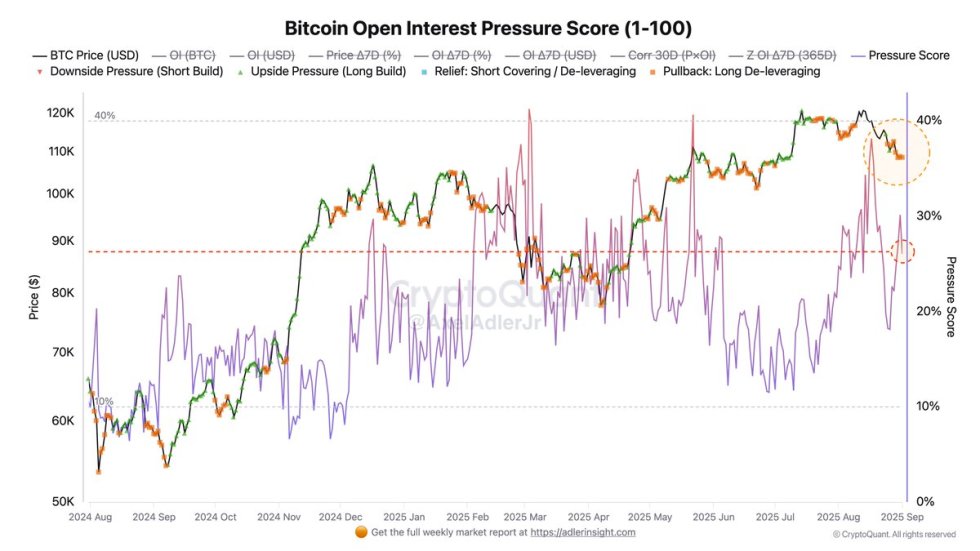
Bitcoin Open Interest Pressure Score (1-100) | Source: Axel Adler

Adler points out that the presence of orange cluster markers on the price chart reinforces this risk. These clusters typically favor continued sideways or lower movement as the market undergoes a process of long de-leveraging. Essentially, traders who overextended during Bitcoin’s surge above $120K are now being forced out of positions, which weighs on momentum and creates a ceiling on recovery attempts.

Adding further pressure is the recent capital rotation trend dominating crypto markets. Institutions and whales have been observed selling portions of their BTC holdings to accumulate Ethereum, a strategy supported by growing ETH adoption and whale activity. This shift of liquidity has likely contributed to Bitcoin’s struggle to hold above the $110K level, weakening bullish conviction.

If Bitcoin fails to reclaim lost ground and derivative pressure remains elevated, a test of the $100K zone becomes increasingly probable. Conversely, stabilization and absorption of selling could reset leverage and prepare BTC for its next major move. Either way, market participants should brace for heightened volatility.

Price Action Details: Testing Pivotal Level

Bitcoin (BTC) is showing signs of stabilization after intense volatility in recent sessions. The chart highlights BTC trading at $110,488, attempting to reclaim ground after dipping below the $110K threshold. This level has now become a pivotal battleground between bulls and bears, with the next moves likely determining short-term direction.
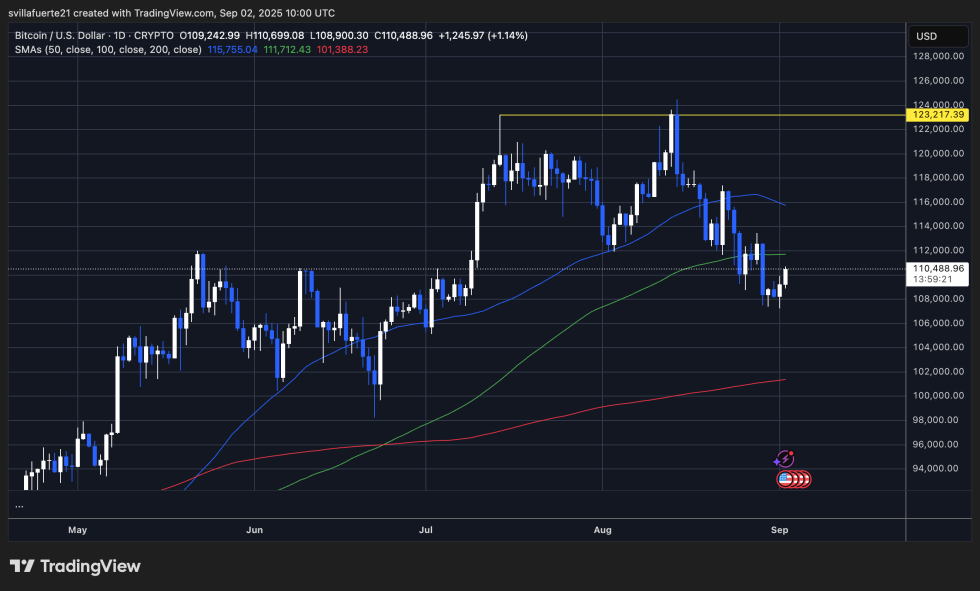
BTC consolidates around pivotal price level | Source: BTCUSDT chart on TradingView

The 50-day moving average sits above current price action, near $115,755, reinforcing the overhead resistance zone. BTC must regain this level to confirm strength and attempt a retest of the $123,217 resistance, which remains the major hurdle for continuation toward new highs. On the downside, the 200-day moving average, currently around $101,388, acts as a critical safety net. A decisive breakdown below that point could accelerate a deeper correction, with the $100K level serving as psychological support.

The structure suggests the market is in a consolidation phase, digesting the steep rally earlier in the cycle. If bulls manage to hold above $110K and build momentum, a move toward $115K and eventually $123K could follow. However, failure here may reopen the door for tests of lower demand zones closer to $105K–$101K.

Featured image from Dall-E, chart from TradingView

Editorial Process for bitcoinist is centered on delivering thoroughly researched, accurate, and unbiased content. We uphold strict sourcing standards, and each page undergoes diligent review by our team of top technology experts and seasoned editors. This process ensures the integrity, relevance, and value of our content for our readers.

Sebastian's journey into the world of crypto began four years ago, driven by a fascination with the potential of blockchain technology to revolutionize financial systems. His initial exploration focused on understanding the intricacies of various crypto projects, particularly those focused on building innovative financial solutions. Through countless hours of research and learning, Sebastian developed a deep understanding of the underlying technologies, market dynamics, and potential applications of cryptocurrencies. As his knowledge grew, Sebastian felt compelled to share his insights with others. He began actively contributing to online discussions on platforms like X and LinkedIn, focusing on fintech and crypto-related content. His goal was to expose valuable trends and insights to a wider audience, fostering a deeper understanding of the rapidly evolving crypto landscape. Sebastian's contributions quickly gained recognition, and he became a trusted voice in the online crypto community. To further enhance his expertise, Sebastian pursued a UC Berkeley Fintech: Frameworks, Applications, and Strategies certification. This rigorous program equipped him with valuable skills and knowledge regarding Financial Technology, bridging the gap between traditional finance (TradFi) and decentralized finance (DeFi). The certification deepened his understanding of the broader financial landscape and its intersection with blockchain technology. Sebastian's passion for finance and writing is evident in his work. He enjoys delving into financial research, analyzing market trends, and exploring the latest developments in the crypto space. In his spare time, Sebastian can often be found immersed in charts, studying 10-K forms, or engaging in thought-provoking discussions about the future of finance. Sebastian's journey as a crypto analyst and investor has been marked by a relentless pursuit of knowledge and a dedication to sharing his insights. His ability to navigate the complex world of crypto, combined with his passion for financial research and communication, makes him a valuable asset to the industry. As the crypto landscape continues to evolve, Sebastian remains at the forefront, providing valuable insights and contributing to the growth of this revolutionary technology.

Nội dung Liên quan

Các ETF Ethereum ghi nhận dòng tiền rút 12,85 triệu USD – Tại sao phe kỳ vọng tăng giá ETH đang đối mặt với một cuộc chiến gian nan

Các quỹ ETF Ethereum tại Mỹ tiếp tục ghi nhận dòng tiền ròng rút ra 12,85 triệu USD, phản ánh sự suy yếu trong nhu cầu từ các nhà đầu tư tổ chức giữa điều kiện thị trường bất ổn. Dòng vốn rút này làm giảm nguồn mua định chế cần thiết để hỗ trợ ổn định giá ETH. Do đó, Ethereum hiện phụ thuộc nhiều hơn vào nhu cầu staking, hoạt động lớp 2 và mua spot hữu cơ để cân bằng thị trường. Nếu nhu cầu mạng lưới không tăng, ETH có thể trải qua giai đoạn củng cố kéo dài và dễ biến động hơn theo tâm lý. Một dấu hiệu đáng theo dõi khác là việc chuyển một lượng ETH lớn (trị giá ~272 triệu USD) vào một ví mới. Mặc dù đây có thể là hành động quản lý ví thông thường, nhưng nếu số tiền này được chuyển đến các sàn giao dịch, nó có thể củng cố tâm lý giảm giá và tạo thêm áp lực bán. Tóm lại, Ethereum vẫn dễ bị tổn thương do nhu cầu định chế suy yếu và cấu trúc thị trường nghiêng về phe gấu. Đồng tiền này cần nhu cầu mua spot mạnh hơn để chống đỡ áp lực bán và khôi phục đà tăng bền vững.

ambcrypto4 giờ trước

Các ETF Ethereum ghi nhận dòng tiền rút 12,85 triệu USD – Tại sao phe kỳ vọng tăng giá ETH đang đối mặt với một cuộc chiến gian nan

ambcrypto4 giờ trước

2028, RSI Đến

**AI có thể tự tạo ra AI mạnh hơn vào năm 2028** Các chuyên gia hàng đầu thế giới cảnh báo về khả năng xảy ra "Cải tiến Đệ quy Tự thân" (RSI), khi AI có thể tự thiết kế và xây dựng thế hệ kế tiếp mạnh hơn mà không cần sự can thiệp của con người. **Dự báo thời gian:** Jack Clark, đồng sáng lập Anthropic, ước tính xác suất 60% RSI sẽ thành hiện thực **trước cuối năm 2028**. Ông đưa ra viễn cảnh Claude 10 tự tạo ra Claude 11. **Toàn ngành đang theo đuổi:** Demis Hassabis, người đứng đầu Google DeepMind, xác nhận tất cả các phòng thí nghiệm AI hàng đầu đều đang tập trung phát triển RSI. Ông bày tỏ lo ngại sâu sắc về hậu quả tiềm ẩn. **Bằng chứng thực tế:** * **Năng suất vượt trội:** Tại Anthropic, hơn 80% mã code được hợp nhất vào khoảng năm 2026 là do Claude viết. Năng suất của kỹ sư tăng gấp 8 lần so với năm 2024. * **Lập trình tự chủ:** Trong bài kiểm tra MirrorCode, Claude Opus 4.7 đã tự động tái tạo một công cụ phần mềm phức tạp chỉ trong 14 giờ (con người cần 2-17 tuần). Một nhiệm vụ khác yêu cầu AI lập trình **liên tục 19 ngày không ngừng nghỉ**. * **Tốc độ gia tăng:** Khả năng tối ưu hóa code nghiên cứu AI của Claude đã tăng từ 3 lần (5/2025) lên **52 lần** (4/2026). **Quan điểm từ OpenAI:** Sam Altman thừa nhận RSI là thách thức an ninh lớn nhất thập kỷ tới. Thông tin nội bộ tiết lộ OpenAI có thể đạt được RSI trong vòng chưa đầy 6 tháng, và điều này thậm chí có thể khiến họ hoãn kế hoạch IPO trị giá 8520 tỷ USD. **Kết luận:** Các dấu hiệu từ Anthropic, DeepMind và OpenAI cho thấy cuộc chạy đua hướng tới "vụ nổ thông minh" đã bắt đầu. Câu hỏi không còn là "liệu nó có xảy ra?" mà là **"Chúng ta đã sẵn sàng chưa?"** khi đồng hồ đếm ngược tới năm 2028.

marsbit4 giờ trước

2028, RSI Đến

marsbit4 giờ trước

Mô hình thế giới, metaverse, song sinh kỹ thuật số, AI vật lý: Chúng có phải là một?

Trong vài năm qua, nhiều khái niệm như metaverse, Web3.0, nền tảng dữ liệu mô phỏng, song sinh kỹ thuật số (Digital Twin) và AI vật lý (Physical AI) liên tục xuất hiện, khiến nhiều người bối rối. Vậy chúng có phải là một với "Mô hình Thế giới" (World Model) không? Câu trả lời là không hoàn toàn, nhưng tất cả đều hướng đến xu hướng xóa mờ ranh giới giữa thế giới số và vật lý. Mô hình Thế giới giống như "lớp nhận thức" hoặc "hệ điều hành nền tảng", giúp AI hiểu và suy luận về thế giới. Các khái niệm trên có thể được phân loại thành: 1) **Trải nghiệm không gian** (Metaverse), 2) **Quan hệ sản xuất** (Web3.0 với blockchain), và 3) **Năng lực kỹ thuật** (gồm các nền tảng mô phỏng, song sinh kỹ thuật số, AI vật lý và Mô hình Thế giới). **Metaverse** là điểm đến ảo, còn **Mô hình Thế giới** là công cụ tạo ra nội dung cho nó, như một "động cơ" tự sinh thế giới tương tác. **Web3.0** tập trung vào quyền sở hữu và kinh tế số, khác biệt về mặt kỹ thuật với Mô hình Thế giới. **Nền tảng dữ liệu mô phỏng** (simulation platform) là phiên bản 1.0, dựa nhiều vào thiết kế thủ công, trong khi Mô hình Thế giới (phiên bản 2.0) sử dụng AI để tự động tạo ra các kịch bản chân thực và quy mô lớn. **Song sinh kỹ thuật số** là bản sao kỹ thuật số phản ánh hiện trạng, còn **Mô hình Thế giới** tiến xa hơn bằng khả năng "dự đoán tương lai" và mô phỏng các kết quả. **AI vật lý** cần Mô hình Thế giới như một thành phần cốt lõi để hiểu các quy luật vật lý, dự đoán và lên kế hoạch hành động trong thế giới thực. Tóm lại, có thể hình dung mối quan hệ theo các tầng: **Cơ sở hạ tầng** (GPU, cảm biến) -> **Lớp nhận thức** (Mô hình Thế giới) -> **Lớp công cụ ứng dụng** (nền tảng mô phỏng, song sinh kỹ thuật số) -> **Lớp hành động** (AI vật lý) -> **Lớp trải nghiệm** (Metaverse) -> **Lớp quy tắc** (Web3.0). Mô hình Thế giới không thay thế các khái niệm khác, mà có khả năng trở thành "hệ điều hành" nền tảng, cung cấp khả năng hiểu biết và suy luận về thế giới để hỗ trợ cho nhiều ứng dụng và tầm nhìn công nghệ trong tương lai.

marsbit4 giờ trước

Mô hình thế giới, metaverse, song sinh kỹ thuật số, AI vật lý: Chúng có phải là một?

marsbit4 giờ trước

Giao dịch

Giao ngay
活动图片