Author:Mesh
Compiled by: Deep Tide TechFlow
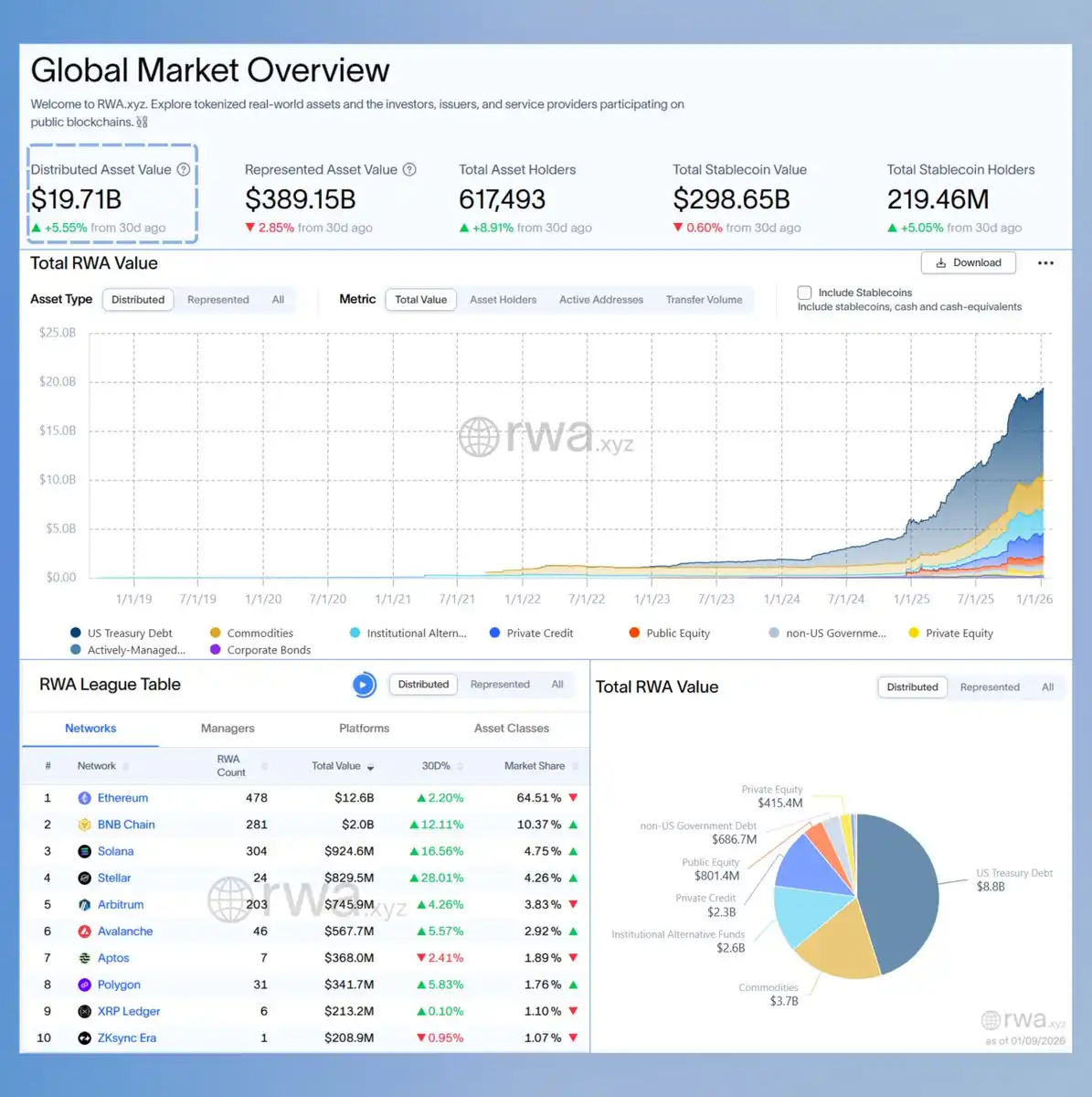
Honestly, the development of institutional-grade RWA (Real World Asset) tokenization over the past six months deserves close attention. The market size is approaching $20 billion. This isn't hype; it's real institutional capital being deployed on-chain.
I've been following this space for a while, and the recent pace of development is astounding. From treasury bonds and private credit to tokenized stocks, these assets are migrating to blockchain infrastructure faster than the market anticipated.
Currently, five protocols have become foundational in this area: Rayls Labs, Ondo Finance, Centrifuge, Canton Network, and Polymesh. They are not competing for the same clients but are addressing different institutional needs: banks require privacy, asset managers pursue efficiency, and Wall Street firms demand compliance infrastructure.
This isn't about who "wins" but about which infrastructure institutions choose and how trillions of dollars in traditional assets migrate through these tools.
An Overlooked Market Nears the $20 Billion Mark
Three years ago, tokenized RWAs were barely a category. Today, on-chain deployed assets for treasury bonds, private credit, and public stocks are nearing $20 billion. This is a significant increase from the $6-8 billion range in early 2024.
Frankly, the performance of the sub-sectors is more interesting than the total size.
According to a market snapshot from rwa.xyz in early January 2026:
- Treasury Bonds and Money Market Funds: Approximately $8-9 billion, representing 45%-50% of the market
- Private Credit: $2-6 billion (smaller base but fastest growing, 20%-30% share)
- Public Stocks: Over $400 million (growing rapidly, primarily driven by Ondo Finance)
Three Key Drivers Accelerating RWA Adoption:
- Appeal of Yield Arbitrage: Tokenized treasury products offer 4%-6% returns with 24/7 access, compared to traditional markets with T+2 settlement cycles. Private credit instruments offer 8%-12% returns. For institutional treasurers managing billions in idle capital, the math is compelling.
- Gradual Regulatory Framework Maturation: The EU's Markets in Crypto-Assets (MiCA) regulation is now enforced across 27 countries. The US SEC's "Project Crypto" is advancing on-chain securities frameworks. Meanwhile, No-Action Letters enable infrastructure providers like DTCC to tokenize assets.
- Maturation of Custody and Oracle Infrastructure: Chronicle Labs handles over $20 billion in Total Value Secured, and Halborn has completed security audits for major RWA protocols. This infrastructure is now mature enough to meet fiduciary standards.
Despite this, the industry faces significant challenges. The cost of cross-chain transactions is estimated at $1.3 billion annually. Price discrepancies of 1%-3% exist for the same asset on different blockchains due to capital movement costs exceeding arbitrage profits. The conflict between privacy needs and regulatory transparency requirements remains unresolved.
Rayls Labs: The Privacy Infrastructure Banks Actually Need
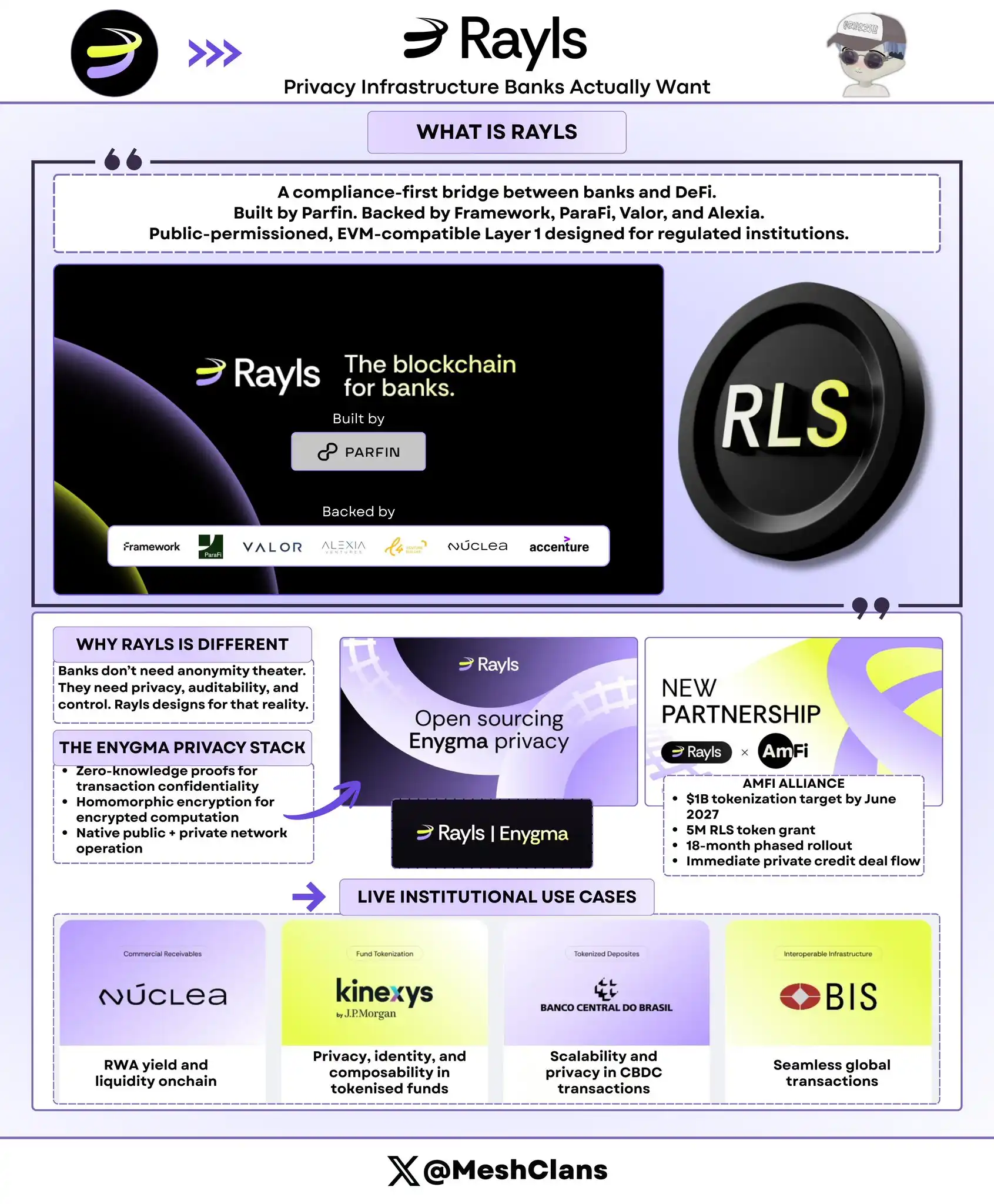
@RaylsLabs positions itself as a compliance-first bridge connecting banks to decentralized finance (DeFi). Developed by Brazilian fintech Parfin and backed by Framework Ventures, ParaFi Capital, Valor Capital, and Alexia Ventures, its architecture is a public, permissioned, EVM-compatible Layer 1 blockchain designed for regulated institutions.
I've been following the development of its Enygma privacy tech stack. The key isn't the technical specs but its methodology. Rayls is solving the problems banks actually have, not catering to the DeFi community's perception of bank needs.
Core Features of the Enygma Privacy Tech Stack:
- Zero-Knowledge Proofs: Ensures transaction confidentiality
- Homomorphic Encryption: Enables computation on encrypted data
- Native Operation: Across public chains and private institutional networks
- Confidential Payments: Supports atomic swaps and embedded Delivery-versus-Payment (DvP)
- Programmable Compliance: Selective data disclosure to designated auditors
Real-World Use Cases:
- Central Bank of Brazil: For cross-border CBDC settlement pilots
- Núclea: Regulated receivables tokenization
- Multiple Undisclosed Node Clients: For privatized DvP workflows
Latest Developments
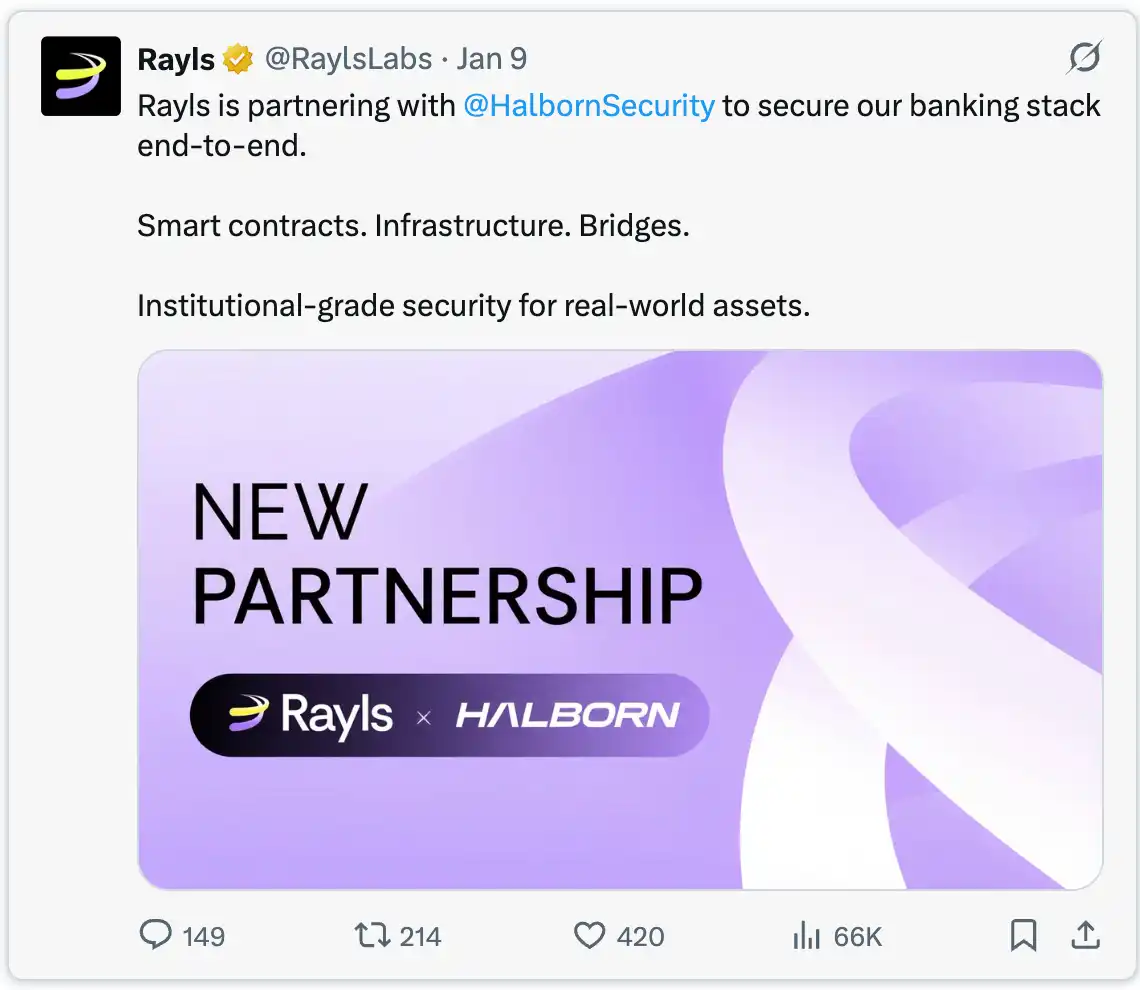
On January 8, 2026, Rayls announced the completion of a security audit by Halborn. This provides institutional-grade security certification for its RWA infrastructure, crucial for banks evaluating production deployment.
Furthermore, the AmFi alliance plans to target $1 billion in tokenized assets on Rayls by June 2027, supported by a 5 million RLS token incentive. AmFi is Brazil's largest private credit tokenization platform, bringing immediate transaction flow to Rayls and setting an 18-month concrete milestone. This is one of the largest institutional RWA commitments in any blockchain ecosystem currently.
Target Market & Challenges
Rayls targets banks, central banks, and asset managers requiring institutional-grade privacy. Its public permissioned model restricts validator participation to licensed financial institutions while ensuring transaction data confidentiality.
However, Rayls faces the challenge of proving market traction. Without public TVL data or announced client deployments beyond pilots, the $1 billion AmFi target by mid-2027 is its key test.
Ondo Finance: The Race for Cross-Chain Expansion
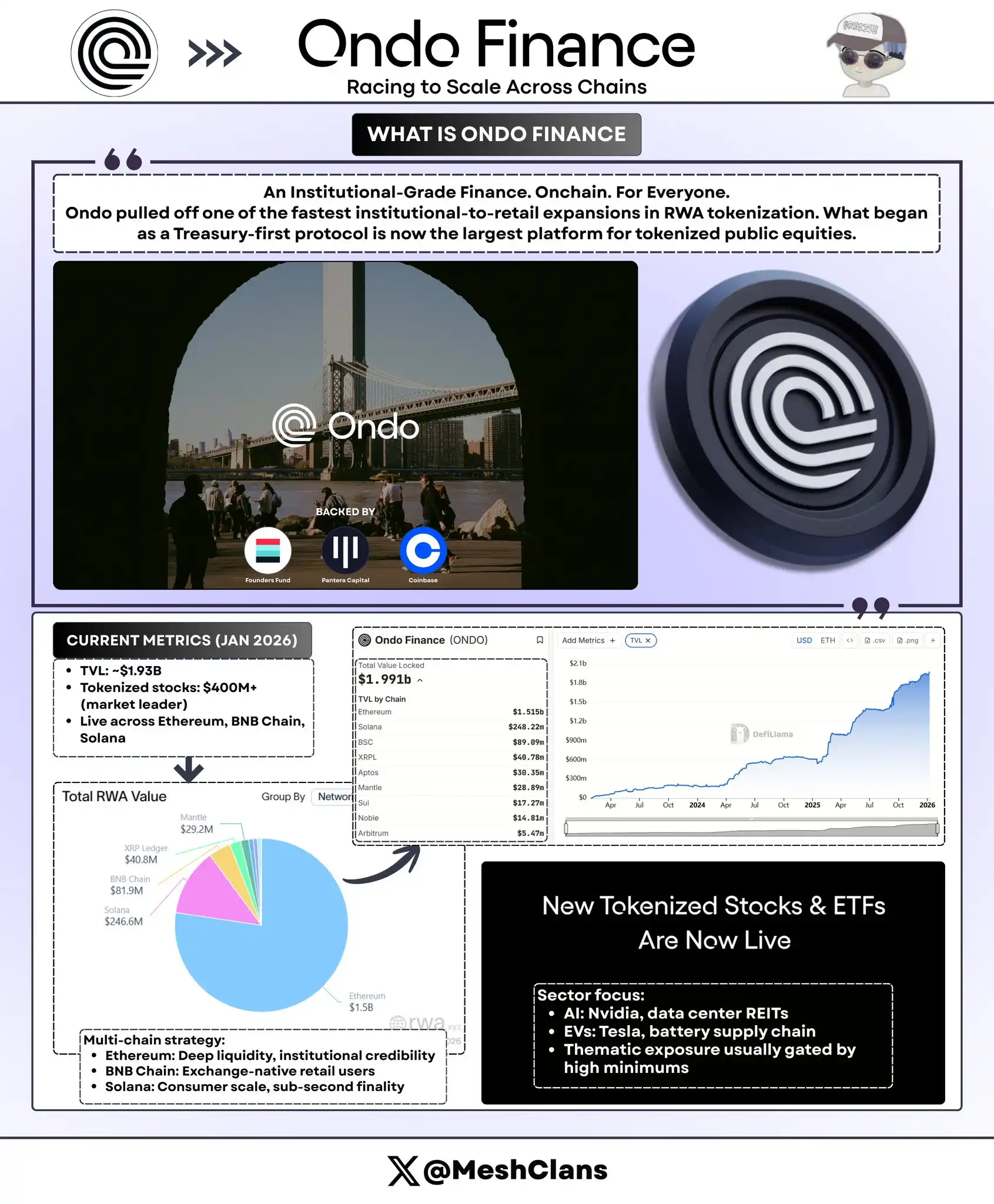
@OndoFinance has achieved the fastest expansion from institutions to retail in the RWA tokenization space. Starting as a treasury-focused protocol, it's now the largest platform for tokenized public stocks.
Latest Data as of January 2026:
- Total Value Locked (TVL): $1.93 billion
- Tokenized Stocks: Over $400 million, 53% market share
- USDY Holdings on Solana: Approximately $176 million
I tested the USDY product on Solana myself; the user experience is seamless: combining institutional-grade treasuries with DeFi convenience is the key.
Latest News
On January 8, 2026, Ondo launched 98 new tokenized assets in one go, covering stocks and ETFs in AI, EV, and thematic investing. This isn't a small test but a full-scale push.
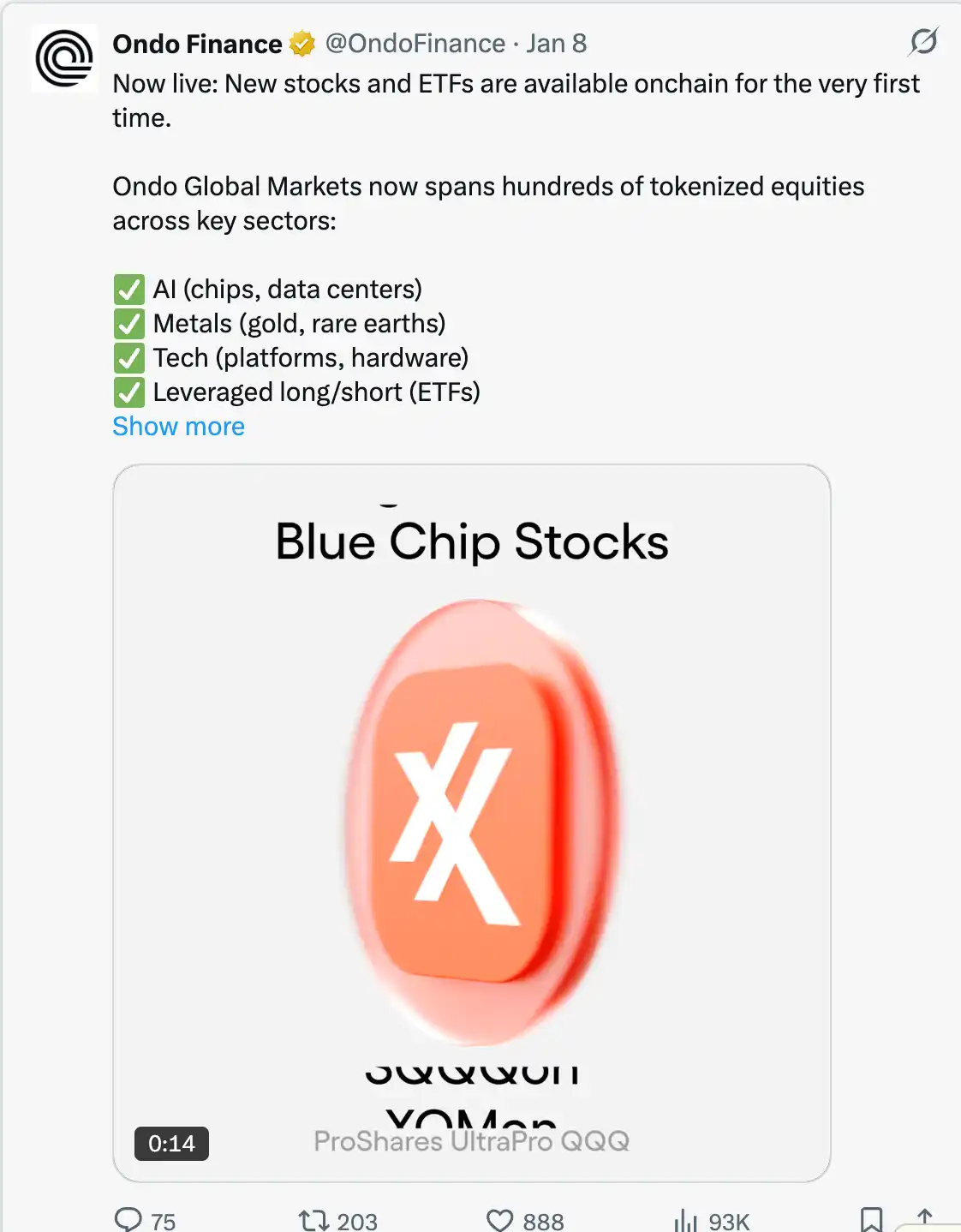
Ondo plans to launch tokenized US stocks and ETFs on Solana in Q1 2026, its most aggressive move into retail-friendly infrastructure. According to the product roadmap, the goal is to list over 1,000 tokenized assets as the expansion progresses.
Sector Focus:
- AI: Nvidia, Data Center REITs
- EV: Tesla, Lithium Battery Makers
- Thematic Investing: Niche sectors traditionally limited by high minimum investments
Multi-Chain Deployment Strategy
- Ethereum: DeFi liquidity and institutional legitimacy
- BNB Chain: Access to exchange-native users
- Solana: Mass consumer scale with sub-second finality
Honestly, Ondo's TVL reaching $1.93 billion while its token price declined is the key signal: protocol growth trumps speculation. This growth is driven by institutional treasuries and DeFi protocols seeking yield on idle stablecoins. TVL growth during the Q4 2025 market consolidation indicates real demand, not just chasing hype.
By establishing custodian-broker-dealer relationships, completing Halborn security audits, and launching products on three major blockchains within six months, Ondo has built a lead that competitors struggle to match. For instance, its competitor Backed Finance has only about $162 million in tokenized assets.
However, Ondo still faces challenges:
- Price Volatility During Non-Trading Hours: Although tokens can be transferred anytime, pricing still references exchange hours, creating arbitrage gaps during US overnight trading.
- Compliance Limitations: Securities laws require strict KYC and accreditation checks, limiting the "permissionless" narrative.
Centrifuge: How Asset Managers Actually Deploy Billions
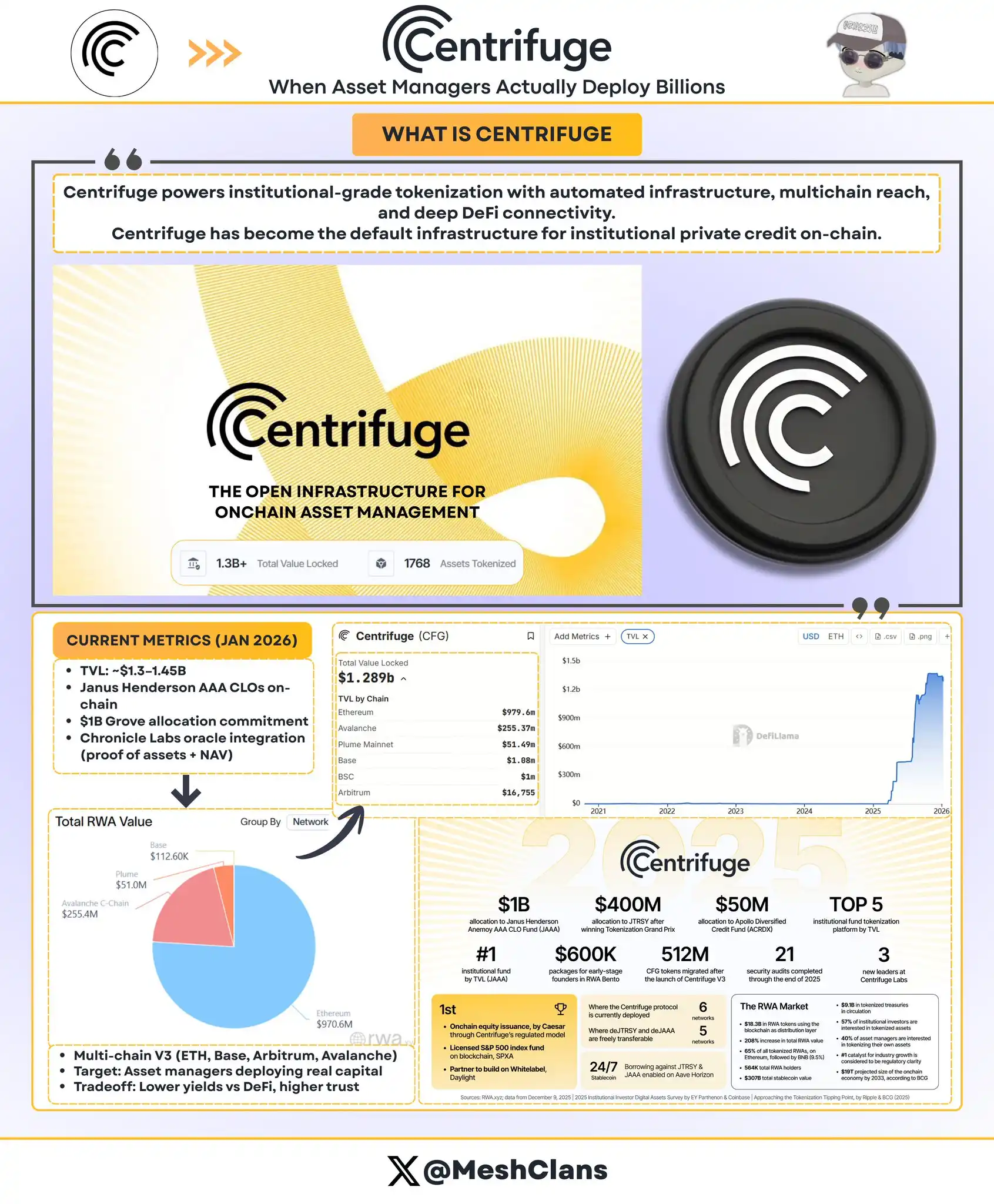
@centrifuge has become the infrastructure standard for institutional private credit tokenization. As of December 2025, the protocol's TVL surged to $1.3 - $1.45 billion, driven by actual deployed institutional capital.
Major Institutional Deployments
- Janus Henderson Partnership (Global asset manager with $373B AUM)
- Anemoy AAA CLO Fund: Fully on-chain AAA-rated Collateralized Loan Obligation (CLO)
- Uses the same portfolio management team as its $21.4B AAA CLO ETF
- Announced expansion plans in July 2025, targeting an additional $250M on Avalanche
- Grove Capital Allocation (Institutional credit protocol for the Sky ecosystem)
- $1 billion committed allocation strategy
- $50 million initial launch capital
- Founding team from Deloitte, Citi, BlockTower Capital, and Hildene Capital Management
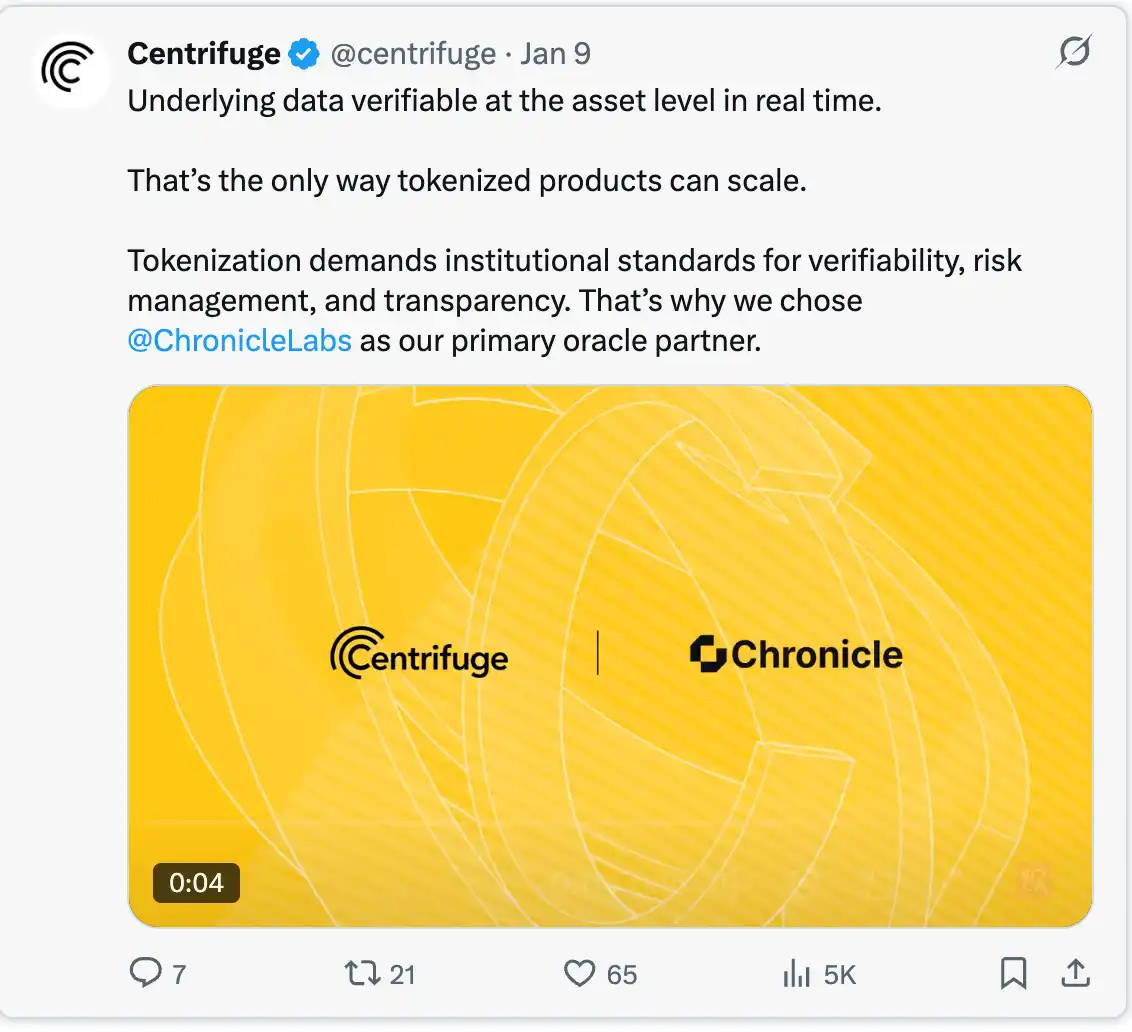
- Chronicle Labs Oracle Partnership (Announced Jan 8, 2026)
- Proof of Asset framework: Provides cryptographically verified holding data
- Supports transparent NAV calculation, custody verification, and compliance reporting
- Provides dashboard access for LPs and auditors
I've been tracking the oracle problem in blockchain, and Chronicle Labs' approach is the first to meet institutional needs: providing verifiable data without sacrificing on-chain efficiency. The Jan 8 announcement included a video demo showing this solution is live, not a future promise.
Centrifuge's Unique Operating Model:
Unlike competitors that simply wrap off-chain products, Centrifuge tokenizes credit strategies at the issuance stage. The process:
- Issuers design and manage funds through a single transparent workflow;
- Institutional investors allocate stablecoins for investment;
- Funds flow to borrowers after credit approval;
- Repayments are distributed pro-rata to token holders via smart contracts;
- AAA asset APY ranges from 3.3%-4.6%, fully transparent.
Multi-chain V3 Architecture Supports: Ethereum; Base; Arbitrum; Celo; Avalanche
The key is that asset managers need to prove on-chain credit can support multi-billion dollar deployments, and Centrifuge has achieved this. The Janus Henderson partnership alone provides multi-billion dollar capacity.
Furthermore, Centrifuge's leadership in industry standards (co-founding the Tokenized Asset Coalition and Real-World Asset Summit) cements its position as infrastructure, not just a product.
While the $1.45 billion TVL proves institutional investment, the 3.8% target APY pales compared to historically higher-risk, higher-reward DeFi opportunities. Attracting DeFi-native LPs beyond the Sky ecosystem allocation is Centrifuge's next hurdle.
Canton Network: Wall Street's Blockchain Infrastructure
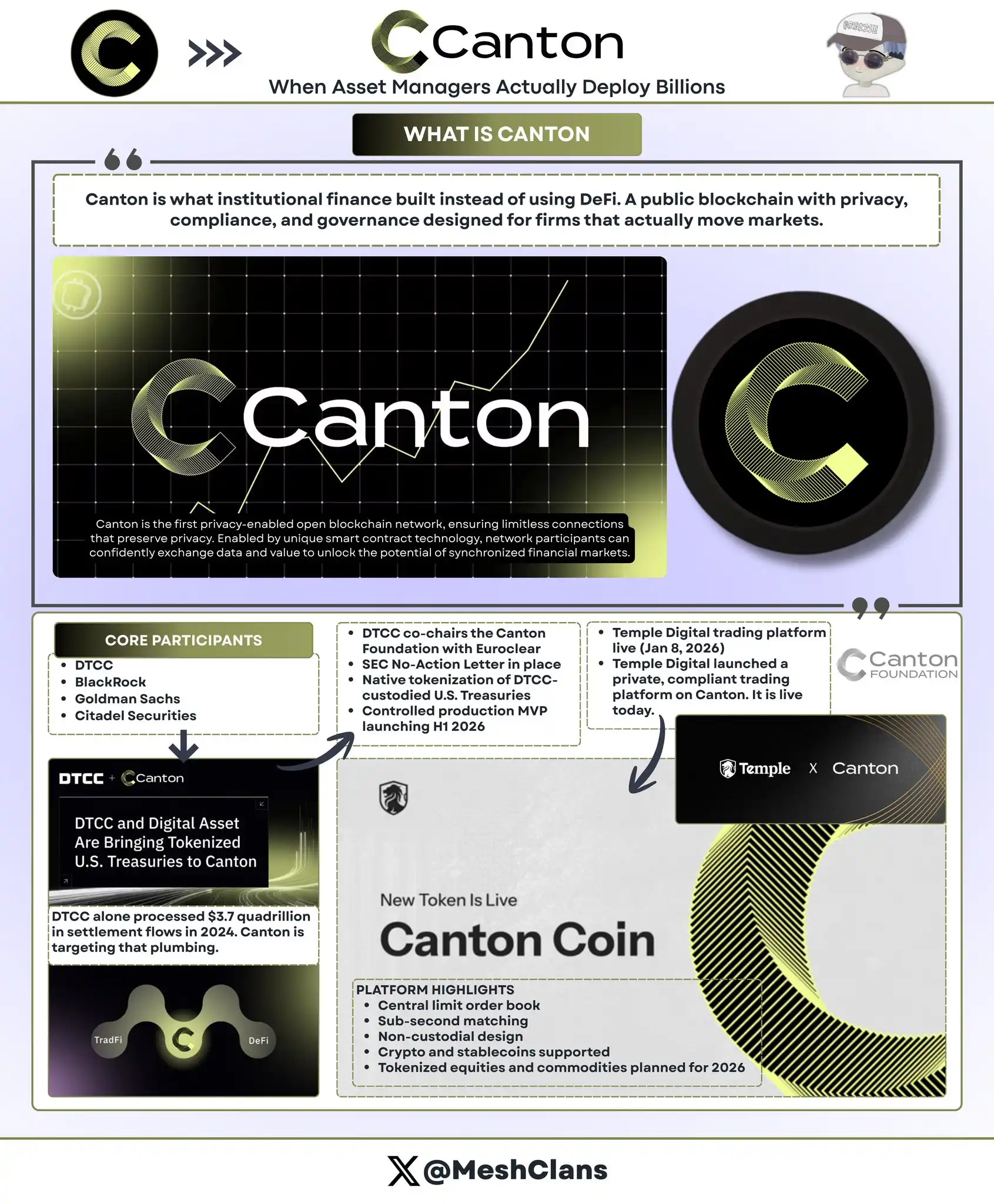
@CantonNetwork is the institutional blockchain's answer to DeFi's permissionless ethos: a privacy-preserving public network backed by top Wall Street firms.
Participating Institutions
- DTCC (Depository Trust & Clearing Corporation)
- BlackRock
- Goldman Sachs
- Citadel Securities
Canton's target is the $370 quadrillion in annual settlement volume DTCC handled in 2024. Yes, that number is correct.
DTCC Partnership (December 2025)
The partnership with DTCC is critical. This isn't just a pilot; it's a core commitment to building US securities settlement infrastructure. Approved by an SEC No-Action Letter, this enables the native tokenization of US Treasuries partially custodied by DTCC on Canton, with a controlled production MVP (Minimum Viable Product) planned for H1 2026.
Key Details:
- DTCC and Euroclear serve as co-chairs of the Canton Foundation;
- Not just participants, but leaders in governance;
- Initial focus on Treasuries (lowest credit risk, high liquidity, clear regulation);
- Potential expansion to corporate bonds, equities, and structured products post-MVP.
Initially, I was skeptical of permissioned blockchains. But the DTCC partnership changed my view. Not because of technical superiority, but because this is the infrastructure traditional finance will actually use.
Temple Digital Platform Launch (January 8, 2026)
Canton's institutional value proposition was further clarified with the launch of the private trading platform by Temple Digital Group on January 8, 2026. This platform is live, not "coming soon."
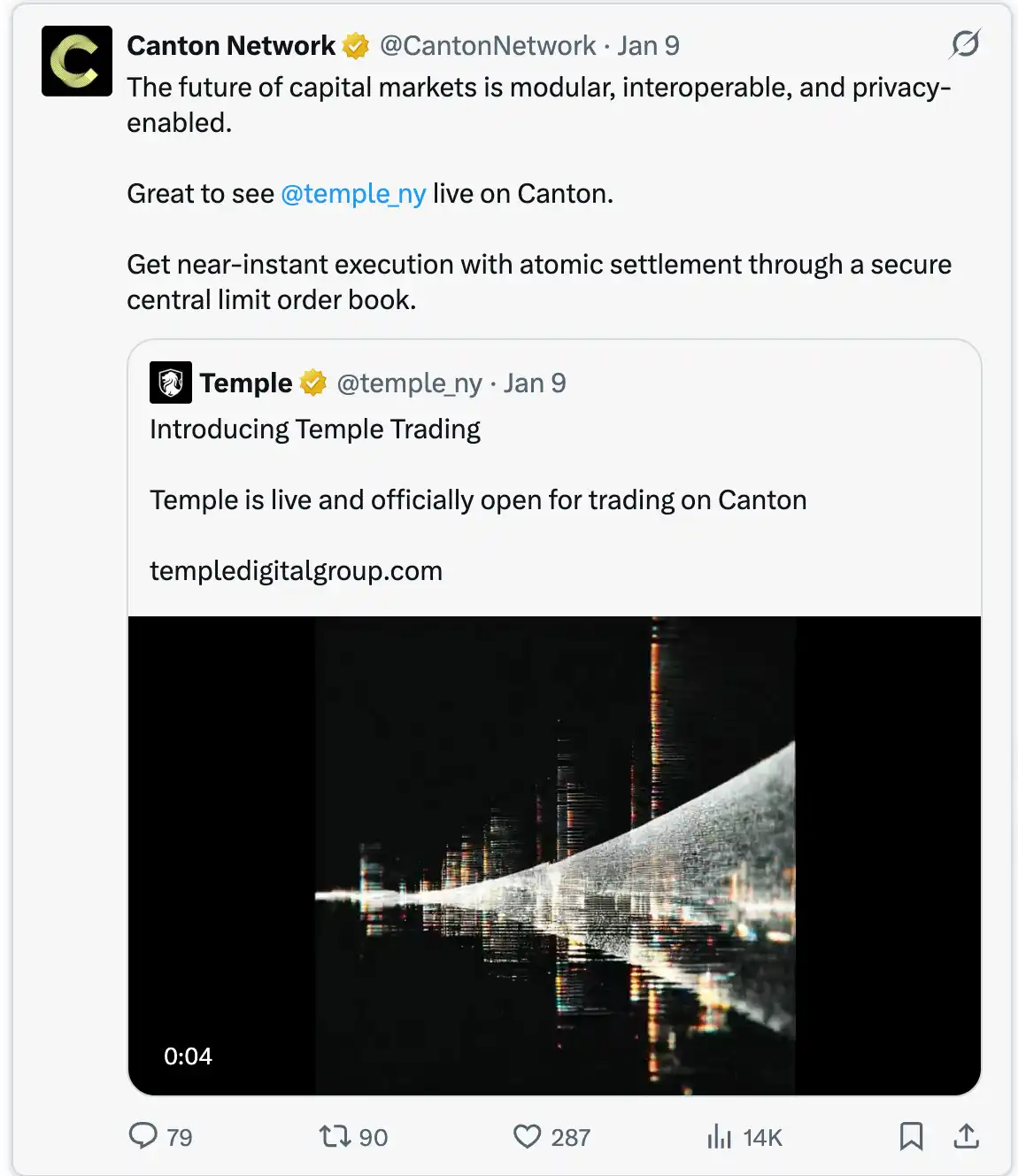
Canton Network provides a Central Limit Order Book (CLOB) with sub-second matching speeds and a non-custodial architecture. It currently supports crypto and stablecoin trading, with plans to add tokenized stocks and commodities in 2026.
Ecosystem Partners
- Franklin Templeton: Manages an $828 million money market fund
- JPMorgan: DvP settlement via JPM Coin
Canton's Privacy Architecture
Canton's privacy features are at the smart contract level, implemented using Daml (Digital Asset Modeling Language):
- Contracts specify which parties see which data;
- Regulators get full audit trail access;
- Counterparties see trade details;
- Competitors and the public see nothing;
- State updates propagate atomically across the network.
For institutions accustomed to Bloomberg Terminals and dark pools for confidential trading, Canton's architecture makes sense: it offers blockchain efficiency without exposing trading strategies. Wall Street will never put proprietary trading activity on a transparent public ledger.
Canton Network's 300+ participating institutions show its institutional appeal. However, much of the reported volume may be simulated pilot activity rather than real production flow.
The current limitation is development speed: the MVP planned for H1 2026 reflects multi-quarter planning cycles. In contrast, DeFi protocols often launch new products in weeks.
Polymesh: The Securities Blockchain Built for Compliance
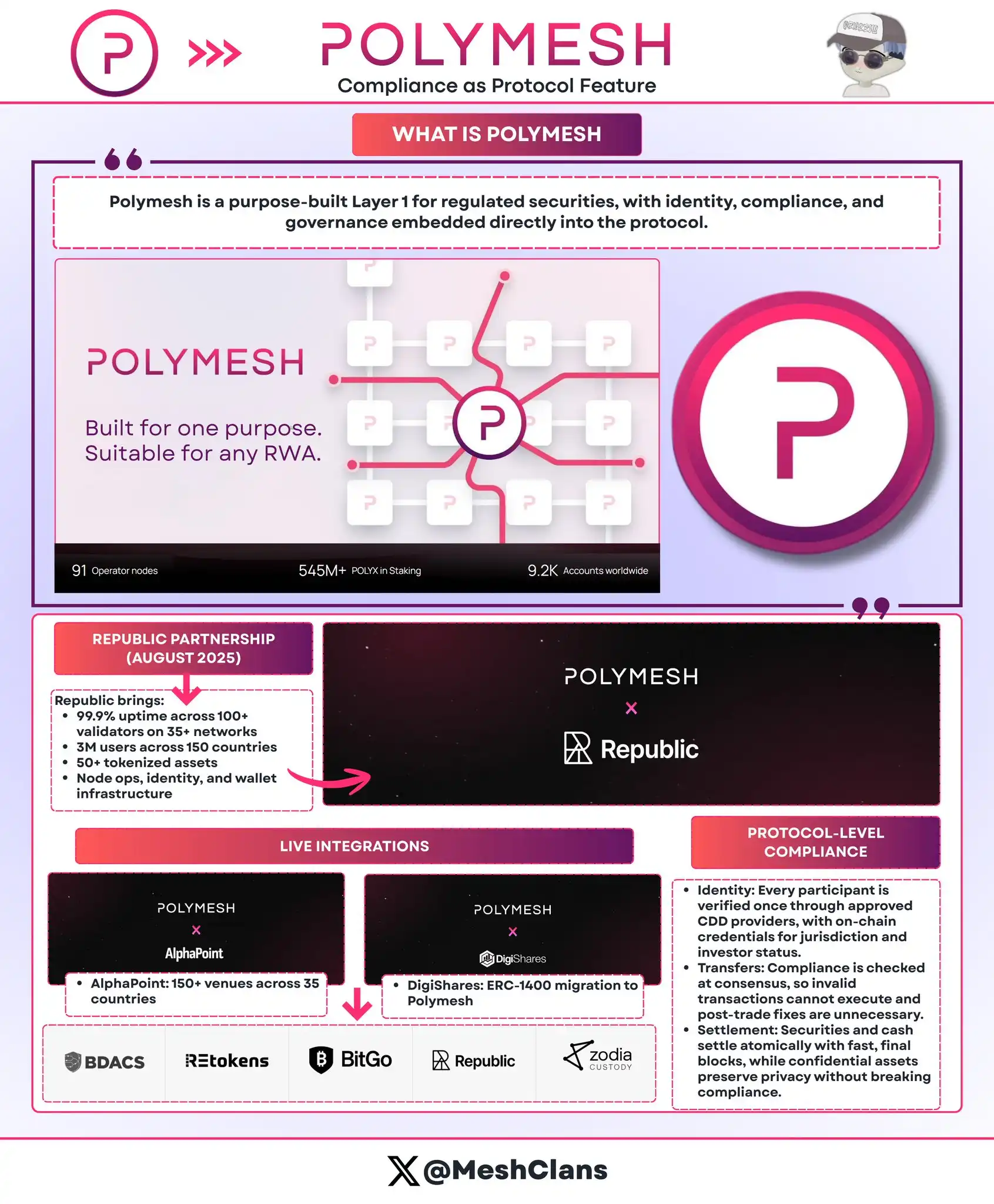
@PolymeshNetwork differentiates itself with protocol-level compliance rather than smart contract complexity. As a blockchain designed for regulated securities, Polymesh validates compliance at the consensus layer, eliminating the need for custom code.
Core Features
- Protocol-Level Identity: Identity verification through permitted CDD providers;
- Embedded Transfer Rules: Non-compliant transactions fail at consensus;
- Atomic DvP: Trades settle with finality in under 6 seconds.
Production Integrations
- Republic (August 2025): For private security issuance;
- AlphaPoint: Reaches 150+ trading venues across 35 countries;
- Target Sectors: Regulated funds, real estate, corporate equity.
Advantages
- No need for custom smart contract audits;
- Protocol automatically adapts to regulatory changes;
- Impossible to execute non-compliant transfers.
Challenges & Future
Polymesh currently operates as a standalone chain, isolating it from DeFi liquidity. To address this, an Ethereum Bridge is planned for Q2 2026. We'll see if it delivers on time.
Frankly, I underestimated the appeal of this "compliance-native" architecture. For security token issuers frustrated by ERC-1400 complexity, Polymesh's approach is attractive: baking compliance into the protocol, not smart contracts.
How Do These Protocols Divide the Market?
These five protocols don't directly compete; they solve different problems:
Privacy Solutions:
- Canton: Daml smart contracts, focused on Wall Street counterparty relationships;
- Rayls: Zero-Knowledge Proofs, offering bank-grade mathematical privacy;
- Polymesh: Protocol-level identity, offering one-stop compliance.
Scaling Strategies:
- Ondo: Manages $1.93B across three chains, prioritizing liquidity speed over depth;
- Centrifuge: Focuses on the $1.3-1.45B institutional credit market, depth over speed.
Target Markets:
- Banks/CBDCs → Rayls
- Retail/DeFi → Ondo
- Asset Managers → Centrifuge
- Wall Street → Canton
- Security Tokens → Polymesh
In my view, this market segmentation is more important than people realize. Institutions won't choose the "best blockchain" but the infrastructure that solves their specific compliance, operational, and competitive needs.
Unresolved Issues
Inter-Chain Liquidity Fragmentation
The cost of cross-chain fragmentation is high: estimated at $1.3 - $1.5 billion annually. High bridging costs create 1%-3% price discrepancies for the same asset on different chains. If this persists until 2030, annual costs could exceed $75 billion.
This is one of my biggest concerns. Even if you build the most advanced tokenization infrastructure, efficiency gains are lost if liquidity is scattered across incompatible chains.
The Privacy vs. Transparency Paradox
Institutions need transaction confidentiality, while regulators demand auditability. In multi-party scenarios (issuers, investors, rating agencies, regulators, auditors), each requires different visibility levels. No perfect solution exists yet.
Regulatory Fragmentation
- The EU passed MiCA, enforceable across 27 countries;
- The US requires case-by-case No-Action Letters, taking months;
- Cross-border flows face jurisdictional conflicts.
Oracle Risk
Tokenized assets rely on off-chain data. If data providers are compromised, on-chain asset performance could reflect a false reality. While Chronicle's Proof of Asset framework offers a solution, the risk remains.
The Path to Trillions: Key 2026 Catalysts
Catalysts to Watch in 2026:
Ondo's Solana Launch (Q1 2026)
- Tests if retail-scale distribution can create sustainable liquidity;
- Success metric: Over 100,000 holders, proving real demand.
Canton's DTCC MVP (H1 2026)
- Validates blockchain feasibility for US Treasury settlement;
- If successful: Could shift trillions in flow to on-chain infrastructure.
US CLARITY Act Passage
- Provides clear regulatory framework;
- Enables capital deployment from currently sidelined institutional investors.
Centrifuge's Grove Deployment
- $1 billion allocation to be deployed throughout 2026;
- Tests real capital movement for institutional credit tokenization;
- If executed smoothly without credit events, boosts asset manager confidence.
Market Predictions
- 2030 Target: $2-4 trillion in tokenized assets;
- Growth Required: 50-100x growth from the current $19.7 billion;
- Assumptions: Regulatory stability, cross-chain interoperability readiness, no major institutional failures.
Growth Predictions by Sector:
- Private Credit: Grow from current $2-6B to $150-200B (smallest base, highest growth rate);
- Tokenized Treasuries: Potential $5T+ if money market funds migrate on-chain;
- Real Estate: Potential $3-4T (depends on property registries adopting blockchain-compatible title records).
The $100 Billion Milestone:
- Expected Timing: 2027-2028;
- Expected Distribution:
- Institutional Credit: $30-40B;
- Treasuries: $30-40B;
- Tokenized Stocks: $20-30B;
- Real Estate/Commodities: $10-20B.
This requires a 5x increase from current levels. While aggressive, given Q4 2025 institutional momentum and upcoming regulatory clarity, it's not out of reach.
Why These Five Protocols Matter
The institutional RWA landscape in early 2026 shows an unexpected trend: no single winner, because there is no single market.
Frankly, this is how infrastructure should develop.
Each Protocol Solves a Different Problem:
- Rayls → Banking Privacy;
- Ondo → Tokenized Stock Distribution;
- Centrifuge → Asset Manager On-Chain Deployment;
- Canton → Wall Street Infrastructure Migration;
- Polymesh → Simplified Securities Compliance.
Growth from $8.5 billion in early 2024 to $19.7 billion shows demand has moved beyond speculation.
Core Needs of Institutional Players:
- Treasurers: Yield and operational efficiency;
- Asset Managers: Lower distribution costs, broader investor base;
- Banks: Compliance-ready infrastructure.
The Next 18 Months Are Critical
- Ondo's Solana Launch → Tests retail scaling;
- Canton's DTCC MVP → Tests institutional-grade settlement;
- Centrifuge's Grove Deployment → Tests credit tokenization with real capital;
- Rayls's $1B AmFi Target → Tests privacy infrastructure adoption.
Execution trumps architecture. Results beat blueprints. That's the key now.
Traditional finance is embarking on a long-term shift on-chain. These five protocols provide the infrastructure institutional capital needs: privacy layers, compliance frameworks, and settlement rails. Their success will determine whether tokenization evolves as an efficiency improvement to existing structures or a new system replacing traditional financial intermediaries.
The infrastructure choices institutions make in 2026 will define the landscape for the next decade.
2026 Key Milestones
- Q1: Ondo's Solana Launch (98+ stocks live);
- H1: Canton's DTCC MVP (Treasury tokenization on Wall Street infra);
- Ongoing: Centrifuge's Grove $1B deployment; Rayls's AmFi ecosystem build-out.
Trillions in assets are coming.
NFA.







