2025 Crypto x AI Year in Review: Which Narratives Survived?

深潮Xuất bản vào 2025-12-15Cập nhật gần nhất vào 2025-12-15

Tóm tắt

The 2025 Crypto x AI landscape saw a shift from speculative narratives to practical, utility-driven applications. Key surviving narratives include DeFAI (Decentralized Finance AI), which evolved through three phases: abstraction layers (simplifying DeFi interactions), autonomous yield agents (managing "set-and-forget" strategies), and AI Vaults (auditable, agent-generated smart contracts). Projects like Giza and Almanak led this space. AI agents, initially overhyped for entertainment, declined due to lack of utility but resurged with new standards like Coinbase's x402 and Ethereum's ERC-8004, enabling verifiable, decentralized agent economies. Decentralized AI (DeAI) emerged as a critical pillar, with Bittensor leading a "Darwinian AI" ecosystem that coordinates global resources for model training, reinforcement learning, and privacy-preserving computation. This infrastructure supports商业化 AI agents and enhances DeFi and prediction markets. Prediction markets integrated AI for forecasting and liquidity provision, though they face challenges like limited liquidity and edge decay. Overall, the trend moved from speculation to infrastructure, with 2026 poised for crypto-native AI products gaining indispensability.

Author:0xJeff

Compiled by: Deep Tide TechFlow

Reviewing the history of Crypto and AI, the narratives that survived and thrived, and the future of this field in 2026.

2024 was the year Crypto x AI truly started trending on Crypto Twitter—the market saw an influx of interesting, useful, and entertaining crypto agents, each with its own token.

In 2025, speculation around crypto agents gradually shifted towards real AI applications, decentralized AI moved from research and conceptual stages to early productization, and "Darwinian AI" became the preferred way to attract new talent and accelerate the development of decentralized AI. Meanwhile, DeFi x AI emerged as the most valuable sub-sector, further enhancing crypto's core value proposition.

2026 will be the year of Crypto AI.

Thanks to the efforts and experiments accumulated between 2024 and 2025, we are beginning to see early signs of product-market fit and a clearer direction on how cryptocurrencies, blockchain, and distributed systems can enhance AI.

Narratives that lacked inherent utility or market demand, or couldn't compete with Web2 AI startups, either died out or stagnated (e.g., AI x Gaming, AI Entertainment, Generative AI, Video/Voice Agents, AI Workflows for Productivity).

Those that survived transformed into innovative models that could change how we work.

DeFAI is the New Generation of DeFi

DeFAI (Decentralized Finance AI) emerged in the crypto space in early 2025, sparking a massive wave of using AI to enhance existing DeFi systems.

The first iteration of DeFi x AI was called "Abstraction layers"—through ChatGPT-like interfaces, users could directly prompt the desired outcome.

This was an "aha moment" for many, as DeFi itself is highly complex—users need to find the right bridges to transfer assets or gas fees, understand how top decentralized exchanges (DEXs) and lending protocols on new chains work, and grasp the nature, risks, and underlying assets of protocols.

Tools that could help users quickly achieve their desired results seemed like the perfect first step to make DeFi more accessible.

While it sounded great in theory, integration in reality faced many challenges. Most DeFAI solutions were either full of vulnerabilities or very difficult to use. UI/UX issues were maddening—users didn't know how to input prompts or even what they could or couldn't input.

As a result, most projects failed, with only a few players pivoting or continuing to deepen their efforts.

  • @HeyAnonai was once a top DeFAI project but has now pivoted to a trading assistant and prediction market tool.

  • @griffaindotcom hasn't updated on X since April and appears to have vanished.

Those who persisted and doubled down:

  • @AIWayfinder continues with its terminal/ChatGPT-style interface and has expanded functionality to include perpetual trading, DeFi strategies, predictions, and more.

  • @bankrbot remains focused on being a terminal-based co-pilot, helping users with trade execution, research, and analysis.

  • @Infinit_Labs focuses on DeFi strategy execution while introducing crowdsourced/creator-driven DeFi strategies (becoming a hub where users can curate and/or invest in top DeFi strategies).

The first iteration of DeFAI failed to achieve product-market fit (PMF) in 2025, but some of these projects might succeed in helping newcomers navigate the on-chain environment more easily.

The failure of the first generation to find PMF spurred the rise of the second generation of DeFAI projects: "autonomous yield agents." The core idea is that users no longer need to think about how to input prompts, which strategy to execute, when to rebalance, or what strategy to choose next—instead, autonomous agents handle all the heavy lifting for users.

This model offers a simple "set and forget" experience, where users delegate all complex operations to personalized smart agents. @gizatechxyz was the first project to popularize this model, with its agent system equipped with numerous security measures (e.g., smart wallets with preset permissions defining what they can and cannot do and which protocols they can interact with; session keys allowing agents limited-time access to necessary permissions to complete tasks).

This time, preliminary product-market fit was validated—Giza achieved approximately $30 million in Assets under Agent (AuA) and generated over $3 billion in trading volume on top lending protocols. The second-tier project @ZyfAI_ also saw significant growth, reaching about $8 million in AuA and around $1.1 billion in trading volume.

However, challenges remain. Large capital, institutional funds, and significant sums remain cautious about entrusting hundreds of millions to autonomous agents, primarily due to concerns about "black-box" operations, potential erroneous decisions (e.g., AI "hallucinations"), and other issues.

It is in this context that the third generation of DeFAI emerged: "AI Vaults." This model leverages a group of specialized smart agents to quickly generate and optimize DeFi smart contracts. @almanak was the first project to realize that this architecture could combine the advantages of both models.

In this model, the core of the strategy remains the DeFi smart contract. These contracts are generated by smart agents in minutes via "vibe-code," drastically reducing the time required for quants and capital allocators to create complex strategies. These contracts are auditable, with everything open and transparent, similar to traditional DeFi contracts that have been battle-tested for years and are more secure.

DeFAI Outlook

DeFAI is gradually evolving towards optimizing AI systems to support DeFi, with its main iterations including:

  1. Abstraction layers—Lowering the barrier to entry, helping new users interested in trading and DeFi yield farming get started quickly.

  2. Autonomous agents—Assisting users in managing "set and forget" DeFi strategies, simplifying the operational process.

  3. AI vaults—Providing more efficient strategy-building tools for on-chain capital allocators, significantly improving efficiency.

In the future, these three directions will likely continue to optimize for their respective target user groups, while we can also expect major DeFi protocols, wallet services, and centralized/decentralized exchanges (CEXs/DEXs) to gradually adopt these products to improve the user DeFi experience.

Trends Worth Watching but Still Early

  1. Trading agents: Currently, most dApps either offer market analysis or are "black-box" AIs that trade for users, while products providing a full-featured, end-to-end solution from scratch are not yet mature. @Cod3xOrg offers the most comprehensive solution, but its UI/UX still needs optimization to suit everyday users.

  2. Dynamic DeFi: Using machine learning systems to make DeFi strategies more dynamic, thereby achieving better risk-adjusted returns. @AlloraNetwork is currently the only project exploring this space but is still in a very early stage.

The Rise, Fall, and Rebirth of AI Agents

The AI agent narrative was first led by @virtuals_io in late 2024, entering the public eye by combining AI applications/products with fair-launched tokens.

This narrative emerged at an opportune time when the market was tired of low-circulation, high-fully diluted valuation (FDV) venture-backed tokens, and high-circulation, low-FDV fair-launched tokens paired with the right narrative were the perfect antidote.

The first generation of AI agents were primarily entertainment and "alpha" agents. For example, @truth_terminal spurred a wave of AI agents on X (commonly called "slops") that spent all day chatting and replying to users. Initially, they were purely for entertainment but gradually evolved into more useful tools (e.g., sharing market analysis, token analysis, etc.). Among them, @aixbt_agent became a standout in this field due to its popular "degen" persona that was both funny and professional.

With the rapid proliferation of "slops," demand for development frameworks surged—these middleware tools helped developers easily build AI agent workflows on X. ElizaOS (initially named AI16Z) quickly became a household name, launching the largest open-source AI wave in crypto history. This further spurred the emergence of more AI agents but also led to growing fatigue among Crypto Twitter (CT) users.

By 2025, the AI agent narrative gradually cooled down, primarily due to a lack of actual utility and overhyped valuations.

It's worth noting that the actual definition of an AI agent is an application that can:

  1. Extract information from a changing and unstructured environment;

  2. Reason about the information based on goals;

  3. Discover patterns in data and learn how to leverage them;

  4. Perform operations its owner hadn't even considered.

(Credit to @almanak for the precise definition)

The initial AI agent products weren't truly "AI agents" in this sense; they were more like AI workflows or applications designed to attract attention, impressive at first sight.

However, as people realized this, attention began shifting to other narratives, such as DeFAI, DeAI, robotics, or even moving away from Crypto x AI entirely.

Things changed in October-November 2025. The payment standard x402, developed by Coinbase, began gaining traction among enterprises, including giants like Google and Cloudflare. More Web3 developers started experimenting with x402, leading to many refreshing applications, such as token launches via x402 links or on-demand payment microservices based on x402.

Simultaneously, the Ethereum Foundation increased its investment in AI, and the ERC-8004 standard began gaining popularity. This standard creates a decentralized "trust layer" for autonomous AI agents, giving them verifiable identity, reputation, and proof of work, enabling them to reliably discover, collaborate, and transact without centralized institutions. The Ethereum Foundation also formed the Ethereum dAI team specifically to support AI agent teams using ERC-8004.

The emergence of x402 and ERC-8004 once again fueled market excitement for the AI agent narrative, but due to macroeconomic volatility, this hype and market uptick didn't last long.

Nevertheless, @virtuals_io remains the premier AI agent hub, but so far, we haven't seen any application or agent from this narrative break out with significant user numbers or revenue.

Perhaps 2026 will see such a breakthrough agent, or perhaps not. My prediction is that breakthrough agents will likely emerge first in other narrative areas, particularly DeFAI and DeAI.

Regardless, frameworks and standards like x402, ERC-8004, and ACP (provided by Virtuals) will shape the future of the on-chain AI agent economy in 2026.

Decentralized AI: The True Crypto x AI Product-Market Fit (PMF)

Since 2023 (or even earlier), decentralized AI (DeAI) has been a potential direction in the Crypto x AI narrative. The prospect of using blockchain and tokens to build distributed systems where humans and machines collectively contribute work and resources is undoubtedly huge.

In reality, we find many underutilized resources:

  • GPUs, gaming chips, edge devices (e.g., work laptops, phones) may be idle more than half the time;

  • Engineers and data scientists from India, Pakistan, and the Philippines are skilled but lack access to top tech companies and cutting-edge AI labs;

  • Investors worldwide want to support early-stage startups driving the next generation of AI innovation to change the world but may not have access to Y Combinator (YC) and Silicon Valley companies.

This is where decentralized AI comes in. Through coordination layers and "Darwinian AI" ecosystems, various resources are integrated, allowing stakeholders to contribute to the development of open-source and decentralized AI in their own way.

  • A developer from Pakistan can train the most accurate ETH price prediction model and be handsomely rewarded;

  • An investor from Iceland can invest in a $20 million market cap startup focused on reinforcement learning innovation;

  • A gamer from Mongolia can contribute their idle GPU resources to support AI model training.

The examples are endless.

2025 was a year of significant progress for decentralized AI (DeAI). Countless research papers and experiments emerged in decentralized training, reinforcement learning, federated learning, privacy preservation, verification techniques, security, and more. @MessariCrypto covered these developments in its "2025 State of AI Report"—check it out if you haven't.

Highlights of the Year

  1. Bittensor (@opentensor) solidified its leadership in the decentralized AI ecosystem

Bittensor successfully solidified its position as the leader of the decentralized AI ecosystem, becoming a hub for many unique AI startups (subnets). There are now 128 subnets, each innovating and developing in different areas. Bittensor subsidizes the operational and capital expenditures of AI development through coordinated incentive mechanisms, driving innovation. Its "Darwinian AI" concept (driving development through incentivized competition and innovation competition) has also inspired many other projects.

  1. Decentralized Reinforcement Learning (RL) achieved scale

Decentralized reinforcement learning technology has been proven to work at scale. Reinforcement learning is often used to optimize models, making them smarter through self-learning and self-play. Multiple decentralized AI labs, such as @gensynai, @NousResearch, @PrimeIntellect, @Gradient_HQ, and @Pluralis, have made progress in reinforcement learning. Once commercialized, this technology has the potential to provide highly intelligent domain-specific solutions for enterprises, such as sales/customer service agents, logistics/supply chain agents, legal, finance, etc.

  1. Enhanced AI transparency and compliance

    To make AI trusted by enterprises, governments, and traditional financial institutions, AI must no longer be a "black box" but a more deterministic and compliant tool. The following technologies are being gradually adopted:

    1. TEE (Trusted Execution Environment) for hardware security (@PhalaNetwork);

    2. AI output verification technologies like zkML, opML, EigenAI (@eigencloud);

    3. Private data and computation (@vana);

    4. Federated learning (@flock_io), training AI while keeping data local and private.

  2. The rise of multi-agent systems (Swarm)

The rise of multi-agent systems increased the need for coordination and orchestration. Standards like MCP (Multi-Agent Communication Protocol) facilitated integration, while orchestration layers enabled multiple agents to collaborate, providing users with more complex AI workflows. Projects like @questflow and @openservai are driving this direction.

All these developments point to a future where both domain-specific application scenarios and crypto-native use cases (e.g., DeFi, trading, prediction, on-chain operations) can be executed and scaled in a safer, more efficient manner. The risks of AI vulnerabilities, runaway AI, and "hallucinations" will be significantly reduced.

Decentralized AI (DeAI) Outlook

More and more startups from Y Combinator (YC) and Silicon Valley are choosing to develop open-source models and adopt decentralized computing, a trend that is accelerating. Inference service providers like @chutes_ai already support billions of tokens processed daily, a trend expected to continue into 2026.

Decentralized AI will drive the birth of commercially viable AI agents suitable for traditional enterprises.

Furthermore, its infrastructure will also support the growth of yield farming, trading, and prediction agents, becoming a core pillar for DeFi protocols, prediction market platforms, centralized exchanges (CEX), and mainstream wallet services.

If you want to dive deeper into decentralized AI, you can read the following articles:

  1. From Closed AI to Open-Source AI to Decentralized AI ➔ Trends Driving DeAI

  2. How Decentralized AI Competes with Centralized AI ➔ Decentralized Training and Reinforcement Learning (RL)

  3. The Economies of Scale of Decentralized AI ➔ The Network Effects of DeAI

The Rise of Prediction Markets and AI

With the rise of prediction markets, machine learning systems found an excellent application—not only predicting event outcomes but also making directional bets and providing liquidity in prediction markets.

The latter, in particular, is growing in popularity. Multiple subnets on Bittensor, such as @sportstensor, @SynthdataCo, @webuildscore, and @sire_agent, are developing machine learning systems that can: Predict the prices of cryptocurrencies like BTC, ETH, SOL; Develop prediction market yield vault products that place bets and generate yield for users.

  • Sportsensor: Became the official liquidity provider/market maker for @Polymarket earlier this year, focusing on sports and esports markets.

  • Synth: Publicly predicted on Polymarket, achieving a return of over 20x in just two months, growing capital from $3,000 to $60,000 with its accurate prediction signals.

  • Sire: Achieved 5%-10% weekly returns on investment through its prediction market yield vault product.

We also see more Darwinian AI projects entering this space, exploring the deep integration of prediction markets and AI.

  1. @AlloraNetwork: Making DeFi More Dynamic

AlloraNetwork uses machine learning systems provided by a network of contributors to predict asset prices and volatility. These price and volatility models can be integrated into smart contracts as AI Oracles, enabling dynamic strategy adjustments based on predictions. For example:

  • Automatic leverage and deleverage loop strategies;

  • AI-managed CLAMM strategies (Concentrated Liquidity Market Making);

  • Delta-neutral strategies (risk hedging). These functions significantly enhance the flexibility and efficiency of DeFi.

  1. @crunchDAO: The Supply Side of Darwinian AI

crunchDAO focuses on the supply side of Darwinian AI, attracting high-quality engineers, data scientists, and talent to participate and contribute to machine learning subnets (like Synth). By mining and optimizing these subnets, it drives the improvement of AI prediction capabilities.

  1. @FractionAI_xyz: Enhancing AI Agent Capabilities Through Competition

FractionAI uses real competition environments to drive the fine-tuning and expansion of domain-specific AI agent capabilities. They launched agent-centric "Spaces," which are games that allow AI agents to continuously improve. The most notable projects include:

  • ALFA: Humans can bet on agent vs. agent trading duels;

  • StableUp: AI agents for stablecoin yield farming.

Beyond the booming prediction markets, Bittensor's competitions and trading contests by @the_nof1 have also injected strong momentum into this field, further promoting the rapid growth of prediction markets x AI.

Prediction Markets x AI Outlook

With the development of large language models (LLMs) and AI workflows, AI terminals, copy-trading in prediction markets, data analysis, and signal tools will become more prevalent. These tools will greatly simplify information research and acquisition, providing prediction market traders with more edge. Among them, @Polysights remains the leader in mining internal signals.

Prediction market APIs and yield vault products that users can "set and automatically profit" will also become more widely available, offering more opportunities for users to try.

Despite the bright prospects, prediction markets still face two major challenges:

  1. Insufficient liquidity: Prediction markets are relatively small, with scarce liquidity;

  2. Edge decay: When bet sizes increase, the trading edge quickly diminishes.

Therefore, machine learning systems focused on arbitrage and providing liquidity (e.g., liquidity mining via limit orders in Yes/No markets) might become the most successful products in prediction markets in 2026. As prediction markets attract significant capital, point rewards and airdrop value will be worth mining, similar to Hyperliquid's early days in perpetuals.

The Future of Decentralized AI and Finance
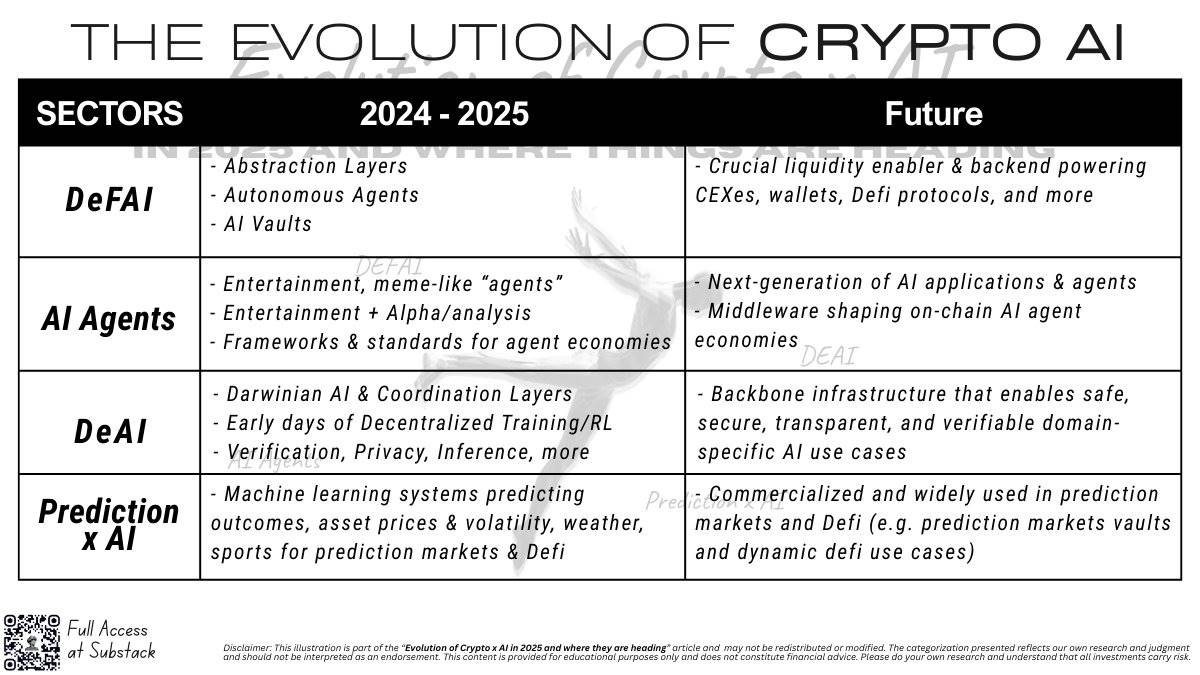
Across all areas, the same trend is evident—the narratives that survived are those with real users, actual utility, and economic alignment.

Decentralized Finance AI (DeFAI) will gradually mature into a three-layer architecture:

  1. Abstraction layer

  2. Automation layer

  3. Strategy creation layer powered by AI agents

It will quietly become the entry and execution layer for millions of users accessing on-chain finance, most of whom may not even realize they are using crypto technology.

Once overhyped AI agents will re-emerge as verifiable economic actors.

This transformation is thanks to standards that赋予AI agents identity, reputation, and deterministic behavior, currently being actively developed and supported by the Ethereum Foundation, Coinbase, Google, Cloudflare, and others.

Decentralized AI (DeAI) remains the most important structural pillar. The networks that excel in the following areas will become long-term winners:

  • Efficiently coordinating computational resources

  • Attracting and retaining global developer talent

  • Verifying results and provenance

  • Providing enterprise-grade reliability

As markets deepen, tools optimize, and machine learning-driven liquidity becomes a sustainable source of yield, prediction markets x AI will continue to expand. However, liquidity constraints and edge decay will remain fundamental challenges for any participant trying to scale capital.

Overall, these development trends indicate that the entire industry is moving from narrative to infrastructure, from speculation to systematic solutions, from hype to actual products. 2026 will be the year crypto-native AI products start becoming indispensable.

If you are new to Crypto x AI, it is recommended to read this "Beginner's Guide" to quickly get up to speed with the latest developments in this field.


Câu hỏi Liên quan

QWhat are the three main iterations of DeFAI (Decentralized Finance AI) that evolved in 2025, and what is the core purpose of each?

AThe three main iterations of DeFAI are: 1. Abstraction layers - Lower the barrier to entry, helping new users interested in trading and DeFi yield farming get started quickly. 2. Autonomous agents - Assist users in managing 'set-and-forget' DeFi strategies, simplifying the operational process. 3. AI vaults - Provide more efficient strategy-building tools for on-chain capital allocators, significantly improving efficiency.

QAccording to the article, what was the key factor that caused the initial AI agent narrative to cool down in 2025?

AThe AI agent narrative cooled down in 2025 primarily due to a lack of actual utility and overhyped valuations. The initial AI agent products were not true 'AI agents' but rather AI workflows or applications designed to attract attention, and people eventually realized this.

QWhich project is highlighted as the leader in the decentralized AI (DeAI) ecosystem, and what concept did it popularize?

ABittensor (@opentensor) is highlighted as consolidating its leadership in the decentralized AI ecosystem. It popularized the 'Darwinian AI' concept, which drives development through incentivized competition and innovation.

QWhat two major standards, mentioned in the article, contributed to a renewed excitement for the AI agent narrative in late 2025?

AThe two major standards that renewed excitement for the AI agent narrative were Coinbase's payment standard x402, which gained traction with enterprises, and the Ethereum Foundation's ERC-8004 standard, which created a decentralized 'trust layer' for autonomous AI agents.

QWhat are the two fundamental challenges that Prediction Markets x AI face, as outlined in the article's outlook?

AThe two fundamental challenges facing Prediction Markets x AI are: 1. Lack of Liquidity - The prediction market is small with scarce liquidity. 2. Edge Decay - The trading edge (advantage) quickly disappears when bet sizes are scaled up.

Nội dung Liên quan

Sentora và Firelight Hợp Tác Mang Lại Bảo Hiểm DeFi Nguyên Bản

Sentora, một nền tảng quản lý rủi ro và trí tuệ DeFi thể chế, đã hợp tác với Firelight Protocol để cung cấp bảo hiểm gốc (native coverage) cho các khoản đầu tư trên nền tảng của mình. Sự hợp tác này nhằm lấp đầy khoảng trống về bảo mật, vốn là rào cản cho sự tham gia của các tổ chức vào DeFi, bằng cách tích hợp một lớp bảo vệ được hỗ trợ bởi vốn trực tiếp vào cơ sở hạ tầng kho tiền (vault). Thông qua quan hệ đối tác, người tham gia vào các vault của Sentora sẽ được bảo vệ bẩm sinh trước các rủi ro như nợ xấu, lỗi Oracle và khai thác hợp đồng thông minh. Firelight, được xây dựng trên Flare Network, sử dụng FXRP (một đại diện 1:1 của XRP) làm cơ chế tài sản thế chấp chính, biến XRP thành một tài sản sinh lời. Giám đốc điều hành Sentora, Anthony DeMartino, nhấn mạnh nhu cầu về một lớp bảo vệ rõ ràng để thúc đẩy áp dụng DeFi rộng rãi hơn. Hugo Philion, đồng sáng lập Flare, cũng đánh giá cao mô hình này như một cơ sở hạ tầng cấp thể chế. Đây được xem là một bước tiến nhằm chuẩn hóa bảo hiểm như một yếu tố cơ bản trong triển khai vốn DeFi, từ đó xây dựng niềm tin và tạo điều kiện cho việc áp dụng trên quy mô lớn.

TheNewsCrypto11 phút trước

Sentora và Firelight Hợp Tác Mang Lại Bảo Hiểm DeFi Nguyên Bản

TheNewsCrypto11 phút trước

Giao dịch

Giao ngay
Hợp đồng Tương lai

Bài viết Nổi bật

GROK AI là gì

Grok AI: Cách mạng hóa Công nghệ Đối thoại trong Kỷ nguyên Web3 Giới thiệu Trong bối cảnh trí tuệ nhân tạo đang phát triển nhanh chóng, Grok AI nổi bật như một dự án đáng chú ý kết nối các lĩnh vực công nghệ tiên tiến và tương tác người dùng. Được phát triển bởi xAI, một công ty do doanh nhân nổi tiếng Elon Musk dẫn dắt, Grok AI nhằm định nghĩa lại cách chúng ta tương tác với trí tuệ nhân tạo. Khi phong trào Web3 tiếp tục phát triển mạnh mẽ, Grok AI hướng tới việc tận dụng sức mạnh của AI đối thoại để trả lời các câu hỏi phức tạp, mang đến cho người dùng một trải nghiệm không chỉ thông tin mà còn giải trí. Grok AI là gì? Grok AI là một chatbot AI đối thoại tinh vi được thiết kế để tương tác với người dùng một cách linh hoạt. Khác với nhiều hệ thống AI truyền thống, Grok AI chấp nhận một loạt các câu hỏi rộng hơn, bao gồm những câu hỏi thường được coi là không phù hợp hoặc ngoài các phản hồi tiêu chuẩn. Các mục tiêu cốt lõi của dự án bao gồm: Lập luận đáng tin cậy: Grok AI nhấn mạnh lập luận theo lẽ thường để cung cấp các câu trả lời hợp lý dựa trên sự hiểu biết về ngữ cảnh. Giám sát có thể mở rộng: Việc tích hợp công cụ hỗ trợ đảm bảo rằng các tương tác của người dùng được theo dõi và tối ưu hóa về chất lượng. Xác minh chính thức: An toàn là điều tối quan trọng; Grok AI tích hợp các phương pháp xác minh chính thức để nâng cao độ tin cậy của các đầu ra của nó. Hiểu biết về ngữ cảnh dài: Mô hình AI xuất sắc trong việc giữ lại và nhớ lại lịch sử cuộc trò chuyện dài, tạo điều kiện cho các cuộc thảo luận có ý nghĩa và nhận thức về ngữ cảnh. Khả năng chống lại các cuộc tấn công: Bằng cách tập trung vào việc cải thiện khả năng phòng thủ chống lại các đầu vào bị thao túng hoặc độc hại, Grok AI nhằm duy trì tính toàn vẹn của các tương tác của người dùng. Nói tóm lại, Grok AI không chỉ là một thiết bị truy xuất thông tin; nó là một đối tác đối thoại hấp dẫn khuyến khích cuộc trò chuyện năng động. Người sáng tạo Grok AI Bộ óc đứng sau Grok AI không ai khác chính là Elon Musk, một cá nhân gắn liền với sự đổi mới trong nhiều lĩnh vực, bao gồm ô tô, du hành vũ trụ và công nghệ. Dưới sự bảo trợ của xAI, một công ty tập trung vào việc phát triển công nghệ AI theo những cách có lợi, tầm nhìn của Musk nhằm định hình lại cách hiểu về các tương tác AI. Sự lãnh đạo và tinh thần nền tảng bị ảnh hưởng sâu sắc bởi cam kết của Musk trong việc thúc đẩy các ranh giới công nghệ. Các nhà đầu tư của Grok AI Mặc dù các chi tiết cụ thể về các nhà đầu tư hỗ trợ Grok AI vẫn còn hạn chế, nhưng đã được công nhận công khai rằng xAI, vườn ươm của dự án, được thành lập và hỗ trợ chủ yếu bởi chính Elon Musk. Các dự án và tài sản trước đây của Musk cung cấp một nền tảng vững chắc, tăng cường thêm độ tin cậy và tiềm năng phát triển của Grok AI. Tuy nhiên, tính đến thời điểm hiện tại, thông tin về các quỹ đầu tư hoặc tổ chức bổ sung hỗ trợ Grok AI vẫn chưa dễ dàng tiếp cận, đánh dấu một lĩnh vực có thể khám phá trong tương lai. Grok AI hoạt động như thế nào? Cơ chế hoạt động của Grok AI sáng tạo không kém gì khung khái niệm của nó. Dự án tích hợp một số công nghệ tiên tiến giúp tạo ra các chức năng độc đáo của nó: Hạ tầng mạnh mẽ: Grok AI được xây dựng bằng Kubernetes cho việc điều phối container, Rust cho hiệu suất và an toàn, và JAX cho tính toán số hiệu suất cao. Bộ ba này đảm bảo rằng chatbot hoạt động hiệu quả, mở rộng hiệu quả và phục vụ người dùng kịp thời. Truy cập kiến thức theo thời gian thực: Một trong những tính năng nổi bật của Grok AI là khả năng truy cập dữ liệu theo thời gian thực thông qua nền tảng X—trước đây được biết đến với tên gọi Twitter. Khả năng này cho phép AI truy cập thông tin mới nhất, giúp nó cung cấp các câu trả lời và khuyến nghị kịp thời mà các mô hình AI khác có thể bỏ lỡ. Hai chế độ tương tác: Grok AI cung cấp cho người dùng sự lựa chọn giữa “Chế độ Vui” và “Chế độ Thông thường.” Chế độ Vui cho phép một phong cách tương tác vui tươi và hài hước hơn, trong khi Chế độ Thông thường tập trung vào việc cung cấp các câu trả lời chính xác và đúng đắn. Sự linh hoạt này đảm bảo một trải nghiệm được cá nhân hóa phù hợp với sở thích của từng người dùng. Nói tóm lại, Grok AI kết hợp hiệu suất với sự tương tác, tạo ra một trải nghiệm vừa phong phú vừa giải trí. Thời gian phát triển của Grok AI Hành trình của Grok AI được đánh dấu bởi các cột mốc quan trọng phản ánh các giai đoạn phát triển và triển khai của nó: Phát triển ban đầu: Giai đoạn nền tảng của Grok AI diễn ra trong khoảng hai tháng, trong đó việc đào tạo và tinh chỉnh ban đầu của mô hình được thực hiện. Phát hành Beta Grok-2: Trong một bước tiến quan trọng, beta Grok-2 đã được công bố. Phiên bản này giới thiệu hai phiên bản của chatbot—Grok-2 và Grok-2 mini—mỗi phiên bản đều có khả năng trò chuyện, lập trình và lập luận. Truy cập công khai: Sau khi phát triển beta, Grok AI đã trở thành có sẵn cho người dùng nền tảng X. Những người có tài khoản được xác minh bằng số điện thoại và hoạt động ít nhất bảy ngày có thể truy cập phiên bản giới hạn, giúp công nghệ có sẵn cho một đối tượng rộng lớn hơn. Thời gian này tóm tắt sự phát triển có hệ thống của Grok AI từ lúc khởi đầu đến khi công khai, nhấn mạnh cam kết của nó đối với việc cải tiến liên tục và tương tác người dùng. Các tính năng chính của Grok AI Grok AI bao gồm một số tính năng chính góp phần vào bản sắc đổi mới của nó: Tích hợp kiến thức theo thời gian thực: Truy cập thông tin hiện tại và liên quan phân biệt Grok AI với nhiều mô hình tĩnh, cho phép một trải nghiệm người dùng hấp dẫn và chính xác. Phong cách tương tác đa dạng: Bằng cách cung cấp các chế độ tương tác khác nhau, Grok AI phục vụ cho sở thích đa dạng của người dùng, khuyến khích sự sáng tạo và cá nhân hóa trong việc trò chuyện với AI. Cơ sở công nghệ tiên tiến: Việc sử dụng Kubernetes, Rust và JAX cung cấp cho dự án một khung vững chắc để đảm bảo độ tin cậy và hiệu suất tối ưu. Xem xét về đạo đức trong đối thoại: Việc bao gồm chức năng tạo hình ảnh thể hiện tinh thần đổi mới của dự án. Tuy nhiên, nó cũng đặt ra các vấn đề đạo đức liên quan đến bản quyền và việc thể hiện tôn trọng các nhân vật dễ nhận biết—một cuộc thảo luận đang diễn ra trong cộng đồng AI. Kết luận Như một thực thể tiên phong trong lĩnh vực AI đối thoại, Grok AI khái quát tiềm năng cho những trải nghiệm người dùng chuyển đổi trong kỷ nguyên số. Được phát triển bởi xAI và được thúc đẩy bởi cách tiếp cận tầm nhìn của Elon Musk, Grok AI tích hợp kiến thức theo thời gian thực với khả năng tương tác tiên tiến. Nó cố gắng mở rộng ranh giới của những gì trí tuệ nhân tạo có thể đạt được trong khi vẫn giữ trọng tâm vào các vấn đề đạo đức và an toàn cho người dùng. Grok AI không chỉ thể hiện sự tiến bộ công nghệ mà còn thể hiện một mô hình đối thoại mới trong bối cảnh Web3, hứa hẹn sẽ thu hút người dùng bằng cả kiến thức sâu sắc và sự tương tác vui tươi. Khi dự án tiếp tục phát triển, nó đứng như một minh chứng cho những gì giao thoa giữa công nghệ, sáng tạo và tương tác giống như con người có thể đạt được.

Tổng lượt xem 468Xuất bản vào 2024.12.26Cập nhật vào 2024.12.26

GROK AI là gì

ERC AI là gì

Euruka Tech: Tổng Quan về $erc ai và Những Tham Vọng trong Web3 Giới thiệu Trong bối cảnh công nghệ blockchain và ứng dụng phi tập trung đang phát triển nhanh chóng, các dự án mới thường xuyên xuất hiện, mỗi dự án đều có những mục tiêu và phương pháp độc đáo. Một trong những dự án đó là Euruka Tech, hoạt động trong lĩnh vực tiền điện tử và Web3 rộng lớn. Mục tiêu chính của Euruka Tech, đặc biệt là token $erc ai của nó, là cung cấp các giải pháp sáng tạo nhằm khai thác những khả năng đang phát triển của công nghệ phi tập trung. Bài viết này nhằm cung cấp một cái nhìn tổng quan về Euruka Tech, khám phá các mục tiêu, chức năng, danh tính của người sáng lập, các nhà đầu tư tiềm năng và tầm quan trọng của nó trong bối cảnh rộng lớn hơn của Web3. Euruka Tech, $erc ai là gì? Euruka Tech được mô tả như một dự án tận dụng các công cụ và chức năng mà môi trường Web3 cung cấp, tập trung vào việc tích hợp trí tuệ nhân tạo trong các hoạt động của nó. Mặc dù các chi tiết cụ thể về khung của dự án vẫn còn mơ hồ, nhưng nó được thiết kế để nâng cao sự tham gia của người dùng và tự động hóa các quy trình trong không gian tiền điện tử. Dự án nhằm tạo ra một hệ sinh thái phi tập trung không chỉ tạo điều kiện cho các giao dịch mà còn tích hợp các chức năng dự đoán thông qua trí tuệ nhân tạo, do đó tên gọi của token, $erc ai. Mục tiêu là cung cấp một nền tảng trực quan giúp tạo ra các tương tác thông minh hơn và xử lý giao dịch hiệu quả hơn trong lĩnh vực Web3 đang phát triển. Ai là Người Sáng Lập Euruka Tech, $erc ai? Hiện tại, thông tin về người sáng lập hoặc đội ngũ sáng lập đứng sau Euruka Tech vẫn chưa được xác định và có phần mờ mịt. Sự thiếu hụt dữ liệu này gây ra lo ngại, vì kiến thức về nền tảng của đội ngũ thường rất quan trọng để thiết lập độ tin cậy trong lĩnh vực blockchain. Do đó, chúng tôi đã phân loại thông tin này là không rõ cho đến khi có các chi tiết cụ thể được công bố trong lĩnh vực công cộng. Ai là Các Nhà Đầu Tư của Euruka Tech, $erc ai? Tương tự, việc xác định các nhà đầu tư hoặc tổ chức hỗ trợ cho dự án Euruka Tech không được cung cấp dễ dàng qua các nghiên cứu hiện có. Một khía cạnh quan trọng đối với các bên liên quan tiềm năng hoặc người dùng đang xem xét tham gia vào Euruka Tech là sự đảm bảo đến từ các quan hệ đối tác tài chính đã được thiết lập hoặc sự hỗ trợ từ các công ty đầu tư uy tín. Thiếu thông tin về các mối quan hệ đầu tư, rất khó để rút ra những kết luận toàn diện về sự an toàn tài chính hoặc độ bền vững của dự án. Theo thông tin đã tìm thấy, phần này cũng đang ở trạng thái không rõ. Euruka Tech, $erc ai hoạt động như thế nào? Mặc dù thiếu các thông số kỹ thuật chi tiết cho Euruka Tech, nhưng điều quan trọng là phải xem xét những tham vọng đổi mới của nó. Dự án tìm cách tận dụng sức mạnh tính toán của trí tuệ nhân tạo để tự động hóa và nâng cao trải nghiệm người dùng trong môi trường tiền điện tử. Bằng cách tích hợp AI với công nghệ blockchain, Euruka Tech nhằm cung cấp các tính năng như giao dịch tự động, đánh giá rủi ro và giao diện người dùng cá nhân hóa. Bản chất đổi mới của Euruka Tech nằm ở mục tiêu tạo ra một kết nối liền mạch giữa người dùng và những khả năng rộng lớn mà các mạng phi tập trung mang lại. Thông qua việc sử dụng các thuật toán học máy và AI, nó nhằm giảm thiểu những thách thức mà người dùng lần đầu gặp phải và tinh giản trải nghiệm giao dịch trong khuôn khổ Web3. Sự cộng sinh giữa AI và blockchain nhấn mạnh tầm quan trọng của token $erc ai, đứng như một cầu nối giữa các giao diện người dùng truyền thống và các khả năng tiên tiến của công nghệ phi tập trung. Thời Gian của Euruka Tech, $erc ai Thật không may, do thông tin hạn chế hiện có về Euruka Tech, chúng tôi không thể trình bày một thời gian biểu chi tiết về các phát triển chính hoặc cột mốc trong hành trình của dự án. Thời gian biểu này, thường rất quý giá trong việc vạch ra sự tiến triển của một dự án và hiểu được quỹ đạo phát triển của nó, hiện không có sẵn. Khi thông tin về các sự kiện đáng chú ý, quan hệ đối tác hoặc các bổ sung chức năng trở nên rõ ràng, các cập nhật chắc chắn sẽ nâng cao sự hiện diện của Euruka Tech trong lĩnh vực tiền điện tử. Làm rõ về Các Dự Án “Eureka” Khác Điều đáng lưu ý là nhiều dự án và công ty chia sẻ một tên gọi tương tự với “Eureka.” Nghiên cứu đã xác định các sáng kiến như một đại lý AI từ NVIDIA Research, tập trung vào việc dạy robot thực hiện các nhiệm vụ phức tạp bằng các phương pháp sinh tạo, cũng như Eureka Labs và Eureka AI, cải thiện trải nghiệm người dùng trong giáo dục và phân tích dịch vụ khách hàng, tương ứng. Tuy nhiên, những dự án này là khác biệt với Euruka Tech và không nên bị nhầm lẫn với các mục tiêu hoặc chức năng của nó. Kết luận Euruka Tech, cùng với token $erc ai của nó, đại diện cho một người chơi hứa hẹn nhưng hiện tại còn mờ mịt trong bối cảnh Web3. Trong khi chi tiết về người sáng lập và các nhà đầu tư vẫn chưa được công bố, tham vọng cốt lõi của việc kết hợp trí tuệ nhân tạo với công nghệ blockchain vẫn là một điểm thu hút sự chú ý. Các phương pháp độc đáo của dự án trong việc thúc đẩy sự tham gia của người dùng thông qua tự động hóa tiên tiến có thể giúp nó nổi bật khi hệ sinh thái Web3 tiến triển. Khi thị trường tiền điện tử tiếp tục phát triển, các bên liên quan nên theo dõi chặt chẽ những tiến bộ xung quanh Euruka Tech, vì sự phát triển của các đổi mới đã được ghi chép, các quan hệ đối tác hoặc một lộ trình rõ ràng có thể mang lại những cơ hội đáng kể trong tương lai gần. Hiện tại, chúng tôi đang chờ đợi những hiểu biết sâu sắc hơn có thể tiết lộ tiềm năng của Euruka Tech và vị trí của nó trong bối cảnh cạnh tranh của tiền điện tử.

Tổng lượt xem 464Xuất bản vào 2025.01.02Cập nhật vào 2025.01.02

ERC AI là gì

DUOLINGO AI là gì

DUOLINGO AI: Tích hợp Học ngôn ngữ với Web3 và Đổi mới AI Trong một kỷ nguyên mà công nghệ định hình lại giáo dục, việc tích hợp trí tuệ nhân tạo (AI) và các mạng blockchain báo hiệu một biên giới mới cho việc học ngôn ngữ. Giới thiệu DUOLINGO AI và đồng tiền điện tử liên quan của nó, $DUOLINGO AI. Dự án này mong muốn kết hợp sức mạnh giáo dục của các nền tảng học ngôn ngữ hàng đầu với những lợi ích của công nghệ Web3 phi tập trung. Bài viết này đi sâu vào các khía cạnh chính của DUOLINGO AI, khám phá các mục tiêu, khung công nghệ, sự phát triển lịch sử và tiềm năng tương lai trong khi duy trì sự rõ ràng giữa tài nguyên giáo dục gốc và sáng kiến tiền điện tử độc lập này. Tổng quan về DUOLINGO AI Cốt lõi của DUOLINGO AI là thiết lập một môi trường phi tập trung nơi người học có thể kiếm được phần thưởng mã hóa cho việc đạt được các cột mốc giáo dục trong khả năng ngôn ngữ. Bằng cách áp dụng hợp đồng thông minh, dự án nhằm tự động hóa các quy trình xác minh kỹ năng và phân bổ token, tuân thủ các nguyên tắc Web3 nhấn mạnh tính minh bạch và quyền sở hữu của người dùng. Mô hình này khác biệt so với các phương pháp truyền thống trong việc tiếp cận ngôn ngữ bằng cách dựa nhiều vào cấu trúc quản trị do cộng đồng điều hành, cho phép những người nắm giữ token đề xuất cải tiến nội dung khóa học và phân phối phần thưởng. Một số mục tiêu đáng chú ý của DUOLINGO AI bao gồm: Học tập gamified: Dự án tích hợp các thành tựu blockchain và token không thể thay thế (NFT) để đại diện cho các cấp độ thành thạo ngôn ngữ, thúc đẩy động lực thông qua các phần thưởng kỹ thuật số hấp dẫn. Tạo nội dung phi tập trung: Nó mở ra cơ hội cho các nhà giáo dục và những người yêu thích ngôn ngữ đóng góp khóa học của họ, tạo điều kiện cho một mô hình chia sẻ doanh thu có lợi cho tất cả các bên đóng góp. Cá nhân hóa dựa trên AI: Bằng cách sử dụng các mô hình học máy tiên tiến, DUOLINGO AI cá nhân hóa các bài học để thích ứng với tiến trình học tập của từng cá nhân, tương tự như các tính năng thích ứng có trong các nền tảng đã được thiết lập. Người sáng lập dự án và Quản trị Tính đến tháng 4 năm 2025, đội ngũ đứng sau $DUOLINGO AI vẫn giữ bí danh, một thực tiễn phổ biến trong lĩnh vực tiền điện tử phi tập trung. Sự ẩn danh này nhằm thúc đẩy sự phát triển tập thể và sự tham gia của các bên liên quan thay vì tập trung vào các nhà phát triển cá nhân. Hợp đồng thông minh được triển khai trên blockchain Solana ghi chú địa chỉ ví của nhà phát triển, điều này thể hiện cam kết về tính minh bạch liên quan đến các giao dịch mặc dù danh tính của các nhà sáng lập vẫn chưa được biết đến. Theo lộ trình của nó, DUOLINGO AI dự định phát triển thành một Tổ chức Tự trị Phi tập trung (DAO). Cấu trúc quản trị này cho phép những người nắm giữ token bỏ phiếu về các vấn đề quan trọng như triển khai tính năng và phân bổ ngân quỹ. Mô hình này phù hợp với tinh thần trao quyền cho cộng đồng có trong nhiều ứng dụng phi tập trung, nhấn mạnh tầm quan trọng của việc ra quyết định tập thể. Nhà đầu tư và Đối tác chiến lược Hiện tại, không có nhà đầu tư tổ chức hoặc nhà đầu tư mạo hiểm nào được xác định công khai liên quan đến $DUOLINGO AI. Thay vào đó, tính thanh khoản của dự án chủ yếu đến từ các sàn giao dịch phi tập trung (DEX), đánh dấu một sự tương phản rõ rệt với các chiến lược tài trợ của các công ty công nghệ giáo dục truyền thống. Mô hình cơ sở này cho thấy một cách tiếp cận do cộng đồng điều hành, phản ánh cam kết của dự án đối với sự phi tập trung. Trong tài liệu trắng của mình, DUOLINGO AI đề cập đến việc hình thành các hợp tác với các “nền tảng giáo dục blockchain” không xác định nhằm làm phong phú thêm các khóa học của mình. Mặc dù các đối tác cụ thể vẫn chưa được công bố, những nỗ lực hợp tác này gợi ý về một chiến lược kết hợp đổi mới blockchain với các sáng kiến giáo dục, mở rộng quyền truy cập và sự tham gia của người dùng qua nhiều con đường học tập khác nhau. Kiến trúc công nghệ Tích hợp AI DUOLINGO AI tích hợp hai thành phần chính dựa trên AI để nâng cao các đề xuất giáo dục của mình: Công cụ học tập thích ứng: Công cụ tinh vi này học từ các tương tác của người dùng, tương tự như các mô hình độc quyền từ các nền tảng giáo dục lớn. Nó điều chỉnh độ khó của bài học một cách linh hoạt để giải quyết các thách thức cụ thể của người học, củng cố các lĩnh vực yếu thông qua các bài tập có mục tiêu. Đại lý hội thoại: Bằng cách sử dụng chatbot được hỗ trợ bởi GPT-4, DUOLINGO AI cung cấp một nền tảng cho người dùng tham gia vào các cuộc hội thoại mô phỏng, thúc đẩy một trải nghiệm học ngôn ngữ tương tác và thực tiễn hơn. Hạ tầng Blockchain Được xây dựng trên blockchain Solana, $DUOLINGO AI sử dụng một khung công nghệ toàn diện bao gồm: Hợp đồng thông minh xác minh kỹ năng: Tính năng này tự động trao token cho người dùng đã vượt qua các bài kiểm tra thành thạo, củng cố cấu trúc khuyến khích cho các kết quả học tập thực sự. Huy hiệu NFT: Những token kỹ thuật số này biểu thị các cột mốc khác nhau mà người học đạt được, chẳng hạn như hoàn thành một phần của khóa học hoặc thành thạo các kỹ năng cụ thể, cho phép họ giao dịch hoặc trưng bày thành tích của mình một cách kỹ thuật số. Quản trị DAO: Các thành viên cộng đồng nắm giữ token có thể tham gia vào quản trị bằng cách bỏ phiếu về các đề xuất chính, tạo điều kiện cho một văn hóa tham gia khuyến khích đổi mới trong các đề xuất khóa học và tính năng của nền tảng. Dòng thời gian lịch sử 2022–2023: Khái niệm Công việc chuẩn bị cho DUOLINGO AI bắt đầu với việc tạo ra một tài liệu trắng, nêu bật sự phối hợp giữa những tiến bộ AI trong học ngôn ngữ và tiềm năng phi tập trung của công nghệ blockchain. 2024: Ra mắt Beta Một phiên bản beta giới hạn giới thiệu các đề xuất trong các ngôn ngữ phổ biến, thưởng cho người dùng sớm bằng các phần thưởng token như một phần của chiến lược tham gia cộng đồng của dự án. 2025: Chuyển đổi DAO Vào tháng 4, một lần ra mắt mainnet đầy đủ diễn ra với sự lưu thông của các token, thúc đẩy các cuộc thảo luận trong cộng đồng về khả năng mở rộng sang các ngôn ngữ châu Á và các phát triển khóa học khác. Thách thức và Hướng đi tương lai Khó khăn kỹ thuật Mặc dù có những mục tiêu tham vọng, DUOLINGO AI phải đối mặt với những thách thức đáng kể. Khả năng mở rộng vẫn là một mối quan tâm liên tục, đặc biệt là trong việc cân bằng chi phí liên quan đến xử lý AI và duy trì một mạng lưới phi tập trung phản hồi. Ngoài ra, việc đảm bảo chất lượng tạo nội dung và quản lý trong bối cảnh cung cấp phi tập trung đặt ra những phức tạp trong việc duy trì tiêu chuẩn giáo dục. Cơ hội chiến lược Nhìn về phía trước, DUOLINGO AI có tiềm năng tận dụng các quan hệ đối tác cấp chứng chỉ vi mô với các tổ chức học thuật, cung cấp các xác nhận kỹ năng ngôn ngữ được xác minh bằng blockchain. Hơn nữa, việc mở rộng chuỗi chéo có thể cho phép dự án tiếp cận các cơ sở người dùng rộng hơn và các hệ sinh thái blockchain bổ sung, nâng cao khả năng tương tác và phạm vi tiếp cận của nó. Kết luận DUOLINGO AI đại diện cho một sự kết hợp đổi mới giữa trí tuệ nhân tạo và công nghệ blockchain, cung cấp một lựa chọn tập trung vào cộng đồng thay thế cho các hệ thống học ngôn ngữ truyền thống. Mặc dù sự phát triển bí danh và mô hình kinh tế mới nổi của nó mang lại một số rủi ro, cam kết của dự án đối với học tập gamified, giáo dục cá nhân hóa và quản trị phi tập trung mở ra một con đường phía trước cho công nghệ giáo dục trong lĩnh vực Web3. Khi AI tiếp tục phát triển và hệ sinh thái blockchain tiến hóa, các sáng kiến như DUOLINGO AI có thể định hình lại cách người dùng tương tác với giáo dục ngôn ngữ, trao quyền cho cộng đồng và thưởng cho sự tham gia thông qua các cơ chế học tập đổi mới.

Tổng lượt xem 490Xuất bản vào 2025.04.11Cập nhật vào 2025.04.11

DUOLINGO AI là gì

Thảo luận

Chào mừng đến với Cộng đồng HTX. Tại đây, bạn có thể được thông báo về những phát triển nền tảng mới nhất và có quyền truy cập vào thông tin chuyên sâu về thị trường. Ý kiến ​​của người dùng về giá của AI (AI) được trình bày dưới đây.

活动图片