Hong Kong proceeds with licensing regimes for virtual asset dealers and custodians

cointelegraphPublished on 2025-12-24Last updated on 2025-12-24

Abstract

Hong Kong regulators are moving forward with new licensing requirements for cryptocurrency dealers and custodians following the conclusion of consultations. The Financial Services and the Treasury Bureau (FSTB) and the Securities and Futures Commission (SFC) announced the decision, which is part of a broader effort to strengthen oversight of the digital asset sector. This builds on the city’s existing regulatory framework, which already mandates licensing for crypto trading platforms and recently enacted a stablecoin licensing regime. Hong Kong aims to position itself as a trusted crypto hub with comprehensive regulations covering stablecoins, tokenization, and now dealer and custody services. Separately, the SFC also launched a consultation for licensing crypto advisory and management service providers, linking the proposals to anti-money laundering and counter-terrorist financing rules.

Hong Kong regulators will proceed with legislating licensing regimes for crypto dealers and custodians after wrapping up consultations, as part of a broader push to tighten oversight.

In a Wednesday announcement, the city’s Financial Services and the Treasury Bureau (FSTB) and the Securities and Futures Commission (SFC) said that they had concluded consultations on proposed licensing regimes, which would require firms providing crypto dealings or custody services in Hong Kong to obtain licenses once the framework takes effect.

The move adds to the city’s expanding crypto licensing framework. Earlier in 2025, Hong Kong brought its Stablecoin Ordinance into force, opening a new licensing regime for stablecoin issuers.

Hong Kong already requires crypto trading platforms to be licensed. The current mandatory regime builds on earlier opt-in framework introduced in 2020, with 11 companies having received approval from the SFC to date.
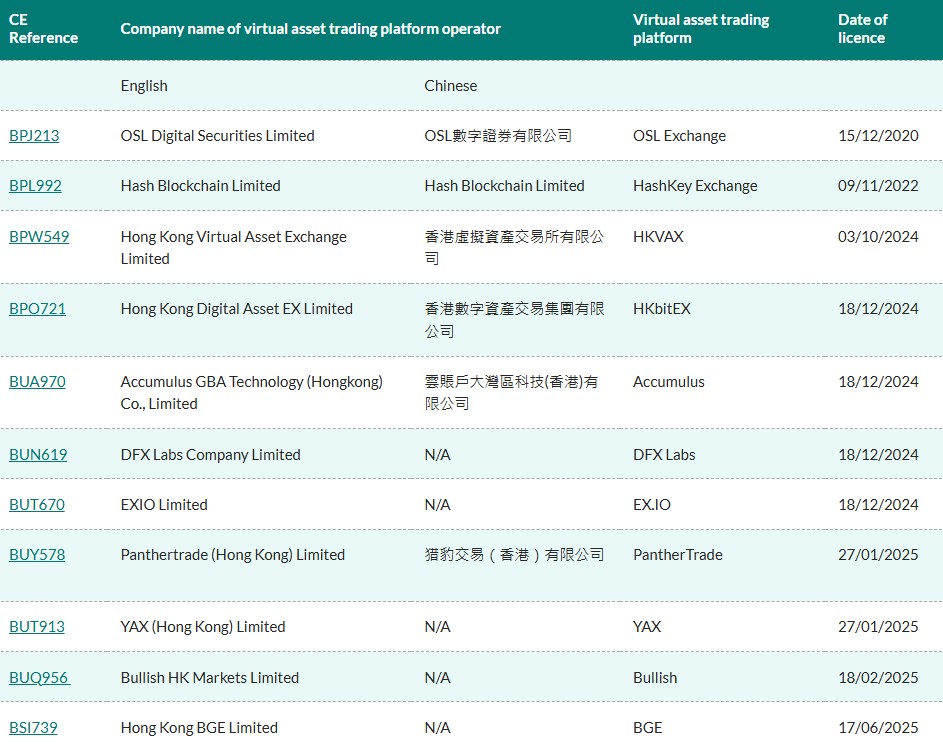
Hong Kong has rejected more applicants for its crypto exchange license than it approved. Source: SFC

Related: Crypto may enter insurers’ portfolios as Hong Kong reviews capital rules

Hong Kong’s broader crypto initiatives

Hong Kong has long expressed its ambitions to develop into a crypto hub. The city already functions as a financial hub with its business-friendly tax regimes and its reputation as a finance gateway between mainland China and global capital markets.

Beyond crypto licensing rules, Hong Kong has also tested tokenization initiatives. In Thursday’s announcement, regulators added that the pending introduction of licensing regimes for crypto dealers and custodians is part of the city’s effort to establish a comprehensive regulatory framework for digital assets alongside stablecoins and tokenization.

​Julia Leung, CEO of the SFC, said that the further development of Hong Kong’s crypto regulatory framework would help the city maintain its position in global digital asset market developments by “fostering a trusted, competitive and sustainable ecosystem.”

Related: Hong Kong launches CARF crypto tax consultation to combat evasion

New advisory and management consultation

The SFC also published a consultation paper on the same day, seeking public feedback on proposals to introduce licensing regimes for crypto advisory service providers and management service providers.

The consultation links the proposed regimes to Hong Kong’s existing Anti‐Mone‐Laundering (AML) framework and Counter‐Terrorist Financing Ordinance, and sets out how advisory and management activities involving digital assets will be brought within the regulatory framework.

It also invites comments on matters such as licensing scope, regulatory powers, sanctions and appeal arrangements, which will be taken into account in finalizing the proposals.


Trending Cryptos

Related Questions

QWhat are the key licensing regimes that Hong Kong is proceeding with for virtual assets?

AHong Kong is proceeding with licensing regimes for virtual asset dealers and custodians, as well as for advisory service providers and management service providers.

QWhich regulatory bodies announced the conclusion of consultations on the proposed licensing frameworks?

AThe Financial Services and the Treasury Bureau (FSTB) and the Securities and Futures Commission (SFC) announced the conclusion of consultations on the proposed licensing regimes.

QWhat earlier crypto-related licensing regime did Hong Kong bring into force in 2025?

AIn early 2025, Hong Kong brought its Stablecoin Ordinance into force, which opened a new licensing regime for stablecoin issuers.

QAccording to the SFC CEO, what is the goal of further developing Hong Kong's crypto regulatory framework?

AAccording to SFC CEO Julia Leung, the goal is to help Hong Kong maintain its position in global digital asset market developments by 'fostering a trusted, competitive and sustainable ecosystem'.

QWhat existing frameworks are the proposed licensing regimes for advisory and management services linked to?

AThe proposed regimes are linked to Hong Kong's existing Anti-Money Laundering (AML) framework and Counter-Terrorist Financing Ordinance.

Related Reads

'Backstabbing' or 'Win-Win'? How Likely Is TradeXYZ to Break Away from Hyperliquid and Go Solo?

The article discusses the growing debate over whether TradeXYZ, which dominates Hyperliquid's HIP-3 market with over 90% of its volume, might break away to build its own independent trading platform. This possibility is fueled by TradeXYZ's immense market influence and the common industry trend of successful projects seeking more control and profit capture. Key arguments for a potential split include TradeXYZ's overwhelming contribution to Hyperliquid's metrics and the financial incentive to retain all transaction fees, as it currently splits them 50/50 with Hyperliquid. The piece draws parallels to other cases, like Anthropic's "Claude Code" competing with its former partner Cursor, suggesting "betrayal" can occur when business leverage shifts. However, strong counterarguments suggest a split is unlikely or would be detrimental. TradeXYZ relies on Hyperliquid's high-performance infrastructure and its platform as a primary user acquisition channel. Building a comparable system would be challenging. Furthermore, the founders of both projects share a history of trust and mutual admiration. The analysis concludes that a separation would likely be a lose-lose scenario: Hyperliquid would lose a major growth narrative and trading volume, while TradeXYZ would face technical hurdles, user migration issues, and reputational damage, potentially allowing competitors to seize market share. The most rational path is seen as continued collaboration, with TradeXYZ potentially negotiating better terms while leveraging Hyperliquid's established strengths.

marsbit4m ago

'Backstabbing' or 'Win-Win'? How Likely Is TradeXYZ to Break Away from Hyperliquid and Go Solo?

marsbit4m ago

The Artificial Intelligence Economy Could Accelerate the Establishment of Dominance for Dollar-Pegged Stablecoins

Economists from the ASEAN+3 Macroeconomic Research Office (AMRO) suggest that the winner in the artificial intelligence (AI) race may not be the country developing the most powerful AI model, but the one whose currency underpins these models and their infrastructure. Their thesis outlines a potential cycle where AI-related costs—such as energy for data centers, infrastructure, and usage fees—are denominated in U.S. dollars. As AI grows into a massive industry, this could significantly increase global demand for U.S. dollar liquidity (first channel of dollar dominance). A second channel involves the currency used for payments between AI agents, expected to become widespread in logistics, inventory, and treasury management. Dollar-pegged stablecoins could provide the programmable settlements required for such agent commerce. These two channels may converge, creating a self-reinforcing "dollar loop" where AI computational payments are settled in stablecoins. Stablecoins could gain an early advantage over alternatives like CBDCs due to existing network effects, further entrenching dollar dominance. This would also boost demand for U.S. Treasury bonds used as collateral for stablecoin reserves. The report warns ASEAN+3 nations of over-reliance on this dollar loop and suggests developing regional data centers and tokenized money based on local currencies to participate in the AI economy without reinforcing dollar dependency.

cryptonews.ru6m ago

The Artificial Intelligence Economy Could Accelerate the Establishment of Dominance for Dollar-Pegged Stablecoins

cryptonews.ru6m ago

Base Claims Its Distribution Advantage Can Outlast Robinhood Chain's Initial Surge

Base, a layer-2 blockchain, argues that its established distribution network will outlast Robinhood Chain's initial popularity surge. While Robinhood Chain quickly attracted 230,000 daily active users and over $9 billion in DEX volume (primarily from meme coins) shortly after launch, its core feature of tokenized stocks saw minimal use. Base acknowledged shortcomings in focusing on social blockchain products and lagging in areas like perpetual contracts, predictions markets, and on-chain tokenized stocks—a move Robinhood got right. In response, Base highlights its nearly three-year head start in building infrastructure. It emphasizes its x402 payment protocol, which has processed 187.8 million agent payments, its $3.9 billion in stablecoin deposits (mostly USDC), and its integration with partners like Visa, Shopify, and JPMorgan for institutional and merchant settlements. Base contends these capabilities for corporate payments and stablecoin liquidity represent a more durable and defensible ecosystem than Robinhood's retail trading metrics. Coinbase plans to launch its own on-chain, share-backed tokenized stocks on Base, which would directly challenge Robinhood's key differentiating feature. Base's strategy bets that its deep-rooted distribution and institutional partnerships will prove harder to overcome than Robinhood's early, meme-driven volume, which may fade after the initial launch hype.

cryptonews.ru9m ago

Base Claims Its Distribution Advantage Can Outlast Robinhood Chain's Initial Surge

cryptonews.ru9m ago

Trading

Spot

Hot Articles

How to Buy VIRTUAL

Welcome to HTX.com! We've made purchasing Virtuals Protocol (VIRTUAL) simple and convenient. Follow our step-by-step guide to embark on your crypto journey.Step 1: Create Your HTX AccountUse your email or phone number to sign up for a free account on HTX. Experience a hassle-free registration journey and unlock all features.Get My AccountStep 2: Go to Buy Crypto and Choose Your Payment MethodCredit/Debit Card: Use your Visa or Mastercard to buy Virtuals Protocol (VIRTUAL) instantly.Balance: Use funds from your HTX account balance to trade seamlessly.Third Parties: We've added popular payment methods such as Google Pay and Apple Pay to enhance convenience.P2P: Trade directly with other users on HTX.Over-the-Counter (OTC): We offer tailor-made services and competitive exchange rates for traders.Step 3: Store Your Virtuals Protocol (VIRTUAL)After purchasing your Virtuals Protocol (VIRTUAL), store it in your HTX account. Alternatively, you can send it elsewhere via blockchain transfer or use it to trade other cryptocurrencies.Step 4: Trade Virtuals Protocol (VIRTUAL)Easily trade Virtuals Protocol (VIRTUAL) on HTX's spot market. Simply access your account, select your trading pair, execute your trades, and monitor in real-time. We offer a user-friendly experience for both beginners and seasoned traders.

6.7k Total ViewsPublished 2024.12.23Updated 2026.06.02

How to Buy VIRTUAL

Discussions

Welcome to the HTX Community. Here, you can stay informed about the latest platform developments and gain access to professional market insights. Users' opinions on the price of VIRTUAL (VIRTUAL) are presented below.

活动图片