With Two Consecutive Quarters of Losses, Coinbase Must Rely on Paths Beyond Trading

marsbitОпубліковано о 2026-07-31Востаннє оновлено о 2026-07-31

Анотація

Coinbase posted its second consecutive quarterly net loss of $359 million on $1.22 billion in revenue for Q2, highlighting its vulnerability to crypto market cycles where weaker prices and lower volatility reduce user trading. However, the report also reveals a strategic shift in its business model. Despite a 25% quarter-over-quarter decline in global spot trading volume, Coinbase increased its market share to a company-record 10.3%. This suggests its position as a compliant U.S. on-ramp is strengthening even in a cooler market. A key development is the diversification of revenue streams. Transaction revenue fell to $599 million, nearly equaling subscription and services revenue of $555 million. Stablecoin services, generating $292 million, are becoming a crucial revenue "floor." This income, derived from interest on the $20 billion average USDC balance held on its platform, is less tied to daily trading activity. Furthermore, while spot trading volume dropped significantly, derivatives volume held steady at $1.03 trillion. Coinbase is pushing to integrate spot, stablecoin, and derivatives liquidity to create a more interconnected and sticky ecosystem for users. The GAAP net loss includes non-cash expenses like stock-based compensation and crypto asset valuation changes. Its adjusted EBITDA remained positive at $208 million for the 14th straight quarter, indicating core operations can cover ongoing costs. The company is also reducing expenses to manage the downturn. The ...

U.S. crypto trading platform Coinbase delivered an earnings report that's easy to misinterpret. In the second quarter, total revenue fell to $1.22 billion, with a GAAP net loss of $359 million. According to the earnings report supplement Coinbase filed with the U.S. Securities and Exchange Commission on July 30th, this marks the company's second consecutive quarter of net losses.

Looking solely at the income statement, the story seems familiar—the crypto cycle. Weak coin prices, declining volatility, reduced user trading, and consequently shrinking exchange revenue. But there's another narrative in this report. According to Coinbase's disclosure, its share of the crypto trading volume market rose to 10.3%, setting a new company-record high. In a receding quarter, it captured more traffic.

Coinbase's cyclicality hasn't disappeared; it's just that it no longer completely mirrors the cyclicality of spot trading. Market share, stablecoins, and derivatives are now splitting the company's revenue and liquidity sources into several distinct streams.

Why Does the Platform Grow Stronger as the Market Cools Down?
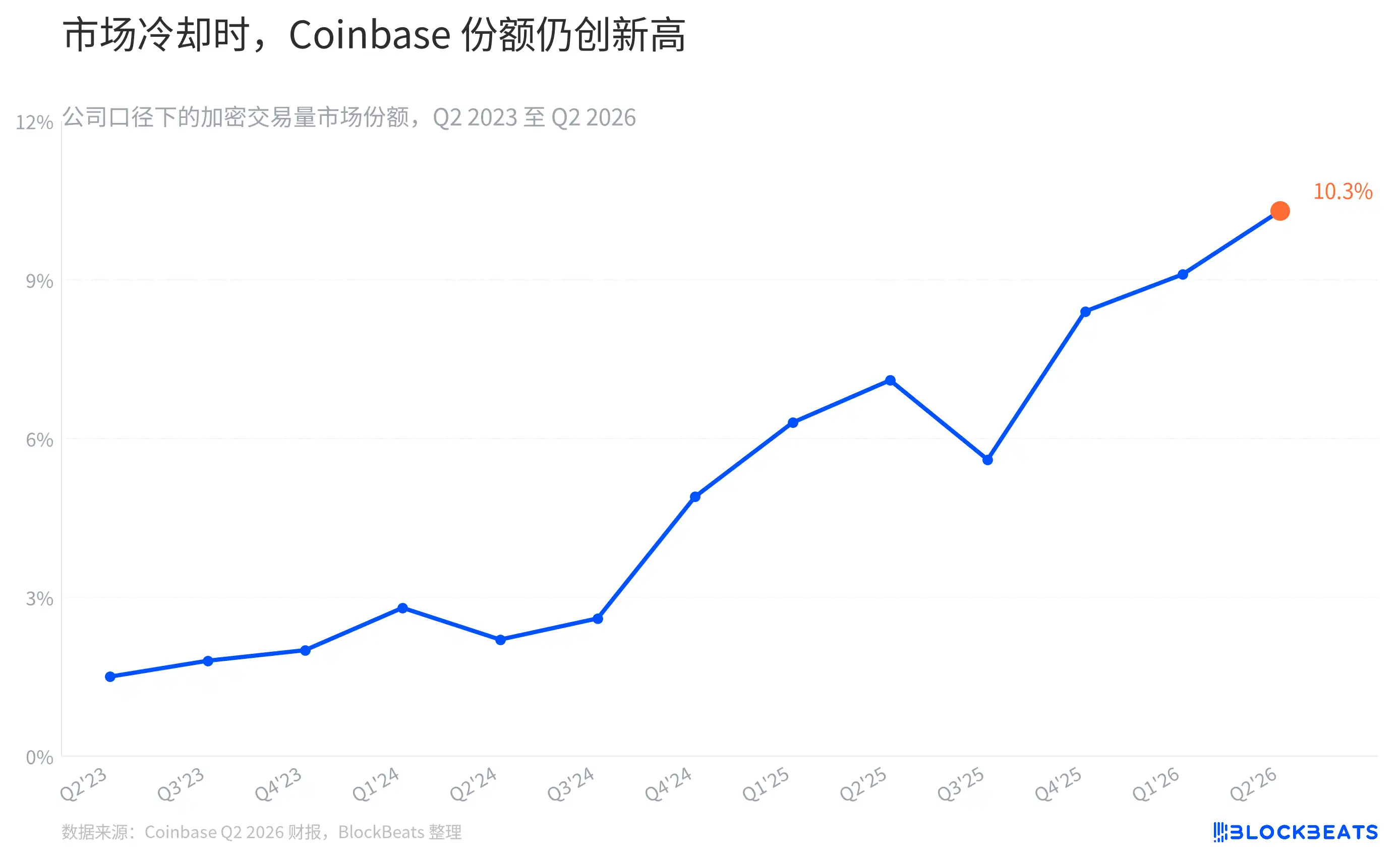
In the second quarter, the global crypto spot trading volume metric used by Coinbase fell 25% quarter-over-quarter. Yet, according to the company's earnings report, Coinbase's market share during the same period climbed from 9.1% in Q1 to 10.3%. Less revenue doesn't mean the platform's relative position has worsened.

Exchanges aren't fighting over a static pie. When the market is hot, retail investors flood in, and liquidity naturally thickens. When the market is dull, the users who remain test the platform's depth, product offerings, and compliant access channels. Coinbase's strongest tag has been its status as the compliant U.S. on-ramp. The current market share curve indicates this on-ramp is attracting a larger portion of trading activity.

However, this curve has its limits. Market share is Coinbase's internal calculation based on data from sources like CoinDesk Data, CoinMetrics, Dune, and Tardis, and includes stablecoin conversion activities. It's suitable for observing changes in its own competitiveness but should not be taken as the sole industry-wide market share standard.

What's Supporting Trading Revenue?
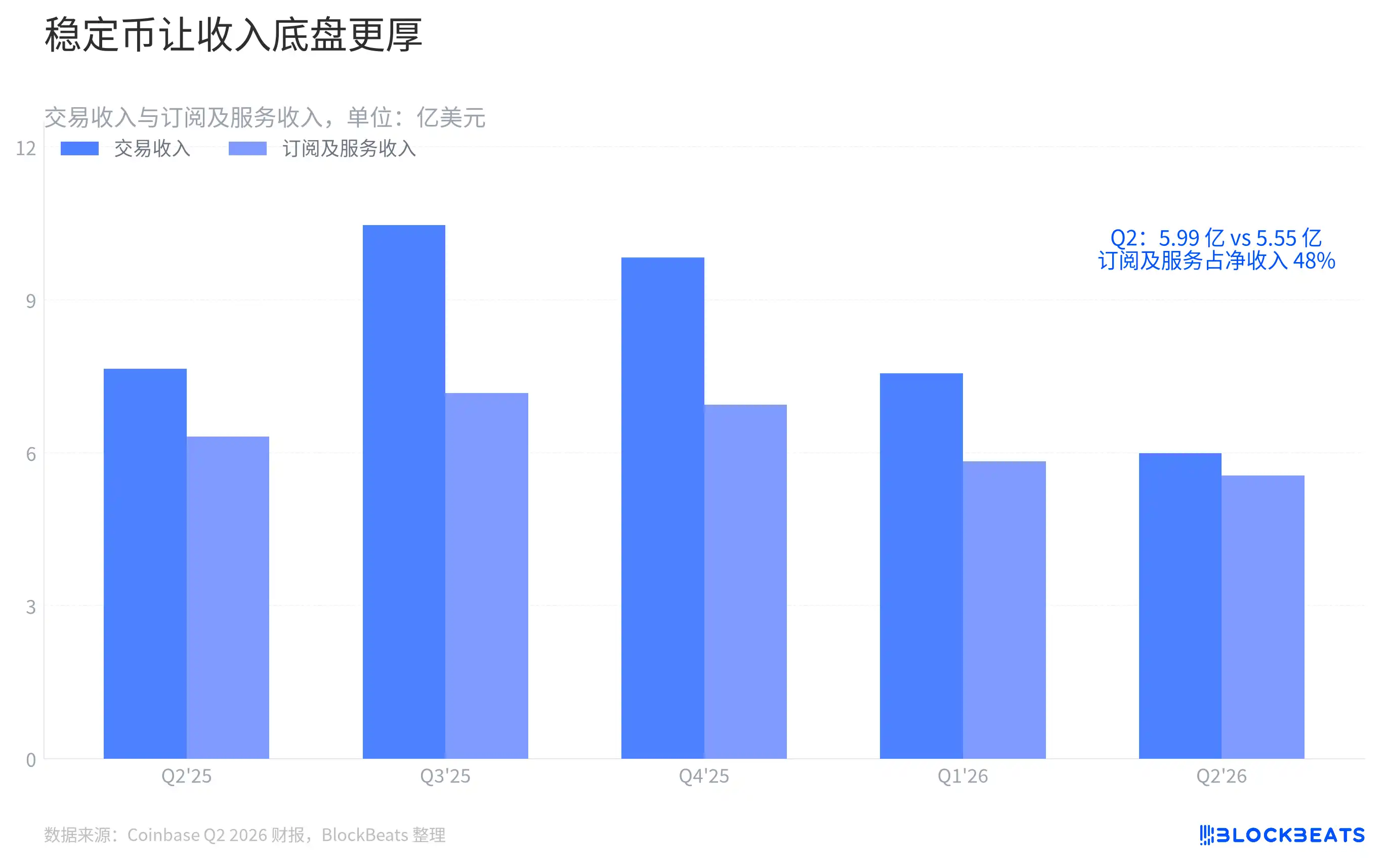
According to Coinbase's earnings report, second-quarter transaction revenue was $599 million, while subscription and services revenue was $555 million. The gap between them is now just a narrow sliver. In the past, transaction revenue was the primary beam that rose swiftly during bull markets. Now, subscription, custody, staking, interest, and stablecoin businesses are forming another layer of foundational income.

The largest portion comes from stablecoins. The company disclosed that stablecoin revenue this quarter was $292 million. Its logic differs from spot commission fees. When users hold USDC within Coinbase's products, the platform can share in the interest from reserve assets and partnership proceeds. A transaction commission is one-time. Stablecoin balances remain, generating returns on a daily basis.

This change is not abstract. The average USDC balance within Coinbase's products has risen to $20 billion. According to the company, over 30% of USDC's circulating supply was within its products at quarter-end. For the exchange, this is akin to turning wallets that were only opened during market rallies into accounts where funds can be parked.

This also explains why subscription and services revenue accounted for 48% of net revenue this quarter. This isn't to say Coinbase has become immune to coin price influences. Interest rate changes, fluctuations in USDC market cap, and user willingness to hold stablecoins will still impact this revenue line. However, its rhythm no longer needs to sync perfectly with spot trading volume.

After Spot Volume Shrinks, Where Does Liquidity Go?
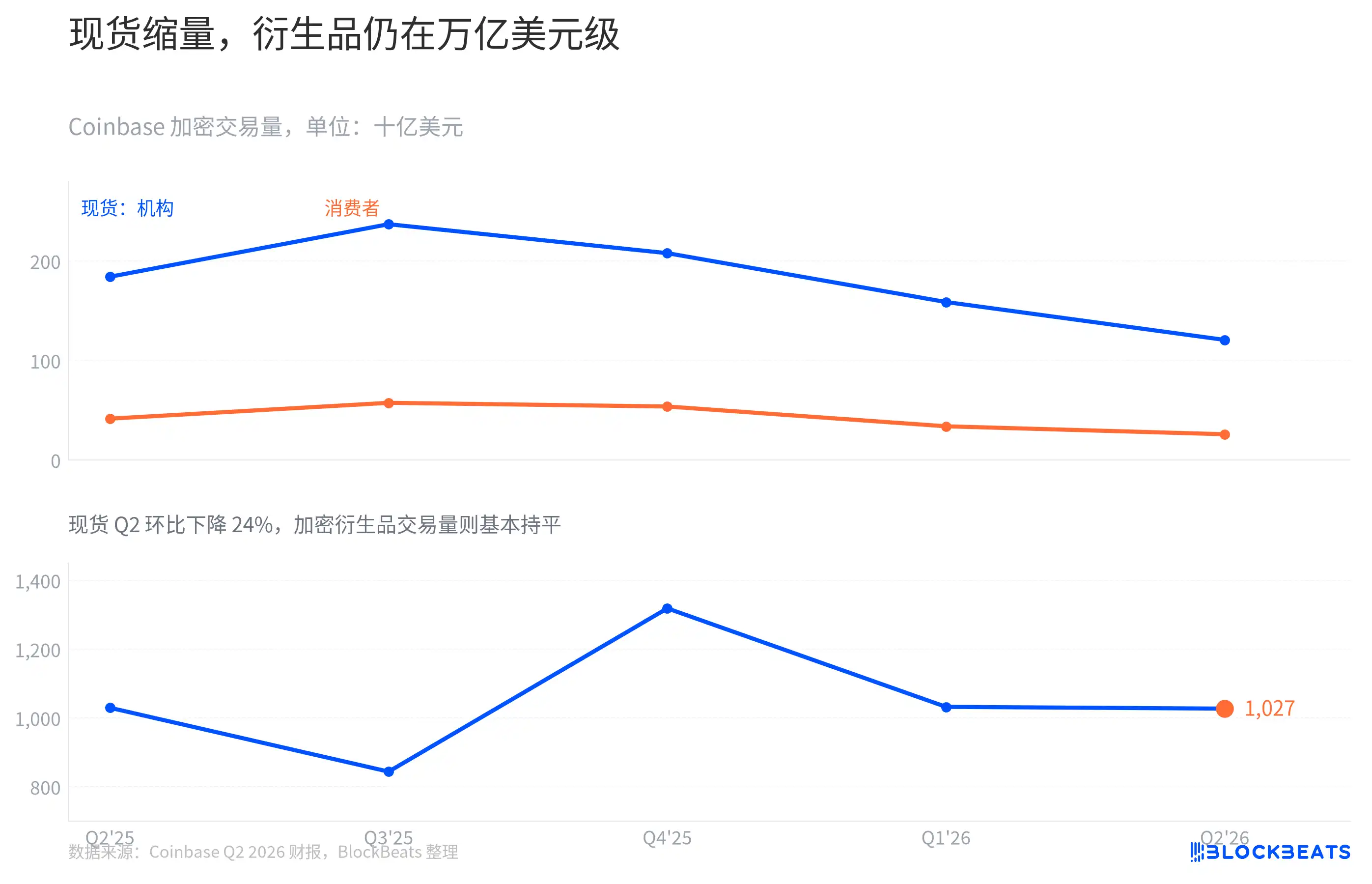
In the second quarter, Coinbase's crypto spot trading volume fell to $146.4 billion. Crypto derivatives trading volume remained at $1.03 trillion. According to the company's report, spot volume declined 24% quarter-over-quarter, while derivatives volume was largely flat.

This isn't a simple case of product substitution. Spot buying and selling are more akin to taking a directional bet on price, most likely to be postponed during low volatility. Derivatives serve purposes like leverage, hedging, and cross-market position adjustments; professional traders don't exit completely just because the market is quiet. Their trading volumes also can't be used directly to extrapolate revenue; derivatives are reported as notional amounts, and their fee structures and revenue recognition logic differ from spot.

Coinbase repeatedly emphasized global perpetual contracts, U.S. compliant access, and Deribit integration in its report. Its goal isn't just to add a derivatives tab next to the spot page; it's to enable one piece of collateral to support more trading needs. Once a platform can connect spot, stablecoins, and derivatives to the same pool of liquidity, the cost for users to leave is no longer just downloading another app.

Net Loss—Where Exactly Is the Loss?
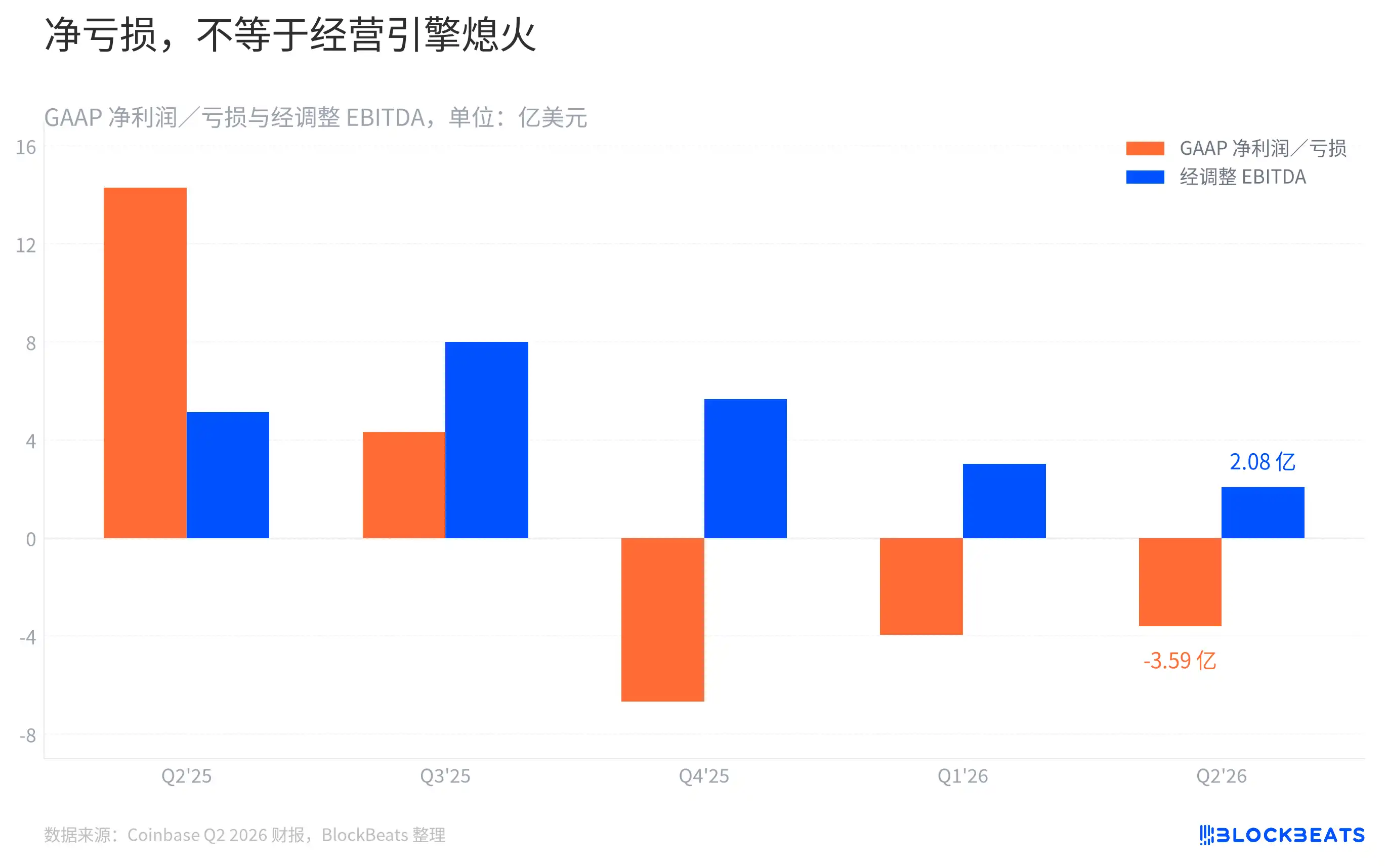
The GAAP net loss of $359 million this quarter is of course a real result. However, according to Coinbase's report, adjusted EBITDA for the same period remained positive at $208 million and has been positive for 14 consecutive quarters. The gap between these two bars is precisely what's most easily overlooked when reading the earnings report.

The GAAP income statement includes fair value changes of crypto asset investments, investment gains/losses, restructuring charges, and stock-based compensation in the current period's results. Adjusted EBITDA removes several of these items. It's a more direct gauge of whether operational activities can cover day-to-day costs in the period, but it's not an alternative scorecard to replace net profit.

According to the company's disclosure, the operating loss this quarter was $113 million, indicating that the decline in transaction revenue is still weighing on the profit side. Adjusted expenses decreased 9% quarter-over-quarter, and the full-year guidance for adjusted expenses was narrowed to $4.20 billion - $4.45 billion. Controlling expenses can reduce bleeding during low-volatility periods, but it cannot replace the validation of new revenue streams.

This is the real question left by Coinbase's earnings report. It has already proven it can gain market share even as the market cools and has stablecoins and derivatives keeping the platform afloat. The next time market trading volume declines, readers should watch not just how much revenue falls, but whether these new streams can continue channeling water into the same account.


Трендові криптовалюти

Пов'язані питання

QAccording to the article, what were the main financial results for Coinbase in Q2?

AIn Q2, Coinbase reported total revenue falling to $1.22 billion and a GAAP net loss of $359 million, marking its second consecutive quarter of net loss.

QDespite a market downturn, what key competitive metric improved for Coinbase according to its internal calculations?

ACoinbase's share of global crypto spot trading volume (as calculated by the company) rose to 10.3% in Q2, a new record high under its methodology.

QWhat is the primary revenue driver for Coinbase's 'Subscriptions and services' income, specifically from stablecoins?

AThe primary driver is USDC. Coinbase earns interest and partnership revenue by holding USDC reserves for users. This income stream is based on the average balance held ($20 billion in Q2), not on transaction commissions.

QHow did trading activity in spot markets versus derivatives markets differ for Coinbase in Q2, and what does the article suggest is the reason?

ASpot trading volume fell 24% to $146.4 billion, while derivatives volume remained roughly flat at $1.03 trillion. The article suggests derivatives are less sensitive to low volatility as they serve needs like hedging and leverage for professional traders who remain active even in quiet markets.

QWhat is the key difference between Coinbase's GAAP net loss and its Adjusted EBITDA for Q2, and what does this indicate about its core operations?

AThe GAAP net loss of $359 million includes items like investment gains/losses and stock-based compensation. Adjusted EBITDA, which was positive at $208 million, excludes these to show that its core business operations were still generating cash to cover ongoing costs for the 14th consecutive quarter.

Пов'язані матеріали

Citi Research Report Analysis: U.S. Proposed Ban on Chinese Optical Modules Has No Substantial Progress, Short-term Enforcement Faces Supply Constraints

Citi Report Analysis: U.S. Proposed Ban on Chinese Optical Modules Lacks Substantive Progress, Faces Supply Bottlenecks in Short Term. Reuters reported on August 4th that the U.S. government and FCC are considering a ban on Chinese optical modules. Citi's August 9th report clarifies that optical modules are not listed on any effective FCC ban. The FCC's Order 26-50 established two restricted list mechanisms (based on manufacturer and production location), but optical modules were only mentioned once, as an example in a disclosure requirement, not as a restricted product. The reported ban remains at a proposal stage. Citi estimates Chinese suppliers provide 60-70% of high-speed optical modules for U.S. hyperscalers. Non-Chinese suppliers cannot fill this gap in the short term, making the immediate implementation of a genuine ban unlikely. Future regulatory paths could be manufacturer-based (least likely), location-based covering all offshore production (strictest), or location-based covering only China (more feasible but with unresolved definitions). A ban would pressure U.S. AI infrastructure, conflicting with stated policy goals. Citi sees low near-term implementation probability, with the issue potentially becoming a negotiation chip in bilateral talks. U.S. domestic capacity build-out is a key long-term variable. Among Chinese companies, XSENS and Dongshan Precision have the highest U.S. exposure, while Tianfu Communication, as a passive component supplier, is relatively insulated. Citi maintains Buy ratings on all three with respective price targets. The conclusion is that Chinese modules are currently irreplaceable in the U.S. AI supply chain, creating a longer timeline for potential restrictions than the market may expect.

marsbit14 хв тому

Citi Research Report Analysis: U.S. Proposed Ban on Chinese Optical Modules Has No Substantial Progress, Short-term Enforcement Faces Supply Constraints

marsbit14 хв тому

Lead Analyst Claims Bitcoin is at a Critical Stage: 'We are at the Bear Market Bottom, What Happens Next…'

Renowned cryptocurrency analyst Benjamin Cowen, in his latest analysis video, examined recent events and historical cycles in the Bitcoin market. Noting Bitcoin's trading range of $64,000 to $65,000, Cowen stated that market dynamics and investor interest show similarities to past cycles, suggesting the upcoming period marks a critical turning point. Cowen observed a significant decline in public interest and investor enthusiasm for the crypto market, with social risk metrics falling to 0.2, far below levels seen four years ago. He added that market volatility has notably decreased, and a sense of distrust prevails among investors, drawing parallels to the ends of bear markets in 2018 and 2022. Historical data indicates Bitcoin markets typically bottom in summer months, followed by a period of stagnation with low volatility, implying a major move could occur in the year's final quarter. However, Cowen noted on-chain indicators like the MVRV Z-Score have not yet signaled a definitive bottom. Cowen believes an event in the coming weeks could shake the market, potentially triggering a final sell-off wave. Such an event, he argues, would bring investors back and pave the way for a new bull cycle. He predicts October as the most likely bottoming period, while acknowledging September or November are also possible, advising crypto users to remain cautious and prepared for a decisive market moment.

cryptonews.ru23 хв тому

Lead Analyst Claims Bitcoin is at a Critical Stage: 'We are at the Bear Market Bottom, What Happens Next…'

cryptonews.ru23 хв тому

Bitcoin Community in Uproar: Deciphering the New Scaling War Sparked by BIP-110

On August 10, Luke Dashjr, a long-time Bitcoin Improvement Proposal (BIP) editor and co-founder of Ocean mining pool, was removed from the BIP editing team for bypassing discussion protocols and preemptively assigning a number to BIP-110, a controversial soft fork proposal he helped draft. The conflict stems from Bitcoin Core's version 30 release in October 2025, which removed the default 83-byte limit on OP_RETURN, a field used for embedding non-transaction data. In response, BIP-110 aimed to enforce this limit as a consensus rule. It controversially lowered the activation threshold for miners to 55% and included a mandatory activation clause, causing significant community backlash. Major mining pools like Foundry USA and AntPool did not support it, with public criticism from figures like F2Pool's Wang Chun and Michael Saylor, who argued it compromised Bitcoin's neutrality. On August 8, at block height 961,632, nodes running the BIP-110 patch rejected the main chain block, causing a chain split. The minority chain, supported by only about 2.53% of the network's hash rate, produced just one additional block before stalling. The main chain quickly outpaced it by over 240 blocks. No major exchanges have supported the minority chain. The event highlighted Bitcoin's governance reality: while rules can be proposed by a few, ultimate authority lies with the economic majority—miners willing to expend hash power and users/exchanges recognizing a chain's validity. Following the failed split, BIP-110 proponents, including Luke Dashjr, have begun discussing a change to the proof-of-work algorithm to create a separate coin, though this remains in early discussion stages.

marsbit44 хв тому

Bitcoin Community in Uproar: Deciphering the New Scaling War Sparked by BIP-110

marsbit44 хв тому

Торгівля

Спот

Популярні статті

Як купити T

Ласкаво просимо до HTX.com! Ми зробили покупку Threshold Network Token (T) простою та зручною. Дотримуйтесь нашої покрокової інструкції, щоб розпочати свою криптовалютну подорож.Крок 1: Створіть обліковий запис на HTXВикористовуйте свою електронну пошту або номер телефону, щоб зареєструвати обліковий запис на HTX безплатно. Пройдіть безпроблемну реєстрацію й отримайте доступ до всіх функцій.ЗареєструватисьКрок 2: Перейдіть до розділу Купити крипту і виберіть спосіб оплатиКредитна/дебетова картка: використовуйте вашу картку Visa або Mastercard, щоб миттєво купити Threshold Network Token (T).Баланс: використовуйте кошти з балансу вашого рахунку HTX для безперешкодної торгівлі.Треті особи: ми додали популярні способи оплати, такі як Google Pay та Apple Pay, щоб підвищити зручність.P2P: Торгуйте безпосередньо з іншими користувачами на HTX.Позабіржова торгівля (OTC): ми пропонуємо індивідуальні послуги та конкурентні обмінні курси для трейдерів.Крок 3: Зберігайте свої Threshold Network Token (T)Після придбання Threshold Network Token (T) збережіть його у своєму обліковому записі на HTX. Крім того, ви можете відправити його в інше місце за допомогою блокчейн-переказу або використовувати його для торгівлі іншими криптовалютами.Крок 4: Торгівля Threshold Network Token (T)Легко торгуйте Threshold Network Token (T) на спотовому ринку HTX. Просто увійдіть до свого облікового запису, виберіть торгову пару, укладайте угоди та спостерігайте за ними в режимі реального часу. Ми пропонуємо зручний досвід як для початківців, так і для досвідчених трейдерів.

723 переглядів усьогоОпубліковано 2024.12.10Оновлено 2026.06.02

Як купити T

Обговорення

Ласкаво просимо до спільноти HTX. Тут ви можете бути в курсі останніх подій розвитку платформи та отримати доступ до професійної ринкової інформації. Нижче представлені думки користувачів щодо ціни T (T).

活动图片