Understanding the Q2 Crypto Market in 5 Charts: RWA Explosion, Fundamentals Continue to Recover

Foresight NewsОпубліковано о 2026-07-15Востаннє оновлено о 2026-07-15

Анотація

Summary of Q2 Crypto Market: RWA Boom and Continued Fundamental Recovery The second quarter of 2026 presented a mixed picture for the crypto market. While major crypto asset prices declined by 36% in H1 2026, the fundamentals of the industry showed significant strength. Key highlights from Bitwise's market review include: 1. **Divergence Between Crypto Stocks and Tokens:** Crypto-related public equities, tracked by the Bitwise Crypto Innovators 30 Index, rose 23% in H1, outperforming most major asset classes. This signals robust investment opportunities within the crypto ecosystem, such as Bitcoin miners benefiting from AI and traditional finance firms deepening crypto integration, even during a bear market for tokens. 2. **Substantial Crypto Application Revenue:** Leading decentralized applications generated a combined $5.9 billion in revenue over the past 12 months, with top protocols like PancakeSwap, Hyperliquid, and Aave each nearing $1 billion. This demonstrates the existence of real, revenue-generating businesses within the sector. 3. **Breakout Growth in Real-World Asset (RWA) Tokenization:** The total value of tokenized real-world assets reached a record $33 billion in Q2, up 12% quarterly and 45% year-to-date. Growth is driven by tokenized U.S. Treasuries, corporate credit, equities, and venture capital shares, indicating accelerating institutional adoption. 4. **Expanding Prediction Markets:** Prediction market open interest hit a new high of $1.8 billion ...


Author: Ryan Rasmussen, Head of Research at Bitwise

Translation: Luffy, Foresight News


Every quarter, we release the "Bitwise Crypto Market Review," a report containing over 50 charts covering comprehensive data on market performance, on-chain fundamentals, institutional adoption, and more.


Data always outlines the full picture of the industry. Sometimes it shows purely bullish or bearish signals, but more often, it's a mix of both, with bright spots and downsides coexisting, worthy of in-depth analysis. The second quarter was such a case: fundamentals like crypto business revenue, real-world asset adoption, and institutional engagement all improved significantly, crypto-related stocks surged, yet the prices of mainstream crypto assets declined overall. How should we understand this divergent market behavior?


If you want to quickly grasp the core conclusions, here are what I consider to be the five most important charts.


Crypto-Related Stocks and Cryptocurrencies Showed Severe Divergence


In the first half of 2026, the overall crypto asset market fell by 36%; during the same period, only gold declined, down 7%, while all other major asset classes rose. This is also why this crypto bear market has been particularly tough: only the crypto sector was under pressure.


In stark contrast, however, crypto-related stocks cumulatively rose 23% in the first half of the year, outperforming all major assets except emerging market stocks. The Bitwise Crypto Innovators 30 Index, which tracks 30 leading publicly traded crypto companies, achieved returns more than double that of the S&P 500.


This data sends a key signal: even in a bear market, the crypto industry is still full of investment opportunities. Bitcoin mining companies are benefiting from the AI industry boom; stablecoin issuers and asset tokenization platforms continue to onboard Wall Street business; the integration between traditional finance and the crypto market is deepening. I predict a recovery in cryptocurrency prices in the second half of the year, but the first-half performance has already confirmed one fact: crypto is not a single asset class; the ecosystem is diverse and dynamic, requiring a broader perspective.
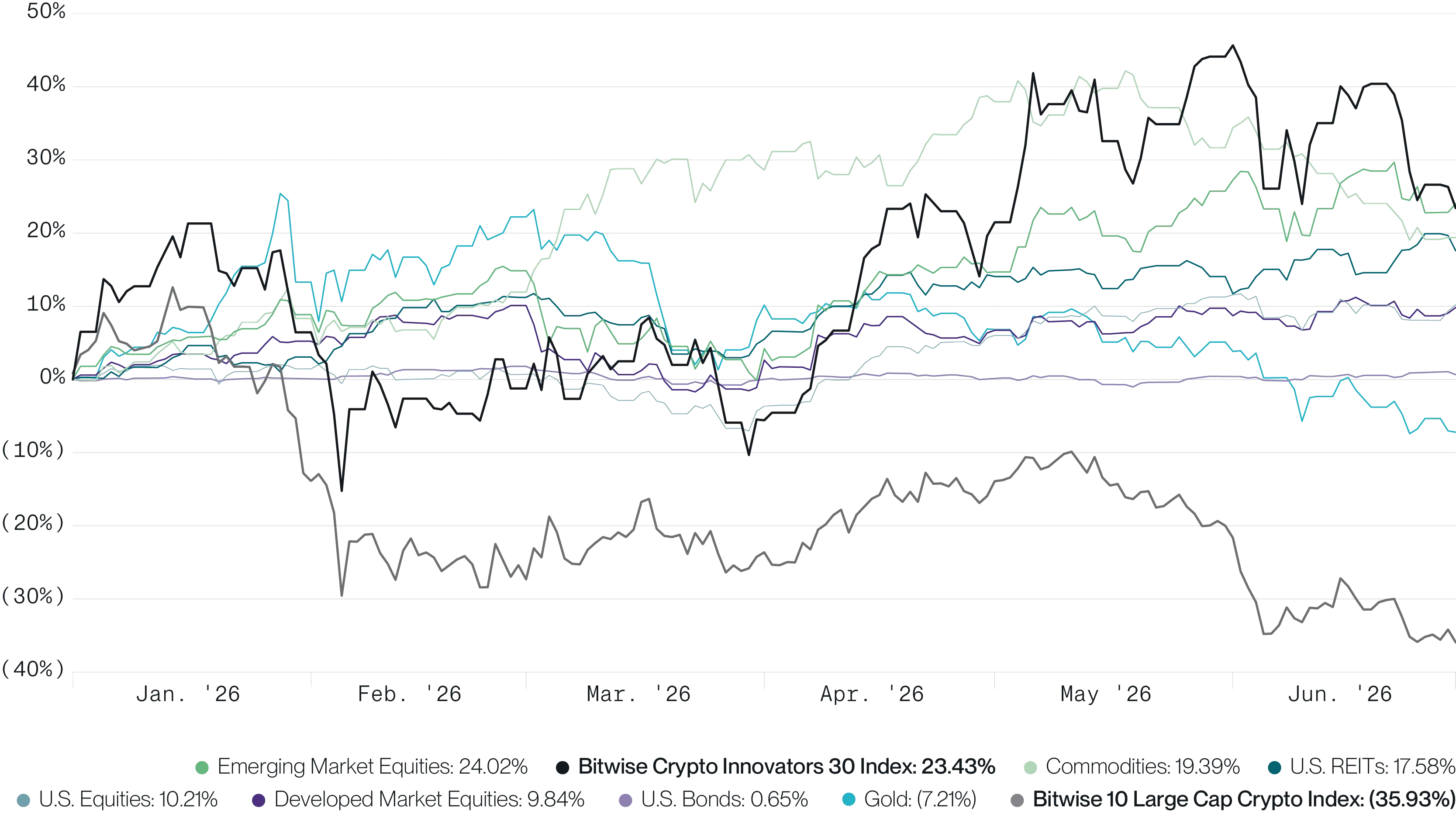

Performance Comparison: Cryptocurrencies vs. Major Asset Classes, Data Source: Bitwise, Bloomberg; Statistics as of June 30, 2026


Crypto Application Revenue is Substantial


Over the past 12 months, the top ten global crypto applications collectively generated $5.9 billion in revenue; the top three, PancakeSwap, Hyperliquid, and Aave, each generated close to $1 billion in revenue individually.


Even in a bear market, these products remain viable business entities with stable cash flows, with revenue coming from transaction fees, lending interest, and staking rewards. Whenever someone questions whether the crypto industry has any real fundamentals, I show them this chart.
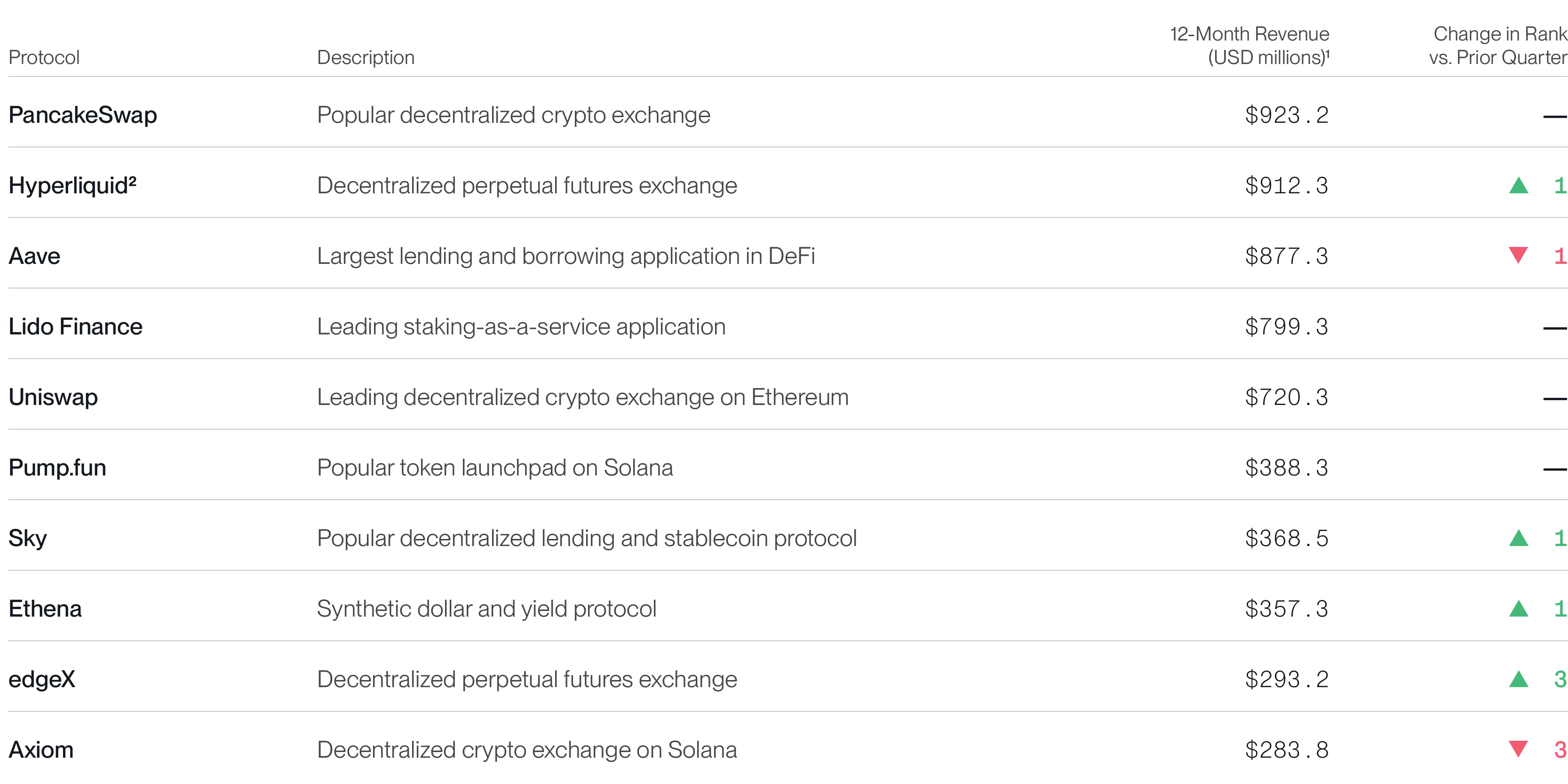

Top Ten Crypto Applications by Revenue, Data Source: Bitwise, Token Terminal; Statistics period: Jan 1, 2025 – Jun 30, 2026


Real-World Asset (RWA) Tokenization Enters a Bull Market


U.S. Treasury Secretary Scott Bessent publicly stated weeks ago: "Digital assets, stablecoins, asset tokenization, and new payment systems will collectively shape the future of the monetary system."


In a sense, the future he described is already here. In Q2, the total value of tokenized real-world assets reached a record high of $33 billion, up 12% quarter-over-quarter and 45% year-to-date; the main drivers of growth were tokenized U.S. Treasuries, corporate credit, equities, and venture capital shares.


This chart clearly shows that leading global asset managers are moving real-world assets onto the blockchain on a large scale, a trend worth continuous tracking.
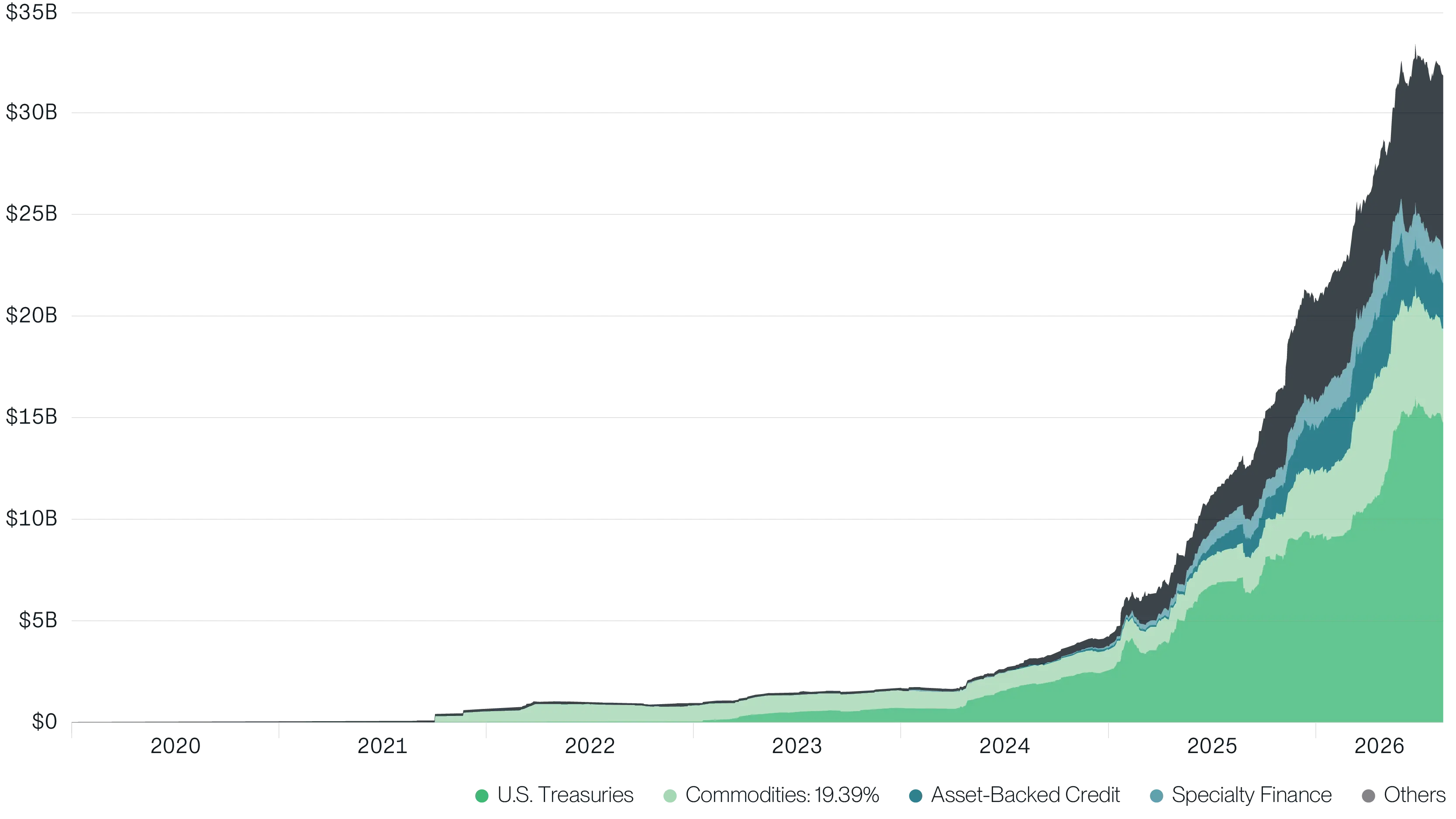

Value of Tokenized Real-World Assets (RWA), Data Source: Bitwise Asset Management, RWA.xyz; Statistics period: Jan 1, 2020 – Jun 30, 2026


Prediction Market Scale Continues to Expand


In Q2, prediction market open interest hit a record high of $1.8 billion, with sporting events becoming the core trading category; quarterly total trading volume also hit a new record, reaching $43 billion.


Platforms like Polymarket reflect a hidden aspect of crypto retail adoption: millions of users leverage crypto's underlying infrastructure to bet on real-world event outcomes, but the vast majority of users are unaware of and indifferent to the blockchain technology behind it.


With the approaching U.S. midterm elections, I predict that prediction market trading volume and open interest will hit new historical highs multiple times this year. The 2024 election theme is what brought prediction markets into the public spotlight, after which the industry's size tripled directly.
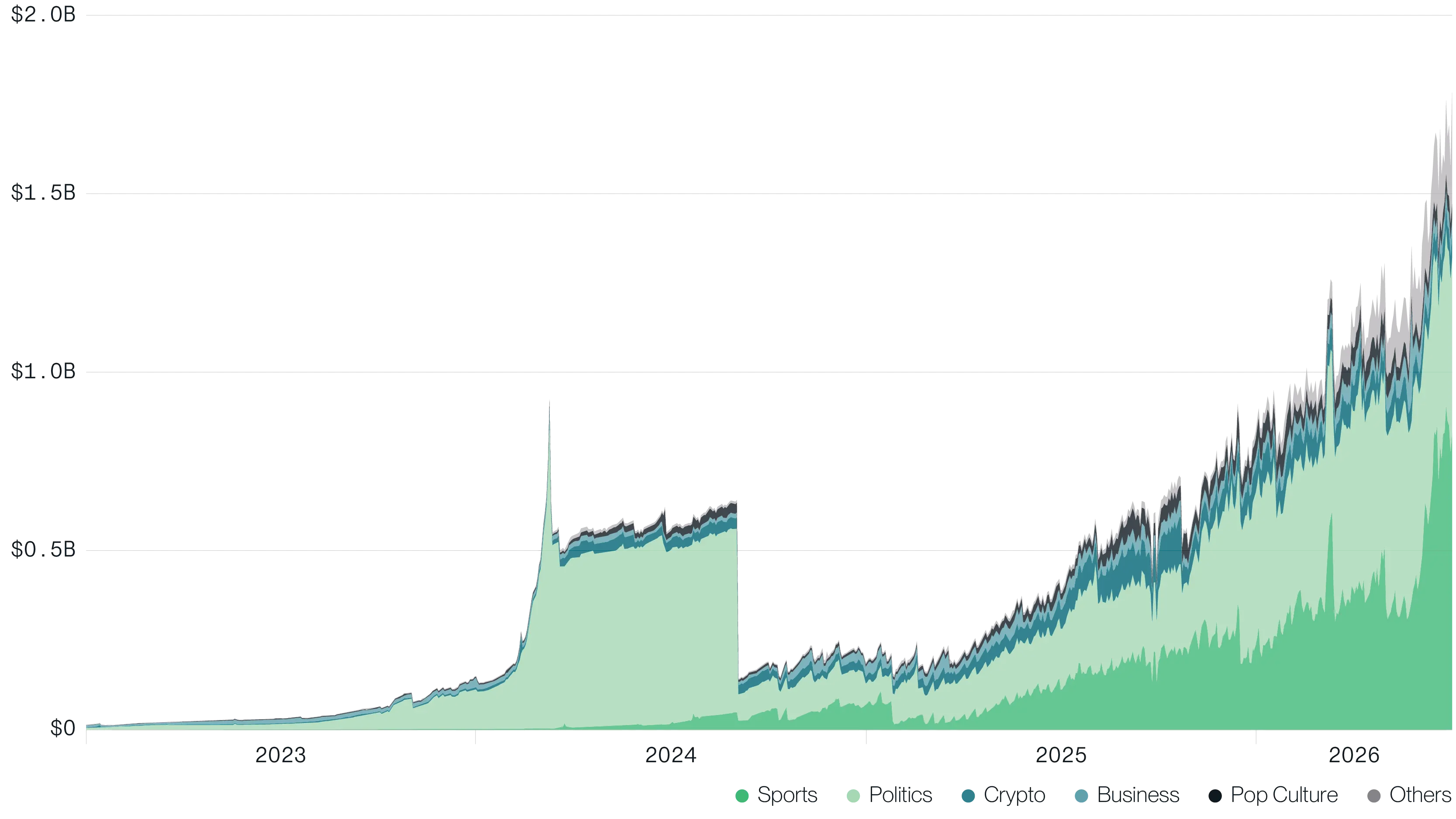

Prediction Market Open Interest Change, Data Source: Bitwise, Blockworks; Statistics period: Jan 1, 2023 – Jun 30, 2026


Crypto-Related Stocks Have Low Correlation with Mainstream Assets


Returning to crypto-related stocks, the most valuable chart shows the 90-day rolling correlation of the Bitwise Crypto Innovators 30 Index with various assets. The key highlight is that, compared to the broader U.S. stock market, this index has a lower correlation with most assets — developed market stocks, emerging market stocks, U.S. REITs, U.S. Treasuries, and gold. The only exception is commodities, where the correlation is negative.


In short, in the first half of 2026, crypto-related stock returns were double those of the U.S. stock market, while also showing low correlation with most assets in an investment portfolio. This combination of high returns and risk diversification is precisely what institutional investors favor for portfolio allocation.
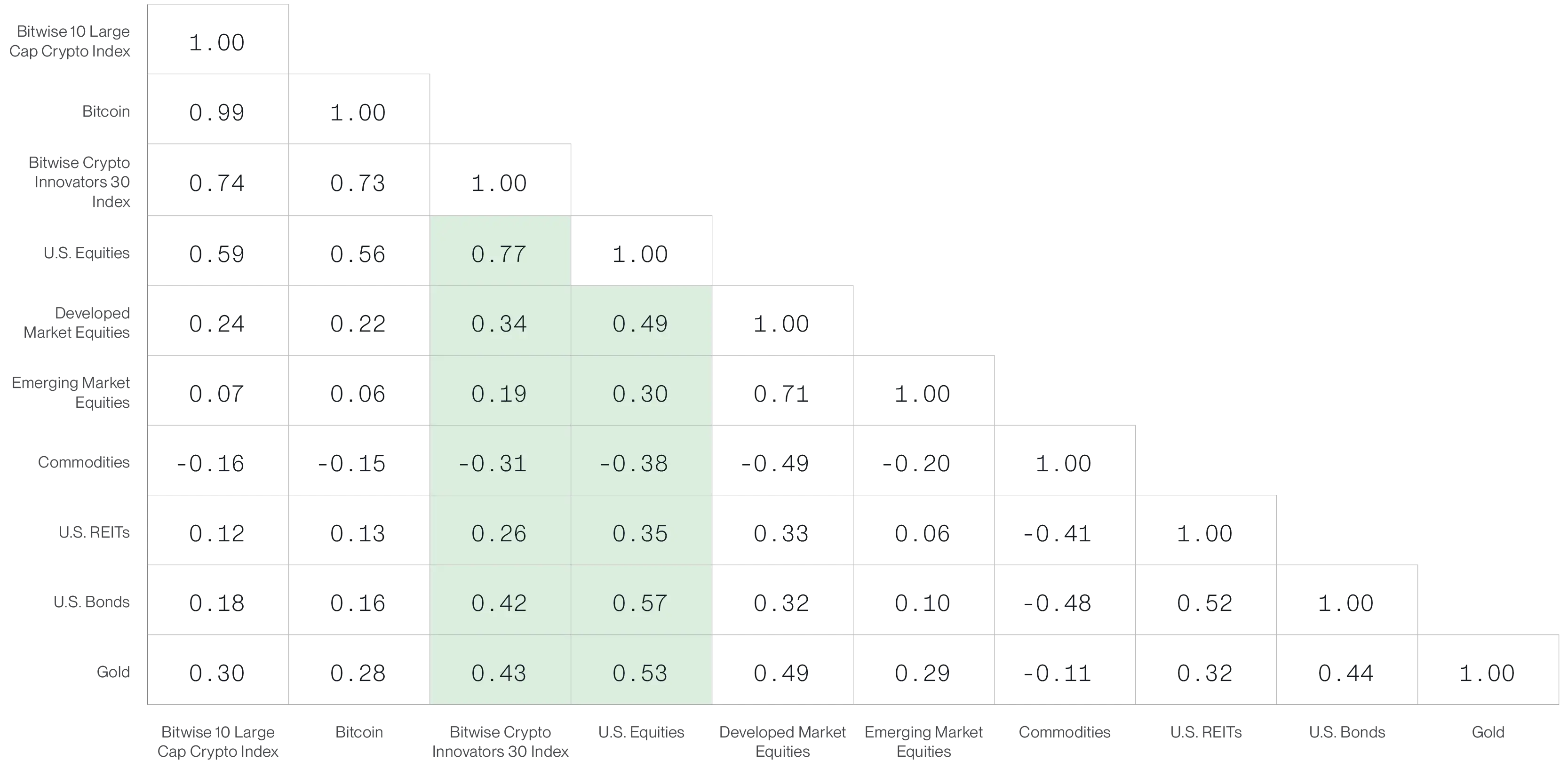


Comparison of 90-Day Rolling Correlations Across Asset Classes, Data Source: Bitwise, Bloomberg; Statistics as of June 30, 2026


Conclusion


The above is my complete interpretation of the Q2 market. The over 50 charts in the report cannot directly answer the market's most pressing question: Have crypto prices bottomed out? However, all the data collectively prove that the fundamentals of the crypto industry are extremely resilient. Even during the bear market cycle, user base, business revenue, and institutional adoption continue to grow.


The current stage the industry is in holds immense research value and is the foundation for the next bull market.


Пов'язані питання

QAccording to the article, what significant divergence occurred between crypto stocks and crypto assets in the first half of 2026?

AIn the first half of 2026, crypto assets as a whole fell by 36%, while crypto stocks, tracked by the Bitwise Crypto Innovators 30 Index, gained 23%, significantly outperforming most major asset classes and doubling the return of the S&P 500.

QWhat are the top three crypto applications by revenue mentioned in the article, and what was the total revenue of the top ten?

AThe top three crypto applications by revenue over the past 12 months were PancakeSwap, Hyperliquid, and Aave, each generating close to $1 billion in revenue. The total revenue for the top ten crypto applications was $5.9 billion.

QWhat trend does the article highlight regarding Real World Assets (RWA) tokenization in Q2 2026?

AIn Q2 2026, the total value of tokenized real-world assets reached a new all-time high of $33 billion, representing a 12% quarterly increase and a 45% increase year-to-date. The main drivers of growth were tokenized U.S. Treasuries, corporate credit, equities, and venture capital shares.

QWhat record did the prediction market achieve in Q2 2026, and what is its primary trading category?

AIn Q2 2026, the prediction market set a new record with open interest reaching $1.8 billion and total quarterly volume hitting $43 billion. Sports events are identified as the core trading category within these markets.

QWhat key characteristic of crypto stocks, as measured by the Bitwise Crypto Innovators 30 Index, makes them attractive to institutional investors according to the article?

AThe key characteristic is their combination of high returns and low correlation with most major assets in a diversified portfolio. In H1 2026, the index had low to negative 90-day rolling correlations with developed market stocks, emerging market stocks, U.S. REITs, U.S. Treasuries, and gold, while delivering returns twice that of the S&P 500.

Пов'язані матеріали

From Being Ignored to the Venture Capital Queen Investing: Has AI Revived This Ultra-Niche Sector?

From obscurity to receiving investment from the "queen of venture capital," AI has revitalized the ultra-niche social networking track. In recent years, the social networking sector experienced a deep freeze in venture capital, with high-profile projects like the video social app "Huayin" (founded by a former WeChat core team member) and the offline-online dating app "Single's Tavern" ultimately failing. These failures underscored the immense difficulty of challenging WeChat's dominance in熟人社交 (close-contact social networking) and the general lack of scalable monetization paths for niche concepts like metaverse, female-only, or Muslim community apps. However, a shift emerged in 2025. "Liangpei," an AI-powered matchmaking company, secured a $2 million angel round from Today Capital, led by renowned investor Xu Xin. Its approach uses AI conversational profiling to create detailed user matches and charges only upon successful connections. Similarly, projects like "Pixel Rhythm" (reportedly focused on AI-assisted content creation for Gen Z overseas) and "Moobius" (AI-native group chat) signal a new trend. The investment logic has fundamentally changed. Instead of pursuing broad, traffic-driven "platform dreams" to compete with giants like WeChat, Douyin, or Soul, the new wave focuses on using AI as a tool to solve specific, high-pain-point problems for targeted, niche user segments. The path to viability now lies in achieving healthy cash flow by solving a concrete problem rather than chasing massive scale.

marsbit18 хв тому

From Being Ignored to the Venture Capital Queen Investing: Has AI Revived This Ultra-Niche Sector?

marsbit18 хв тому

From TrueFi to Elara: Why the Next Stop for On-Chain Finance is Liquidity Infrastructure?

From TrueFi to Elara: Why On-Chain Finance's Next Stage is Liquidity Infrastructure? The article analyzes the evolving focus in decentralized finance, shifting from narrative-driven expansion to robust, operationally sound infrastructure. The author, drawing from experience at TrueFi and building Elara, argues that early DeFi incorrectly assumed technological superiority alone would force adoption. Instead, financial systems evolve through workflow compatibility. Traditional finance prioritizes stability and predictability, creating intentional "viscosity" (friction) through controls, which slows execution but ensures durability. Crypto-native systems minimized friction for rapid experimentation and iteration but often lacked operational safeguards, leading to reflexive liquidity that can disintegrate under stress. The core insight is that sustainable on-chain finance cannot rely solely on isolated products like RWA lending or token incentives. The real opportunity lies in a coordinated financial architecture for liquidity management, collateral coordination, and capital deployment. Elara is presented as an example of this next-generation "programmable treasury infrastructure"—a yield-bearing, dollar-pegged collateral asset designed for capital efficiency and operational flexibility within fragmented digital markets. A key architectural decision separates liquidity from yield generation, allowing the collateral to remain liquid and programmable while accruing value. The funding environment has also shifted. Investors now prioritize operational proof—working systems, integrations, and controls—over visionary narratives. Competitive advantage comes from building systems that endure under real market conditions, not just launching quickly. Ultimately, the path forward is not a sudden replacement of traditional finance but a selective hybridization. Lasting infrastructure will combine the iterative speed of digital assets with the control architecture of traditional finance. Systems like Elara are built to operate efficiently in today's low-viscosity crypto markets while embedding the operational discipline—compliance, reporting, risk management—required to eventually support institutional capital as it gradually integrates with on-chain settlement rails. The focus is not on who launches first, but on who can build infrastructure capable of managing both high-speed digital-native liquidity and the slower, more deliberate flow of institutional capital.

marsbit28 хв тому

From TrueFi to Elara: Why the Next Stop for On-Chain Finance is Liquidity Infrastructure?

marsbit28 хв тому

GPT-5.6 Cracks a 50-Year-Old Math Problem in 1 Hour, 64 AIs Claim the Crown Jewel of Graph Theory

OpenAI announced that its AI model, GPT-5.6 Sol Ultra, has successfully proved the 50-year-old Cycle Double Cover (CDC) conjecture in graph theory in under an hour. This long-standing problem, posed independently by several prominent mathematicians, states that every bridgeless finite undirected graph contains a set of cycles where each edge is covered exactly twice. The breakthrough was achieved using a novel "parallel test-time computation" (TTC) approach. Instead of a single AI working sequentially, the system deployed 64 concurrent AI agents, each exploring distinct proof strategies—from algebraic perspectives to structural induction. The process included strict protocols to avoid common research pitfalls: initial exploration of fundamentally different paths, preventing herd mentality by not revealing the most promising direction, and employing a "critic squad" of agents to rigorously attack and verify every proposed proof step. The system forbade vague assertions, demanding concrete lemmas and constructions. The resulting proof, generated by GPT-5.6 and formatted with Codex, employed a sophisticated multi-step strategy. It first reduced the general case to cubic graphs, then leveraged Tutte's group-flow theorem to establish the existence of a nowhere-zero 8-flow on the graph. A key inventive step was introducing a "two-element set" labeling scheme (Lemma 2.1), which, if satisfied, guarantees a cycle double cover. The AI then transformed this combinatorial condition into a large system of linear equations (Lemma 2.2), using linear algebra over finite fields to conclusively demonstrate that a solution always exists. Researchers highlighted that parallel TTC dramatically compressed the reasoning time, making deep, extended AI problem-solving practically feasible. While some observers marveled at the implications for mathematics and science, others questioned whether parallel breadth can fully substitute for deep, continuous logical chains. Nonetheless, this achievement marks a significant advance in AI's autonomous capacity for high-level abstract reasoning and complex proof generation.

marsbit1 год тому

GPT-5.6 Cracks a 50-Year-Old Math Problem in 1 Hour, 64 AIs Claim the Crown Jewel of Graph Theory

marsbit1 год тому

Prompt Engineering Paper Accepted at ICML 2026 Sparks Heated Debate Among Netizens

A paper on prompt engineering, titled "Verbalized Sampling (VS)," has been accepted by the prestigious machine learning conference ICML 2026, sparking significant debate online. The paper addresses the problem of "mode collapse" in large language models (LLMs), where models tend to produce repetitive, safe, and homogeneous outputs. Instead of proposing new training algorithms or model architectures, the authors introduce a simple yet effective prompt-based method. The core technique, Verbalized Sampling, instructs the model to generate multiple responses (e.g., five jokes) while also outputting a possible probability value for each. This prompt adjustment alone was shown to significantly increase output diversity by 1.6x to 2.1x in creative writing tasks, without compromising factual accuracy or safety. The authors argue that the root cause of mode collapse lies not in optimization algorithms but in the "typicality bias" present in human preference data used for alignment. Human annotators naturally favor familiar and fluent text, which steers models toward conservative outputs. The VS method aims to counteract this by leveraging the model's inherent pre-training distribution during inference. The paper's acceptance has led to polarized reactions. Critics argue that prompt engineering lacks the theoretical depth and algorithmic innovation expected from top-tier conferences like ICML, questioning its novelty, generalizability across models, and experimental scale. Some draw parallels to reproducibility crises in other fields, citing a potential over-reliance on empirical results. Supporters, including an author who responded online, defend the work's rigor. They emphasize its comprehensive problem analysis, theoretical grounding, mathematical derivation, and extensive quantitative experiments. Proponents compare VS to seminal techniques like Chain-of-Thought (CoT) prompting, suggesting that inference-stage methods are becoming a core part of ML research capable of expanding model capabilities without retraining. The research was conducted by a team from Northeastern University, Stanford University, and West Virginia University, with Jiayi Zhang, Simon Yu, and Derek Chong as co-first authors.

marsbit1 год тому

Prompt Engineering Paper Accepted at ICML 2026 Sparks Heated Debate Among Netizens

marsbit1 год тому

Торгівля

Спот
活动图片