Prompt Engineering Paper Accepted at ICML 2026 Sparks Heated Debate Among Netizens

marsbitОпубліковано о 2026-07-15Востаннє оновлено о 2026-07-15

Анотація

A paper on prompt engineering, titled "Verbalized Sampling (VS)," has been accepted by the prestigious machine learning conference ICML 2026, sparking significant debate online. The paper addresses the problem of "mode collapse" in large language models (LLMs), where models tend to produce repetitive, safe, and homogeneous outputs. Instead of proposing new training algorithms or model architectures, the authors introduce a simple yet effective prompt-based method. The core technique, Verbalized Sampling, instructs the model to generate multiple responses (e.g., five jokes) while also outputting a possible probability value for each. This prompt adjustment alone was shown to significantly increase output diversity by 1.6x to 2.1x in creative writing tasks, without compromising factual accuracy or safety. The authors argue that the root cause of mode collapse lies not in optimization algorithms but in the "typicality bias" present in human preference data used for alignment. Human annotators naturally favor familiar and fluent text, which steers models toward conservative outputs. The VS method aims to counteract this by leveraging the model's inherent pre-training distribution during inference. The paper's acceptance has led to polarized reactions. Critics argue that prompt engineering lacks the theoretical depth and algorithmic innovation expected from top-tier conferences like ICML, questioning its novelty, generalizability across models, and experimental scale. Some draw...

Prompt engineering can get a paper published in ICML these days???

Recently, a guy shared a paper just accepted by ICML 2026 on Reddit, and the post instantly went viral, with the number of comments skyrocketing.

However, everyone was left scratching their heads: Is this for real?
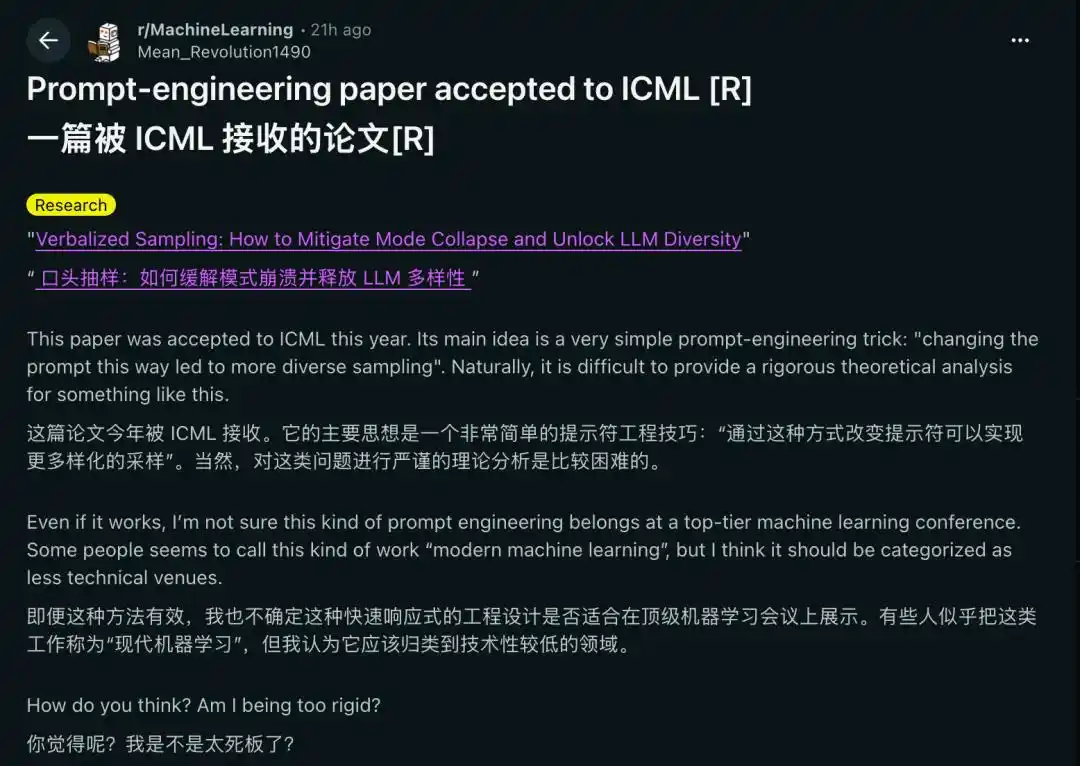
The authors didn't propose any new optimization algorithms or train any new large models. They simply did one thing—

Modified the Prompt.

The paper proposes a method called Verbalized Sampling (VS), which significantly enhances the diversity of large language model outputs and alleviates the long-standing issue of Mode Collapse in LLMs, solely by adjusting the prompt.

It sounds quite practical, but is it right for a mere prompt trick to get into a top-tier conference?

Let's take a look at the paper first before passing judgment.

A Highly Controversial ICML Paper
Have you ever felt that AI is becoming increasingly homogeneous?

Ask it ten times to "Tell me a joke," and the answers you get are often highly similar. This is not only true for creative tasks but also for Q&A, code generation...

This phenomenon is collectively referred to as mode collapse in academia.

Simply put, models increasingly prefer to output the highest probability, safest, and most classic answers, while rejecting alternative creative ideas.
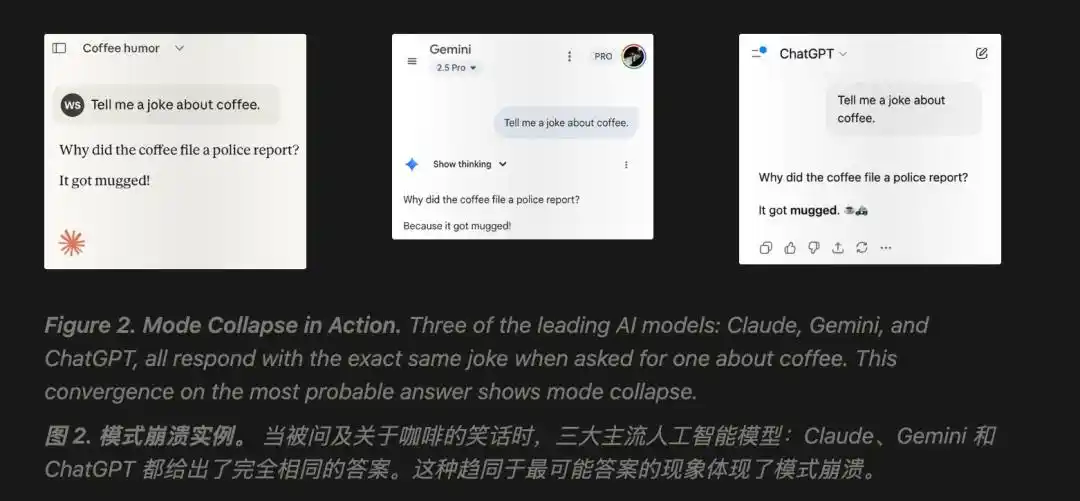
In the past, to solve this model problem, most researchers would first think of adjusting sampling parameters, modifying decoding algorithms, retraining, etc. However, this paper takes a different approach: directly asking the model to output its own sampling process along with the answer.

For example, using the earlier joke-telling scenario, the authors would modify the prompt, requiring the model to:

Generate 5 jokes, while also assigning a possible probability value to each joke.

Then the model can produce more varied and less repetitive answers.

It sounds very simple, doesn't it? In fact, this is the core contribution of the paper—the Verbalized Probability Sampling method. No fine-tuning is needed; just by changing the way of asking, content diversity can be significantly improved.
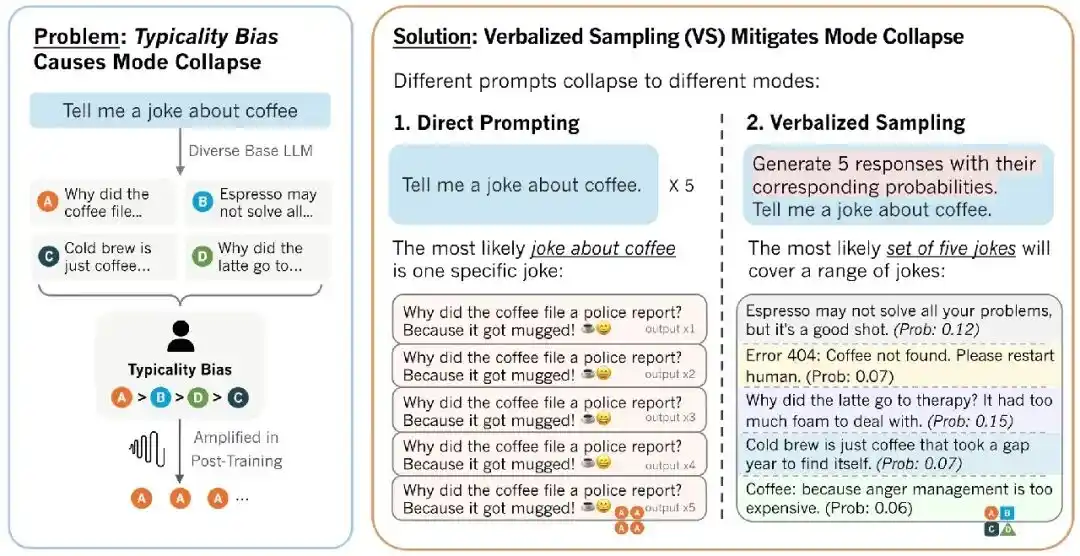
In the paper, however, the authors provide a rigorous argumentation process for this.

First, they address the root cause of the model's uniformity.

Past academia attributed this problem to algorithmic aspects, such as insufficient reward models or improperly set KL penalty terms. This paper delves deeper, suggesting the real root lies in the preference data itself.

They propose a concept called prototypical bias. From a cognitive psychology perspective, human annotators naturally prefer familiar, fluent, conventional text, and instinctively give higher scores to stereotypical, mainstream answers.
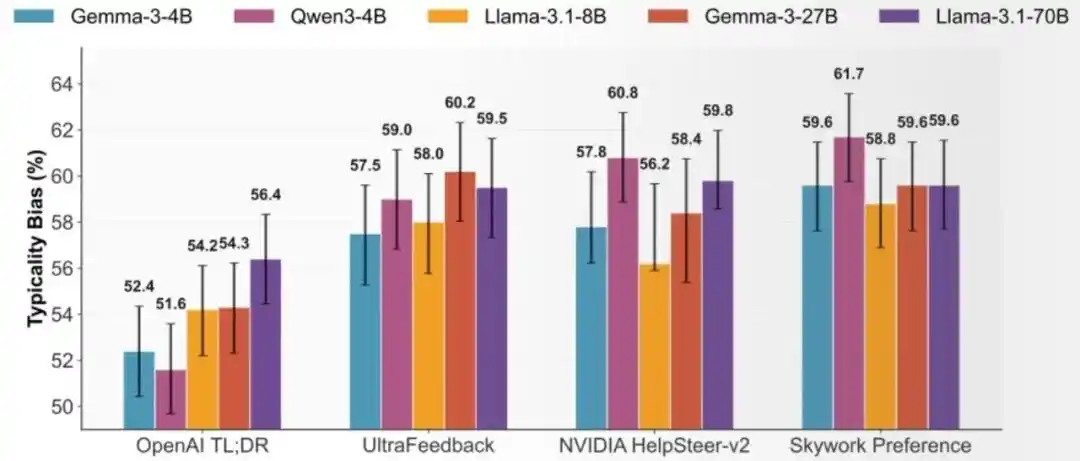
Therefore, even if reward models and optimization algorithms are perfected, as long as the human preference data used for training inherently contains prototypical bias, post-alignment models will still suffer from mode collapse.

The authors tested this repeatedly on five preference datasets and different base models, and the conclusion remained consistent.

After realizing this, the authors argue that since the problem is rooted in the training data, one only needs to consider designing a prompt-based correction scheme during the inference stage. That is, by making the model output the complete probability distribution in the prompt, the model's inherent diverse output distribution from the pre-training phase can be awakened, restoring diversity.

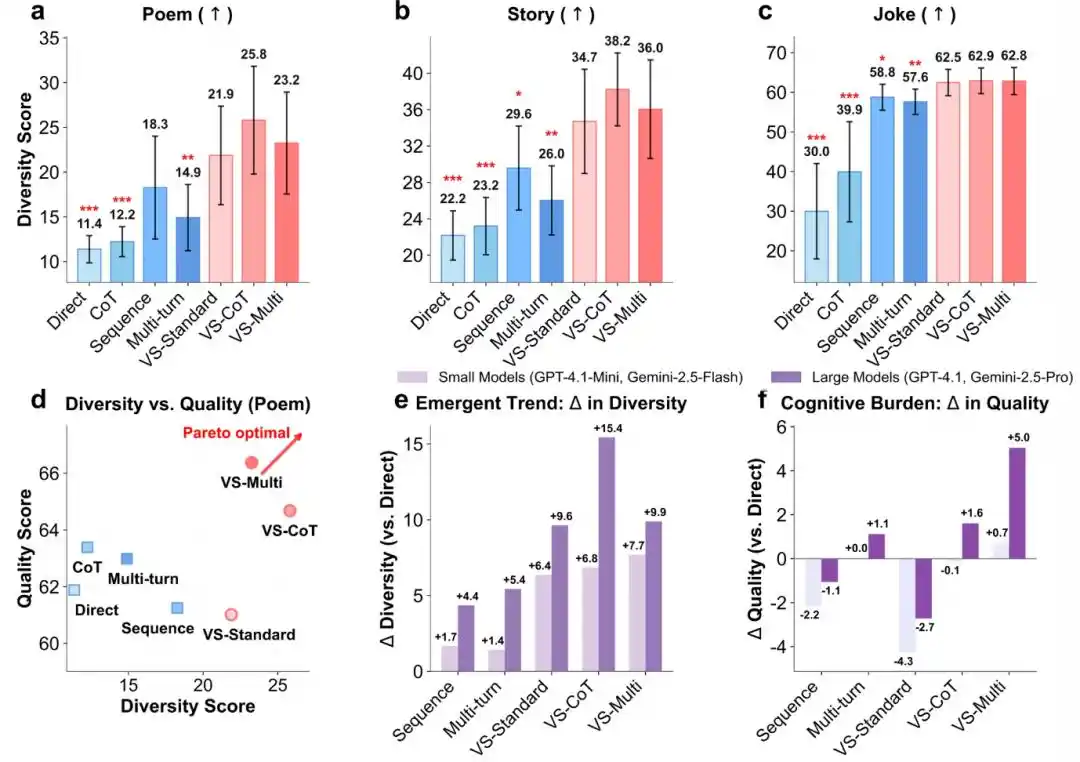
The rest involved running experiments with this method in various scenarios. The results show that in creative writing tasks, diversity was 1.6~2.1 times that of ordinary prompts, without reducing factual accuracy or compromising model safety.

Furthermore, the stronger the model's capabilities and the larger the parameter count, the more pronounced the diversity improvement brought by VS.
So, while the final method presented in the paper is simple, ICML still passed it.

Reddit Users in a Heated Debate

Under the original post, however, opinions on this paper are polarized.

Many netizens expressed that in the past, ICML featured hardcore innovations like new models, new algorithms, and new theories. Merely optimizing prompts or inference processes doesn't qualify as serious machine learning research.

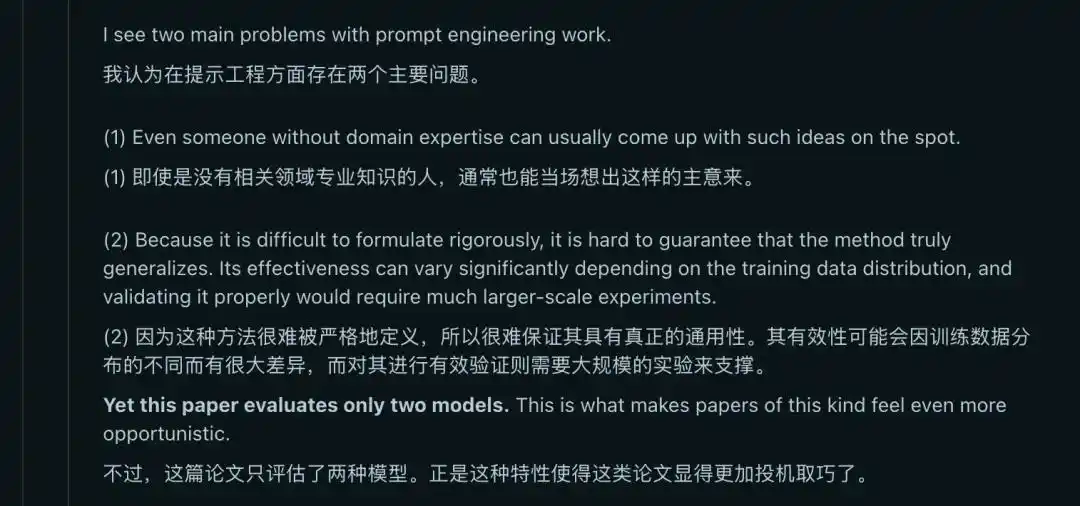
In comparison, the innovation of this work seems somewhat thin, and several issues exist:

First, similar instruction-writing methods are not unique; some even claimed they were writing prompts like this just yesterday. Second, the theory is difficult to verify because prompts might fail when models are changed, unlike algorithms which are more stable. Third, the experimental scale is limited, insufficient to prove this is a universal law.
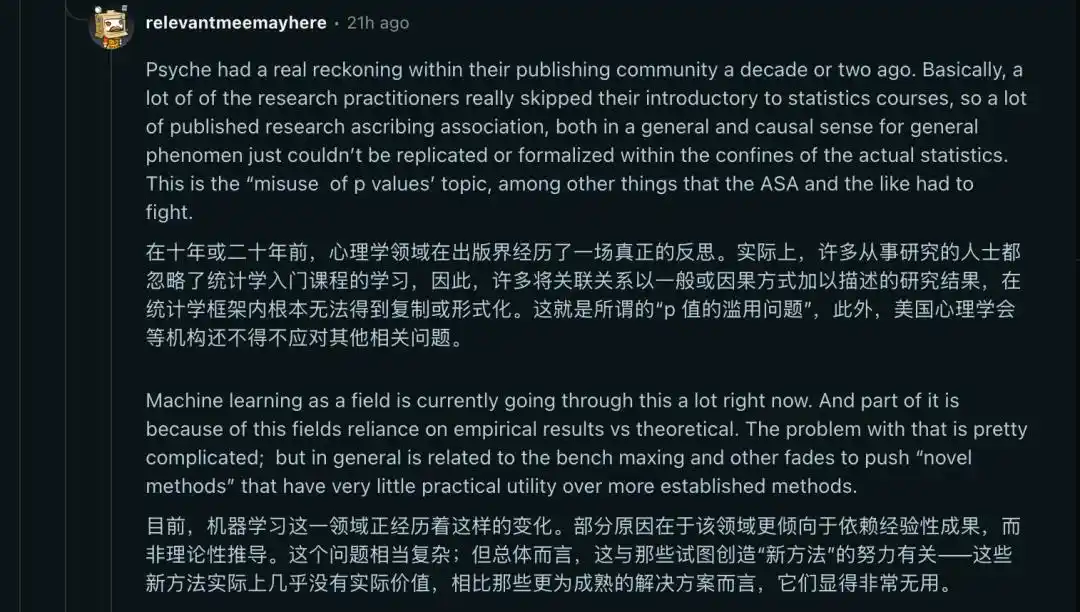
Some netizens directly compared the current state of the machine learning field to the academic crisis in psychology over a decade ago.

Back then, many researchers had weak statistical foundations and misused statistical tools, leading to many papers with unreproducible conclusions and a severe trust crisis in the field. Similarly, the machine learning industry now heavily relies on empirical experiments and undervalues rigorous theoretical support.

The industry is internally competitive, chasing new methods, but there's a widespread atmosphere of excessive hyperparameter tuning and benchmark score chasing. Many so-called innovative algorithms offer little practical value compared to mature baseline models, being packaged as innovative achievements based on tiny metric improvements.

Essentially, these are issues in paper publishing caused by unclear professional standards following the rapid expansion of the discipline.
But supporters argue that scientific research is not about whose method is more complex. As long as the hypothesis is clear, experiments are sufficient, and results are stable and reproducible, it can still be excellent research.

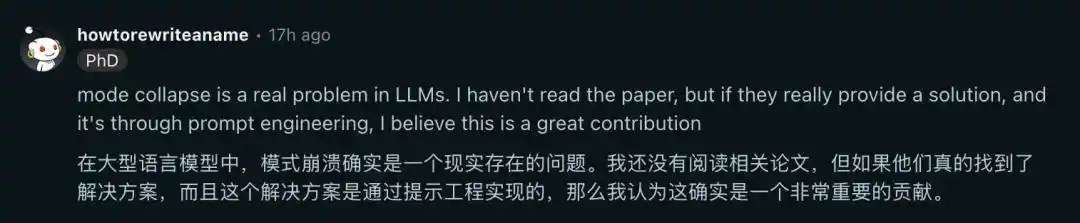
For example, this paper thoroughly explains what mode collapse is and proposes that the real problem lies in prototypical bias—a viewpoint more important than the prompt itself.
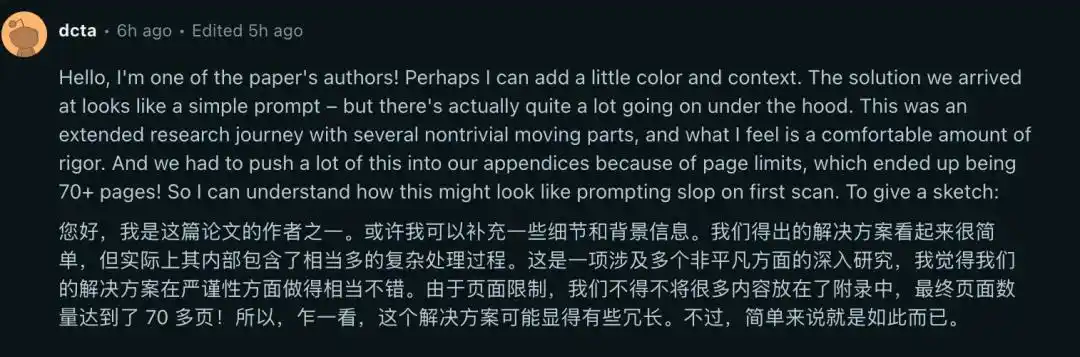
One of the authors also replied in the comments, stating that while the paper appears simple, it actually involves a great deal of complex processing.

The entire work includes complete problem tracing, new theoretical attribution, mathematical derivation, and multi-dimensional quantitative experiments—it's not a shallow, trivial prompt-tuning effort.
Many also mentioned Chain-of-Thought (CoT). When CoT first appeared, it was essentially a one-line prompt:

Let’s think step by step.

But now, almost all reasoning methods can be traced back to CoT. This precisely indicates that prompt engineering is no longer just about writing prompts; it is becoming a new method for studying model behavior.

Over the past decade, machine learning research has almost revolved around training. But now, some usage techniques during the inference stage are gradually moving toward the core of machine learning research.

Perhaps in the coming years, we will see more and more papers like this. They don't add a single line of training code or an extra model parameter, yet they can still change the capability boundaries of large models.

Research Team Introduction

Finally, let's take a look at the research team.

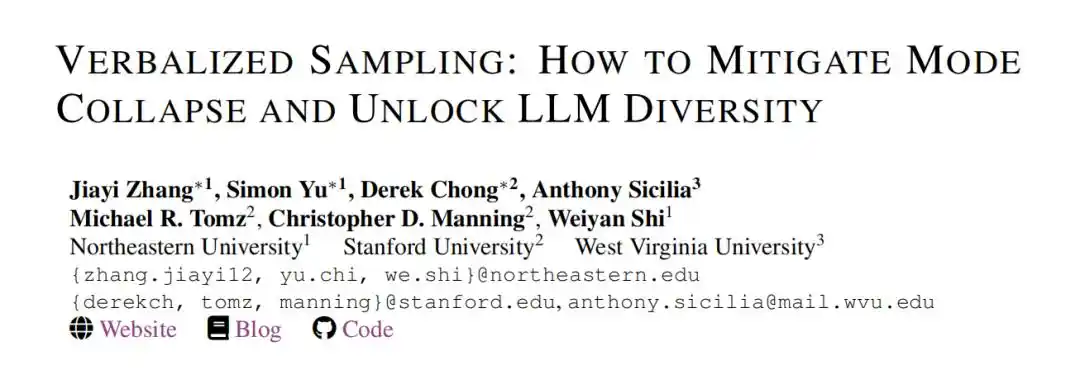
This work was completed by Weiyan Shi's team at Northeastern University (USA) in collaboration with Stanford's Manning Lab and West Virginia University. Jiayi Zhang, Simon Yu, and Derek Chong are listed as co-first authors.

Jiayi Zhang completed her undergraduate studies at the University of Michigan, earning triple bachelor's degrees in Computer Science, Mathematics, and Linguistics. She then pursued a Master's in Computer Science at Northeastern University (USA).

Another paper of hers, "Analyzing the Role of Semantic Representations in the Era of Large Language Models," accepted by the NLP top conference NAACL 2024, also revolves around semantic representation and large models.

Simon Yu is currently pursuing a Ph.D. at Northeastern University (USA), with his main research direction focusing on alignment and reinforcement learning mechanisms in large models. He completed both his bachelor's and master's degrees at the University of Edinburgh and has published several top conference papers.

Besides this paper, another one of his papers, "Unsafer in Many Turns: Benchmarking and Defending Multi-Turn Safety Risks in Tool-Using Agents," was also accepted by ICML 2026.

Derek Chong earned his Master's from Stanford University and is currently a researcher at the Stanford Artificial Intelligence Laboratory. His research primarily focuses on large language models in NLP.

He previously had three years of experience as a founder-entrepreneur and worked at Ello as an Applied Scientist, participating in industry-end AI implementation R&D. He possesses both solid theoretical research skills and rich hands-on practical experience.

References:[1]https://www.reddit.com/r/MachineLearning/comments/1uv1xb3/promptengineering_paper_accepted_to_icml_r/

[2]https://www.linkedin.com/in/jiayizx/[3]https://simonucl.github.io/[4]https://www.linkedin.com/in/derekch/

This article is from the WeChat public account "Qubit" (量子位), author: Focus on Frontier Technology


Трендові криптовалюти

Пов'язані питання

QWhat is the main contribution of the 'Verbalized Sampling' paper accepted at ICML 2026?

AThe main contribution is a method called 'Verbalized Sampling' (VS), which involves adjusting prompts to ask language models to output their sampling process (e.g., assign probabilities to multiple generated answers). This simple intervention significantly increases the diversity of LLM outputs and mitigates the 'mode collapse' problem without requiring model retraining or new algorithms.

QAccording to the paper, what is identified as the root cause of the mode collapse problem in LLMs?

AThe paper identifies the root cause as 'typicality bias' in the human preference data used for training. This cognitive bias leads human annotators to consistently favor familiar, fluent, and conventional text. Consequently, the reward models trained on this data steer aligned models towards safe, high-probability answers, causing mode collapse.

QWhat are some of the key criticisms from Reddit users regarding this paper's acceptance at ICML?

ACritics argue that the innovation is thin, noting similar prompt techniques are already in use and questioning the method's stability across different models. They also contend that the experimental scale is insufficient to prove a universal law and express concern that the field is drifting towards an over-reliance on empirical results and 'benchmark hacking' rather than rigorous theoretical contributions.

QHow do the paper's supporters defend its value and acceptance at a top-tier conference?

ASupporters argue that good research is defined by clear hypotheses, rigorous experimentation, and reproducible results, not just complexity. They highlight that the paper's core contribution is the novel theoretical insight into the cause of mode collapse (typicality bias). They also compare it to foundational techniques like Chain-of-Thought, suggesting prompt engineering is evolving into a legitimate method for studying model behavior.

QWhat was the observed impact of the Verbalized Sampling method on creative writing tasks?

AIn creative writing tasks, the Verbalized Sampling method increased output diversity by 1.6 to 2.1 times compared to standard prompting, without compromising factual accuracy or model safety. The effectiveness of the method was also shown to be more pronounced in larger, more capable models.

Пов'язані матеріали

From Being Ignored to the Venture Capital Queen Investing: Has AI Revived This Ultra-Niche Sector?

From obscurity to receiving investment from the "queen of venture capital," AI has revitalized the ultra-niche social networking track. In recent years, the social networking sector experienced a deep freeze in venture capital, with high-profile projects like the video social app "Huayin" (founded by a former WeChat core team member) and the offline-online dating app "Single's Tavern" ultimately failing. These failures underscored the immense difficulty of challenging WeChat's dominance in熟人社交 (close-contact social networking) and the general lack of scalable monetization paths for niche concepts like metaverse, female-only, or Muslim community apps. However, a shift emerged in 2025. "Liangpei," an AI-powered matchmaking company, secured a $2 million angel round from Today Capital, led by renowned investor Xu Xin. Its approach uses AI conversational profiling to create detailed user matches and charges only upon successful connections. Similarly, projects like "Pixel Rhythm" (reportedly focused on AI-assisted content creation for Gen Z overseas) and "Moobius" (AI-native group chat) signal a new trend. The investment logic has fundamentally changed. Instead of pursuing broad, traffic-driven "platform dreams" to compete with giants like WeChat, Douyin, or Soul, the new wave focuses on using AI as a tool to solve specific, high-pain-point problems for targeted, niche user segments. The path to viability now lies in achieving healthy cash flow by solving a concrete problem rather than chasing massive scale.

marsbit18 хв тому

From Being Ignored to the Venture Capital Queen Investing: Has AI Revived This Ultra-Niche Sector?

marsbit18 хв тому

From TrueFi to Elara: Why the Next Stop for On-Chain Finance is Liquidity Infrastructure?

From TrueFi to Elara: Why On-Chain Finance's Next Stage is Liquidity Infrastructure? The article analyzes the evolving focus in decentralized finance, shifting from narrative-driven expansion to robust, operationally sound infrastructure. The author, drawing from experience at TrueFi and building Elara, argues that early DeFi incorrectly assumed technological superiority alone would force adoption. Instead, financial systems evolve through workflow compatibility. Traditional finance prioritizes stability and predictability, creating intentional "viscosity" (friction) through controls, which slows execution but ensures durability. Crypto-native systems minimized friction for rapid experimentation and iteration but often lacked operational safeguards, leading to reflexive liquidity that can disintegrate under stress. The core insight is that sustainable on-chain finance cannot rely solely on isolated products like RWA lending or token incentives. The real opportunity lies in a coordinated financial architecture for liquidity management, collateral coordination, and capital deployment. Elara is presented as an example of this next-generation "programmable treasury infrastructure"—a yield-bearing, dollar-pegged collateral asset designed for capital efficiency and operational flexibility within fragmented digital markets. A key architectural decision separates liquidity from yield generation, allowing the collateral to remain liquid and programmable while accruing value. The funding environment has also shifted. Investors now prioritize operational proof—working systems, integrations, and controls—over visionary narratives. Competitive advantage comes from building systems that endure under real market conditions, not just launching quickly. Ultimately, the path forward is not a sudden replacement of traditional finance but a selective hybridization. Lasting infrastructure will combine the iterative speed of digital assets with the control architecture of traditional finance. Systems like Elara are built to operate efficiently in today's low-viscosity crypto markets while embedding the operational discipline—compliance, reporting, risk management—required to eventually support institutional capital as it gradually integrates with on-chain settlement rails. The focus is not on who launches first, but on who can build infrastructure capable of managing both high-speed digital-native liquidity and the slower, more deliberate flow of institutional capital.

marsbit28 хв тому

From TrueFi to Elara: Why the Next Stop for On-Chain Finance is Liquidity Infrastructure?

marsbit28 хв тому

Understanding the Q2 Crypto Market in 5 Charts: RWA Explosion, Fundamentals Continue to Recover

Summary of Q2 Crypto Market: RWA Boom and Continued Fundamental Recovery The second quarter of 2026 presented a mixed picture for the crypto market. While major crypto asset prices declined by 36% in H1 2026, the fundamentals of the industry showed significant strength. Key highlights from Bitwise's market review include: 1. **Divergence Between Crypto Stocks and Tokens:** Crypto-related public equities, tracked by the Bitwise Crypto Innovators 30 Index, rose 23% in H1, outperforming most major asset classes. This signals robust investment opportunities within the crypto ecosystem, such as Bitcoin miners benefiting from AI and traditional finance firms deepening crypto integration, even during a bear market for tokens. 2. **Substantial Crypto Application Revenue:** Leading decentralized applications generated a combined $5.9 billion in revenue over the past 12 months, with top protocols like PancakeSwap, Hyperliquid, and Aave each nearing $1 billion. This demonstrates the existence of real, revenue-generating businesses within the sector. 3. **Breakout Growth in Real-World Asset (RWA) Tokenization:** The total value of tokenized real-world assets reached a record $33 billion in Q2, up 12% quarterly and 45% year-to-date. Growth is driven by tokenized U.S. Treasuries, corporate credit, equities, and venture capital shares, indicating accelerating institutional adoption. 4. **Expanding Prediction Markets:** Prediction market open interest hit a new high of $1.8 billion in Q2, with sports being a key category. Quarterly trading volume also reached a record $43 billion. Platforms like Polymarket represent a form of mainstream, albeit often unaware, adoption of crypto infrastructure for event betting, with further growth expected around the U.S. midterm elections. 5. **Attractive Profile of Crypto Equities:** The Bitwise Crypto Innovators 30 Index exhibited low 90-day rolling correlations with most major assets (developed market stocks, EM stocks, REITs, bonds, gold) and negative correlation with commodities. This combination of high returns and portfolio diversification is highly attractive to institutional investors. In conclusion, despite weak token prices, core industry fundamentals—including user activity, business revenues, and institutional adoption—continue to advance, building a strong foundation for the next market cycle.

Foresight News57 хв тому

Understanding the Q2 Crypto Market in 5 Charts: RWA Explosion, Fundamentals Continue to Recover

Foresight News57 хв тому

GPT-5.6 Cracks a 50-Year-Old Math Problem in 1 Hour, 64 AIs Claim the Crown Jewel of Graph Theory

OpenAI announced that its AI model, GPT-5.6 Sol Ultra, has successfully proved the 50-year-old Cycle Double Cover (CDC) conjecture in graph theory in under an hour. This long-standing problem, posed independently by several prominent mathematicians, states that every bridgeless finite undirected graph contains a set of cycles where each edge is covered exactly twice. The breakthrough was achieved using a novel "parallel test-time computation" (TTC) approach. Instead of a single AI working sequentially, the system deployed 64 concurrent AI agents, each exploring distinct proof strategies—from algebraic perspectives to structural induction. The process included strict protocols to avoid common research pitfalls: initial exploration of fundamentally different paths, preventing herd mentality by not revealing the most promising direction, and employing a "critic squad" of agents to rigorously attack and verify every proposed proof step. The system forbade vague assertions, demanding concrete lemmas and constructions. The resulting proof, generated by GPT-5.6 and formatted with Codex, employed a sophisticated multi-step strategy. It first reduced the general case to cubic graphs, then leveraged Tutte's group-flow theorem to establish the existence of a nowhere-zero 8-flow on the graph. A key inventive step was introducing a "two-element set" labeling scheme (Lemma 2.1), which, if satisfied, guarantees a cycle double cover. The AI then transformed this combinatorial condition into a large system of linear equations (Lemma 2.2), using linear algebra over finite fields to conclusively demonstrate that a solution always exists. Researchers highlighted that parallel TTC dramatically compressed the reasoning time, making deep, extended AI problem-solving practically feasible. While some observers marveled at the implications for mathematics and science, others questioned whether parallel breadth can fully substitute for deep, continuous logical chains. Nonetheless, this achievement marks a significant advance in AI's autonomous capacity for high-level abstract reasoning and complex proof generation.

marsbit1 год тому

GPT-5.6 Cracks a 50-Year-Old Math Problem in 1 Hour, 64 AIs Claim the Crown Jewel of Graph Theory

marsbit1 год тому

Торгівля

Спот

Популярні статті

Що таке G$

Розуміння GoodDollar ($G$): План для децентралізованого універсального базового доходу Вступ У постійно змінному ландшафті криптовалют та технології блокчейн ініціативи, що прагнуть вирішити нагальні соціальні проблеми, привертають все більше уваги. Одним із таких проектів є GoodDollar ($G$), рішення для універсального базового доходу (UBI) на базі Web3. GoodDollar намагається подолати нерівність і скоротити розрив у багатстві, створюючи та розподіляючи доступні економічні ресурси тим, хто найбільше цього потребує. Завдяки інноваційному використанню децентралізованих фінансів (DeFi) GoodDollar представляє унікальну модель, яка може суттєво змінити сприйняття та надання фінансової допомоги у всьому світі. Що таке GoodDollar ($G$)? GoodDollar - це криптовалютний протокол, який полегшує випуск і розподіл цифрових токенів, що називаються $G$, своїм зареєстрованим користувачам на щоденній основі. Ці токени функціонують як форма універсального базового доходу, сприяючи фінансовій підтримці людей з різних культур, особливо тих, хто традиційно виключений із фінансової системи. Функціонуючи на блокчейні, GoodDollar використовує кілька мереж, включаючи Ethereum, Celo та Fuse, забезпечуючи широкий доступ і зручність. Основною метою GoodDollar є зробити криптовалюту доступною та вигідною для всіх, незалежно від їх економічного старту. Творець GoodDollar ($G$) Деталі щодо творця GoodDollar залишаються дещо неясними. Однак варто зазначити, що проект має сильну підтримку від eToro, широко визнаної інвестиційної платформи, яка надала початкове фінансування та основну підтримку для розвитку GoodDollar. Візія проекту не є виключно прибутковою, а більше схиляється до соціального підприємництва, прагнучи до системних змін у економічній доступності. Інвестори GoodDollar ($G$) GoodDollar користується фінансовою підтримкою та оперативною підтримкою eToro. Це партнерство зіграло значну роль у запуску протоколу та його подальшому розвитку. Хоча eToro відігравала важливу роль у встановленні основ проекту, GoodDollar прагне перейти до моделі, що фінансується її спільнотою в довгостроковій перспективі. Цей перехід до фінансування спільнотою відповідає зобов'язанням GoodDollar щодо децентралізації, що дає можливість її користувачам мати прямий інтерес у майбутньому проекту. Як працює GoodDollar ($G$)? Операційна структура GoodDollar значною мірою базується на принципах DeFi для генерації процентів від застрахованих криптовалют. Цей механізм дозволяє проекту карбувати та розподіляти токени $G$ як цифровий базовий дохід для користувачів у всьому світі. Декілька ключових характеристик роблять GoodDollar унікальним і інноваційним: Універсальний базовий дохід (UBI): Щодня зареєстровані користувачі отримують безкоштовні токени, що встановлює автоматичний потік доходу, призначений для полегшення фінансового тиску. Стійка економічна модель: Токеноміка проекту націлена на балансування попиту та пропозиції токенів $G$, щоб забезпечити стабільність їхньої вартості з часом. Токени з резервами: Кожен токен $G$ забезпечується резервом криптовалют, що надає йому вбудовану цінність і надійність, що є критично важливим для підтримки довіри користувачів. Децентралізоване управління: GoodDollar впроваджує демократичний підхід до прийняття рішень через управління на основі токенів. Це дозволяє членам спільноти активно брати участь у формуванні траєкторії проекту, роблячи його дійсно орієнтованим на спільноту. Глобальна доступність: GoodDollar створив значний слід у спільноті, з понад 640 000 членами в 181 країні. Такий широкий охват є інструментом у полегшенні UBI на глобальному рівні. Хронологія GoodDollar ($G$) Еволюція GoodDollar позначена кількома значними етапами в його історії: 2019: Запуск гаманця GoodDollar став першим кроком до реалізації його бачення надання UBI через криптовалюту. 2020: Після успішного впровадження гаманця, протокол GoodDollar офіційно дебютував. Це ознаменувало критичну фазу в його місії надання щоденних розподільних доходів. 2021: Проект далі прогресував із запровадженням свого Децентралізованого автономного органу (DAO), що сприяло більшій залученості спільноти та управлінню. 2022: GoodDollar представив свою дружню до DeFi версію 2 (V2), прагнучи до підвищення залученості користувачів та ефективності роботи. Того ж року також відбувся перехід до децентралізованої структури управління через GoodDAO. 2022: Була концептуалізована нова дорожня карта, зосереджена на ініціативах, таких як грантова програма, спрямована на просування підприємницьких проектів, пов'язаних з $G$, і оновленого ринку GoodDollar. Ключові особливості GoodDollar ($G$) Проект GoodDollar вводить численні важливі особливості, спрямовані на переосмислення ландшафту базового доходу: Універсальний базовий дохід: Щоденна доставка безкоштовних токенів своїм користувачам основополагає його місію з усунення економічної нестабільності. Багатоканальна операція: Використання кількох блокчейн-мереж підвищує доступність і масштабованість, забезпечуючи ширшу участь. Взаємодія з децентралізованими фінансами: Використання DeFi дозволяє забезпечити сталість фінансування моделі UBI, зміцнюючи її життєздатність як економічного рішення. Залучення спільноти та управління: GoodDollar передбачає модель, в якій спільнота впливає на операції через демократичну участь, що сприяє прозорості та підзвітності. Глобальна спільнота: Наявність різноманітної глобальної спільноти дозволяє проекту реалізовувати рішення UBI, адаптовані до різних культурних та економічних контекстів. Висновок GoodDollar представляє собою трансформаційний крок до впровадження принципів універсального базового доходу через інноваційний погляд на технологію блокчейн. Використовуючи децентралізовані фінанси, проект не лише пропонує рішення для фінансової нерівності, але й активно залучає користувачів до його управління та операцій. Зростаюча спільнота та еволюційна дорожня карта роблять GoodDollar значущим гравцем на перетині криптовалюти та соціального добра, прокладаючи шлях до більш справедливого фінансового майбутнього. Як він продовжує еволюціонувати, шлях GoodDollar може в кінцевому підсумку надихнути інші ініціативи розглянути подібні моделі, просуваючи справу економічного розширення можливостей для всіх.

134 переглядів усьогоОпубліковано 2024.04.05Оновлено 2024.12.03

Що таке G$

Як купити G

Ласкаво просимо до HTX.com! Ми зробили покупку Gravity (G) простою та зручною. Дотримуйтесь нашої покрокової інструкції, щоб розпочати свою криптовалютну подорож.Крок 1: Створіть обліковий запис на HTXВикористовуйте свою електронну пошту або номер телефону, щоб зареєструвати обліковий запис на HTX безплатно. Пройдіть безпроблемну реєстрацію й отримайте доступ до всіх функцій.ЗареєструватисьКрок 2: Перейдіть до розділу Купити крипту і виберіть спосіб оплатиКредитна/дебетова картка: використовуйте вашу картку Visa або Mastercard, щоб миттєво купити Gravity (G).Баланс: використовуйте кошти з балансу вашого рахунку HTX для безперешкодної торгівлі.Треті особи: ми додали популярні способи оплати, такі як Google Pay та Apple Pay, щоб підвищити зручність.P2P: Торгуйте безпосередньо з іншими користувачами на HTX.Позабіржова торгівля (OTC): ми пропонуємо індивідуальні послуги та конкурентні обмінні курси для трейдерів.Крок 3: Зберігайте свої Gravity (G)Після придбання Gravity (G) збережіть його у своєму обліковому записі на HTX. Крім того, ви можете відправити його в інше місце за допомогою блокчейн-переказу або використовувати його для торгівлі іншими криптовалютами.Крок 4: Торгівля Gravity (G)Легко торгуйте Gravity (G) на спотовому ринку HTX. Просто увійдіть до свого облікового запису, виберіть торгову пару, укладайте угоди та спостерігайте за ними в режимі реального часу. Ми пропонуємо зручний досвід як для початківців, так і для досвідчених трейдерів.

505 переглядів усьогоОпубліковано 2024.12.10Оновлено 2026.06.02

Як купити G

Що таке @G

Graphite Network, $@G: Міст між традиційними фінансами та Web3 Вступ до Graphite Network, $@G У яскравому світі криптовалют та проектів web3 Graphite Network виступає як маяк інновацій. З його рідним токеном, $@G, цей блокчейн Layer-1, що працює на основі Proof-of-Authority (PoA), призначений для подолання розриву між традиційними фінансами (TradFi) та швидко розвиваючою екосистемою Web3. Оскільки цифрові валюти набирають популярності, Graphite Network прагне запропонувати блокчейн-платформу, яка пріоритетно ставить безпеку, відповідність та швидкість, представляючи себе як посередника довіри та підзвітності. Що таке Graphite Network, $@G? Graphite Network не просто ще один блокчейн-проект; він має на меті переосмислити, як децентралізація, безпека та підзвітність користувачів сприймаються у сфері цифрових фінансів. Проект має ряд відмінних характеристик: Блокчейн на основі репутації: У своїй основі Graphite Network реалізує політику один користувач, один рахунок, підкріплену інтегрованою перевіркою Know Your Customer (KYC) та механізмами оцінки. Цей дизайн забезпечує баланс між конфіденційністю користувачів та прозорістю — критично важливий аспект фінансових операцій у сучасному цифровому світі. Дохід від вузлів входу: Мережа стимулює користувачів налаштовувати вузли входу, що дозволяє операторам отримувати винагороди від транзакцій у мережі. Ця модель генерації доходу не лише підвищує залученість користувачів, але й зміцнює здоров'я мережі та децентралізацію. Сумісність з EVM: Завдяки віртуальній машині (VM), сумісній з Ethereum, Graphite Network забезпечує безшовну інтеграцію існуючих децентралізованих додатків (dApps) на Solidity та смарт-контрактів, запрошуючи розробників використовувати її можливості без значних модифікацій. Інтеграція KYC: В епоху, коли відповідність є надзвичайно важливою, інтегрована структура KYC з кількома рівнями перевірки підвищує контроль над фінансовими операціями без обов'язкової участі, встановлюючи прецедент для автономії користувачів. Хто є творцем Graphite Network, $@G? Graphite Network виник внаслідок зусиль Graphite Foundation, неприбуткової організації, що займається розвитком, підтримкою та еволюцією Graphite Network. Зобов'язання фонду підкреслює бачення проекту створити безпечне та стійке блокчейн-середовище, зосереджене на справжньому залученні користувачів та відповідності. Хто є інвесторами Graphite Network, $@G? На даний момент є обмежена інформація про конкретних інвесторів, які підтримують ініціативу Graphite Network. Засновницька організація, Graphite Foundation, функціонує незалежно, сприяючи зростанню проекту, одночасно шукаючи партнерства, які резонують з її баченням відповідальної та доступної блокчейн-платформи. Як працює Graphite Network, $@G? Операція Graphite Network ґрунтується на його унікальному механізмі консенсусу Proof-of-Authority, який досягає вражаючого балансу між високою пропускною здатністю та децентралізацією. Давайте розглянемо різні компоненти, які визначають його роботу: Транспортні вузли: Служачи вузлами входу, вони є критично важливими для екосистеми. Оператори можуть отримувати дохід від транзакцій, які проходять через мережу, що не лише надає можливості окремим користувачам, але й зміцнює децентралізацію мережі. Авторизовані вузли: У центрі Graphite Network знаходяться основні валідатори, які проходять суворі тести на відповідність, що включають надійну перевірку KYC разом з технічними оцінками. Цей рівень довіри є важливим для забезпечення високого рівня цілісності транзакцій у мережі. Система тікерів: Graphite Network використовує унікальну систему тікерів для своїх обгорнених токенів, позначених як @G. Ця функція підвищує ясність інтеграції активів, роблячи транзакції користувачів зрозумілими та простими. Інноваційний підхід Graphite Network відображає значний крок у вирішенні критичних питань цифрових фінансів, позиціонуючи себе вигідно для майбутнього, оскільки все більше користувачів переходять від традиційних форм фінансів до світу децентралізованих додатків. Хронологія Graphite Network, $@G Щоб зрозуміти прогрес і етапи Graphite Network, корисно переглянути ключові події в його хронології: 2021: Заснування Graphite Network Graphite Foundation знаменує початок нової ери в розвитку блокчейнів, зосереджуючись на відповідності та розширенні можливостей користувачів. Ключові події: Після запуску впровадження доходу від вузлів входу, встановлення моделі на основі репутації, інтегрована перевірка KYC та забезпечення сумісності з EVM представляють значні досягнення в проекті. Останні події: Постійний розвиток та зусилля Graphite Foundation зосереджені на покращенні функцій мережі, одночасно сприяючи зростанню екосистеми, демонструючи довгострокове зобов'язання до стійкості та інновацій. Додаткові ключові моменти Окрім своїх основних компонентів, Graphite Network охоплює кілька інструментів та функцій, які підвищують його зручність: Гаманець Graphite: Зручне розширення для Chrome, яке полегшує доступ до різних функцій та додатків мережі на сумісних з Ethereum ланцюгах, підвищуючи зручність для користувачів. Міст Graphite: Цей інструмент дозволяє безшовні передачі активів Graphite через різні мережі, сприяючи інтегрованій та взаємодійній екосистемі. Explorer Graphite: Служачи важливим інструментом у межах екосистеми, ця функція дозволяє користувачам переглядати та перевіряти вихідний код смарт-контрактів, відстежувати транзакції та досліджувати іншу важливу інформацію в реальному часі. Тестова мережа Graphite: Проект забезпечує надійне тестове середовище для розробників, дозволяючи їм забезпечити стабільність та масштабованість перед розгортанням у основній мережі. Ця ініціатива не лише надає можливості розробникам, але й підвищує надійність усієї мережі. Висновок Graphite Network з його рідним токеном $@G представляє значний крок до подолання розриву між традиційними фінансами та передовими блокчейн-технологіями. Зосереджуючись на безпеці, відповідності та децентралізації, ця інноваційна платформа готова очолити перехід у еру Web3. Оскільки залучення користувачів зростає, а все більше проектів використовують її можливості, Graphite Network має всі шанси зробити тривалі внески в швидко змінюваний цифровий ландшафт. На завершення, Graphite Network є свідченням того, що можна досягти, коли інноваційне мислення зустрічається з зростаючими вимогами сучасних фінансів та технологій. Оскільки світ досліджує потенціал децентралізованих фінансів, Graphite Network, безумовно, залишиться помітним гравцем у цій сфері.

27 переглядів усьогоОпубліковано 2025.01.06Оновлено 2025.01.06

Що таке @G

Обговорення

Ласкаво просимо до спільноти HTX. Тут ви можете бути в курсі останніх подій розвитку платформи та отримати доступ до професійної ринкової інформації. Нижче представлені думки користувачів щодо ціни G (G).

活动图片