The Success of Robinhood Chain Proves Ethereum Is Not Dead

marsbitОпубліковано о 2026-07-13Востаннє оновлено о 2026-07-13

Анотація

The article argues that Robinhood's decision to build its own dedicated blockchain, Robinhood Chain, as an Ethereum Layer 2 (L2) using Arbitrum technology is a powerful endorsement of Ethereum's L1+L2 model, not a rejection of it. This move reflects a broader shift in the crypto industry from projects focused on token monetization to real-world businesses building cash-generating operations. Historically, many crypto projects chose infrastructure to support token sales and speculative value. In contrast, businesses like Robinhood and Coinbase (with Base) choose infrastructure based on commercial needs: security, liquidity, customer reach, and control. Ethereum's model provides a trusted, neutral, and liquid global settlement layer (L1) coupled with customizable, high-performance execution environments (L2s). This allows companies to maintain control and specialization without the cost and risk of building an independent L1 from scratch. The author contends that as more traditional enterprises enter the space to build sustainable businesses, they will rationally select Ethereum's L1 for maximum security and liquidity and its L2s for scalability and customization. This trend strengthens Ethereum's network effects and the utility of ETH as the native gas and asset within this expanding ecosystem. Robinhood's choice is thus seen as a landmark example of pragmatic business strategy aligning with Ethereum's architectural strengths.

Original Ryan Berckmans

Compiled / Odaily Planet Daily Golem

The previous era of the crypto industry dumped tokens via infrastructure, while its next era will choose Ethereum L1+L2 to build real businesses.

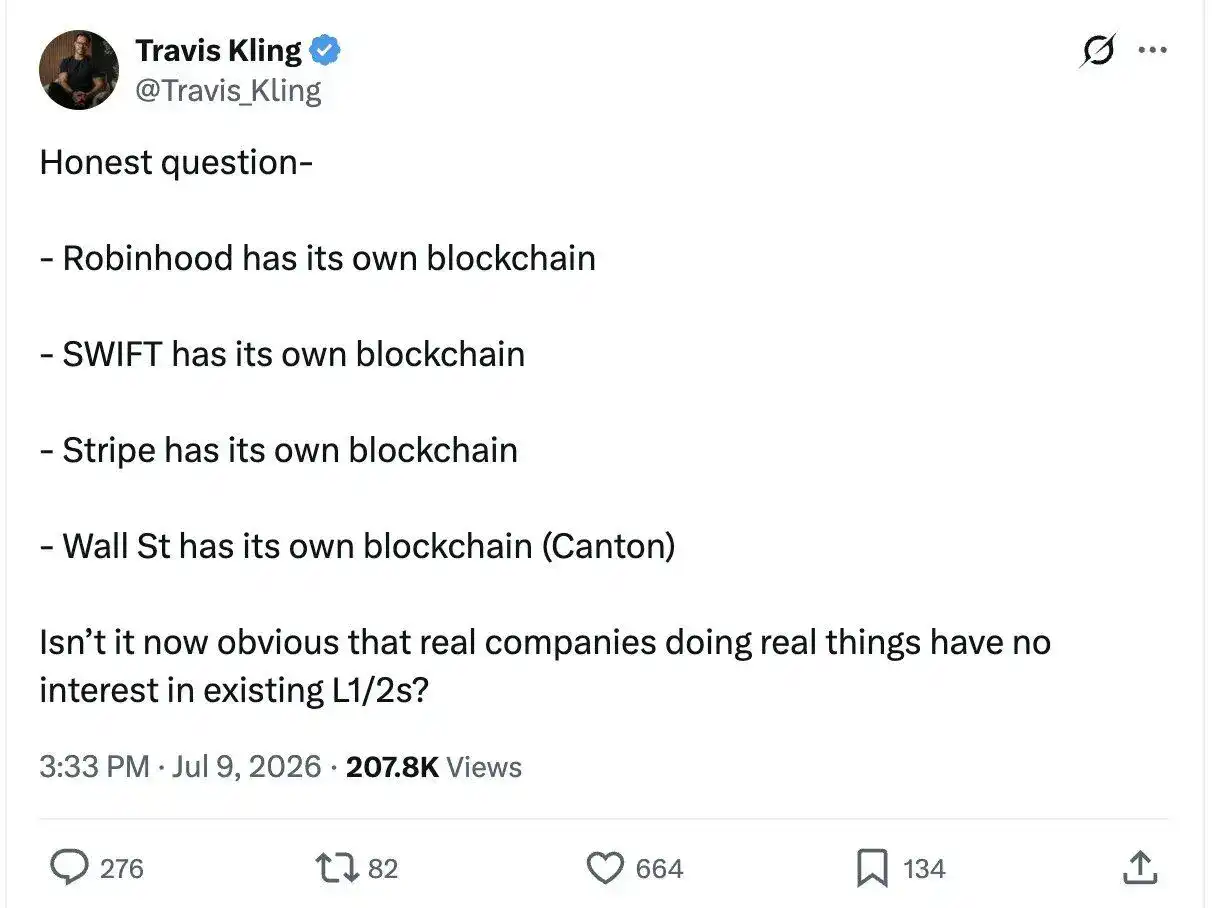
Travis Kling posed a question this week: "Is it now obvious that companies doing real business are not interested in L1/L2?" Robinhood was his first example. But on the contrary, Robinhood is almost a perfect counterexample: when entity companies make business decisions, they almost always choose the Ethereum L1+L2 model.
Robinhood chose an existing L1—Ethereum, and then built its own Ethereum L2 leveraging Arbitrum technology. Robinhood Chain uses Ethereum blobs for data availability, uses ETH as its native gas token, and its security is also provided by Ethereum.

Therefore, Robinhood has not negated Ethereum's L1+L2 model; on the contrary, the model is running on Robinhood as intended.

The "buyers" choosing Ethereum have changed. In the past, crypto projects chose public chains and technologies to sell their own tokens, while the emerging real-world on-chain economy is adopting the Ethereum L1+L2 model as the foundation for cash businesses.

As the composition of buyers changes, I believe Ethereum's advantages will become even more apparent.

The Old Crypto Economy Was Token-Centric

By "real businesses serving real users," I mean a traditional corporate model: building products customers need, earning profits by serving them, and increasing the equity value of those profits.

"Real users" here refers to consumption demand arising from ordinary economic needs, not speculative demand primarily generated by new token issuance. Crypto-native users are obviously real users. This is not a moral judgment on a protocol's usefulness or its developers' sincerity, but merely a distinction regarding the goal of operating a real economy business.

Token value can only come from three sources:

  • Cash: A reliable claim on future cash flows, similar to on-chain equity or bonds;
  • Utility: Access, control, governance, or other privileged participation rights to a valuable system. Even without cash flow, tokens that control important things clearly have value;
  • Monetary Premium: People hold the asset because they expect others to accept and recognize its value in the future. This asset is no longer merely a claim that must ultimately be exchanged for something else; it becomes a store of wealth—a terminal value asset.

The monetary premium is real but extremely difficult to sustain. It requires deep network effects in trust, liquidity, distribution, integration, and utility. Gold, the US dollar, Bitcoin, and Ethereum have all built different versions of this effect, while few other assets have achieved it.

Looking back, since programmable cryptocurrencies became popular, the vast majority of industry participants have not been ordinary cash flow businesses. Their economic goal has often been to sell a token whose value is primarily based on utility, an anticipated monetary premium, or distant promises of future cash.

Sometimes their plans were straightforward—launch a protocol and sell its token; sometimes more indirect—receive funding from a token-funded ecosystem and then cash out the tokens; sometimes a project genuinely expected future profitability, but since the token's valuation was detached from any plausible future cash, the actual business model still relied on confidence in the token itself.

This became the norm because almost every project was doing something similar, but there were exceptions.

Centralized exchanges are inherently cash transaction platforms and are naturally multi-chain, adding another chain is like adding another deposit/withdrawal channel. Some stablecoin issuers are also cash transaction businesses, initially serving crypto-native clients and now rapidly expanding into the broader economy.

But these exceptions precisely prove the point: Businesses aiming for ordinary cash transactions choose infrastructure that maximizes their business, not token value.

Different Business Goals Will Build Different Projects

A business's ultimate goal determines its technology choices.

If the goal is a cash transaction business, then blockchain is infrastructure, and the selection criteria are to reduce risk, improve the product, reach customers, and secure profits. If the goal is token monetization, then blockchain choice has more degrees of freedom. After receiving funding from a public chain, a business can choose to develop on the chain that funded it.

For example, if a protocol succeeds on Chain A, you can launch a similar protocol on Chain B so investors can price your token by comparison. Want momentum for a new token? Then a new L1, L2, appchain, gas token, governance system, or a particular tech stack can become selling points.

The problem is not technological diversity itself; the crypto industry will continue to see an explosion of applications, protocols, L2 architectures, and specialized execution environments. The problem is the tendency to turn every new idea into a sovereign, independent ecosystem (with its own L1 architecture, security validation, liquidity base, and monetary asset), regardless of whether the underlying product warrants it.

As the industry now shifts toward cash businesses, experiments continue, but they will increasingly be built on shared infrastructure. Businesses will specialize at the application layer or on L2s, while relying on the Ethereum L1 layer for settlement, security validation, liquidity maintenance, and monetary asset management. The result is not less innovation, but a balance: more diversity at the edges, more concentration at the base.

The traditional crypto economy typically chose architecture around the token it wanted to sell, while the emerging on-chain economy will choose architecture around the product it wants its customers to buy.

The Buyers Are Changing

The future of the crypto industry will be fundamentally different from the past because the "buyers" have changed.

Previous US administrations actively suppressed on-chain transaction development. Now this trend has reversed. The GENIUS Act is now in effect, providing a legal framework for payment stablecoins, and Europe's MiCA regulatory framework is fully applicable. Brokers, payment companies, banks, asset managers, and governments worldwide are formulating strategies for stablecoins, tokenization, and on-chain transactions.

This doesn't mean all regulatory issues are resolved, but at least it shows large institutions can attempt more blockchain business.

We are approaching the beginning of the S-curve for true crypto industry adoption.

When we emerge from this phase, the crypto industry and traditional finance will no longer be distinct categories. Property, money, transactions, finance, identity, and trust will all be coordinated through a network of on-chain and off-chain systems. Eventually, "Web 3" will fade away like "Web 2," and everything will simply be the internet.

As this process advances, a larger proportion of crypto market participants will be entity businesses serving ordinary consumers in the broader economy. This proportion will be reflected not just in the number of companies, but in capital volume, user numbers, asset scale, and institutional influence.

These companies are no longer crypto projects seeking a business model to support their token, but businesses using crypto technology to optimize existing or emerging cash businesses. This determines their technology choices. Infrastructure choices made for token economics do not well guide choices made for cash economics.

Entity Businesses Won't Build Infrastructure from Scratch

Typically, entity businesses have limited budgets for risky infrastructure development. They don't want consensus mechanisms, cross-chain bridges, validator economics, gas, governance tokens, and liquidity bootstrapping to become six separate side hustles. Each additional element must create customer value or it becomes a burden.

The chain should serve the business, not the business serve the chain.

Some businesses are inherently multi-chain. Exchanges, wallets, stablecoin issuers, and certain asset issuers may require broad distribution. Even then, "multi-chain" rarely means all chains are equally important. Different chains often have their own domains in terms of liquidity, issuance, settlement, product status, or deeper integration.

Most on-chain businesses need to commit to one chain or a small number of chains. Their choice typically takes three forms:

  • When on-chain businesses need maximum decentralization, credible neutrality, minimized risk, or liquidity, they use Ethereum L1 services. L1 execution is more costly because it bears the most powerful shared environment;
  • When businesses need control, customization, compliance, predictable unit economics, low latency, or high throughput, they build their own Ethereum L2. Because they can have their own dedicated chain as they wish, while maintaining a direct connection to Ethereum;
  • When businesses don't need L1 and building their own L2 isn't necessary, they typically use one or more mature shared L2s. Base, Arbitrum One, Robinhood, and other mature Ethereum L2s have become common deployment platforms.

These on-chain businesses will still bridge assets, "export products," and connect to other networks. Having a main chain doesn't mean isolation; importing, exporting, and interoperability are also core parts of on-chain business. But the main chain remains crucial. It determines the system's security, canonical state, liquidity relationships, operational model, and long-term dependencies.

Why Ethereum's L1+L2 Model Remains Useful

Ethereum separates the two major elements large enterprises need.

The L1 provides a highly decentralized, credibly neutral, and highly liquid global hub. L2s provide a market of fast, low-cost, specialized, controllable, and customizable execution environments.

The L1 remains neutral, while L2s at the edge can adapt to different operators, jurisdictions, products, and users. L2s extend Ethereum not just technically but also politically: organizations can operate their way without asking the global hub (L1) to become their private chain.

Independent L1s can offer control and performance advantages. In some cases, full sovereignty over consensus and data availability is worth it for a project, but acquiring it isn't cheap.

A new L1 must create and maintain its own security system, validator or operator set, bridges, liquidity, tooling, integrations, and reputation. It creates a new security and liquidity silo, increasing the cost and friction of interoperability with Ethereum L1 and the broader L2 economy (the dominant on-chain economic network).

For the vast majority of businesses, the value created by an independent L1 doesn't offset these costs.

A custom Ethereum L2 gets most of the business advantages a company wants from an independent L1: high TPS, control over execution, upgrades, fees, sequencing, latency, access rules, and product-specific features.

Furthermore, L2s provide advantages independent L1s don't inherently have: Ethereum for settlement and data availability, a standard L1 bridge, proximity to Ethereum's assets and capital, and a path for increasingly trust-minimized interoperability.

L2 design still matters. Admin keys, upgrade keys, proof systems, and withdrawal guarantees determine how much security users have at any moment. But even an L2 controlled by a few operators can offer users a solid settlement foundation on Ethereum L1. Companies don't need to operate and maintain their own L1 layer to run their business.

Ethereum L2s are both independent blockchains and part of the Ethereum economic system. They can own and customize their execution environment while leveraging Ethereum for settlement, data availability, and interoperability management.

L2s often deeply integrate ETH into their application economies, for example as the native Gas token. Canonical bridging models provide a trust-minimized path for capital and assets on L1 to enter the L2's "local economy." Each new L2 has a unique product interface, and Ethereum's network effects grow stronger.

Robinhood Made This Business Decision

Robinhood's development path is highly instructive.

It first launched stock tokens on the mature L2 Arbitrum One, validated the product, and understood its own needs, then launched a proprietary chain built on the Arbitrum platform.

This will likely become a standard strategy for entity businesses: build a business on a blockchain first, then upgrade to a dedicated L2 once scale, product needs, and unit economics justify it.

Robinhood Chain is customized for the financial services industry. It uses Arbitrum technology, offers 100-millisecond latency, predictable transaction pricing, high throughput, and infrastructure tailored to Robinhood's performance, security, and regulatory requirements.

At the same time, Robinhood Chain remains an Ethereum L2. It uses Ethereum blobs for data availability and uses ETH as the native gas. Its official bridge to Ethereum requires no third-party validator set. This is what it looks like when an entity business builds a real on-chain product.

Robinhood doesn't need to launch a Robinhood gas token or convince the public it's worthy of a lasting monetary premium. Robinhood itself owns stock; its economic gains come from customers, products, assets, transactions, and cash flow. Blockchain is just its infrastructure.

Using ETH as gas is a simple business decision. L2 services already use ETH to pay for L1 services. ETH is liquid, widely adopted, and the system's native token. If Robinhood used a proprietary Gas token, it would add issues of distribution, liquidity, pricing, and legality, and launching a token wouldn't improve Robinhood's core product.

Robinhood's success will depend on its application layer and the off-chain business enabled by it, not the efficiency with which it creates a new monetary asset. Therefore, when someone says Robinhood built its own blockchain and rejected existing L1 and L2 services, it's inaccurate.

Robinhood merely rejected sharing its dedicated execution environment with other projects, not Ethereum. On the contrary, it chose Ethereum as the parent chain for its proprietary blockchain.

Previously, Coinbase made a similar decision by launching Base. Coinbase is not an Ethereum maximalist, and it's well known that Brian Armstrong has publicly stated his enthusiasm for Bitcoin far exceeds that for Ethereum. Yet, when Coinbase chose infrastructure for its on-chain business, it still chose to become an Ethereum L2.

Base is precisely the strongest evidence that Ethereum's L1+L2 model is not just talk; Coinbase's decision was business-driven, not ideological.

When companies build cash businesses rather than conduct token sales, they make business decisions, and this leads them to choose infrastructure—the Ethereum L1+L2 model.

What This Means for Ethereum and ETH

This shift in participant composition is extremely bullish for Ethereum.

Historically, the blockchain competitive landscape was dominated by teams whose incentives focused on token creation, ecosystem funding, and token valuation. Looking ahead, the blockchain competitive landscape will increasingly be dominated by companies optimizing for security, customers, control, distribution, liquidity, and interoperability—all to serve cash businesses.

This shifts demand toward Ethereum's "barbell" structure: L1 for maximum risk reduction and liquidity; L2s for scaling, customization, and operator control.

Ethereum developed into a global universal platform not by forcing all companies into the same shared execution environment, but by becoming the common underlying settlement, security, liquidity, and asset layer for numerous environments.

This is also bullish for ETH. ETH's success lies in building a monetary network and global trust. ETH is an excellent staking asset and the native asset of Ethereum's global settlement layer. Across the ecosystem, it serves as collateral, a liquid asset, a treasury asset, a productive asset, and is becoming a terminal asset.

As more entity businesses build on Ethereum, they will distribute ETH to more users, integrate it into more products, and make it useful in more areas. This enhances ETH's liquidity and investor confidence, which in turn strengthens the monetary premium, which ultimately evolves into a larger network effect.

Robinhood is not an exception, but a beacon.

Real businesses use Ethereum L1 when they need the world's most neutral, lowest-risk, and most liquid shared environment. When they need control, customization, and high performance, they build their own Ethereum L2. And when their business doesn't yet justify building an independent blockchain, they deploy to mature blockchains, typically Ethereum L2s.

This is not because they are Ethereum fans, but because they are making rational business decisions.

Трендові криптовалюти

Пов'язані матеріали

Tokenized Equity Is Unbundling Venture Capital's One-Stop-Shop Financing Business

Tokenized Equity Splits VC's One-Stop Financing Business The article explores how tokenizing company shares on the blockchain fundamentally reshapes the venture capital model. Traditionally, a VC's term sheet is a bundled service providing capital, valuation, curation/signaling, network access, governance, and implied follow-on funding. Tokenized equity, where shares are natively issued and registered on-chain, enables the unbundling of these services. Securitize exemplified this by listing on the NYSE while simultaneously issuing its native stock tokens on Solana and Avalanche. This creates continuous liquidity and price discovery, allowing startups to source services separately. Market-based platforms can handle funding and valuation; specialized service providers manage cap tables, token vesting, and programmable governance; and key individuals or smaller funds can offer brand credibility and network access. While this unbundling commoditizes transactional and administrative functions, core VC value persists in areas resistant to digitization: deep value judgment, strategic guidance, and using personal reputation to attract talent, customers, and future investors. Just as record labels survived by focusing on A&R (artist discovery) after music distribution was digitized, VCs will evolve to specialize in the nuanced, human-centric aspects of startup building. Founders gain the freedom to choose which services to source from the market versus which to obtain from trusted partners, fundamentally changing early-stage decision-making.

Foresight News54 хв тому

Tokenized Equity Is Unbundling Venture Capital's One-Stop-Shop Financing Business

Foresight News54 хв тому

South Korean Broker's 'Below-Expectations' Forecast Triggers 12% Plunge in SK Hynix, Putting Pressure on Entire Storage Sector

South Korean brokerage KIS released a forecast for SK Hynix's Q2 2026 earnings, predicting operating profit of 60.4 trillion won, up 556% year-over-year. However, this figure was about 8% below the market consensus of 65 trillion won. The shortfall was attributed to SK Hynix's high proportion of HBM (High Bandwidth Memory) revenue. HBM is typically sold under long-term agreements (LTAs) with fixed prices, which limited the company's average selling price (ASP) growth compared to the soaring spot market prices for standard DRAM and NAND. KIS emphasized this was a methodological adjustment to include LTA pricing, not a fundamental deterioration, and maintained its buy rating and 3.8 million won target price. Nevertheless, the report triggered a sharp market sell-off. SK Hynix's stock plunged over 12%, falling below 2 million won and extending its pullback from recent highs. The sell-off spread to related assets: leveraged ETFs tracking SK Hynix and Samsung Electronics fell sharply in Hong Kong, and A-share memory stocks also declined. Analysts note the incident highlights market sensitivity to earnings misses versus high expectations. However, KIS argues the long-term investment thesis remains intact, with the industry shift toward LTAs potentially leading to more stable, sustained profitability rather than volatile quarter-to-quarter ASP gains.

链捕手1 год тому

South Korean Broker's 'Below-Expectations' Forecast Triggers 12% Plunge in SK Hynix, Putting Pressure on Entire Storage Sector

链捕手1 год тому

Торгівля

Спот

Популярні статті

Що таке ETH 2.0

ETH 2.0: Нова ера для Ethereum Вступ ETH 2.0, широко відомий як Ethereum 2.0, є величезним оновленням для блокчейну Ethereum. Ця трансформація не є лише косметичною зміною; вона має на меті фундаментально покращити масштабованість, безпеку та сталий розвиток мережі. З переходом від енергомісткого механізму консенсусу Proof of Work (PoW) до більш ефективного Proof of Stake (PoS), ETH 2.0 обіцяє трансформаційний підхід до екосистеми блокчейнів. Що таке ETH 2.0? ETH 2.0 — це збірка особливих, взаємопов’язаних оновлень, спрямованих на оптимізацію можливостей та продуктивності Ethereum. Це перетворення розроблене для вирішення критичних викликів, з якими стикалося існуюче механізм Ethereum, зокрема щодо швидкості транзакцій та заторів у мережі. Мета ETH 2.0 Основні цілі ETH 2.0 зосереджені на покращенні трьох ключових аспектів: Масштабованість: Мета — значно підвищити кількість транзакцій, які мережа може обробити за секунду; ETH 2.0 прагне вийти за межі поточного обмеження приблизно в 15 транзакцій на секунду, потенційно досягнувши тисяч. Безпека: Підвищені заходи безпеки є невід’ємною частиною ETH 2.0, зокрема через покращену стійкість до кібератак і збереження децентралізованої етики Ethereum. Сталий розвиток: Новий механізм PoS розроблений не тільки для підвищення ефективності, але й для різкого зменшення споживання енергії, що узгоджує операційну структуру Ethereum з екологічними міркуваннями. Хто є творцем ETH 2.0? Створення ETH 2.0 можна віднести до Ethereum Foundation. Ця неприбуткова організація, яка відіграє важливу роль у підтримці розвитку Ethereum, очолюється відомим співавтором Віталіком Бутеріним. Його бачення більш масштабованого та стійкого Ethereum стало рушійною силою цього оновлення, залучаючи внески зі всього світу від розробників і ентузіастів, які прагнуть покращити протокол. Хто є інвесторами ETH 2.0? Хоча подробиці про інвесторів ETH 2.0 не були оприлюднені, відомо, що Ethereum Foundation отримує підтримку від різних організацій та осіб у сфері блокчейну та технологій. Ці партнери включають венчурні капітальні компанії, технологічні компанії та філантропічні організації, які мають спільний інтерес у підтримці розвитку децентралізованих технологій та інфраструктури блокчейну. Як працює ETH 2.0? ETH 2.0 відзначається введенням низки ключових функцій, які відрізняють його від попередника. Proof of Stake (PoS) Перехід до механізму консенсусу PoS є одним із знакових змін ETH 2.0. На відміну від PoW, який покладається на енергомісткий видобуток для перевірки транзакцій, PoS дозволяє користувачам підтверджувати транзакції та створювати нові блоки відповідно до кількості ETH, яку вони ставлять у мережі. Це призводить до підвищення енергоефективності, зменшуючи споживання приблизно на 99,95%, завдяки чому Ethereum 2.0 стає значно більш екологічною альтернативою. Шардові ланцюги Шардові ланцюги є ще одним ключовим нововведенням ETH 2.0. Ці менші ланцюги працюють паралельно з основним ланцюгом Ethereum, що дозволяє обробляти кілька транзакцій одночасно. Це підходи покращує загальну ємність мережі, усуваючи проблеми масштабованості, які переслідували Ethereum. Beacon Chain У центрі ETH 2.0 знаходиться Beacon Chain, яка координує мережу і управляє протоколом PoS. Вона виконує роль організатора: контролює валідаторів, забезпечує з’єднання шард з мережею і моніторить загальний стан екосистеми блокчейнів. Хронологія ETH 2.0 Шлях ETH 2.0 характеризується кількома ключовими етапами, які відображають еволюцію цього значного оновлення: Грудень 2020: Запуск Beacon Chain ознаменував введення PoS, проклавши шлях до міграції на ETH 2.0. Вересень 2022: Завершення "Злиття" є знаковим моментом, коли мережа Ethereum успішно перейшла з PoW на PoS, відкриваючи нову еру для Ethereum. 2023: Очікуване розгортання шардових ланцюгів має на меті подальше покращення масштабованості мережі Ethereum, закріплюючи ETH 2.0 як надійну платформу для децентралізованих додатків і послуг. Ключові особливості та переваги Покращена масштабованість Однією з найзначніших переваг ETH 2.0 є його покращена масштабованість. Поєднання PoS та шардових ланцюгів дозволяє мережі розширити свою ємність, що дозволяє їй обробляти набагато більший обсяг транзакцій в порівнянні з класичною системою. Енергоефективність Запровадження PoS є величезним кроком до енергоефективності в технології блокчейн. Значно зменшуючи споживання енергії, ETH 2.0 не тільки знижує операційні витрати, але також ближче узгоджується з глобальними цілями сталого розвитку. Підвищена безпека Оновлені механізми ETH 2.0 сприяють підвищенню безпеки по всій мережі. Впровадження PoS, поряд з інноваційними контрольними заходами, встановленими через шардові ланцюги та Beacon Chain, забезпечує вищий рівень захисту від потенційних загроз. Зниження витрат для користувачів З покращенням масштабованості вплив на витрати на транзакції також стане очевидним. Збільшена ємність і зменшені затори, як очікується, призведуть до зниження зборів для користувачів, що зробить Ethereum більш доступним для повсякденних транзакцій. Висновок ETH 2.0 є значною еволюцією в екосистемі блокчейну Ethereum. Оскільки він вирішує важливі питання, такі як масштабованість, споживання енергії, ефективність транзакцій і загальна безпека, важливість цього оновлення не можна недооцінювати. Перехід до Proof of Stake, введення шардових ланцюгів і фундаментальна робота Beacon Chain свідчать про майбутнє, в якому Ethereum може задовольнити зростаючі вимоги децентралізованого ринку. В індустрії, що рухається вперед завдяки інноваціям та прогресу, ETH 2.0 є підтвердженням можливостей технології блокчейн у прокладенні шляху до більш сталого та ефективного цифрового економіки.

190 переглядів усьогоОпубліковано 2024.04.04Оновлено 2024.12.03

Що таке ETH 2.0

Що таке ETH 3.0

ETH3.0 та $eth 3.0: Глибоке дослідження майбутнього Ethereum Вступ У швидко змінюваному світі криптовалют та технології блокчейн, ETH3.0, часто позначуваний як $eth 3.0, став темою значного інтересу та спекуляцій. Цей термін охоплює два основні концепти, які потребують уточнення: Ethereum 3.0: Це потенційне майбутнє оновлення, яке має на меті покращення можливостей існуючого блокчейну Ethereum, зокрема, фокусуючись на поліпшенні масштабованості та продуктивності. ETH3.0 Мем Токен: Цей окремий криптовалютний проект прагне використовувати блокчейн Ethereum для створення екосистеми, орієнтованої на меми, сприяючи залученню до криптовалютної громади. Розуміння цих аспектів ETH3.0 є важливим не лише для криптоентузіастів, але й для тих, хто спостерігає за широкими технологічними тенденціями у цифровому просторі. Що таке ETH3.0? Ethereum 3.0 Ethereum 3.0 пропонується як оновлення вже існуючої мережі Ethereum, яка стала основою багатьох децентралізованих додатків (dApps) та смарт-контрактів з моменту свого виникнення. Передбачувані удосконалення зосереджені в основному на масштабованості — інтегруючи передові технології, такі як шардінг та нульові знання (zk-докази). Ці технологічні нововведення націлені на забезпечення безпрецедентної кількості транзакцій на секунду (TPS), потенційно досягаючи мільйонів, тим самим вирішуючи одну з найзначніших обмежень, з якими стикається сучасна технологія блокчейн. Покращення є не лише технічним, а й стратегічним; воно спрямоване на підготовку мережі Ethereum до широкого прийняття та корисності в майбутньому, позначеному збільшеним попитом на децентралізовані рішення. ETH3.0 Мем Токен На відміну від Ethereum 3.0, ETH3.0 Мем Токен пропонує легшу та грайливішу домену, поєднуючи культуру інтернет-мемів із динамікою криптовалют. Цей проект дозволяє користувачам купувати, продавати та обмінювати меми на блокчейні Ethereum, надаючи платформу, яка сприяє залученню громади через креативність та спільні інтереси. ETH3.0 Мем Токен має на меті продемонструвати, як технологія блокчейн може перетинатися з цифровою культурою, створюючи випадки використання, які є водночас розважальними та фінансово життєздатними. Хто є творцем ETH3.0? Ethereum 3.0 Ініціатива щодо Ethereum 3.0 переважно підтримується консорціумом розробників та дослідників у межах громади Ethereum, зокрема, до складу якого входить Джастін Дрейк. Відомий своїми думками та внеском у розвиток Ethereum, Дрейк є помітною особистістю в обговореннях щодо переходу Ethereum на новий рівень консенсусу, який називається «Beam Chain». Цей колабораційний підхід до розробки свідчить про те, що Ethereum 3.0 не є продуктом єдиного творця, а скоріше втіленням колективної винахідливості, спрямованої на просування технології блокчейн. ETH3.0 Мем Токен Деталі про творця ETH3.0 Мем Токена наразі не відстежуються. Природа мем-токенів часто призводить до більш децентралізованої та громартової структури, що може пояснити відсутність специфічної атрибуції. Це узгоджується з етикою ширшої крипто-спільноти, де інновації часто виникають з колективних, а не індивідуальних зусиль. Хто є інвесторами ETH3.0? Ethereum 3.0 Підтримка Ethereum 3.0 переважно надходить від Фонду Ethereum поряд з ентузіастичною спільнотою розробників та інвесторів. Це базове співробітництво надає значний градус легітимності та підвищує ймовірність успішної реалізації, оскільки воно використовує довіру та авторитет, накопичені за роки роботи мережі. У швидко змінюваному кліматі криптовалют підтримка громади займає важливу роль у розвитку та прийнятті, позиціонуючи Ethereum 3.0 як серйозного конкурента для майбутніх блокчейн-інновацій. ETH3.0 Мем Токен Хоча наразі доступні джерела не надають явної інформації щодо інвестиційних фондів або організацій, що підтримують ETH3.0 Мем Токен, це свідчить про типову модель фінансування для мем-токенів, яка часто спирається на підтримку знизу та залучення громади. Інвестори в такі проекти зазвичай складаються з осіб, які мотивовані потенціалом інновацій, що керуються спільнотою, та духом співпраці, притаманним крипто-спільноті. Як працює ETH3.0? Ethereum 3.0 Відмінні риси Ethereum 3.0 полягають у його запропонованій реалізації технології шардінгу та zk-proof. Шардінг — це метод розподілу блокчейну на менші, керовані частини чи «шарди», які можуть обробляти транзакції одночасно, а не послідовно. Це децентралізоване оброблення допомагає запобігти заторам та забезпечити оперативність мережі навіть під великим навантаженням. Технологія нульових доказів (zk-proof) надає ще один рівень складності, дозволяючи валідацію транзакцій без розкриття підпорядкованих даних. Цей аспект не лише підвищує конфіденційність, а й збільшує загальну ефективність мережі. Також обговорюється включення нульової Ефірної віртуальної машини (zkEVM) в це оновлення, що ще більше підвищить можливості та корисність мережі. ETH3.0 Мем Токен ETH3.0 Мем Токен виділяється завдяки використанню популярності культури мемів. Він створює ринок, на якому користувачі можуть брати участь у торгівлі мемами не лише для розваги, але й для потенційного економічного вигоди. Інтегруючи функції, такі як стейкінг, забезпечення ліквідності та механізми управління, проект сприяє створенню середовища, яке заохочує взаємодію та участь громади. Пропонуючи унікальне поєднання розваг та економічних можливостей, ETH3.0 Мем Токен прагне залучити різну аудиторію, яка охоплює від криптоентузіастів до casual-консумерів мемів. Хронологія ETH3.0 Ethereum 3.0 11 листопада 2024: Джастін Дрейк натякає на майбутнє оновлення ETH 3.0, яке зосереджене на поліпшеннях масштабованості. Це оголошення означає початок формальних обговорень щодо майбутньої архітектури Ethereum. 12 листопада 2024: Очікується, що запропоновану пропозицію для Ethereum 3.0 буде представлено на Devcon у Бангкоку, що готує ґрунт для більш широкого зворотного зв'язку від громади та потенційних наступних кроків у розвитку. ETH3.0 Мем Токен 21 березня 2024: ETH3.0 Мем Токен офіційно потрапляє у список на CoinMarketCap, що означає його дебют у публічному крипто-просторі та підвищує видимість для його меморієнтованої екосистеми. Ключові моменти На завершення, Ethereum 3.0 представляє значну еволюцію в межах мережі Ethereum, зосереджуючись на подоланні обмежень щодо масштабованості та продуктивності через передові технології. Його запропоновані оновлення відображають проактивний підхід до майбутніх вимог і корисності. Натомість ETH3.0 Мем Токен втілює суть культури, керованої громадою, у сфері криптовалют, використовуючи культуру мемів для створення привабливих платформ, які заохочують творчість і участь користувачів. Розуміння окремих цілей і функцій ETH3.0 та $eth 3.0 є надзвичайно важливим для кожного, хто цікавиться поточними подіями в крипто-просторі. З обома ініціативами, які прокладають унікальні шляхи, вони разом підкреслюють динамічну та багатогранну природу інновацій у блокчейн-технологіях.

180 переглядів усьогоОпубліковано 2024.04.04Оновлено 2024.12.03

Що таке ETH 3.0

Як купити ETH

Ласкаво просимо до HTX.com! Ми зробили покупку Ethereum (ETH) простою та зручною. Дотримуйтесь нашої покрокової інструкції, щоб розпочати свою криптовалютну подорож.Крок 1: Створіть обліковий запис на HTXВикористовуйте свою електронну пошту або номер телефону, щоб зареєструвати обліковий запис на HTX безплатно. Пройдіть безпроблемну реєстрацію й отримайте доступ до всіх функцій.ЗареєструватисьКрок 2: Перейдіть до розділу Купити крипту і виберіть спосіб оплатиКредитна/дебетова картка: використовуйте вашу картку Visa або Mastercard, щоб миттєво купити Ethereum (ETH).Баланс: використовуйте кошти з балансу вашого рахунку HTX для безперешкодної торгівлі.Треті особи: ми додали популярні способи оплати, такі як Google Pay та Apple Pay, щоб підвищити зручність.P2P: Торгуйте безпосередньо з іншими користувачами на HTX.Позабіржова торгівля (OTC): ми пропонуємо індивідуальні послуги та конкурентні обмінні курси для трейдерів.Крок 3: Зберігайте свої Ethereum (ETH)Після придбання Ethereum (ETH) збережіть його у своєму обліковому записі на HTX. Крім того, ви можете відправити його в інше місце за допомогою блокчейн-переказу або використовувати його для торгівлі іншими криптовалютами.Крок 4: Торгівля Ethereum (ETH)Легко торгуйте Ethereum (ETH) на спотовому ринку HTX. Просто увійдіть до свого облікового запису, виберіть торгову пару, укладайте угоди та спостерігайте за ними в режимі реального часу. Ми пропонуємо зручний досвід як для початківців, так і для досвідчених трейдерів.

3.2k переглядів усьогоОпубліковано 2024.12.10Оновлено 2026.06.02

Як купити ETH

Обговорення

Ласкаво просимо до спільноти HTX. Тут ви можете бути в курсі останніх подій розвитку платформи та отримати доступ до професійної ринкової інформації. Нижче представлені думки користувачів щодо ціни ETH (ETH).

活动图片