The post-2000s generation of entrepreneurs has stepped onto the stage.
Not getting ready to step on, but with some already sitting in the C-suite of industries, some having sold products to tens of millions of users, and some entering businesses that were once the sole domain of industry veterans—like chips, robotics, and defense.
Born in 2004, Huang Yi founded the humanoid robotics company RoboParty in 2025. By July 2026, the company had consecutively completed Angel++ and Pre-A funding rounds, raising close to 500 million yuan.
Born in 2001, Qin Shentao is still pursuing his doctorate at Tsinghua University. His company, Yuanche Taichu, started from the surface electromyography sensing and data infrastructure for embodied intelligence. When announcing funding in May 2026, the company had been officially operating for about 5 months, with cumulative financing exceeding 500 million yuan.
In the US, three high school debate team classmates founded Mercor. In 2025, this AI talent and expert data company reached a valuation of $10 billion; by 2026, its annualized revenue had once hit $1 billion. The three founders were 23 years old and had never held a full-time job before.
If you only understand these stories as tales of 'young prodigies,' you fundamentally misunderstand the future.
I call them the 'successors of the 21st century,' not because they are to take over their parents' companies, shares, and offices. Quite the opposite, the vast majority on this list have nothing to inherit; they are not the so-called 'rich second generation.'
What they are inheriting is the technical window just opened by AI, the unresolved physical problems of robots, and the questions without written answers in chips, computing power, biomaterials, and new types of organizations.
This is not a success list, much less a valuation list.
After meeting Min Hengyu in Hefei in June, I began focusing on the group of post-2000 founders, starting extensive discovery and observation of entrepreneurs born in 2000 or later who have participated in founding or substantially lead companies and have already demonstrated public progress in products, users, revenue, orders, or funding.
Many companies are still early, and many numbers come from company disclosures or media reports; they will certainly change in the future. What we really need to look at is not who has already won, but why a generation can sit at the table so early.
Their Most Important Feature Isn't Youth, It's Compression
The common path for the previous generation of entrepreneurs was: study first, then work; master a profession first, then lead a team; gain industry experience and connections, and finally start a business.
For this generation of post-2000 entrepreneurs, the timelines are stacked together.
School, lab, company, and funding happen simultaneously. Papers have their deadlines, funding has its deadlines, and products have their own delivery dates. Some haven't received their diplomas yet but are already hiring engineers ten years older; some have never been an employee, their first full-time job is CEO.
In the Hurun U25 China Young Entrepreneur Pioneer List published in July 2026, among the 44 listed, 41 were self-made entrepreneurs, with only 3 being true successors of family businesses. The companies they founded or led had been established for an average of two years, with an average valuation already reaching 900 million yuan.
This isn't a case of a generation suddenly becoming collectively smarter; it's that the first half of the entrepreneurial journey has been compressed.
Large models have reduced the cost of accessing knowledge and producing code; the open-source community pushes lab results before everyone; mature supply chains allow small teams to touch hardware; and venture capital is willing to bet early on a technology window. The people, tools, and resources past entrepreneurs needed to assemble themselves can now be rapidly combined like calling APIs.
Of course, this only compresses the first half of the journey.
Products can be made faster, funding can happen earlier; why customers keep paying, why teams are willing to follow, why promises are worth believing—there are no shortcuts for these things. AI lowers the threshold for making products, but not the threshold for building a good company.
China's Post-2000s Are Giving AI a Body
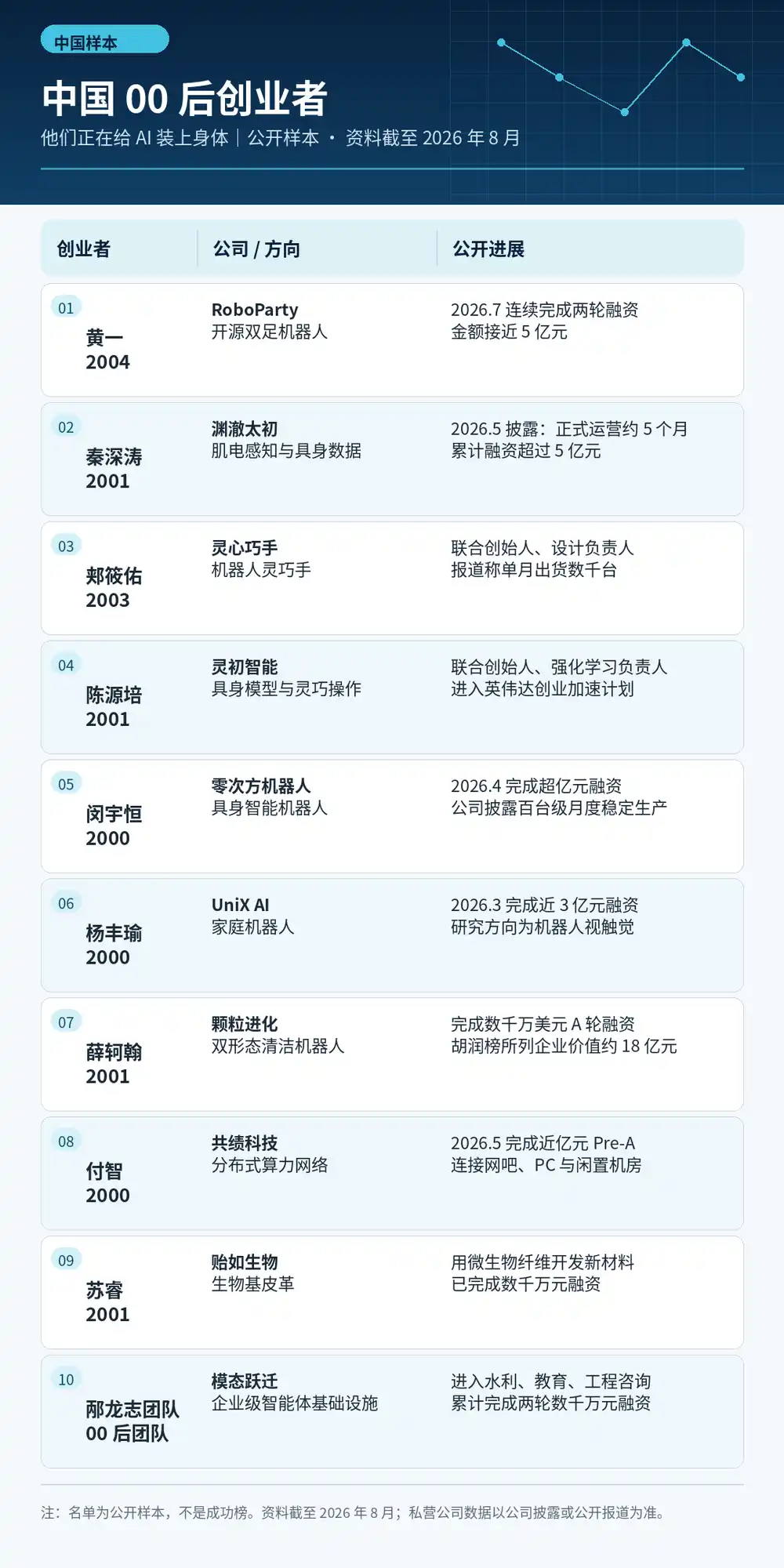
Judging from this sample, the densest battlefield for Chinese post-2000 entrepreneurs is not in traffic, but in the physical world. They are building hands, feet, home robots, and cleaning robots; they are also supplementing the foundations of computing power, materials, and industrial intelligence.
Huang Yi is one of the most representative.
Born in 2004, during his studies at Harbin Institute of Technology (HIT), he created a low-cost bipedal robot and open-sourced the tech stack. In 2025, RoboParty was founded; by July 2026, the company had consecutively completed two funding rounds, raising close to 500 million yuan.
Open source does not automatically equal commercial success, but it does change how a young hardware team gets seen. Huang Yi didn't have to first build a mature company to prove himself to the outside world. He first showcased the robot's capabilities, letting developers, peers, and the industry participate in testing, then converted that technical influence into the company's starting point. The product is still early, the organization even earlier, yet capital has already entered—this is both a new opportunity and a pressure that must be repaid in the future.
Qin Shentao took a different path.
Born in 2001, with a bachelor's from HIT and currently a Ph.D. candidate at Tsinghua University, he founded Yuanche Taichu, attempting to solve how robots understand human actions and intentions from aspects like surface EMG signals and embodied data. When the company announced funding in May 2026, it had been officially operating for about 5 months, with cumulative financing exceeding 500 million yuan.
In the past, a researcher would typically complete academic training before entering industry; Qin Shentao, however, must simultaneously face three evaluation systems: papers look for innovation, products look for iteration, capital looks for growth. They are not the same thing, yet are compressed into the same schedule. This is arguably more worthy of observation than the 'young CEO' label: research and entrepreneurship are becoming two parallel, even mutually pulling, tracks.
On the robotics line, there are also a group of even younger co-founders and technical leads.
Born in 2003, Jia Xiaoyou is the co-founder and design lead of Lingxinqiaoshou (Deft Hand). She graduated with a bachelor's degree in 2025. The company makes one of the most critical yet often overlooked components of robots—dexterous hands. By 2026, media reported that Lingxinqiaoshou's monthly shipments had reached several thousand units. For a robotics company, the ability to deliver stably and reduce costs further is more important than temporary valuation.
Born in 2001, Chen Yuanpei is the co-founder and reinforcement learning lead of Lingchu Intelligence, having studied and researched at South China University of Technology, Peking University, Stanford, and other institutions. The company focuses on R&D around embodied models and dexterous manipulation and has entered the NVIDIA Inception startup accelerator program. He is not the CEO but represents a new path for this generation of entrepreneurs: young researchers no longer necessarily wait for a complete resume before bringing technology into a company.
Born in 2000, Min Yuheng had more than one entrepreneurial attempt before founding Zero Power Robotics. The company was established in 2025 and completed over 100 million yuan in funding in April 2026; according to company disclosures, robots have achieved stable production at a level of hundreds of units per month. The most valuable part of this story is not '25-year-old raises over 100 million' but that he experienced failure, restart, and mass production early on. Funding is a judgment; production is the daily exam.
Also born in 2000, Yang Fengyu completed his undergraduate studies at the University of Michigan and then pursued a Ph.D. at Yale, researching robotic visuotactile sensing. His company, UniX AI, directly enters the home robotics scene: an environment that is non-standard, with unfixed tasks and extremely low error tolerance. In March 2026, the company disclosed completing nearly 300 million yuan in funding. There are no factory guardrails at home; every robot 'almost' can become a customer's return.
Born in 2001, Xue Kehan graduated from Northwestern Polytechnical University, studied at the Chinese University of Hong Kong's Robotics Institute, and later founded Granular Evolution. Their TR1 robot chose to start with a dual-form cleaning robot, not first telling the grand story of 'general-purpose humanoid,' but first answering a simple question: can it stably clean the floor? The company has completed a Series A funding round of tens of millions of dollars, with an enterprise value listed on the Hurun list around 1.8 billion yuan. What will determine its position next is not how big the story is, but whether it can deliver on effectiveness, cost, reliability, and after-sales service.
The Chinese sample is not only about robotics.
Born in 2000, Fu Zhi, with a Tsinghua background, first started a low-code game engine venture which didn't make it to the end. Later, he founded Gongji Tech, connecting internet cafes, personal computers, and idle server rooms into a computing power network. In May 2026, the company completed a nearly 100 million yuan Pre-A round. Born in 2001, Su Rui studied biomedical engineering at ShanghaiTech University and founded Yiru Biological, developing bio-based leather using microbial fibers, having completed tens of millions in funding. Bing Longzhi, with a Wuhan University background, and his post-2000s team founded Modal Leap, bringing enterprise-grade intelligent agents into scenarios like water conservancy, education, and engineering consulting, cumulatively completing two rounds of tens of millions in funding.
Looking at these people together reveals a clear line: they don't just want to make AI better at talking; they want to give AI hands and feet, connect it to computing power, enter materials, and finally enter factories, homes, and the real world.
America's Post-2000s Are Reorganizing the Digital World
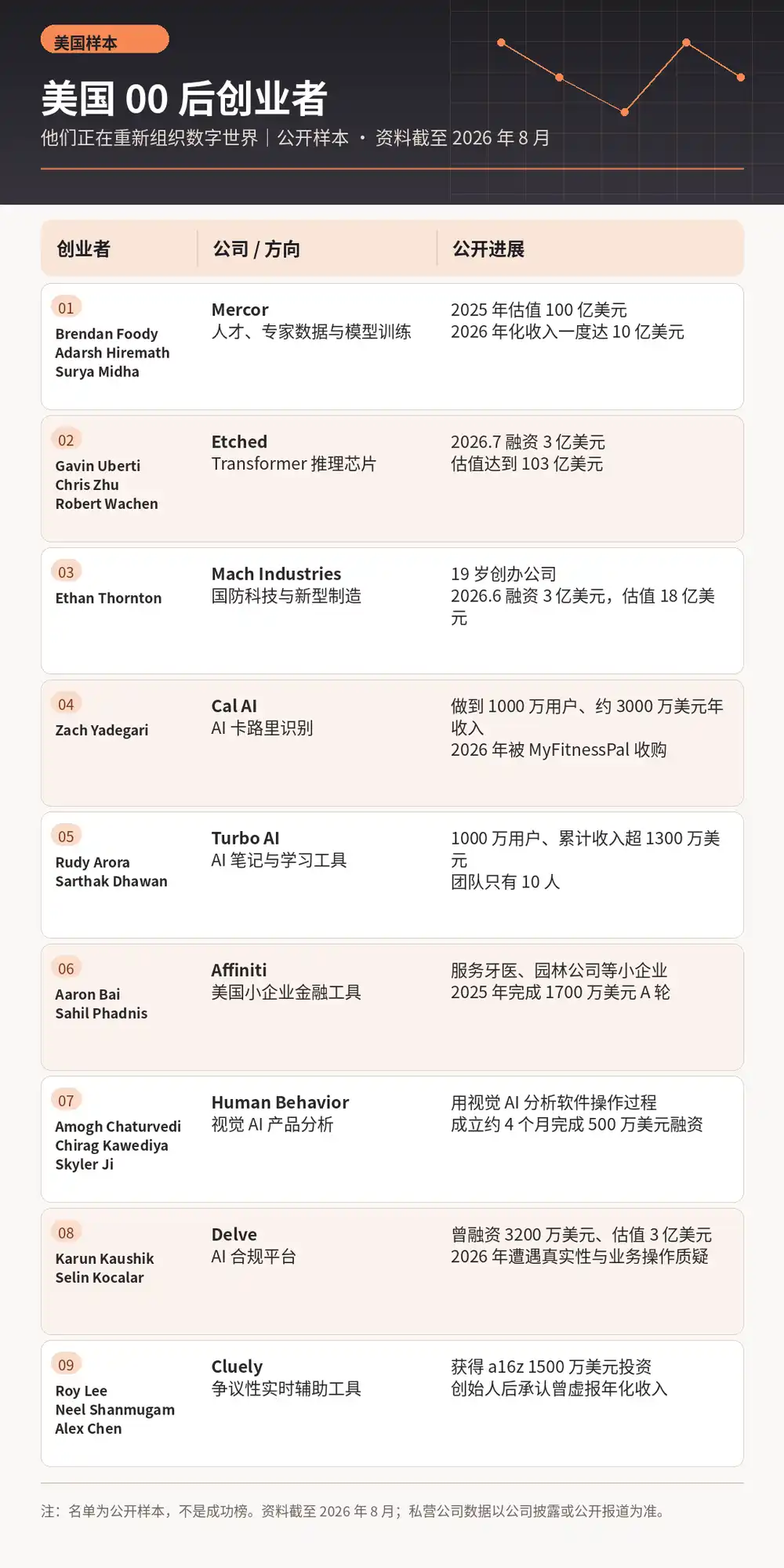
This US sample exhibits a different kind of speed: rapidly turning AI into software, subscriptions, transactions, and global distribution.
Mercor is the most extreme example.
Brendan Foody, Adarsh Hiremath, and Surya Midha were high school debate team classmates. In 2023, they founded Mercor, expanding from AI recruitment to expert matching, data, and model training. In 2025, the company's valuation reached $10 billion; in 2026, media reports stated its annualized revenue once hit $1 billion.
The most dramatic detail is that the three founders had never held a full-time job before. People who have never been employees started designing how others are discovered, priced, and deployed. This isn't proving work experience is obsolete, but reminding us: when an industry's rules are being rewritten, old experience is sometimes no longer the entry ticket.
But Mercor also quickly encountered problems with organization, fraud prevention, security, and cultural governance. Technological and revenue growth can follow an exponential curve, but management capability rarely grows along the same curve. The faster a company grows, the more management lessons the founders owe, and eventually, they must be paid.
Young disruptors are also appearing in high-barrier industries.
Gavin Uberti, Chris Zhu, and Robert Wachen dropped out of Harvard to found Etched, betting on chips specialized for Transformer inference. In July 2026, the company completed $300 million in funding, reaching a valuation of $10.3 billion. Chip entrepreneurship hasn't become easier because of this; it's just that a new round of architectural changes gives newcomers a moment to reopen the door.
Ethan Thornton dropped out of MIT and founded Mach Industries at 19, entering drones, weapons systems, and new manufacturing. In June 2026, the company completed a $300 million Series C round, valued at $1.8 billion. Defense tech is still constrained by long delivery cycles, compliance, and government procurement, but capital is already willing to believe a young team can first secure a position, then prove eligibility through delivery.
American post-2000s choose shorter product paths.
Zach Yadegari started making products during his teenage years, later founding the AI calorie recognition app Cal AI, reaching 10 million users and approximately $30 million in annual revenue, acquired by MyFitnessPal in 2026. Rudy Arora and Sarthak Dhawan founded the AI note-taking tool Turbo AI, reaching 10 million users by July 2026, with cumulative revenue exceeding $13 million, and a team of only 10 people. Small teams serving massive users aren't new today; Instagram and WhatsApp proved it long ago. The change AI brings is pushing this organizational leverage even lower, allowing more young teams a chance to replicate it.
Aaron Bai and Sahil Phadnis founded Affiniti, providing expense management and financial tools for small US businesses like dentists, landscaping companies, and small manufacturers, completing a $17 million Series A in 2025. Amogh Chaturvedi, Chirag Kawediya, and Skyler Ji founded Human Behavior, using visual AI to analyze how users operate software, completing $5 million in funding about 4 months after founding. One serves corner-street small businesses, the other observes user actions on screens; essentially, both are reorganizing originally scattered, vague operational information into a product that can be charged for.
Speed also has its shadows.
The AI compliance company Delve was founded by young entrepreneurs including Karun Kaushik and Selin Kocalar, having completed $32 million in funding with a $300 million valuation. In 2026, online questioning emerged from former clients regarding report authenticity and business practices; the company responded that the incident included targeted cyberattacks while also admitting internal areas needing improvement. Facts still require more independent evidence, but the fact that a company doing compliance is first questioned about its own compliance already shows how fragile trust is.
Cluely was more direct. Roy Lee, Neel Shanmugam, Alex Chen, and others used a highly controversial 'real-time assistance' product and marketing to quickly gain traction, securing $15 million from a16z; later Roy Lee publicly admitted to having inflated annualized revenue by $7 million. Growth can manufacture attention, and attention can also obscure problems until they turn around and swallow credibility.
Why Are Chinese and American Post-2000 Samples Diverging?
This is not a statistical conclusion about all post-2000 entrepreneurs in China and the US, only the tendency shown by this public sample.
Chinese samples come more from robotics, hard tech reports, while US samples come more from Silicon Valley funding and tech media, so the list itself already carries selection bias.
Even so, the differences are still worth noting.
Chinese teams often start from university labs, robotics competitions, and the supply chain, proving prototypes, costs, output, and delivery to the outside; American teams more often start from campus projects, startup accelerators, and venture capital networks, proving users, subscriptions, annualized revenue, and global distribution to the outside.
Young American entrepreneurs are better at reorganizing information, talent, and knowledge labor: Mercor redoing the human and expert market, Turbo AI redoing learning tools, Affiniti redoing small business finance. Young Chinese entrepreneurs are more willing to push AI into machines, factories, and materials: dexterous hands, home robots, computing power networks, bio-based leather all need to withstand friction in the real world.
One side is more about rewriting the digital world, the other side is more about giving the digital world a body.
This is, of course, not 'China only does hardware, America only does software.' Etched is making chips, Mach is building equipment; China also has software and infrastructure companies like Modal Leap and Gongji Tech. It just illustrates that different capital structures, industrial foundations, and customer environments push the same generation of entrepreneurs toward different entry points.
The Real Difference Between Post-2000s and Previous Generations Isn't Age
Among entrepreneurs born in the 20th century, there was never a shortage of young people. Zuckerberg started in a college dorm, many internet company founders also started in their twenties. What's new today is not 'young people finally dare to start businesses,' but that the infrastructure they can call upon has changed.
The internet generation called upon websites, apps, traffic, mobile payments, and cloud services; the AI generation builds on that, further calling upon large models, intelligent agents, open-source code, computing platforms, automated workflows, and more mature global supply chains.
The internet lowered the cost of information distribution; AI is beginning to lower the cost of some cognitive labor and organizational collaboration. What used to require a team for research, design, coding, and operations might now be done in a first version by one person with a set of tools. Technical paths that took years to explore within a company can now find an entry point rapidly through papers, open-source projects, and developer communities.
So, it's not that post-2000s are naturally smarter; it's that they are standing on a longer lever.
When the lever lengthens, success is amplified, and so are mistakes. Ten people can serve tens of millions of users, but an unverified promise can also spread across the market overnight; young people can bypass long resumes and directly become CEOs, but they cannot bypass hiring, compensation, conflict, compliance, and credibility.
Technology can skip grades; management cannot get a free pass.
This is the judgment this sample should most leave for the previous generation of entrepreneurs, not just a phrase like 'the younger generation is formidable.'
Who Will Stay Next?
In the next three to five years, this list will certainly change dramatically.
Those surrounded by capital today may fall behind in mass production, delivery, or organization; a product that seems like just a small tool today may suddenly grow into the entry point of a new industry. Sitting at the table doesn't equal winning the hand; valuation is not a diploma.
The real watershed is whether these young founders can complete their second growth.
The first growth is from student to entrepreneur: making a product, getting the first batch of users and the first pot of money. The second growth is from product creator to company leader: able to deliver consistently, build an organization, take responsibility for customers and employees, and also uphold credibility when temptation is greatest. The former can be accelerated by technology; the latter can only grow day by day.
For bosses already running a company, my compilation and observation of post-2000 entrepreneurs isn't for you to watch for fun or to create age anxiety.
I'm reminding the pre-2000s, i.e., the 90s, 80s, 70s, 60s generations, what needs to be re-evaluated: Which abilities no longer require a ten-year resume? Which young people should not just be assigned execution? Which university labs are becoming the birthplace of companies? Which of today's suppliers and partners will suddenly become competitors tomorrow with the help of AI, capital, and supply chains?
The relationship between mature enterprises and young teams cannot be reduced to just hiring and outsourcing. Joint R&D, supply chain cooperation, strategic investment, even M&A, will be more realistic than 'wait until he grows up.' Because what this generation of companies lacks least is probably the speed of growing up.
Capital's taste will also change. In the last stage, money was willing to pay for youth, technology, and a window of opportunity; in the next stage, the market will demand delivery, revenue, repeat business, and credibility. Whether fundraising stars can become entrepreneurs depends on whether they exchange the time given by capital for tangible business results.
In the past, when we talked about successors, we always thought there needed to be a father, a company, and a set of keys waiting to be handed over.
This group of people has no ready-made family business to inherit. What they inherit is the exam paper just issued by AI, the unfinished body of robots, and a new business world whose rules are not yet written.
They will, of course, fail. Many valuations will fall, many of today's stars will need to make up lessons in organization, credibility, and business common sense.
But one thing has already happened: the 21st century finally has entrepreneurs born in the 21st century.
They are not here to take our place; they are taking over the duties of this century.
This article is from WeChat Official Account: Ji Zhongzhan Talks Decision-Making , Author: Ji Zhongzhan Talks Decision-Making, Original Title:《The 19 Must-Know Top Chinese and American Entrepreneurs Born After 2000 • The 21st-Century Successors Have Arrived|#New Ranking》