Texas targets crypto, gambling loopholes amid prediction market concerns

ambcryptoОпубліковано о 2026-04-01Востаннє оновлено о 2026-04-01

Анотація

Prediction markets have gained significant attention, particularly during the U.S. election cycle, but the rise of gambling within these markets has eroded public trust. In response, Texas Lieutenant Governor Dan Patrick is pushing for legislative changes to close gambling loopholes. He aims to prevent the exploitation of federal regulations, such as those of the CFTC, to bypass state gambling prohibitions. The goal is to ensure the integrity of elections and sports in Texas. Additionally, Patrick advocates for assessing the state’s approach to emerging financial technologies, including crypto, while prioritizing consumer protection and addressing issues like crypto ATM scams. The move coincides with a decline in public interest in prediction market gambling, as shown by Google Trends data.

Prediction markets have gained a lot of attention in the past two years. Zooming in, the rise in these markets escalated in Q4 2024 as the U.S. election started to heat up. However, on the flip side, gambling also became an integral part of the prediction markets’ growth cycle.

These began to undermine people’s trust in the prediction market. Hence, to combat this problem and to regain trust, Dan Patrick, Lieutenant Governor of Texas, came up with some legislative changes.

Under the State Affairs Committee category, Patrick underlined plans to close the gambling loopholes. In this push, the governor urged the lawmakers to,

Study the sudden inundation of prediction market gambling and the exploitation of federal law to circumvent Texas gambling prohibitions by allowing users to place bets on the outcome of elections and other events.

The reason behind this crackdown?

Needless to say, this move is intended to protect and reinforce the regulatory oversight of the Commodity Futures Trading Commission (CFTC). Patrick believes that the prediction markets are now exploiting the CFTC regulations just to bypass Texas state gambling prohibitions.

With clear intentions to have fair elections and corruption-free sports in Texas, Patrick added,

Make recommendations to ensure the integrity of Texas elections and Texas sports.

Echoing similar sentiments at the broader level, David Miller, enforcement director of CFTC, in his first public remark after joining, added,

We are aware of the speculation about insider trading. We are watching.

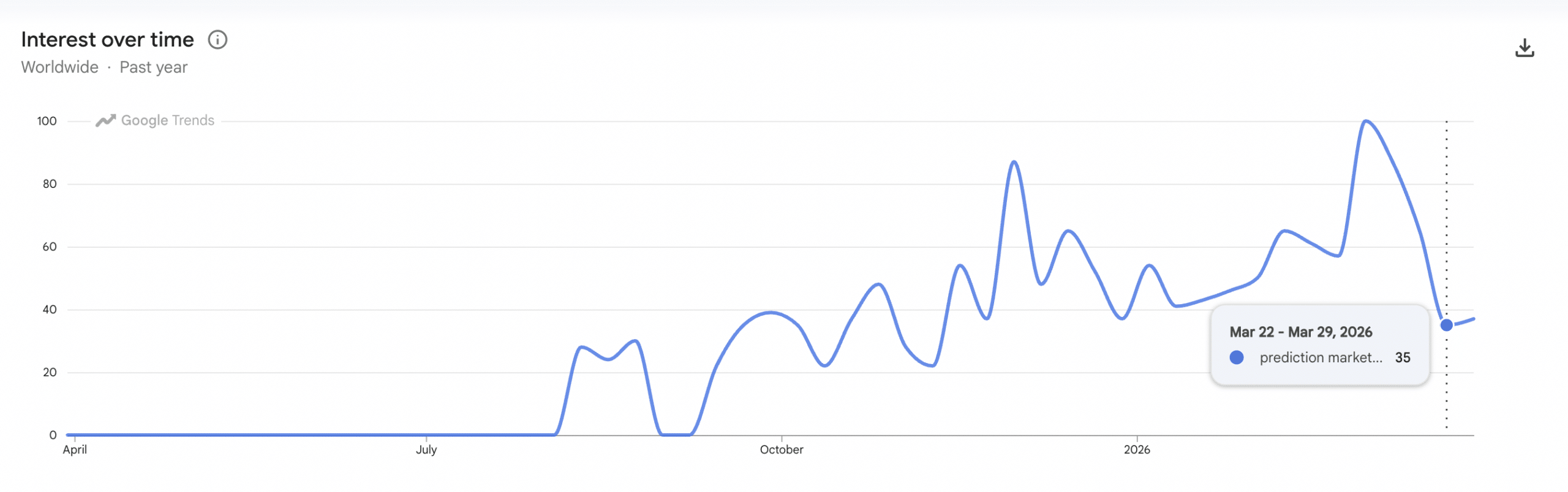
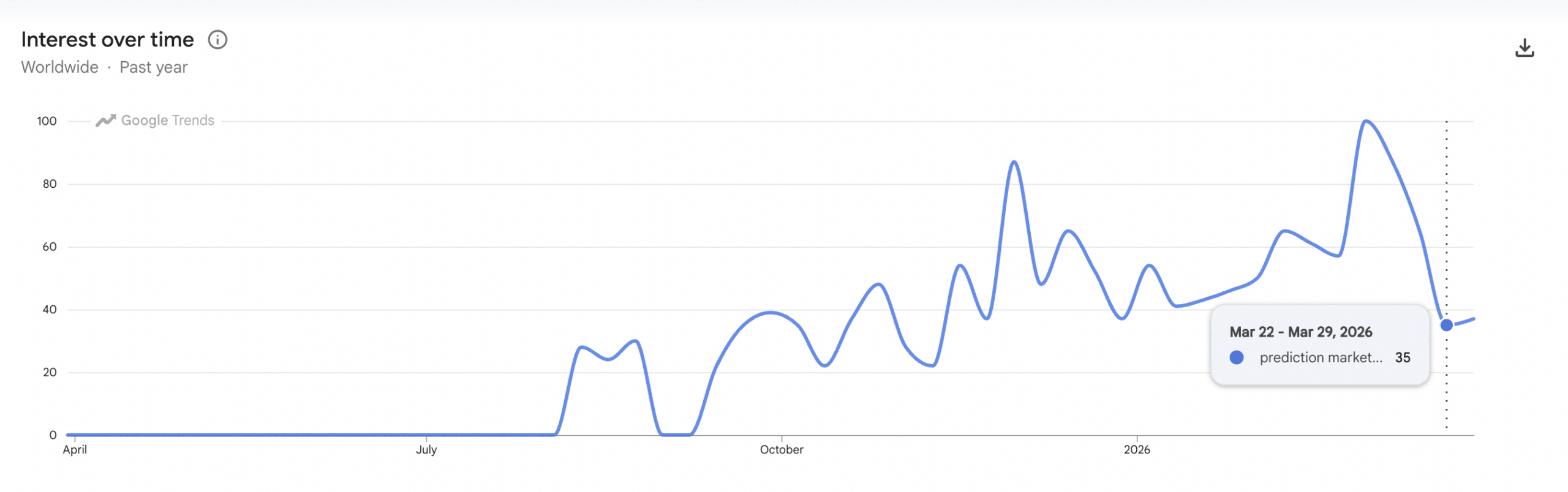
This comes as the Google Trends data saw a drop in the “prediction market gambling” keyword as of writing.
Source: Google Trends

As per the chart, the keyword had peaked to a Google Search score of 100 in early March. However, by the end of Q1 2026, the score stood at 35.

Besides prediction market reforms, Patrick has also come up with a plan to expand the future of crypto in Texas. He urged the lawmakers to:

Assess how the state’s financial regulatory agencies respond to emerging financial technologies and business models, while prioritizing the protection of consumers.

In fact, he also stressed the loopholes of scams surrounding the growing scale of crypto ATMs (virtual currency kiosks).

Lastly, the governor made a point to the lawmakers to look into Senate Bill 21 and how effectively it’s being implemented and whether it’s achieving its goal. For those unaware, Senate Bill 21 of Texas refers to the Texas Strategic Bitcoin Reserve bill implemented on the 20th of June, 2025.

This coincided with Polymarket recently coming up with its updated rulebook across its DeFi platform and CFTC-regulated U.S. exchange.


Final Summary

  • Prediction markets are growing, but with this growth, gambling has taken center stage, raising credibility issues.
  • David Patrick’s push for blockchain technology underlines how individual states are stepping up their crypto game as the U.S.-Iran war continues.


Пов'язані питання

QWhat is the main concern that prompted Texas Lieutenant Governor Dan Patrick to propose legislative changes regarding prediction markets?

AThe main concern is that gambling has become an integral part of prediction markets, which began to undermine people's trust in them. This includes the use of crypto to circumvent Texas gambling prohibitions by allowing bets on elections and other events.

QWhich regulatory body's oversight does Dan Patrick aim to reinforce with his proposed crackdown on prediction markets?

ADan Patrick aims to reinforce the regulatory oversight of the Commodity Futures Trading Commission (CFTC).

QBesides prediction market reforms, what other emerging technology did Dan Patrick urge lawmakers to assess in relation to consumer protection?

ADan Patrick urged lawmakers to assess how the state's financial regulatory agencies respond to emerging financial technologies and business models, specifically mentioning the need to prioritize consumer protection in the context of crypto and the growing scale of crypto ATMs.

QWhat specific Texas bill, related to Bitcoin, did Dan Patrick ask lawmakers to review for effective implementation?

ADan Patrick asked lawmakers to look into Senate Bill 21, which is the Texas Strategic Bitcoin Reserve bill implemented on June 20, 2025.

QAccording to the Google Trends data mentioned in the article, what was the search score for 'prediction market gambling' by the end of Q1 2026?

AThe Google Search score for 'prediction market gambling' stood at 35 by the end of Q1 2026, down from a peak of 100 in early March.

Пов'язані матеріали

The King of Blind Date Attire in Korea: How SK Hynix Made a Comeback Against Samsung?

In South Korea's dating scene, SK Hynix employees are now highly sought after, a status shift fueled by the company's astronomical profits and employee bonuses, projected to reach up to 6.1 million RMB per person by 2027. This marks a dramatic reversal for the long-time second-place player in memory semiconductors, which has now surpassed its rival Samsung in annual operating profit. The turnaround story began in 2008 when a struggling Hynix, emerging from bankruptcy restructuring, took a risky bet by agreeing to develop High Bandwidth Memory (HBM) with AMD. At the time, HBM had no clear market beyond high-end graphics cards and was a costly, complex technology. Major players like Samsung, pursuing its own HMC technology, declined. For Hynix, with only memory as its core business, it was a gamble born of necessity. The pivotal moment came in 2012 when SK Group Chairman Chey Tae-won acquired Hynix. Defying industry downturns, he invested heavily in R&D and fabrication, sustaining the HBM project through over a decade of commercial uncertainty and internal challenges. A key break occurred around 2016-2017 when Samsung faced production issues supplying HBM2 for Google's TPU, allowing SK Hynix to gain a crucial foothold in the data center market. The AI explosion post-ChatGPT in 2022 was the catalyst, turning HBM into a critical bottleneck for AI accelerators like NVIDIA's GPUs. By 2025, SK Hynix captured 62% of the global HBM market, leaving Samsung at 17%. For the first time, its annual operating profit exceeded Samsung's. Analysts point to the "innovator's dilemma" to explain Samsung's miss: its vast, successful business portfolio made it risk-averse, preventing an all-in bet on the initially niche HBM technology. In contrast, SK Hynix, as a challenger with its back against the wall, had no choice but to commit fully. The story highlights how Korea's chaebol system allows for ultra-long-term bets beyond quarterly pressures. However, SK Hynix's lead isn't guaranteed. Samsung is aggressively catching up on HBM4, and challenges like customer concentration (heavy reliance on NVIDIA) and technical hurdles in advanced packaging remain. The narrative underscores a market truth: the greatest alpha often comes from betting on uncertain, long-term directions others dismiss, much like HBM in 2008.

marsbit27 хв тому

The King of Blind Date Attire in Korea: How SK Hynix Made a Comeback Against Samsung?

marsbit27 хв тому

Understanding Hash in One Article: The "Browser Miner" on Ethereum

Hash is an Ethereum-based ERC-20 token described as a "browser-minable post-quantum token." Its key features include enabling browser-based GPU mining without specialized hardware, a fixed supply cap of 21 million tokens, immutable and permissionless smart contracts with no team allocation or pre-mining, and an emphasis on post-quantum security using Keccak256 hashing. The mining mechanism is a simplified on-chain proof-of-work where miners solve unique challenges tied to their wallet address. Key design elements prevent answer theft, with epochs resetting every 100 blocks (~20 minutes) and a per-block minting limit. Emission follows a Bitcoin-like halving schedule every 100,000 mints, starting at 100 tokens per mint. Projections suggest all tokens could be mined within approximately 294 days if a target rate of one mint per minute is sustained. Hash emphasizes "post-quantum" security by leveraging hash-based primitives like Keccak256, which are considered more resistant to quantum attacks compared to elliptic-curve cryptography. While not a fully post-quantum asset, it aligns with Ethereum's broader post-quantum research narrative. The project completed its Genesis sale at $0.03 and began trading on Uniswap, with its price reaching around $0.19. The initial circulating supply is small, with 5% sold in Genesis and 5% allocated to liquidity. The majority (47.6% of total supply) is allocated to early-stage mining, leading to a front-loaded emission schedule. This structure, combined with low initial liquidity, makes Hash a high-volatility, high-risk project dependent on sustained miner participation and market demand to absorb new supply.

marsbit40 хв тому

Understanding Hash in One Article: The "Browser Miner" on Ethereum

marsbit40 хв тому

Торгівля

Спот
Ф'ючерси
活动图片