Telegram taps Lighter for 50x perps trading across crypto, stocks, and commodities: Details

ambcryptoОпубліковано о 2026-04-04Востаннє оновлено о 2026-04-04

Анотація

Telegram has integrated Lighter, a decentralized exchange (DEX) specializing in perpetual trading, to power its native leveraged trading feature. Through the Wallet in Telegram, users can now trade cryptocurrencies, stocks, metals, and oil with up to 50x leverage. This integration, Telegram's largest with Lighter to date, could significantly boost trading volumes for the DEX by tapping into Telegram’s vast user base of over 150 million registered and 25 million active wallet users. The partnership arrives as Lighter faces a substantial decline in activity and revenue—weekly trading volumes dropped 89% from its November peak to $8B in April, while revenue fell 91% to $325K weekly. This downturn followed the end of LIT token farming after its December debut. The Telegram deal has already spurred a 30% price recovery for LIT in early April. If the integration drives renewed user activity, it may reverse Lighter’s declining metrics and support further token buybacks; otherwise, LIT could face renewed downward pressure.

Lighter, a DEX focused on perpetual (perps) trading, has been tapped to power Telegram’s native leveraged trading.

In a statement on the 2nd of April, Wallet in Telegram said that users on the privacy-focused messenger can now trade crypto, stocks, metals, and oil with up to 50x leverage.

The wallet has seen strong adoption with over 150 million registered users.

About 25 million of these users are considered active, especially in P2P transfers and fiat on-ramps, making Telegram a key crypto trading terminal. The messenger itself has over 1 billion users.

As such, the integration of Lighter could boost trading volumes on the DEX too. As it stands, this is the primary and largest Lighter integration to date.

For comparison, its rival Hyperliquid runs perps trading for Phantom, Rabby, MetaMask, and others. This fueled Hyperliquid’s initial adoption by sharing fees from trades routed by the apps.

Could Lighter benefit from a similar traction?

Will the deal boost Lighter’s trading activity?

The collaboration comes at a time when the demand for perpetual trading has exploded. At the market peak last October, the overall perp volume reached $350 billion and $25 billion in Open Interest (OI).
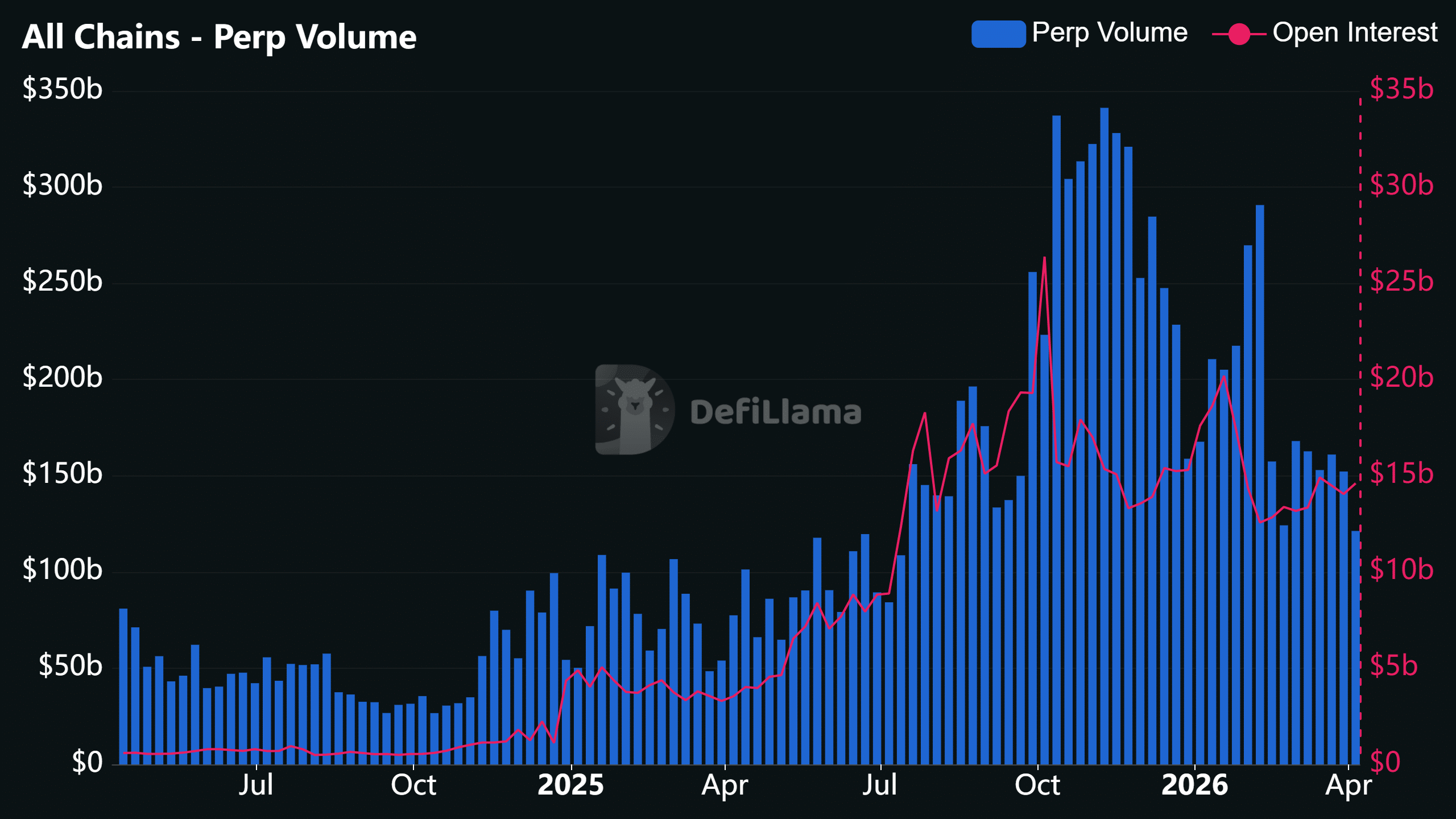
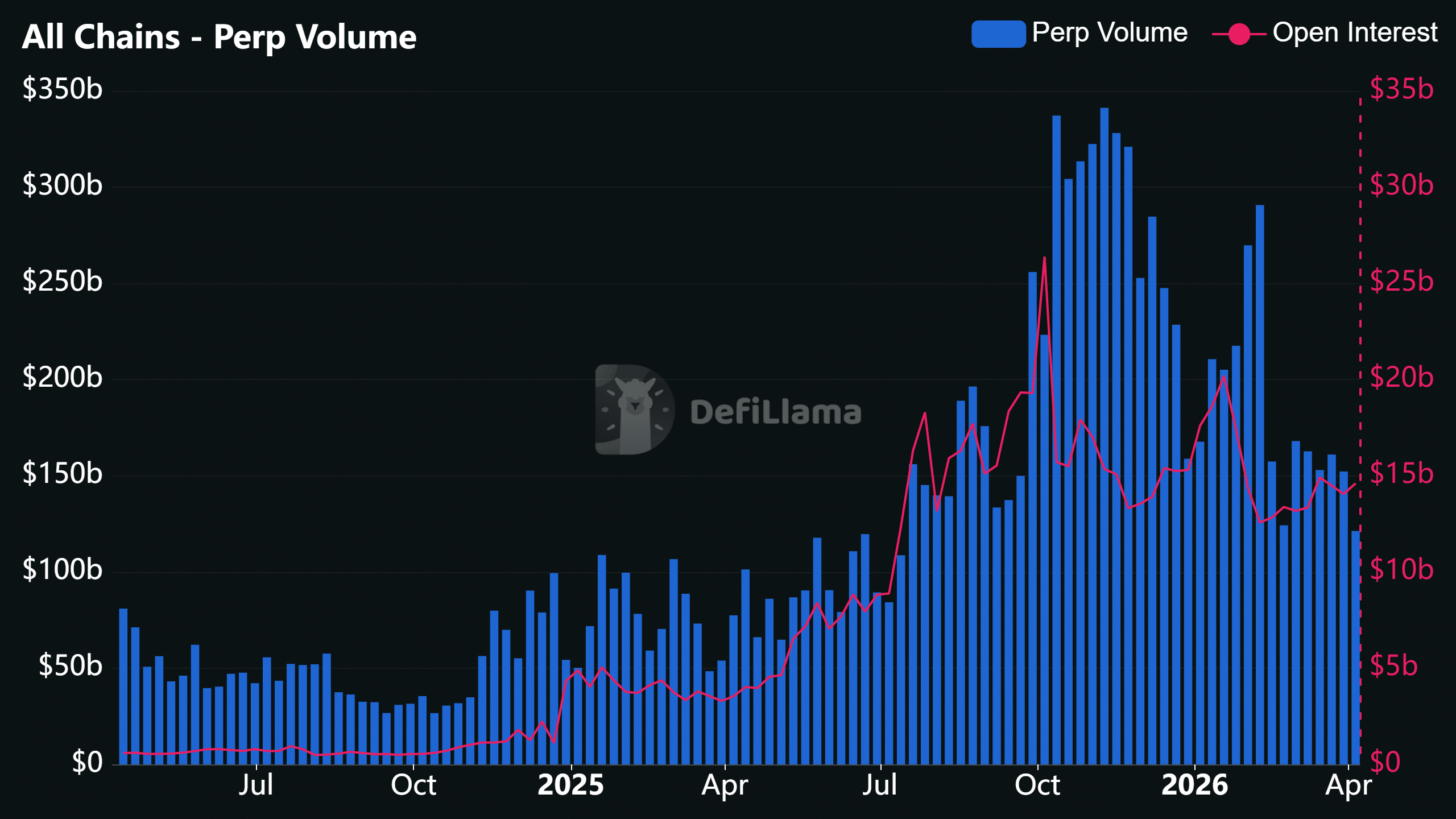
Source: DeFiLlama

Despite the broader crypto rout in the past few months, perp volume still hovered around $150 billion.

However, Lighter’s trading activity has declined significantly. Especially after the LIT’s token debut at the end of last December, which ended the farming period. As a result, traders who were hunting for an airdrop migrated elsewhere to search for new opportunities.

Consequently, Lighter’s trading activity fell sharply after December. This decline has extended into Q1 2026, and there hasn’t been any meaningful recovery in Q2 as the broader crypto market remains subdued.

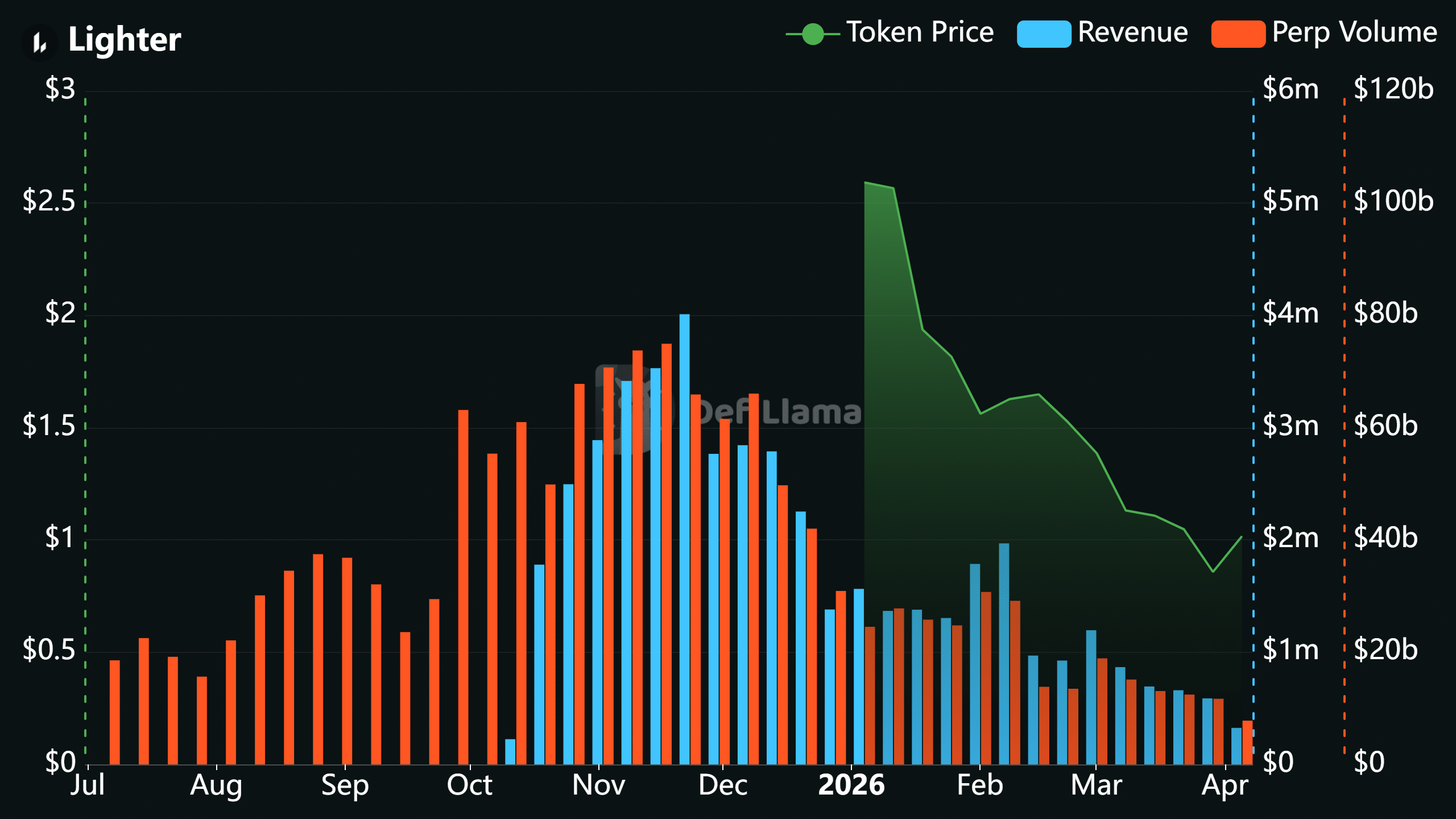
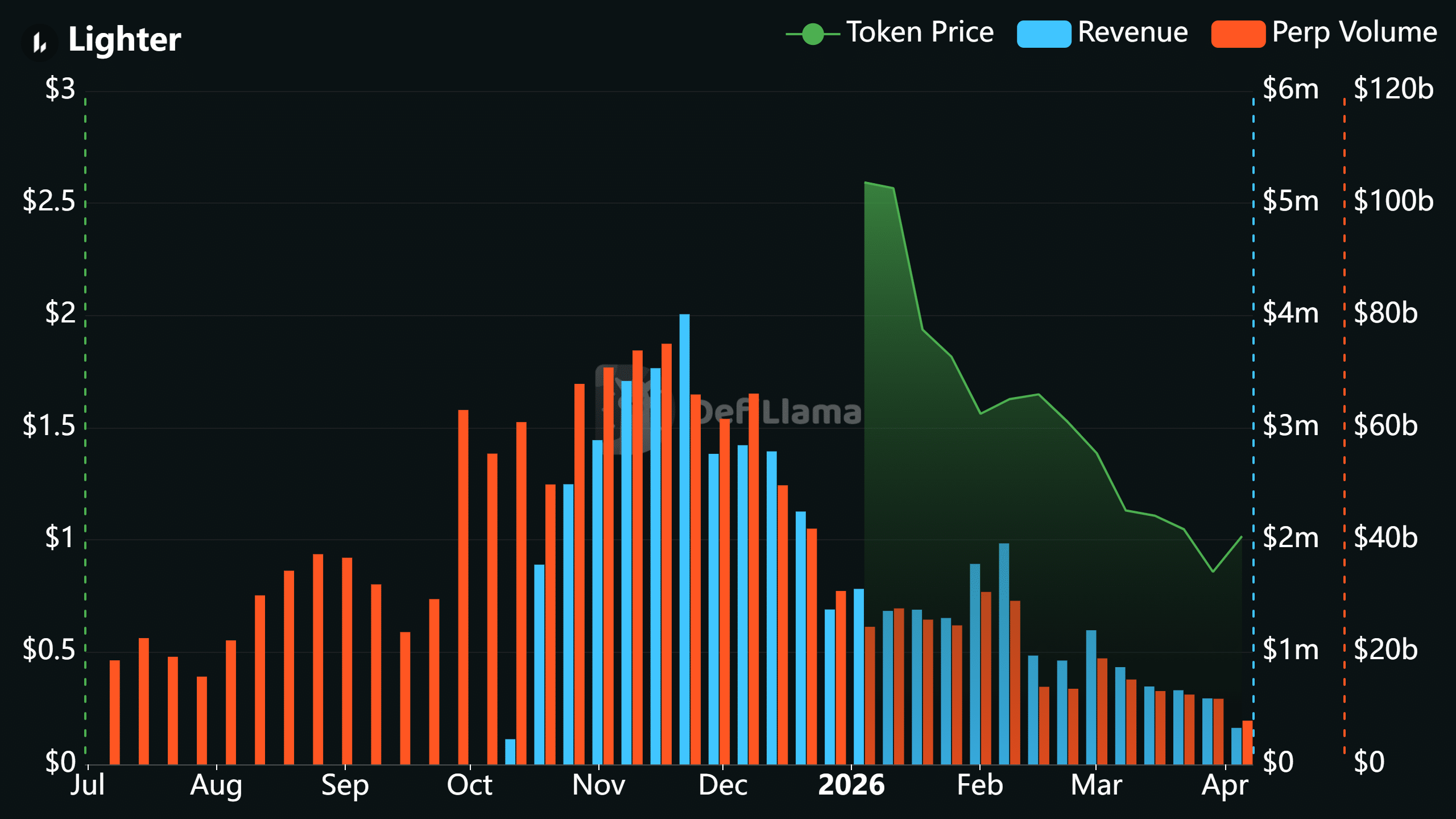
So far, the weekly perps volumes have fallen from a record $75B in November to about $8B in April—an 89% decline in trading activity.
Source: DeFiLlama

The protocol’s revenue also went downwards. It dropped from a weekly average of $4M to $325K, translating to a 91% revenue crash.

It’s worth pointing out that the brief relief in February boosted activity and revenue. Ultimately, this fueled the buyback of LIT, the protocol’s native token.

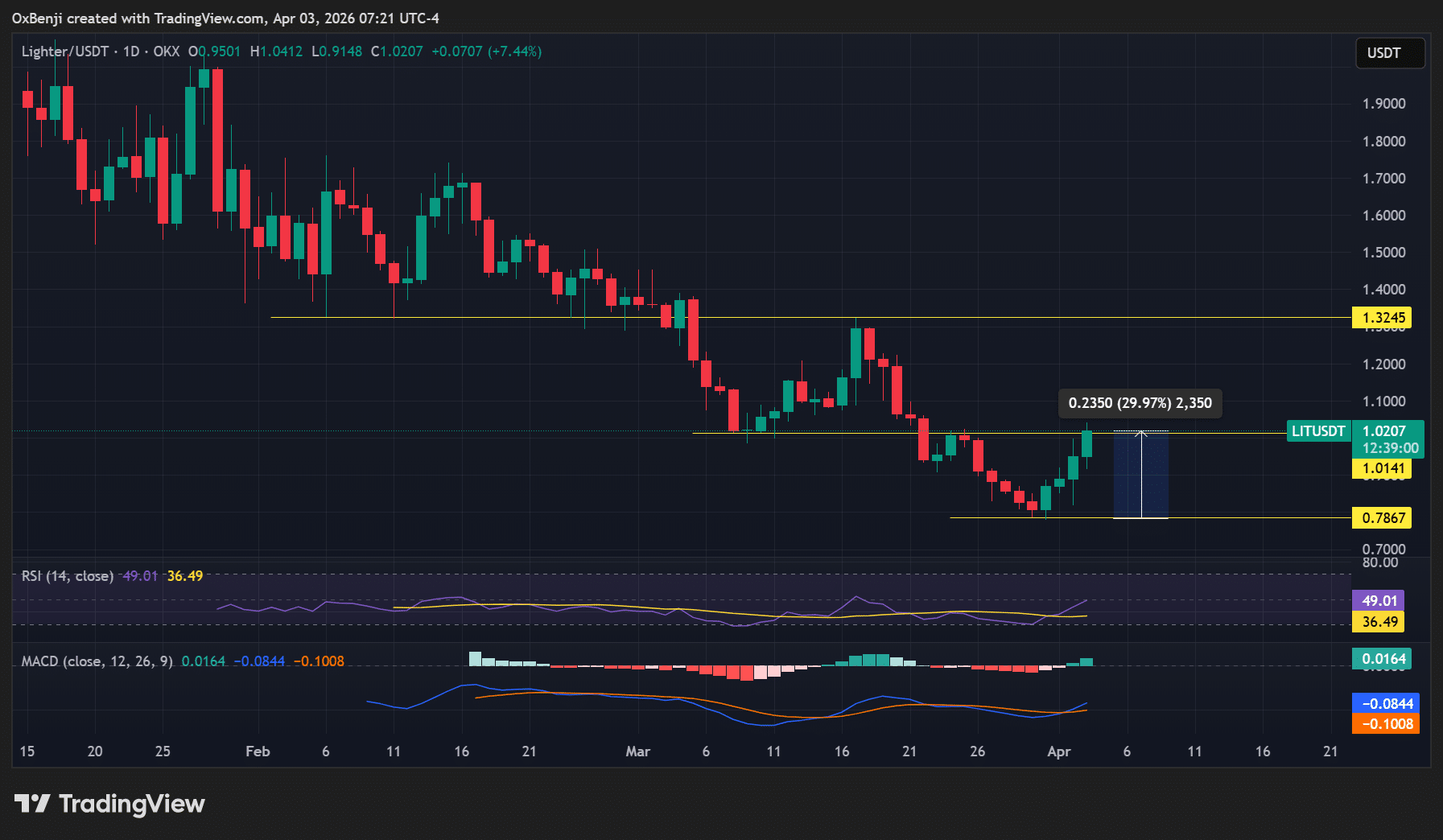
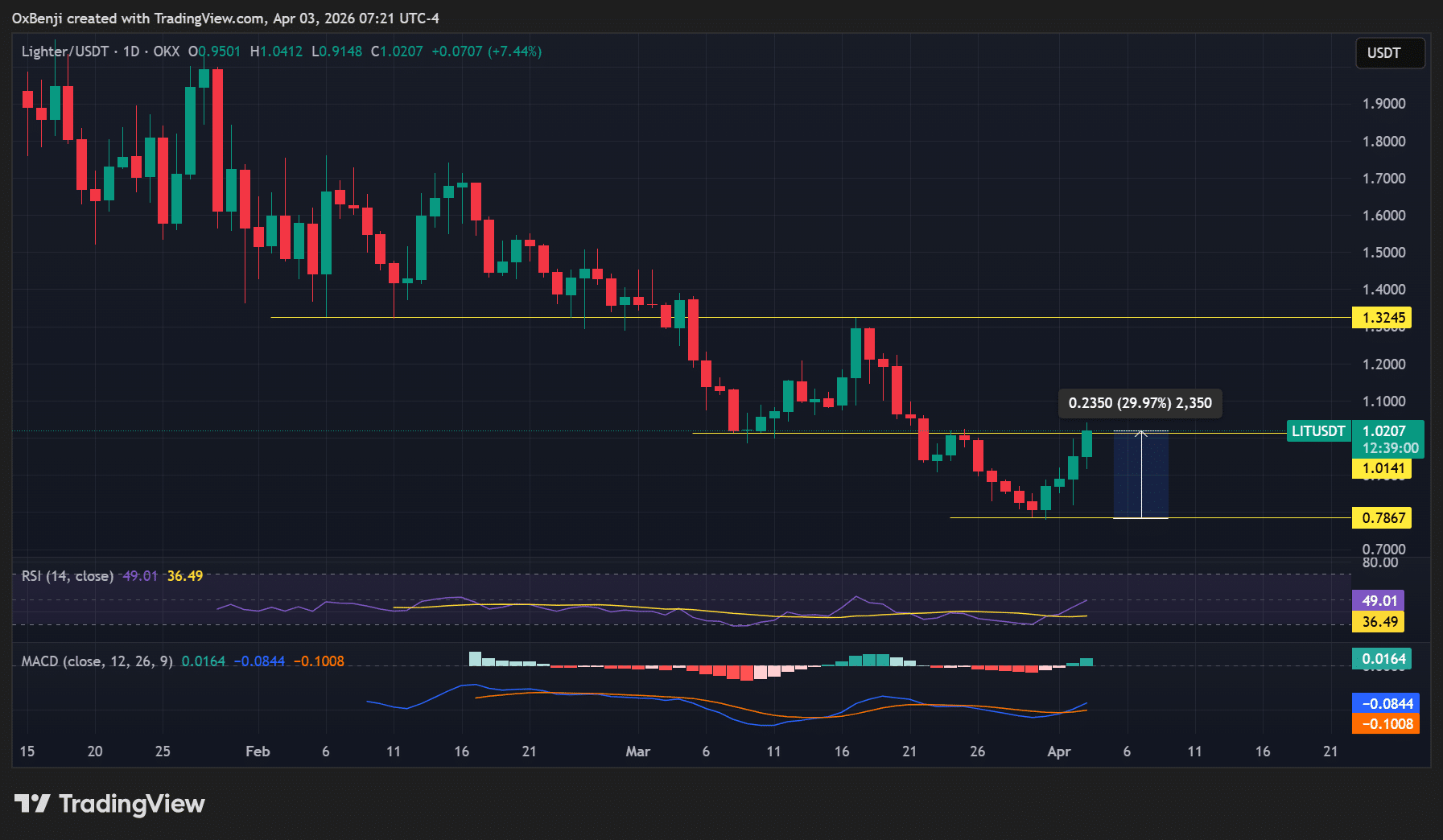
If Telegram integration improves activity and revenue improve in April, then the recent 30% recovery rally could extend. Otherwise, a rejection at $1 and low activity could drag LIT back to $0.78 or below.
Source: LIT/USDT, TradingView

Final Summary

  • Telegram integration has fueled LIT’s recovery by 30% in early April.
  • Lighter DEX’s revenue crashed 91%, but renewed trading activity from Telegram could help reverse it and boost LIT buyback.


Пов'язані питання

QWhat is the main partnership announced between Telegram and Lighter?

ATelegram has partnered with Lighter, a decentralized exchange (DEX), to power its native leveraged trading feature, allowing users to trade crypto, stocks, metals, and oil with up to 50x leverage.

QHow many active users does Wallet in Telegram have, and why is this significant?

AWallet in Telegram has about 25 million active users, which is significant because their activity in P2P transfers and fiat on-ramps makes Telegram a key crypto trading terminal, potentially boosting Lighter's trading volumes.

QWhat happened to Lighter's trading activity and revenue after its token debut in December?

ALighter's trading activity fell sharply after its LIT token debut in December, with weekly perps volumes declining by 89% from $75B in November to about $8B in April, and revenue crashing by 91% from a weekly average of $4M to $325K.

QHow did the Telegram integration affect LIT's token price in early April?

AThe Telegram integration fueled a 30% recovery rally for LIT's token price in early April.

QWhat is the potential future price movement for LIT depending on the success of the Telegram integration?

AIf the Telegram integration improves trading activity and revenue, the recent 30% recovery rally for LIT could extend. Otherwise, a rejection at $1 and low activity could drag LIT back to $0.78 or below.

Пов'язані матеріали

Wall Street Morning News: V-shaped Rebound at Month-end, but Nasdaq Suffers Worst July in 12 Years; Funds Accelerate Concentration Towards Cloud Giants

Despite a V-shaped rebound at the end of July, the Nasdaq posted its worst July since 2004, while the S&P 500 had its worst July since 2014. Markets were jolted by geopolitical shifts, as President Trump canceled a planned strike on Iran, leading WTI crude to plunge over 8%. This, alongside OPEC+ announcing a supply increase, reversed crude's sharp July gains. Treasury yields surged, with the 10-year yield rising over 30 basis points in July—its largest July increase since 2005. In a rare move, the US and Japan jointly intervened to weaken the USD/JPY, aiming to prevent potential Japanese sales of US Treasuries. While the tech sector faced deleveraging pressure throughout July, cloud giants staged a massive rally on strong earnings. Microsoft, Amazon, and Google collectively added nearly $1.5 trillion in market value last week. Amazon soared over 15% on accelerating AWS growth, Microsoft extended historic gains, Google fully recovered post-earnings losses, and Meta ended an 11-day losing streak. In contrast, Apple tumbled over 7% on supply chain and guidance concerns, ceding its "world's most valuable company" title to Nvidia. The memory and storage sector corrected sharply. Gold edged up 0.91% in July, with analysts viewing the ~30% pullback from January highs as a potential basing period, supported by long-term central bank demand. Key events to watch this week include earnings from Palantir, AMD, SpaceX (its first post-IPO report), and memory giants like Western Digital. The US July non-farm payrolls report on Friday will be critical for gauging the Fed's policy path. SpaceX also faces a significant lock-up expiration, testing market liquidity.

marsbit36 хв тому

Wall Street Morning News: V-shaped Rebound at Month-end, but Nasdaq Suffers Worst July in 12 Years; Funds Accelerate Concentration Towards Cloud Giants

marsbit36 хв тому

Rubin Ultra Makes Major Cuts, Even Nvidia Can't Handle Memory Price Hikes?

NVIDIA's Rubin Ultra, the top-tier variant of the newly announced Rubin AI accelerators, has reportedly seen significant specification downgrades, according to an industry report from SemiAnalysis. Initially designed with four compute dies (4-die), the Rubin Ultra is now said to be reduced to a 2-die design. Key changes highlighted in the report include: * **No increase in peak theoretical compute performance**, remaining at 35 PFLOPs like the standard Rubin. * **Severe reduction in memory capacity** to 192GB using 8-Hi HBM stacks, which is less than the standard Rubin's 288GB using 12-Hi stacks. * **Negligible memory bandwidth improvement** of only 1 TB/s. * **Slightly higher chip-level power consumption**. * The **primary upgrade is a massive increase in scale-up interconnect capacity**, supporting connections for up to 576 GPUs via NVLink, compared to 72 for the standard Rubin. The report suggests the redesign is primarily a cost-optimization move driven by the sharp rise in HBM (High-Bandwidth Memory) prices. By reducing the expensive HBM content and shifting investment towards enhanced system-scale networking, NVIDIA aims to maintain the platform's value for large-scale AI training clusters while managing soaring material costs. The news reportedly triggered a sell-off in South Korean memory stocks, with SK Hynix and Samsung shares falling around 8%, as markets grew concerned that NVIDIA—a major HBM buyer—might be reducing its reliance on high-capacity memory, potentially capping future pricing power for memory makers.

Odaily星球日报57 хв тому

Rubin Ultra Makes Major Cuts, Even Nvidia Can't Handle Memory Price Hikes?

Odaily星球日报57 хв тому

Can Generative Models Finally Be Trained End-to-End? The Core Is a For Loop

This article introduces a novel training paradigm for generative models called Explorative Modeling (XM), which enables true end-to-end training. Traditionally, powerful generative models like autoregressive and diffusion models are not trained end-to-end. They are trained to predict a single small step but require iterative multi-step sampling for inference. This "exposure bias" leads to error accumulation and limits performance. The core challenge XM addresses is "mode blurring." In generative tasks, a single input (e.g., "generate a dog") corresponds to many valid outputs (multiple modes). Standard training objectives like reconstruction loss force the model to average these modes, producing unrealistic, blurry outputs. To avoid this, existing models break generation into many small, almost deterministic steps, sacrificing end-to-end training. XM tackles this by restructuring the training loop itself. Its key insight is to amplify "generative expressivity." For each training input, instead of generating one sample, the model generates K candidate outputs. Only the candidate closest to the real data is used for computing the loss and updating the model via backpropagation. This simple "best-of-K" mechanism is implemented as a short for-loop. By exploring multiple possibilities, the model learns to distribute its guesses across different modes rather than collapsing to their uninformative average. The paper demonstrates that "exploration" acts as a new, powerful scaling axis. Gains from XM increase with model size, data scale, and compute. Experiments show improvements in FID scores for image generation and significant efficiency gains, sometimes outperforming larger models without exploration. When pushed to the limit, XM enables fully single-step, end-to-end generative models. In robotics tasks, an "Explorative Policy" matched the performance of a 100-step Diffusion Policy with a single forward pass, drastically improving inference speed. While the best-of-K concept is not entirely new, the authors' contribution lies in formally understanding it as a direct method to boost generative expressivity without fragmenting the generation process. This work suggests that as models scale, enhancing exploration during training may become crucial for overcoming fundamental performance bottlenecks.

marsbit1 год тому

Can Generative Models Finally Be Trained End-to-End? The Core Is a For Loop

marsbit1 год тому

Торгівля

Спот
活动图片