From Monday to Friday morning, focusing on macro trends, U.S. stocks, AI, precious metals, crude oil, and more, we review the market with data and seize opportunities through trends. Brought to you by PANews.
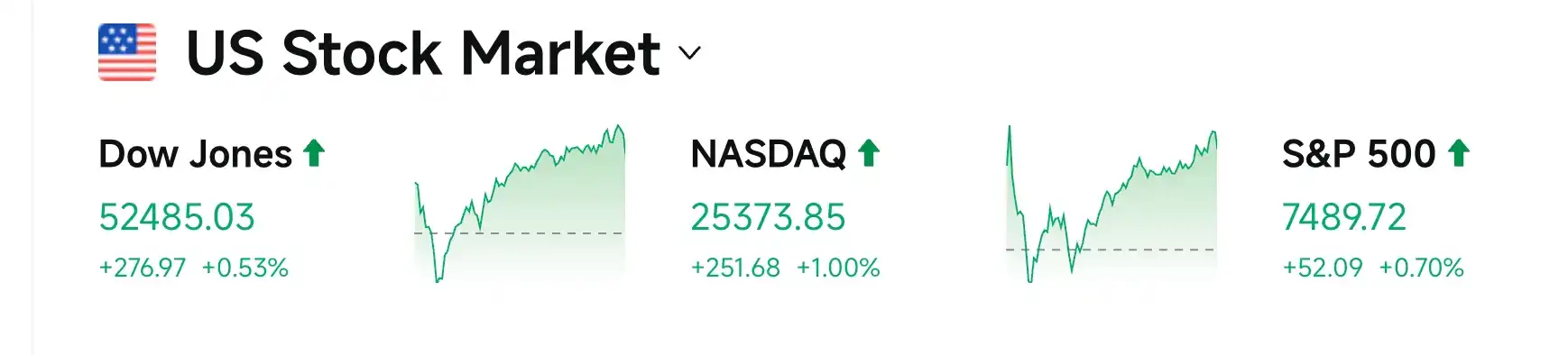
U.S. stocks staged a V-shaped reversal last Friday, with all three major indices rising: The Dow Jones rose 0.53%, the S&P 500 rose 0.70%, and the Nasdaq rose 1.00%. However, this rebound could not mask the poor performance throughout July: The S&P 500 index was essentially flat for the entire month, marking its worst July performance since 2014; the Nasdaq index fell 3.2% for the month, its worst July since 2004.
Trump Cancels Iran Strike, OPEC+ Increases Production, Crude Oil Crashes 8%
A major weekend plot twist: Trump announced over the weekend that, at the request of Saudi Arabia, the UAE, and Qatar, he canceled the planned new round of military strikes against Iran, stating that a framework for the "Hormuz Strait agreement" is already in place, and denuclearization negotiations will also commence on Tuesday.
WTI crude oil plunged over 8% at Monday's open, briefly falling below $78 per barrel, while Brent crude oil also plummeted over 6%. Previously, crude oil had surged over 20% in July (its biggest July gain in 30 years) due to risks in the Hormuz Strait, Houthi attacks, and damage to Russian refineries.
OPEC+ also dealt a blow from the supply side. The latest statement shows that OPEC+ agreed to increase its September oil production quota by 188,000 barrels per day. Saudi Arabia, Russia, Iraq, Kuwait, Kazakhstan, Algeria, and Oman agreed to adjust production and reiterated their commitment to maintaining market stability. The next meeting is scheduled for September 6. Traders generally believe that Trump's repeated script of "threaten - pause" has been played out multiple times, and the market's current core focus remains on whether details regarding Strait navigation and denuclearization can truly be finalized.
Gold Fluctuated Slightly in July, Closing Up 0.91%
Since 2026, influenced by factors such as heightened rate hike expectations triggered by US-Israel-Iran conflicts, fund diversion due to the tech stock boom, and some central bank selling, gold prices have corrected significantly by about 30% from the January high. Gold rose slightly by 0.91% in July and is currently fluctuating around $4050 per ounce.
Analysts point out that in the short term, gold prices are still suppressed by the US dollar index and real interest rates. However, as Federal Reserve tightening expectations are gradually digested and central bank gold-buying demand provides support, gold prices are expected to enter a phase of consolidation and bottoming repair. AG Thorson, a technical analysis expert from GoldPredict, noted that gold is currently in a bottoming process. A break below $4000 per ounce could see it continue to seek support, but holding above this level would be seen as a bull market shakeout.
In the medium to long term, the trend of weakening US dollar credit and strategic gold accumulation by global central banks remains unchanged. The logic of gold as a risk-hedging asset allocation remains solid. The current market adjustment provides a favorable window for medium-to-long-term allocation for investors. It is expected that gold price volatility for the year will range between $3800 and $4500 per ounce.
US and Japan Unusually Jointly Intervene on Yen, 30-Year US Treasury Hits 2007 High
Both Trump and US Treasury Secretary Besant confirmed that the US participated in last week's foreign exchange intervention to push up the yen's exchange rate and stated they would not hesitate to continue joint action with Japan. As a result, the USD/JPY pair fell rapidly in early Monday trading, breaking below the 156 level for the first time since May 6.
Analysis indicates that this intervention aims to prevent a yen collapse from triggering large-scale Japanese sales of US Treasuries, which would push up US financing costs. James Thorne, Chief Market Strategist at Wellington Altus, warned that if the Japanese Ministry of Finance is forced to sell US Treasuries to defend the exchange rate, as the largest overseas holder of US debt, its shift to being a seller would force a revaluation of long-term US Treasury yields.
Amid inflation anxiety triggered by energy shocks, the 10-year US Treasury yield ended July at 4.74%, surging over 30 basis points during the month, marking its largest monthly July increase since 2005. Meanwhile, the 30-year US Treasury yield also rose to around 5.281%, reaching its highest level since July 2007.
Cloud Giants' Combined Market Cap Increased Nearly $1.5 Trillion Last Week; Meta Ends 11-Day Losing Streak
Deleveraging in tech and memory stocks persisted throughout July. Goldman Sachs Prime Brokerage data showed that the three trading days from the previous Friday to last Tuesday saw the largest one-sided unwinding since November 2022, primarily concentrated in highly leveraged positions in semiconductors, memory, and AI infrastructure established from April to May.
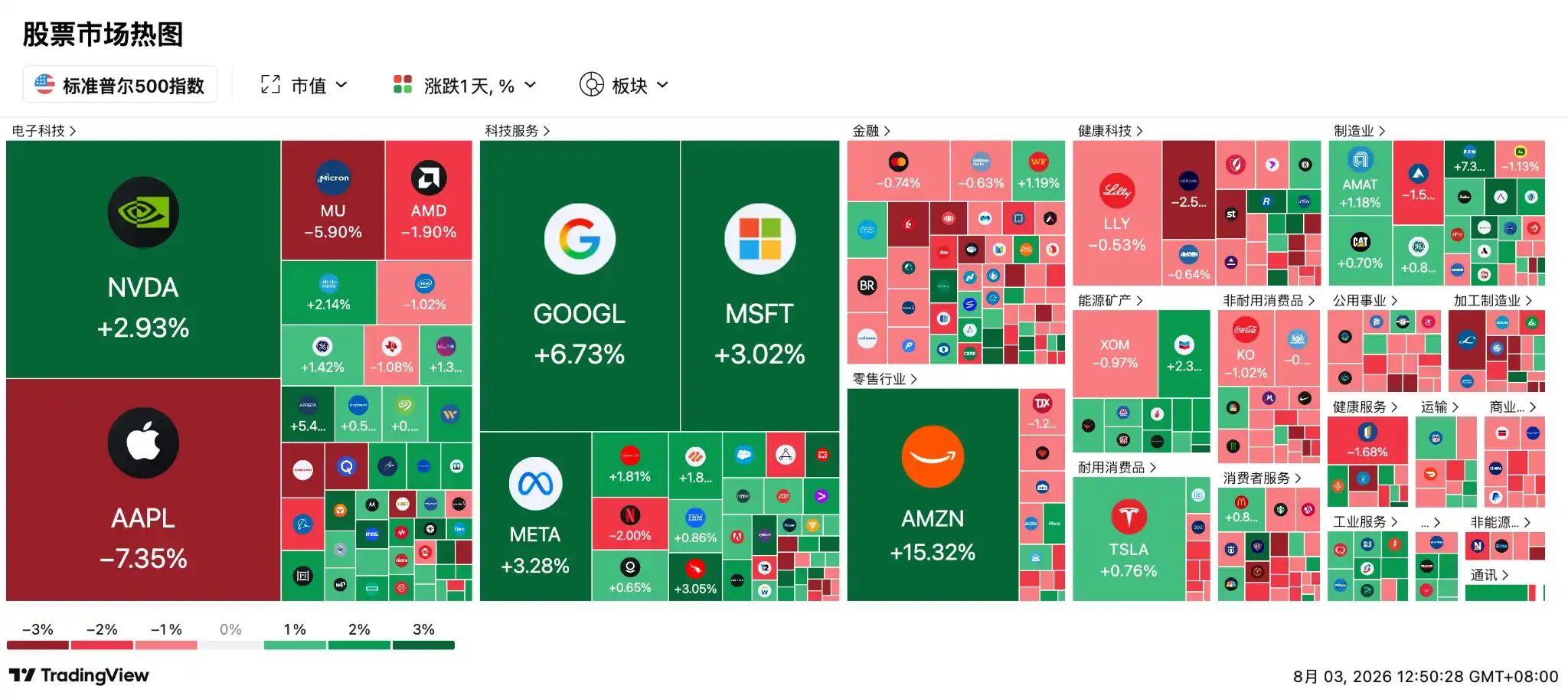
Despite facing deleveraging pressure, the cloud sector performed strongly. On Friday, tech heavyweights made a strong comeback. AWS's better-than-expected performance ignited the cloud sector, Microsoft continued its gains, Google recovered its post-earnings losses, and Meta ended its eleven-day losing streak. Data shows that last week, the combined market capitalization of cloud giants increased by nearly $1.5 trillion, with Microsoft's market cap increasing by approximately $616.5 billion, Amazon's by about $425.6 billion, and Google's by nearly $445 billion. In contrast, the storage and some semiconductor sectors pulled back after rallying, while Apple suffered a heavy drop due to supply constraints and a soft outlook.
Analysis suggests that the market is not abandoning AI but rather undergoing structural repositioning. Funds are being withdrawn from overcrowded storage and hardware sectors and are accelerating their flow towards cloud giants and application-side companies that can effectively convert capital expenditures into cash flow.
Specific Company Actions and Stock Price Movements:
-
Amazon skyrocketed 15.32%, its biggest single-day gain since 2012. AWS Q2 revenue grew 36.7% year-over-year, the fastest growth in 18 quarters. CEO Andy Jassy stated AWS is "very likely" moving towards annual revenue of one trillion dollars. The market had previously been concerned about Amazon's heavy AI capital expenditures and unclear returns, but the earnings report showed AWS growth re-accelerating, with profitability stronger than expected. The company also disclosed in a regulatory filing that it has completed its full $50 billion cumulative investment commitment in OpenAI.
-
Microsoft extended Thursday's historic 15.5% single-day gain, rising another 3.02% on Friday. Capital expenditure showed restraint, free cash flow remained robust, and preliminary evidence of Azure and Copilot monetization alleviated concerns about a "bottomless money pit."
-
Google surged 6.88%, completely recovering its post-earnings losses. DeepMind released the next-generation robot AI model Gemini Robotics 2, achieving full-body control of humanoid robots for the first time.
-
Meta rose 3.28%, ending the gloom of its 11-day losing streak. Funds flowed back into AI platform companies after cloud giants' earnings exceeded expectations, with Meta, as a key player in large models, advertising AI, and computing power investment, seeing buying for a recovery. However, the core issue Meta faces remains the pace of capital expenditure and returns.
-
Apple plunged 7.35%, shedding over $358 billion in market cap in a single day, its biggest single-day drop since April 2025. Its title as the "world's most valuable stock" was ceded to Nvidia. CFO Parekh stated on the earnings call that memory shortages and component supply constraints will drag down Q4 iPhone, Mac, and iPad business. The Q4 revenue growth guidance of 9%-11% was below the market's expectation of 12.1%.
-
Storage sector collectively corrected: Micron fell 5.9% (down 28.7% for the month, but still up over 180% year-to-date), SanDisk fell 5.09% (down 46.57% for the month), SK Hynix US-listed shares fell 3.54% (down over 7% for the week). Kioxia's earnings missed expectations, with its ADR plummeting 10.1%, adding further pressure. Western Digital bucked the trend, rising 2.21%, and Seagate edged up 0.52%.
-
Optical communication sector broadly gained, with Coherent, Applied Optoelectronics up over 5%, and Astera Labs up over 3%.
-
Palantir closed up 0.65% on Friday, with volatility heating up ahead of post-market earnings. Palantir will report earnings after the US market close today. As one of the most sought-after AI application-side stocks, Palantir's earnings report will directly test the substance of "AI moving from computing power to software revenue."
-
SpaceX fell 3.41%, with Musk's net worth shrinking over $600 billion from its June peak. SpaceX continues to face pressure recently, with the market awaiting its first post-IPO earnings report. The company will release its first post-IPO earnings report after the market close on August 5th Beijing Time. The market is focusing on Starlink revenue and Starship commercialization progress. A bigger risk looms on August 6th: up to 911.5 million restricted shares become eligible for sale. Based on the latest stock price of $108.37, the potential value is close to $100 billion.
-
Other Giants: Nvidia rose 2.93%, receiving public praise from Trump. Tesla rose 0.78%, after rumors about spinning off its China business to pave the way for a SpaceX merger were dismissed by Musk on platform X as "fake news." Intel fell 1.02%, down 2.3% for the week, marking its sixth consecutive weekly decline. The market is watching the competitive pressure from TSMC's development of advanced AI chip packaging technology on Intel's packaging roadmap.
This Week's Focus:
August 3 (Monday)
-
Berkshire Hathaway Earnings: The market will focus on Buffett's cash reserves, stock buybacks, insurance underwriting profits, railroad and energy business performance, and whether he continues to reduce or increase core holdings like Apple, Bank of America, and Occidental Petroleum.
August 4 (Tuesday)
-
August 4-6, Ai4 2026 and FMS Flash Memory Summit Open: The North American AI Industry Summit and the Global Flash Memory Summit open concurrently, with attendance from industry giants like Nvidia, Google, Microsoft, Meta, Samsung, etc. Three AI pioneers, Hinton, Fei-Fei Li, and Andrew Ng, will share the stage for the first time. Samsung is expected to unveil its HBM4E roadmap.
-
Key Earnings: Palantir, ON Semiconductor, Snap, Luckin Coffee, McDonald's, Caterpillar, Pfizer, Merck, Spotify, Hut 8, Cipher Mining, HSBC Holdings, Techtronic Industries, etc.
August 5 (Wednesday)
-
04:30 SpaceX's First Post-IPO Earnings Report: The market is focusing on Starlink revenue, Starship commercialization progress, free cash flow, and the pace of capital expenditures. As SpaceX faces a large-scale lock-up expiration two days later, if the earnings report does not provide a strong enough growth narrative, the stock price may face dual pressures from liquidity and valuation. If Starlink revenue and commercial launch guidance are strong, it could alleviate pre-unlock selling pressure.
-
05:00 AMD, Astera Labs, Arista Networks Earnings: AMD's report is a key test for the AI chip second tier. The market is focused on MI series AI chip shipments, data center revenue, gross margin, and H2 guidance. Astera Labs is a key player in AI server interconnect and data center connectivity chips. Arista is a bellwether for AI network switches and cloud data center capital expenditures.
-
Key Earnings: Circle, Eli Lilly, Novo Nordisk, Disney, SanDisk, Western Digital, Applovin, IonQ, BeiGene, etc.
August 6 (Thursday)
-
SpaceX Lock-up Expiration: Up to 911.5 million restricted shares of SpaceX become eligible for sale, with a potential value close to $100 billion based on the latest stock price. This is the week's biggest liquidity stress test. If selling pressure after the unlock is limited, it will boost market confidence in the capacity to absorb high-valuation tech assets. If concentrated selling pressure emerges, it could weigh on Nasdaq and Musk-related asset sentiment.
-
05:00 SanDisk, Western Digital Post-Market Earnings: Will directly impact the sentiment direction of the storage sector. Following recent continuous pullbacks in Micron, SanDisk, and SK Hynix, the market will focus on enterprise SSD, NAND prices, AI data center storage demand, inventory cycles, and H2 guidance.
-
Key Earnings: Crypto Miners CleanSpark, MARA, Datadog, D-Wave Quantum, ConocoPhillips, Unity, AAOI, MP Materials, Atlassian, Rigetti, MGM China, Zai Lab, etc.
August 7 (Friday)
-
20:30 US July Non-Farm Payrolls Report, US July Unemployment Rate: This is the week's most critical macro data. The market expects July non-farm payrolls to add around 90,000, higher than June's 57,000. The unemployment rate is expected to rise from 4.2% to 4.3%. If non-farm payrolls exceed 100,000, the market may continue to bet on a September rate hike, with US Treasury yields and the USD rising, pressuring tech stocks. If employment underperforms expectations for a second consecutive month, rate hike bets may cool, potentially benefiting growth stocks, gold, and long-term bonds.
-
China July Import/Export Data, Foreign Exchange Reserves: Export data will test the resilience of external demand, import data will reflect domestic demand and commodity demand, and forex reserve data will influence RMB exchange rate expectations and cross-border capital sentiment.
-
Key Earnings: Cambricon, China Rare Earth Holdings, Oklo, Vistra Energy, Under Armour, Lioncore, etc.
August 9 (Sunday)
-
China July CPI/PPI Data Release: Will test the price recovery trend following the Politburo meeting, allowing the market to assess the pace of domestic demand and industrial product price stabilization.