In 2012, AlexNet decisively ended an era with an overwhelming victory. Before that, image recognition relied on manually designed, multi-stage feature extraction pipelines. AlexNet proved something that would be repeatedly validated later: handing the entire task to the model to learn end-to-end almost always outperforms human-designed, staged workflows.
From image classification to object detection to image segmentation, behind every leap in deep learning was the same mantra: let it learn everything in one go.
There has been only one consistent exception: generative models.
Today's strongest, most scalable generative models (whether autoregressive or diffusion models) are not end-to-end.
During training, they only learn to predict "one small step," but during inference, they have to recurrently unfold this step hundreds or thousands of times.
The sampling methods used for training and inference are not the same. This discrepancy leads to an old problem: errors from one step are fed into the next, the input gradually drifts away from the distribution seen during training, and errors accumulate layer by layer. Academically, this is called "exposure bias."
In other words, the core tenet of deep learning—"end-to-end is better"—has for over a decade failed to fully materialize in generative modeling.
Recently, however, a paper from UIUC and Harvard University attempts to complete this final piece of the puzzle.
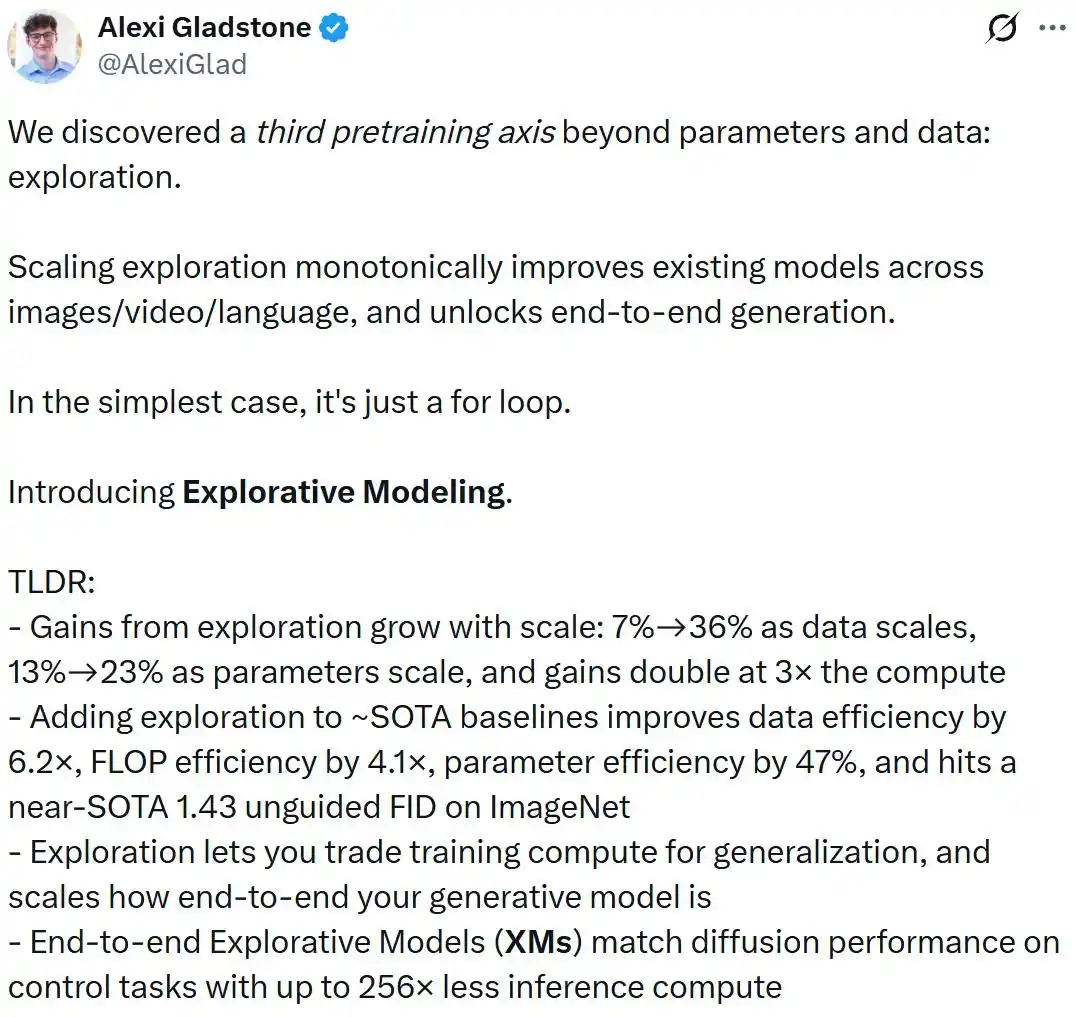
The authors named this new paradigm Explorative Modeling, abbreviated as XM. Its idea is so simple it borders on naive, yet points to a bold conclusion: Beyond parameters and data, generative models actually have a third axis that can be scaled.
Project Website: https://explorative-modeling.github.io
Paper: https://arxiv.org/abs/2607.27372
Code Repository: https://github.com/alexiglad/XM
The Root Problem: Models Only Know How to "Take the Average"
To understand what this paper solves, one must first understand why generation is hard.
In ordinary supervised learning (e.g., classification), each input essentially has only one correct answer; the model learns a deterministic mapping.
But generation is different. When you ask a model to "generate a dog," there can be infinitely many correct answers. These valid outputs are the many modes (i.e., distinct peaks) within the data distribution. Generation is difficult precisely because it must capture all these modes simultaneously.
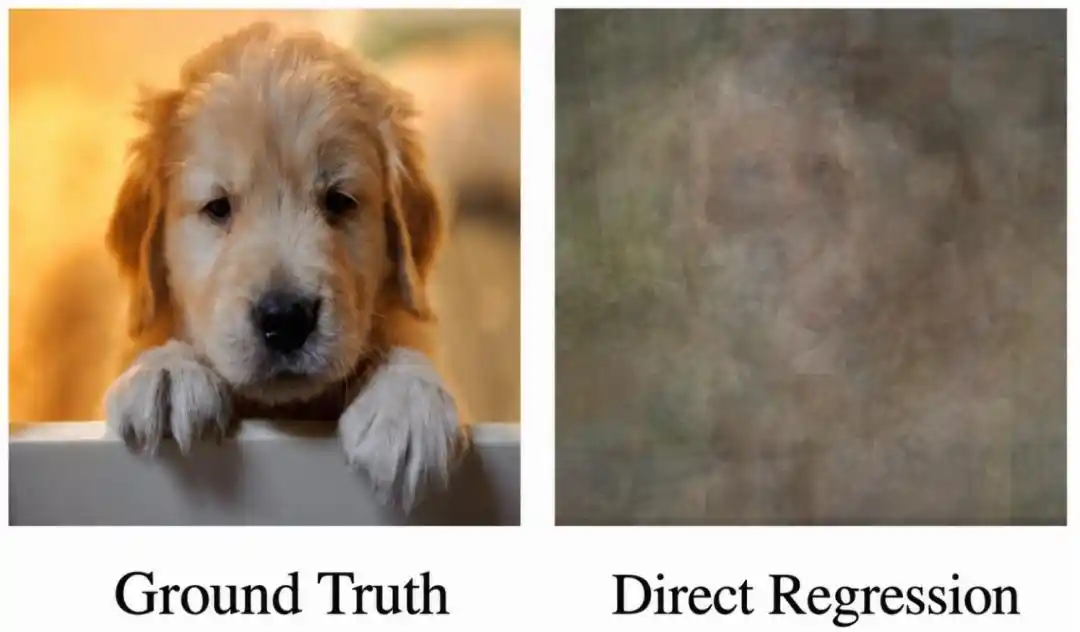
The trouble is, mainstream generative models are trained with reconstruction losses (e.g., squared error). When an input is paired with many different valid targets at random, the optimal solution for a reconstruction loss is the average of those targets. For most real-world data, this average does not lie on the data manifold but falls between modes, resembling none of them.
A figure in the paper illustrates this clearly: when asked to regress directly end-to-end without any tricks, three clusters of points would be predicted as a single point in the middle, a photo of a dog would blur into a smudge, and a sentence would degenerate into endless repetitions of "the." This is "mode blurring," where the optimal solution is precisely the answer least resembling real data.
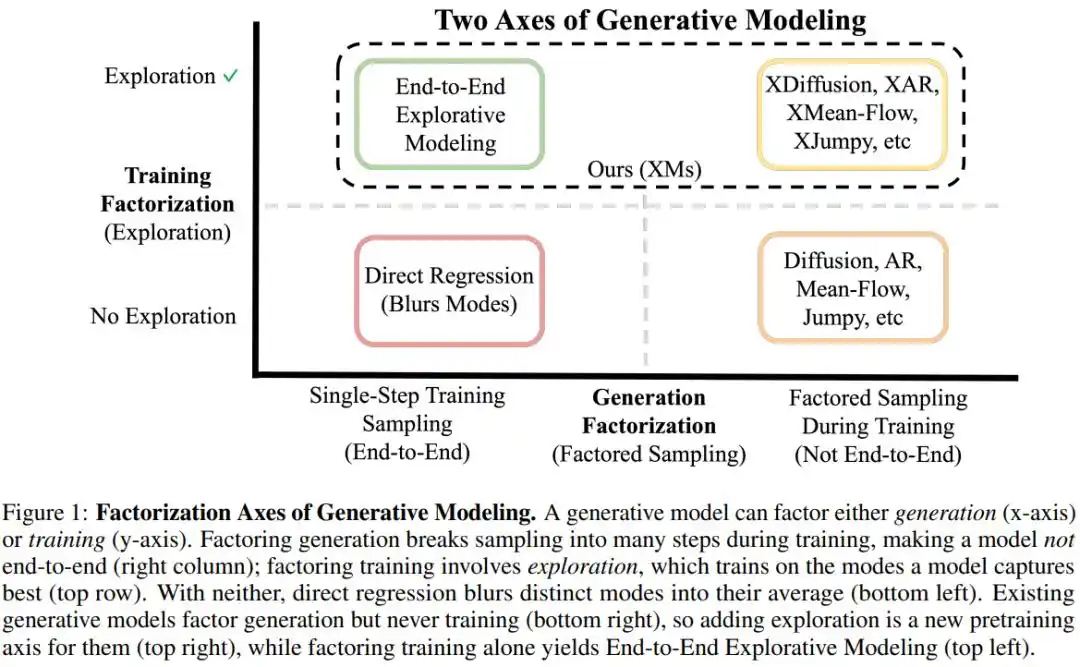
How do existing models circumvent this? By breaking the "generation" process into tiny pieces. Autoregressive models predict only one element at a time; diffusion models remove a little noise at each step. Each small-step target is sliced until it contains essentially a single mode, preventing the reconstruction loss from averaging.
This strategy of "splitting the generative process" is precisely why diffusion and autoregressive models can produce high-quality samples, but it is also why they cannot be end-to-end.
The authors thus pose a crucial question: A generative model has only two things that can be broken down—how it generates and how it trains.
Since breaking the generation process destroys end-to-end capability, why not break the training instead?
A For Loop: The Entire Essence of Explorative Modeling
Explorative Modeling breaks down the training loop itself.
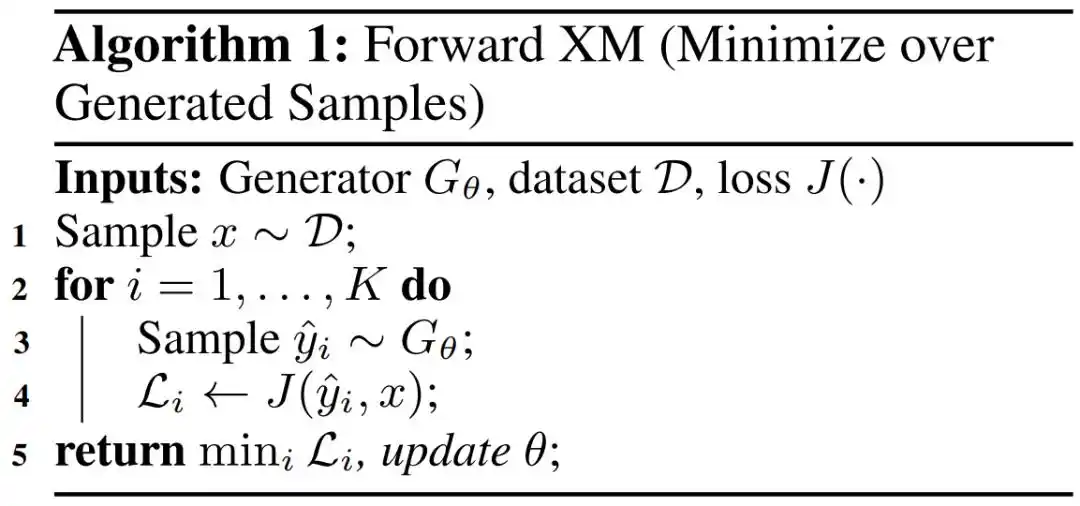
Its mechanism can be stated in one sentence: In each training step, instead of generating one sample to fit the target, the model generates K candidates and then selects only the one closest to the real data for training and gradient backpropagation. The paper implements this as a 3-5 line for loop, so simple it's almost suspicious (Algorithm 1).
Why does this solve mode blurring?
Think of a real-life analogy: guessing dart landing positions. If you are only allowed one guess, your optimal strategy is to guess the average position of all darts—but that's often a spot on the board where few darts actually land. However, if you are allowed K guesses and are scored only on your closest guess, the optimal strategy immediately changes: you would spread your guesses, letting each cover a different cluster of landing points.
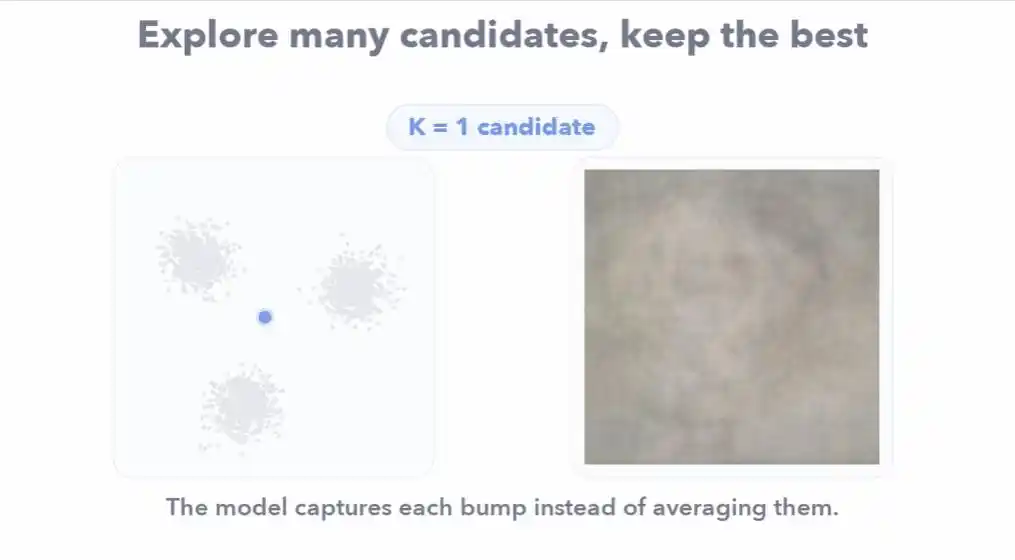
The model behaves similarly. When allowed to explore K candidates, different input noises will "claim" different modes, instead of all crowding towards the middle to take the average. The number of explorations directly determines how many modes the model can stably capture.
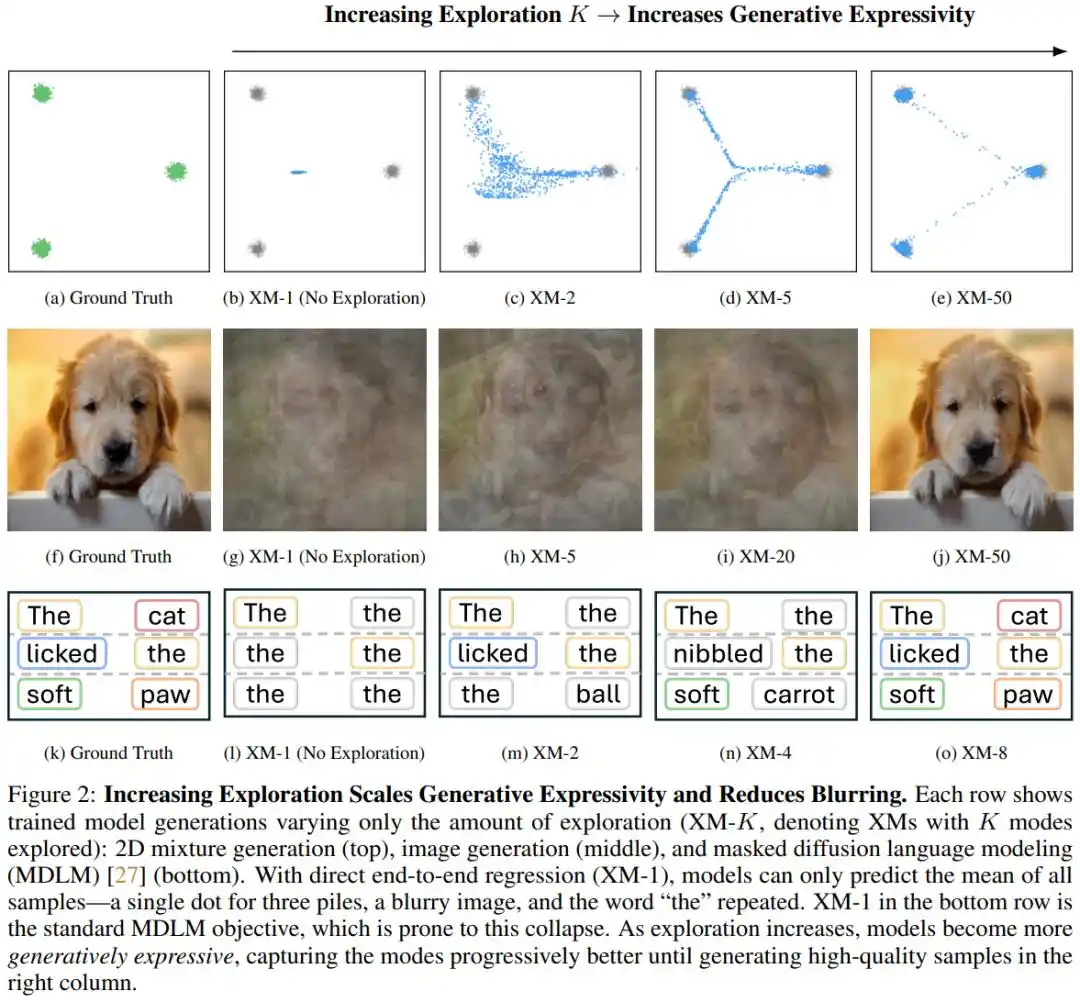
The authors name this long-overlooked capability "generative expressivity," noting that it is determined by the training objective itself—no matter how much you scale parameters and data, it won't increase on its own.

This also explains a phenomenon long observed in the field: why today's best models are so reliant on "guidance" techniques.
Classifier-free guidance essentially "pushes" the prediction away from that blurry average. But if the model itself weren't blurry, why push it? The usefulness of guidance stems precisely from the lingering disease of mode blurring.
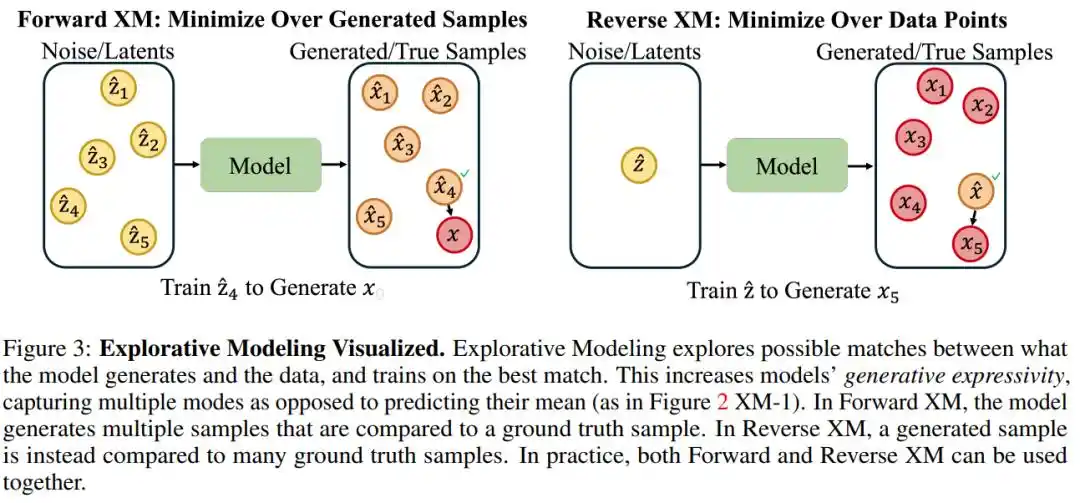
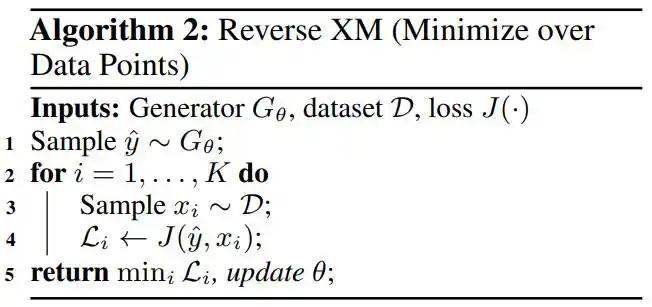
The paper also introduces Forward and Reverse exploration directions. Forward fixes a real target and searches among its own generations for the closest one, favoring "recall" (covering all modes). Reverse fixes a generation and searches among real data for the closest one, favoring "precision," and incurs almost no additional computational cost, at the risk of collapsing to a few modes. The two are complementary and can be used in combination.
The Third Axis: Greater Gains as You Scale
The most substantial conclusion of this paper is that it validates "exploration" as a genuine scaling axis.
The authors applied exploration to diffusion/flow models, Jumpy models, and even masked diffusion language models, observing consistent, monotonic performance improvements across image, video, and language modalities. More importantly, the trend of gains with scale: the bigger you go, the greater the benefit.
The numbers reported in the paper show: as data scale increases, gains from exploration rise from 7% to 36%; as model size grows, from 13% to 23%; when compute is tripled, efficiency gains more than double.
Specifically in efficiency, exploration improved FLOP efficiency by 4.1x, sample efficiency by 6.2x, and parameter efficiency by 47%. In image generation, it pushed the current strongest RAE formulation to an unguided FID of 1.43 on ImageNet, nearing the state-of-the-art.
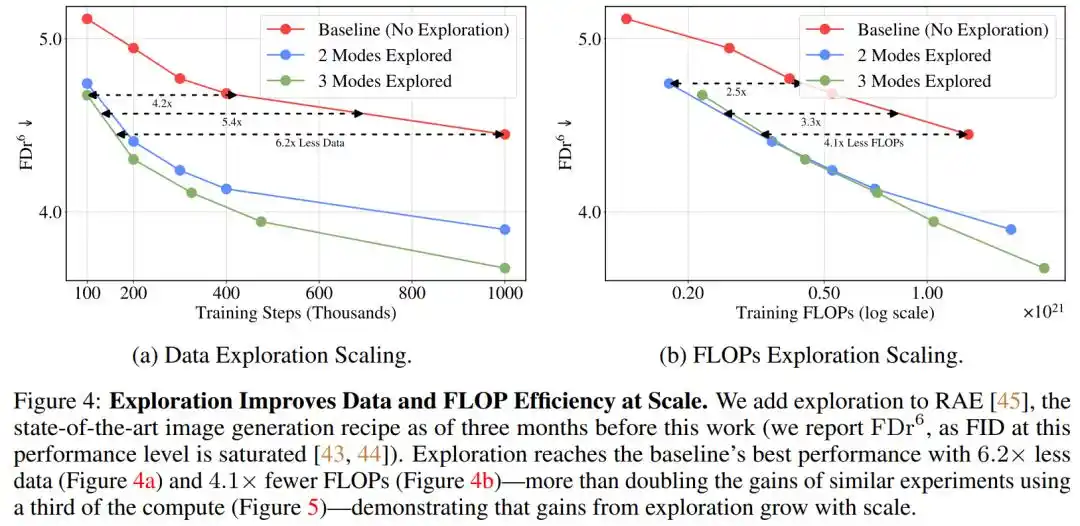
A Large model exploring 5 modes can even outperform an XLarge model with 47% more parameters but no exploration.
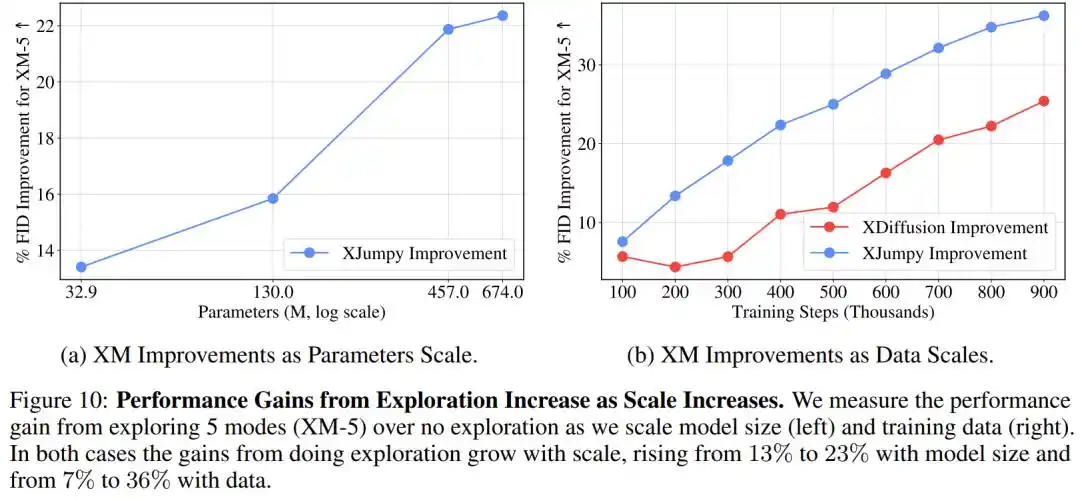
The implications of this trend are significant. The authors explain: at small scale, models are primarily bottlenecked by parameters and data; generative expressivity isn't the limiting factor yet. But once parameters and data are scaled to the point where they are "no longer the limit," generative expressivity increasingly becomes the real bottleneck. And that is exactly what exploration directly scales.
Considering that true foundation model training today uses roughly four orders of magnitude more compute than the largest experiment in this paper, the authors believe the reported numbers likely represent only a lower bound for the gains at larger scales.
Truly End-to-End Generation
If exploration is pushed to the extreme, what happens? The answer circles back to the opening suspense: Generative models can finally be end-to-end.
The authors used XM as a standalone end-to-end model for robot control tasks. In Behavior Cloning, their Explorative Policy matched or even surpassed Diffusion Policy (which requires 100 forward passes) using only a single network forward pass. In goal-directed world modeling, the Explorative World Model achieved better average performance than Diffuser, using 16 to 256 times less inference compute.
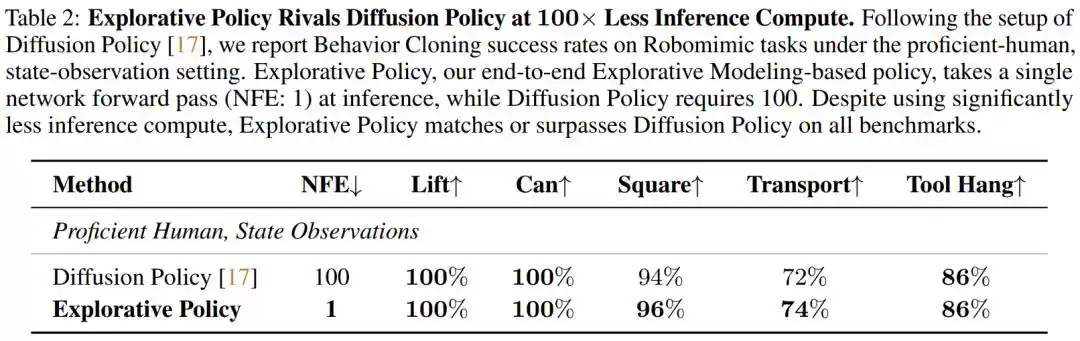
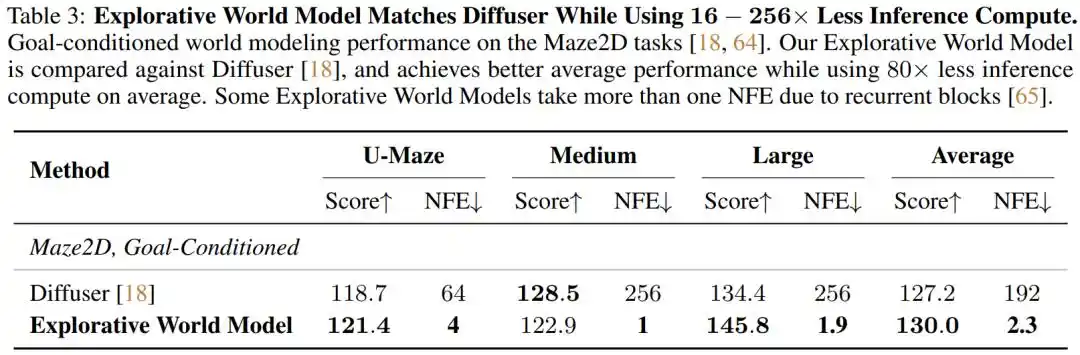
The source of this gap is clear: diffusion models trade hundreds of inference steps for expressivity, while end-to-end XM shifts this cost to exploration during training, allowing inference with just one forward pass. "Handling multi-modality"—the same thing—can be done either by breaking it down slowly during inference or by exploring it thoroughly once during training; this paper chooses the latter.
About the Authors
The first author of this paper, Alexi Gladstone, is not a newcomer. As recently as July 2025, his work on Energy-Based Transformers (EBT) sparked considerable discussion on social platforms.

That work claimed to "beat" the scaling curve of standard feedforward Transformers on multiple dimensions for the first time and attempted to generalize "System 2 thinking" to arbitrary modes. See the Machine Heart report: "New Paradigm Arrived! New Energy Model Breaks Transformer++ Scaling Limits, Training Scaling Rate 35% Faster."
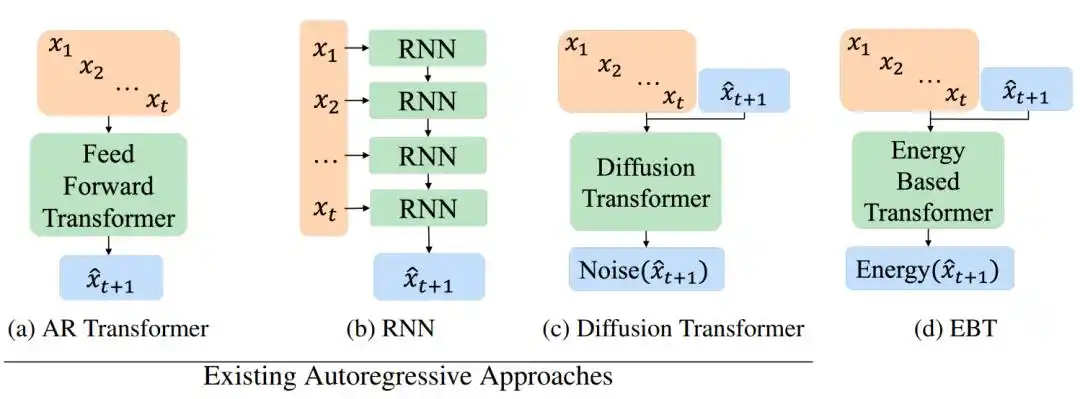
Explorative Modeling aligns with his consistent line of thinking: questioning "whether a model can, through some form of search or exploration, achieve what a single forward pass cannot." Furthermore, this paper builds upon another theory, Mode Forcing, by him and his collaborators (Yilun Du and Heng Ji). The paper candidly states that because of that prior theoretical foundation, most of XM's results were theoretically predicted first and then experimentally verified, which is relatively rare in the deep learning field, where the norm is often "run experiments first, explain later."
The authors are also frank about limitations: the best-of-K idea itself is not new and has been tried many times before; their real contribution is clarifying what this simple loop actually does: it directly amplifies generative expressivity without breaking down the generative process.
Additionally, autoregressive language models remain the toughest challenge, and pure end-to-end Forward XM is still too expensive for highly multi-modal distributions (like image generation), leaving room for future work.
For over a decade, we've grown accustomed to tuning generative models with two knobs: making them bigger and feeding them more data.
The third knob proposed in this paper is remarkably simple: let the model guess multiple times and keep only the best one. But if the trend it reveals holds true, then as scale continues to expand, the first two knobs will eventually be maxed out, while the third has only just begun to turn.
Reference Links
https://x.com/AlexiGlad/status/2083230922196107288
This article is from the WeChat public account "Machine Heart" (ID: almosthuman2014), author: Panda