# Пов'язані статті щодо Quantitative Trading

Центр новин HTX надає останні статті та поглиблений аналіз на тему "Quantitative Trading", що охоплює ринкові тренди, оновлення проєктів, технологічні розробки та регуляторну політику в криптоіндустрії.

Making a Fortune of $10.32 Million: The World Cup Money-Printing Tactic of a Polymarket Whale

**Earning $10.32 Million: A Polymarket Whale's World Cup Profit Strategy** While teams battle for the World Cup trophy, a hidden whale nicknamed "swisstony" has been quietly making a fortune on the prediction market Polymarket. This account, created around July 2025, boasts total profits of $18.62 million, with $10.33 million earned in the past month alone. With a 52.9% win rate, it has placed over 139,600 predictions, averaging about 380 trades per day—indicating it is likely a high-frequency quantitative bot. The account's signature "trash panda" aptly describes its strategy: sifting through vast market data and tiny price discrepancies to build wealth. Its current holdings are heavily concentrated on the France vs. Spain semi-final, including a roughly $160,000 bet against France. Analysis shows two core tactics driving its success: 1. **High-Volume "Anti-Favorite" Bets:** Placing large wagers (often $400k-$1M) against overvalued favorites like Germany or England, buying "No" shares at favorable prices when market-implied win probability is 46%-64%. It has recorded over 17 individual profits exceeding $1 million using this method. 2. **"Lottery-Ticket" Bets on Extreme Long Shots:** Allocating small amounts (thousands of dollars) to buy shares priced as low as 0.2¢-1.2¢ on outcomes deemed nearly impossible. While most of these bets lose, the occasional win—like those with payouts over 100x—generates significant profits (over $100,000 per hit) that boost overall returns without risking much capital. This dual approach combines consistent, large-scale profit from correcting major market mispricings with opportunistic, high-reward bets on extreme underdogs. The account exemplifies how systematic, high-frequency execution can amplify a small statistical edge into millions in profits on prediction markets.

Foresight News07/13 04:03

Making a Fortune of $10.32 Million: The World Cup Money-Printing Tactic of a Polymarket Whale

Foresight News07/13 04:03

Jane Street: The Most Powerful Behind-the-Scenes Operator in the Crypto Industry

Jane Street: Crypto's Most Powerful Behind-the-Scenes Operator A recent 13F filing revealed Jane Street, the secretive Wall Street quant giant, drastically reduced its Bitcoin ETF holdings while increasing stakes in Ethereum ETFs. This move highlights its role not as a directional investor, but as a critical infrastructure player extracting "tolls" from crypto's institutionalization. The firm, founded in 2000 and famously lacking a CEO, has systematically embedded itself across crypto markets. It acts as a key Authorized Participant (AP) and market maker for major Bitcoin and Ethereum ETFs, profiting from arbitrage between ETF shares and underlying assets. Its approach combines quantitative prowess with a willingness to hold positions for structural arbitrage, differing from pure high-frequency traders. Jane Street faces allegations related to the 2022 Terra (LUNA) collapse. A lawsuit claims it used non-public information to withdraw $85 million in UST minutes before a critical withdrawal by Terraform Labs, allegedly exacerbating the crash and avoiding over $200 million in losses. The company denies the claims. Further indicating its reach, a wallet suspected to be operated by Jane Street ("JaneStreetIndia") was identified on the prediction market Polymarket. This bot executed over 11,000 high-frequency trades on short-term crypto price movements with a near-perfect win rate, showcasing a套利 strategy divorced from traditional prediction. Beyond trading, Jane Street holds equity in crypto infrastructure like Kraken, 1inch, and Arbitrum, and mining stocks. Its strategy is clear: avoid betting on winners, but secure a position in the market's essential plumbing. By becoming a ubiquitous part of the liquidity infrastructure—from ETFs to OTC trading and potentially链上 markets—Jane Street operates as a market force itself, raising questions about whether crypto's decentralized,散户-friendly alpha is being permanently eroded by traditional finance's most sophisticated players.

Foresight News06/16 03:32

Jane Street: The Most Powerful Behind-the-Scenes Operator in the Crypto Industry

Foresight News06/16 03:32

Wall Street's Most Mysterious Money Machine: Dumping Bitcoin at 10 AM Sharp Every Day

A mysterious pattern dubbed the "Jane 10 AM Dump" has been observed in Bitcoin markets, where prices drop sharply each day at 10 AM EST, coinciding with the US stock market open. Traders and media, including ZeroHedge, point to Jane Street, a major market maker and large holder of BlackRock's Bitcoin ETF (IBIT), as the likely orchestrator—selling at 10 AM to then buy back at lower prices. This theory gained traction amid a lawsuit from Terraform Labs' bankruptcy estate. The suit alleges Jane Street used insider information to exit TerraUSD (UST) positions just before its May 2022 collapse, avoiding $40 billion in losses. Key to the case is a former Terra intern, Bryce Pratt, who joined Jane Street and allegedly ran a secret chat group ("Bryce's Secret") to funnel non-public information from Terraform insiders. The complaint details that Jane Street, which had a prior trading relationship with Terraform, withdrew 85 million UST from a liquidity pool minutes after Terraform secretly pulled 150 million UST—before public panic began. Chain analysis suggests Jane Street systematically reduced exposure pre-collapse. Further supporting the pattern of misconduct, India's regulator SEBI fined Jane Street a record $570 million for a "pump-and-dump" scheme manipulating banking index options, exploiting retail investors. While unproven, the cases depict Jane Street as a powerful, secretive firm adept at leveraging information advantages, now under scrutiny for practices that blur ethical and legal lines. The "10 AM dump" pattern reportedly stopped after the Terra lawsuit, adding circumstantial weight to the allegations.

marsbit02/26 01:09

Wall Street's Most Mysterious Money Machine: Dumping Bitcoin at 10 AM Sharp Every Day

marsbit02/26 01:09

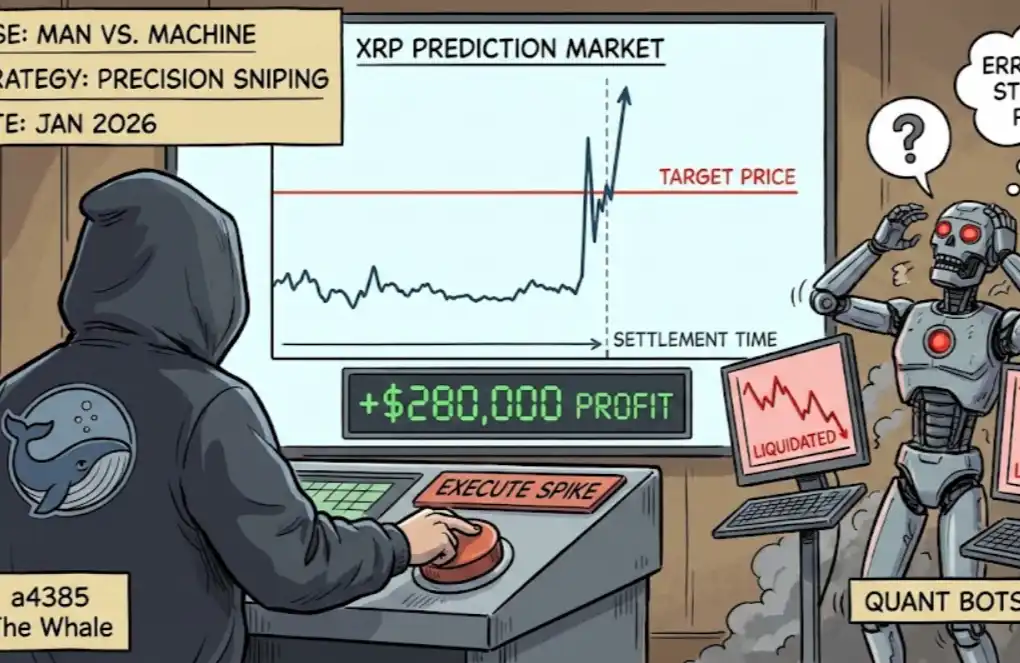
1-Minute Breakdown of Quantitative Models: High Rollers Hunt Down Trading Bots

In the emerging prediction markets, a mysterious trader known as a4385 executed a sophisticated attack against quantitative trading bots, netting $280,000 in 48 hours. These markets allow users to bet on short-term price movements of assets like XRP—for example, predicting whether the price will rise or fall within 15 minutes. Quant algorithms typically profit by exploiting散户情绪 and market inefficiencies with毫秒级 precision. On January 17, 2026, a4385 placed a "rise" bet in an XRP market when the price was below the starting price and the probability of success was only 36%. In the final minute before settlement, a4385 executed large market buy orders, artificially pumping XRP’s price just above the starting threshold at the exact moment of settlement—ensuring his bet paid out. The strategy relied on shallow order book depth (due to weekend trading and XRP’s lower liquidity), allowing a4385 to move the market with relatively modest volume (~$569,000 in the final minute. Each operation cost about $6,200 in fees, but yielded returns as high as $40,218 per round. To hedge against post-settlement price drops, a4385 held short positions of equivalent size, ensuring overall portfolio stability. This required significant capital—over a million dollars—highlighting that this was not luck or a散户 victory, but a calculated exploit of market structure, liquidity conditions, and quantitative model behavior.

marsbit01/21 04:45

1-Minute Breakdown of Quantitative Models: High Rollers Hunt Down Trading Bots

marsbit01/21 04:45

Dialogue with Axis: How a Group of Quantitative Traders is Reshaping 'Yield-Bearing Dollars' with Institutional Strategies?

Axis, founded by a team of quantitative traders including Chris (an early QCP Capital employee and co-founder of the $400M+ AUM fund Alphanonce with 35%+ annual returns), is building a protocol to generate sustainable, transparent yield on-chain through institutional-grade arbitrage strategies. The core product is USDx, a dollar-pegged synthetic asset that users can stake to earn yield. Unlike many DeFi protocols that rely on unsustainable token incentives or directional market bets, Axis’s returns are generated from real, verifiable cross-market arbitrage opportunities. The team’s extensive background in traditional finance, quant trading, and DeFi (with experience from firms like BlackRock, Tether, Ondo, and Maple) informs their focus on capital efficiency, rigorous risk management, and institutional security practices. Axis recently raised a $5M private round led by Galaxy Ventures, with participation from OKX Ventures and FalconX. The protocol is built on Plasma, chosen for its deep USDT liquidity and mature DeFi infrastructure, and is currently in a private testing phase ahead of public launch. Key innovations include a dynamic “arbitrage engine” that allocates capital across multiple strategies (not just basis trading) to capture opportunities in various market conditions. The team emphasizes transparency, with plans for on-chain, third-party-verified proof of reserves and delta-neutrality to build trust. Long-term, Axis aims to evolve from a yield generator into critical “liquidity infrastructure” for the on-chain economy, with plans to expand into yield-bearing assets backed by Bitcoin and gold.

marsbit01/20 03:03

Dialogue with Axis: How a Group of Quantitative Traders is Reshaping 'Yield-Bearing Dollars' with Institutional Strategies?

marsbit01/20 03:03

活动图片