By: Will Awang
On July 16, Visa announced the Visa Stablecoin Platform (VSP), a platform for minting, transferring, and managing stablecoins, launching first with OpenUSD—a stablecoin initiated by an alliance of over 140 major institutions. That week, the news flooded feeds in both payments and crypto circles—a network that clears nearly half of global card transactions announcing it would provide the operational foundation for stablecoins.
Twelve days later, on the FY2026 Q3 earnings call, Visa CEO Ryan McInerney spoke about this platform to global investors. He spoke comprehensively: functions, positioning, the launch currency, and future plans to integrate with Pismo to support tokenized deposits. Yet, his entire statement contained not a single word about how it would be monetized, which revenue line item it would fall under, its commercial launch timeline, or who the initial clients were. During the financial section by CFO Christopher Suh, the three letters VSP never once appeared.
The more complete the product description, the more conspicuous the absence of money.
The Q&A session laid this bare. Of the 13 analysts, only Jeff Cantwell from Seaport asked about stablecoins, questioning, "Is OpenUSD going after Circle and Tether?"; the remaining questions focused on cross-border growth, the one-time push from FIFA, value-added services, client incentives, and that annual question about the revenue formula. The two analysts with the highest price targets for Visa, one asked about the progress of internal AI adoption, the other about disruptions from promotional timing.
The market didn't treat VSP as headline news; those who price Visa didn't see it as a pressing issue. And the first sentence of McInerney's answer to Cantwell also poured cold water on stablecoins. He didn't address competition directly but began with this: Stablecoins haven't truly scaled beyond a few use cases yet—like the stablecoin-linked cards we've issued in various places.
This article does one thing: it measures every action Visa takes related to stablecoins and agentic commerce against its income statement. Doing so reveals their strategic position within Visa and how much the narrative around these terms has been inflated.
1. Visa's Profit Yardstick
During an earnings call, the CFO talks about one thing: revenue lines. Which ones grew, by how much, driven by what, and tied to which metrics. The only reason stablecoins didn't appear in his script is: they don't belong to any of those lines.
So this chapter first establishes a yardstick: who Visa is, where its revenue comes from, and how much it ultimately takes from every hundred dollars.
Thinking of Visa as a highway makes everything easier. It doesn't manufacture cars, drive them, or own any warehouses at the start or end points. It builds the road, sets the rules, and collects tolls at the exit. Each transaction on this road involves four parties: the cardholder, the issuer (the cardholder's bank), the merchant, and the acquirer (the merchant's service provider). Visa is none of these, but it is the road all four must pass through together.
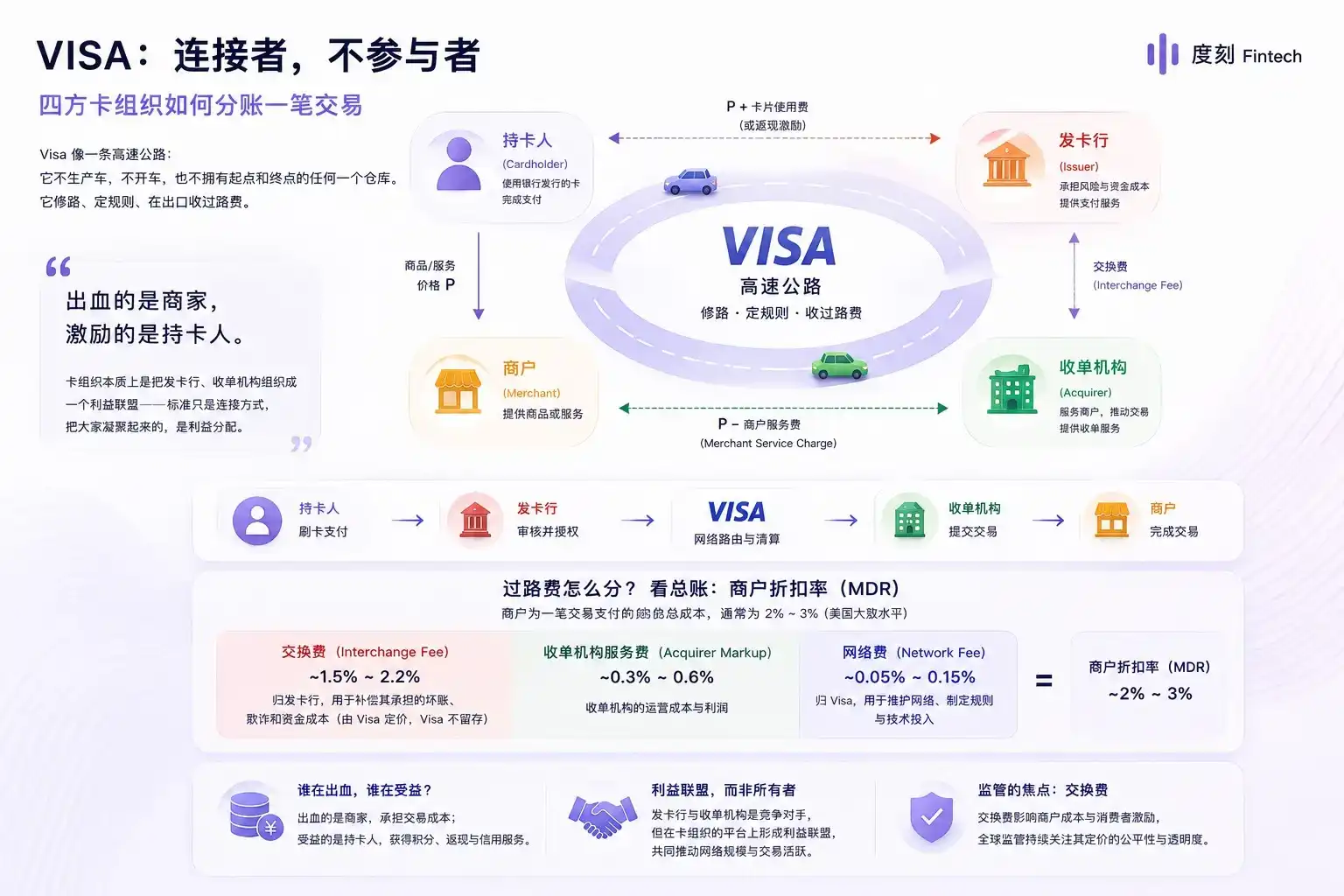
How is the toll split? First, look at the total bill. The total cost a merchant pays for a transaction is the Merchant Discount Rate (MDR), roughly 2% to 3% in the US, divided into three parts: the largest portion is the interchange fee, going to the issuer; part is the acquirer's markup; and a very small remaining portion is the network fee, belonging to Visa. And while Visa sets the interchange fee, it keeps none of it: it flows from the acquirer to the issuer, compensating the issuer for bearing credit risk, fraud, and funding costs. This is also why global regulators repeatedly scrutinize it.
The merchants bear the cost; the cardholders are incentivized.
At its core, a card network organizes issuers and acquirers into an interest alliance—standards are just the connection method; what binds everyone together is the profit distribution.
The entire road operates on the same logic: let others take the lion's share. The "tap" on a phone—the wallet provider takes a cut from the issuer; Stripe and Adyen, through merchant relationships, operate their own fleets on the road; those fintechs touting "payment disruption" all run on Visa's license plates.
Visa has turned every potential disruptor into a paying driver on its own road.
1.1 Four Toll Booths for a Cup of Coffee
A Hong Kong user buys a $10 coffee at a convenience store in Tokyo, paying with a Visa card issued in Hong Kong.
Assume the store's MDR is 2.5%. The merchant nets $9.75, paying out 25 cents. The bulk of this 25 cents is the interchange fee, flowing to the Hong Kong issuer—it bears this user's credit and fraud risks; part goes to the Japanese acquirer; and Visa takes about 9 cents. (Visa doesn't disclose itemized rates; actual pricing varies by region, card type, merchant category. The numbers below are derived from public aggregate data, assuming they are stated, you can recalculate yourself.)
These 9 cents aren't collected all at once; they are collected separately at four toll booths.
The first booth: Service Revenue. This isn't charged for this specific swipe, but for the fact that "this card can be accepted." The same card works at a Tokyo convenience store, a New York website, and a Shenzhen subway turnstile—the existence of this acceptance network itself is the product, billed as a percentage of the issuer's transaction volume. It's revenue based on amount: the more expensive the coffee, the more collected here.
The second booth: Data Processing Revenue. In the one or two seconds of the card swipe, the authorization request travels from the POS to the acquirer, to VisaNet, to the issuer, and back; overnight, there's clearing and netting.
This booth charges per transaction, a fixed amount. Annual data processing revenue is about $20 billion, processing about 2.9 trillion transactions, about 7 cents per transaction. Whether the coffee costs $10 or $1,000, this 7 cents is the same.
This booth also has a unique growth driver: penetration. Bringing vehicles already on the road onto Visa's road. Colombia's processing penetration was in the single digits five years ago, now exceeding 90%—this growth doesn't require consumers to spend a penny more.
The third booth: International Transaction Revenue. This coffee was bought with a Hong Kong dollar card in a yen-based country, triggering the most expensive booth. It's expensive because it combines both cross-border fees and currency conversion: Visa must both process the transaction and handle the HKD-JPY exchange; FX is a major profit contributor here. This booth also charges based on amount, so its contribution to the 9 cents is significantly higher than for a local transaction of the same amount.
The fourth booth: Other Revenue. If this transaction is scanned by risk controls, if the issuer's card account runs on Pismo, if the card's marketing campaign was done by Visa: this booth charges neither by amount nor by transaction, but by service, unrelated to the coffee itself. Risk and security (Featurespace), issuing processing (Pismo, DPS), acceptance solutions, consulting, marketing services all fall into this category.
A note on a commonly confused term: Value-Added Services (VAS) is a business category spanning the four revenue lines (risk falls under data processing, consulting and marketing under other revenue), while "Other Revenue" is just one line item on the financial statement; the two are not equal. Both numbers will be examined together in section 1.3.
Now looking back at the 9 cents: the 7 cents from the second booth is fixed, the remaining ~2 cents come from the booths that charge by amount. For comparison, Visa's average transaction size is $56, with a net rate of 0.29%, yielding about 16 cents—similarly, 7 cents fixed, 9 cents variable by amount.
The same fee structure: a $56 transaction yields a 0.29% fee, while the $10 coffee actually yields 0.9%. The smaller the transaction, the heavier the weight of that fixed 7-cent fee.
1.2 The Token that Rides Along
There's another element that doesn't have its own toll booth but rides along with the vehicle: Tokenization. This system is called Visa Token Service, which replaces the 16-digit card number on the card face with an alternative number that only works in specific contexts.
Take our user. They add their card to Apple Pay; upon adding, Visa issues a token valid only for that device. They also store the card on an e-commerce site—that's another token. Three months later, when the card expires and is replaced, the physical card number changes, but both tokens auto-update, requiring no re-binding. And if that e-commerce site is breached, what's leaked is a string of numbers useless elsewhere.
Each issuance, update, verification, and routing is an extra trip on the road, billed under the second booth. Globally, about half of all e-commerce transactions are now completed via tokens.
The credentials Visa issues to AI agents also run on this same infrastructure.
1.3 Client Incentives, and What the Yardstick Measured This Quarter
After the four booths collect, one item is subtracted: Client Incentives, money returned to issuers and acquirers.
Rebates negotiated during major issuer renewals, signing terms for new clients—all here. The key is: incentives are a deduction from revenue, not a cost, so Visa reports "Net Revenue." This quarter, incentives grew 18%, up 4 percentage points from the previous quarter.
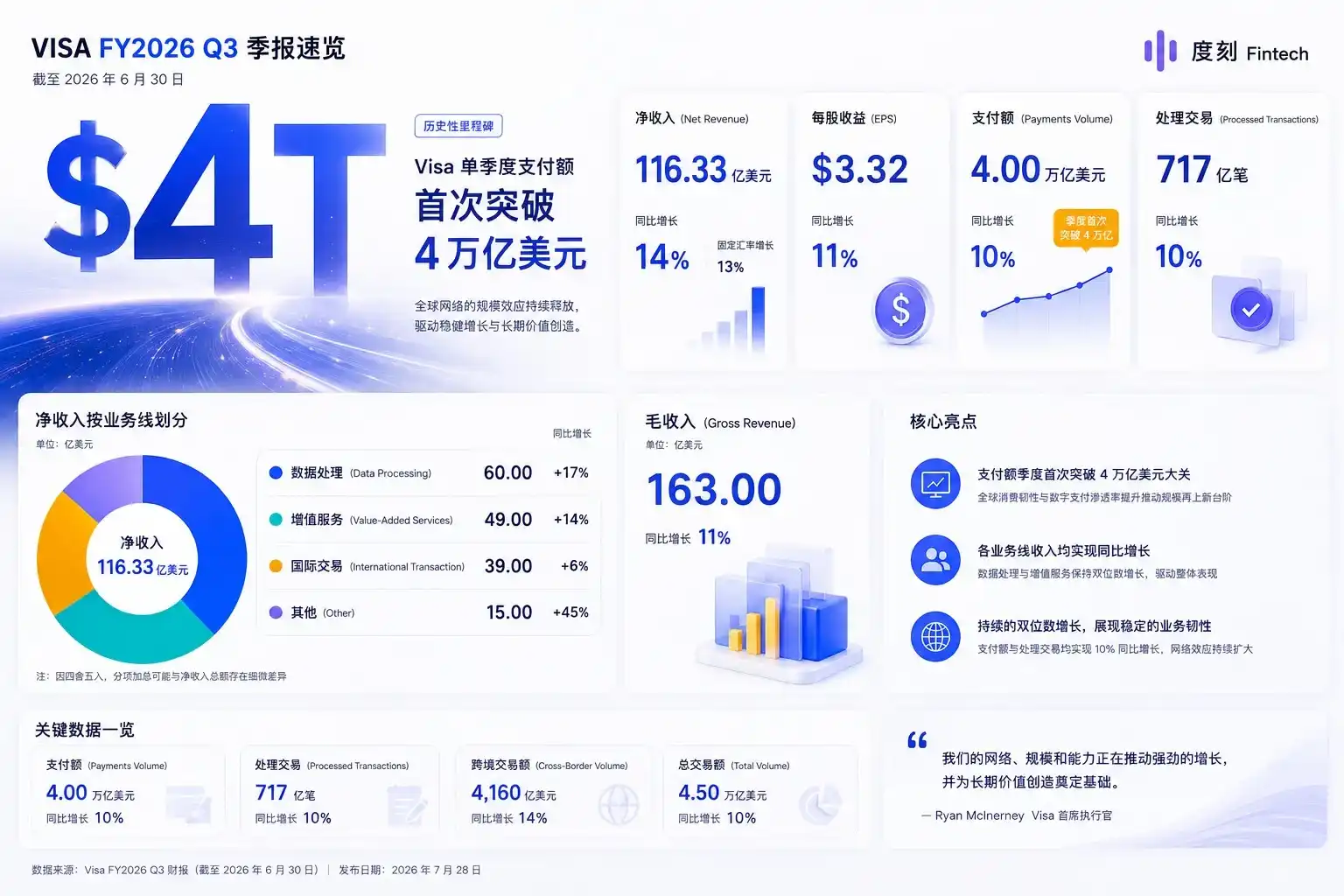
After the four booths collect and incentives are deducted, net revenue divided by payments volume yields:
0.29%, or 29 basis points. For every $100 of traffic, Visa ends up with twenty-nine cents. Referred to as 29 basis points hereafter.
The last full fiscal year aligns: net revenue ~$40 billion, annual payments volume $14.2 trillion, 28 basis points.
The interesting point about this number is that it hasn't moved for a decade. Over the long term, Visa's gross toll rate has remained stable at around forty basis points of traffic volume; during the same period, the proportion returned as incentives has risen from ~17% to ~29%, nearly doubling. Squeezed between the two, the net toll rate has remained almost static. In other words, the increase from the high-priced lanes of cross-border and value-added services over the years hasn't turned into extra profit for Visa; it has become the rebate paid to the traffic drivers.
This is the key to understanding Visa: It is not raising tolls; it is using changes in traffic composition to pay for rising customer acquisition costs, keeping the comprehensive rate constant.
A company that has lived for decades by maintaining equilibrium won't alter that equilibrium itself for a new thing.
2. Stablecoin-Related Business
We now have Visa's yardstick: one road, four toll booths, twenty-nine basis points.
To date, Visa's substantial engagements with stablecoins are only two areas: consumer-facing U Cards, and settlement—how institutions clear accounts among themselves. The two operate differently. More importantly, they fall in completely different places.
2.1 U Cards are Essentially Card Transactions
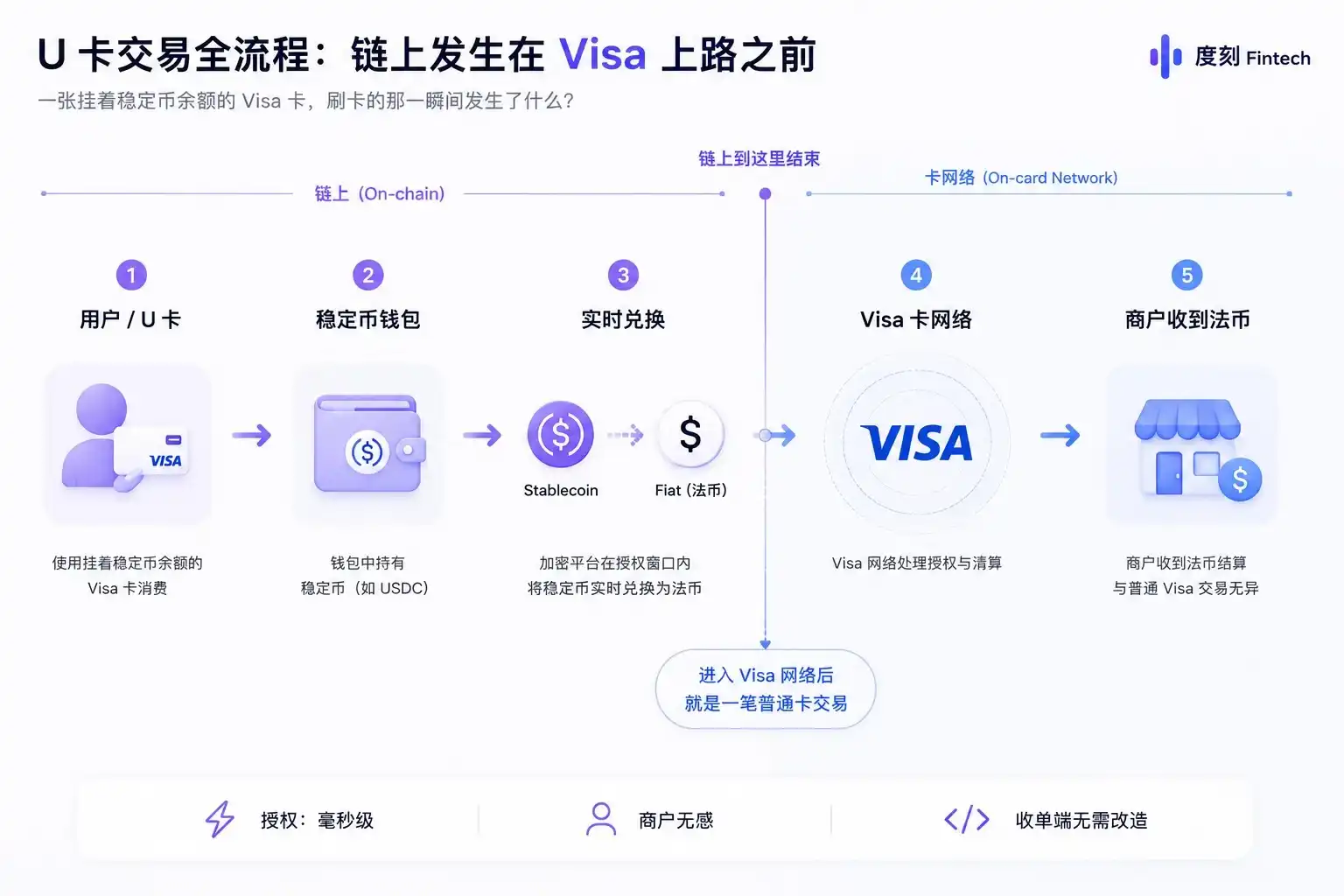
What happens the moment a Visa card linked to a stablecoin balance—commonly called a U Card in the industry—is swiped?
The network reads the BIN and routes the authorization request to the corresponding issuer. The issuer asks the underlying crypto platform: does this user have sufficient balance? If yes, the platform immediately calculates how much stablecoin needs to be sold to cover the purchase and completes the conversion within the authorization window. After the fiat amount is confirmed, the issuer sends back authorization, and the merchant receives approval.
The entire process completes within milliseconds. For the merchant, this is no different from any ordinary Visa transaction—it receives fiat currency, and its acquiring side requires not a single line of code change.
This is the most critical characteristic of U Cards: the on-chain segment all happens before the transaction enters Visa's road.
A U Card isn't something a single company can accomplish. It requires at least a few elements: card network membership and BIN, on-chain custody, liquidity for real-time conversion, and a full suite of KYC/AML and compliance capabilities. Traditionally, it involves finding a licensed institution for BIN sponsorship, which provides membership and card number ranges, with the crypto project issuing white-label cards on top. This path saves years of applying for licenses.
A more advanced model has emerged in recent years: full-stack issuers like Rain, Reap become Visa Principal Members directly: no longer needing a bank intermediary, they are the issuer of record, settling directly with Visa. Rain alone supports over 200 card programs.
How is money divided on this chain?
The issuer takes the interchange, typically 1% to 2% of the transaction amount. This money either becomes cashback subsidizing the user or stays as profit. The conversion party takes FX and exchange spreads. The project can also charge cardholders annual fees and withdrawal fees. What Visa takes is the 29 basis points beyond these.
So where do U Cards fit? They go through all four toll booths because they are essentially ordinary card transactions. What runs on the road after conversion is fiat; the toll booths don't even know stablecoins existed.
Visa has documented two settlement models for U Cards: In the traditional model, the project converts stablecoins to fiat before settling with Visa, using the blockchain only as a ledger; in the emerging model, the Principal Member settles directly with Visa using USDC, which is then converted to fiat by Visa's digital custodians to pay the acquirer. Either way, only the back-end segment changes—how institutions clear the accounts.
This is the weightiest counter-evidence in the entire piece: The only stablecoin-related action generating revenue is the one that turns stablecoins back into card transactions.
2.2 The Backend Road: Settlement
Visa cards handle consumer payments; stablecoins handle fund flows—two layers of infrastructure, each managing a segment.
The two roads don't intersect. Stablecoins appear differently on each. On the front-end consumer path, they must be converted to fiat before entering VisaNet; the four toll booths in Chapter 1 are all on this road. On the back-end settlement road, they can serve directly as the settlement asset, resolving the net position between issuers and acquirers.
For a card transaction, what the consumer experiences is the one-to-two-second authorization, but that's just the information flow. The actual money movement between issuer and acquirer happens later, with Visa's treasury and settlement system in the middle. It nets all receivables and payables for a member institution each day and settles once. This net amount is what Visa officially calls VisaNet obligations.
Traditionally, this net amount moves via fiat systems—ACH, Fedwire, SEPA, or local clearing—which only operate during banking hours. What stablecoin settlement changes is one thing: which asset is used to clear this net amount, near real-time, 24/7.
There's demand for this because time gaps cost money. A transaction authorized Friday night might not settle until Monday at the earliest; someone must fund the gap. And not everyone funds—Visa's rule is that clients whose credit doesn't meet a threshold must post collateral. Those with good credit usually don't need to lock up funds, but crypto issuers with significant volume but average credit must keep money parked there, unavailable for business.
Collateral exists because Visa guarantees to its clients: if any party fails to fulfill a settlement obligation, Visa will cover it. In FY2025, its average daily settlement exposure was $91.2 billion. On this backend road, Visa doesn't collect a toll, but it shoulders the guarantee.
2.3 From Stablecoin Settlement to VSP
Visa's stablecoin settlement pilot began as early as March 2021. The first client was Crypto.com, with a very specific pain point: originally needing to sell crypto assets for USD and wire them to Visa to cover card program liabilities; after switching to USDC, they could directly send coins to Visa's custody wallet, eliminating one conversion and a wire transfer deadline. Since then, the pilot expanded from the issuer side to the acquirer side (Worldpay, Nuvei), launching domestically in the US in December 2025, and by April 2026, it supported nine blockchains.
Visa's list of benefits for this is straightforward: funds available seven days a week, no interruption on weekends/holidays, potential for collateral reduction due to seven-day settlement, automated treasury, and simplified reconciliation. But the most crucial part is the disclaimer-like addition—the consumer's card experience doesn't change at all.
Scale? Annualized $3.5 billion in November 2025, $4.5 billion in January 2026, $7 billion in April 2026. Doubled in five months—that's the growth rate.
The denominator Sheffield gave in a January Reuters interview was: Visa's processed payment volume the previous year was $14.2 trillion. Using the April $7 billion figure: 0.05%.
Changing the asset used to clear VisaNet obligations from fiat to stablecoin doesn't change Visa's fee by a cent. The benefits go to issuers—shorter exposure windows, less collateral locked up, ability to move funds on weekends. The merchant discount rate doesn't change because settlement is faster; the consumer feels nothing at checkout.
This is an operational improvement, not a revenue recognition event. And what VSP aims to commercialize is precisely this segment of the road.
The settlement pilot is for Visa's own use; VSP is selling this capability for others to use: a new toll booth on the backend road. Theoretically, wallet-as-a-service should follow the logic of Service Revenue; minting and transfers should follow Data Processing logic. But so far, Visa hasn't provided any billing details, line item assignment, or commercial timeline. The platform is in beta; clients are unnamed.
Not that it can't charge, it just hasn't started charging.
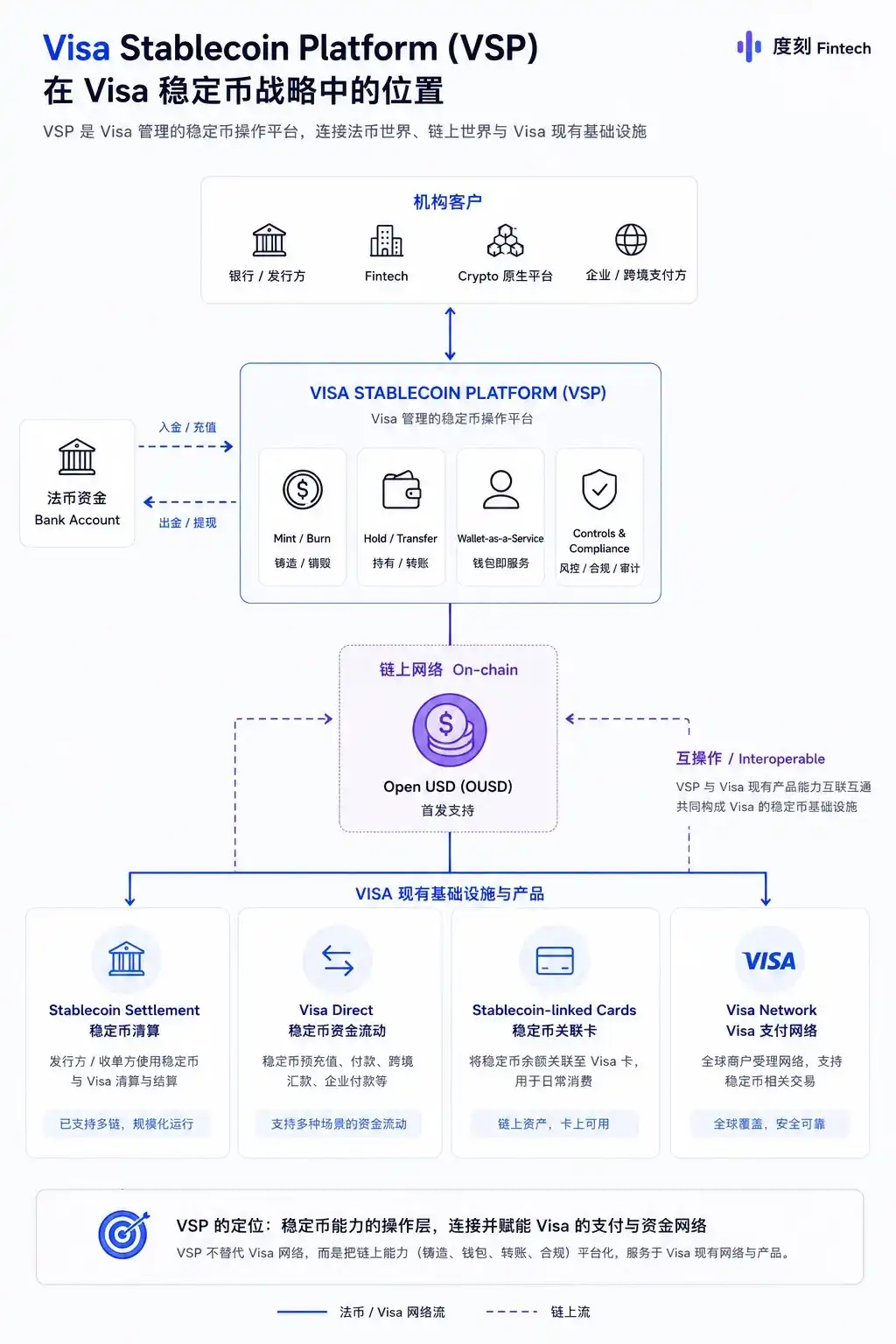
Tallying up, Visa's revenue from stablecoins today comes from only two sources: the transaction that turns stablecoins back into a card payment, and selling advice about stablecoins.
This playbook is anything but new. Looking back at Chapter 1: Stablecoins are just the newest name on the list of paying drivers. And on that list, no name has yet opened a new toll booth for Visa.
Placing the three actions back onto the two roads: U Cards are on the front-end road; settlement and VSP are on the backend road. And toll booths are only on the front-end. This is the entire reason U Cards make money, while settlement and VSP do not.
3. Agentic Commerce Related Business
Finished measuring stablecoins; the front-end half is simpler—it all falls on the front-end road.
3.1 Front-End: The Device to Let Agents on the Road
Nothing new on the front-end: Every agentic product Visa makes is a device to let Agents onto the old road.
The division is Visa's own. During the VSP launch in July, Chief Product and Strategy Officer Jack Forestell said AI is transforming the front-end of commerce, stablecoins are reshaping the backend; three months later on the earnings call, McInerney repeated this almost verbatim. This isn't PR talk; it's internal strategic division.
The product list isn't long: Agent Score, Agent Directory, Token Assurance Framework, plus partnerships with OpenAI and Meta. They all go through the fourth booth—billing method undisclosed, but they sell capabilities like scoring, directories, credential management, charged as services, not by transaction amount; they also all use the same tokenization infrastructure from Chapter 1, just extended from phones to agents.
3.2 Substitution vs. Creation: Visa Only Sees Half
Only one thing doesn't fit neatly into front-end or backend: transactions between agents.
A Bernstein analyst asked this directly—how would agentic expand the addressable market, could agent-to-agent form new economic structures.
McInerney answered the first half, using analogies: e-commerce, mobile commerce, tokenization, tap-to-pay, each went through "first establish standards, then early adoption, then consumer momentum, finally scale." The conclusion was that agentic commerce is a "when" question, not an "if." He didn't answer the second half.
But that series of analogies itself answered. E-commerce, mobile payments, tokenization, tap-to-pay—the common thread among these four precedents is they changed "how people pay," none changed "who is buying."
Agentic commerce is actually two things, a distinction we've repeatedly emphasized in our agentic payments research:
One type: agents buying on behalf of people. An IT Agent automatically adds/removes SaaS seats based on employee onboarding/offboarding; a travel Agent books flights and hotels based on budget and policy. These transactions have higher amounts, with merchants and channels similar to traditional e-commerce—it's substitution, taking share from existing human shopping behavior.
The other type: procurement between machines. A research Agent pays a few cents each to multiple data service providers to pull financial reports for cross-verification; a primary Agent outsources a subtask to a retrieval Agent, which then buys a report from a data Agent. These transactions are high-frequency, low-value, with no accounts or contracts between buyer and seller—it's creation; these transactions simply didn't exist before.
Visa's analogy sequence only covers the first type from start to finish. The sell-side uses the same yardstick: Morgan Stanley's 2030 forecast of $190-385 billion, described as "10% to 20% of US e-commerce," measures only AI shopping on behalf of people—the first half.
Visa isn't building a new road for agentic; it's putting new drivers on this old road.
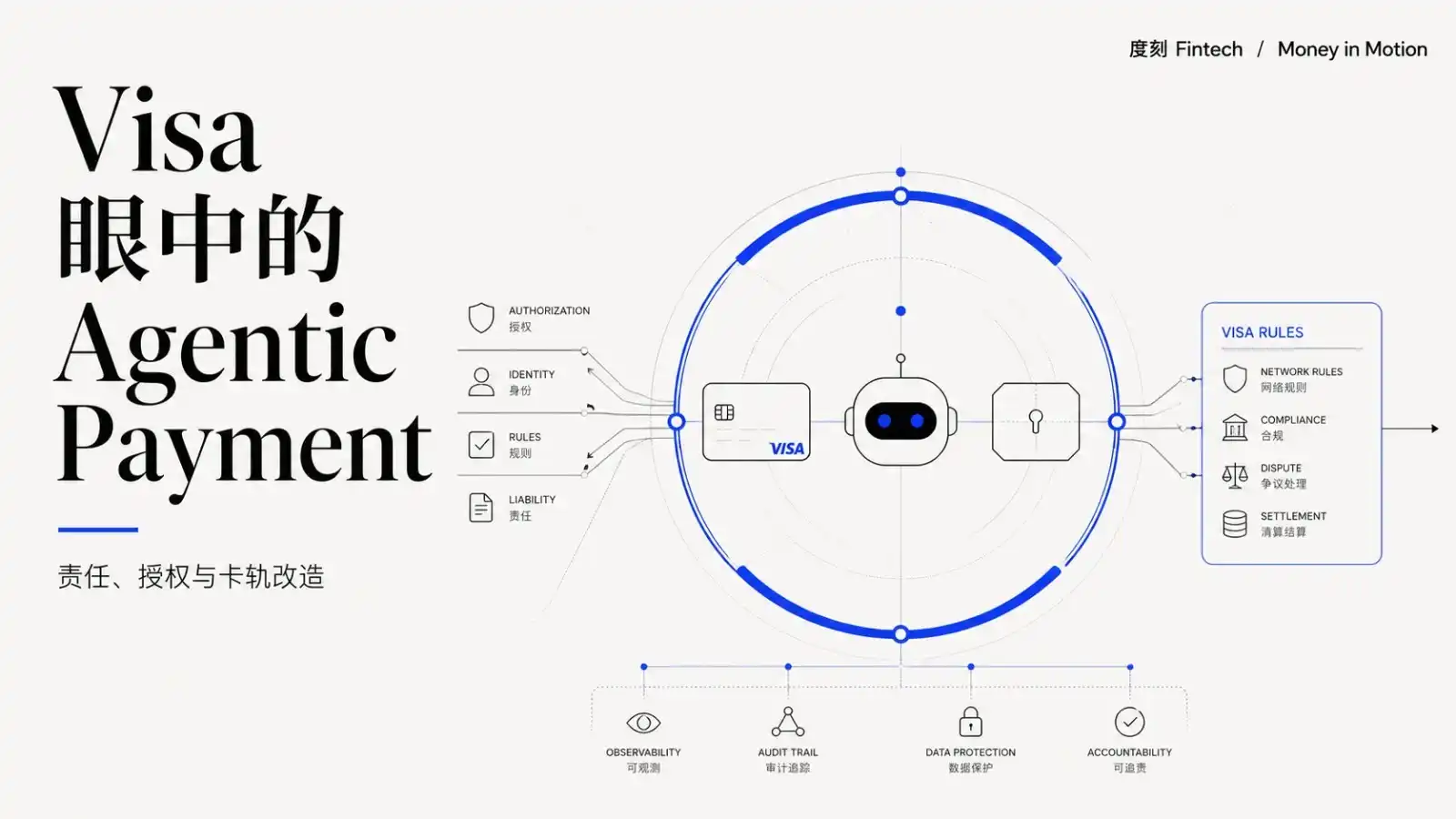
(Agentic Payment as Visa Sees It)
4. The Strategic Positioning of Stablecoins and Agentic Commerce within Visa
4.1 Fourth Tier, Ranked with Brand Advertising
First, see how high a priority Visa assigns this. The answer is the fourth tier, ranked alongside brand advertising.
This quarter, Visa laid off approximately 2,600 people, about 7% of its workforce, primarily in technology and product roles, taking a $563 million restructuring charge. KBW's Sanjay Sakhrani asked whether the savings would flow to the bottom line or be reinvested.
McInerney answered "all reinvested," then listed investment priorities from the top: Consumer Payments (acceptance expansion in cash-dominated markets, high-end client segments, cross-border e-commerce), Value-Added Services (risk and security, marketing services, Pismo, Featurespace), Commercial & Money Movement (unified B2B, embedded finance, cross-border remittances), and then, "on top of that, stablecoins, agentic."
Transcripts vary slightly in ordering the top tiers, but stablecoins and agentic rank last in every one. This is an off-the-cuff ranking by the CEO when pressed on capital allocation—more credible than any keynote.
Two other pieces of evidence are clear. One, they are not among the growth engines—Visa's 10-K and past earnings calls have only three strategic pillars: Consumer Payments, Commercial & Money Movement, Value-Added Services. Stablecoins and agentic are parts within these engines, embedded across the three, so the strategic framework itself hasn't allocated a toll booth position for them.
Two, they are the only direction without a stated Total Addressable Market (TAM). Visa is a company heavily reliant on TAM narratives: Consumer Payments, annual addressable consumer spend over $40 trillion (excluding China/Russia), with the "underserved" portion exceeding $20 trillion; Commercial & Money Movement, annual payments volume opportunity $200 trillion; Value-Added Services, annual potential revenue opportunity $520 billion. Each leg has a trillion or hundred-billion denominator, while stablecoins and agentic have none.
4.2 The Triple Jump: Settlement, VSP, OUSD Are on the Same Line
Fourth tier doesn't mean no strategy. On the contrary, Visa's actions on the backend road follow a strict sequence.
First level: Settlement Pilot. The five-year-old initiative from Chapter 2. It doesn't make money, but it built an entire dedicated logistics lane: custody, multi-chain bridging, fiat-stablecoin on/off-ramps, reconciliation.
Second level: VSP. Opening this dedicated lane for public use, selling it to external clients. And who are the clients? Chapter 2 already told us—those companies that have issued tokens but can't let users spend them. Visa's Global Head of Growth, Rubail Birwadker, put it even more plainly:
It's less about acquiring stablecoins, more about how this thing interoperates with clients' treasury settlement, money movement workflows, existing bank setups.
This is a confession of a treasury business, not a declaration of a crypto business.
Third level: OUSD.
Two details about OUSD. First, Visa obtained a seat at the distribution table, not ownership of the alliance—the alliance is managed by Stripe-affiliated people, and its most direct competitors sit at the same table. Second, the first stablecoin supported on VSP is OpenUSD.
The loop closes: the road Visa built for its own settlement opened up as the VSP platform; and the first vehicles designated to run on this road carry the license plate Visa co-governs and that stablecoin.
4.3 The Neighbor Spent $1.8B on a Bridge
Facing the same question, Mastercard submitted a completely different answer.
On August 3, six days after Visa's earnings call, Mastercard completed its acquisition of BVNK. Founded in 2021, the company processes an annualized ~$30 billion in stablecoin payment volume, covering 200 countries and regions. The deal value was up to $1.8 billion—$1.5 billion base, plus $300 million in performance-based earnouts; the agreement announced in March originally planned for year-end closing, but it closed nearly five months early. Another detail: on BVNK's client list is a name called Visa Direct—on the bridge Mastercard bought, Visa's vehicles were already running.
Put two numbers together: The stablecoin volume Mastercard bought in one go is over four times that of Visa's own five-year pilot.
And the nature differs: BVNK's $30 billion is client payment volume—revenue-generating; Visa's $7 billion is internal settlement on the backend road—not revenue-generating.
Mastercard Chief Product Officer Jorn Lambert's statement is worth comparing: Stablecoins are addressing real needs in areas like cross-border B2B, remittances, disbursements, settlement, treasury. One is listing specific use cases; the other is emphasizing lack of scale—same time window, same industry stature.
Settlement talks compatibility; the new platform talks taking sides.
One spent money on its balance sheet, the other on its product roadmap.

(Mastercard's $1.8B BVNK Acquisition: Buying Time, Not Tech)
5. Why Are New Vehicles Still Driving on Old Tracks?
At this point, the strategic shape is clear: don't issue coins, don't assume liability, don't take the float, build a dedicated lane on the backend road, and build a narrow ramp at every intersection that could bypass it.
The question is, why is this obviously conservative playbook sufficient?
5.1 The Moat is Wide Enough
The sell-side consensus offers a clean answer. A Third Bridge expert compressed it into one sentence:
Stablecoins threaten the economics of the four-party model, not its infrastructure—what they lack is consumer protection, fraud management, and a trust layer, and this gap is precisely where Visa and Mastercard stand firmest.
Why is consumer protection a moat? Because it's expensive. A chargeback requires a full process of evidence submission, investigation, adjudication, fund reversal, involving four parties—cardholder, merchant, issuer, acquirer—each requiring manual intervention. Visa has run this rulebook for decades, accumulating precedents, timelines, evidence standards, and appeal mechanisms—others aren't incapable of building it, but the cost of rebuilding is so high it's not worth it.
This moat is wide enough, but goods with zero probability of dispute have already left the card rails. Like buying tokens, calling APIs, renting compute power in A2A machine transactions—delivery equals consumption, no possibility of recourse. On-chain transactions have no authorization forms, no recourse, no dispute channels; for these goods, being "bare" is precisely the advantage.
They can leave not because on-chain is cheaper (though it often is), but because they never used what the card offered in the first place. Conversely, what remains on cards today are precisely those with dispute costs that haven't yet dropped.
So the question isn't "will stablecoins be cheaper," but where the cost curve of dispute resolution will go. If an agent can automatically retrieve order records, shipping proofs, product photos, chat logs, automatically compare merchant refund policies, automatically generate dispute claims and follow through to resolution, the marginal cost of handling a dispute could drop from "tens of dollars in labor" to "pennies in inference." Then, the system remains, the rules remain, but the cost barrier supporting it thins.
This is a bet: that dispute costs will trend down, not that the system itself will become obsolete. Bet wrong, and Third Bridge's judgment is correct; Visa's position is even more solid than it appears.
5.2 Stating the Load-Bearing Assumption Explicitly
All the preceding analysis—two roads, four toll booths, 29 basis points—rests on an unstated premise.
Could a stablecoin payment simply not need any card network at all?
If a merchant directly receives digital dollars from a customer or corporate wallet, Visa isn't underpaid—it's simply absent. The income statement wouldn't show a smaller number; it would show nothing at all.
This scenario is being piloted in Japan. Starting January 26 this year, shops like "Edo Shokuhinkan" in Terminal 3 of Haneda Airport began accepting USDC settlement in a proof-of-concept, initiated by payment gateway StarPay operator NETSTARS and Japan Airport Terminal Co., targeting inbound tourists; users scan the store QR code and pay directly with USDC from private wallets like MetaMask. Previously, SBI VC Trade and Aplus announced launching similar in-store settlement proofs in spring 2026, and Lawson is testing a scheme using existing POS terminals without dedicated hardware for stablecoin settlement.
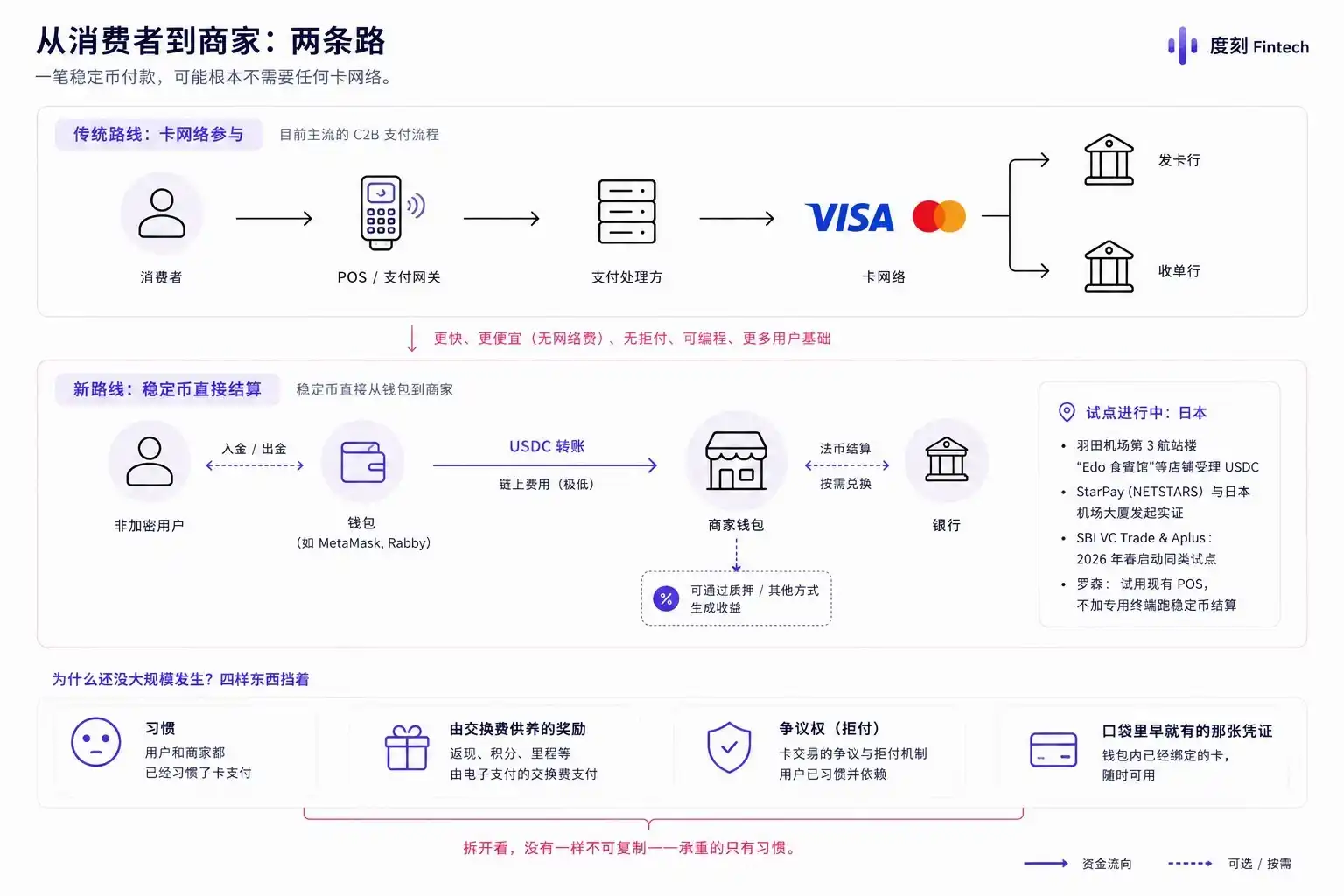
Why isn't this happening at scale today? Four things block it: habit, rewards funded by interchange fees, dispute rights, and the credential already in one's pocket. Examining each, none are irreplicable—rewards can be offered by wallets or merchants themselves, dispute mechanisms can be rebuilt on new rails, credentials can be built into apps. Only habit is truly load-bearing.
And where habit doesn't guard, leakage has begun—cross-border B2B, disbursements. These flows have no cardholders, no rewards, no chargeback expectations; stablecoins' advantage here is purely cost advantage.
The reason Visa's stablecoin strategy appears composed is because the traffic it defends is precisely where habit is thickest. And habit is not eternal.
6. What the Market Is Really Buying
Measuring with the yardstick leaves one final question unanswered: If stablecoins and agentic aren't at the toll booths, what is the market paying that premium multiple for?
Flipping through sell-side writing from the past year, the answer appears with a frequency bordering on tedium.
January earnings: McInerney called the quarter "very strong," revenue and EPS both up 15%, attributing it to consumer spending resilience, strong holiday season, value-added services, and commercial products. April earnings: media headlines read "Visa's strong performance driven by consumer spending resilience." July quarter: the lead remains sustained strength in consumer and commercial spending, despite macro uncertainty.
This was stated most bluntly during the March stock pullback. The debate was summarized as: Payments stocks are being re-evaluated, with the criterion being "can stable consumer spending continue to support premium valuations." Visa dispatched Chief Product and Strategy Officer Forestell to the Wolfe FinTech Forum to contain the damage; the data he brought was 8% growth in US payment volume in January, 9% credit, 6% debit.
A company called "future payment infrastructure," when its stock price is under pressure, hands out the answer: how many cards Americans swiped in January. This is the anchor for Visa's valuation.
Now look at the second anchor: portfolio shift. Last quarter, value-added services grew 27% at constant currency, reaching 30% of net revenue; this quarter, 34%, nearing one-third. Sell-side growth models basically follow "consumer payments provide the base, value-added services and commercial payments provide acceleration." The third anchor is buybacks—new $20 billion authorization in April, another $4.9 billion bought this quarter.
Three anchors; none named stablecoins.
Then what are stablecoins and agentic in sell-side writing? The most typical phrasing goes like this: Visa's bullish thesis includes "healthy consumer spending, stable cross-border activity, expanding value-added services, and growing blockchain initiatives."
The first three have numbers; the last is an adjective, hanging at the end of the sentence. It's not absent; it's there, but it's not load-bearing.
So the complete picture is this: The market buys the current global consumption, plus a future that doesn't need to be priced.
The former has numbers, quarterly verification, models; the latter only needs to exist, only needs to prove this company hasn't been absent in the next tech cycle.
And this is precisely what Visa provides—it builds a ramp at every intersection that could bypass it, but each ramp is built narrow. A seat at the issuance alliance table, a pilot running nine blockchains on settlement, VSP on operations, using Pismo for tokenized deposits on the issuing processing side, extending token infrastructure to agents on the front-end.
The density of ramps clearly doesn't match their investment priority, and this mismatch itself reveals their nature: insurance and options, not bets.
Insurance and options need to be bought early, bought broadly, but not expensively.
Returning to the beginning. That viral headline is Visa's fourth-tier investment item. The gap was never between "Visa's words" and "Visa's books"—McInerney's every word was measured; we were the ones who over-interpreted.
The inflation happened on the narrative side, not the company side.